On your own idea
what Is Art ?
Plato (Idealist)
art is an imitation of an imitation.
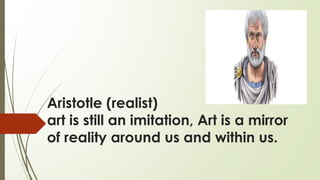
Aristotle (realist)
art is still an imitation, Art is a mirror
of reality around us and within us.
What is HUMANITIES ?
HUMANITIES came from the Latin word “
“HUMANUS” which means “human Cultured
refined”. It Is the Study of humans have
express themselves though the arts throughout
the history.
A LIST OF SUBJECTS OFTEN COVERED IN
HUMANITIES COURSES:
3 form of Art
1. Visual arts
2. Auditory arts
3. Combined arts
Letter number activity
16 3 3 18
P C C R
16 1 9 14 20 9 14 7
Painting
⮚Is the practice of applying paint, pigment,
to a color surface.
⮚Visual Arts,
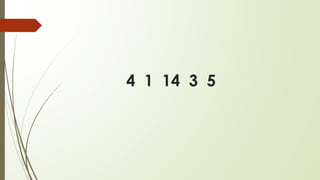
4 1 14 3 5
Dance
⮚Also an art usually performed by individual
or group of people existing in time, space,
form and flow.
⮚Combined arts.
13 21 19 9 3
Music
⮚is the art of combining vocal or instrument
sounds.
⮚Auditory arts.
19 3 21 12 16 20 21 18 5
Sculpture
⮚the art of making two or three dimensional
representative or abstract form especially
by carving stone or wood.
⮚Visual or spatial arts.
1 18 3 8 9 20 5 3 20 21 18 5
Architecture
⮚planning, designing, and constructing
building.
⮚Visual arts
12 9 20 5 18 1 20 21 18 5
Literature
⮚written works, especially those considered
of superior or lasting artistic merit.
⮚Auditory arts.
20 8 5 1 20 5 18
Theater
⮚collaborative fine art that uses live
performer typically actor and actresses
⮚Combined arts.
6 9 12 13
Film
⮚a movie, motion, picture shown on screen
⮚Combined arts.
16 8 15 20 15 7 18 1 16 25
Photography
⮚practice of creating durable images
⮚Visual arts.
VISUAL ARTS. (spatial art)
those art forms we perceive with our eyes
and which occupy space .
AUDITORY ARTS. (Temporal art)
are those art forms that can be heard and
are expressed in time.
COMBINED ARTS. (Performing arts)
it involves performance, are those can
be both seen and heard, and these art
forms unfold in both space and time.
How to study Humanities
�Text
Primary sources
�Context
Describe the historical and cultural background
�Subtext
Secondary meaning
HERE ARE A FEW EXAMPLES OF HOW ONE
CAN ACTUALLY ENGAGE IN PURSUIT OF THE
HUMANITIES:
⮚ Visit a park, visit a museum, visit a library .
⮚ Watch a film, watch a concert, parade or dance
performance .
⮚ Sing a song, Dance to a beat, play musical instrument or
recite a poem from memory.
⮚ Attend a lecture, attend a symphony concert, attend
an art gallery or attend festival .
⮚ Listen to a band or debate .
WHY STUDY THE HUMANITIES ?
� Humanities make us human
� To let them know how man thinks, feels and act
� Appreciate beautiful things
� Influenced to change our ways and behavior
� Achieve the ideals that make for the meaningfulness of
life
� Will help student know the origin and development of
man as individual
How can we tell if the artwork
is great?
C E S A I C E H T
V A L U E
AESTHETIC VALUE
Refers to that value which causes an object
to be “work of art”
T U A L T E L L E C I N
VALUE
INTELLECTUAL VALUE
“An artwork stimulates thought”
it enriches our mental life by making us realize fundamental truths
about ourselves , about human beings and about the world arounds us
T I V E S U G G E S T N E S S
SUGGESTIVENESS
This is the quality associated with the
emotional power of art
L U A T I R I P S
VALUE
SPIRITUAL VALUE
Art elevates the spirit by bringing out moral
values
M A N A N C E P E R
PERMANENCE
A great work of art endures.
Give fresh delight and new insight
U N I S A L I T Y V E R
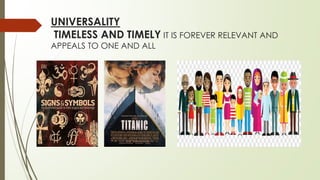
UNIVERSALITY
TIMELESS AND TIMELY IT IS FOREVER RELEVANT AND
APPEALS TO ONE AND ALL
L T S Y E
STYLE
This is the peculiar way in which an artist
sees his object, form his ideas and
expresses them.
M O R F
FORM
Skeletal structures or conceptual
framework.
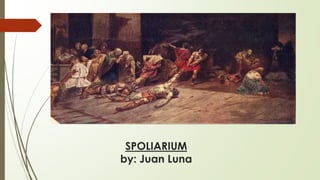
SPOLIARIUM
by: Juan Luna
Guide Questions:
1. How is the Spoliarium beneficial to Filipinos ?
2. Why was the Spoliarium the best work of Juan
Luna?
3. Kindly give your own interpretation or ideas
about the painting of Juan Luna.
THE VALUES OF ART ?
HOW CAN WE TELL IF AN ARTWORK IS GREAT ?
� AESTHETIC VALUE
Refers to that value which causes an object to be a “ work of art “, This is a quality
appeals to our sense of beauty.
� INTELLECTUAL VALUE
An artwork stimulates thought. It enriches our mental life by making us realize
fundamental truths about ourselves, about other human beings and about the world
around us.
� SUGGESTIVENESS
This is quality associated with the emotional power of art.
� SPRITUAL VALUE
Art elevates the spirit by bringing out moral which make us better person.
� PERMANENCE
A great work of art endures. It can be viewed again
and again as each encounter gives fresh delight and
new insight and opens new world of meaning and
experience it appeals lasting .
� UNIVERSALITY
TIME AND TIMELY, It is forever relevant and appeals to
one and all anytime, anywhere it deals with
elemental feelings fundamental truth and universal
conditions.
� STYLE
Subject ideals and expresses

What-is-Humanities.pptx

  • 1.
    On your ownidea what Is Art ?
  • 2.
    Plato (Idealist) art isan imitation of an imitation.
  • 3.
    Aristotle (realist) art isstill an imitation, Art is a mirror of reality around us and within us.
  • 4.
  • 5.
    HUMANITIES came fromthe Latin word “ “HUMANUS” which means “human Cultured refined”. It Is the Study of humans have express themselves though the arts throughout the history.
  • 6.
    A LIST OFSUBJECTS OFTEN COVERED IN HUMANITIES COURSES: 3 form of Art 1. Visual arts 2. Auditory arts 3. Combined arts
  • 7.
  • 8.
    16 1 914 20 9 14 7
  • 9.
    Painting ⮚Is the practiceof applying paint, pigment, to a color surface. ⮚Visual Arts,
  • 10.
    4 1 143 5
  • 11.
    Dance ⮚Also an artusually performed by individual or group of people existing in time, space, form and flow. ⮚Combined arts.
  • 12.
  • 13.
    Music ⮚is the artof combining vocal or instrument sounds. ⮚Auditory arts.
  • 14.
    19 3 2112 16 20 21 18 5
  • 15.
    Sculpture ⮚the art ofmaking two or three dimensional representative or abstract form especially by carving stone or wood. ⮚Visual or spatial arts.
  • 16.
    1 18 38 9 20 5 3 20 21 18 5
  • 17.
    Architecture ⮚planning, designing, andconstructing building. ⮚Visual arts
  • 18.
    12 9 205 18 1 20 21 18 5
  • 19.
    Literature ⮚written works, especiallythose considered of superior or lasting artistic merit. ⮚Auditory arts.
  • 20.
    20 8 51 20 5 18
  • 21.
    Theater ⮚collaborative fine artthat uses live performer typically actor and actresses ⮚Combined arts.
  • 22.
  • 23.
    Film ⮚a movie, motion,picture shown on screen ⮚Combined arts.
  • 24.
    16 8 1520 15 7 18 1 16 25
  • 25.
    Photography ⮚practice of creatingdurable images ⮚Visual arts.
  • 26.
    VISUAL ARTS. (spatialart) those art forms we perceive with our eyes and which occupy space .
  • 27.
    AUDITORY ARTS. (Temporalart) are those art forms that can be heard and are expressed in time.
  • 28.
    COMBINED ARTS. (Performingarts) it involves performance, are those can be both seen and heard, and these art forms unfold in both space and time.
  • 29.
    How to studyHumanities �Text Primary sources �Context Describe the historical and cultural background �Subtext Secondary meaning
  • 30.
    HERE ARE AFEW EXAMPLES OF HOW ONE CAN ACTUALLY ENGAGE IN PURSUIT OF THE HUMANITIES: ⮚ Visit a park, visit a museum, visit a library . ⮚ Watch a film, watch a concert, parade or dance performance . ⮚ Sing a song, Dance to a beat, play musical instrument or recite a poem from memory. ⮚ Attend a lecture, attend a symphony concert, attend an art gallery or attend festival . ⮚ Listen to a band or debate .
  • 31.
    WHY STUDY THEHUMANITIES ? � Humanities make us human � To let them know how man thinks, feels and act � Appreciate beautiful things � Influenced to change our ways and behavior � Achieve the ideals that make for the meaningfulness of life � Will help student know the origin and development of man as individual
  • 32.
    How can wetell if the artwork is great?
  • 33.
    C E SA I C E H T V A L U E
  • 34.
    AESTHETIC VALUE Refers tothat value which causes an object to be “work of art”
  • 35.
    T U AL T E L L E C I N VALUE
  • 36.
    INTELLECTUAL VALUE “An artworkstimulates thought” it enriches our mental life by making us realize fundamental truths about ourselves , about human beings and about the world arounds us
  • 37.
    T I VE S U G G E S T N E S S
  • 38.
    SUGGESTIVENESS This is thequality associated with the emotional power of art
  • 39.
    L U AT I R I P S VALUE
  • 40.
    SPIRITUAL VALUE Art elevatesthe spirit by bringing out moral values
  • 41.
    M A NA N C E P E R
  • 42.
    PERMANENCE A great workof art endures. Give fresh delight and new insight
  • 43.
    U N IS A L I T Y V E R
  • 44.
    UNIVERSALITY TIMELESS AND TIMELYIT IS FOREVER RELEVANT AND APPEALS TO ONE AND ALL
  • 45.
    L T SY E
  • 46.
    STYLE This is thepeculiar way in which an artist sees his object, form his ideas and expresses them.
  • 47.
  • 48.
    FORM Skeletal structures orconceptual framework.
  • 49.
  • 50.
    Guide Questions: 1. Howis the Spoliarium beneficial to Filipinos ? 2. Why was the Spoliarium the best work of Juan Luna? 3. Kindly give your own interpretation or ideas about the painting of Juan Luna.
  • 51.
    THE VALUES OFART ? HOW CAN WE TELL IF AN ARTWORK IS GREAT ? � AESTHETIC VALUE Refers to that value which causes an object to be a “ work of art “, This is a quality appeals to our sense of beauty. � INTELLECTUAL VALUE An artwork stimulates thought. It enriches our mental life by making us realize fundamental truths about ourselves, about other human beings and about the world around us. � SUGGESTIVENESS This is quality associated with the emotional power of art. � SPRITUAL VALUE Art elevates the spirit by bringing out moral which make us better person.
  • 52.
    � PERMANENCE A greatwork of art endures. It can be viewed again and again as each encounter gives fresh delight and new insight and opens new world of meaning and experience it appeals lasting . � UNIVERSALITY TIME AND TIMELY, It is forever relevant and appeals to one and all anytime, anywhere it deals with elemental feelings fundamental truth and universal conditions. � STYLE Subject ideals and expresses