WHAT DRIVES A MOVIE‐GOER TO SEE A 
                     MOVIE???   
Few  things  never  change  with  times…  Gone  are  the  days  when  the  only  way  to  ensure  ROI  for 
producing  a  ‘Bollywood’  flick  was  Box  office  collections.  These  days,  the  movie  maker  gets  more 
than  his  movie’s  worth  in  gold  through  distribution  of  music  rights,  distribution  rights,  in  film 
placements,  co‐branding  opportunities  and  what  not…  However,  this  doesn’t  change  the  fact  that 
till this date the only way to determine if a movie was a ‘Blockbuster hit’ or a ‘Flop’ is its fate at the 
box  office.  And  here’s  where  a  movie  marketer  comes  into  the  picture  frame.  A  movie  marketer 
does  (or  is  supposed  to  do)  everything  under  the  blue  sky  to  ensure  that  the  movie  opens  to  a 
packed house so that the first 9 exhibitions of the movie should fetch enough moolah for the makers 
to have a ‘close‐up’ smile.   

In  order  to  ensure  such  exorbitant  results,  one  must  know  what  drives  a  tom,  dick  and  harry  to 
watch  a  movie  in  the  theatres  in  the  initial  weeks.  And  that’s  where  these  papers  come  into  the 
picture. I’m a student, pursuing a career in the field of movie marketing. And I’m of the view that it’s 
of utmost importance to understand what drives the people’s urge to see movies paying a premium 
amount  in  local  theatres  and  multiplexes,  when  pirated  versions  are  easily  available  at  every 
‘nukkad’. Also for the affluent types, the ‘torrents’ and the ‘limewires’ form a relatively simpler and 
cheaper option. Keeping all of this in view, I have attempted a research on this subject which gives 
interesting,  yet  obvious  insights.  Through  this  series  of  papers  I  would  like  to  share  this  with 
anyone who’s interested to know more on this subject. 

In order to understand the psyche of the frequent movie goers I conducted a quantitative research 
across  four  major  cities  namely  Mumbai,  Delhi,  Kolkata  and  Ahmedabad.  However,  this  doesn’t 
mean  that  I  have  neglected  the  other  markets.  Yes,  I  have  made  a  conscious  attempt  to  exclude 
states down south; however I have covered the smaller towns like Jamshedpur, Kanpur, Faridabad 
etc for the research purposes. The sample size selected for the research was 760 individuals. Which 
means (for the statisticians) for a confidence level of 95% and percentage at 50%, the confidence 
interval at given sample size is 3.55. Which means, one can be  95% sure that whatever the result 
shows is within +/‐ 3.55% of the given results. 

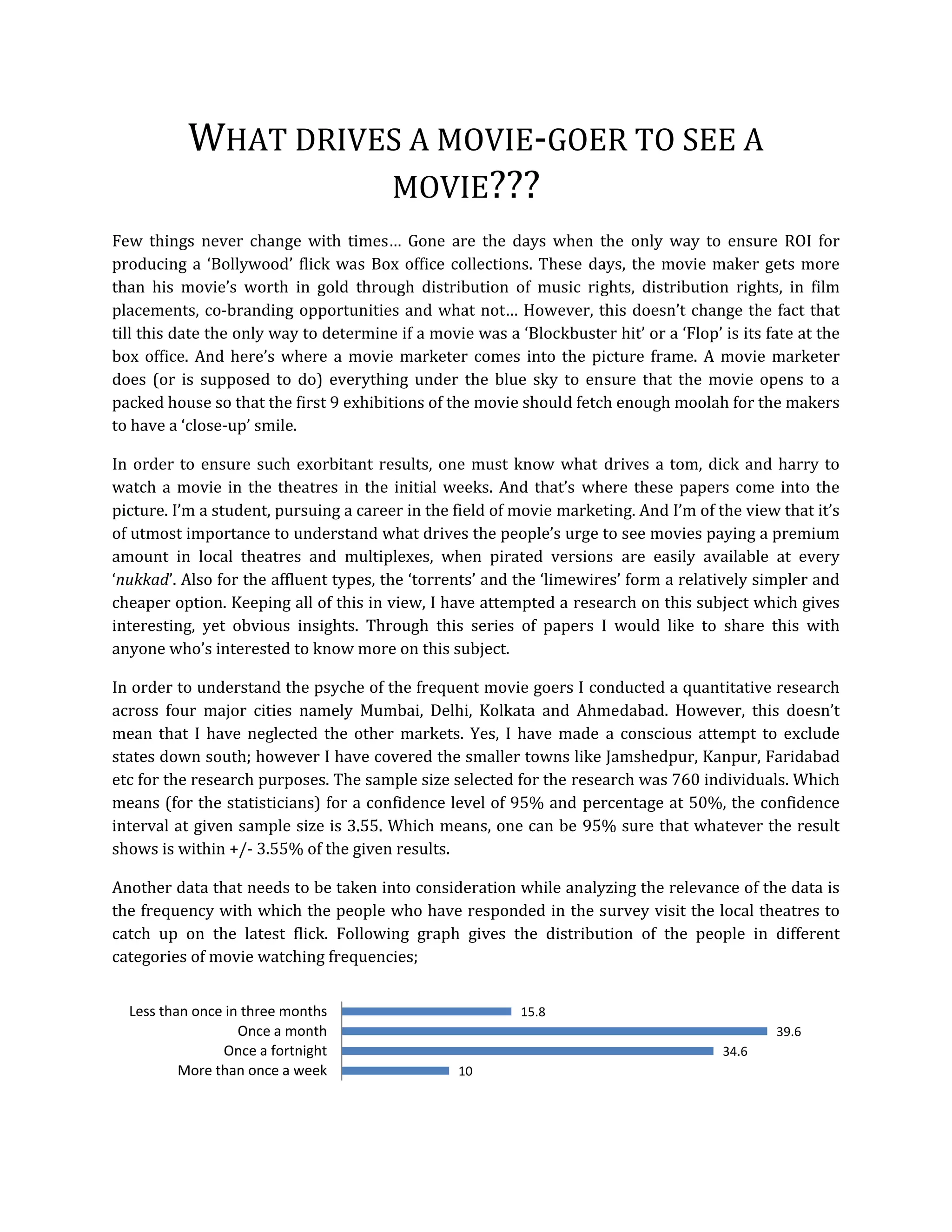
Another data that needs to be taken into consideration while analyzing the relevance of the data is 
the frequency with which the people who have responded in the survey visit the local theatres to 
catch  up  on  the  latest  flick.  Following  graph  gives  the  distribution  of  the  people  in  different 
categories of movie watching frequencies;  


  Less than once in three months                               15.8
                   Once a month                                                                       39.6
                Once a fortnight                                                              34.6
          More than once a week                      10
                                                                                                                 
The  graph  clearly  shows  that  around  84%  of  the  total  respondents  watch  movies  in  the  theatres 
which includes single theatres, multiplexes, local screens (like the one in Sanpada station) and open 
theatres (like ‘Drive in’ in Ahmedabad). To give you the age‐wise distribution of the respondents, 
please refer to the following fig;  


          40+ years     1.8
  30 years‐39 years                       15.8
  20 years‐29 years                                                                              61.2
  15 years‐19 years                    14
  12 years‐14 years            7.1

The research data shows a bit of a skew towards the 20+ year age group, as compared to any other 
age  group.  However,  the  numbers  here  are  indicative  of  the  percentage  in  each  age  group,  which 
when computed comes out to be a sizeable number. For example, 15.8% in the 30 years‐39 years 
category amounts to 120 odd respondents across cities and so on so forth. Also, as per the reports 
submitted by major research organizations of the country, the reach of cinema as a medium within 
age  groups  also  matches  the  above  graph,  which  validates  the  age‐wise  distribution  of  the 
respondents. 

Now  let’s  get  down  to  hard  core  number  crunching…  For  this  part,  we  would  be  looking  at  the 
trends and likes of respondents who watch movies in theatres once or more than once a fortnight. 
For people in this group, following is the distribution;  


                                 More than once a week       Once a fortnight
                                                                                                                          

When we look at the age‐wise distribution within this group, it more or less resembles the overall 
distribution with 60.9% in the 20 years‐29 years category, 14.2% each in 30 years‐39 years and 15 
years‐19 years category. Followed by 12 years‐14 years category at 8.3% and 40+ years category at 
2.4%.  What would be interesting to know is what do these people love to see in the theatres? These 
can be determined from their current viewing habits. The reason why its important to know their 
viewing habits is because they form the core part of the opinion leaders amongst their peer group, 
influencing  the  movie  viewing  decisions  of  a  sizeable  audience.  Thus  following  are  their 
preferences,  
Love story                                                                         56.8
       Epics                                      27.8
    Children                            19.5
    Musicals                                       29.0
  Animation                                        29.0
      Action                                                            46.2
     Thriller                                                                    53.8
    Comedy                                                                                          69.2

As  the  results  show,  there  is  a  clear  preference  of  ‘Comedy/Humor’  as  a  genre  over  any  other. 
Probably  that  explains  the  success  of  latest  Vipul  Shah  Movies,  without  undermining  Akshay 
Kumar’s role as well. The next in line is ‘Love Stories’, the age old bollywood formula…What follows 
is,  ‘thrillers’  and  ‘Action’  movies.  As  the  result  clearly  shows,  there’s  no  real  enthusiasm  towards 
Animation  and  Musicals  as  a  genre  of  movies,  probably  ‘Roadside Romeo’  by  Yashraj  Films  might 
change this a little bit; although we have seen movies like ‘Hanuman’ succeed at the box office. 

I think we can end this part here, probably discuss a few more insights from the research next time 
round.  However,  I  would  solicit  your  feedback  on  this  article.  Also  if  you  wish  to  see  the  entire 
report, please feel free to write to me at filmmarketeer@gmail.com 


what-drives-a-movie-goer-to-wach-movies

  • 1.
    WHAT DRIVES A MOVIE‐GOER TO SEE A  MOVIE???    Few  things  never  change  with  times…  Gone  are  the  days  when  the  only  way  to  ensure  ROI  for  producing  a  ‘Bollywood’  flick  was  Box  office  collections.  These  days,  the  movie  maker  gets  more  than  his  movie’s  worth  in  gold  through  distribution  of  music  rights,  distribution  rights,  in  film  placements,  co‐branding  opportunities  and  what  not…  However,  this  doesn’t  change  the  fact  that  till this date the only way to determine if a movie was a ‘Blockbuster hit’ or a ‘Flop’ is its fate at the  box  office.  And  here’s  where  a  movie  marketer  comes  into  the  picture  frame.  A  movie  marketer  does  (or  is  supposed  to  do)  everything  under  the  blue  sky  to  ensure  that  the  movie  opens  to  a  packed house so that the first 9 exhibitions of the movie should fetch enough moolah for the makers  to have a ‘close‐up’ smile.    In  order  to  ensure  such  exorbitant  results,  one  must  know  what  drives  a  tom,  dick  and  harry  to  watch  a  movie  in  the  theatres  in  the  initial  weeks.  And  that’s  where  these  papers  come  into  the  picture. I’m a student, pursuing a career in the field of movie marketing. And I’m of the view that it’s  of utmost importance to understand what drives the people’s urge to see movies paying a premium  amount  in  local  theatres  and  multiplexes,  when  pirated  versions  are  easily  available  at  every  ‘nukkad’. Also for the affluent types, the ‘torrents’ and the ‘limewires’ form a relatively simpler and  cheaper option. Keeping all of this in view, I have attempted a research on this subject which gives  interesting,  yet  obvious  insights.  Through  this  series  of  papers  I  would  like  to  share  this  with  anyone who’s interested to know more on this subject.  In order to understand the psyche of the frequent movie goers I conducted a quantitative research  across  four  major  cities  namely  Mumbai,  Delhi,  Kolkata  and  Ahmedabad.  However,  this  doesn’t  mean  that  I  have  neglected  the  other  markets.  Yes,  I  have  made  a  conscious  attempt  to  exclude  states down south; however I have covered the smaller towns like Jamshedpur, Kanpur, Faridabad  etc for the research purposes. The sample size selected for the research was 760 individuals. Which  means (for the statisticians) for a confidence level of 95% and percentage at 50%, the confidence  interval at given sample size is 3.55. Which means, one can be  95% sure that whatever the result  shows is within +/‐ 3.55% of the given results.  Another data that needs to be taken into consideration while analyzing the relevance of the data is  the frequency with which the people who have responded in the survey visit the local theatres to  catch  up  on  the  latest  flick.  Following  graph  gives  the  distribution  of  the  people  in  different  categories of movie watching frequencies;   Less than once in three months 15.8 Once a month 39.6 Once a fortnight 34.6 More than once a week 10  
  • 2.
    The  graph  clearly shows  that  around  84%  of  the  total  respondents  watch  movies  in  the  theatres  which includes single theatres, multiplexes, local screens (like the one in Sanpada station) and open  theatres (like ‘Drive in’ in Ahmedabad). To give you the age‐wise distribution of the respondents,  please refer to the following fig;   40+ years 1.8 30 years‐39 years 15.8 20 years‐29 years 61.2 15 years‐19 years 14 12 years‐14 years 7.1 The research data shows a bit of a skew towards the 20+ year age group, as compared to any other  age  group.  However,  the  numbers  here  are  indicative  of  the  percentage  in  each  age  group,  which  when computed comes out to be a sizeable number. For example, 15.8% in the 30 years‐39 years  category amounts to 120 odd respondents across cities and so on so forth. Also, as per the reports  submitted by major research organizations of the country, the reach of cinema as a medium within  age  groups  also  matches  the  above  graph,  which  validates  the  age‐wise  distribution  of  the  respondents.  Now  let’s  get  down  to  hard  core  number  crunching…  For  this  part,  we  would  be  looking  at  the  trends and likes of respondents who watch movies in theatres once or more than once a fortnight.  For people in this group, following is the distribution;   More than once a week Once a fortnight                 When we look at the age‐wise distribution within this group, it more or less resembles the overall  distribution with 60.9% in the 20 years‐29 years category, 14.2% each in 30 years‐39 years and 15  years‐19 years category. Followed by 12 years‐14 years category at 8.3% and 40+ years category at  2.4%.  What would be interesting to know is what do these people love to see in the theatres? These  can be determined from their current viewing habits. The reason why its important to know their  viewing habits is because they form the core part of the opinion leaders amongst their peer group,  influencing  the  movie  viewing  decisions  of  a  sizeable  audience.  Thus  following  are  their  preferences,  
  • 3.
    Love story 56.8 Epics 27.8 Children 19.5 Musicals 29.0 Animation 29.0 Action 46.2 Thriller 53.8 Comedy 69.2 As  the  results  show,  there  is  a  clear  preference  of  ‘Comedy/Humor’  as  a  genre  over  any  other.  Probably  that  explains  the  success  of  latest  Vipul  Shah  Movies,  without  undermining  Akshay  Kumar’s role as well. The next in line is ‘Love Stories’, the age old bollywood formula…What follows  is,  ‘thrillers’  and  ‘Action’  movies.  As  the  result  clearly  shows,  there’s  no  real  enthusiasm  towards  Animation  and  Musicals  as  a  genre  of  movies,  probably  ‘Roadside Romeo’  by  Yashraj  Films  might  change this a little bit; although we have seen movies like ‘Hanuman’ succeed at the box office.  I think we can end this part here, probably discuss a few more insights from the research next time  round.  However,  I  would  solicit  your  feedback  on  this  article.  Also  if  you  wish  to  see  the  entire  report, please feel free to write to me at filmmarketeer@gmail.com