What Role Does SOC Play in Preventing Data Breaches?
The intensity and frequency of cyberattacks have reached unprecedented levels over the past
few years, bringing data security into pressing concern for businesses across industries. In 2023
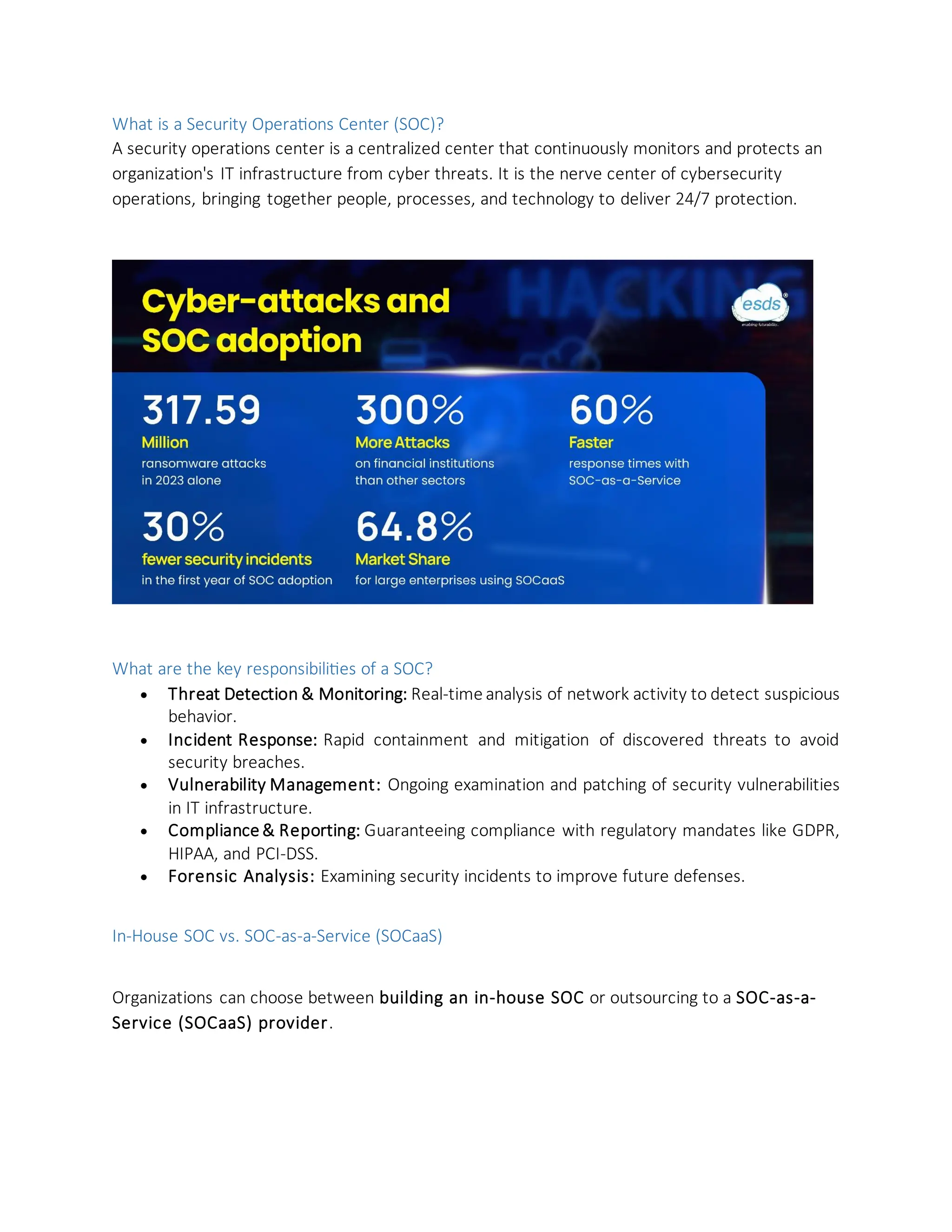
alone, 317.59 million ransomware attacks occurred in all organizations worldwide, emphasizing
the critical need for preventative cybersecurity measures. Financial institutions face more than
300% more cyberattacks than other industries because they handle high-value data.
To tackle such threats, companies are looking for security operations centers (SOC), specialized
security centers that monitor, detect, investigate, and respond to cyber threats in real-time. SOC
services enable companies to get 24/7 security monitoring, allowing them to prevent potential
breaches before they become critical issues. Surveys show that 60% of SOC-as-a-Service
(SOCaaS) users have faster incident response times, with an average decrease in security
incidents by 30% in the first year of operation.
What is a Security Operations Center (SOC)?
A security operations center is a centralized center that continuously monitors and protects an
organization's IT infrastructure from cyber threats. It is the nerve center of cybersecurity
operations, bringing together people, processes, and technology to deliver 24/7 protection.
What are the key responsibilities of a SOC?
• Threat Detection & Monitoring: Real-time analysis of network activity to detect suspicious
behavior.
• Incident Response: Rapid containment and mitigation of discovered threats to avoid
security breaches.
• Vulnerability Management: Ongoing examination and patching of security vulnerabilities
in IT infrastructure.
• Compliance & Reporting: Guaranteeing compliance with regulatory mandates like GDPR,
HIPAA, and PCI-DSS.
• Forensic Analysis: Examining security incidents to improve future defenses.
In-House SOC vs. SOC-as-a-Service (SOCaaS)
Organizations can choose between building an in-house SOC or outsourcing to a SOC-as-a-
Service (SOCaaS) provider.
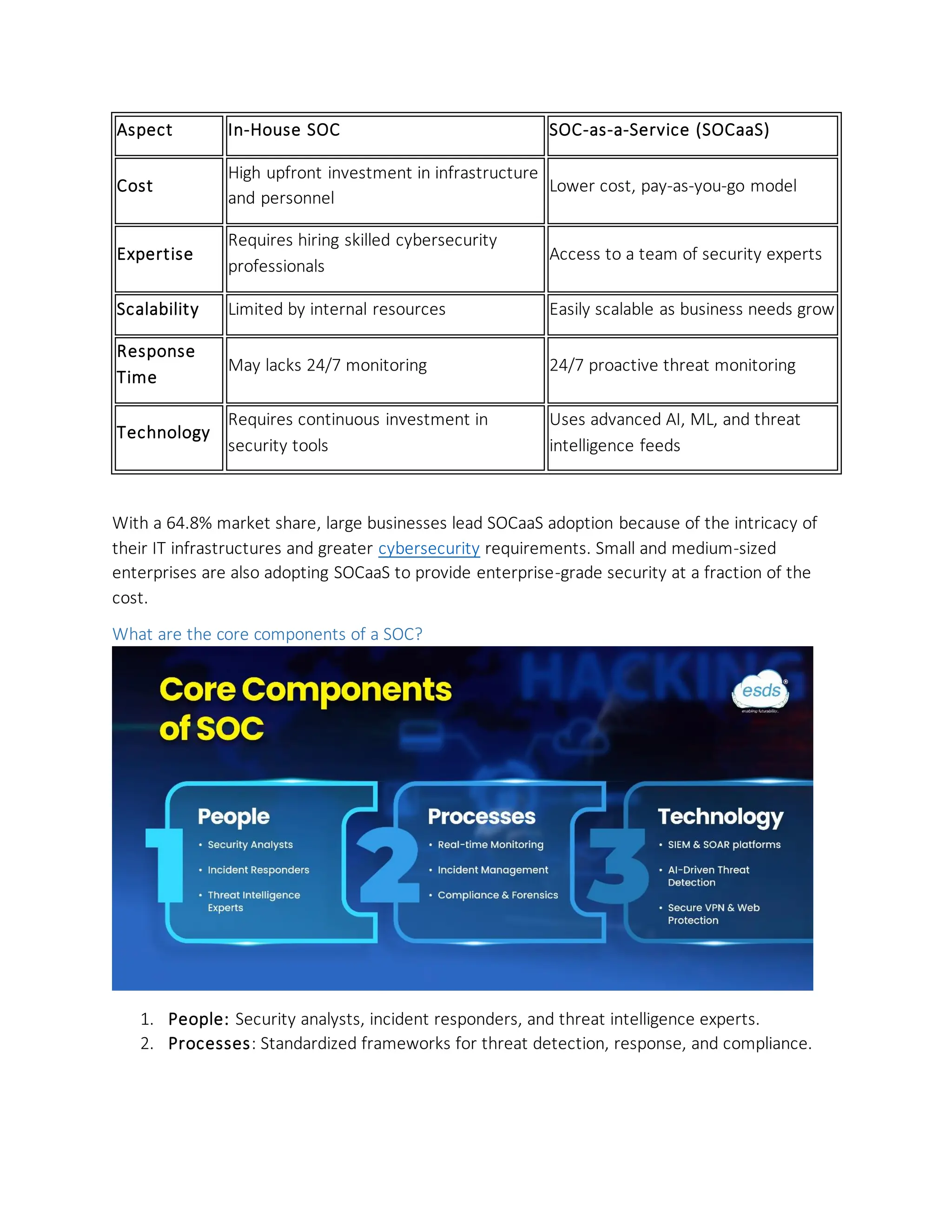
Aspect In-House SOC SOC-as-a-Service (SOCaaS)
Cost
High upfront investment in infrastructure
and personnel
Lower cost, pay-as-you-go model
Expertise
Requires hiring skilled cybersecurity
professionals
Access to a team of security experts
Scalability Limited by internal resources Easily scalable as business needs grow
Response
Time
May lacks 24/7 monitoring 24/7 proactive threat monitoring
Technology
Requires continuous investment in
security tools
Uses advanced AI, ML, and threat
intelligence feeds
With a 64.8% market share, large businesses lead SOCaaS adoption because of the intricacy of
their IT infrastructures and greater cybersecurity requirements. Small and medium-sized
enterprises are also adopting SOCaaS to provide enterprise-grade security at a fraction of the
cost.
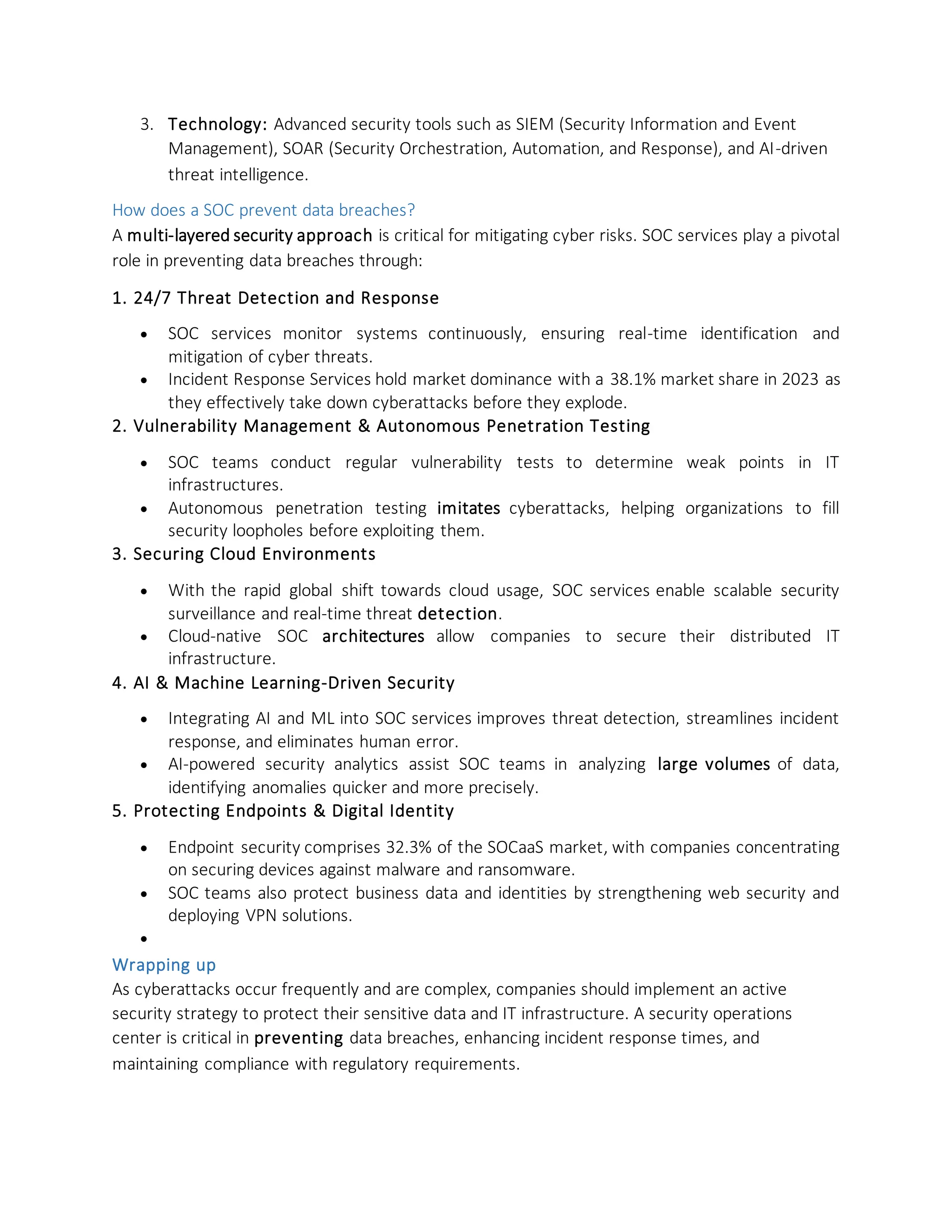
What are the core components of a SOC?
1. People: Security analysts, incident responders, and threat intelligence experts.
2. Processes: Standardized frameworks for threat detection, response, and compliance.
3. Technology: Advanced security tools such as SIEM (Security Information and Event
Management), SOAR (Security Orchestration, Automation, and Response), and AI-driven
threat intelligence.
How does a SOC prevent data breaches?
A multi-layered security approach is critical for mitigating cyber risks. SOC services play a pivotal
role in preventing data breaches through:
1. 24/7 Threat Detection and Response
• SOC services monitor systems continuously, ensuring real-time identification and
mitigation of cyber threats.
• Incident Response Services hold market dominance with a 38.1% market share in 2023 as
they effectively take down cyberattacks before they explode.
2. Vulnerability Management & Autonomous Penetration Testing
• SOC teams conduct regular vulnerability tests to determine weak points in IT
infrastructures.
• Autonomous penetration testing imitates cyberattacks, helping organizations to fill
security loopholes before exploiting them.
3. Securing Cloud Environments
• With the rapid global shift towards cloud usage, SOC services enable scalable security
surveillance and real-time threat detection.
• Cloud-native SOC architectures allow companies to secure their distributed IT
infrastructure.
4. AI & Machine Learning-Driven Security
• Integrating AI and ML into SOC services improves threat detection, streamlines incident
response, and eliminates human error.
• AI-powered security analytics assist SOC teams in analyzing large volumes of data,
identifying anomalies quicker and more precisely.
5. Protecting Endpoints & Digital Identity
• Endpoint security comprises 32.3% of the SOCaaS market, with companies concentrating
on securing devices against malware and ransomware.
• SOC teams also protect business data and identities by strengthening web security and
deploying VPN solutions.
•
Wrapping up
As cyberattacks occur frequently and are complex, companies should implement an active
security strategy to protect their sensitive data and IT infrastructure. A security operations
center is critical in preventing data breaches, enhancing incident response times, and
maintaining compliance with regulatory requirements.
Using SOC-as-a-Service (SOCaaS), organizations, large businesses, or SMBs can have enterprise-
level security without significant upfront investments. The SOCaaS market keeps growing, fueled
by increasing cyber threats, cloud usage, and AI-based security innovations.
To remain one step ahead of cybercriminals, companies must invest in end-to-end SOC solutions
that provide 24/7 monitoring, AI-based threat intelligence, and quick incident response,
guaranteeing long-term cybersecurity resilience.
More on SOC service providers
As a cybersecurity partner, ESDS delivers Security as a Service (SECaaS) to enterprises, BFSI
institutions, and government organizations. ESDS SOC ensures operational resilience and
regulatory compliance by offering:
• Tier 3 cloud infrastructure,
• "Eagle Eye Services" for subscription-based cyber monitoring,
• Secure VPN access for remote work,
• Web security and digital identity protection,
• SOAR to automate and streamline threat detection and response.
To know more about how your organizations can scale and get secured, you can contact our
security experts.
Visit us: https://www.esds.co.in/soc-as-a-service
For more information, contact Team ESDS through:
🖂 Email: getintouch@esds.co.in; ✆ Toll-Free: 1800-209-3006; Website:
https://www.esds.co.in/

What Role Does SOC Play in Preventing Data Breaches

  • 1.
    What Role DoesSOC Play in Preventing Data Breaches? The intensity and frequency of cyberattacks have reached unprecedented levels over the past few years, bringing data security into pressing concern for businesses across industries. In 2023 alone, 317.59 million ransomware attacks occurred in all organizations worldwide, emphasizing the critical need for preventative cybersecurity measures. Financial institutions face more than 300% more cyberattacks than other industries because they handle high-value data. To tackle such threats, companies are looking for security operations centers (SOC), specialized security centers that monitor, detect, investigate, and respond to cyber threats in real-time. SOC services enable companies to get 24/7 security monitoring, allowing them to prevent potential breaches before they become critical issues. Surveys show that 60% of SOC-as-a-Service (SOCaaS) users have faster incident response times, with an average decrease in security incidents by 30% in the first year of operation.
  • 2.
    What is aSecurity Operations Center (SOC)? A security operations center is a centralized center that continuously monitors and protects an organization's IT infrastructure from cyber threats. It is the nerve center of cybersecurity operations, bringing together people, processes, and technology to deliver 24/7 protection. What are the key responsibilities of a SOC? • Threat Detection & Monitoring: Real-time analysis of network activity to detect suspicious behavior. • Incident Response: Rapid containment and mitigation of discovered threats to avoid security breaches. • Vulnerability Management: Ongoing examination and patching of security vulnerabilities in IT infrastructure. • Compliance & Reporting: Guaranteeing compliance with regulatory mandates like GDPR, HIPAA, and PCI-DSS. • Forensic Analysis: Examining security incidents to improve future defenses. In-House SOC vs. SOC-as-a-Service (SOCaaS) Organizations can choose between building an in-house SOC or outsourcing to a SOC-as-a- Service (SOCaaS) provider.
  • 3.
    Aspect In-House SOCSOC-as-a-Service (SOCaaS) Cost High upfront investment in infrastructure and personnel Lower cost, pay-as-you-go model Expertise Requires hiring skilled cybersecurity professionals Access to a team of security experts Scalability Limited by internal resources Easily scalable as business needs grow Response Time May lacks 24/7 monitoring 24/7 proactive threat monitoring Technology Requires continuous investment in security tools Uses advanced AI, ML, and threat intelligence feeds With a 64.8% market share, large businesses lead SOCaaS adoption because of the intricacy of their IT infrastructures and greater cybersecurity requirements. Small and medium-sized enterprises are also adopting SOCaaS to provide enterprise-grade security at a fraction of the cost. What are the core components of a SOC? 1. People: Security analysts, incident responders, and threat intelligence experts. 2. Processes: Standardized frameworks for threat detection, response, and compliance.
  • 4.
    3. Technology: Advancedsecurity tools such as SIEM (Security Information and Event Management), SOAR (Security Orchestration, Automation, and Response), and AI-driven threat intelligence. How does a SOC prevent data breaches? A multi-layered security approach is critical for mitigating cyber risks. SOC services play a pivotal role in preventing data breaches through: 1. 24/7 Threat Detection and Response • SOC services monitor systems continuously, ensuring real-time identification and mitigation of cyber threats. • Incident Response Services hold market dominance with a 38.1% market share in 2023 as they effectively take down cyberattacks before they explode. 2. Vulnerability Management & Autonomous Penetration Testing • SOC teams conduct regular vulnerability tests to determine weak points in IT infrastructures. • Autonomous penetration testing imitates cyberattacks, helping organizations to fill security loopholes before exploiting them. 3. Securing Cloud Environments • With the rapid global shift towards cloud usage, SOC services enable scalable security surveillance and real-time threat detection. • Cloud-native SOC architectures allow companies to secure their distributed IT infrastructure. 4. AI & Machine Learning-Driven Security • Integrating AI and ML into SOC services improves threat detection, streamlines incident response, and eliminates human error. • AI-powered security analytics assist SOC teams in analyzing large volumes of data, identifying anomalies quicker and more precisely. 5. Protecting Endpoints & Digital Identity • Endpoint security comprises 32.3% of the SOCaaS market, with companies concentrating on securing devices against malware and ransomware. • SOC teams also protect business data and identities by strengthening web security and deploying VPN solutions. • Wrapping up As cyberattacks occur frequently and are complex, companies should implement an active security strategy to protect their sensitive data and IT infrastructure. A security operations center is critical in preventing data breaches, enhancing incident response times, and maintaining compliance with regulatory requirements.
  • 5.
    Using SOC-as-a-Service (SOCaaS),organizations, large businesses, or SMBs can have enterprise- level security without significant upfront investments. The SOCaaS market keeps growing, fueled by increasing cyber threats, cloud usage, and AI-based security innovations. To remain one step ahead of cybercriminals, companies must invest in end-to-end SOC solutions that provide 24/7 monitoring, AI-based threat intelligence, and quick incident response, guaranteeing long-term cybersecurity resilience. More on SOC service providers As a cybersecurity partner, ESDS delivers Security as a Service (SECaaS) to enterprises, BFSI institutions, and government organizations. ESDS SOC ensures operational resilience and regulatory compliance by offering: • Tier 3 cloud infrastructure, • "Eagle Eye Services" for subscription-based cyber monitoring, • Secure VPN access for remote work, • Web security and digital identity protection, • SOAR to automate and streamline threat detection and response. To know more about how your organizations can scale and get secured, you can contact our security experts. Visit us: https://www.esds.co.in/soc-as-a-service For more information, contact Team ESDS through: 🖂 Email: getintouch@esds.co.in; ✆ Toll-Free: 1800-209-3006; Website: https://www.esds.co.in/