GPU Cloud vs Physical GPU Servers: Which Is Better for Enterprises?
TL; DR Summary
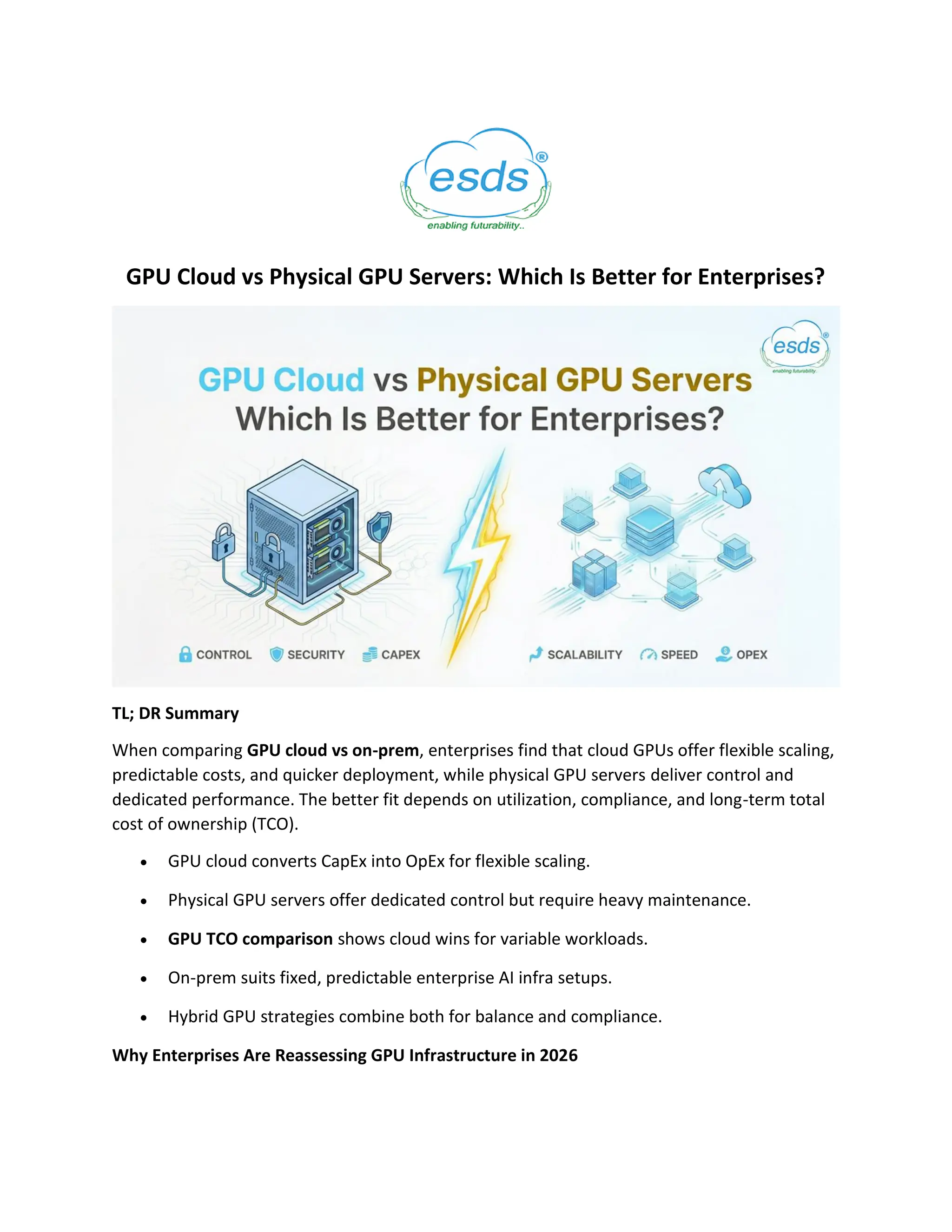
When comparing GPU cloud vs on-prem, enterprises find that cloud GPUs offer flexible scaling,
predictable costs, and quicker deployment, while physical GPU servers deliver control and
dedicated performance. The better fit depends on utilization, compliance, and long-term total
cost of ownership (TCO).
• GPU cloud converts CapEx into OpEx for flexible scaling.
• Physical GPU servers offer dedicated control but require heavy maintenance.
• GPU TCO comparison shows cloud wins for variable workloads.
• On-prem suits fixed, predictable enterprise AI infra setups.
• Hybrid GPU strategies combine both for balance and compliance.
Why Enterprises Are Reassessing GPU Infrastructure in 2026
As enterprise AI adoption deepens, compute strategy has become a board-level topic.
Training and deploying machine learning or generative AI models demand high GPU density, yet
ownership models vary widely.
CIOs and CTOs are weighing GPU cloud vs on-prem infrastructure to determine which aligns
with budget, compliance, and operational flexibility. In India, where data localization and AI
workloads are rising simultaneously, the question is no longer about performance alone—it’s
about cost visibility, sovereignty, and scalability.
GPU Cloud: What It Means for Enterprise AI Infra
A GPU cloud provides remote access to high-performance GPU clusters hosted within data
centers, allowing enterprises to provision compute resources as needed.
Key operational benefits include:
• Instant scalability for AI model training and inference
• No hardware depreciation or lifecycle management
• Pay-as-you-go pricing, aligned to actual compute use
• API-level integration with modern AI pipelines
For enterprises managing dynamic workloads such as AI-driven risk analytics, product
simulations, or digital twin development GPU cloud simplifies provisioning while maintaining
cost alignment.
Physical GPU Servers Explained
Physical GPU servers or on-prem GPU setups reside within an enterprise’s data center or co-
located facility. They offer direct control over hardware configuration, data security, and
network latency.
While this setup provides certainty, it introduces overhead: procurement cycles, power
management, physical space, and specialized staffing. In regulated sectors such as BFSI or
defense, where workload predictability is high, on-prem servers continue to play a role in
sustaining compliance and performance consistency.
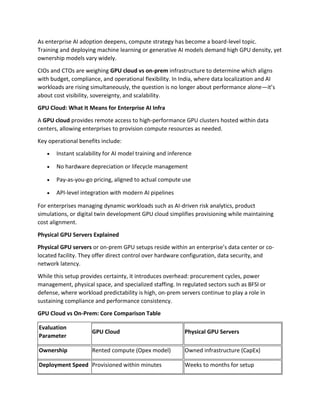
GPU Cloud vs On-Prem: Core Comparison Table
Evaluation
Parameter
GPU Cloud Physical GPU Servers
Ownership Rented compute (Opex model) Owned infrastructure (CapEx)
Deployment Speed Provisioned within minutes Weeks to months for setup
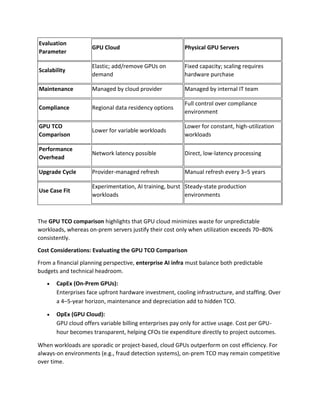
Evaluation
Parameter
GPU Cloud Physical GPU Servers
Scalability
Elastic; add/remove GPUs on
demand
Fixed capacity; scaling requires
hardware purchase
Maintenance Managed by cloud provider Managed by internal IT team
Compliance Regional data residency options
Full control over compliance
environment
GPU TCO
Comparison
Lower for variable workloads
Lower for constant, high-utilization
workloads
Performance
Overhead
Network latency possible Direct, low-latency processing
Upgrade Cycle Provider-managed refresh Manual refresh every 3–5 years
Use Case Fit
Experimentation, AI training, burst
workloads
Steady-state production
environments
The GPU TCO comparison highlights that GPU cloud minimizes waste for unpredictable
workloads, whereas on-prem servers justify their cost only when utilization exceeds 70–80%
consistently.
Cost Considerations: Evaluating the GPU TCO Comparison
From a financial planning perspective, enterprise AI infra must balance both predictable
budgets and technical headroom.
• CapEx (On-Prem GPUs):
Enterprises face upfront hardware investment, cooling infrastructure, and staffing. Over
a 4–5-year horizon, maintenance and depreciation add to hidden TCO.
• OpEx (GPU Cloud):
GPU cloud offers variable billing enterprises pay only for active usage. Cost per GPU-
hour becomes transparent, helping CFOs tie expenditure directly to project outcomes.
When workloads are sporadic or project-based, cloud GPUs outperform on cost efficiency. For
always-on environments (e.g., fraud detection systems), on-prem TCO may remain competitive
over time.
Performance and Latency in Enterprise AI Infra
Physical GPU servers ensure immediate access with no network dependency, ideal for
workloads demanding real-time inference. However, advances in edge networking and regional
cloud data centers are closing this gap.
Modern GPU cloud platforms now operate within Tier III+ Indian data centers, offering sub-5ms
latency for most enterprise AI infra needs. Cloud orchestration tools also dynamically allocate
GPU resources, reducing idle cycles and improving inference throughput without manual
intervention.
Security, Compliance, and Data Residency
In India, compliance mandates such as the Digital Personal Data Protection Act (DPDP) and
MeitY data localization guidelines drive infrastructure choices.
• On-Prem Servers: Full control over physical and logical security. Enterprises manage
access, audits, and encryption policies directly.
• GPU Cloud: Compliance-ready options hosted within India ensure sovereignty for BFSI,
government, and manufacturing clients. Most providers now include data encryption,
IAM segregation, and logging aligned with Indian regulatory norms.
Thus, in regulated AI deployments, GPU cloud vs on-prem is no longer a binary choice but a
matter of selecting the right compliance envelope for each workload.
Operational Agility and Upgradability
Hardware refresh cycles for on-prem GPUs can be slow and capital intensive. Cloud models
evolve faster providers frequently upgrade to newer GPUs such as NVIDIA A100 or H100, letting
enterprises access current-generation performance without hardware swaps.
Operationally, cloud GPUs support multi-zone redundancy, disaster recovery, and usage
analytics. These features reduce unplanned downtime and make performance tracking more
transparent benefits often overlooked in enterprise AI infra planning.
Sustainability and Resource Utilization
Enterprises are increasingly accountable for power consumption and carbon metrics. GPU cloud
services run on shared, optimized infrastructure, achieving higher utilization and lower
emissions per GPU-hour.
On-prem setups often overprovision to meet peak loads, leaving resources idle during off-peak
cycles.
Thus, beyond cost, GPU cloud indirectly supports sustainability reporting by lowering unused
energy expenditure across compute clusters.
Choosing the Right Model: Hybrid GPU Strategy
In most cases, enterprises find balance through a hybrid GPU strategy.
This combines the control of on-prem servers for sensitive workloads with the scalability of GPU
cloud for development and AI experimentation.
Hybrid models allow:
• Controlled residency for regulated data
• Flexible access to GPUs for innovation
• Optimized TCO through workload segmentation
A carefully designed hybrid GPU architecture gives CTOs visibility across compute environments
while maintaining compliance and budgetary discipline.
For Indian enterprises evaluating GPU cloud vs on-prem, ESDS Software Solution Ltd. offers
GPU as a Service (GPUaaS) through its India-based data centers.
These environments provide region-specific GPU hosting with strong compliance alignment,
measured access controls, and flexible billing suited to enterprise AI infra planning.
With ESDS GPUaaS, organizations can deploy AI workloads securely within national borders,
scale training capacity on demand, and retain predictable operational costs without committing
to physical hardware refresh cycles.
For more information, contact Team ESDS through:
Visit us: https://www.esds.co.in/gpu-as-a-service
🖂 Email: getintouch@esds.co.in; ✆ Toll-Free: 1800-209-3006

GPU Cloud vs Physical GPU Servers Which Is Better for Enterprises.pdf

  • 1.
    GPU Cloud vsPhysical GPU Servers: Which Is Better for Enterprises? TL; DR Summary When comparing GPU cloud vs on-prem, enterprises find that cloud GPUs offer flexible scaling, predictable costs, and quicker deployment, while physical GPU servers deliver control and dedicated performance. The better fit depends on utilization, compliance, and long-term total cost of ownership (TCO). • GPU cloud converts CapEx into OpEx for flexible scaling. • Physical GPU servers offer dedicated control but require heavy maintenance. • GPU TCO comparison shows cloud wins for variable workloads. • On-prem suits fixed, predictable enterprise AI infra setups. • Hybrid GPU strategies combine both for balance and compliance. Why Enterprises Are Reassessing GPU Infrastructure in 2026
  • 2.
    As enterprise AIadoption deepens, compute strategy has become a board-level topic. Training and deploying machine learning or generative AI models demand high GPU density, yet ownership models vary widely. CIOs and CTOs are weighing GPU cloud vs on-prem infrastructure to determine which aligns with budget, compliance, and operational flexibility. In India, where data localization and AI workloads are rising simultaneously, the question is no longer about performance alone—it’s about cost visibility, sovereignty, and scalability. GPU Cloud: What It Means for Enterprise AI Infra A GPU cloud provides remote access to high-performance GPU clusters hosted within data centers, allowing enterprises to provision compute resources as needed. Key operational benefits include: • Instant scalability for AI model training and inference • No hardware depreciation or lifecycle management • Pay-as-you-go pricing, aligned to actual compute use • API-level integration with modern AI pipelines For enterprises managing dynamic workloads such as AI-driven risk analytics, product simulations, or digital twin development GPU cloud simplifies provisioning while maintaining cost alignment. Physical GPU Servers Explained Physical GPU servers or on-prem GPU setups reside within an enterprise’s data center or co- located facility. They offer direct control over hardware configuration, data security, and network latency. While this setup provides certainty, it introduces overhead: procurement cycles, power management, physical space, and specialized staffing. In regulated sectors such as BFSI or defense, where workload predictability is high, on-prem servers continue to play a role in sustaining compliance and performance consistency. GPU Cloud vs On-Prem: Core Comparison Table Evaluation Parameter GPU Cloud Physical GPU Servers Ownership Rented compute (Opex model) Owned infrastructure (CapEx) Deployment Speed Provisioned within minutes Weeks to months for setup
  • 3.
    Evaluation Parameter GPU Cloud PhysicalGPU Servers Scalability Elastic; add/remove GPUs on demand Fixed capacity; scaling requires hardware purchase Maintenance Managed by cloud provider Managed by internal IT team Compliance Regional data residency options Full control over compliance environment GPU TCO Comparison Lower for variable workloads Lower for constant, high-utilization workloads Performance Overhead Network latency possible Direct, low-latency processing Upgrade Cycle Provider-managed refresh Manual refresh every 3–5 years Use Case Fit Experimentation, AI training, burst workloads Steady-state production environments The GPU TCO comparison highlights that GPU cloud minimizes waste for unpredictable workloads, whereas on-prem servers justify their cost only when utilization exceeds 70–80% consistently. Cost Considerations: Evaluating the GPU TCO Comparison From a financial planning perspective, enterprise AI infra must balance both predictable budgets and technical headroom. • CapEx (On-Prem GPUs): Enterprises face upfront hardware investment, cooling infrastructure, and staffing. Over a 4–5-year horizon, maintenance and depreciation add to hidden TCO. • OpEx (GPU Cloud): GPU cloud offers variable billing enterprises pay only for active usage. Cost per GPU- hour becomes transparent, helping CFOs tie expenditure directly to project outcomes. When workloads are sporadic or project-based, cloud GPUs outperform on cost efficiency. For always-on environments (e.g., fraud detection systems), on-prem TCO may remain competitive over time.
  • 4.
    Performance and Latencyin Enterprise AI Infra Physical GPU servers ensure immediate access with no network dependency, ideal for workloads demanding real-time inference. However, advances in edge networking and regional cloud data centers are closing this gap. Modern GPU cloud platforms now operate within Tier III+ Indian data centers, offering sub-5ms latency for most enterprise AI infra needs. Cloud orchestration tools also dynamically allocate GPU resources, reducing idle cycles and improving inference throughput without manual intervention. Security, Compliance, and Data Residency In India, compliance mandates such as the Digital Personal Data Protection Act (DPDP) and MeitY data localization guidelines drive infrastructure choices. • On-Prem Servers: Full control over physical and logical security. Enterprises manage access, audits, and encryption policies directly. • GPU Cloud: Compliance-ready options hosted within India ensure sovereignty for BFSI, government, and manufacturing clients. Most providers now include data encryption, IAM segregation, and logging aligned with Indian regulatory norms. Thus, in regulated AI deployments, GPU cloud vs on-prem is no longer a binary choice but a matter of selecting the right compliance envelope for each workload. Operational Agility and Upgradability Hardware refresh cycles for on-prem GPUs can be slow and capital intensive. Cloud models evolve faster providers frequently upgrade to newer GPUs such as NVIDIA A100 or H100, letting enterprises access current-generation performance without hardware swaps. Operationally, cloud GPUs support multi-zone redundancy, disaster recovery, and usage analytics. These features reduce unplanned downtime and make performance tracking more transparent benefits often overlooked in enterprise AI infra planning. Sustainability and Resource Utilization Enterprises are increasingly accountable for power consumption and carbon metrics. GPU cloud services run on shared, optimized infrastructure, achieving higher utilization and lower emissions per GPU-hour. On-prem setups often overprovision to meet peak loads, leaving resources idle during off-peak cycles. Thus, beyond cost, GPU cloud indirectly supports sustainability reporting by lowering unused energy expenditure across compute clusters.
  • 5.
    Choosing the RightModel: Hybrid GPU Strategy In most cases, enterprises find balance through a hybrid GPU strategy. This combines the control of on-prem servers for sensitive workloads with the scalability of GPU cloud for development and AI experimentation. Hybrid models allow: • Controlled residency for regulated data • Flexible access to GPUs for innovation • Optimized TCO through workload segmentation A carefully designed hybrid GPU architecture gives CTOs visibility across compute environments while maintaining compliance and budgetary discipline. For Indian enterprises evaluating GPU cloud vs on-prem, ESDS Software Solution Ltd. offers GPU as a Service (GPUaaS) through its India-based data centers. These environments provide region-specific GPU hosting with strong compliance alignment, measured access controls, and flexible billing suited to enterprise AI infra planning. With ESDS GPUaaS, organizations can deploy AI workloads securely within national borders, scale training capacity on demand, and retain predictable operational costs without committing to physical hardware refresh cycles. For more information, contact Team ESDS through: Visit us: https://www.esds.co.in/gpu-as-a-service 🖂 Email: getintouch@esds.co.in; ✆ Toll-Free: 1800-209-3006