What is Technology?
What is Technology?
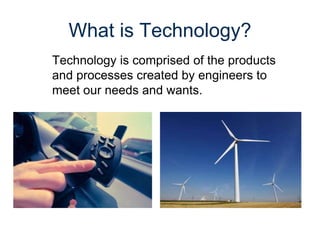
Technology is comprised of the products
and processes created by engineers to
meet our needs and wants.
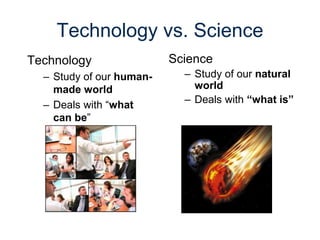
Technology vs. Science
Technology
– Study of our human-
made world
– Deals with “what
can be”
Science
– Study of our natural
world
– Deals with “what is”
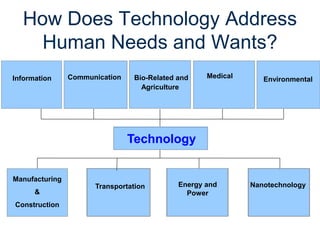
How Does Technology Address
Human Needs and Wants?
Transportation
Technology
Medical
Manufacturing
&
Construction
Bio-Related and
Agriculture
Nanotechnology
Information Communication
Energy and
Power
Environmental
Information Technology
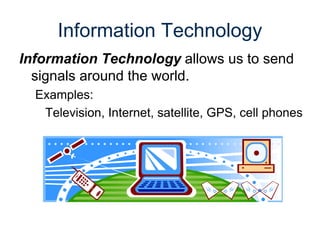
Information Technology allows us to send
signals around the world.
Examples:
Television, Internet, satellite, GPS, cell phones
Impacts of Information Technology
POSITIVE
IMPACTS
NEGATIVE
IMPACTS
INTERNET –
Information
is stored for
easy access
INTERNET –
Harder to
distinguish between
reliable and
unreliable sources
Communication Technology
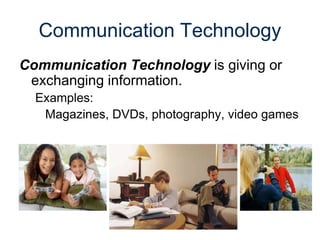
Communication Technology is giving or
exchanging information.
Examples:
Magazines, DVDs, photography, video games
Impacts of Communication Technology
POSITIVE IMPACTS NEGATIVE IMPACTS
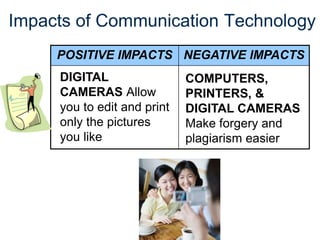
DIGITAL
CAMERAS Allow
you to edit and print
only the pictures
you like
COMPUTERS,
PRINTERS, &
DIGITAL CAMERAS
Make forgery and
plagiarism easier
Bio-related and Agricultural
Technology
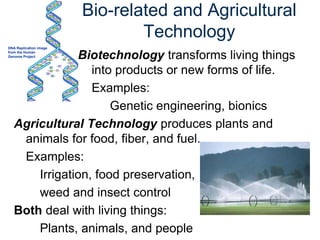
Biotechnology transforms living things
into products or new forms of life.
Examples:
Genetic engineering, bionics
Agricultural Technology produces plants and
animals for food, fiber, and fuel.
Examples:
Irrigation, food preservation,
weed and insect control
Both deal with living things:
Plants, animals, and people
DNA Replication image
from the Human
Genome Project
Impacts of Bio-Related
Technology
POSITIVE
IMPACTS
NEGATIVE
IMPACTS
HEALTH –
Improves quality
of life, vitamins,
vaccines,
medications
HEALTH – Side
effects of some
medications –
nausea, shortness
of breath, etc.
Impacts of Agricultural
Technology
POSITIVE IMPACTS NEGATIVE IMPACTS
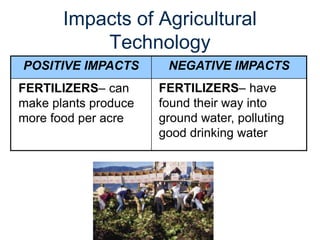
FERTILIZERS– can
make plants produce
more food per acre
FERTILIZERS– have
found their way into
ground water, polluting
good drinking water
Medical Technology
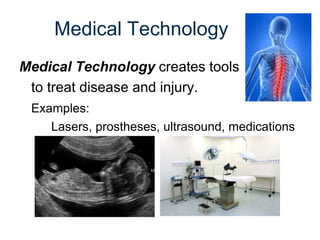
Medical Technology creates tools
to treat disease and injury.
Examples:
Lasers, prostheses, ultrasound, medications
Impacts of Medical Technology
POSITIVE
IMPACTS
NEGATIVE
IMPACTS
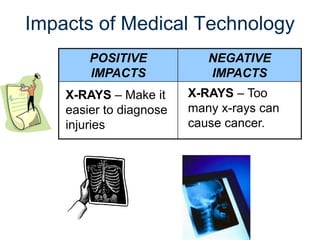
X-RAYS – Make it
easier to diagnose
injuries
X-RAYS – Too
many x-rays can
cause cancer.
Environmental Technology
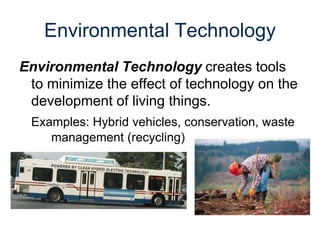
Environmental Technology creates tools
to minimize the effect of technology on the
development of living things.
Examples: Hybrid vehicles, conservation, waste
management (recycling)
Impacts of Environmental
Technology
POSITIVE IMPACTS NEGATIVE IMPACTS
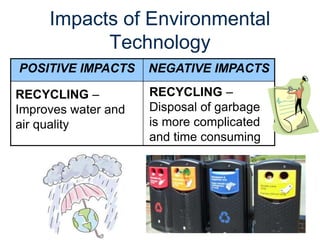
RECYCLING –
Improves water and
air quality
RECYCLING –
Disposal of garbage
is more complicated
and time consuming
Production Technology
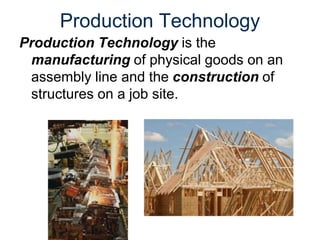
Production Technology is the
manufacturing of physical goods on an
assembly line and the construction of
structures on a job site.
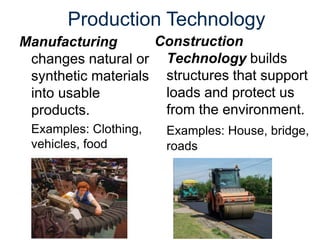
Manufacturing
changes natural or
synthetic materials
into usable
products.
Examples: Clothing,
vehicles, food
Construction
Technology builds
structures that support
loads and protect us
from the environment.
Examples: House, bridge,
roads
Production Technology
Impacts of Production Technology
POSITIVE IMPACTS NEGATIVE IMPACTS
MANUFACTURING – MANUFACTURING –
CONSTRUCTION – CONSTRUCTION –
New products help to
make our life easier
and increase leisure
time
Many industries use
materials that can
harm the
environment
Provides shelter,
improves roads,
creates employment
opportunities
Noise and debris,
traffic problems,
accidents and
injuries
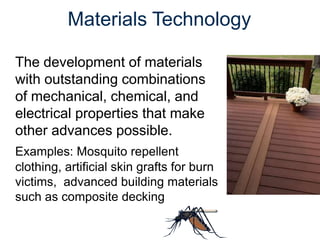
The development of materials
with outstanding combinations
of mechanical, chemical, and
electrical properties that make
other advances possible.
Examples: Mosquito repellent
clothing, artificial skin grafts for burn
victims, advanced building materials
such as composite decking
Materials Technology
Impacts of Materials Technology
POSITIVE IMPACTS NEGATIVE IMPACTS
NEW MATERIALS –
able to reuse recycled
materials to help the
environment
NEW MATERIALS –
don’t know how the
materials will behave
over long periods of
time.
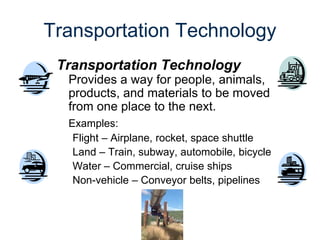
Transportation Technology
Provides a way for people, animals,
products, and materials to be moved
from one place to the next.
Examples:
Flight – Airplane, rocket, space shuttle
Land – Train, subway, automobile, bicycle
Water – Commercial, cruise ships
Non-vehicle – Conveyor belts, pipelines
Impacts of Transportation
Technology
POSITIVE
IMPACTS
NEGATIVE
IMPACTS
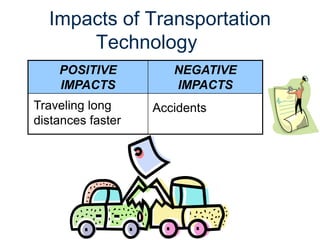
Traveling long
distances faster
Accidents
Energy and Power Technology
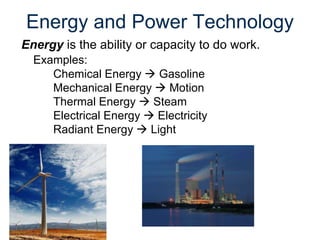
Energy is the ability or capacity to do work.
Examples:
Chemical Energy  Gasoline
Mechanical Energy  Motion
Thermal Energy  Steam
Electrical Energy  Electricity
Radiant Energy  Light
Energy and Power Technology
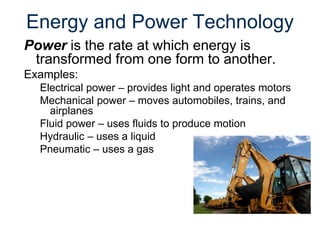
Power is the rate at which energy is
transformed from one form to another.
Examples:
Electrical power – provides light and operates motors
Mechanical power – moves automobiles, trains, and
airplanes
Fluid power – uses fluids to produce motion
Hydraulic – uses a liquid
Pneumatic – uses a gas
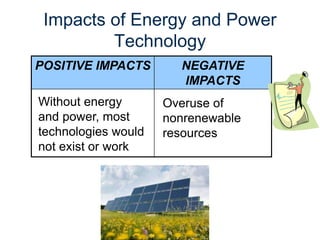
Impacts of Energy and Power
Technology
POSITIVE IMPACTS NEGATIVE
IMPACTS
Without energy
and power, most
technologies would
not exist or work
Overuse of
nonrenewable
resources
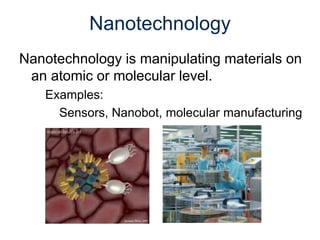
Nanotechnology
Nanotechnology is manipulating materials on
an atomic or molecular level.
Examples:
Sensors, Nanobot, molecular manufacturing
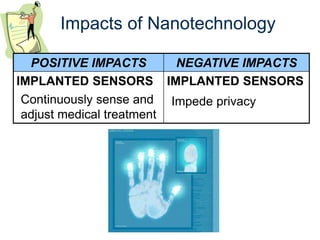
Impacts of Nanotechnology
POSITIVE IMPACTS NEGATIVE IMPACTS
IMPLANTED SENSORS IMPLANTED SENSORS
Continuously sense and
adjust medical treatment
Impede privacy
Image Resources
Microsoft, Inc. (2008). Clip Art. Retrieved September 10, 2008, from
http://office.microsoft.com/en-us/clipart/default.aspx
National Aeronautics and Space Administration (NASA). (n.d.).
Genesis: Search for origins. Retrieved September 10, 2008, from
http://genesismission.jpl.nasa.gov/educate/scimodule/cosmic/ptable.
html

What is Technology for New IT Person [Basic]

  • 1.
  • 2.
    What is Technology? Technologyis comprised of the products and processes created by engineers to meet our needs and wants.
  • 3.
    Technology vs. Science Technology –Study of our human- made world – Deals with “what can be” Science – Study of our natural world – Deals with “what is”
  • 4.
    How Does TechnologyAddress Human Needs and Wants? Transportation Technology Medical Manufacturing & Construction Bio-Related and Agriculture Nanotechnology Information Communication Energy and Power Environmental
  • 5.
    Information Technology Information Technologyallows us to send signals around the world. Examples: Television, Internet, satellite, GPS, cell phones
  • 6.
    Impacts of InformationTechnology POSITIVE IMPACTS NEGATIVE IMPACTS INTERNET – Information is stored for easy access INTERNET – Harder to distinguish between reliable and unreliable sources
  • 7.
    Communication Technology Communication Technologyis giving or exchanging information. Examples: Magazines, DVDs, photography, video games
  • 8.
    Impacts of CommunicationTechnology POSITIVE IMPACTS NEGATIVE IMPACTS DIGITAL CAMERAS Allow you to edit and print only the pictures you like COMPUTERS, PRINTERS, & DIGITAL CAMERAS Make forgery and plagiarism easier
  • 9.
    Bio-related and Agricultural Technology Biotechnologytransforms living things into products or new forms of life. Examples: Genetic engineering, bionics Agricultural Technology produces plants and animals for food, fiber, and fuel. Examples: Irrigation, food preservation, weed and insect control Both deal with living things: Plants, animals, and people DNA Replication image from the Human Genome Project
  • 10.
    Impacts of Bio-Related Technology POSITIVE IMPACTS NEGATIVE IMPACTS HEALTH– Improves quality of life, vitamins, vaccines, medications HEALTH – Side effects of some medications – nausea, shortness of breath, etc.
  • 11.
    Impacts of Agricultural Technology POSITIVEIMPACTS NEGATIVE IMPACTS FERTILIZERS– can make plants produce more food per acre FERTILIZERS– have found their way into ground water, polluting good drinking water
  • 12.
    Medical Technology Medical Technologycreates tools to treat disease and injury. Examples: Lasers, prostheses, ultrasound, medications
  • 13.
    Impacts of MedicalTechnology POSITIVE IMPACTS NEGATIVE IMPACTS X-RAYS – Make it easier to diagnose injuries X-RAYS – Too many x-rays can cause cancer.
  • 14.
    Environmental Technology Environmental Technologycreates tools to minimize the effect of technology on the development of living things. Examples: Hybrid vehicles, conservation, waste management (recycling)
  • 15.
    Impacts of Environmental Technology POSITIVEIMPACTS NEGATIVE IMPACTS RECYCLING – Improves water and air quality RECYCLING – Disposal of garbage is more complicated and time consuming
  • 16.
    Production Technology Production Technologyis the manufacturing of physical goods on an assembly line and the construction of structures on a job site.
  • 17.
    Manufacturing changes natural or syntheticmaterials into usable products. Examples: Clothing, vehicles, food Construction Technology builds structures that support loads and protect us from the environment. Examples: House, bridge, roads Production Technology
  • 18.
    Impacts of ProductionTechnology POSITIVE IMPACTS NEGATIVE IMPACTS MANUFACTURING – MANUFACTURING – CONSTRUCTION – CONSTRUCTION – New products help to make our life easier and increase leisure time Many industries use materials that can harm the environment Provides shelter, improves roads, creates employment opportunities Noise and debris, traffic problems, accidents and injuries
  • 19.
    The development ofmaterials with outstanding combinations of mechanical, chemical, and electrical properties that make other advances possible. Examples: Mosquito repellent clothing, artificial skin grafts for burn victims, advanced building materials such as composite decking Materials Technology
  • 20.
    Impacts of MaterialsTechnology POSITIVE IMPACTS NEGATIVE IMPACTS NEW MATERIALS – able to reuse recycled materials to help the environment NEW MATERIALS – don’t know how the materials will behave over long periods of time.
  • 21.
    Transportation Technology Transportation Technology Providesa way for people, animals, products, and materials to be moved from one place to the next. Examples: Flight – Airplane, rocket, space shuttle Land – Train, subway, automobile, bicycle Water – Commercial, cruise ships Non-vehicle – Conveyor belts, pipelines
  • 22.
  • 23.
    Energy and PowerTechnology Energy is the ability or capacity to do work. Examples: Chemical Energy  Gasoline Mechanical Energy  Motion Thermal Energy  Steam Electrical Energy  Electricity Radiant Energy  Light
  • 24.
    Energy and PowerTechnology Power is the rate at which energy is transformed from one form to another. Examples: Electrical power – provides light and operates motors Mechanical power – moves automobiles, trains, and airplanes Fluid power – uses fluids to produce motion Hydraulic – uses a liquid Pneumatic – uses a gas
  • 25.
    Impacts of Energyand Power Technology POSITIVE IMPACTS NEGATIVE IMPACTS Without energy and power, most technologies would not exist or work Overuse of nonrenewable resources
  • 26.
    Nanotechnology Nanotechnology is manipulatingmaterials on an atomic or molecular level. Examples: Sensors, Nanobot, molecular manufacturing
  • 27.
    Impacts of Nanotechnology POSITIVEIMPACTS NEGATIVE IMPACTS IMPLANTED SENSORS IMPLANTED SENSORS Continuously sense and adjust medical treatment Impede privacy
  • 28.
    Image Resources Microsoft, Inc.(2008). Clip Art. Retrieved September 10, 2008, from http://office.microsoft.com/en-us/clipart/default.aspx National Aeronautics and Space Administration (NASA). (n.d.). Genesis: Search for origins. Retrieved September 10, 2008, from http://genesismission.jpl.nasa.gov/educate/scimodule/cosmic/ptable. html

Editor's Notes

  • #3 Human innovation in action! People have to need it – people have to want it – in order for technology to happen.
  • #4 When we study Science, we look at it in different subject areas. Earth Science Biology Chemistry Physics Astronomy Meteorology Other specialty areas such as Quantum Physics and Computer Science
  • #5 Just like with science, when we study technology we look at it in the following categories These forms of technology will be discussed throughout the presentation.
  • #6 Information Technology is the process of gathering and storing data to be used in various forms. Provides streamlined access to vast sources of information Allows us to produce more accurate forms of communication Includes expanded resource choices Enables us to retrieve data in seconds
  • #7 Impacts slides will provide one positive and one negative example. There should be a class discussion about how other technologies impact the student, school, community, world, etc. COMPUTERS – Use of a computer to easily gather and store data OBSCELENCE –Machines must be maintained and upgraded Yellow Pages book compared to finding phone numbers on line – or stored in the memory of a phone.
  • #8 Communication Technology is a process of giving or exchanging information. Provides streamlined publishing techniques and allows us to produce more accurate drawings Includes expanded entertainment choices Enables us to contact people thousands of miles away
  • #9 CAD – Using a computer to generate more accurate drawings in a shorter period of time PAPER USAGE – People tend to create and print more documents
  • #10 Bio-related Technology Pharmaceuticals Artificial limbs Genetic engineering Hydroponics Imaging devices Cardiovascular devices Ethics The Human Genome Project (HGP) was one of the great feats of exploration in history. The HGP gave us the ability to, for the first time, to read nature's complete genetic blueprint for building a human being. Agricultural biotechnology is a range of tools, including traditional breeding techniques, that alter living organisms, or parts of organisms, to make or modify products; improve plants or animals; or develop microorganisms for specific agricultural uses. Modern biotechnology today includes the tools of genetic engineering. Biotechnology provides farmers with tools that can make production cheaper and more manageable. For example, some biotechnology crops can be engineered to tolerate specific herbicides, which makes weed control simpler and more efficient. Other crops have been engineered to be resistant to specific plant diseases and insect pests, which can make pest control more reliable and effective, and/or can decrease the use of synthetic pesticides. These crop production options can help countries keep pace with demands for food while reducing production costs. Advances in biotechnology may provide consumers with foods that are nutritionally-enriched or longer-lasting, or that contain lower levels of certain naturally occurring toxicants present in some food plants. Developers are using biotechnology to try to reduce saturated fats in cooking oils, reduce allergens in foods, and increase disease-fighting nutrients in foods. They are also researching ways to use genetically engineered crops in the production of new medicines, which may lead to a new plant-made pharmaceutical industry that could reduce the costs of production using a sustainable resource. http://www.usda.gov/wps/portal/!ut/p/_s.7_0_A/7_0_1OB?contentidonly=true&navid=AGRICULTURE&contentid=BiotechnologyFAQs.xml
  • #11 DISEASE – Research on controlling and eliminating diseases DISEASE – Not all cultures embrace use of vaccines and thus disease spreads
  • #12 FOOD – More variety, healthier choices, processed so that it is safe and tastes good GENTICALLY ALTERED CROPS – Potential for weeds and insects to mutate and become resistant
  • #15 Environmental Technology is study of processes to control waste, soil erosion, reducing sediment in waterways, conserving water, and improving water quality.
  • #16 DISEASE – Reduces chance of disease from pollution and chemicals
  • #18 Natural (found in nature) or Synthetic (human-made) Examples of Manufacturing Technology: Clothing, entertainment devices, automobiles, chemical products, lumber, steel, food Examples of Construction Technology: Houses, high-rise buildings, bridges, roads, dams, schools
  • #20 Decking - Recycled plastic and saw dust to make simulated wood deck materials Car bodies can be made from plastic instead of metal. The B-2 bomber uses high tech composites to achieve its stealth capabilities. The materials that form a composite are not changed. They work together to create a new material with desirable qualities.
  • #21 Materials technology enables us to design durable construction components. The ability to design and adopt better-performing, energy-saving, cost-efficient materials with known durability characteristics is key to our construction industries future.
  • #23 Traveling long distances faster Use of energy, pollution
  • #24 Technological products and systems need energy to function. The availability of energy often determines the development of technology.
  • #25 In the last slide, we stated that energy is the capacity to do work. In this definition, we are referring to potential energy. Once we have potential energy, we put it to use by converting it into kinetic energy. We have power when we can apply kinetic energy over a period of time to do work. Power makes work easier.
  • #26 Burning fossil fuels causes greenhouse gases associated with global warming.
  • #27 Nanotechnology is the creation of functional materials, devices and systems through control of matter on the nanometer length scale (1-100 nanometers), and exploitation of novel phenomena and properties (physical, chemical, biological, mechanical, electrical...) at that length scale. For comparison, 10 nanometers is 1000 times smaller than the diameter of a human hair. A scientific and technical revolution has just begun based upon the ability to systematically organize and manipulate matter at nanoscale. http://www.ipt.arc.nasa.gov/nanotechnology.html
  • #28 MOLECULAR MANUFACTURING – Faster diagnosis of diseases MOLECULAR MANUFACTURING – Weapons and surveillance devices can be made small, cheap, and powerful.