2
GOALS
Understand whywe study statistics.
Explain what is meant by descriptive
statistics and inferential statistics.
Distinguish between a qualitative variable
and a quantitative variable.
Describe how a discrete variable is different
from a continuous variable.
Distinguish among the nominal, ordinal,
interval, and ratio levels of measurement.
3.
3
What is Meantby Statistics?
Statistics is the science of
collecting, organizing, presenting,
analyzing, and interpreting
numerical data to assist in
making more effective decisions.
4.
4
Who Uses Statistics?
Statisticaltechniques are used
extensively by marketing,
accounting, quality control,
consumers, professional sports
people, hospital administrators,
educators, politicians, physicians,
etc...
5.
5
Types of Statistics– Descriptive
Statistics
Descriptive Statistics - methods of organizing,
summarizing, and presenting data in an
informative way.
EXAMPLE 1: A Gallup poll found that 49% of the people in a survey knew the name of
the first book of the Bible. The statistic 49 describes the number out of every 100
persons who knew the answer.
EXAMPLE 2: According to Consumer Reports, General Electric washing machine
owners reported 9 problems per 100 machines during 2001. The statistic 9
describes the number of problems out of every 100 machines.
Inferential Statistics: A decision, estimate,
prediction, or generalization about a
population, based on a sample.
6.
6
Population versus Sample
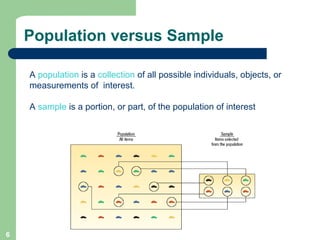
Apopulation is a collection of all possible individuals, objects, or
measurements of interest.
A sample is a portion, or part, of the population of interest
7.
7
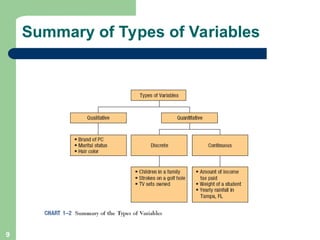
Types of Variables
A.Qualitative or Attribute variable - the
characteristic being studied is nonnumeric.
EXAMPLES: Gender, religious affiliation, type of automobile
owned, state of birth, eye color are examples.
B. Quantitative variable - information is reported
numerically.
EXAMPLES: balance in your checking account, minutes
remaining in class, or number of children in a family.
8.
8
Quantitative Variables -Classifications
Quantitative variables can be classified as either discrete
or continuous.
A. Discrete variables: can only assume certain values
and there are usually “gaps” between values.
EXAMPLE: the number of bedrooms in a house, or the number of hammers sold at the local
Home Depot (1,2,3,…,etc).
B. Continuous variable can assume any value within a
specified range.
EXAMPLE: The pressure in a tire, the weight of a pork chop, or the height of students in a
class.
10
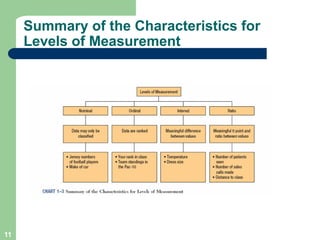
Four Levels ofMeasurement
Nominal level - data that is
classified into categories and
cannot be arranged in any
particular order.
EXAMPLES: eye color, gender,
religious affiliation.
Ordinal level – involves data
arranged in some order, but the
differences between data
values cannot be determined or
are meaningless.
EXAMPLE: During a taste test of
4 soft drinks, Mellow Yellow
was ranked number 1, Sprite
number 2, Seven-up number
3, and Orange Crush number
4.
Interval level - similar to the ordinal
level, with the additional
property that meaningful
amounts of differences between
data values can be determined.
There is no natural zero point.
EXAMPLE: Temperature on the
Fahrenheit scale.
Ratio level - the interval level with
an inherent zero starting point.
Differences and ratios are
meaningful for this level of
measurement.
EXAMPLES: Monthly income
of surgeons, or distance
traveled by manufacturer’s
representatives per month.