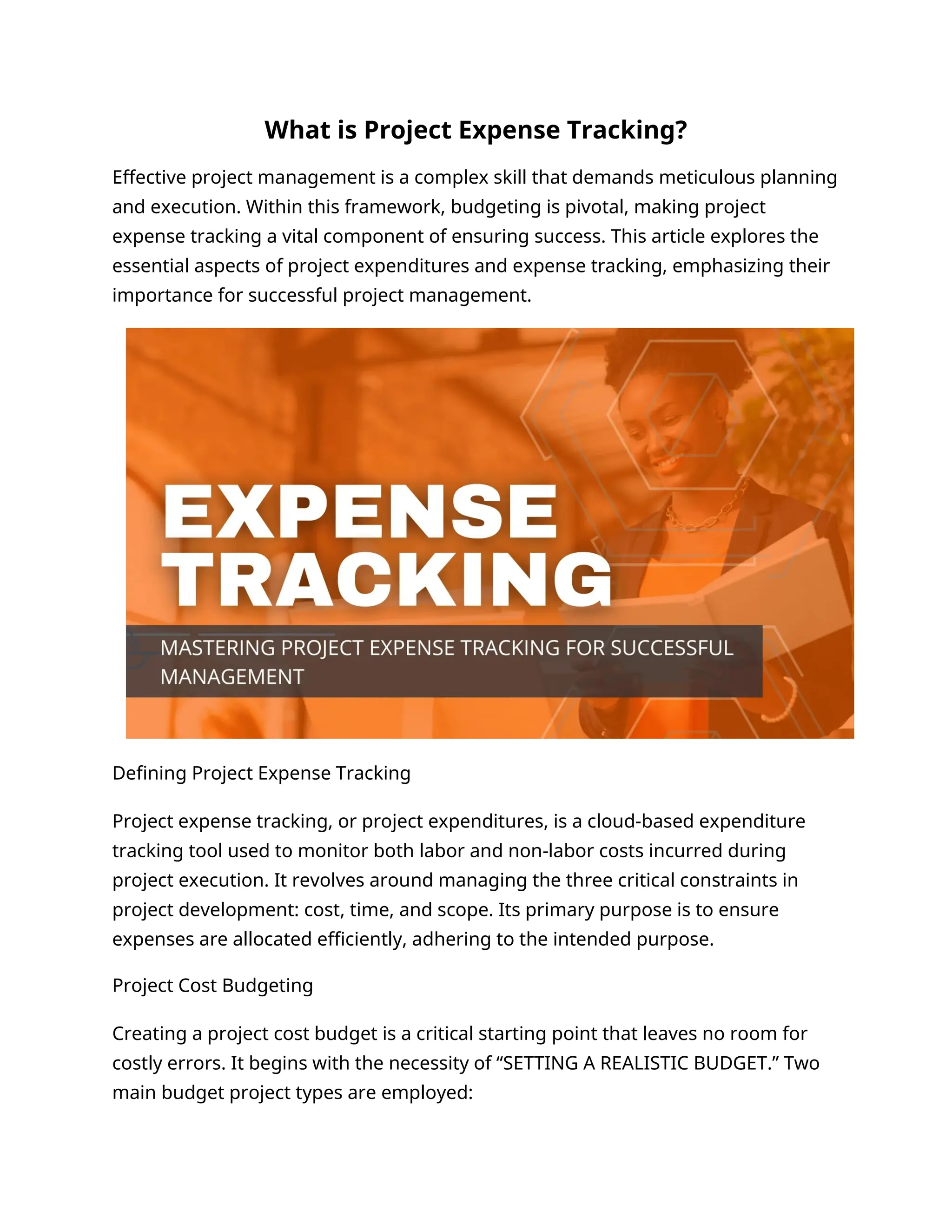
What is Project Expense Tracking?
Effective project management is a complex skill that demands meticulous planning
and execution. Within this framework, budgeting is pivotal, making project
expense tracking a vital component of ensuring success. This article explores the
essential aspects of project expenditures and expense tracking, emphasizing their
importance for successful project management.
Defining Project Expense Tracking
Project expense tracking, or project expenditures, is a cloud-based expenditure
tracking tool used to monitor both labor and non-labor costs incurred during
project execution. It revolves around managing the three critical constraints in
project development: cost, time, and scope. Its primary purpose is to ensure
expenses are allocated efficiently, adhering to the intended purpose.
Project Cost Budgeting
Creating a project cost budget is a critical starting point that leaves no room for
costly errors. It begins with the necessity of “SETTING A REALISTIC BUDGET.” Two
main budget project types are employed:
1. Time and Materials-Based Budgeting: This budget type relies on estimates
of time and materials used, with clients approving expenses based on these
factors. It offers flexibility for adjustments as the project evolves.
2. Fixed Price Budgets: A fixed price budget entails a set cost regardless of
project efforts. This type maintains a fixed scope, with the budget remaining
constant.
Types of Project Cost Estimation
Accurate cost estimation is paramount in project management. Estimation
methods vary depending on the project type:
1. Expert’s Judgement: Expert professionals provide cost estimates based on
experience and knowledge.
2. Quality Cost: This approach estimates costs associated with ensuring high
project quality and managing potential failures, minimizing financial losses.
3. Using Project Valuation Software: Software tools rely on project-specific
data to estimate and report expenses. Spreadsheets can be used to verify
and compare outcomes.
4. Vendor Bid Analysis: Commonly used in public project tenders, this method
involves comparing bids from various vendors to select the best-suited
option.
5. Reserve Analysis: Estimating costs associated with potential project risks
and the necessary resources to secure and manage these risks.
6. Bottom-up Estimation: Based on previously defined work packages, this
approach compares past work packages to the current project to estimate
costs accurately.
7. Three-point Estimation: This involves analyzing the average, optimistic,
and pessimistic estimations.
8. Parametric Estimation: Utilizes statistical modeling based on historical
data and various variables’ relationships.
9. Analogous Estimation: This relies on data from similar projects completed
in the past.
Essential Components of Project Expense Tracking
Project expense tracking encompasses crucial components:
1. Resource Planning: Planning resources is vital before project initiation,
addressing how to achieve project goals, the necessary activities, and
required resources.
2. Cost Estimations: Estimating the costs of materials and resources essential
for project completion.
3. Budgeting: Cost estimations lead to budget development. Realistic budget
setting is critical.
4. Cost Control: The final component analyzes and tracks project expenses
throughout its lifecycle.
Importance of Project Expense Tracking
Project tracking is often underestimated, but it provides several key benefits:
1. Savings in Time and Money: Efficient expense tracking leads to cost
savings and timely project completion.
2. Enhanced Communication: It improves internal communication, ensuring
everyone is on the same page regarding project finances.
3. Iterative Project Success: Continuous tracking allows for adjustments and
iterations, increasing the likelihood of project success.
4. Informed Decision Making: Project expense data enables better decision-
making.
5. Improved Project Planning: It supports project planning by providing real-
time expense information.
Project Expense Tracking Process
The project expense tracking process begins during project initiation. Key steps
include:
1. Estimate Costs: Forecasting project costs, including labor and material
expenses.
2. Allocating Costs: Managers create phase-specific budgets using cost
estimations.
3. Establishing Controls: Implement measures that hold team members
accountable for their expenses.
4. Cost Tracking: Continuously monitor project expenses, including human
resources and material costs. Project expense tracking software can help
with this.
5. Updating Forecasts: As the project progresses, monitor actual expenses
against the plan and update forecasts as necessary.
Project expense tracking is instrumental in ensuring projects stay within their
budgets, reflecting the estimated time, costs, and resource utilization. Proper
budget management is essential for achieving successful project outcomes.
Coexsys is here to help if you require professional assistance – contact us today!

What is Project Expense Tracking? .docx

  • 1.
    What is ProjectExpense Tracking? Effective project management is a complex skill that demands meticulous planning and execution. Within this framework, budgeting is pivotal, making project expense tracking a vital component of ensuring success. This article explores the essential aspects of project expenditures and expense tracking, emphasizing their importance for successful project management. Defining Project Expense Tracking Project expense tracking, or project expenditures, is a cloud-based expenditure tracking tool used to monitor both labor and non-labor costs incurred during project execution. It revolves around managing the three critical constraints in project development: cost, time, and scope. Its primary purpose is to ensure expenses are allocated efficiently, adhering to the intended purpose. Project Cost Budgeting Creating a project cost budget is a critical starting point that leaves no room for costly errors. It begins with the necessity of “SETTING A REALISTIC BUDGET.” Two main budget project types are employed:
  • 2.
    1. Time andMaterials-Based Budgeting: This budget type relies on estimates of time and materials used, with clients approving expenses based on these factors. It offers flexibility for adjustments as the project evolves. 2. Fixed Price Budgets: A fixed price budget entails a set cost regardless of project efforts. This type maintains a fixed scope, with the budget remaining constant. Types of Project Cost Estimation Accurate cost estimation is paramount in project management. Estimation methods vary depending on the project type: 1. Expert’s Judgement: Expert professionals provide cost estimates based on experience and knowledge. 2. Quality Cost: This approach estimates costs associated with ensuring high project quality and managing potential failures, minimizing financial losses. 3. Using Project Valuation Software: Software tools rely on project-specific data to estimate and report expenses. Spreadsheets can be used to verify and compare outcomes. 4. Vendor Bid Analysis: Commonly used in public project tenders, this method involves comparing bids from various vendors to select the best-suited option. 5. Reserve Analysis: Estimating costs associated with potential project risks and the necessary resources to secure and manage these risks. 6. Bottom-up Estimation: Based on previously defined work packages, this approach compares past work packages to the current project to estimate costs accurately. 7. Three-point Estimation: This involves analyzing the average, optimistic, and pessimistic estimations. 8. Parametric Estimation: Utilizes statistical modeling based on historical data and various variables’ relationships. 9. Analogous Estimation: This relies on data from similar projects completed in the past.
  • 3.
    Essential Components ofProject Expense Tracking Project expense tracking encompasses crucial components: 1. Resource Planning: Planning resources is vital before project initiation, addressing how to achieve project goals, the necessary activities, and required resources. 2. Cost Estimations: Estimating the costs of materials and resources essential for project completion. 3. Budgeting: Cost estimations lead to budget development. Realistic budget setting is critical. 4. Cost Control: The final component analyzes and tracks project expenses throughout its lifecycle. Importance of Project Expense Tracking Project tracking is often underestimated, but it provides several key benefits: 1. Savings in Time and Money: Efficient expense tracking leads to cost savings and timely project completion. 2. Enhanced Communication: It improves internal communication, ensuring everyone is on the same page regarding project finances. 3. Iterative Project Success: Continuous tracking allows for adjustments and iterations, increasing the likelihood of project success. 4. Informed Decision Making: Project expense data enables better decision- making. 5. Improved Project Planning: It supports project planning by providing real- time expense information. Project Expense Tracking Process The project expense tracking process begins during project initiation. Key steps include: 1. Estimate Costs: Forecasting project costs, including labor and material expenses. 2. Allocating Costs: Managers create phase-specific budgets using cost estimations.
  • 4.
    3. Establishing Controls:Implement measures that hold team members accountable for their expenses. 4. Cost Tracking: Continuously monitor project expenses, including human resources and material costs. Project expense tracking software can help with this. 5. Updating Forecasts: As the project progresses, monitor actual expenses against the plan and update forecasts as necessary. Project expense tracking is instrumental in ensuring projects stay within their budgets, reflecting the estimated time, costs, and resource utilization. Proper budget management is essential for achieving successful project outcomes. Coexsys is here to help if you require professional assistance – contact us today!