PART I: LANGUAGE
CHAPTER 1: WHAT IS
LANGUAGE?
1
What is language?
•According to Longman Dictionary of
Contemporary English, fifth edition
(2009), language is defined as the
following:
A system of communication by written or
spoken words, which is used by the
people of a particular country or area.
What is language? (2)
•Pinker’s The Language Instinct (1994) defines:
Language is a complex, specialized skill,
which develops in the child spontaneously,
without conscious effort or formal
instruction, is deployed without awareness of
its underlying logic, is qualitatively the same
in every individual, and is distinct from more
general abilities to process information or
behave intelligently. (p.18)
What is language? (3)
•A synthesis of standard definitions
defines:
Language is a system of arbitrary
conventionalized vocal, written, or
gestural symbols that enable members of
a given community to communicate
intelligibly with one another.
What is language? (4)
•A consolidation of a number of possible
definitions of language yields the
following composite definition.
•Language is systematic.
•Language is a set of arbitrary symbols.
(social agreement; signifier/linguistic form
and signified/concept)
•Those symbols are primarily vocal, but may
also be visual.(communicating idea)
•The symbols have conventionalized
meanings to which they refer.
What is language? (5)
•Language is used for communication.
•Language operates in a speech
community or culture.
•Language is essentially human, although
possibly not limited to humans.
•Language is acquired by all people in
much the same way; language and
language learning both have universal
characteristics.
What does it mean to know a
language?
•When you know a language, you can
speak and be understood by others
who know that language.
•This means you have the capacity to
produce sounds that signify certain
meanings and to understand or
interpret the sounds produced by
others.
What does it mean to know a
language? (2)
•Therefore, part of knowing a language
means knowing what sounds (or signs) are
in that language and what sounds are not.
E.g. ménage à trois
this /ðis/, that /ðæt/
•It also means knowing which sounds may
start a word, end a word, and follow each
other.
E.g. Nkrumah (Nekrumah or Enkrumah)
What does it mean to know a
language? (3)
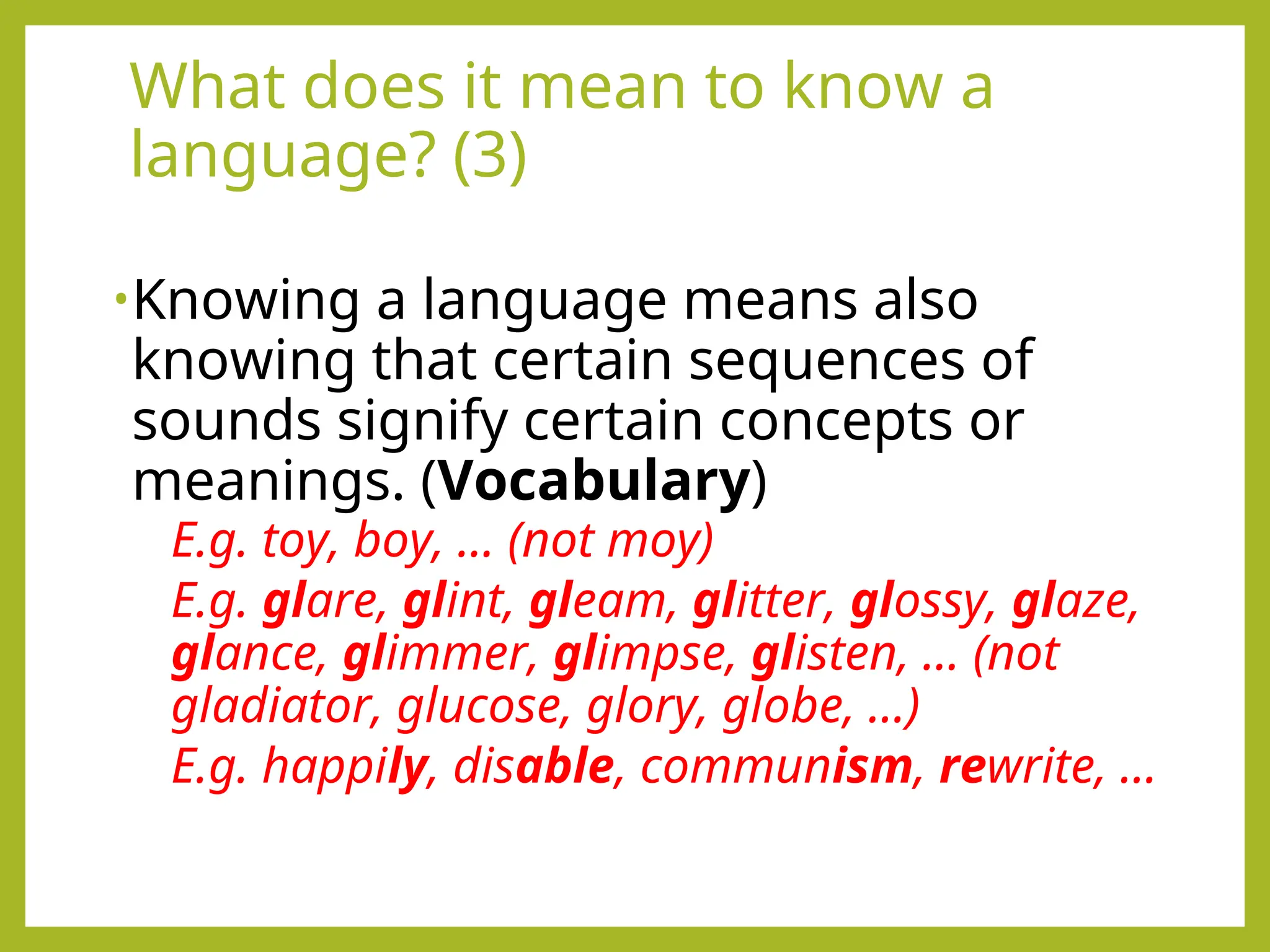
•Knowing a language means also
knowing that certain sequences of
sounds signify certain concepts or
meanings. (Vocabulary)
E.g. toy, boy, … (not moy)
E.g. glare, glint, gleam, glitter, glossy, glaze,
glance, glimmer, glimpse, glisten, … (not
gladiator, glucose, glory, globe, …)
E.g. happily, disable, communism, rewrite, …
What does it mean to know a
language? (4)
•Knowing a language also means being
able to produce new sentences never
spoken before and to understand
sentences never heard before.
•You cannot buy a dictionary or phrase
book of any language with all the
sentences of the language, because the
number of sentences in a language is
infinite.
What does it mean to know a
language? (5)
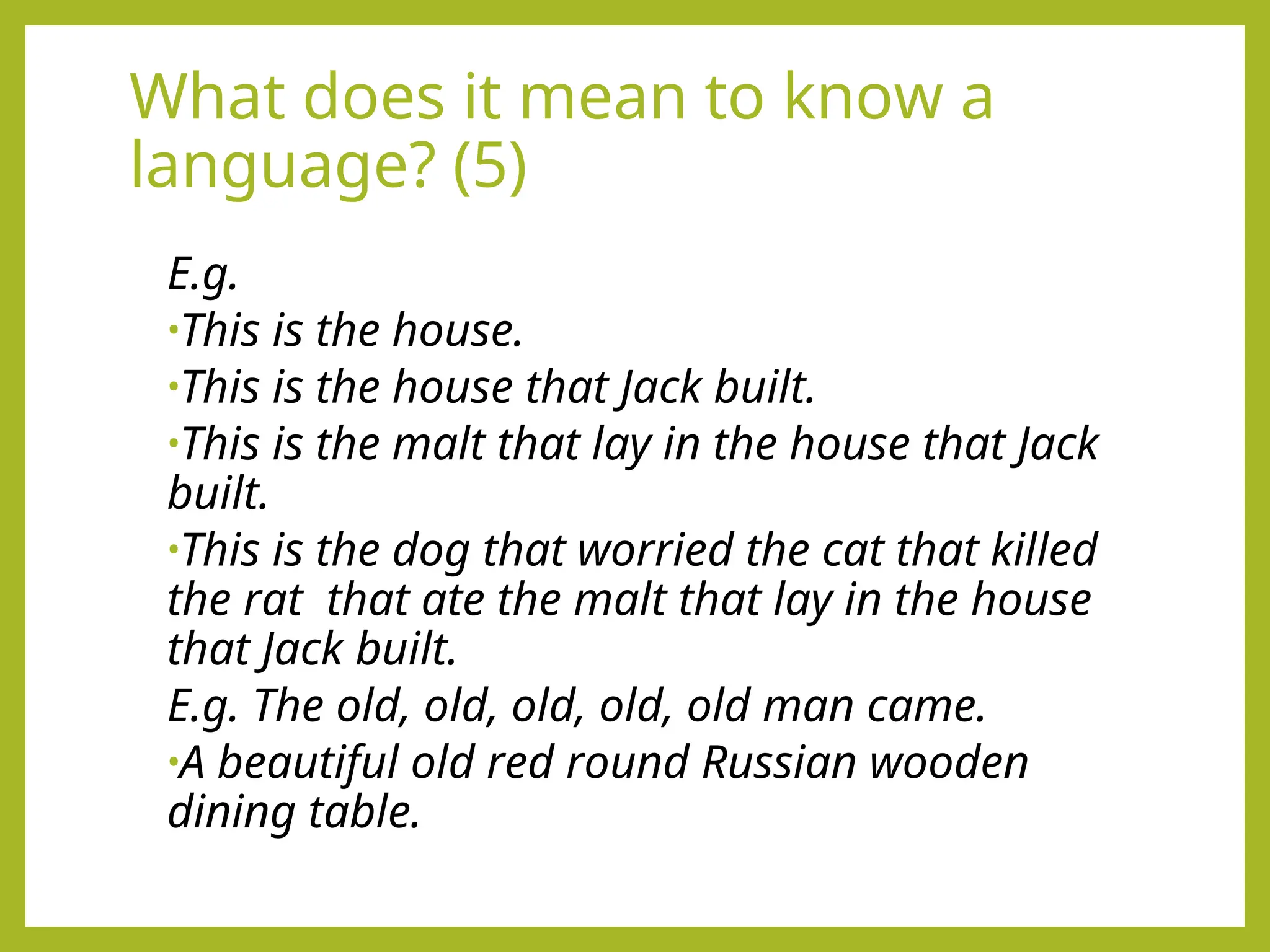
E.g.
•This is the house.
•This is the house that Jack built.
•This is the malt that lay in the house that Jack
built.
•This is the dog that worried the cat that killed
the rat that ate the malt that lay in the house
that Jack built.
E.g. The old, old, old, old, old man came.
•A beautiful old red round Russian wooden
dining table.
What does it mean to know a
language? (6)
•In addition to knowing the words of
the language, linguistic knowledge
includes rules for forming sentences
and making the kinds of judgments
about those sentences. (The
Grammar)
What does it mean to know a
language? (7)
E.g. (a) John kissed the little old lady who owned the
shaggy dog.
(b) Who owned the shaggy dog John kissed the little
old lady.
(c) John is difficult to love.
(d) It is difficult to love John.
(e) John is anxious to go.
(f) It is anxious to go John.
(g) John, who was a student, flunked his exams.
(h) Exams his flunked student a was who John.
Aspects of Language
 Difficult to define, simply because it is
not an object (which has representation)
 It has many different aspects:
 As a social fact
 As a psychological state
 As a set of structure
 As a collection of outputs
14
Different Views of Language
•As a social fact
•Existing in each individual’s heads, but not
complete in any individual
•A virtual collection of individuals to make up the
language in the community
•Read p. 1
•As a mental reality
•Assumed to exist in the heads of people speaking it
based on the fact that people have the ability to
learn language(s) in general & practice in dealing
with a language 15
•Grammar is a mental entity, represented
in the mind/brain of an individual and
characterizing that individual’s
linguistic capacity.
•Grammatical system allows speakers to
produce appropriate utterance.
16
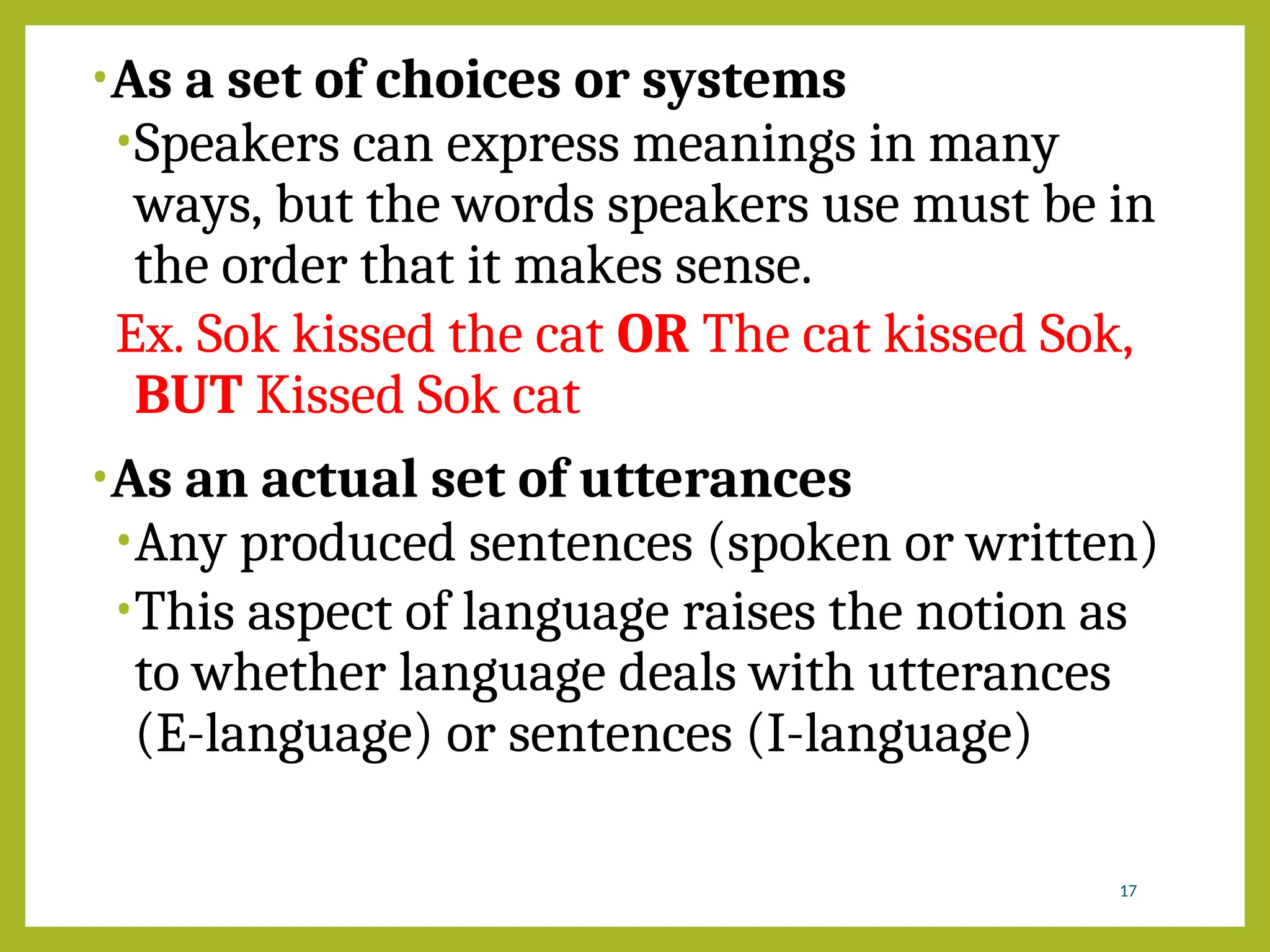
•As a set of choices or systems
•Speakers can express meanings in many
ways, but the words speakers use must be in
the order that it makes sense.
Ex. Sok kissed the cat OR The cat kissed Sok,
BUT Kissed Sok cat
•As an actual set of utterances
•Any produced sentences (spoken or written)
•This aspect of language raises the notion as
to whether language deals with utterances
(E-language) or sentences (I-language)
17
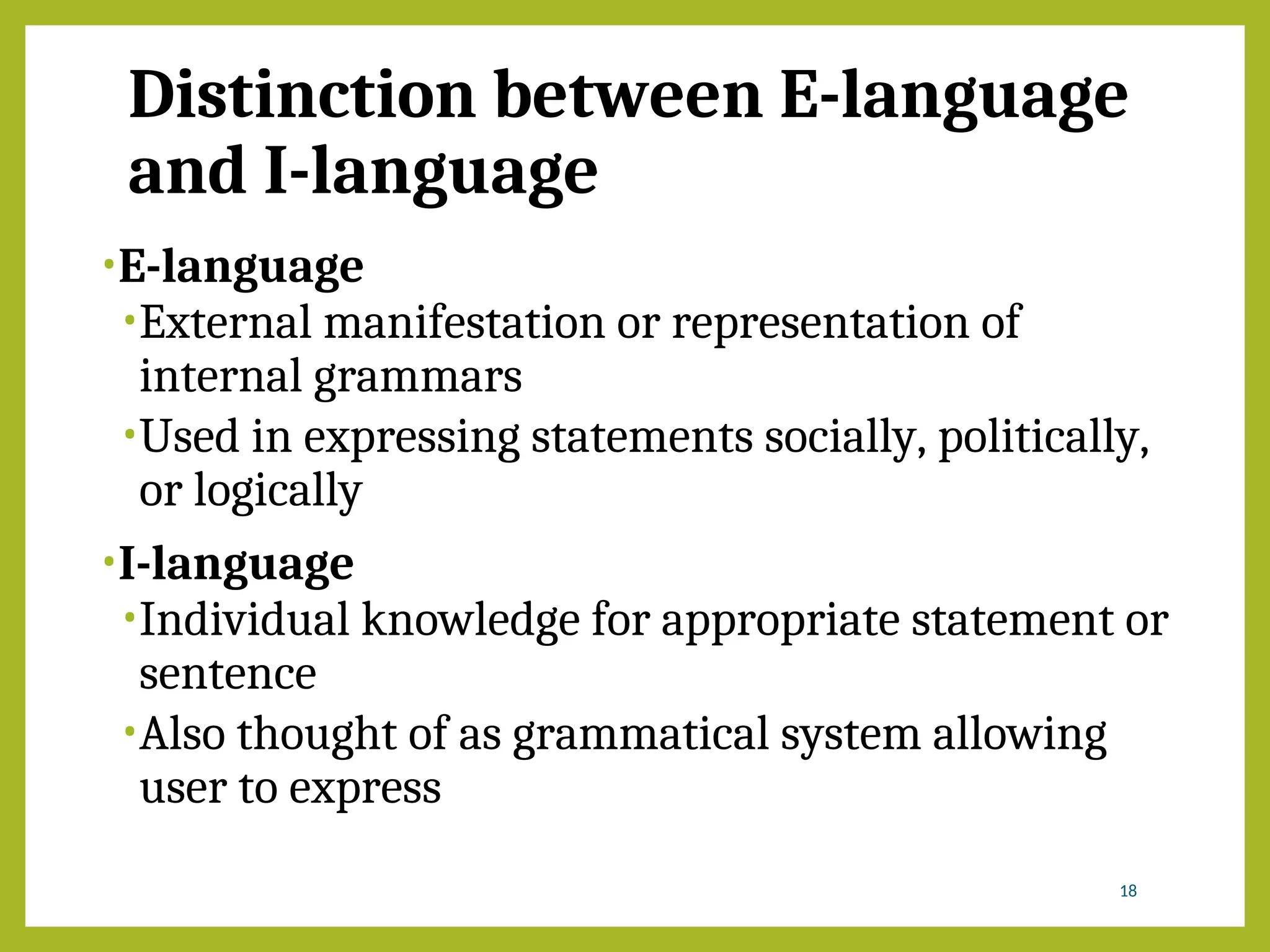
Distinction between E-language
and I-language
•E-language
•External manifestation or representation of
internal grammars
•Used in expressing statements socially, politically,
or logically
•I-language
•Individual knowledge for appropriate statement or
sentence
•Also thought of as grammatical system allowing
user to express
18
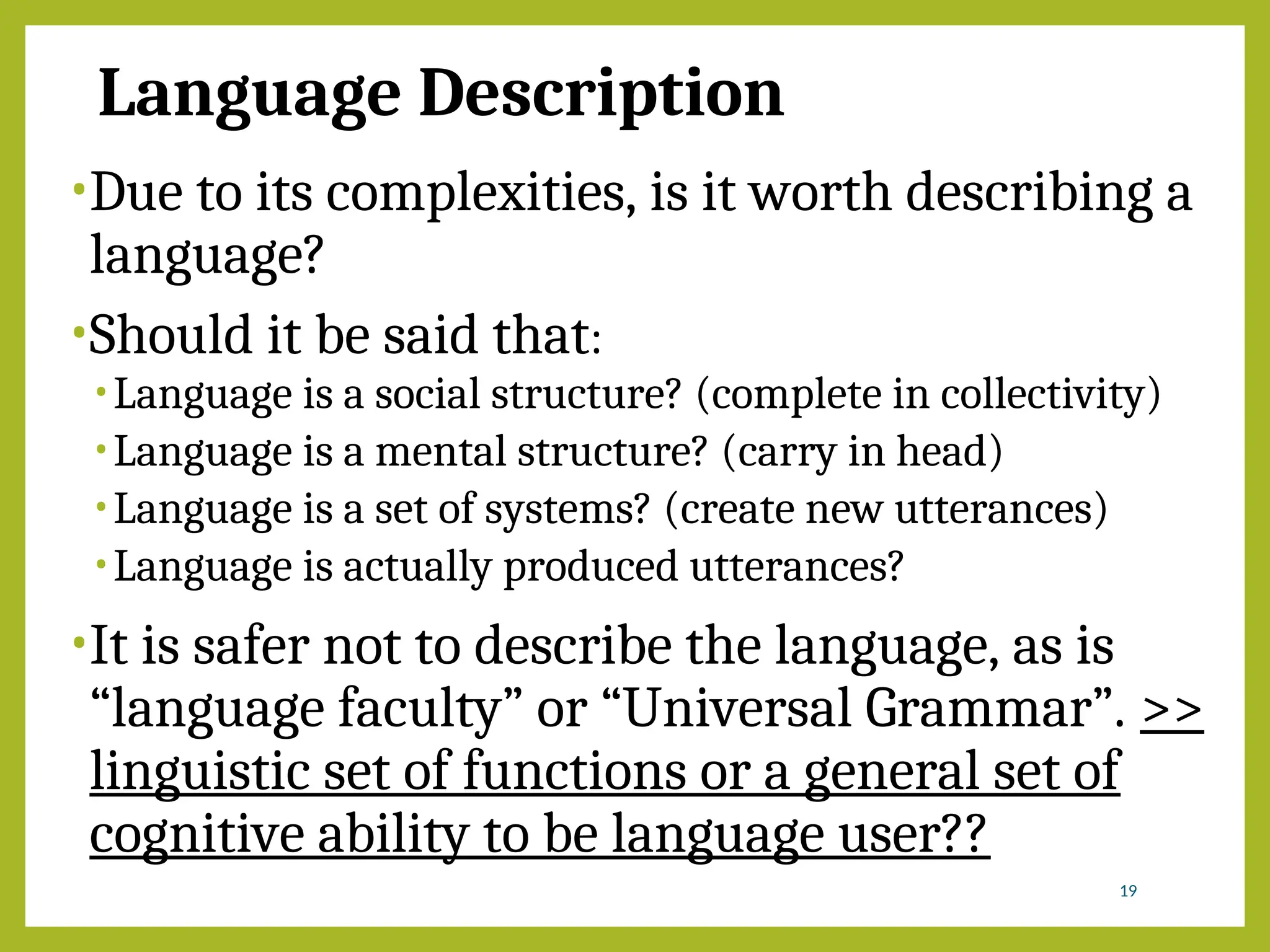
Language Description
•Due to its complexities, is it worth describing a
language?
•Should it be said that:
•Language is a social structure? (complete in collectivity)
•Language is a mental structure? (carry in head)
•Language is a set of systems? (create new utterances)
•Language is actually produced utterances?
•It is safer not to describe the language, as is
“language faculty” or “Universal Grammar”. >>
linguistic set of functions or a general set of
cognitive ability to be language user??
19
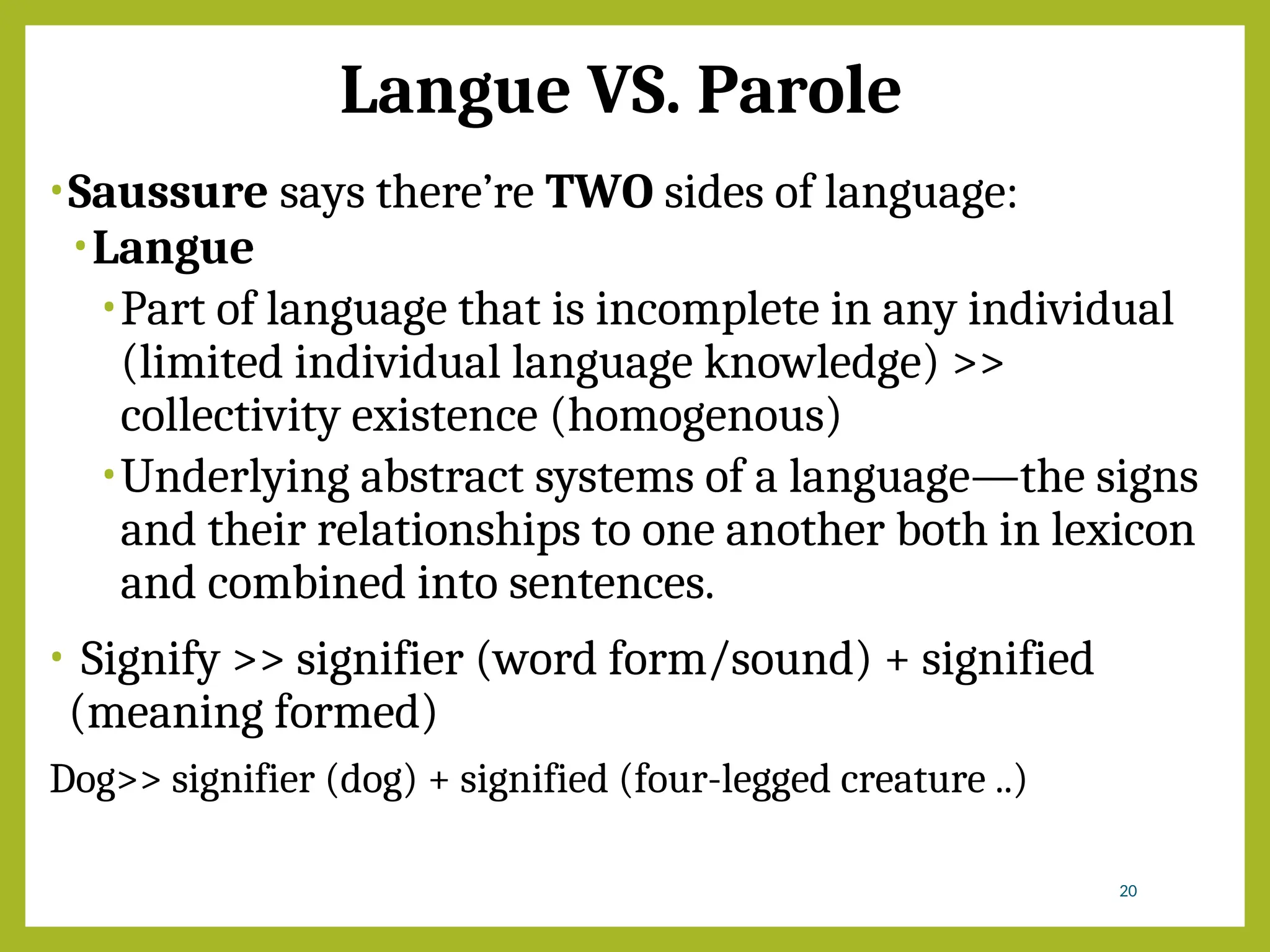
Langue VS. Parole
•Saussure says there’re TWO sides of language:
•Langue
•Part of language that is incomplete in any individual
(limited individual language knowledge) >>
collectivity existence (homogenous)
•Underlying abstract systems of a language―the signs
and their relationships to one another both in lexicon
and combined into sentences.
• Signify >> signifier (word form/sound) + signified
(meaning formed)
Dog>> signifier (dog) + signified (four-legged creature ..)
20
•Parole
•Observable in the behavior of the
individual (not homogenous) (written
and spoken language actually used)>>
actual utterance or concrete use of
language /actual speech that speakers
produce
21
•The distinction between langue and parole has suffered
TWO major changes later on.
•First, a third level has been added—NORM
NORM.
•E.g. The same idea can be expressed in many ways.
Our langue allows us to do so. And when we actually
produce, it can be in many utterances. However,
according to the NORM, we are supposed to say
certain things in certain circumstances.
•Second, there has been similar distinction before—that
of COMPETENCE & PERFORMANCE, the confusing
side of which is individual perception of the word
“langue” and “competence” by Saussure and Chomsky
respectively.
22
 For Saussure, langue is a system of sign
sign
 For Chomsky, competence is a generative
generative
system
system OR mental construct individual
 For Saussure, linguistics deals with langue—
involving studying the language of the
community
 For Chomsky, linguistics deals with I-language
(the third distinction between I-language and
E-language) that takes over competence and
performance—involving the studying the
language potential of the individual
23
COMPETENCE Vs. PERFORMANCE
 Competence
 Users’ actual knowledge of the language
 Performance
 Users’ ability to use the language in spoken and
written contexts
 However, this distinction also elicits some criticism.
 Does users’ performance really represent users’
actual competence?
 Difficult to tell whether a particular phenomenon is
a performance or a competence.
24

What is language-language learning and acquisition

  • 1.
    PART I: LANGUAGE CHAPTER1: WHAT IS LANGUAGE? 1
  • 2.
    What is language? •Accordingto Longman Dictionary of Contemporary English, fifth edition (2009), language is defined as the following: A system of communication by written or spoken words, which is used by the people of a particular country or area.
  • 3.
    What is language?(2) •Pinker’s The Language Instinct (1994) defines: Language is a complex, specialized skill, which develops in the child spontaneously, without conscious effort or formal instruction, is deployed without awareness of its underlying logic, is qualitatively the same in every individual, and is distinct from more general abilities to process information or behave intelligently. (p.18)
  • 4.
    What is language?(3) •A synthesis of standard definitions defines: Language is a system of arbitrary conventionalized vocal, written, or gestural symbols that enable members of a given community to communicate intelligibly with one another.
  • 5.
    What is language?(4) •A consolidation of a number of possible definitions of language yields the following composite definition. •Language is systematic. •Language is a set of arbitrary symbols. (social agreement; signifier/linguistic form and signified/concept) •Those symbols are primarily vocal, but may also be visual.(communicating idea) •The symbols have conventionalized meanings to which they refer.
  • 6.
    What is language?(5) •Language is used for communication. •Language operates in a speech community or culture. •Language is essentially human, although possibly not limited to humans. •Language is acquired by all people in much the same way; language and language learning both have universal characteristics.
  • 7.
    What does itmean to know a language? •When you know a language, you can speak and be understood by others who know that language. •This means you have the capacity to produce sounds that signify certain meanings and to understand or interpret the sounds produced by others.
  • 8.
    What does itmean to know a language? (2) •Therefore, part of knowing a language means knowing what sounds (or signs) are in that language and what sounds are not. E.g. ménage à trois this /ðis/, that /ðæt/ •It also means knowing which sounds may start a word, end a word, and follow each other. E.g. Nkrumah (Nekrumah or Enkrumah)
  • 9.
    What does itmean to know a language? (3) •Knowing a language means also knowing that certain sequences of sounds signify certain concepts or meanings. (Vocabulary) E.g. toy, boy, … (not moy) E.g. glare, glint, gleam, glitter, glossy, glaze, glance, glimmer, glimpse, glisten, … (not gladiator, glucose, glory, globe, …) E.g. happily, disable, communism, rewrite, …
  • 10.
    What does itmean to know a language? (4) •Knowing a language also means being able to produce new sentences never spoken before and to understand sentences never heard before. •You cannot buy a dictionary or phrase book of any language with all the sentences of the language, because the number of sentences in a language is infinite.
  • 11.
    What does itmean to know a language? (5) E.g. •This is the house. •This is the house that Jack built. •This is the malt that lay in the house that Jack built. •This is the dog that worried the cat that killed the rat that ate the malt that lay in the house that Jack built. E.g. The old, old, old, old, old man came. •A beautiful old red round Russian wooden dining table.
  • 12.
    What does itmean to know a language? (6) •In addition to knowing the words of the language, linguistic knowledge includes rules for forming sentences and making the kinds of judgments about those sentences. (The Grammar)
  • 13.
    What does itmean to know a language? (7) E.g. (a) John kissed the little old lady who owned the shaggy dog. (b) Who owned the shaggy dog John kissed the little old lady. (c) John is difficult to love. (d) It is difficult to love John. (e) John is anxious to go. (f) It is anxious to go John. (g) John, who was a student, flunked his exams. (h) Exams his flunked student a was who John.
  • 14.
    Aspects of Language Difficult to define, simply because it is not an object (which has representation)  It has many different aspects:  As a social fact  As a psychological state  As a set of structure  As a collection of outputs 14
  • 15.
    Different Views ofLanguage •As a social fact •Existing in each individual’s heads, but not complete in any individual •A virtual collection of individuals to make up the language in the community •Read p. 1 •As a mental reality •Assumed to exist in the heads of people speaking it based on the fact that people have the ability to learn language(s) in general & practice in dealing with a language 15
  • 16.
    •Grammar is amental entity, represented in the mind/brain of an individual and characterizing that individual’s linguistic capacity. •Grammatical system allows speakers to produce appropriate utterance. 16
  • 17.
    •As a setof choices or systems •Speakers can express meanings in many ways, but the words speakers use must be in the order that it makes sense. Ex. Sok kissed the cat OR The cat kissed Sok, BUT Kissed Sok cat •As an actual set of utterances •Any produced sentences (spoken or written) •This aspect of language raises the notion as to whether language deals with utterances (E-language) or sentences (I-language) 17
  • 18.
    Distinction between E-language andI-language •E-language •External manifestation or representation of internal grammars •Used in expressing statements socially, politically, or logically •I-language •Individual knowledge for appropriate statement or sentence •Also thought of as grammatical system allowing user to express 18
  • 19.
    Language Description •Due toits complexities, is it worth describing a language? •Should it be said that: •Language is a social structure? (complete in collectivity) •Language is a mental structure? (carry in head) •Language is a set of systems? (create new utterances) •Language is actually produced utterances? •It is safer not to describe the language, as is “language faculty” or “Universal Grammar”. >> linguistic set of functions or a general set of cognitive ability to be language user?? 19
  • 20.
    Langue VS. Parole •Saussuresays there’re TWO sides of language: •Langue •Part of language that is incomplete in any individual (limited individual language knowledge) >> collectivity existence (homogenous) •Underlying abstract systems of a language―the signs and their relationships to one another both in lexicon and combined into sentences. • Signify >> signifier (word form/sound) + signified (meaning formed) Dog>> signifier (dog) + signified (four-legged creature ..) 20
  • 21.
    •Parole •Observable in thebehavior of the individual (not homogenous) (written and spoken language actually used)>> actual utterance or concrete use of language /actual speech that speakers produce 21
  • 22.
    •The distinction betweenlangue and parole has suffered TWO major changes later on. •First, a third level has been added—NORM NORM. •E.g. The same idea can be expressed in many ways. Our langue allows us to do so. And when we actually produce, it can be in many utterances. However, according to the NORM, we are supposed to say certain things in certain circumstances. •Second, there has been similar distinction before—that of COMPETENCE & PERFORMANCE, the confusing side of which is individual perception of the word “langue” and “competence” by Saussure and Chomsky respectively. 22
  • 23.
     For Saussure,langue is a system of sign sign  For Chomsky, competence is a generative generative system system OR mental construct individual  For Saussure, linguistics deals with langue— involving studying the language of the community  For Chomsky, linguistics deals with I-language (the third distinction between I-language and E-language) that takes over competence and performance—involving the studying the language potential of the individual 23
  • 24.
    COMPETENCE Vs. PERFORMANCE Competence  Users’ actual knowledge of the language  Performance  Users’ ability to use the language in spoken and written contexts  However, this distinction also elicits some criticism.  Does users’ performance really represent users’ actual competence?  Difficult to tell whether a particular phenomenon is a performance or a competence. 24