HOW CRYPTOCURRENCY
WORKS: A BEGINNER’S
GUIDE
Understanding the basics of digital
currencies.
INTRODUCTION
Cryptocurrency has revolutionized the
financial world, but how does it work?
This guide simplifies the complexities for
beginners.
Statistic: "Over 420 million people
worldwide now own cryptocurrency.
(Source: TripleA)
WHAT IS
CRYPTOCURRENCY?
Cryptocurrency is a digital or virtual currency
that uses cryptography for security. Unlike
traditional money, it’s decentralized.
Examples: Bitcoin, Ethereum, Litecoin.
Key Features:
Peer-to-peer transactions.
No central authority like a bank.
Transactions recorded on a blockchain.
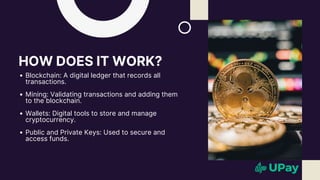
HOW DOES IT WORK?
Blockchain: A digital ledger that records all
transactions.
Mining: Validating transactions and adding them
to the blockchain.
Wallets: Digital tools to store and manage
cryptocurrency.
Public and Private Keys: Used to secure and
access funds.
WHAT IS BLOCKCHAIN?
A blockchain is a decentralized and immutable ledger
of all transactions across a network.
Benefits:
Transparent.
Secure.
Tamper-proof.
Example: Bitcoin’s blockchain has recorded over
800 million transactions.
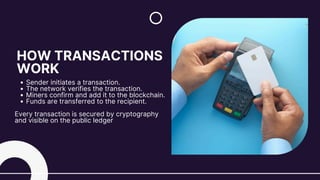
HOW TRANSACTIONS
WORK
Sender initiates a transaction.
The network verifies the transaction.
Miners confirm and add it to the blockchain.
Funds are transferred to the recipient.
Every transaction is secured by cryptography
and visible on the public ledger
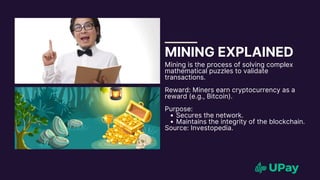
MINING EXPLAINED
Mining is the process of solving complex
mathematical puzzles to validate
transactions.
Reward: Miners earn cryptocurrency as a
reward (e.g., Bitcoin).
Purpose:
Secures the network.
Maintains the integrity of the blockchain.
Source: Investopedia.
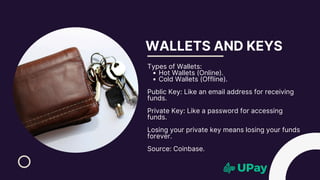
WALLETS AND KEYS
Types of Wallets:
Hot Wallets (Online).
Cold Wallets (Offline).
Public Key: Like an email address for receiving
funds.
Private Key: Like a password for accessing
funds.
Losing your private key means losing your funds
forever.
Source: Coinbase.
POPULAR
CRYPTOCURRENCIES
Bitcoin (BTC): The first and most well-known
cryptocurrency.
Ethereum (ETH): Powers smart contracts and
dApps.
Litecoin (LTC): Known for faster
transactions.
Stablecoins: Pegged to traditional assets like
USD (e.g., USDT).
Source: CoinMarketCap.
ADVANTAGES OF
CRYPTOCURRENCY
Decentralized and global.
Fast and low-cost transactions.
Transparent and secure.
Financial inclusion for the unbanked.
Example: El Salvador using Bitcoin as legal tender.
CHALLENGES AND
RISKS
Volatility: Prices can change rapidly.
Regulatory Uncertainty: Rules vary by country.
Security Risks: Hacks and phishing attacks.
Environmental Concerns: Energy usage in mining.
Source: Reuters.
HOW TO START
USING
CRYPTOCURRENCY
Research and choose a reliable exchange.
Set up a secure wallet.
Start with small investments.
Stay updated on market trends.
Always invest what you can afford to lose.
How Cryptocurrency Works - A Beginner’s Guide.pdf

How Cryptocurrency Works - A Beginner’s Guide.pdf

  • 1.
    HOW CRYPTOCURRENCY WORKS: ABEGINNER’S GUIDE Understanding the basics of digital currencies.
  • 2.
    INTRODUCTION Cryptocurrency has revolutionizedthe financial world, but how does it work? This guide simplifies the complexities for beginners. Statistic: "Over 420 million people worldwide now own cryptocurrency. (Source: TripleA)
  • 3.
    WHAT IS CRYPTOCURRENCY? Cryptocurrency isa digital or virtual currency that uses cryptography for security. Unlike traditional money, it’s decentralized. Examples: Bitcoin, Ethereum, Litecoin. Key Features: Peer-to-peer transactions. No central authority like a bank. Transactions recorded on a blockchain.
  • 5.
    HOW DOES ITWORK? Blockchain: A digital ledger that records all transactions. Mining: Validating transactions and adding them to the blockchain. Wallets: Digital tools to store and manage cryptocurrency. Public and Private Keys: Used to secure and access funds.
  • 6.
    WHAT IS BLOCKCHAIN? Ablockchain is a decentralized and immutable ledger of all transactions across a network. Benefits: Transparent. Secure. Tamper-proof. Example: Bitcoin’s blockchain has recorded over 800 million transactions.
  • 7.
    HOW TRANSACTIONS WORK Sender initiatesa transaction. The network verifies the transaction. Miners confirm and add it to the blockchain. Funds are transferred to the recipient. Every transaction is secured by cryptography and visible on the public ledger
  • 8.
    MINING EXPLAINED Mining isthe process of solving complex mathematical puzzles to validate transactions. Reward: Miners earn cryptocurrency as a reward (e.g., Bitcoin). Purpose: Secures the network. Maintains the integrity of the blockchain. Source: Investopedia.
  • 10.
    WALLETS AND KEYS Typesof Wallets: Hot Wallets (Online). Cold Wallets (Offline). Public Key: Like an email address for receiving funds. Private Key: Like a password for accessing funds. Losing your private key means losing your funds forever. Source: Coinbase.
  • 11.
    POPULAR CRYPTOCURRENCIES Bitcoin (BTC): Thefirst and most well-known cryptocurrency. Ethereum (ETH): Powers smart contracts and dApps. Litecoin (LTC): Known for faster transactions. Stablecoins: Pegged to traditional assets like USD (e.g., USDT). Source: CoinMarketCap.
  • 12.
    ADVANTAGES OF CRYPTOCURRENCY Decentralized andglobal. Fast and low-cost transactions. Transparent and secure. Financial inclusion for the unbanked. Example: El Salvador using Bitcoin as legal tender.
  • 13.
    CHALLENGES AND RISKS Volatility: Pricescan change rapidly. Regulatory Uncertainty: Rules vary by country. Security Risks: Hacks and phishing attacks. Environmental Concerns: Energy usage in mining. Source: Reuters.
  • 14.
    HOW TO START USING CRYPTOCURRENCY Researchand choose a reliable exchange. Set up a secure wallet. Start with small investments. Stay updated on market trends. Always invest what you can afford to lose.