Conversion Rate Optimization (CRO) -
A Beginner's Guide
2. Importance of CRO
3. Identifying Conversion Goals
4. Analyzing User Behavior
5. Optimizing Website Design
6. Testing and Experimentation
7. Improving Page Load Speed
8. Personalizing User Experience
9. Building Trust and Credibility
10. Continuous Optimization
1. Understanding Conversion Rate
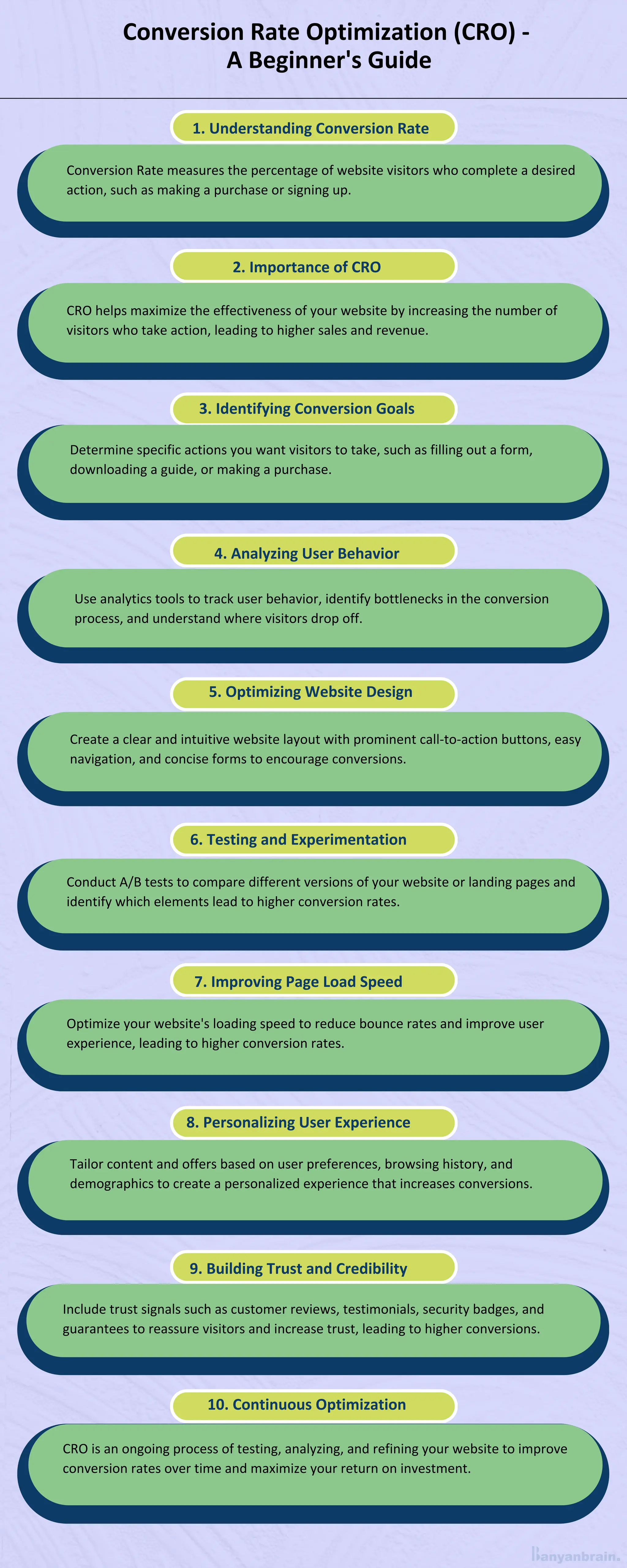
Conversion Rate measures the percentage of website visitors who complete a desired
action, such as making a purchase or signing up.
CRO helps maximize the effectiveness of your website by increasing the number of
visitors who take action, leading to higher sales and revenue.
Determine specific actions you want visitors to take, such as filling out a form,
downloading a guide, or making a purchase.
Use analytics tools to track user behavior, identify bottlenecks in the conversion
process, and understand where visitors drop off.
Create a clear and intuitive website layout with prominent call-to-action buttons, easy
navigation, and concise forms to encourage conversions.
Conduct A/B tests to compare different versions of your website or landing pages and
identify which elements lead to higher conversion rates.
Optimize your website's loading speed to reduce bounce rates and improve user
experience, leading to higher conversion rates.
Tailor content and offers based on user preferences, browsing history, and
demographics to create a personalized experience that increases conversions.
Include trust signals such as customer reviews, testimonials, security badges, and
guarantees to reassure visitors and increase trust, leading to higher conversions.
CRO is an ongoing process of testing, analyzing, and refining your website to improve
conversion rates over time and maximize your return on investment.

What is Conversion Rate Optimizaion | Banyanbrain

  • 1.
    Conversion Rate Optimization(CRO) - A Beginner's Guide 2. Importance of CRO 3. Identifying Conversion Goals 4. Analyzing User Behavior 5. Optimizing Website Design 6. Testing and Experimentation 7. Improving Page Load Speed 8. Personalizing User Experience 9. Building Trust and Credibility 10. Continuous Optimization 1. Understanding Conversion Rate Conversion Rate measures the percentage of website visitors who complete a desired action, such as making a purchase or signing up. CRO helps maximize the effectiveness of your website by increasing the number of visitors who take action, leading to higher sales and revenue. Determine specific actions you want visitors to take, such as filling out a form, downloading a guide, or making a purchase. Use analytics tools to track user behavior, identify bottlenecks in the conversion process, and understand where visitors drop off. Create a clear and intuitive website layout with prominent call-to-action buttons, easy navigation, and concise forms to encourage conversions. Conduct A/B tests to compare different versions of your website or landing pages and identify which elements lead to higher conversion rates. Optimize your website's loading speed to reduce bounce rates and improve user experience, leading to higher conversion rates. Tailor content and offers based on user preferences, browsing history, and demographics to create a personalized experience that increases conversions. Include trust signals such as customer reviews, testimonials, security badges, and guarantees to reassure visitors and increase trust, leading to higher conversions. CRO is an ongoing process of testing, analyzing, and refining your website to improve conversion rates over time and maximize your return on investment.