What does
MSHA do and
it's history!
Mining has long been considered one of the world’s most
dangerous jobs. From explosions and cave-ins to methane gas
and carbon monoxide, every time a miner descends below the
Earth’s surface, they face a range of hazardous working
conditions, conditions that have, unfortunately, taken thousands
upon thousands of lives. the highest paying positions in oil and
gas – is heating up, fast.
Introduction
In order to improve safety within the industry, the federal
government established the Bureau of Mines in 1910, whose
original goal was to conduct research to improve mine safety. But
over the decades, the Bureau’s responsibilities expanded vastly,
pushing Congress to create a new enforcement agency, the Mining
Enforcement and Safety Administration (MESA), in 1973.
MESA enforced all safety and health regulations associated with
U.S. mines, while the Bureau of Mines focused on mineral resource
development.
History
Despite MESA and Bureau of Mines working together to create
safer mines and industry-specific regulations, there were still an
average of 356 mine fatalities per year between 1967 and 1976. So
Congress reorganized everything again, and in 1977, the Mine Act
was passed, and with it, the enforcement agency moved over to
the Department of Labor and the Mine Safety and Health
Administration (MSHA) was formed.
History - MSHA formed
The signing of the Mine Act affected every aspect of mine safety
and health, providing changes to “how the law is administered and
who is covered, the establishment of new avenues of appeal for
mine operators who are covered, the establishment of new
avenues of appeal for mine operators who contest citations for
violations, and increased involvement by miners or their
representatives in processes affecting their safety and health,”
according to the Department of Labor.
MSHA’s role in saving lives
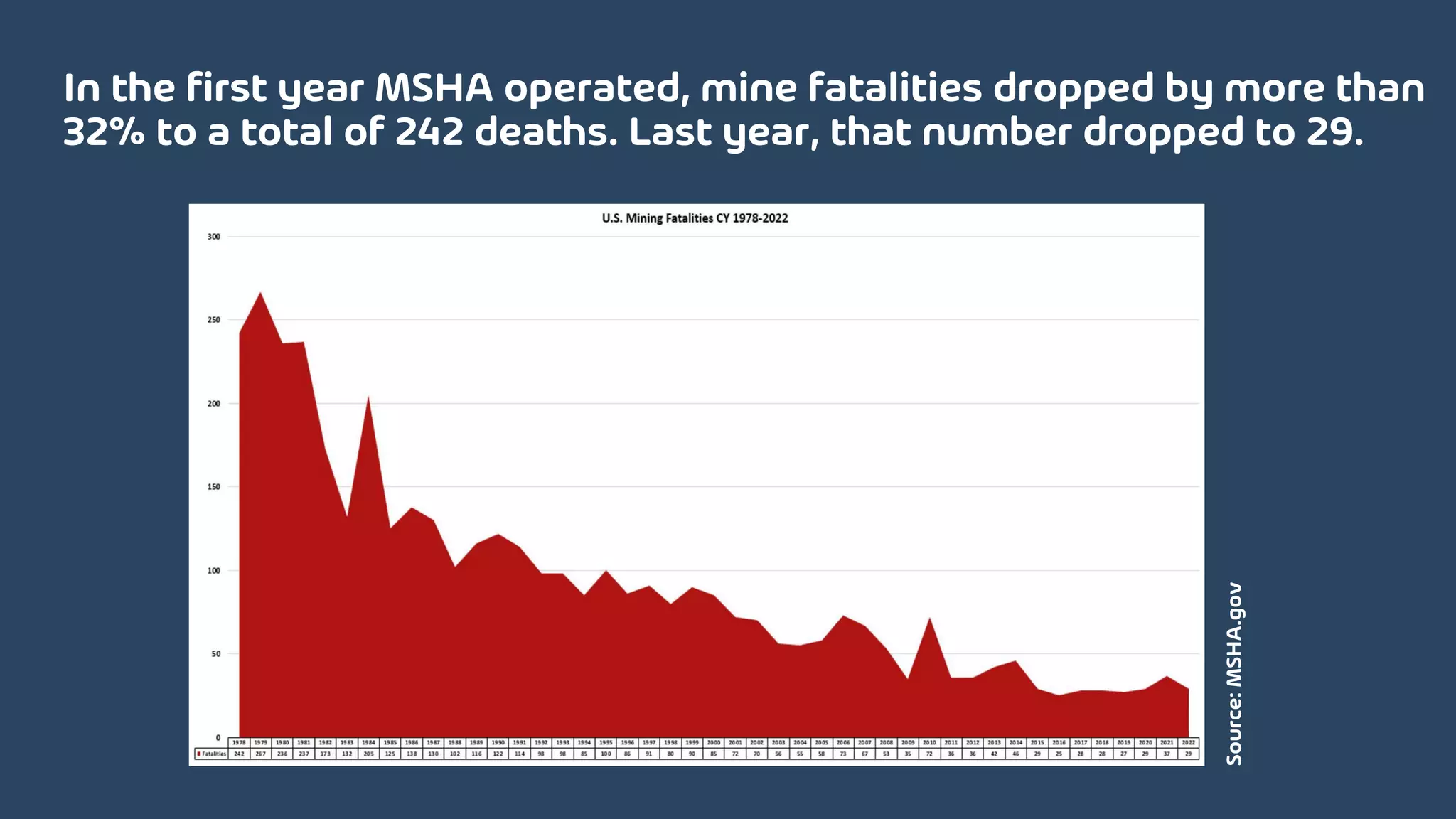
In the first year MSHA operated, mine fatalities dropped by more than
32% to a total of 242 deaths. Last year, that number dropped to 29.
Source:
MSHA.gov
Office of the Assistant Secretary for Mine Safety and Health
Coal Mine Safety and Health
Metal and Nonmetal Mine Safety and Health
Program Evaluation and Information Resources
Administration and Management
Technical Support
Educational Policy and Development
Standards, Regulations and Variances
Assessments, Accountability, Special Enforcement and Investigations
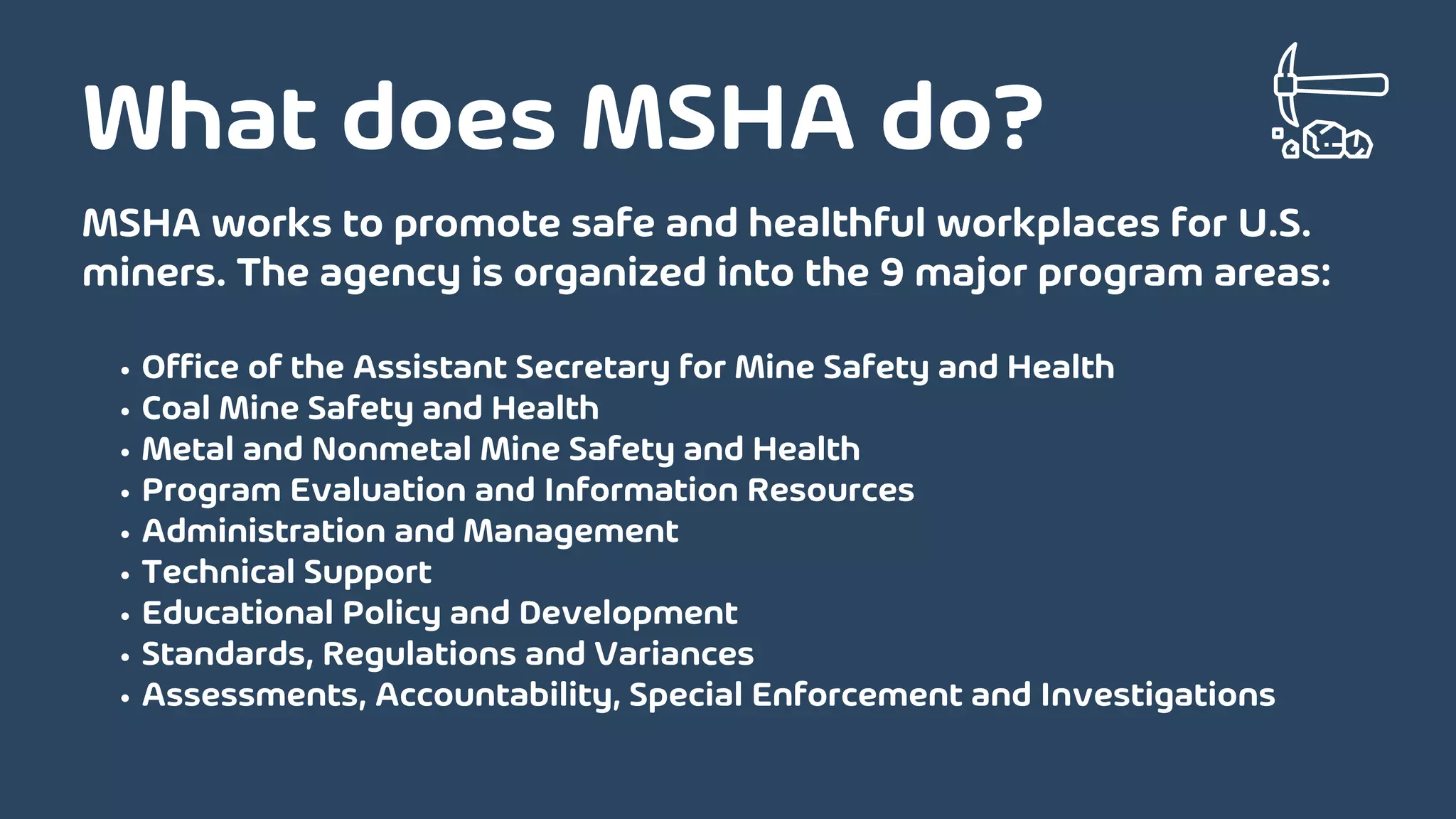
MSHA works to promote safe and healthful workplaces for U.S.
miners. The agency is organized into the 9 major program areas:
What does MSHA do?
Through MSHA, federal laws now require all miners receive basic
and annual refresher training, which are governed by sections of
the federal code – 30 CFR Part 48 and Part 46.
Part 48 covers all underground mining and surface mining of coal
and some metals, like gold, while Part 46 covers the aggregate
industry, including granite, sand, gravel, lime and cement
operations.
MSHA Training - Part 48
vs Part 46
What courses accredited
courses are available?
Virtual MSHA Part 46 New Miner Training Course
Virtual MSHA Part 46 Annual Refresher Training Course
Virtual MSHA Part 48 (A) New Miner Training Course
Virtual MSHA Part 48 (A) Annual Refresher Training Course
Virtual MSHA Part 48 (B) New Miner Training Course
Virtual MSHA Part 48 (B) Annual Refresher Training Course
You can find a number of classes including:
easybooktraining.com

What does MSHA do and it's history!.pdf

  • 1.
    What does MSHA doand it's history!
  • 2.
    Mining has longbeen considered one of the world’s most dangerous jobs. From explosions and cave-ins to methane gas and carbon monoxide, every time a miner descends below the Earth’s surface, they face a range of hazardous working conditions, conditions that have, unfortunately, taken thousands upon thousands of lives. the highest paying positions in oil and gas – is heating up, fast. Introduction
  • 3.
    In order toimprove safety within the industry, the federal government established the Bureau of Mines in 1910, whose original goal was to conduct research to improve mine safety. But over the decades, the Bureau’s responsibilities expanded vastly, pushing Congress to create a new enforcement agency, the Mining Enforcement and Safety Administration (MESA), in 1973. MESA enforced all safety and health regulations associated with U.S. mines, while the Bureau of Mines focused on mineral resource development. History
  • 4.
    Despite MESA andBureau of Mines working together to create safer mines and industry-specific regulations, there were still an average of 356 mine fatalities per year between 1967 and 1976. So Congress reorganized everything again, and in 1977, the Mine Act was passed, and with it, the enforcement agency moved over to the Department of Labor and the Mine Safety and Health Administration (MSHA) was formed. History - MSHA formed
  • 5.
    The signing ofthe Mine Act affected every aspect of mine safety and health, providing changes to “how the law is administered and who is covered, the establishment of new avenues of appeal for mine operators who are covered, the establishment of new avenues of appeal for mine operators who contest citations for violations, and increased involvement by miners or their representatives in processes affecting their safety and health,” according to the Department of Labor. MSHA’s role in saving lives
  • 6.
    In the firstyear MSHA operated, mine fatalities dropped by more than 32% to a total of 242 deaths. Last year, that number dropped to 29. Source: MSHA.gov
  • 7.
    Office of theAssistant Secretary for Mine Safety and Health Coal Mine Safety and Health Metal and Nonmetal Mine Safety and Health Program Evaluation and Information Resources Administration and Management Technical Support Educational Policy and Development Standards, Regulations and Variances Assessments, Accountability, Special Enforcement and Investigations MSHA works to promote safe and healthful workplaces for U.S. miners. The agency is organized into the 9 major program areas: What does MSHA do?
  • 8.
    Through MSHA, federallaws now require all miners receive basic and annual refresher training, which are governed by sections of the federal code – 30 CFR Part 48 and Part 46. Part 48 covers all underground mining and surface mining of coal and some metals, like gold, while Part 46 covers the aggregate industry, including granite, sand, gravel, lime and cement operations. MSHA Training - Part 48 vs Part 46
  • 9.
    What courses accredited coursesare available? Virtual MSHA Part 46 New Miner Training Course Virtual MSHA Part 46 Annual Refresher Training Course Virtual MSHA Part 48 (A) New Miner Training Course Virtual MSHA Part 48 (A) Annual Refresher Training Course Virtual MSHA Part 48 (B) New Miner Training Course Virtual MSHA Part 48 (B) Annual Refresher Training Course You can find a number of classes including:
  • 10.