What Are We Shooting At?
Jacob Johnson, Jordan Lawrence, Samantha Pitkin,
Nicholas Schuth, and Zoe Seznec Sweetland
The College at Brockport Communications Department
What Are We Shooting At? 2
Table of Contents
Executive Summary............................................................................................................................1
Introduction .......................................................................................................................................3
Framework.........................................................................................................................................6
Ownership..............................................................................................................................7
Advertising .......................................................................................................................... 10
Sourcing .............................................................................................................................. 12
Flak ..................................................................................................................................... 14
Conclusions & Recommendations ..................................................................................................... 16
Works Cited..................................................................................................................................... 17
What Are We Shooting At? 17
Executive Summary
Gun control is one of the most highly
controversial and debated topics today. It
continues to be a prevalent issue with mass
shootings such as Sandy Hook Elementary
that continue to occur. The media coverage
of events like this spark confusion and
panic, however this coverage is biased. The
purpose of this analysis is to get through the
noise to have a relevant conversation about
the debate over gun control and how those
involved go about addressing the issue. And
then apply specifically the media coverage
of this debate to the propaganda model.
The propaganda model developed by
Herman and Chompsky analyzes each
aspect of propaganda through its five filters;
ownership, advertising, sourcing, flak and
god/devil terms. These filters highlight
different aspects upon which different forces
dominate the influx of media and messages
as well as to whom they are received by. As
this relates to gun control we will analyze
how the media’s coverage affect the public’s
opinion about the topic using these filters.
Ownership refers to the concept that the
message going through the propaganda
model originated from
someone/something/somewhere. The origin
has an effect on how the message is
portrayed. Relating this to our case,
ownership is concerned with the media;
specifically the big six. The Big Six consists
of; Comcast, the Walt Disney Corporation,
News Corp, Viacom, CBS, and Time
Warner. Together this conglomerate controls
90% of the media. Each has different
viewpoints that their companies incorporate
into their media. This is important because
the image that these companies wish to
portray will be how the public receives the
message.
“Advertising is a primary source of income.
To remain profitable, most media rely on
advertising dollars for the bulk of their
revenue. It is therefore against the interests
of the news media to produce content that
might antagonize advertisers” (Enoch). This
is problematic because what is profitable is
not always true and vice versa. Altering and
exaggerating the truth can shape the public's
view of reality or what they believe to be
real. When applied to the debate over gun
control, companies (on both sides of the
debate) such as the NRA or politicians
spend millions of dollars on ad campaigns
either pro or anti-gun control. These ad
campaigns are then sold to the media outlets
that portray the message to the public.
Sourcing refers to the source of the message
itself. Media companies cannot be
omniscient, they rely on alternate sources
for information about current events. This
effects the type of information the audiences
of the media companies receive even before
the media puts their own spin on it. The
source is essentially the first wave of bias,
that is why looking at the source and making
sure it is reliable is so crucial.
Dictionary.com defines Flak as “criticism;
hostile reaction; abuse,” however in relation
to the propaganda model it refers to how
these negative responses are altered to
receive the greatest response from the
public. Relating to gun control negative
responses are abundant on both sides of the
argument. Which ones are publicized are
often more edgy from larger forces such as
the NRA, Michael Bloomberg, etc.
All in all, gun control continues to be a
highly controversial and debated topic. This
is because there is no apparent solution that
can be obtained in the near future. Rather
What Are We Shooting At? 2
than working toward solving the issue the
media distorts information while the debate
continues. Questions arise such as who is to
blame? And the answer is that there is no
answer, and more importantly there is no
clear way to say one solution is the best
method to gun control. Moving forward
from this analysis it is important to
remember that you should always be
consciences of the bias’s involved with the
information that you receive. Filtering our
analysis through the propaganda model
merely sheds a new light on this topic,
however it can be applied throughout all of
the debate. Also, it is important to keep in
mind there are more than two possible
solutions for this debate. Complete
regulation of guns and the complete
disregard of gun control are the two polar
extremes. The middle ground somewhere in
between may very well be the answer.
Either way the highly toxic debate over gun
control in the U.S. continues without any
sign of slowing down.
What Are We Shooting At? 17
Intro:
December 14th 2012 was meant to be a day
just like any other at Sandy Hook
Elementary until around 9:30 when Adam
Lanza fired half a dozen rounds from a
semiautomatic rifle into the school's front
door. Thus, making a hole big enough for
him to step through and enter the school,
beginning his devastating operation. At the
echoing sound of gunfire teachers locked
their doors and tried their best to hide the
children. They all used different methods to
try to keep their kids calm from reading
them stories to whispering Christmas carols
to mask the sound of the screams and
gunshots. “One young survivor said the
gunshots sounded like pots and pans falling
to the floor” (Connecticut). After shooting
the principal and psychologist, Lanza
entered the classroom of substitute teacher
Lauren Rousseau where according to a law
enforcement officer, “there were 14 coats
hanging there and 14 bodies. He killed them
all” (Mahoney). Next he entered Victoria
Soto’s classroom who is believed to have
tried to hide her 6 and 7 year old students in
a classroom closet. She tried to lead Lanza
away from her classroom by telling him her
students were at the other end of the school
in the auditorium but 6 of Soto’s students
tried to flee and Lanza shot them down
along with Soto and another teacher in the
room. Later police found 7 of Sotos
remaining students still hiding in that closet
(Mahoney).
The gruesome violence only lasted about 10
minutes but in those 10 minutes it is
believed Lanza fired off at least three 30-
round magazines killing 26 people including
20 children, 4 teachers, the school principal
and school psychologist. Connecticut
medical examiner H. Wayne Carver said “I
did seven (autopsies) myself with three to 11
wounds a piece. Only two were shot at close
range. I believe everybody was hit (by
bullets) more than once” (Mahoney). Lanza
used his mother's assault rifle, thought to
have been a Bushmaster AR-15-style rifle, a
civilian version of the military's M-16 which
Carver noted “the bullets are designed in
such a fashion that the energy is deposited in
the tissue and so the bullet stays in. This is a
very devastating set of injuries”
(Connecticut).
The events at Sandy Hook consumed our
media outlets in the days following. Our TV
screens and newspaper pages were plastered
with images of those terrified 6 and 7 year
olds being guided to safety by anxious
teachers. Stories of survivors and witnesses
pulled at our heartstrings as we thought of
our own children and how we hoped they
would never face something like this. We
asked ourselves who could possibly commit
such a horrible crime and how could this
have been prevented. Within 5 hours of the
shooting, President Obama came out and
spoke to the public, while visibly emotional
and called for change saying, “As a country
we’ve been through this too many times. …
And we’re going to have to come together
and take meaningful action to prevent more
tragedies like this, regardless of the politics.
… And I will do everything in my power as
president to help.” (Obama). Then a few
days later at the interfaith vigil in honor of
the victims he gave another speech once
again reiterating his point saying, “In the
coming weeks, I will use whatever power
this office holds to engage my fellow
citizens… in an effort aimed at preventing
more tragedies like this” (Transcript:
President Obama).
Obama's remarks came just 5 hours after the
gunfire had ceased. A time in which this
horror was still fresh in our hearts yet the
details were perhaps still a bit unclear. Yet
Obama made it clear he already had plans on
What Are We Shooting At? 4
how to react to this shooting. In his remarks,
he made an indirect reference to increased
gun control as a necessary effort to “prevent
tragedies like this”. While Obama had faced
other mass shootings during his time as
president leading up to Sandy Hook, this
was the first time he made a forceful claim
towards changing gun laws. Up until this
point, there had seemed to be an unspoken
rule that no one should use a mass shooting
like this to talk about policy proposals to
stop them from happening (Cogan).
However, after Sandy Hook, that rule
seemed to be thrown out the window as
Obama and other advocates of gun control
came forward calling for change. With
Obama's statements, images of the events,
and other media discussion being displayed,
the public image on gun control shifted.
According to a Gallup poll, in 2012 (the
year in which Sandy Hook took place) 43%
of Americans favored stricter gun laws. In
2013 (the year directly after Sandy Hook)
that percent jumped to 58% (Swift).
This cycle of events has become all too
familiar in our society. Mass shootings like
the one at Sandy Hook get reported, they
consume our media, which leads to
conversations of gun control yet not much
ever actually gets accomplished. Then after
a certain amount of time, the media will stop
talking about the shooting and conversations
of gun control will die down until the next
mass shooting occurs and the cycle resets
itself. The phenomenon is known as the
“issue-attention cycle” in which a dramatic
event happens, bringing a policy issue to the
media and public's attention only for a brief
time before moving on to a different issue.
In the week following the tragedy,
December 15 through December 21, there
were 2,472 news stories mentioning gun
control in the nation's newspapers. The next
week, the number of stories mentioning gun
control fell by more than half, to 1,192.
(Hayes).
This cycle offers a skewed view of gun
violence and in turn gun control. These mass
shootings get talked about on almost every
media outlet and give the public the idea that
these events are something we need to stop
and the way to do that is to talk about gun
control. After mass shootings there will be
those who speak in favor of increased gun
control and those who speak in opposition to
gun control. But in the sense of urgency
following these shootings, often many
details get skewed and lead the public to
false conclusions. We tend to look at gun
control just as a way to end mass shootings
when in reality, mass shooting don’t even
account for most of the gun violence.
According to the most recent definition from
the FBI a mass murder is defined as one in
which four or more people are murdered
during the same incident without an
excessive time gap between the murders
(Johns). With this definition in mind,
according to the Bureau of Justice Statistics,
“From 2002 to 2011, the majority (95%) of
homicide incidents involved the killing of a
single victim. During the same period, about
4% of homicide incidents involved two
victims, 0.6% involved three victims, and
0.2% involved four or more victims”
(Smith). From this information we can see
that the homicides deemed “mass shootings”
only accounted for 0.2% of all homicides
from 2002 to 2011. That’s a very small
percentage once put into perspective. Yet, as
discussed earlier, these mass shootings
saturate so much of the gun control debate.
They saturate so much of the gun control
debate, because they saturate so much of our
media outlets. A Lexis search found that
amongst stories from 24 different
newspapers between December 10, 2012
and April 21, 2012 “gun control” appeared
What Are We Shooting At? 5
in 7,245 stories and “Newton” appeared in
6,175 stories. During the same time period, a
Pew Research study found that the term
“Gun control” was the leading term on cable
news being mentioned in 656 programs out
of 1,425 and “Newton” came in a close
second being mentioned in 605 out of the
1,425 programs. The term “Newton” was the
leading term for broadcast news being
mentioned in 259 out of 665 programs with
“gun control” being mentioned in 210 of the
665 (Gun Control).
Both those studies demonstrate how closely
related coverage of Newton and gun control
were in the months following the shooting.
When gun control is discussed in the wake
of shootings like the one in Newton, it’s
hard to get a complete picture of what the
issues at hand are and how we can solve
them. If the only time people tune into talks
about gun control is in the wake of mass
shootings then it’s important to understand
what message they are receiving and how
this affects their opinion. These messages
people receive are constructed by the media
thus constructing the general public's
opinion.
What Are We Shooting At? 6
Framework:
One framework that helps to explain this
effect is that of The Propaganda Model
developed by Edward Herman & Noam
Chomsky. The propaganda model describes
the way in which our media and messages
are controlled through dominant forces and
an inequality of wealth and power. These
forces often act so naturally that the
receivers of the news often don’t even
notice, and believe they interpret the news
objectively. However, before the news
reaches the general public, it flows through a
set of “filters” that interact with each other
in order to cleanse the message into a final
product that fits the dominant forces
interests. These filters can be summarized
under the titles: ownership, advertising,
sourcing, flak, and god/devil terms
(Herman).
Each filter reinforces the other. News is
never reported without going through a
series of these steps. This leaves little
interpretation and some sense of bias in the
message that is being reported. The message
“is manipulated, and how the social,
economic, political attitudes are fashioned in
the minds of people through
propaganda.”(All About) If we can
understand each of these filters though, we
can be one step closer to being able to
analyze news messages and form our own
opinion from them.
What Are We Shooting At? 7
Ownership:
The first filter, ownership is the concept that
the message going through the propaganda
model originated from
someone/something/somewhere. This origin
has a direct impact on how that message is
portrayed, who portrays this message, and
what medium/outlets are used to propagate
this message. In 1983, 90% of American
media was owned by 50 companies. As
early as 2011 this same 90% of the media
the American public receives every day is
now controlled by six “mega-corporations”
known as “the Big Six.” The Big Six
consists of; Comcast, the Walt Disney
Corporation, News Corp, Viacom, CBS, and
Time Warner (Lutz). The convergence of
media outlets in America may have
unintended negative consequences for the
American public not only because of the
role that the American press is supposed to
play in our Democratic society.
Before jumping into the statistics behind
these massive media corporations and our
ethical/moral arguments for or against them,
I believe it is vital to first determine what
the role of the media is in our society. C.
Edwin Baker wrote a book titled Media
Concentration and Democracy in which he
was summarized as saying:
“…news corporations, or the
communications industry in general, play a
special mediatory role in a democratic
society. Democracies require that their
citizens be able to voice opinions and make
informed decisions about their government.
Because the media influence the creation of
public opinion and how individuals cast
their vote, the media therefore provide a
crucial forum for such communicative
exchange.” (Shiner)
This is an extremely powerful responsibility
in a society such as ours, and when that
responsibility becomes entangled with
corporate greed and all the pitfalls that come
with a capitalistic business market, the
information that these companies distribute
to their consumers becomes much more
liable to be founded in personal/corporate
biases. It is the responsibility of these news
outlets to try and portray the most accurate
and free information as possible, and that is
absolutely something we need when it
comes to the debate of gun control in
America.
At the very heart of our country stands a
right we hold dearly a right like no other: the
right to vote. To vote on elected officials,
what we believe is moral/legal, what we
want to believe, and countless other “votes”
we participate every day on society. What
happens when we are not receiving the
correct information, or are simply having
certain information omitted completely
before we formulate our opinions? In the
past, 50 companies had a competing
marketplace of ideas that constituted all of
our media, free market competition was
allowed to regulate what was true and what
was false in order to allow citizens to make
an informed decision. But now, with only 6
companies that offer us our media: the
messages each company propagates do not
come with as much parity between them.
Anup Shah stated it best by saying:
“In some places major multinational
corporations own media stations and outlets.
Often, many media institutions survive on
advertising fees, which can lead to the media
outlet being influenced by various corporate
interests. Other times, the ownership
interests may affect what is and is not
covered. Stories can end up being biased or
omitted so as not to offend advertisers or
owners. The ability for citizens to make
informed decisions is crucial for a free and
functioning democracy but now becomes
threatened by such concentration in
ownership… The idea of corporate media
What Are We Shooting At? 8
itself may not be a bad thing, for it can
foster healthy competition and provide a
check against governments. However, the
concern is when there is a concentration of
ownership due to the risk of increased
economic and political influence that can
itself be unaccountable.” (Shah)
The problem lies in the last point that Shah
eludes too: that the concentration of
ownership in media is the most dangerous
aspect. With concentration of companies
comes a concentration of wealth, power,
access, and countless other factors of control
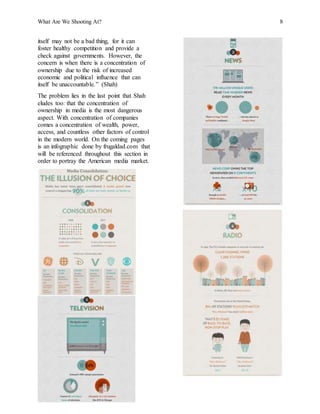
in the modern world. On the coming pages
is an infographic done by frugaldad.com that
will be referenced throughout this section in
order to portray the American media market.
What Are We Shooting At? 9
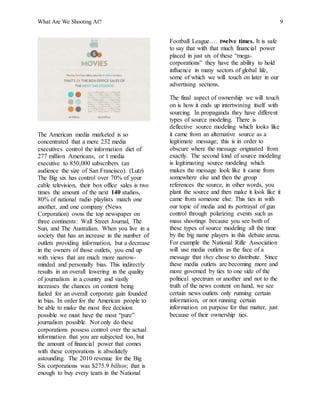
The American media marketed is so
concentrated that a mere 232 media
executives control the information diet of
277 million Americans, or 1 media
executive to 850,000 subscribers (an
audience the size of San Francisco). (Lutz)
The Big six has control over 70% of your
cable television, their box office sales is two
times the amount of the next 140 studios,
80% of national radio playlists match one
another, and one company (News
Corporation) owns the top newspaper on
three continents: Wall Street Journal, The
Sun, and The Australian. When you live in a
society that has an increase in the number of
outlets providing information, but a decrease
in the owners of those outlets, you end up
with views that are much more narrow-
minded and personally bias. This indirectly
results in an overall lowering in the quality
of journalism in a country and vastly
increases the chances on content being
fueled for an overall corporate gain founded
in bias. In order for the American people to
be able to make the most free decision
possible we must have the most “pure”
journalism possible. Not only do these
corporations possess control over the actual
information that you are subjected too, but
the amount of financial power that comes
with these corporations is absolutely
astounding. The 2010 revenue for the Big
Six corporations was $275.9 billion; that is
enough to buy every team in the National
Football League…. twelve times. It is safe
to say that with that much financial power
placed in just six of these “mega-
corporations” they have the ability to hold
influence in many sectors of global life,
some of which we will touch on later in our
advertising sections.
The final aspect of ownership we will touch
on is how it ends up intertwining itself with
sourcing. In propaganda they have different
types of source modeling. There is
deflective source modeling which looks like
it came from an alternative source as a
legitimate message; this is in order to
obscure where the message originated from
exactly. The second kind of source modeling
is legitimating source modeling which
makes the message look like it came from
somewhere else and then the group
references the source, in other words, you
plant the source and then make it look like it
came from someone else. This ties in with
our topic of media and its portrayal of gun
control through polarizing events such as
mass shootings because you see both of
these types of source modeling all the time
by the big name players in this debate arena.
For example the National Rifle Association
will use media outlets as the face of a
message that they chose to distribute. Since
these media outlets are becoming more and
more governed by ties to one side of the
political spectrum or another and not to the
truth of the news content on hand, we see
certain news outlets only running certain
information, or not running certain
information on purpose for that matter, just
because of their ownership ties.
What Are We Shooting At? 10
Advertising:
The next filter is titled advertising. The
NRA spent $28.2 million on ad campaigns
advocating for fewer gun restrictions in
2014 (King). This displays how they’re
involved in the advertising filter of the
propaganda model. If they sold these
advertisements to media outlets, then it
would be in those media outlets best
interests not to promote increased gun
control. These media outlets receive money
from the NRA for showing their
advertisements and this is money the media
outlets don’t want to lose. That is what the
advertising filter is all about. The idea that
these media outlets need ads to be purchased
to generate revenue so they need to keep
their advertisers happy.
Advertising for firearms in the United States
is a topic that is not brought up a lot when
discussing firearm safety, simply because it
is not seen a lot. Immediately following
World War II the nation was in recovery, the
economy was doing relatively well, and
citizens needed a sense of protection. One
way they could feel protected was buying a
house or building one, but even after there
were many who still feared what might
come to knock on their front door. The first
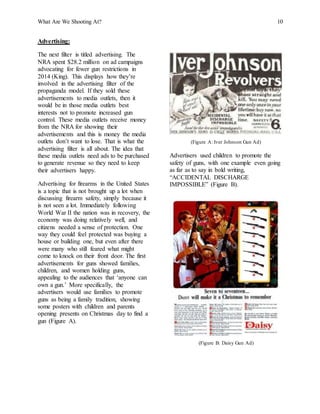
advertisements for guns showed families,
children, and women holding guns,
appealing to the audiences that ‘anyone can
own a gun.’ More specifically, the
advertisers would use families to promote
guns as being a family tradition, showing
some posters with children and parents
opening presents on Christmas day to find a
gun (Figure A).
(Figure A: Iver Johnson Gun Ad)
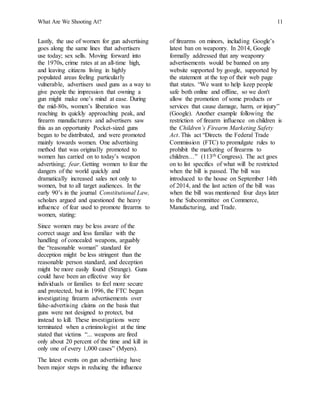
Advertisers used children to promote the
safety of guns, with one example even going
as far as to say in bold writing,
“ACCIDENTAL DISCHARGE
IMPOSSIBLE” (Figure B).
(Figure B: Daisy Gun Ad)
What Are We Shooting At? 11
Lastly, the use of women for gun advertising
goes along the same lines that advertisers
use today; sex sells. Moving forward into
the 1970s, crime rates at an all-time high,
and leaving citizens living in highly
populated areas feeling particularly
vulnerable, advertisers used guns as a way to
give people the impression that owning a
gun might make one’s mind at ease. During
the mid-80s, women’s liberation was
reaching its quickly approaching peak, and
firearm manufacturers and advertisers saw
this as an opportunity Pocket-sized guns
began to be distributed, and were promoted
mainly towards women. One advertising
method that was originally promoted to
women has carried on to today’s weapon
advertising; fear. Getting women to fear the
dangers of the world quickly and
dramatically increased sales not only to
women, but to all target audiences. In the
early 90’s in the journal Constitutional Law,
scholars argued and questioned the heavy
influence of fear used to promote firearms to
women, stating:
Since women may be less aware of the
correct usage and less familiar with the
handling of concealed weapons, arguably
the “reasonable woman” standard for
deception might be less stringent than the
reasonable person standard, and deception
might be more easily found (Strange). Guns
could have been an effective way for
individuals or families to feel more secure
and protected, but in 1996, the FTC began
investigating firearm advertisements over
false-advertising claims on the basis that
guns were not designed to protect, but
instead to kill. These investigations were
terminated when a criminologist at the time
stated that victims “... weapons are fired
only about 20 percent of the time and kill in
only one of every 1,000 cases” (Myers).
The latest events on gun advertising have
been major steps in reducing the influence
of firearms on minors, including Google’s
latest ban on weaponry. In 2014, Google
formally addressed that any weaponry
advertisements would be banned on any
website supported by google, supported by
the statement at the top of their web page
that states. “We want to help keep people
safe both online and offline, so we don't
allow the promotion of some products or
services that cause damage, harm, or injury”
(Google). Another example following the
restriction of firearm influence on children is
the Children’s Firearm Marketing Safety
Act. This act “Directs the Federal Trade
Commission (FTC) to promulgate rules to
prohibit the marketing of firearms to
children…” (113th Congress). The act goes
on to list specifics of what will be restricted
when the bill is passed. The bill was
introduced to the house on September 14th
of 2014, and the last action of the bill was
when the bill was mentioned four days later
to the Subcommittee on Commerce,
Manufacturing, and Trade.
What Are We Shooting At? 12
Sourcing:
Sourcing is a profound part of the
propaganda model. The source of the
message has say into who these people are
but also what they are saying. Specific news
companies cannot be everywhere all at once.
They rely on other sources for information.
This puts more filters on the applied
information (All About).
The big six are the main sources
surrounding this argument. These six
corporations control ninety percent of media
in America. These companies affect the
source of the media significantly. This
means that “two hundred and thirty two
media executives control the information
diet of two hundred million Americans”
(Rogers). Fox news, wall street journal and
the New York post are all under the News-
Corp umbrella. You can expect their
message to be similar and what they
contribute to the conversation to also be
similar (Rogers).
When something happens, especially
something tragic, the news at first has very
little fact about what is happening. This is
where sourcing is very important because
the people reporting on these stories tend to
put more commentary in and make
accusations to make it seem like there is
more information than there actually is. This
commentary is specifically what the
sourcing filter refers to because these
commentators’ ideas become the news.
Their opinions can deeply affect the
message and the people who are watching.
When a shooting happens, people become
afraid and become very vulnerable to faulty
information because the consumers of media
crave any information at all.
In the case of the Newtown shooting, Adam
Lanza’s name was dragged through the mud.
It is very easy for the news to ruin
someone’s reputation this way. The
gunman’s name, things about his mother and
even how he entered the building was
reported wrong. Dawn Hochsprung, the
principle of the elementary school was also
talked about in false stories. It is not
common for reporters to apologize for this
common misjudgment. News stations are in
such a rush to report the news that they
forget how it can affect people’s lives. The
best news stations are the ones that wait to
report statements that have been fact
checked (Morse).
Some of things that were reported wrong
were the type of weapon he used, that the
principle let him in, that his motive was a
previous altercation, a possible second
gunman, and his name was Ryan and much
more (Kaczynski). “Simply accepting that
there is no solution for reporting huge
chunks of a major story incorrectly in the
moment sounds like a forward-looking
acceptance of social media's impact," Eric
Deggans at the Tampa Bay Times said. He
also believes that by doing this it could
potentially ruin the news industry (Rogers).
“The problem is the nature of
TV news at this moment,”
Tucker wrote. “There is a
compulsion to stay on the
story for hours on end, with
each network looking at the
other, not wanting to become
the first to cut away. The
result is an endless repetition
of the few known facts,
surrounded by far too much
improvised speculation, and
the kind of sentimentality that
does not do justice to the
victims. … TV news would
have done much better to
pause, to resume its regular
programming after the initial
reports, to break in when
there was something
What Are We Shooting At? 13
important, such as the
president’s statement and
updates from Connecticut
law enforcement, and then do
what news organizations are
supposed to do — gather
facts; report out the story;
and assemble well-written,
clear-eyed reportage. Then
come back on the air with
fact-filled coverage” (Askar).
Robert Ebert made an important statement in
1999 on NBC News after the mass shooting
at Columbine High School. This is relatable
even to this day. ”Events like this, if they are
influenced by anything, are influenced by
news programs like your own,” (Askar). He
also talked about how “ordinary news” is
dropped when a school shooting happens. It
becomes the news for days on end. Once the
facts are gathered, later that week the
diagnosis of the shooter begins and then the
topics of guns arise once again. This is a
vicious cycle that continues to this day.
When talking about sourcing there is a
question that continues to be brought up.
“Does media coverage of school shooting
lead to more school shootings?” Are these
mass shooters copycats, or kids that want
fame or is it seriously troubled kids. School
shootings have become a common thing and
our society has become desensitized to
them. Four major tv stations and the Seattle
Pacific University are currently in a court
case about the release of the surveillance
video of the shooting at this university
which happened in June of 2014. The media
can be relentless and not particularly
sensitive about the situations. Media stations
are arguing it’s the public’s right to the
information (Herz).
Sourcing is a filter that can easily distort
information greatly for the general public. It
can also easily hurt someone's reputation
when certain commentary is involved.
Consumers are hungry for information so
the media begins to act in ruthless manors to
be able to feed consumers desires. This
cycle of media the message is never ending.
What Are We Shooting At? 14
Flak:
The next filter, flak, is all about how
negative responses are construed and used to
effect public opinion. Flak can come from a
variety of sources rather it be large scale or
smaller scaled individuals and groups. The
strongest sources of flak are the most costly
and threatening and those tend to come from
more powerful sources. The National Rifle
Association tends to be one of those
powerful sources of flak in the media. The
NRA often makes negative statements about
certain efforts towards increased gun
control.
One of the NRA’s statements, came as an
attack on the Obama administration. In the
wake of the events that took place at Sandy
Hook, president Obama put vice president
Joe Biden in charge of a task force on gun
violence. After a meeting held between that
task force and gun owner groups, the NRA
came out publicly saying,
“We were disappointed with how little this
meeting had to do with keeping our children
safe and how much it had to do with an
agenda to attack the second amendment.
While claiming that no policy proposals
would be 'prejudged,' this task force spent
most of its time on proposed restrictions on
lawful firearms owners — honest,
taxpaying, hardworking Americans. It is
unfortunate that this Administration
continues to insist on pushing failed
solutions to our nation's most pressing
problems" (NRA Disappointed). This
statement from the NRA clearly expressed
their negative response to the efforts made
by the Obama administration. They make it
sound as though the efforts made by
Obama's administration and the proposals
made by Biden are meant to punish or hurt
the American people rather than help them.
They claimed the proposals from the
administration would attack the second
amendment rights given to every American
which just shows their opinion. But with the
NRA being such a powerful force, when
they make a negative statement like this,
they can generate quite a bit of support
behind them.
But not only does the NRA generate flak,
they also anticipate any flack they may
receive and try to avoid it. Directly after the
events in Newton, the NRA was oddly
silent. Their Facebook page was deactivated
and if you did try to visit their page, you
were redirected to a revised page, which
didn’t allow comments, only likes. Their
twitter went silent for days, and their
website had no new posts (Boyette). This
was most likely in anticipation of negative
feedback. With a mass shooting as
devastating as this one they were worried
people would point their fingers to the NRA
and blame guns for what happened. But by
removing the comment section and not
posting anything, this protected the NRA
from any direct negative feedback from the
general public.
However, their silence could only last so
long and after about a week the NRA finally
spoke publicly about the events at Sandy
Hook. Their statement however, didn’t
please everyone. In their statement, the
NRA’s vice president introduced the idea of
having armed guards in every school in the
US. One expert called this suggestion
“disturbing and dangerous”. Former mayor
of New York, Michael Bloomberg called the
NRA “shameful” and attacked them by
saying,
“Instead of offering solutions to a problem
they have helped create, they offered a
paranoid, dystopian vision of a more
dangerous and violent America where
everyone is armed and no place is safe.
Leadership is about taking responsibility,
especially in times of crisis. The NRA's
What Are We Shooting At? 15
lobbyists blamed everyone but themselves
for the crisis of gun violence” (Osborne).
Former New Jersey senator Frank
Lautenberg said, “It is beyond belief that
following the Newtown tragedy, the
National Rifle Association's leaders want to
fill our communities with guns and arm
more Americans. The NRA points the finger
of blame everywhere and anywhere it can,
but they cannot escape the devastating
effects of their reckless comments and
irresponsible lobbying tactic.”
The statements made by these people and
others generated flak that put the NRA in a
negative light. So just as the NRA attacked
the Obama administration’s efforts, these
people and others attacked the NRA’s effort.
With so much flak generating in the media
it’s hard for people to form their own
opinions. It’s so easy to be influenced by
these negative responses we hear. What you
may have originally thought on your own
was a good idea can quickly seem the
opposite once you hear a negative response
from a credible source.
That is often the goal of flak generating
sources. They wish to attack their opposition
by implanting these negative opinions into
the media for consumers to view and
consent with. It can often be hard for us to
avoid hearing these negative statements
because as Herman and Chomsky said,
“News management itself is designed to
produce flak” (Herman).
What Are We Shooting At? 16
Conclusion and Recommendations:
Sandy Hook was a mass shooting that began
to shine a light on problems surrounding gun
control. This light has diminished through
the past couple years but the amount of
shootings has not. This controversial topic
leads to heated discussions. Are guns the
problem or the people themselves? It seems
like it is just too soon to tell for our nation.
Our country was set up on many morals and
beliefs it hard to see what will work for us
because it is so hard to compare ourselves to
other nations around the world. The fix or
solution is not near but there have definitely
been people offering their different opinions
and ideas on what will work.
It's hard to compare our nation to others in
regards to gun control. Our nation was set
up and continues to run in a very different
manner than others do, for example in our
constitution we talk about the second
amendment. People are afraid to go against
the second amendment to potentially find a
way to reform this problem we have.
Because of this, putting a law in place or
even creating an effective bill is still a far
off idea. You may ask yourself what will be
the horrible and tragic event that will have to
happen for people to start seeing that gun
control is a topic that is very relevant and
important. Future studies would most likely
show that we are nowhere near a clear and
effective solution since many ideas differ so
much.
A source of blame is commonly brought up
even through these differing viewpoints.
People who use their guns for protection,
hunting and recreations are not the people to
blame. We know this because these people
do not end up on the evening news. The
question is then who do we blame. Blame
someone for the shooting but also blame
someone for how the message is being
affected and distorted yet nothing is still
being done. Is it the politician’s job to bring
up these issues? Is it the president's job to
speak on our behalf? Or is it media's fault
for continuing this vicious cycle?
Above you can see a major fault is the
media and how they portray this
information. From reading this you can learn
how to allow yourself to not overcome to the
media's version of the message. A first
suggestion is to be aware that there is a bias
on the information you are receiving.
Understand that political opinions and
money effect the message. Commentary and
facts are two different things and everything
you hear is not necessarily fact checked.
Through the filters of the propaganda model
you can see quite how much a message goes
through and how easily it is distorted. Once
you are aware of this bias, try to make a
point to hear both sides of every argument
so you can become the most informed.
Realize that there are more than two
solutions to this problem. Mass shootings
are a tragic thing but little is being done to
prevent them. The media coverage of
shootings is continually followed by the gun
control topic and tends to polarize the debate
into two extremes. Politicians tend to bring
up these two "solutions", taking away
people's guns and giving everyone guns.
However looking at these two sides will not
convey an appropriate response to the
problem.
There is no straight answer to the gun
control debate. This paper hopes to show a
side of how the gun control debate is forced
in the wake of mass shootings and is not as
factual as it seems at first glance. The media
affects all messages we receive and digest so
our duty as a citizen is to look closer at those
messages. When we look through the filters
of the propaganda model, we can become
more educated on this topic of gun control.
What Are We Shooting At? 17
Works Cited
113th Congress. "Text - H.R.5093 - 113th Congress (2013-2014): Children's Firearm Marketing
Safety Act." Text. N.p., 2014. Web. 16 Dec. 2015.
"All About the Theories for Communication." Communication Theory. N.p., n.d. Web. 16 Dec.
2015.
Askar, Jamshid Ghazi. "TV Coverage of Sandy Hook Shootings Draws Heavy Criticism."
<i>DeseretNews.com</i>. N.p., 17 Dec. 2012. Web. 16 Dec. 2015.
Baker, C. Edwin. "1." Media Concentration and Democracy: Why Ownership Matters.
Cambridge: Cambridge UP, 2007. 5. Print.
Bagdikian, Ben H. The Media Monopoly. 6th ed. Boston, MA: Beacon, 2000. 223-24. Print.
Boyette, Chris. "After Newtown, the NRA Goes Silent." CNN. Cable News Network, 18
Dec. 2012. Web. 15 Oct. 2015.
Codon, Stephanie. "NRA "disappointed" with Biden Gun Meeting." CBSNews. N.p., 10
Jan. 2013. Web. 16 Dec. 2015.
Cogan, Marin. "How Obama Learned to 'Politicize' Shootings. “Dailey Intelligencer. NY
Magazine, 18 June 2015. Web. 18 Nov. 2015
"Connecticut Shooting: How It Happened - BBC News." BBC News. 18 Dec. 2012.
Web. 14 Oct. 2015.
Cox, John Woodrow. "Why the CDC Still Isn't Researching Gun Violence, despite the
Ban Being Lifted Two Years Ago." Washington Post. The Washington Post, n.d.
Web. 14 Oct. 2015.
What Are We Shooting At? 18
Works Cited Continued
Enoch, Simon. "The Propaganda Model." Beautiful Trouble. N.p., n.d. Web. 16 Dec. 2015.
Google. "Dangerous Products or Services." - Advertising Policies Help. Google, 2014.
Web. 16 Dec. 2015.
"Gun Control and the Media." Pew Research Center. N.p., 25 Apr. 2013. Web.
Hayes, Danny. "How Media Lose Interest in Gun Control." CNN. N.p., 11 Jan. 2013.
Web. 16 Dec. 2015.
Herman, Edward, and Noam Chomsky. "A Propaganda Model." Chomsky.info. N.p., n.d.
Web. 15 Oct. 2015.
Herz, Ansel. "Does Media Coverage of School Shootings Lead to More School Shootings?"
<i>The Stranger</i>. N.p., 6 Aug. 2014. Web. 16 Dec. 2015.
Hickey, Walter. "How The NRA Killed Federal Funding For Gun Violence Research."
Mahoney, Edmund, and Dave Altimari. "A Methodical Massacre: Horror and Heroics."
Courant.com. The Hartford Courant, 15 Dec. 2012. Web. 14 Oct. 2015.
Johns Et Al. "Serial Murder." Federal Bureau of Investigation. 21 May 2010. Web. 18
Nov. 2015.
Kaczynski, Andrew. "9 Things The Media Got Wrong About The Sandy Hook Shooting."
BuzzFeed. N.p., 17 Dec. 2012. Web. 16 Dec. 2015.
King, James. "NRA Outspends Gun Violence Researchers Six To One." Vocativ. N.p.,13 Oct.
2015. Web. 15 Oct. 2015.
Lutz, Ashley. "These 6 Corporations Control 90% Of The Media In America." Business Insider.
Business Insider, Inc, 14 June 2012. Web. 16 Dec. 2015
What Are We Shooting At? 19
Works Cited Continued
Matthew, David. "How Gun Advertising in America Has Changed Since the 1950s."
Fusion. Wayback Machine, 8 Oct. 2015. Web. 16 Dec. 2015.
Morse, Stephen Robert. "Sandy Hook Shooting: How the Media Screwed Up the Reporting of
This Tragedy." The Huffington Post. TheHuffingtonPost.com, n.d. Web. 16 Dec. 2015.
Myers, Linnet. "Ftc Reviewing Ad For Guns As Self-protection."
Tribunedigital-chicagotribune. Washinton Bureau, 26 Feb. 1996. Web. 16 Dec. 2015.
"NRA "disappointed" with Biden Gun Meeting." <i>CBSNews</i>. CBS Interactive, n.d. Web.
16 Dec. 2015.
Obama, Barack. “Statement by the President on the School Shooting in Newtown, CT.”
Office of the Press Secretary. The White House, Washington D.C. 14 December,
2012. Statement.
Osborne, Hannah. "Michael Bloomberg and Michael Moore Join Outrage over NRA's Sandy
Hook Response." International Business Times RSS. N.p., 21 Dec. 2012. Web. 16 Dec.
2015.
Rogers, Abby. "These Are The Worst Errors Reported After The Sandy Hook Massacre."
Business Insider. Business Insider, Inc., 18 Dec. 2012. Web. 16 Dec. 2015.
Shah, Anup. "Media Conglomerates, Mergers, Concentration of Ownership." Media
Conglomerates, Mergers, Concentration of Ownership. GlobalIssues.org, 22 Jan. 1999.
Web. 16 Dec. 2015.
What Are We Shooting At? 20
Works Cited Continued
Shiner, Roger A., and Sara Weaver. "Review Essay Media Concentration, Freedom of
Expression, and Democracy." Canadian Journal of Communication. University of British
Columbia Okanagan, 2008. Web. 12 Dec. 2015.
Stange, Mary Zeiss, and Carol K. Oyster. "Gun Women." Google Books. NYU Press, 1
Sept. 2000. Web. 16 Dec. 2015.
Smith, Erica, and Alexia Cooper. "Homicide in the U.S. Known to Law Enforcement,
2011." Bureau of Justice Statistics. 1 Dec. 2013. Web. 18 Nov. 2015.
Swift, Art. "Americans' Desire for Stricter Gun Laws Up Sharply." Gallup. 19 Oct. 2015.
Web. 18 Nov. 2015.
"Transcript: President Obama at Sandy Hook Prayer Vigil." NPR. NPR, 16 Dec. 2012.
Web. 14 Oct. 2015.

What Are We Shooting At

  • 1.
    What Are WeShooting At? Jacob Johnson, Jordan Lawrence, Samantha Pitkin, Nicholas Schuth, and Zoe Seznec Sweetland The College at Brockport Communications Department
  • 2.
    What Are WeShooting At? 2 Table of Contents Executive Summary............................................................................................................................1 Introduction .......................................................................................................................................3 Framework.........................................................................................................................................6 Ownership..............................................................................................................................7 Advertising .......................................................................................................................... 10 Sourcing .............................................................................................................................. 12 Flak ..................................................................................................................................... 14 Conclusions & Recommendations ..................................................................................................... 16 Works Cited..................................................................................................................................... 17
  • 3.
    What Are WeShooting At? 17 Executive Summary Gun control is one of the most highly controversial and debated topics today. It continues to be a prevalent issue with mass shootings such as Sandy Hook Elementary that continue to occur. The media coverage of events like this spark confusion and panic, however this coverage is biased. The purpose of this analysis is to get through the noise to have a relevant conversation about the debate over gun control and how those involved go about addressing the issue. And then apply specifically the media coverage of this debate to the propaganda model. The propaganda model developed by Herman and Chompsky analyzes each aspect of propaganda through its five filters; ownership, advertising, sourcing, flak and god/devil terms. These filters highlight different aspects upon which different forces dominate the influx of media and messages as well as to whom they are received by. As this relates to gun control we will analyze how the media’s coverage affect the public’s opinion about the topic using these filters. Ownership refers to the concept that the message going through the propaganda model originated from someone/something/somewhere. The origin has an effect on how the message is portrayed. Relating this to our case, ownership is concerned with the media; specifically the big six. The Big Six consists of; Comcast, the Walt Disney Corporation, News Corp, Viacom, CBS, and Time Warner. Together this conglomerate controls 90% of the media. Each has different viewpoints that their companies incorporate into their media. This is important because the image that these companies wish to portray will be how the public receives the message. “Advertising is a primary source of income. To remain profitable, most media rely on advertising dollars for the bulk of their revenue. It is therefore against the interests of the news media to produce content that might antagonize advertisers” (Enoch). This is problematic because what is profitable is not always true and vice versa. Altering and exaggerating the truth can shape the public's view of reality or what they believe to be real. When applied to the debate over gun control, companies (on both sides of the debate) such as the NRA or politicians spend millions of dollars on ad campaigns either pro or anti-gun control. These ad campaigns are then sold to the media outlets that portray the message to the public. Sourcing refers to the source of the message itself. Media companies cannot be omniscient, they rely on alternate sources for information about current events. This effects the type of information the audiences of the media companies receive even before the media puts their own spin on it. The source is essentially the first wave of bias, that is why looking at the source and making sure it is reliable is so crucial. Dictionary.com defines Flak as “criticism; hostile reaction; abuse,” however in relation to the propaganda model it refers to how these negative responses are altered to receive the greatest response from the public. Relating to gun control negative responses are abundant on both sides of the argument. Which ones are publicized are often more edgy from larger forces such as the NRA, Michael Bloomberg, etc. All in all, gun control continues to be a highly controversial and debated topic. This is because there is no apparent solution that can be obtained in the near future. Rather
  • 4.
    What Are WeShooting At? 2 than working toward solving the issue the media distorts information while the debate continues. Questions arise such as who is to blame? And the answer is that there is no answer, and more importantly there is no clear way to say one solution is the best method to gun control. Moving forward from this analysis it is important to remember that you should always be consciences of the bias’s involved with the information that you receive. Filtering our analysis through the propaganda model merely sheds a new light on this topic, however it can be applied throughout all of the debate. Also, it is important to keep in mind there are more than two possible solutions for this debate. Complete regulation of guns and the complete disregard of gun control are the two polar extremes. The middle ground somewhere in between may very well be the answer. Either way the highly toxic debate over gun control in the U.S. continues without any sign of slowing down.
  • 5.
    What Are WeShooting At? 17 Intro: December 14th 2012 was meant to be a day just like any other at Sandy Hook Elementary until around 9:30 when Adam Lanza fired half a dozen rounds from a semiautomatic rifle into the school's front door. Thus, making a hole big enough for him to step through and enter the school, beginning his devastating operation. At the echoing sound of gunfire teachers locked their doors and tried their best to hide the children. They all used different methods to try to keep their kids calm from reading them stories to whispering Christmas carols to mask the sound of the screams and gunshots. “One young survivor said the gunshots sounded like pots and pans falling to the floor” (Connecticut). After shooting the principal and psychologist, Lanza entered the classroom of substitute teacher Lauren Rousseau where according to a law enforcement officer, “there were 14 coats hanging there and 14 bodies. He killed them all” (Mahoney). Next he entered Victoria Soto’s classroom who is believed to have tried to hide her 6 and 7 year old students in a classroom closet. She tried to lead Lanza away from her classroom by telling him her students were at the other end of the school in the auditorium but 6 of Soto’s students tried to flee and Lanza shot them down along with Soto and another teacher in the room. Later police found 7 of Sotos remaining students still hiding in that closet (Mahoney). The gruesome violence only lasted about 10 minutes but in those 10 minutes it is believed Lanza fired off at least three 30- round magazines killing 26 people including 20 children, 4 teachers, the school principal and school psychologist. Connecticut medical examiner H. Wayne Carver said “I did seven (autopsies) myself with three to 11 wounds a piece. Only two were shot at close range. I believe everybody was hit (by bullets) more than once” (Mahoney). Lanza used his mother's assault rifle, thought to have been a Bushmaster AR-15-style rifle, a civilian version of the military's M-16 which Carver noted “the bullets are designed in such a fashion that the energy is deposited in the tissue and so the bullet stays in. This is a very devastating set of injuries” (Connecticut). The events at Sandy Hook consumed our media outlets in the days following. Our TV screens and newspaper pages were plastered with images of those terrified 6 and 7 year olds being guided to safety by anxious teachers. Stories of survivors and witnesses pulled at our heartstrings as we thought of our own children and how we hoped they would never face something like this. We asked ourselves who could possibly commit such a horrible crime and how could this have been prevented. Within 5 hours of the shooting, President Obama came out and spoke to the public, while visibly emotional and called for change saying, “As a country we’ve been through this too many times. … And we’re going to have to come together and take meaningful action to prevent more tragedies like this, regardless of the politics. … And I will do everything in my power as president to help.” (Obama). Then a few days later at the interfaith vigil in honor of the victims he gave another speech once again reiterating his point saying, “In the coming weeks, I will use whatever power this office holds to engage my fellow citizens… in an effort aimed at preventing more tragedies like this” (Transcript: President Obama). Obama's remarks came just 5 hours after the gunfire had ceased. A time in which this horror was still fresh in our hearts yet the details were perhaps still a bit unclear. Yet Obama made it clear he already had plans on
  • 6.
    What Are WeShooting At? 4 how to react to this shooting. In his remarks, he made an indirect reference to increased gun control as a necessary effort to “prevent tragedies like this”. While Obama had faced other mass shootings during his time as president leading up to Sandy Hook, this was the first time he made a forceful claim towards changing gun laws. Up until this point, there had seemed to be an unspoken rule that no one should use a mass shooting like this to talk about policy proposals to stop them from happening (Cogan). However, after Sandy Hook, that rule seemed to be thrown out the window as Obama and other advocates of gun control came forward calling for change. With Obama's statements, images of the events, and other media discussion being displayed, the public image on gun control shifted. According to a Gallup poll, in 2012 (the year in which Sandy Hook took place) 43% of Americans favored stricter gun laws. In 2013 (the year directly after Sandy Hook) that percent jumped to 58% (Swift). This cycle of events has become all too familiar in our society. Mass shootings like the one at Sandy Hook get reported, they consume our media, which leads to conversations of gun control yet not much ever actually gets accomplished. Then after a certain amount of time, the media will stop talking about the shooting and conversations of gun control will die down until the next mass shooting occurs and the cycle resets itself. The phenomenon is known as the “issue-attention cycle” in which a dramatic event happens, bringing a policy issue to the media and public's attention only for a brief time before moving on to a different issue. In the week following the tragedy, December 15 through December 21, there were 2,472 news stories mentioning gun control in the nation's newspapers. The next week, the number of stories mentioning gun control fell by more than half, to 1,192. (Hayes). This cycle offers a skewed view of gun violence and in turn gun control. These mass shootings get talked about on almost every media outlet and give the public the idea that these events are something we need to stop and the way to do that is to talk about gun control. After mass shootings there will be those who speak in favor of increased gun control and those who speak in opposition to gun control. But in the sense of urgency following these shootings, often many details get skewed and lead the public to false conclusions. We tend to look at gun control just as a way to end mass shootings when in reality, mass shooting don’t even account for most of the gun violence. According to the most recent definition from the FBI a mass murder is defined as one in which four or more people are murdered during the same incident without an excessive time gap between the murders (Johns). With this definition in mind, according to the Bureau of Justice Statistics, “From 2002 to 2011, the majority (95%) of homicide incidents involved the killing of a single victim. During the same period, about 4% of homicide incidents involved two victims, 0.6% involved three victims, and 0.2% involved four or more victims” (Smith). From this information we can see that the homicides deemed “mass shootings” only accounted for 0.2% of all homicides from 2002 to 2011. That’s a very small percentage once put into perspective. Yet, as discussed earlier, these mass shootings saturate so much of the gun control debate. They saturate so much of the gun control debate, because they saturate so much of our media outlets. A Lexis search found that amongst stories from 24 different newspapers between December 10, 2012 and April 21, 2012 “gun control” appeared
  • 7.
    What Are WeShooting At? 5 in 7,245 stories and “Newton” appeared in 6,175 stories. During the same time period, a Pew Research study found that the term “Gun control” was the leading term on cable news being mentioned in 656 programs out of 1,425 and “Newton” came in a close second being mentioned in 605 out of the 1,425 programs. The term “Newton” was the leading term for broadcast news being mentioned in 259 out of 665 programs with “gun control” being mentioned in 210 of the 665 (Gun Control). Both those studies demonstrate how closely related coverage of Newton and gun control were in the months following the shooting. When gun control is discussed in the wake of shootings like the one in Newton, it’s hard to get a complete picture of what the issues at hand are and how we can solve them. If the only time people tune into talks about gun control is in the wake of mass shootings then it’s important to understand what message they are receiving and how this affects their opinion. These messages people receive are constructed by the media thus constructing the general public's opinion.
  • 8.
    What Are WeShooting At? 6 Framework: One framework that helps to explain this effect is that of The Propaganda Model developed by Edward Herman & Noam Chomsky. The propaganda model describes the way in which our media and messages are controlled through dominant forces and an inequality of wealth and power. These forces often act so naturally that the receivers of the news often don’t even notice, and believe they interpret the news objectively. However, before the news reaches the general public, it flows through a set of “filters” that interact with each other in order to cleanse the message into a final product that fits the dominant forces interests. These filters can be summarized under the titles: ownership, advertising, sourcing, flak, and god/devil terms (Herman). Each filter reinforces the other. News is never reported without going through a series of these steps. This leaves little interpretation and some sense of bias in the message that is being reported. The message “is manipulated, and how the social, economic, political attitudes are fashioned in the minds of people through propaganda.”(All About) If we can understand each of these filters though, we can be one step closer to being able to analyze news messages and form our own opinion from them.
  • 9.
    What Are WeShooting At? 7 Ownership: The first filter, ownership is the concept that the message going through the propaganda model originated from someone/something/somewhere. This origin has a direct impact on how that message is portrayed, who portrays this message, and what medium/outlets are used to propagate this message. In 1983, 90% of American media was owned by 50 companies. As early as 2011 this same 90% of the media the American public receives every day is now controlled by six “mega-corporations” known as “the Big Six.” The Big Six consists of; Comcast, the Walt Disney Corporation, News Corp, Viacom, CBS, and Time Warner (Lutz). The convergence of media outlets in America may have unintended negative consequences for the American public not only because of the role that the American press is supposed to play in our Democratic society. Before jumping into the statistics behind these massive media corporations and our ethical/moral arguments for or against them, I believe it is vital to first determine what the role of the media is in our society. C. Edwin Baker wrote a book titled Media Concentration and Democracy in which he was summarized as saying: “…news corporations, or the communications industry in general, play a special mediatory role in a democratic society. Democracies require that their citizens be able to voice opinions and make informed decisions about their government. Because the media influence the creation of public opinion and how individuals cast their vote, the media therefore provide a crucial forum for such communicative exchange.” (Shiner) This is an extremely powerful responsibility in a society such as ours, and when that responsibility becomes entangled with corporate greed and all the pitfalls that come with a capitalistic business market, the information that these companies distribute to their consumers becomes much more liable to be founded in personal/corporate biases. It is the responsibility of these news outlets to try and portray the most accurate and free information as possible, and that is absolutely something we need when it comes to the debate of gun control in America. At the very heart of our country stands a right we hold dearly a right like no other: the right to vote. To vote on elected officials, what we believe is moral/legal, what we want to believe, and countless other “votes” we participate every day on society. What happens when we are not receiving the correct information, or are simply having certain information omitted completely before we formulate our opinions? In the past, 50 companies had a competing marketplace of ideas that constituted all of our media, free market competition was allowed to regulate what was true and what was false in order to allow citizens to make an informed decision. But now, with only 6 companies that offer us our media: the messages each company propagates do not come with as much parity between them. Anup Shah stated it best by saying: “In some places major multinational corporations own media stations and outlets. Often, many media institutions survive on advertising fees, which can lead to the media outlet being influenced by various corporate interests. Other times, the ownership interests may affect what is and is not covered. Stories can end up being biased or omitted so as not to offend advertisers or owners. The ability for citizens to make informed decisions is crucial for a free and functioning democracy but now becomes threatened by such concentration in ownership… The idea of corporate media
  • 10.
    What Are WeShooting At? 8 itself may not be a bad thing, for it can foster healthy competition and provide a check against governments. However, the concern is when there is a concentration of ownership due to the risk of increased economic and political influence that can itself be unaccountable.” (Shah) The problem lies in the last point that Shah eludes too: that the concentration of ownership in media is the most dangerous aspect. With concentration of companies comes a concentration of wealth, power, access, and countless other factors of control in the modern world. On the coming pages is an infographic done by frugaldad.com that will be referenced throughout this section in order to portray the American media market.
  • 11.
    What Are WeShooting At? 9 The American media marketed is so concentrated that a mere 232 media executives control the information diet of 277 million Americans, or 1 media executive to 850,000 subscribers (an audience the size of San Francisco). (Lutz) The Big six has control over 70% of your cable television, their box office sales is two times the amount of the next 140 studios, 80% of national radio playlists match one another, and one company (News Corporation) owns the top newspaper on three continents: Wall Street Journal, The Sun, and The Australian. When you live in a society that has an increase in the number of outlets providing information, but a decrease in the owners of those outlets, you end up with views that are much more narrow- minded and personally bias. This indirectly results in an overall lowering in the quality of journalism in a country and vastly increases the chances on content being fueled for an overall corporate gain founded in bias. In order for the American people to be able to make the most free decision possible we must have the most “pure” journalism possible. Not only do these corporations possess control over the actual information that you are subjected too, but the amount of financial power that comes with these corporations is absolutely astounding. The 2010 revenue for the Big Six corporations was $275.9 billion; that is enough to buy every team in the National Football League…. twelve times. It is safe to say that with that much financial power placed in just six of these “mega- corporations” they have the ability to hold influence in many sectors of global life, some of which we will touch on later in our advertising sections. The final aspect of ownership we will touch on is how it ends up intertwining itself with sourcing. In propaganda they have different types of source modeling. There is deflective source modeling which looks like it came from an alternative source as a legitimate message; this is in order to obscure where the message originated from exactly. The second kind of source modeling is legitimating source modeling which makes the message look like it came from somewhere else and then the group references the source, in other words, you plant the source and then make it look like it came from someone else. This ties in with our topic of media and its portrayal of gun control through polarizing events such as mass shootings because you see both of these types of source modeling all the time by the big name players in this debate arena. For example the National Rifle Association will use media outlets as the face of a message that they chose to distribute. Since these media outlets are becoming more and more governed by ties to one side of the political spectrum or another and not to the truth of the news content on hand, we see certain news outlets only running certain information, or not running certain information on purpose for that matter, just because of their ownership ties.
  • 12.
    What Are WeShooting At? 10 Advertising: The next filter is titled advertising. The NRA spent $28.2 million on ad campaigns advocating for fewer gun restrictions in 2014 (King). This displays how they’re involved in the advertising filter of the propaganda model. If they sold these advertisements to media outlets, then it would be in those media outlets best interests not to promote increased gun control. These media outlets receive money from the NRA for showing their advertisements and this is money the media outlets don’t want to lose. That is what the advertising filter is all about. The idea that these media outlets need ads to be purchased to generate revenue so they need to keep their advertisers happy. Advertising for firearms in the United States is a topic that is not brought up a lot when discussing firearm safety, simply because it is not seen a lot. Immediately following World War II the nation was in recovery, the economy was doing relatively well, and citizens needed a sense of protection. One way they could feel protected was buying a house or building one, but even after there were many who still feared what might come to knock on their front door. The first advertisements for guns showed families, children, and women holding guns, appealing to the audiences that ‘anyone can own a gun.’ More specifically, the advertisers would use families to promote guns as being a family tradition, showing some posters with children and parents opening presents on Christmas day to find a gun (Figure A). (Figure A: Iver Johnson Gun Ad) Advertisers used children to promote the safety of guns, with one example even going as far as to say in bold writing, “ACCIDENTAL DISCHARGE IMPOSSIBLE” (Figure B). (Figure B: Daisy Gun Ad)
  • 13.
    What Are WeShooting At? 11 Lastly, the use of women for gun advertising goes along the same lines that advertisers use today; sex sells. Moving forward into the 1970s, crime rates at an all-time high, and leaving citizens living in highly populated areas feeling particularly vulnerable, advertisers used guns as a way to give people the impression that owning a gun might make one’s mind at ease. During the mid-80s, women’s liberation was reaching its quickly approaching peak, and firearm manufacturers and advertisers saw this as an opportunity Pocket-sized guns began to be distributed, and were promoted mainly towards women. One advertising method that was originally promoted to women has carried on to today’s weapon advertising; fear. Getting women to fear the dangers of the world quickly and dramatically increased sales not only to women, but to all target audiences. In the early 90’s in the journal Constitutional Law, scholars argued and questioned the heavy influence of fear used to promote firearms to women, stating: Since women may be less aware of the correct usage and less familiar with the handling of concealed weapons, arguably the “reasonable woman” standard for deception might be less stringent than the reasonable person standard, and deception might be more easily found (Strange). Guns could have been an effective way for individuals or families to feel more secure and protected, but in 1996, the FTC began investigating firearm advertisements over false-advertising claims on the basis that guns were not designed to protect, but instead to kill. These investigations were terminated when a criminologist at the time stated that victims “... weapons are fired only about 20 percent of the time and kill in only one of every 1,000 cases” (Myers). The latest events on gun advertising have been major steps in reducing the influence of firearms on minors, including Google’s latest ban on weaponry. In 2014, Google formally addressed that any weaponry advertisements would be banned on any website supported by google, supported by the statement at the top of their web page that states. “We want to help keep people safe both online and offline, so we don't allow the promotion of some products or services that cause damage, harm, or injury” (Google). Another example following the restriction of firearm influence on children is the Children’s Firearm Marketing Safety Act. This act “Directs the Federal Trade Commission (FTC) to promulgate rules to prohibit the marketing of firearms to children…” (113th Congress). The act goes on to list specifics of what will be restricted when the bill is passed. The bill was introduced to the house on September 14th of 2014, and the last action of the bill was when the bill was mentioned four days later to the Subcommittee on Commerce, Manufacturing, and Trade.
  • 14.
    What Are WeShooting At? 12 Sourcing: Sourcing is a profound part of the propaganda model. The source of the message has say into who these people are but also what they are saying. Specific news companies cannot be everywhere all at once. They rely on other sources for information. This puts more filters on the applied information (All About). The big six are the main sources surrounding this argument. These six corporations control ninety percent of media in America. These companies affect the source of the media significantly. This means that “two hundred and thirty two media executives control the information diet of two hundred million Americans” (Rogers). Fox news, wall street journal and the New York post are all under the News- Corp umbrella. You can expect their message to be similar and what they contribute to the conversation to also be similar (Rogers). When something happens, especially something tragic, the news at first has very little fact about what is happening. This is where sourcing is very important because the people reporting on these stories tend to put more commentary in and make accusations to make it seem like there is more information than there actually is. This commentary is specifically what the sourcing filter refers to because these commentators’ ideas become the news. Their opinions can deeply affect the message and the people who are watching. When a shooting happens, people become afraid and become very vulnerable to faulty information because the consumers of media crave any information at all. In the case of the Newtown shooting, Adam Lanza’s name was dragged through the mud. It is very easy for the news to ruin someone’s reputation this way. The gunman’s name, things about his mother and even how he entered the building was reported wrong. Dawn Hochsprung, the principle of the elementary school was also talked about in false stories. It is not common for reporters to apologize for this common misjudgment. News stations are in such a rush to report the news that they forget how it can affect people’s lives. The best news stations are the ones that wait to report statements that have been fact checked (Morse). Some of things that were reported wrong were the type of weapon he used, that the principle let him in, that his motive was a previous altercation, a possible second gunman, and his name was Ryan and much more (Kaczynski). “Simply accepting that there is no solution for reporting huge chunks of a major story incorrectly in the moment sounds like a forward-looking acceptance of social media's impact," Eric Deggans at the Tampa Bay Times said. He also believes that by doing this it could potentially ruin the news industry (Rogers). “The problem is the nature of TV news at this moment,” Tucker wrote. “There is a compulsion to stay on the story for hours on end, with each network looking at the other, not wanting to become the first to cut away. The result is an endless repetition of the few known facts, surrounded by far too much improvised speculation, and the kind of sentimentality that does not do justice to the victims. … TV news would have done much better to pause, to resume its regular programming after the initial reports, to break in when there was something
  • 15.
    What Are WeShooting At? 13 important, such as the president’s statement and updates from Connecticut law enforcement, and then do what news organizations are supposed to do — gather facts; report out the story; and assemble well-written, clear-eyed reportage. Then come back on the air with fact-filled coverage” (Askar). Robert Ebert made an important statement in 1999 on NBC News after the mass shooting at Columbine High School. This is relatable even to this day. ”Events like this, if they are influenced by anything, are influenced by news programs like your own,” (Askar). He also talked about how “ordinary news” is dropped when a school shooting happens. It becomes the news for days on end. Once the facts are gathered, later that week the diagnosis of the shooter begins and then the topics of guns arise once again. This is a vicious cycle that continues to this day. When talking about sourcing there is a question that continues to be brought up. “Does media coverage of school shooting lead to more school shootings?” Are these mass shooters copycats, or kids that want fame or is it seriously troubled kids. School shootings have become a common thing and our society has become desensitized to them. Four major tv stations and the Seattle Pacific University are currently in a court case about the release of the surveillance video of the shooting at this university which happened in June of 2014. The media can be relentless and not particularly sensitive about the situations. Media stations are arguing it’s the public’s right to the information (Herz). Sourcing is a filter that can easily distort information greatly for the general public. It can also easily hurt someone's reputation when certain commentary is involved. Consumers are hungry for information so the media begins to act in ruthless manors to be able to feed consumers desires. This cycle of media the message is never ending.
  • 16.
    What Are WeShooting At? 14 Flak: The next filter, flak, is all about how negative responses are construed and used to effect public opinion. Flak can come from a variety of sources rather it be large scale or smaller scaled individuals and groups. The strongest sources of flak are the most costly and threatening and those tend to come from more powerful sources. The National Rifle Association tends to be one of those powerful sources of flak in the media. The NRA often makes negative statements about certain efforts towards increased gun control. One of the NRA’s statements, came as an attack on the Obama administration. In the wake of the events that took place at Sandy Hook, president Obama put vice president Joe Biden in charge of a task force on gun violence. After a meeting held between that task force and gun owner groups, the NRA came out publicly saying, “We were disappointed with how little this meeting had to do with keeping our children safe and how much it had to do with an agenda to attack the second amendment. While claiming that no policy proposals would be 'prejudged,' this task force spent most of its time on proposed restrictions on lawful firearms owners — honest, taxpaying, hardworking Americans. It is unfortunate that this Administration continues to insist on pushing failed solutions to our nation's most pressing problems" (NRA Disappointed). This statement from the NRA clearly expressed their negative response to the efforts made by the Obama administration. They make it sound as though the efforts made by Obama's administration and the proposals made by Biden are meant to punish or hurt the American people rather than help them. They claimed the proposals from the administration would attack the second amendment rights given to every American which just shows their opinion. But with the NRA being such a powerful force, when they make a negative statement like this, they can generate quite a bit of support behind them. But not only does the NRA generate flak, they also anticipate any flack they may receive and try to avoid it. Directly after the events in Newton, the NRA was oddly silent. Their Facebook page was deactivated and if you did try to visit their page, you were redirected to a revised page, which didn’t allow comments, only likes. Their twitter went silent for days, and their website had no new posts (Boyette). This was most likely in anticipation of negative feedback. With a mass shooting as devastating as this one they were worried people would point their fingers to the NRA and blame guns for what happened. But by removing the comment section and not posting anything, this protected the NRA from any direct negative feedback from the general public. However, their silence could only last so long and after about a week the NRA finally spoke publicly about the events at Sandy Hook. Their statement however, didn’t please everyone. In their statement, the NRA’s vice president introduced the idea of having armed guards in every school in the US. One expert called this suggestion “disturbing and dangerous”. Former mayor of New York, Michael Bloomberg called the NRA “shameful” and attacked them by saying, “Instead of offering solutions to a problem they have helped create, they offered a paranoid, dystopian vision of a more dangerous and violent America where everyone is armed and no place is safe. Leadership is about taking responsibility, especially in times of crisis. The NRA's
  • 17.
    What Are WeShooting At? 15 lobbyists blamed everyone but themselves for the crisis of gun violence” (Osborne). Former New Jersey senator Frank Lautenberg said, “It is beyond belief that following the Newtown tragedy, the National Rifle Association's leaders want to fill our communities with guns and arm more Americans. The NRA points the finger of blame everywhere and anywhere it can, but they cannot escape the devastating effects of their reckless comments and irresponsible lobbying tactic.” The statements made by these people and others generated flak that put the NRA in a negative light. So just as the NRA attacked the Obama administration’s efforts, these people and others attacked the NRA’s effort. With so much flak generating in the media it’s hard for people to form their own opinions. It’s so easy to be influenced by these negative responses we hear. What you may have originally thought on your own was a good idea can quickly seem the opposite once you hear a negative response from a credible source. That is often the goal of flak generating sources. They wish to attack their opposition by implanting these negative opinions into the media for consumers to view and consent with. It can often be hard for us to avoid hearing these negative statements because as Herman and Chomsky said, “News management itself is designed to produce flak” (Herman).
  • 18.
    What Are WeShooting At? 16 Conclusion and Recommendations: Sandy Hook was a mass shooting that began to shine a light on problems surrounding gun control. This light has diminished through the past couple years but the amount of shootings has not. This controversial topic leads to heated discussions. Are guns the problem or the people themselves? It seems like it is just too soon to tell for our nation. Our country was set up on many morals and beliefs it hard to see what will work for us because it is so hard to compare ourselves to other nations around the world. The fix or solution is not near but there have definitely been people offering their different opinions and ideas on what will work. It's hard to compare our nation to others in regards to gun control. Our nation was set up and continues to run in a very different manner than others do, for example in our constitution we talk about the second amendment. People are afraid to go against the second amendment to potentially find a way to reform this problem we have. Because of this, putting a law in place or even creating an effective bill is still a far off idea. You may ask yourself what will be the horrible and tragic event that will have to happen for people to start seeing that gun control is a topic that is very relevant and important. Future studies would most likely show that we are nowhere near a clear and effective solution since many ideas differ so much. A source of blame is commonly brought up even through these differing viewpoints. People who use their guns for protection, hunting and recreations are not the people to blame. We know this because these people do not end up on the evening news. The question is then who do we blame. Blame someone for the shooting but also blame someone for how the message is being affected and distorted yet nothing is still being done. Is it the politician’s job to bring up these issues? Is it the president's job to speak on our behalf? Or is it media's fault for continuing this vicious cycle? Above you can see a major fault is the media and how they portray this information. From reading this you can learn how to allow yourself to not overcome to the media's version of the message. A first suggestion is to be aware that there is a bias on the information you are receiving. Understand that political opinions and money effect the message. Commentary and facts are two different things and everything you hear is not necessarily fact checked. Through the filters of the propaganda model you can see quite how much a message goes through and how easily it is distorted. Once you are aware of this bias, try to make a point to hear both sides of every argument so you can become the most informed. Realize that there are more than two solutions to this problem. Mass shootings are a tragic thing but little is being done to prevent them. The media coverage of shootings is continually followed by the gun control topic and tends to polarize the debate into two extremes. Politicians tend to bring up these two "solutions", taking away people's guns and giving everyone guns. However looking at these two sides will not convey an appropriate response to the problem. There is no straight answer to the gun control debate. This paper hopes to show a side of how the gun control debate is forced in the wake of mass shootings and is not as factual as it seems at first glance. The media affects all messages we receive and digest so our duty as a citizen is to look closer at those messages. When we look through the filters of the propaganda model, we can become more educated on this topic of gun control.
  • 19.
    What Are WeShooting At? 17 Works Cited 113th Congress. "Text - H.R.5093 - 113th Congress (2013-2014): Children's Firearm Marketing Safety Act." Text. N.p., 2014. Web. 16 Dec. 2015. "All About the Theories for Communication." Communication Theory. N.p., n.d. Web. 16 Dec. 2015. Askar, Jamshid Ghazi. "TV Coverage of Sandy Hook Shootings Draws Heavy Criticism." <i>DeseretNews.com</i>. N.p., 17 Dec. 2012. Web. 16 Dec. 2015. Baker, C. Edwin. "1." Media Concentration and Democracy: Why Ownership Matters. Cambridge: Cambridge UP, 2007. 5. Print. Bagdikian, Ben H. The Media Monopoly. 6th ed. Boston, MA: Beacon, 2000. 223-24. Print. Boyette, Chris. "After Newtown, the NRA Goes Silent." CNN. Cable News Network, 18 Dec. 2012. Web. 15 Oct. 2015. Codon, Stephanie. "NRA "disappointed" with Biden Gun Meeting." CBSNews. N.p., 10 Jan. 2013. Web. 16 Dec. 2015. Cogan, Marin. "How Obama Learned to 'Politicize' Shootings. “Dailey Intelligencer. NY Magazine, 18 June 2015. Web. 18 Nov. 2015 "Connecticut Shooting: How It Happened - BBC News." BBC News. 18 Dec. 2012. Web. 14 Oct. 2015. Cox, John Woodrow. "Why the CDC Still Isn't Researching Gun Violence, despite the Ban Being Lifted Two Years Ago." Washington Post. The Washington Post, n.d. Web. 14 Oct. 2015.
  • 20.
    What Are WeShooting At? 18 Works Cited Continued Enoch, Simon. "The Propaganda Model." Beautiful Trouble. N.p., n.d. Web. 16 Dec. 2015. Google. "Dangerous Products or Services." - Advertising Policies Help. Google, 2014. Web. 16 Dec. 2015. "Gun Control and the Media." Pew Research Center. N.p., 25 Apr. 2013. Web. Hayes, Danny. "How Media Lose Interest in Gun Control." CNN. N.p., 11 Jan. 2013. Web. 16 Dec. 2015. Herman, Edward, and Noam Chomsky. "A Propaganda Model." Chomsky.info. N.p., n.d. Web. 15 Oct. 2015. Herz, Ansel. "Does Media Coverage of School Shootings Lead to More School Shootings?" <i>The Stranger</i>. N.p., 6 Aug. 2014. Web. 16 Dec. 2015. Hickey, Walter. "How The NRA Killed Federal Funding For Gun Violence Research." Mahoney, Edmund, and Dave Altimari. "A Methodical Massacre: Horror and Heroics." Courant.com. The Hartford Courant, 15 Dec. 2012. Web. 14 Oct. 2015. Johns Et Al. "Serial Murder." Federal Bureau of Investigation. 21 May 2010. Web. 18 Nov. 2015. Kaczynski, Andrew. "9 Things The Media Got Wrong About The Sandy Hook Shooting." BuzzFeed. N.p., 17 Dec. 2012. Web. 16 Dec. 2015. King, James. "NRA Outspends Gun Violence Researchers Six To One." Vocativ. N.p.,13 Oct. 2015. Web. 15 Oct. 2015. Lutz, Ashley. "These 6 Corporations Control 90% Of The Media In America." Business Insider. Business Insider, Inc, 14 June 2012. Web. 16 Dec. 2015
  • 21.
    What Are WeShooting At? 19 Works Cited Continued Matthew, David. "How Gun Advertising in America Has Changed Since the 1950s." Fusion. Wayback Machine, 8 Oct. 2015. Web. 16 Dec. 2015. Morse, Stephen Robert. "Sandy Hook Shooting: How the Media Screwed Up the Reporting of This Tragedy." The Huffington Post. TheHuffingtonPost.com, n.d. Web. 16 Dec. 2015. Myers, Linnet. "Ftc Reviewing Ad For Guns As Self-protection." Tribunedigital-chicagotribune. Washinton Bureau, 26 Feb. 1996. Web. 16 Dec. 2015. "NRA "disappointed" with Biden Gun Meeting." <i>CBSNews</i>. CBS Interactive, n.d. Web. 16 Dec. 2015. Obama, Barack. “Statement by the President on the School Shooting in Newtown, CT.” Office of the Press Secretary. The White House, Washington D.C. 14 December, 2012. Statement. Osborne, Hannah. "Michael Bloomberg and Michael Moore Join Outrage over NRA's Sandy Hook Response." International Business Times RSS. N.p., 21 Dec. 2012. Web. 16 Dec. 2015. Rogers, Abby. "These Are The Worst Errors Reported After The Sandy Hook Massacre." Business Insider. Business Insider, Inc., 18 Dec. 2012. Web. 16 Dec. 2015. Shah, Anup. "Media Conglomerates, Mergers, Concentration of Ownership." Media Conglomerates, Mergers, Concentration of Ownership. GlobalIssues.org, 22 Jan. 1999. Web. 16 Dec. 2015.
  • 22.
    What Are WeShooting At? 20 Works Cited Continued Shiner, Roger A., and Sara Weaver. "Review Essay Media Concentration, Freedom of Expression, and Democracy." Canadian Journal of Communication. University of British Columbia Okanagan, 2008. Web. 12 Dec. 2015. Stange, Mary Zeiss, and Carol K. Oyster. "Gun Women." Google Books. NYU Press, 1 Sept. 2000. Web. 16 Dec. 2015. Smith, Erica, and Alexia Cooper. "Homicide in the U.S. Known to Law Enforcement, 2011." Bureau of Justice Statistics. 1 Dec. 2013. Web. 18 Nov. 2015. Swift, Art. "Americans' Desire for Stricter Gun Laws Up Sharply." Gallup. 19 Oct. 2015. Web. 18 Nov. 2015. "Transcript: President Obama at Sandy Hook Prayer Vigil." NPR. NPR, 16 Dec. 2012. Web. 14 Oct. 2015.