What are the Two Primary Functions for Drawing?
Drawing has always been a fundamental skill in visual art, communication, and design. Throughout
history, humans have used drawing not only to express creative ideas but also to record important
information. Though drawing has evolved alongside technology and society, its core functions have
remained fairly consistent. These can be distilled into two primary purposes: **communication**
and creative expression.
1. Drawing as a Tool for Communication
From the earliest cave paintings to modern architectural blueprints, drawing has served as a critical
medium for communication. It transcends linguistic barriers, enabling people to convey ideas
visually, often in ways that words alone cannot.
Visual Language and Information Transfer
One of the most vital aspects of drawing is its ability to serve as a visual language. Drawings can
communicate concepts that may be difficult or even impossible to express through written or spoken
words. This is evident in fields such as science, engineering, and architecture, where complex ideas
need to be represented visually for clarity. For example, scientists often rely on diagrams to explain
abstract theories, while architects use technical drawings to present building plans.
In the realm of education, drawing can be a powerful tool for teaching. Visual aids, such as charts,
graphs, and diagrams, simplify complicated information and make it more accessible. The
combination of visual elements and text helps in reinforcing understanding. Teachers often use this
method to enhance retention in students, particularly those who are more visually oriented learners.
Universal Language
Another unique advantage of drawing as a communication tool is its universality. Since drawing
relies on imagery rather than words, it transcends language and cultural differences. For instance, a
drawing of a heart can symbolize love regardless of the viewer’s native tongue, while a sketch of a
face displaying emotions can communicate sadness, joy, or anger without needing translation. This is
one of the reasons why symbols and icons are so prevalent in digital communication today; they are
based on the universal language of drawing.
In professional fields such as design, drawing is used to communicate concepts to clients or team
members who may not have the technical expertise to understand complex written explanations.
Whether through sketches or refined illustrations, drawing helps bridge the gap between the
technical and non-technical worlds.
2. Drawing as a Form of Creative Expression
While communication is one of drawing’s what are the two primary functions of drawing, its role in
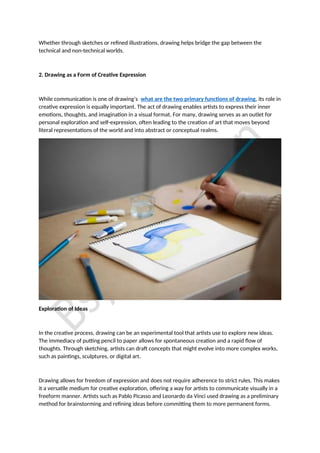
creative expression is equally important. The act of drawing enables artists to express their inner
emotions, thoughts, and imagination in a visual format. For many, drawing serves as an outlet for
personal exploration and self-expression, often leading to the creation of art that moves beyond
literal representations of the world and into abstract or conceptual realms.
Exploration of Ideas
In the creative process, drawing can be an experimental tool that artists use to explore new ideas.
The immediacy of putting pencil to paper allows for spontaneous creation and a rapid flow of
thoughts. Through sketching, artists can draft concepts that might evolve into more complex works,
such as paintings, sculptures, or digital art.
Drawing allows for freedom of expression and does not require adherence to strict rules. This makes
it a versatile medium for creative exploration, offering a way for artists to communicate visually in a
freeform manner. Artists such as Pablo Picasso and Leonardo da Vinci used drawing as a preliminary
method for brainstorming and refining ideas before committing them to more permanent forms.
Emotional and Aesthetic Value
The emotional depth that drawing can evoke is another critical aspect of its function as a tool for
creative expression. Through the use of line, form, and shading, artists can create works that evoke a
wide range of emotions, from joy to melancholy to awe. The texture and style of a drawing can
greatly influence its emotional impact, making it a powerful medium for conveying feelings.
Moreover, drawing serves as a means of aesthetic exploration. It allows artists to play with forms,
proportions, and compositions to create visually compelling pieces. In this way, drawing is not only a
means of expression but also a method for artists to engage with the formal aspects of art, such as
balance, harmony, and rhythm.
Conclusion
In conclusion, drawing serves two primary functions: communication and creative expression. As a
communication tool, it provides a visual language that transcends cultural and linguistic barriers,
making it an indispensable method for conveying complex ideas and emotions. In its role as a
medium for creative expression, drawing enables artists to explore new concepts and express their
inner world. These two functions, while distinct, are deeply interconnected and highlight the
versatility of drawing as both a practical and artistic medium. Whether used for scientific diagrams,
architectural plans, or fine art, drawing remains a powerful and universal form of visual
communication.

What are the Two Primary Functions for Drawing.docx

  • 1.
    What are theTwo Primary Functions for Drawing? Drawing has always been a fundamental skill in visual art, communication, and design. Throughout history, humans have used drawing not only to express creative ideas but also to record important information. Though drawing has evolved alongside technology and society, its core functions have remained fairly consistent. These can be distilled into two primary purposes: **communication** and creative expression. 1. Drawing as a Tool for Communication From the earliest cave paintings to modern architectural blueprints, drawing has served as a critical medium for communication. It transcends linguistic barriers, enabling people to convey ideas visually, often in ways that words alone cannot. Visual Language and Information Transfer One of the most vital aspects of drawing is its ability to serve as a visual language. Drawings can communicate concepts that may be difficult or even impossible to express through written or spoken words. This is evident in fields such as science, engineering, and architecture, where complex ideas need to be represented visually for clarity. For example, scientists often rely on diagrams to explain abstract theories, while architects use technical drawings to present building plans. In the realm of education, drawing can be a powerful tool for teaching. Visual aids, such as charts, graphs, and diagrams, simplify complicated information and make it more accessible. The combination of visual elements and text helps in reinforcing understanding. Teachers often use this method to enhance retention in students, particularly those who are more visually oriented learners. Universal Language Another unique advantage of drawing as a communication tool is its universality. Since drawing relies on imagery rather than words, it transcends language and cultural differences. For instance, a drawing of a heart can symbolize love regardless of the viewer’s native tongue, while a sketch of a face displaying emotions can communicate sadness, joy, or anger without needing translation. This is one of the reasons why symbols and icons are so prevalent in digital communication today; they are based on the universal language of drawing. In professional fields such as design, drawing is used to communicate concepts to clients or team members who may not have the technical expertise to understand complex written explanations.
  • 2.
    Whether through sketchesor refined illustrations, drawing helps bridge the gap between the technical and non-technical worlds. 2. Drawing as a Form of Creative Expression While communication is one of drawing’s what are the two primary functions of drawing, its role in creative expression is equally important. The act of drawing enables artists to express their inner emotions, thoughts, and imagination in a visual format. For many, drawing serves as an outlet for personal exploration and self-expression, often leading to the creation of art that moves beyond literal representations of the world and into abstract or conceptual realms. Exploration of Ideas In the creative process, drawing can be an experimental tool that artists use to explore new ideas. The immediacy of putting pencil to paper allows for spontaneous creation and a rapid flow of thoughts. Through sketching, artists can draft concepts that might evolve into more complex works, such as paintings, sculptures, or digital art. Drawing allows for freedom of expression and does not require adherence to strict rules. This makes it a versatile medium for creative exploration, offering a way for artists to communicate visually in a freeform manner. Artists such as Pablo Picasso and Leonardo da Vinci used drawing as a preliminary method for brainstorming and refining ideas before committing them to more permanent forms.
  • 3.
    Emotional and AestheticValue The emotional depth that drawing can evoke is another critical aspect of its function as a tool for creative expression. Through the use of line, form, and shading, artists can create works that evoke a wide range of emotions, from joy to melancholy to awe. The texture and style of a drawing can greatly influence its emotional impact, making it a powerful medium for conveying feelings. Moreover, drawing serves as a means of aesthetic exploration. It allows artists to play with forms, proportions, and compositions to create visually compelling pieces. In this way, drawing is not only a means of expression but also a method for artists to engage with the formal aspects of art, such as balance, harmony, and rhythm. Conclusion In conclusion, drawing serves two primary functions: communication and creative expression. As a communication tool, it provides a visual language that transcends cultural and linguistic barriers, making it an indispensable method for conveying complex ideas and emotions. In its role as a medium for creative expression, drawing enables artists to explore new concepts and express their inner world. These two functions, while distinct, are deeply interconnected and highlight the versatility of drawing as both a practical and artistic medium. Whether used for scientific diagrams, architectural plans, or fine art, drawing remains a powerful and universal form of visual communication.