WIDER AND ENHANCED VERIFICATION FOR YOU
Online disinformation and fake media content have emerged as a serious threat
to democracy, economy and society. Content verification is currently far from
trivial, even for experienced journalists, human rights activists or media literacy
scholars. Moreover, recent advances in artificial intelligence (deep learning) have
enabled the creation of intelligent bots and highly realistic synthetic multimedia
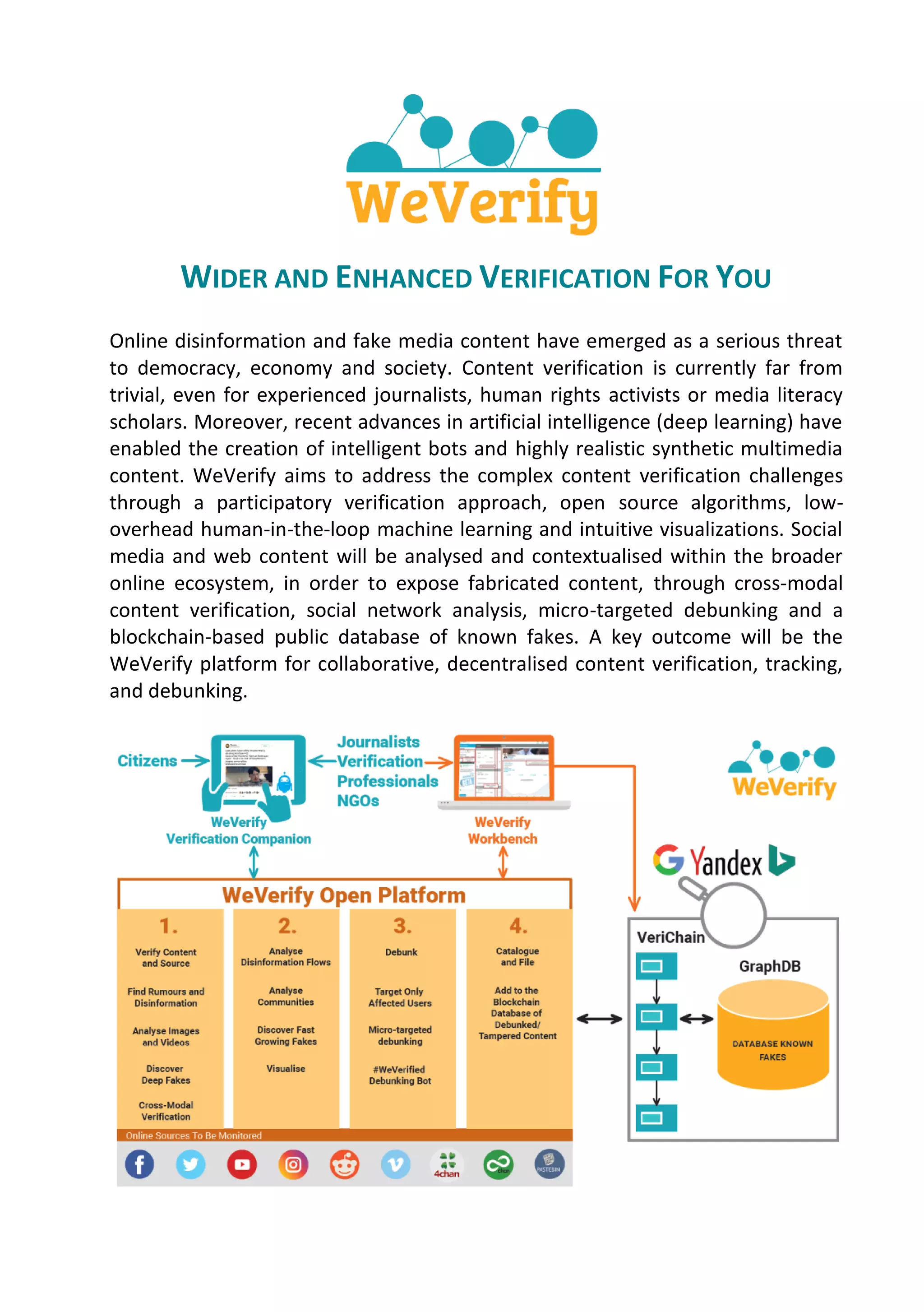
content. WeVerify aims to address the complex content verification challenges
through a participatory verification approach, open source algorithms, low-
overhead human-in-the-loop machine learning and intuitive visualizations. Social
media and web content will be analysed and contextualised within the broader
online ecosystem, in order to expose fabricated content, through cross-modal
content verification, social network analysis, micro-targeted debunking and a
blockchain-based public database of known fakes. A key outcome will be the
WeVerify platform for collaborative, decentralised content verification, tracking,
and debunking.
WeVerify Consortium Partners
Contact Persons
Dr. Milena Yankova-Doseva – Project Coordinator
Ontotext AD, email: milena.yankova@ontotext.com
Zlatina Marinova – Administrative Coordinator
Ontotext AD, email: zlatina.marinova@ontotext.com
Prof. Kalina Bontcheva – Scientific Director
University of Sheffield, email: k.bontcheva@sheffield.ac.uk
Nikos Sarris – Exploitation Director
ATC, email: n.sarris@atc.gr
Denis Teyssou – Innovation Manager
AFP, email: denis.teyssou@afp.com
Jochen Spangenberg – Dissemination Lead
DW, jochen.spangenberg@dw.com
Website/Social Media
https://weverify.eu
https://twitter.com/WeVerify
This project has received funding from the European Union's
Horizon 2020 research and innovation programme under grant
agreement No 825297.

WeVerify project description

  • 1.
    WIDER AND ENHANCEDVERIFICATION FOR YOU Online disinformation and fake media content have emerged as a serious threat to democracy, economy and society. Content verification is currently far from trivial, even for experienced journalists, human rights activists or media literacy scholars. Moreover, recent advances in artificial intelligence (deep learning) have enabled the creation of intelligent bots and highly realistic synthetic multimedia content. WeVerify aims to address the complex content verification challenges through a participatory verification approach, open source algorithms, low- overhead human-in-the-loop machine learning and intuitive visualizations. Social media and web content will be analysed and contextualised within the broader online ecosystem, in order to expose fabricated content, through cross-modal content verification, social network analysis, micro-targeted debunking and a blockchain-based public database of known fakes. A key outcome will be the WeVerify platform for collaborative, decentralised content verification, tracking, and debunking.
  • 2.
    WeVerify Consortium Partners ContactPersons Dr. Milena Yankova-Doseva – Project Coordinator Ontotext AD, email: milena.yankova@ontotext.com Zlatina Marinova – Administrative Coordinator Ontotext AD, email: zlatina.marinova@ontotext.com Prof. Kalina Bontcheva – Scientific Director University of Sheffield, email: k.bontcheva@sheffield.ac.uk Nikos Sarris – Exploitation Director ATC, email: n.sarris@atc.gr Denis Teyssou – Innovation Manager AFP, email: denis.teyssou@afp.com Jochen Spangenberg – Dissemination Lead DW, jochen.spangenberg@dw.com Website/Social Media https://weverify.eu https://twitter.com/WeVerify This project has received funding from the European Union's Horizon 2020 research and innovation programme under grant agreement No 825297.