Accelerating Decarbonization
through Trade in Climate Goods
and Services
I N S I G H T R E P O R T
S E P T E M B E R 2 0 2 2
Contents
Preface
Executive summary
Introduction
1 Climate goods trade
1.1 Categorizing relevant items
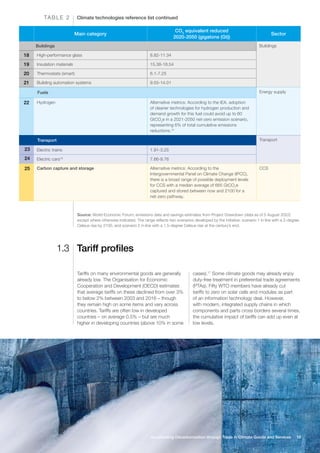
1.2 Proposed climate goods list
1.3 Tariff profiles
1.4 Potential emissions reductions
2 Non-tariff barriers
2.1 Challenges to consider
2.2 Climate NTBs
3 Trade in climate services
3.1 What is a climate service?
3.2 Identifying climate services
3.3 Services trade challenges
3.4 Proposed climate services list
4 Developing country priorities
4.1 A just transition
4.2 Green jobs
4.3 Regulatory capacity building
4.4 Other concerns
Conclusion
Contributors
Endnotes
3
4
5
7
8
8
10
11
12
13
13
16
17
17
18
20
23
24
24
25
25
26
28
29
Images: Getty images, Unsplash, Pexels
© 2022 World Economic Forum. All rights reserved. No part of this
publication may be reproduced or transmitted in any form or by any
means, including photocopying and recording, or by any information
storage and retrieval system.
Disclaimer
This document is published by the World Economic Forum as a
contribution to a project, insight area or interaction. The findings,
interpretations and conclusions expressed herein are a result of a
collaborative process facilitated and endorsed by the World Economic
Forum but whose results do not necessarily represent the views of the
World Economic Forum, nor the entirety of its Members, Partners or
other stakeholders.
Accelerating Decarbonization through Trade in Climate Goods and Services 2
Preface
As the world looks to transition to new, decarbonized
production and consumption systems rapidly, a great
number of climate-related technologies and services
need to be deployed. Trade can be a critical means
of reducing costs and spreading these innovations to
new markets. Addressing trade barriers can speed
up that process, leading to gains for consumers and
businesses shouldering the climate transition while
opening new markets for exporters. Lowering trade
barriers could equally encourage greater foreign
direct investment into climate-related projects.
It is vital that climate goods and services trade is
understood in order to structure market signals,
incentives and partnerships. Many governments
increasingly realize the potential in this space. The
World Economic Forum is contributing to ongoing
discussions at the World Trade Organization (WTO)
on trade and the environment. Other trade talks in
regional and bilateral settings are also under way.
To encourage timely outcomes, this report
highlights top climate technologies and services
that help reduce emissions, which trade policy-
makers should focus on. The insights are based
on the Forum’s Climate Trade Zero initiative and
community discussions that bring together trade
and climate experts from all regions.
We must accelerate our response to climate
change. Yet, leaders across the globe know they
need to do so in a way that brings opportunities,
jobs and prosperity to all parts of society. Trade
is an engine of growth, and this engine must
be rewired to support the spread of green
technologies and services. No country and
company can do that alone. Through thoughtful
trade collaboration, we stand a better chance of
realizing a net-zero economic future.
Trade, investment and international partnerships
can deliver the markets and innovations needed
to address climate change.
Børge Brende
President, World
Economic Forum
Kimberley Botwright
Head, Sustainable Trade,
World Economic Forum
Accelerating Decarbonization through
Trade in Climate Goods and Services
September 2022
3
Accelerating Decarbonization through Trade in Climate Goods and Services
Executive summary
Trade can support climate action
Trade can help spread climate-friendly technologies
around the world. Wind turbines contain around
9,000 components traded in global and regional
value chains, electric cars are made from
components sourced in many countries, and global
heat pump markets are growing. Services trade
supports climate technology roll out, like monitoring
wind turbine performance to repair faulty parts,
or engineering advisory, design, consulting and
project management functions that deliver clean
energy projects. As well as increasing availability,
trade in climate goods and services can reduce
costs and increase choice, making industries
dependent on emissions savings more competitive.
Government collaboration has been mixed, but
action is needed now
Governments have long recognized the importance
of a broader push for more environmental goods
and services trade. Yet efforts to work together
to reduce barriers – from tariffs to regulatory
complexity or limitations on foreign suppliers –
have been mixed. The urgency of climate action
means the time is ripe for a renewed, focused
collaboration on boosting trade in climate goods
and services.
Trade in 25 climate goods could help
emissions reductions
This report presents a list of 25 key climate
technologies that trade policy-makers could
prioritize in discussions. These were identified
based on three sectors that will play an essential
role in reaching net-zero emissions, according to
the Intergovernmental Panel on Climate Change
(IPCC), including energy supply, transport
and buildings. Goods for carbon capture and
storage (CCS) and refrigerant management
are also included as these are promising for
decarbonization too. Technologies proposed
include wind and solar power, heat pumps,
alternative refrigerants, insulation, efficient motors,
LED lighting, smart thermostats, electric cars and
biogas stoves.
A longer list is also available that indicates inputs
to key technologies and relevant tariff codes. That
information is specifically designed to help policy-
makers explore value chains and areas of most
interest to their national context.
Non-tariff barriers matter more than tariffs
A tariff-cutting deal on climate goods would send
an important message. It would demonstrate
that participating governments are serious
about aligning their commercial and economic
policies with climate action. Most research to
date also notes the importance of addressing
non-tariff barriers (NTBs) – like different testing
and certification requirements for safely placing a
product on a market. The report lists seven types of
NTBs and suggests priorities for further work.
Services trade restrictions slow down climate
goods distribution
Interviews for this report confirmed that trade barriers
to providing climate-related services have resulted
in missed business opportunities for the sale of
climate goods. The report presents a list of climate
services, associated with the five sectors targeted for
increased climate goods trade, to encourage trade
policy efforts. The list includes “core” environmental
services and services that “enable” or are
“indispensable” to climate goods trade.
Developing countries must be included, and
value chain competitiveness can help
Globally, 759 million people do not have access to
electricity, even though it is vital for development
and clean energy solutions. Developing countries
equally need to secure clean energy supplies to
power companies engaged in global value chains
as attention grows around supplier emissions. While
south-south trade in clean energy technologies
is growing, developed country markets could be
opened up through regulatory cooperation in areas
such as standards and technical requirements for
key products.
A climate trade deal can start targeted and grow
over time
A trade deal among a broad number of interested
countries focused on a tight list of items with
significant potential for cutting emissions would be a
positive move. The agreement could be broadened
in time, especially as policy-makers build up
confidence in trade collaboration and undertake
effective capacity building.
The Climate Trade Zero community stands ready to
support these and other efforts aimed at maximizing
the positive contribution that trade can make to
addressing climate change.
Boosting trade in specific climate action-
related technologies and services could help
encourage emissions reductions in industries
and homes worldwide.
4
Accelerating Decarbonization through Trade in Climate Goods and Services
Introduction
Trade can support climate action by increasing
the availability of climate-friendly technologies.
Reducing trade barriers around these items
encourages their spread. For example, eliminating
tariffs and NTBs on certain clean energy
technologies and energy efficiency products
could increase their trade volume by 14%
and 60%, respectively.1
Many climate goods
also depend on a wide range of supporting
services. Solar and wind energy projects
involve services such as the assessment of
solar and wind resources, site analysis, project
development, project financing, engineering
and design services, assembly and installation,
operation, and maintenance of equipment
(see Box 1).2
Services trade facilitation can
help ensure these support systems are widely
available. Governments have long recognized the
importance of environmental goods and services
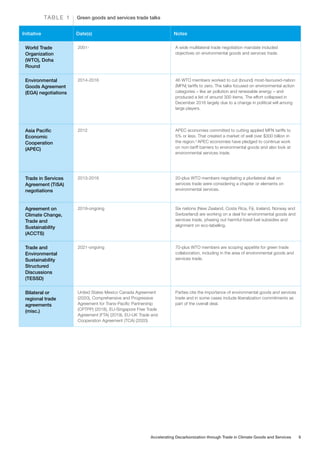
(EGS) trade (see Table 1). Trade negotiations in
this area, however, have had only mixed success
for a range of technical and political reasons.
Today, with ever more apparent climate impacts
and a need to move quickly on industry
decarbonization and innovation, governments
could work together on the trade of climate
goods and services as a specific sub-category.
That would send a postive signal to markets and
could support new value chain partnerships.
Trade-related tensions and disputes on renewable
energy specifically have risen since 2010.3
These
trade tensions are partly due to the design and
implementation of industrial policies in numerous
countries around clean energy production.
Indeed, green job creation is an important
target for many policy-makers, but this report
suggests localization is not the best way to
deliver this, especially in the long-term. Business
and academia can help champion an alternative
path. Fewer trade barriers to critical climate
action goods and services will have positive
knock-on effects on competitiveness and growth
opportunities in a net-zero emissions future.
This insight report presents reference lists for
climate goods and services that trade policy-
makers could consider in their discussions. It
also identifies non-tariff barriers around climate
goods. It concludes with a look at priorities
for developing economies as it is vital for all
countries to grow green. Tailored policy design
for different countries will be the focus of a
follow-up initiative from this report (currently
in scope). The report’s recommendations are
assembled thanks to a 70-plus community of
experts working through the Climate Trade Zero
initiative. Climate Trade Zero brings trade and
climate practitioners together for knowledge
exchange and targeted project work. The report
also benefited from 30 interviews with industry
and academia and peer review.
Trade tensions risk reducing the potential
of economies of scale to increase the
availability of climate-friendly technologies.
Wind turbines contain around 9,000 components
that are traded in global and regional value chains.
Design, knowledge and technical know-how are
also critical to the manufacture of high-quality wind
turbines that can compete with incumbent energy
technologies and scale up industry electrification.
Tariff barriers around wind energy inputs are
relatively low among large emitting economies.
However, barriers to trade in services and NTBs,
such as local content requirements, impede trade
inputs around wind power plants more than tariffs.
Services trade is also an important part of
climate goods value chains. Constructing a
wind farm requires environmental consultants
to identify a suitable location and prepare an
environmental impact assessment; financial
and consulting services are needed in the
project development stage; and specialist
delivery firms ensure the delivery of parts.
Assembly, construction, testing, IT, monitoring,
grid connection and maintenance services are
equally essential.
Wind farms and trade
B O X 1
Source: National Board of Trade Sweden, 2021
Fewer trade
barriers to critical
climate action
goods and services
will have positive
knock-on effects
on competitiveness
and growth
opportunities in a
net-zero emissions
future.
Accelerating Decarbonization through Trade in Climate Goods and Services 5
Green goods and services trade talks
TA B L E 1
Initiative Date(s) Notes
World Trade
Organization
(WTO), Doha
Round
2001- A wide multilateral trade negotiation mandate included
objectives on environmental goods and services trade.
Environmental
Goods Agreement
(EGA) negotiations
2014-2016 46 WTO members worked to cut (bound) most-favoured-nation
(MFN) tariffs to zero. The talks focused on environmental action
categories – like air pollution and renewable energy – and
produced a list of around 300 items. The effort collapsed in
December 2016 largely due to a change in political will among
large players.
Asia Pacific
Economic
Cooperation
(APEC)
2012 APEC economies committed to cutting applied MFN tariffs to
5% or less. That created a market of well over $300 billion in
the region.4
APEC economies have pledged to continue work
on non-tariff barriers to environmental goods and also look at
environmental services trade.
Trade in Services
Agreement (TiSA)
negotiations
2013-2016 20-plus WTO members negotiating a plurilateral deal on
services trade were considering a chapter or elements on
environmental services.
Agreement on
Climate Change,
Trade and
Sustainability
(ACCTS)
2019-ongoing Six nations (New Zealand, Costa Rica, Fiji, Iceland, Norway and
Switzerland) are working on a deal for environmental goods and
services trade, phasing out harmful fossil fuel subsidies and
alignment on eco-labelling.
Trade and
Environmental
Sustainability
Structured
Discussions
(TESSD)
2021-ongoing 70-plus WTO members are scoping appetite for green trade
collaboration, including in the area of environmental goods and
services trade.
Bilateral or
regional trade
agreements
(misc.)
United States Mexico Canada Agreement
(2020), Comprehensive and Progressive
Agreement for Trans-Pacific Partnership
(CPTPP) (2018), EU-Singapore Free Trade
Agreement (FTA) (2019), EU-UK Trade and
Cooperation Agreement (TCA) (2020)
Parties cite the importance of environmental goods and services
trade and in some cases include liberalization commitments as
part of the overall deal.
Accelerating Decarbonization through Trade in Climate Goods and Services 6
Climate goods trade
1
Trade discussions should prioritize items with
significant emissions reduction potential.
Accelerating Decarbonization through Trade in Climate Goods and Services 7
Categorizing relevant items
1.1
Climate goods can be difficult to pinpoint
precisely in the World Customs Organization
(WCO) Harmonized System (HS), which classifies
over 5,000 commodity groups with six-digit
codes. Countries use these as a basis for trade
in terms of customs tariffs, international trade
statistics and to determine the relevant rules and
regulations that must be complied with. Some
six-digit subheadings single out an environmental
or climate good, while other subheadings cover
both environmental and non-environmental
goods. Nonetheless, that has not proved an
insurmountable obstacle in previous negotiations,
with policy-makers using product descriptions
known as “ex-outs” to identify the item in
question.5
The recent HS review for the 2022
tariff schedule (HS-2022) entered into force on 1
January 2022 and added several new goods or
additional tariff lines that better capture goods
rele­
vant to climate action – such as LED lights that
consume less power.6
While this progress is good,
specific harmonized codes are still needed for
emerging environmental goods. Governments can
use the forthcoming review of the HS for the 2027
tariff schedule to further clarify climate goods tariff
codes. More precise codes would generate better
trade statistics and make it easier to detect where
NTBs pose trade barriers.7
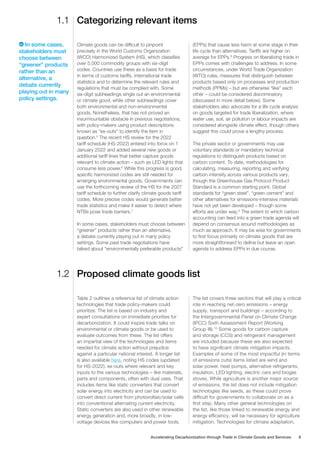
In some cases, stakeholders must choose between
“greener” products rather than an alternative,
a debate currently playing out in many policy
settings. Some past trade negotiations have
talked about “environmentally preferable products”
(EPPs) that cause less harm at some stage in their
life cycle than alternatives. Tariffs are higher on
average for EPPs.8
Progress on liberalizing trade in
EPPs comes with challenges to address. In some
circumstances, under World Trade Organization
(WTO) rules, measures that distinguish between
products based only on processes and production
methods (PPMs) – but are otherwise “like” each
other – could be considered discriminatory
(discussed in more detail below). Some
stakeholders also advocate for a life cycle analysis
on goods targeted for trade liberalization, where
water use, soil, air pollution or labour impacts are
considered alongside climate effect, though others
suggest this could prove a lengthy process.
The private sector or governments may use
voluntary standards or mandatory technical
regulations to distinguish products based on
carbon content. To date, methodologies for
calculating, measuring, reporting and verifying
carbon intensity across various products vary,
though the Greenhouse Gas Protocol Product
Standard is a common starting point. Global
standards for “green steel”, “green cement” and
other alternatives for emissions-intensive materials
have not yet been developed – though some
efforts are under way.9
The extent to which carbon
accounting can feed into a green trade agenda will
depend on consensus around methodologies as
much as approach. It may be wise for governments
to first focus primarily on climate goods that are
more straightforward to define but leave an open
agenda to address EPPs in due course.
Proposed climate goods list
1.2
In some cases,
stakeholders must
choose between
“greener” products
rather than an
alternative, a
debate currently
playing out in many
policy settings.
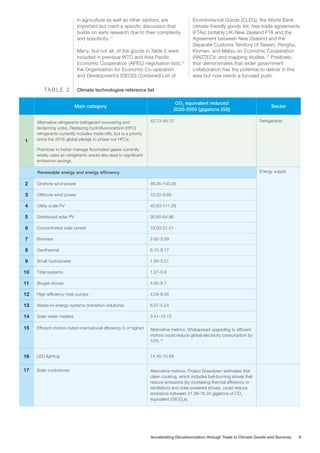
Table 2 outlines a reference list of climate action
technologies that trade policy-makers could
prioritize. The list is based on industry and
expert consultations on immediate priorities for
decarbonization. It could inspire trade talks on
environmental or climate goods or be used to
evaluate outcomes from these. The list offers
an impartial view of the technologies and items
needed for climate action without prejudice
against a particular national interest. A longer list
is also available here, noting HS codes (updated
for HS-2022), ex-outs where relevant and key
inputs to the various technologies – like materials,
parts and components, often with dual uses. That
includes items like static converters that convert
solar energy into electricity and can be used to
convert direct current from photovoltaic/solar cells
into conventional alternating current electricity.
Static converters are also used in other renewable
energy generation and, more broadly, in low-
voltage devices like computers and power tools.
The list covers three sectors that will play a critical
role in reaching net-zero emissions – energy
supply, transport and buildings – according to
the Intergovernmental Panel on Climate Change
(IPCC) Sixth Assessment Report (Working
Group III).10
Some goods for carbon capture
and storage (CCS) and refrigerant management
are included because these are also expected
to have significant climate mitigation impacts.
Examples of some of the most impactful (in terms
of emissions cuts) items listed are wind and
solar power, heat pumps, alternative refrigerants,
insulation, LED lighting, electric cars and biogas
stoves. While agriculture is another major source
of emissions, the list does not include mitigation
technologies like seeds, as these could prove
difficult for governments to collaborate on as a
first step. Many other general technologies on
the list, like those linked to renewable energy and
energy efficiency, will be necessary for agriculture
mitigation. Technologies for climate adaptation,
Accelerating Decarbonization through Trade in Climate Goods and Services 8
in agriculture as well as other sectors, are
important but merit a specific discussion that
builds on early research due to their complexity
and specificity.11
Many, but not all, of the goods in Table 2 were
included in previous WTO and Asia Pacific
Economic Cooperation (APEC) negotiation lists;12
the Organisation for Economic Co-operation
and Development’s (OECD) Combined List of
Environmental Goods (CLEG); the World Bank
climate-friendly goods list; free trade agreements
(FTAs) (notably UK-New Zealand FTA and the
Agreement between New Zealand and the
Separate Customs Territory of Taiwan, Penghu,
Kinmen, and Matsu on Economic Cooperation
(ANZTEC)); and mapping studies.13
Positively,
that demonstrates that wider government
collaboration has the potential to deliver in this
area but now needs a focused push.
Climate technologies reference list
TA B L E 2
Main category
CO2
equivalent reduced
2020-2050 (gigatons (Gt))
Sector
1
Alternative refrigerants (refrigerant recovering and
reclaiming units). Replacing hydrofluorocarbon (HFC)
refrigerants currently includes trade-offs, but is a priority
since the 2016 global pledge to phase out HFCs.
Practices to better manage fluorinated gases currently
widely used as refrigerants would also lead to significant
emissions savings.
42.73-48.75 Refrigerants
Renewable energy and energy efficiency Energy supply
2 Onshore wind power 46.95-143.56
3 Offshore wind power 10.22-9.89
4 Utility scale PV 40.83-111.59
5 Distributed solar PV 26.65-64.86
6 Concentrated solar power 18.00-21.51
7 Biomass 2.62-3.59
8 Geothermal 6.15-9.17
9 Small hydropower 1.65-3.21
10 Tidal systems 1.27-0.8
11 Biogas stoves 4.65-9.7
12 High-efficiency heat pumps 4.04-9.05
13 Waste-to-energy systems (transition solutions) 6.27-5.24
14 Solar water heaters 3.41-13.73
15 Efficient motors (rated international efficiency 3 or higher) Alternative metrics: Widespread upgrading to efficient
motors could reduce global electricity consumption by
10%.14
16 LED lighting 14.45-15.69
17 Solar cookstoves Alternative metrics: Project Drawdown estimates that
clean cooking, which includes fuel-burning stoves that
reduce emissions (by increasing thermal efficiency or
ventilation) and solar-powered stoves, could reduce
emissions between 31.38-76.34 gigatons of CO2
equivalent (GtCO2
e).
Accelerating Decarbonization through Trade in Climate Goods and Services 9
Buildings Buildings
18 High-performance glass 8.82-11.34
19 Insulation materials 15.38-18.54
20 Thermostats (smart) 6.1-7.25
21 Building automation systems 9.55-14.01
Fuels Energy supply
22 Hydrogen Alternative metrics: According to the IEA, adoption
of cleaner technologies for hydrogen production and
demand growth for this fuel could avoid up to 60
GtCO2
e in a 2021-2050 net-zero emission scenario,
representing 6% of total cumulative emissions
reductions.15
Transport Transport
23 Electric trains 1.91-3.25
24 Electric cars16
7.66-9.76
25 Carbon capture and storage Alternative metrics: According to the
Intergovernmental Panel on Climate Change (IPCC),
there is a broad range of possible deployment levels
for CCS with a median average of 665 GtCO2
e
captured and stored between now and 2100 for a
net-zero pathway.
CCS
Climate technologies reference list continued
TA B L E 2
Main category
CO2
equivalent reduced
2020-2050 (gigatons (Gt))
Sector
Source: World Economic Forum; emissions data and savings estimates from Project Drawdown (data as of 5 August 2022)
except where otherwise indicated. The range reflects two scenarios developed by the initiative: scenario 1 in line with a 2-degree
Celsius rise by 2100, and scenario 2 in line with a 1.5-degree Celsius rise at the century’s end.
Tariff profiles
1.3
Tariffs on many environmental goods are generally
already low. The Organisation for Economic
Cooperation and Development (OECD) estimates
that average tariffs on these declined from over 3%
to below 2% between 2003 and 2016 – though
they remain high on some items and vary across
countries. Tariffs are often low in developed
countries – on average 0.5% – but are much
higher in developing countries (above 10% in some
cases).17
Some climate goods may already enjoy
duty-free treatment in preferential trade agreements
(PTAs). Fifty WTO members have already cut
tariffs to zero on solar cells and modules as part
of an information technology deal. However,
with modern, integrated supply chains in which
components and parts cross borders several times,
the cumulative impact of tariffs can add up even at
low levels.
Accelerating Decarbonization through Trade in Climate Goods and Services 10
Emissions reductions resulting
from tariff cuts on a large list of
environmental goods by 2030
1%
CO2
levels by 2030 to be on
track with a 1.5°C pathway
~20Gt
Current CO2
emissions per year
that need to be reduced to zero
by 2050
~36Gt CO2
emissions increase in
2021
4.9%
Amount of abated CO2
linked to
the spread of associated clean
energy technologies
6.5Gt
Potential emissions reductions
1.4
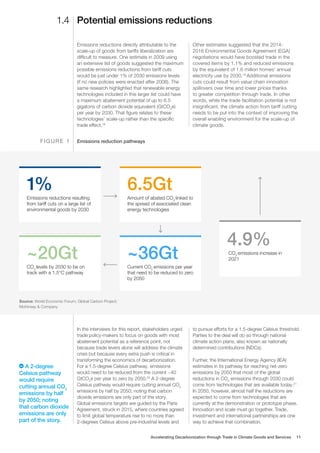
Emissions reductions directly attributable to the
scale-up of goods from tariffs liberalization are
difficult to measure. One estimate in 2009 using
an extensive list of goods suggested the maximum
possible emissions reductions from tariff cuts
would be just under 1% of 2030 emissions levels
(if no new policies were enacted after 2008). The
same research highlighted that renewable energy
technologies included in this larger list could have
a maximum abatement potential of up to 6.5
gigatons of carbon dioxide equivalent (GtCO2
e)
per year by 2030. That figure relates to these
technologies’ scale-up rather than the specific
trade effect.18
Other estimates suggested that the 2014-
2016 Environmental Goods Agreement (EGA)
negotiations would have boosted trade in the
covered items by 1.1% and reduced emissions
by the equivalent of 1.6 million homes’ annual
electricity use by 2030.19
Additional emissions
cuts could result from value chain innovation
spillovers over time and lower prices thanks
to greater competition through trade. In other
words, while the trade facilitation potential is not
insignificant, the climate action from tariff cutting
needs to be put into the context of improving the
overall enabling environment for the scale-up of
climate goods.
A 2-degree
Celsius pathway
would require
cutting annual CO2
emissions by half
by 2050; noting
that carbon dioxide
emissions are only
part of the story.
Emissions reduction pathways
F I G U R E 1
Source: World Economic Forum; Global Carbon Project;
McKinsey & Company
In the interviews for this report, stakeholders urged
trade policy-makers to focus on goods with most
abatement potential as a reference point, not
because trade levers alone will address the climate
crisis but because every extra push is critical in
transforming the economics of decarbonization.
For a 1.5-degree Celsius pathway, emissions
would need to be reduced from the current ~40
GtCO2
e per year to zero by 2050.20
A 2-degree
Celsius pathway would require cutting annual CO2
emissions by half by 2050; noting that carbon
dioxide emissions are only part of the story.
Global emissions targets are guided by the Paris
Agreement, struck in 2015, where countries agreed
to limit global temperature rise to no more than
2-degrees Celsius above pre-industrial levels and
to pursue efforts for a 1.5-degree Celsius threshold.
Parties to the deal will do so through national
climate action plans, also known as nationally
determined contributions (NDCs).
Further, the International Energy Agency (IEA)
estimates in its pathway for reaching net-zero
emissions by 2050 that most of the global
reductions in CO2
emissions through 2030 could
come from technologies that are available today.21
In 2050, however, almost half the reductions are
expected to come from technologies that are
currently at the demonstration or prototype phase.
Innovation and scale must go together. Trade,
investment and international partnerships are one
way to achieve that combination.
Accelerating Decarbonization through Trade in Climate Goods and Services 11
Non-tariff barriers
2
Climate technology trade can be held up by
more than just customs tariffs – “behind-the-
border” issues often present a greater challenge
for exporters and importers.
Accelerating Decarbonization through Trade in Climate Goods and Services 12
Challenges to consider
Climate NTBs
2.1
2.2
Non-tariff barriers (NTBs) present a challenge
for global trade and, in almost all sectors, act
as a bigger obstacle than tariffs.22
One study on
climate goods trade specifically found that, when
combined with tariffs, NTBs could result in average
levels of protection ten times greater than tariffs
alone.23
Measures that present as NTBs are not
necessarily bad, covering things like product safety
or sustainability, but their design can sometimes
affect market access. International dialogue
is therefore important in this area to ensure
key regulatory objectives are maintained while
providing opportunities for economies of scale in
product distribution. In a recent Forum study on
climate and trade, participants called for more
evidence around climate goods NTBs, including
creating a categorisation of “green NTBs”. Policy-
makers have also asked the Forum to help them
understand and prioritize NTBs that matter most
for climate action.
To meet these asks, industry and experts were
consulted over a period of six months. The
conversations were guided by a climate NTB
categorization, developed based on earlier
industry surveys by the OECD,24
Monkelbaan,25
and UNCTAD’s International Classification of NTMs
(see Table 3).26
Interview participants were asked
to give a sense of both the degree of prevalence
and the degree of restrictiveness of climate
NTBs within these various categories. The top
three identified on both fronts include technical
barriers to trade, local content requirements and
challenges around government procurement,
which are discussed below in greater detail.
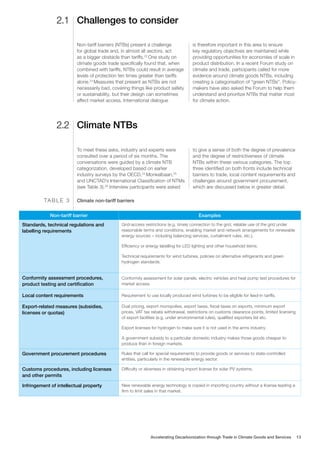
Climate non-tariff barriers
TA B L E 3
Non-tariff barrier Examples
Standards, technical regulations and
labelling requirements
Grid-access restrictions (e.g. timely connection to the grid, reliable use of the grid under
reasonable terms and conditions, enabling market and network arrangements for renewable
energy sources – including balancing services, curtailment rules, etc.).
Efficiency or energy labelling for LED lighting and other household items.
Technical requirements for wind turbines, policies on alternative refrigerants and green
hydrogen standards.
Conformity assessment procedures,
product testing and certification
Conformity assessment for solar panels, electric vehicles and heat pump test procedures for
market access.
Local content requirements Requirement to use locally produced wind turbines to be eligible for feed-in tariffs.
Export-related measures (subsidies,
licenses or quotas)
Dual pricing, export monopolies, export taxes, fiscal taxes on exports, minimum export
prices, VAT tax rebate withdrawal, restrictions on customs clearance points, limited licensing
of export facilities (e.g. under environmental rules), qualified exporters list etc.
Export licenses for hydrogen to make sure it is not used in the arms industry.
A government subsidy to a particular domestic industry makes those goods cheaper to
produce than in foreign markets.
Government procurement procedures Rules that call for special requirements to provide goods or services to state-controlled
entities, particularly in the renewable energy sector.
Customs procedures, including licenses
and other permits
Difficulty or slowness in obtaining import license for solar PV systems.
Infringement of intellectual property New renewable energy technology is copied in importing country without a license leading a
firm to limit sales in that market.
Accelerating Decarbonization through Trade in Climate Goods and Services 13
Many experts expect hydrogen to be a vital source
of energy by 2050. The International Renewable
Energy Agency (IRENA) expects that more than
30% of hydrogen produced by 2050 will be traded
internationally. Standards around the safety and
quality of green hydrogen goods and services is
one way to build a resilient global green hydrogen
economy. At this early stage, fragmentation
is a key challenge, with different hydrogen
classifications emerging using colour schemes
or levels. Some industry associations are actively
working to develop private sector standards
for green hydrogen that could be scaled up.
For instance, the Green Hydrogen Organization
is looking to establish a standard for accurate
greenhouse gas (GHG) emissions accounting
within the sector. Existing models could feed into
the development of a common approach.
Currently, MFN tariffs on hydrogen are very low
or non-existent. Rather than having a separate
tariff line for green hydrogen, policy-makers could
instead provide trade preferences via certification
systems for this type of trade, assuming
compliance with WTO rules. Industry players and
governments could also draw on best practices
from trade in other relevant green goods and
services to create a level playing field.
Green hydrogen trade
B O X 2
Technical barriers to trade
Technical barriers to trade (TBTs) include standards,
technical regulations, conformity assessment
procedures (testing and certification) and labelling
requirements. The topic covers mandatory
technical regulations and voluntary standards
that define a product’s specific characteristics,
such as its size, shape, design, functionality
or performance. WTO rules provide policy-
makers with guidance on NTBs. The Technical
Barriers to Trade Agreement requires technical
measures to be prepared, adopted and applied
according to some basic principles to minimize
their negative impact on trade. Principles are also
included on how policy-makers might interact
with voluntary standards. The five core principles
of the TBT Agreement include transparency,
non-discrimination and national treatment,
proportionality, use of international standards
(whenever possible), and equivalence. Countries’
FTAs also work to address and harmonize various
TBT issues.
Climate goods producers must nonetheless
contend with a growing array of requirements
for selling across markets – suggesting greater
regulatory coherence is needed beyond adherence
to TBT principles. Interviewees reported multiple
markets imposing similar yet slightly different
requirements that must be complied with, ultimately
raising the cost of the item. One recent analysis
found that static converters – worth about $60
billion in global exports per year – faced 523
technical requirements, applied by 61 different
countries, globally. These requirements may
be important and do not necessarily need to
be eliminated, but governments could work on
regulatory cooperation to maintain the outcome
and reduce trade friction.27
Another study in 2019
on heat pump water heaters notes that there are
many test methods across regions with major
differences between them. Manufacturers must
undertake different tests to sell products, which
adds to product cost and can create confusion.28
Climate-linked standards and regulations are
also related to trade law discussion around
“non-product-related processes and production
methods” (PPMs). PPMs refer to processes or
production methods that do not physically manifest
themselves in the final product. Relevant PPM
examples could be standards for green hydrogen
production (also see Box 2) and low-carbon
steel. These final products are not distinguishable
from regular hydrogen and steel from outside
appearance or performance. Measures based
on PPMs, like emissions-labelling requirements,
emissions-link taxes or duties, will need to consider
WTO rules. There is debate on whether WTO
rules will allow different treatment for products
based only on their carbon intensity. Equally, trade
lawyers suggest it is not clear cut which PPMs
might fall within the scope of the TBT Agreement.
Some FTAs have already started to innovate in
this area, like the European Free Trade Association
(EFTA)-Indonesia arrangement that gives a greater
tariff reduction up to a set quota for palm oil based
on compliance with an international private sector-
led sustainability standard.29
One recent
analysis found that
static converters
– worth about $60
billion in global
exports per year –
faced 523 technical
requirements,
applied by 61
different countries,
globally.
Accelerating Decarbonization through Trade in Climate Goods and Services 14
Local content requirements
Government procurement
Local content requirements (LCRs) require firms
to use domestically manufactured goods or
domestically-supplied services to operate in an
economy. They have emerged as a particularly
prevalent form of NTB in the context of some
green industries, including solar and wind
generation manufacturing and, more recently,
electric vehicles. That has led to several
trade disputes at the WTO since the General
Agreement on Tariffs and Trade (GATT) and the
Trade-Related Investment Measures (TRIMs)
Agreement constrain the use of LCRs. For
example, under the National Treatment principle
(Article III of GATT), countries are expected
not to discriminate in policy-making between
“like products” from local industries and imports.
The Agreement on Subsidies and Countervailing
Measures (ASCM) prohibits subsidies granted to
investors or industries contingent on the use of
domestic products.
Yet, even though some forms of LCRs are
inconsistent with WTO obligations, they continue
to be used by many countries, particularly in
government procurement. This is despite many
businesses indicating that LCRs are ineffective in
encouraging domestic industry development. In
a survey as far back as 2015, 80% of investors
disagreed that LCRs encouraged them to invest in
local manufacturing or to source inputs locally.30
Government procurement accounts for 10-15%
of national GDP on average across the world.
Directing government spending towards more
sustainable projects represents a major opportunity
to reduce emissions created by governments’
operations and support markets for new
technologies. For example, the EU has a portal
for Green Public Procurement, which is divided up
into ten categories, including the circular economy,
energy efficiency and green space. The Biden
Administration’s Green Procurement plan includes
carbon capture, utilization and storage (CCUS),
hydrogen and other “buy clean” areas.
A subset of 48 WTO members have signed up
to the plurilateral Agreement on Government
Procurement (GPA). The fundamental aim of the
GPA is to mutually open government procurement
markets among its parties. An outstanding
challenge for industry, however, can be that central
or sub-central authorities influence procurement
processes in ways that give preference to
domestic over foreign firms. Definitions of what
“sustainable” means may vary greatly across
national and sub-national government tenders.
This blunts the effectiveness of climate-linked
public procurement since climate goods providers
must invest a lot of time in compliance and
tailoring bids.
Interviewees also suggested that many
governments explicitly or tacitly embed LCRs into
tenders. For example, an eligibility requirement
for government procurement in renewable
energy projects might be the use of local inputs.
There are several remaining issues in this space,
especially regarding public utilities, and whether
their purchase of renewable energy falls under
government procurement. The problem with
governments putting LCRs in place is that they
may raise prices, keep the most innovative
products out of the market and slow down the
scale-up of clean energy in the long term (after
giving it an initial boost).
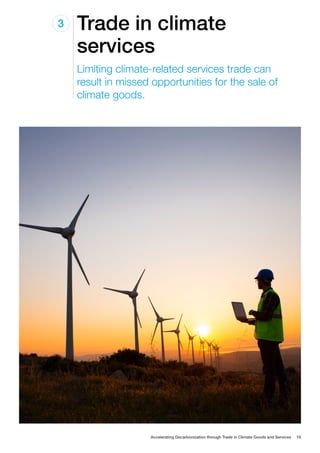
Definitions of
what “sustainable”
means may vary
greatly across
national and
sub-national
government
tenders.
Accelerating Decarbonization through Trade in Climate Goods and Services 15
Trade in climate
services
3
Limiting climate-related services trade can
result in missed opportunities for the sale of
climate goods.
Accelerating Decarbonization through Trade in Climate Goods and Services 16
What is a climate service?
Identifying climate services
3.1
3.2
There is no clear and agreed-upon definition
among either international experts or countries on
what constitutes a climate service, making trade
talks in this area tricky. Negotiators must also
grapple with scope since many different services
can be relevant for addressing climate change, but
these may also have other uses, like engineering
services. To unpack this complexity, it may be
helpful to differentiate between “traditional” or
“core” environmental services, and those that
“enable” or are “indispensable” to climate goods
trade as follows:
1. Traditional environmental services are those
that can be qualified as environmental in nature,
as their end-use is purely environmental.
The WTO lists these service sectors in the
Services Sectoral Classification List (W/120
list), based on the provisional version of
Division 94 of the United Nations Central
Product Classification (UN CPC)31
and includes
services such as sewage, refuge disposal and
sanitation. Trade negotiators use these lists
to categorize, negotiate and schedule WTO
General Agreement on Trade in Services (GATS)
commitments on environmental services.
2. Many of the indispensable services for
climate goods trade and use cannot be easily
categorized in the W/120 and Division 94 lists.32
The provision of renewable energy, energy
efficiency or low emissions technologies, for
instance, would likely fit under other services
sectors than the ones listed under traditional
environmental services.33
A wide array of
services sectors, like engineering, design,
construction, legal, IT and digital, and so on,
support climate goods.
Like climate-related goods, rapid technological
development is also challenging to contend with
since it can affect the definition and categorization
of services. Trade deals covering climate services
would need to consider this and, where possible,
include review clauses that ensure scope and
coverage are discussed in the future.
One way to identify climate services is to use
a cluster approach.34
This means services are
identified based on their importance for climate
mitigation activities. Identifying services through the
cluster approach would not require reform of the
existing services classifi­
cation system.35
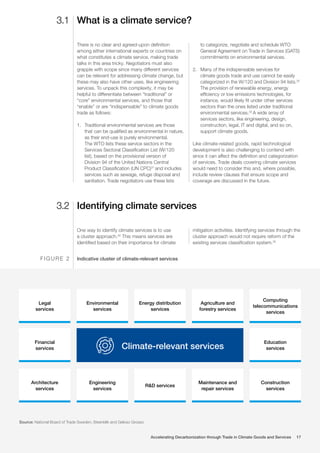
Indicative cluster of climate-relevant services
F I G U R E 2
Source: National Board of Trade Sweden; Steenblik and Geloso Grosso
Legal
services
Financial
services
Education
services
Architecture
services
Environmental
services
Engineering
services
Energy distribution
services
R&D services
Agriculture and
forestry services
Maintenance and
repair services
Computing
telecommunications
services
Construction
services
Climate-relevant services
Accelerating Decarbonization through Trade in Climate Goods and Services 17
An often-heard objection to the liberalization of
so-called dual-use services at the CPC code
level is that it could lead to unintended but wider
liberalization than just for climate purposes. For
example, engineering services can be used for
solar power projects and oil extraction. This could
be overcome by specifying the climate end use
in GATS schedule commitments, working in a
similar way as ex-outs are used to single out
climate goods.36
Services would thus be specified
in more detail than the CPC code to clarify the
climate application. An example is when “general
construction of power plants” (CPC 2.1 code
54262) is specified as an ex-out to cover only
“plants powered by renewable energy”. In the
resulting services schedules, it would be essential
to avoid overlap among sectors, and the scope of
the commitments should be defined clearly and
precisely. In sum, the end use of a service and
its relation to a climate purpose would determine
whether it would be included in an outcome.
Services trade challenges
Existing research37
suggests a host of barriers affect
climate services (defined widely). These include but
are not limited to barriers to setting up in a country,
visa issues, discriminatory tax systems and data
transfer limitations. These barriers mainly lie in
cross-border commercial presence and investment-
related restrictions (mode 3) and the movement
of natural persons (mode 4) (see Figure 3). Due to
technological developments, however, cross-border
supply (mode 1) is gaining importance – such as
the digital monitoring of a wind power project from
abroad. The OECD’s Services Trade Restrictiveness
Index (STRI)38
also shows where services trade
barriers exist. Generally, the STRI demonstrates
that the services sectors with the highest levels of
protection are legal services, accounting services
and rail freight transport. These services are often
relevant for developing renewable energy and public
transport systems.
Trade negotiations can address services barriers
through commitments as well as regulatory
cooperation. Commitments are organized by
“mode of supply”, in other words, how the
services are delivered. Currently, 59 of 164 WTO
members, including the EU, have committed at a
global level to liberalizing trade in environmental
services (in the traditional sense).39
In general,
though, multilateral environmental services
trade liberalization is lower than commitments in
other areas, like tourism, financial services and
telecommunications. This may be due to many
factors, including the role of public entities in
providing environmental services or the propensity
of environmental services to become natural
monopolies (special distribution or collection
networks, high capital investments). Some
governments go further in FTAs. In 2009, the
OECD conducted a survey of the preferential
content of services in regional trade agreements,
finding that roughly 40% of all market-access
commitments for environmental services in
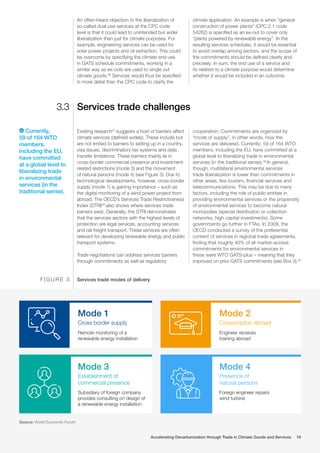
these were WTO GATS-plus – meaning that they
improved on prior GATS commitments (see Box 3).40
Services trade modes of delivery
F I G U R E 3
Mode 1
Cross border supply
Remote monitoring of a
renewable energy installation
Mode 3
Establishment of
commercial presence
Subsidiary of foreign company
provides consulting on design of
a renewable energy installation
Mode 4
Presence of
natural persons
Foreign engineer repairs
wind turbine
Mode 2
Consumption abroad
Engineer receives
training abroad
Source: World Economic Forum
Currently,
59 of 164 WTO
members,
including the EU,
have committed
at a global level to
liberalizing trade
in environmental
services (in the
traditional sense).
3.3
Accelerating Decarbonization through Trade in Climate Goods and Services 18
Community discussions around this report
confirmed that barriers to the provision of climate-
related services have resulted in missed business
opportunities for the sale of climate goods across
multiple markets. LCRs and restrictions on the
movement of professionals can pose significant
barriers to trade. Similar to goods, LCRs for
services are often linked to obtaining low-interest
loans, tender eligibility and grants, feed-in tariffs,
and tax rebates. Professional movement can be
particularly important for deploying renewable
energy in developing countries that might lack a
large pool of skilled technicians to install renewable
energy equipment. Increased trade in climate
services could subsequently facilitate the transfer of
knowledge and improve the skills and employability
of individuals in these countries over the long term.
Another climate-related area affected by services
trade restrictions is renewable energy supply,
transmission, dispatch and distribution. While
multilateral trade rules focus on ensuring market
access, additional measures may be needed to
guarantee the availability of fixed infrastructure
and timely access to energy networks and
distribution systems.41
Additional commitments,
either in an annex to the GATS on energy services
or a reference paper, could be used to address
competition issues, third-party access to fixed
infrastructure, interconnection with energy
networks and grids, transparency, standards
and infrastructure development for clean energy.
Governments have already done this at the WTO for
the telecommunications sector.
The General Agreement on Trade in Services
(GATS) is one of the main pillars of the WTO. The
GATS applies to all service sectors and types of
service supplies. It lays down the general rules and
obligations for trade in services, particularly the
MFN obligation and principles of proportionality
and transparency. WTO members must publish
and notify measures affecting trade in services.
Various GATS annexes contain clarifications and
specific provisions relating to natural persons
supplying services, air transport services,
financial services, maritime transport services
and telecommunications services. The lists of
commitments and exemptions from the MFN
obligation of WTO members contain the specific
market access rights for foreign service suppliers.
Each member inscribes in its list those service
sectors in which it grants market access to foreign
suppliers and sets out quantitative restrictions
(quotas, need clauses, monopolies), limitations
on the form of juridical persons and foreign
participation in corporate capital as well as
reservations on national treatment.
FTAs often contain “negative-listing” of sectors,
meaning that countries list the sectors they will
not liberalize (thus, “negative” listing) in their
schedules. Sectors not included in the schedules
are therefore fully liberalized – which is usually
more ambitious and the opposite of “positive”
listing of sectors under GATS.
The relationship between the GATS and FTAs
B O X 3
Accelerating Decarbonization through Trade in Climate Goods and Services 19
Proposed climate services list
3.4
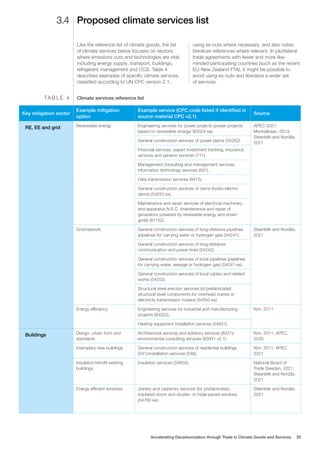
Like the reference list of climate goods, the list
of climate services below focuses on sectors
where emissions cuts and technologies are vital,
including energy supply, transport, buildings,
refrigerant management and CCS. Table 4
describes examples of specific climate services,
classified according to UN CPC version 2.1,
using ex-outs where necessary, and also notes
literature references where relevant. In plurilateral
trade agreements with fewer and more like-
minded participating countries (such as the recent
EU-New Zealand FTA), it might be possible to
avoid using ex-outs and liberalize a wider set
of services.
Climate services reference list
TA B L E 4
Key mitigation sector
Example mitigation
option
Example service (CPC code listed if identified in
source material CPC v2.1)
Source
RE, EE and grid Renewable energy Engineering services for power projects (power projects
based on renewable energy) (83324 ex).
APEC 2021;
Monkelbaan, 2013;
Steenblik and Nordås,
2021
General construction services of power plants (54262).
Financial services, expert investment banking, insurance
services and pension services (711).
Management consulting and management services,
information technology services (831).
Data transmission services (8415).
General construction services of dams (hydro-electric
dams) (54233 ex).
Maintenance and repair services of electrical machinery
and apparatus N.E.C. (maintenance and repair of
generators powered by renewable energy and smart
grids) (87152).
Grid/network General construction services of long-distance pipelines
(pipelines for carrying water or hydrogen gas) (54241).
Steenblik and Nordås,
2021
General construction services of long-distance
communication and power lines (54242).
General construction services of local pipelines (pipelines
for carrying water, sewage or hydrogen gas) (54241 ex).
General construction services of local cables and related
works (54252).
Structural steel erection services (of prefabricated
structural steel components for overhead cranes or
electricity transmission towers) (54550 ex).
Energy efficiency Engineering services for industrial and manufacturing
projects (83322).
Kim, 2011
Heating equipment installation services (54631).
Buildings Design, urban form and
standards
Architectural services and advisory services (8321)/
environmental consulting services (83931 v2.1).
Kim, 2011; APEC,
2020
Exemplary new buildings General construction services of residential buildings
(541)/installation services (546).
Kim, 2011; APEC
2021
Insulation/retrofit existing
buildings
Insulation services (54650). National Board of
Trade Sweden, 2021;
Steenblik and Nordås,
2021
Energy efficient windows Joinery and carpentry services (for prefabricated,
insulated doors and double- or triple-paned window)
(54760 ex).
Steenblik and Nordås,
2021
Accelerating Decarbonization through Trade in Climate Goods and Services 20
Climate services reference list continued
TA B L E 4
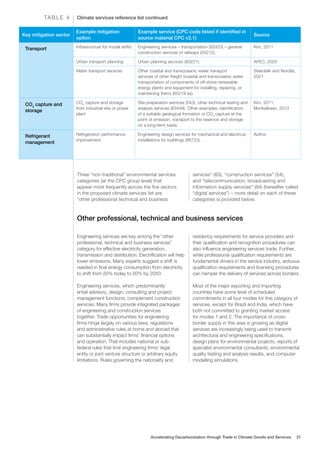
Transport Infrastructure for modal shifts Engineering services – transportation (83323) – general
construction services of railways (54212).
Kim, 2011
Urban transport planning Urban planning services (83221). APEC, 2020
Water transport services Other coastal and transoceanic water transport
services of other freight (coastal and transoceanic water
transportation of components of off-shore renewable
energy plants and equipment for installing, repairing, or
maintaining them) (65219 ex).
Steenblik and Nordås,
2021
CO2
capture and
storage
CO2
capture and storage
from industrial site or power
plant
Site preparation services (543), other technical testing and
analysis services (83449). Other examples: identification
of a suitable geological formation or CO2
capture at the
point of emission, transport to the reservoir and storage
on a long-term basis.
Kim, 2011;
Monkelbaan, 2013
Refrigerant
management
Refrigeration performance
improvement
Engineering design services for mechanical and electrical
installations for buildings (86723).
Author
Key mitigation sector
Example mitigation
option
Example service (CPC code listed if identified in
source material CPC v2.1)
Source
Three “non-traditional” environmental services
categories (at the CPC group level) that
appear most frequently across the five sectors
in the proposed climate services list are
“other professional technical and business
services” (83), “construction services” (54),
and “telecommunication, broadcasting and
information supply services” (84) (hereafter called
“digital services”) – more detail on each of these
categories is provided below.
Other professional, technical and business services
Engineering services are key among the “other
professional, technical and business services”
category for effective electricity generation,
transmission and distribution. Electrification will help
lower emissions. Many experts suggest a shift is
needed in final energy consumption from electricity
to shift from 20% today to 50% by 2050.
Engineering services, which predominantly
entail advisory, design, consulting and project
management functions, complement construction
services. Many firms provide integrated packages
of engineering and construction services
together. Trade opportunities for engineering
firms hinge largely on various laws, regulations
and administrative rules at home and abroad that
can substantially impact firms’ financial options
and operation. That includes national or sub-
federal rules that limit engineering firms’ legal
entity or joint venture structure or arbitrary equity
limitations. Rules governing the nationality and
residency requirements for service providers and
their qualification and recognition procedures can
also influence engineering services trade. Further,
while professional qualification requirements are
fundamental drivers in the service industry, arduous
qualification requirements and licensing procedures
can hamper the delivery of services across borders.
Most of the major exporting and importing
countries have some level of scheduled
commitments in all four modes for this category of
services, except for Brazil and India, which have
both not committed to granting market access
for modes 1 and 2. The importance of cross-
border supply in this area is growing as digital
services are increasingly being used to transmit
architectural and engineering specifications,
design plans for environmental projects, reports of
specialist environmental consultants, environmental
quality testing and analysis results, and computer
modelling simulations.
Accelerating Decarbonization through Trade in Climate Goods and Services 21
Construction and infrastructure services
Construction services implement various
mitigation options across multiple sectors,
including energy supply, transport, buildings,
industry and waste. An important driver for the
sector, particularly in the developed world, is
increased spending on infrastructure and non-
residential development. Government procurement
practices are crucial, too, given that the sector’s
most significant client segment is the public
sector. Preferential treatment for local companies
or minimum requirements for financial support that
are favourable to local companies often hinder
market entry for foreign providers.
Construction projects require much local activity
because they are highly intensive in labour and
materials. Commitments around mode 3 and
mode 4 are essential here. Yet, restrictions on
commercial presence are generally the most
common barriers to trade in the construction
service sector. Limitations on investment take
the form of firm ownership rules, the type of legal
entity for a foreign company (e.g. mandatory local
incorporation), the number of suppliers and the
value of transactions or assets, among others.
Limitations in mode 4 might include limited
recognition of services providers’ qualifications
from third countries and restrictions on foreign
nationals’ acquisition of land and real estate.
Restrictions on land and real estate use or
ownership, along with other restrictions, can
significantly impact the provision of construction
services, as these restrictions prevent property
developers from acquiring real estate under
construction until the completion of the project.42
Opaque, expensive and overly bureaucratic
administrative processes of construction permits
increase transaction costs and business risks,
resulting in lower investment in new infrastructure
and buildings.
Digital services
Digital tools can help consumers make greener
choices – such as through eco-routing in digital
maps and making emissions from transport
and energy use more visible.43
Cloud-based
computing may be more energy efficient than
on-premise (and non-traded) services based on
local servers.44
After-sales services powered by ICT
are particularly important when products are sold
overseas and the customer is distant. Sensors and
big data aggregation facilitate better monitoring,
parts replacement and so on. Interviewees also
highlighted the importance of digital services and
grid aggregation technology in managing “smart”
electricity networks. These services can play a
vital role in ensuring efficient grid management and
supporting the integration of a greater proportion
of renewable energy into the system. Delivering
such services often relies on data flows (mode
1), and governments’ data flow restrictions are
growing. Equally, the use of new technologies in
certain markets or for particular applications may
increasingly be regulated.
Opaque,
expensive and
overly bureaucratic
administrative
processes of
construction
permits increase
transaction costs
and business risks
resulting in lower
investment.
Accelerating Decarbonization through Trade in Climate Goods and Services 22
Developing
country priorities
4
Involving developing countries in climate goods
and services trade is essential for building an
inclusive, global net-zero economy.
Accelerating Decarbonization through Trade in Climate Goods and Services 23
A just transition
Green jobs
4.1
4.2
For many developing countries, the energy
transition is first and foremost about energy
access. Worldwide, 759 million people do not
have access to electricity, mainly in Sub-Saharan
Africa and South Asia. Electrification is critical
for both a just and green transition. From an
industry perspective, developing countries must
also secure access to clean energy for exporting
companies since many firms and investors will
prioritize emissions reductions in supply chains.
Positively, South-South trade in electrification
and clean energy technologies such as solar
photovoltaic cells and modules, batteries, wind-
powered generating sets, hydraulic turbines and
biomass generation-related products is growing
faster than global trade in the same products.45
Most of the growth, however, has been
regionally concentrated in East and South-
East Asia.46
More developing countries need
to be brought into these value chains. Many
low-income countries can access the EU, US,
Japan and other advanced economy markets
through development-related preferential tariff
schemes. That means some gains may come
from lowering tariffs between low- and middle-
income countries.47
A lot of developing countries –
particularly in Africa, the Pacific and parts of Latin
America – have not engaged in EGS-related trade
talks in the past. Both public and private sectors
in advanced economies should work to change
that through targeted outreach and technical
assistance. For example, technical assistance can
focus on links between countries’ decarbonization
plans and the types of goods in focus and
connections made to low-carbon manufacturing.
Technology transfer discussions will be an
important complement – including carefully
synergizing between Paris Agreement
commitments in this area. In terms of climate
services, many have argued that, by improving
access to environmental know-how and
technology, liberalization will also lead to
greater environmental protection and access to
sustainable energy within developing countries,
thereby providing a ‘win-win-win’ outcome for
socioeconomic development, the environment
and trade.48
Further, some developing countries may not
have export interests in climate goods now,
but they may foresee developing such interests
in the future. Costa Rica, for example, joined
the Information Technology Agreement (ITA)
in 1997 when it had no exports of IT-related
products. By joining the ITA, Costa Rica attracted
investments in IT, and for several years, 20% of
Costa Rica’s exports consisted of IT products.49
Non-tariff barriers may pose a bigger challenge
for developing to developed economy trade
since firms in low-income countries may have
more difficulty meeting technical requirements or
may not have similar standards. A global value
chain approach might also consider intermediate
products and components that many developing
countries produce.50
Green jobs are a priority for most countries.
Politicians often champion the production and use
of climate goods. The International Renewable
Energy Agency (IRENA) estimates the renewable
energy sector alone employed 11.5 million people
in 2020.51
Facilitating climate goods trade may
bring new industries to developing communities.
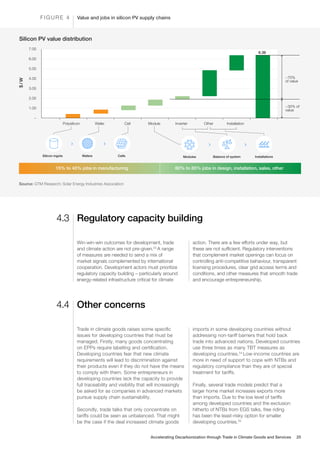
An older study on imported solar technology in
India showed that 70% of the value created by
solar projects and approximately 60-85% of the
jobs were downstream of manufacturing (and
related to design, installation, sales and other
areas), while only 15-40% of the jobs generated
were in upstream manufacturing (see Figure 4).52
These figures have likely grown with increased
climate commitments under the Paris Agreement.
Supplier emissions reduction programmes through
companies’ value chains may also help create
demand for climate goods and services within
developing economies and associated jobs.
By joining
the ITA, Costa
Rica attracted
investments in IT,
and for several
years, 20% of
Costa Rica’s
exports consisted
of IT products.
Accelerating Decarbonization through Trade in Climate Goods and Services 24
Value and jobs in silicon PV supply chains
F I G U R E 4
1.00
Polysilicon
Silicon ingots Modules Balance of system Installations
Wafers Cells
Wafer Cell Module Inverter Other Installation
~70%
of value
~30% of
value
6.36
–
2.00
3.00
4.00
5.00
6.00
7.00
Silicon PV value distribution
$
/
W
15% to 40% jobs in manufacturing 60% to 85% jobs in design, installation, sales, other
Source: GTM Research; Solar Energy Industries Association
Regulatory capacity building
Other concerns
4.3
4.4
Win-win-win outcomes for development, trade
and climate action are not pre-given.53
A range
of measures are needed to send a mix of
market signals complemented by international
cooperation. Development actors must prioritize
regulatory capacity building – particularly around
energy-related infrastructure critical for climate
action. There are a few efforts under way, but
these are not sufficient. Regulatory interventions
that complement market openings can focus on
controlling anti-competitive behaviour, transparent
licensing procedures, clear grid access terms and
conditions, and other measures that smooth trade
and encourage entrepreneurship.
Trade in climate goods raises some specific
issues for developing countries that must be
managed. Firstly, many goods concentrating
on EPPs require labelling and certification.
Developing countries fear that new climate
requirements will lead to discrimination against
their products even if they do not have the means
to comply with them. Some entrepreneurs in
developing countries lack the capacity to provide
full traceability and visibility that will increasingly
be asked for as companies in advanced markets
pursue supply chain sustainability.
Secondly, trade talks that only concentrate on
tariffs could be seen as unbalanced. That might
be the case if the deal increased climate goods
imports in some developing countries without
addressing non-tariff barriers that hold back
trade into advanced nations. Developed countries
use three times as many TBT measures as
developing countries.54
Low-income countries are
more in need of support to cope with NTBs and
regulatory compliance than they are of special
treatment for tariffs.
Finally, several trade models predict that a
larger home market increases exports more
than imports. Due to the low level of tariffs
among developed countries and the exclusion
hitherto of NTBs from EGS talks, free riding
has been the least-risky option for smaller
developing countries.55
Accelerating Decarbonization through Trade in Climate Goods and Services 25
Conclusion
Environmental goods and services trade talks have
made limited progress over the years. The urgency
of climate action calls for accelerated efforts in all
policy areas, and trade is no exception. Ideally, the
broadest number of countries would create a list
of climate goods for trade facilitation and develop
an open architecture that others can join in time.
The Climate Trade Zero community recommends
starting with a tight, focused and actionable list of
items that both hold the greatest potential for cutting
emissions and are economically viable in terms of
cost savings. Even if the scope is small, such an
outcome could demonstrate to global markets that
certain governments are serious about aligning their
commercial and economic policies with climate
action. Over the long term, more goods can be
added, including dual-use goods and EPPs, as long
as they are carefully specified to target climate uses.
Businesses and experts can identify essential
technologies and inputs critical for decarbonization.
They can share trade-related challenges and
champion greater distribution worldwide.
Researchers can provide support by modelling the
impact of tariff rate reductions and understanding
NTBs. It would be particularly helpful to have
NTB information by major product category and
at a country level since this level of granularity is
necessary for effective regulatory cooperation.
Multistakeholder groups could evaluate suggested
products and services for environmental credibility
in the short term and update policy-makers on
technological change in time. It is crucial for
trade talks seeking to have a specific impact – like
aligning trade flows with decarbonization – to use
“living lists”.56
There are precedents such as the
WTO Pharmaceuticals Agreement, the GPA and
the ITA that were designed as living agreements
or agreements that could be updated over time.
If done under the WTO umbrella, other initiatives
could be marshalled to support a plurilateral
deal, including:
1. Implementing the Trade Facilitation Agreement
(TFA) to help border officials deal with evolutions
in customs codes.
2. Technical assistance and capacity building
– on everything from identifying priority trade
flows to support on implementation – through
Aid for Trade (AfT) efforts and the Enhanced
Integrated Framework designed to support least
developed countries (LDC) trade.
3. Coordinating with relevant WTO bodies
such as the TBT Committee for guidance on
best practices on standards and technical
regulations (including information on national
implementation of international standards).
Accelerating Decarbonization through Trade in Climate Goods and Services 26
4. Facilitating trade in services that are
indispensable for using the goods mentioned in
this report through work in the Committee on
Trade in Services (CTS).
5. Facilitating foreign direct investment to address
administrative breaks on capital flows in
climate mitigation and adaptation projects.
Political realities being what they are, a
climate trade deal can still be championed
by a smaller group of nations, as the ACCTS
negotiations demonstrate. Countries may wish
to explore options regionally or bilaterally. The
following additional steps will be vital for a truly
comprehensive outcome, which countries could
take over time:
– Identify and liberalize indispensable inputs to
climate goods and include products of
interest to developing countries, like nature-
based products.
– Commit to cooperation in the WCO to better
align the HS nomenclature to support the
climate transition (including through the next
WCO HS update in 2027).
– Broaden the scope of talks on climate goods
beyond tariffs and include NTBs.
– Broker mutual recognition agreements (MRAs)
on conformity assessment for climate goods.57
Through MRAs, the outcomes from conformity
assessments of one party can assess products
for import against the requirements of the other
party and vice versa.
– Deliver outcomes on climate services trade.
– Complement climate services trade talks
with regulatory capacity building, including
coordinating with existing development
programmes, such as those run by multilateral
or regional development banks.
– Scope trade support for key climate adaptation
technologies.
Climate trade efforts must not be done in a vacuum
but in conjunction with various interventions, including
supporting those unable to bear transition costs.
Such support could include incentives to boost
employment in green sectors, retraining to build
new skills and capacities, and financial assistance
packages to SMEs – especially in developing
countries. Trade liberalization can sometimes
cause communities to lose jobs in specific sectors;
countries engaging in climate trade talks should
evaluate specific items carefully to understand where
there are risks and how best to manage those as part
of an overall climate action strategy.
To support this movement, the Climate Trade
Zero community will continue to host dialogue
and explore country-specific analysis. Countries
need to be supported in understanding the links
between industry decarbonization and trade
competitiveness; that means examining both
imports and exports in key value chains. Doing
so can help countries determine which climate
goods and services they may have a competitive
advantage in exporting (and what needs to be
imported), which export industries will be most
affected by climate transition efforts and what viable
technological or alternative pathways exist. Global
and local industries are best placed to help policy-
makers understand the criss-crossing of value
chains that drive economic activity in their country
and how to align these flows to the climate agenda.
Accelerating Decarbonization through Trade in Climate Goods and Services 27
Contributors
World Economic Forum
Joachim Monkelbaan
Climate Trade Lead
Soumyajit Kar
Specialist, Sustainable Trade
The project team would like to thank all
the experts and reviewers who contributed
to shaping this insight report.
Accelerating Decarbonization through Trade in Climate Goods and Services 28
1. Monkelbaan, J., M. Sugathan and A. Naranjo, Environmental Goods and Services: Questions and Possible Ways Forward
in the TESSD, Working Paper No. 2 in Trade and Environmental Sustainability Series, Quaker United Nations Office, 2021.
2. National Board of Trade Sweden, Making Green Trade Happen – Environmental Goods and Indispensable Services, 2014,
https://www.kommerskollegium.se/globalassets/publikationer/rapporter/2016-och-aldre/making-green-trade-happen
webb.pdf.
3. Some World Trade Organization (WTO) disputes related to renewable energy and local content requirements (LCRs)
include: the Canada renewable energy case launched in 2010 by Japan against the province of Ontario’s feed-in tariff
(FIT) programme, the China wind power case raised in 2010 by the US, the India solar modules case brought by the US
in 2013, and the UK low-carbon energy contracts for a different complaint raised by the EU in 2022.
4. Kuriyama, C., “A Review of the APEC List of Environmental Goods”, APEC, 2021, https://www.apec.org/docs/default-
source/Publications/2021/10/A-Review-of-the-APEC-List-of-Environmental-Goods/221_PSU_Review-of-APEC-List-of-
Environmental-Goods.pdf.
5. When ex-outs are used, participants at the start of the negotiations may have slightly different descriptions of those
technologies in their national tariff schedules and must therefore negotiate a commonly agreed description or add further
sub-categorisations at 8-, 9- and 10-digit levels. The WTO’s Information Technology Agreement (ITA), Agreement on
Trade in Civil Aircraft, and Agreement on Trade in Pharmaceutical Products all involve ex-outs.
6. Steenblik, R., Code Shift: The Environmental Significance of the 2022 Amendments to the Harmonized System,
International Institute for Sustainable Development, 2020. For an overview of the timelines for the HS2027 review, also
see Grooby G., “Some common questions about the HS, and how to change it to meet needs”, WCO News, 98, issue 2,
2022, https://mag.wcoomd.org/magazine/98-issue-2-2022/some-common-questions-hs/.
7. National Board of Trade Sweden, Trade and Climate Change – promoting climate goals with a WTO agreement, 2021,
https://www.kommerskollegium.se/en/publications/reports/2021/trade-and-climate-change/.
8. Brenton, Paul and Vicky Chemutai, The Trade and Climate Change Nexus: The Urgency and Opportunities for Developing
Countries, World Bank Group, 2021, https://openknowledge.worldbank.org/handle/10986/36294.
9. Forster, Hector, “Low Emissions Steel Standards Needed to Market Green Steel: ArcelorMittal”, S&P Global, 20 January
2021, https://www.spglobal.com/platts/en/market-insights/latest-news/metals/012021-low-emissions-steel-standards-
needed-to-market-green-steel-arcelormittal. A recent initiative by Responsible Steel and The Climate Group (SteelZero)
is looking at defining low-carbon steel. Research is also available on augmenting green steel demand, see Energy
Transitions Commission, Steeling Demand: Mobilising buyers to bring net-zero steel to market before 2030, 2021,
https://www.energy-transitions.org/publications/steeling-demand/.
10. IPCC, Climate Change 2022: Mitigation of Climate Change, 2022, https://www.ipcc.ch/report/sixth-assessment-report-
working-group-3/.
11. Dekens, J., A. Hammill, D. Hoffmann and C. Bellmann, Leveraging trade to support climate adaptation in developing
countries, International Institute for Sustainable Development, 2021.
12. APEC, Scoping Study on New and Emerging Environmental Goods, 2021, https://www.apec.org/publications/2021/12/
scoping-study-on-new-and-emerging-environmental-goods#:~:text=This%20study%20provides%20new%20
research,other%20plurilateral%20and%20multilateral%20forums.
13. Vossenaar, Rene, Identifying Products with Climate and Development Benefits for an Environmental Goods Agreement,
ICTSD, 2014; Reinsch, William, E. Benson and C. Puga, Environmental Goods Agreement: A New Frontier or an Old
Stalemate? CSIS, 2021, https://csis-website-prod.s3.amazonaws.com/s3fs-public/publication/211028_Reinsch_
Environmental_Goods_0.pdf?QkV7SYIFwwxpGM0DdiDst4CuNPk4.ayI.
14. ABB, Achieving the Paris Agreement: The vital role of high-efficiency motors and drives in reducing energy consumption,
2021, https://www.energyefficiencymovement.com/wp-content/uploads/2021/03/ABB_MotionEnergyEfficiency_
WhitePaper.pdf.
15. “Hydrogen”, IEA, https://www.iea.org/fuels-and-technologies/hydrogen.
16. For a detailed overview of cleaner road transport goods and electric vehicles, see National Board of Trade, Trade Barriers
to Goods and Services Important for Climate Action, 2020, Annex I, https://www.kommerskollegium.se/en/publications/
reports/2020/trade-barriers-to-goods-and-services-important-for-climate-action--and-opportunities-for-reform/.
17. De Melo, Jaime and Jean-Marc Solleder, “What’s wrong with the WTO’s environmental goods agreement”, VoxEU, 2019,
https://voxeu.org/article/what-s-wrong-wto-s-environmental-goods-agreement.
18. Wooders, Peter, Greenhouse Gas Emission Impacts of Liberalizing Trade in Environmental Goods, IISD, 2009,
https://www.iisd.org/system/files/publications/bali_2_copenhagen_egs.pdf.
19. The modelling approach used was subject to limitations, for example, not fully capturing effects on global value chains
and aggregation issues, which make it difficult to capture effects at a product level. In addition, the modelling only partially
captures the technique effect, includes dual-use products that would not have been included under the agreement due to
the use of ex-outs and addresses a different set of goods than those included in the environment goods agreement lists
(due to confidentiality).
Endnotes
Accelerating Decarbonization through Trade in Climate Goods and Services 29
20. McKinsey, Climate math: What a 1.5-degree pathway would take, 2020.
21. International Energy Agency (IEA), Net Zero by 2050: A Roadmap for the Global Energy Sector, 2021.
22. United Nations Conference on Trade and Development (UNCTAD) and World Bank Group, The unseen impact of non-tariff
measures, 2018, https://unctad.org/webflyer/unseen-impact-non-tariff-measures-insights-new-database.
23. De Melo, Jaime and Jean-Marc Solleder, “The role of an Environmental Goods Agreement in the quest to improve the
regime complex for Climate Change”, EUI Working Paper, 2019.
24. Organisation for Economic Co-operation and Development (OECD), Business Perceptions of Non-Tariff Barriers (NTBs)
Facing Trade in Selected Environmental Goods and Associated Services: Survey Results, COM/ENV/TD(2006)48/FINAL,
2007.
25. Monkelbaan, J., Trade Sustainability Impact Assessment on the Environmental Goods Agreement, EU publications, 2016.
26. UNCTAD, International Classification of Non-tariff Measures, 2019; The International Classification of non-tariff measures
(NTMs) follows a taxonomy of all measures considered relevant in today’s international trade. It comprises technical
measures and other measures traditionally used as instruments of commercial policy, e.g. quotas, price control, exports
restrictions or contingent trade protective measures. Finally, the international classification of NTMs also comprises
behind-the-border measures, such as competition, trade-related investment measures, government procurement or
distribution restrictions. This classification is determined by a group of eight international organizations, including the
International Monetary Fund (IMF), the OECD, the World Bank and the WTO.
27. “How do Technical Barriers to Trade impact trade in environmental goods”, UK Department for International Trade,
19 July 2022.
28. International Energy Agency, Test Procedures and Quality Labels for Heat Pump Water Heaters, 2019,
https://heatpumpingtechnologies.org/annex46/wp-content/uploads/sites/53/2020/10/hpt-an46-05-task-1-test-
procedures-and-quality-labels-for-heat-pump-water-heaters.pdf.
29. World Economic Forum, Delivering a Climate Trade Agenda: Industry Insights, 2021, https://www3.weforum.org/docs/
WEF_Delivering_a_Climate_Trade_Agenda_2021.pdf.
30. OECD, Overcoming Barriers to International Investment in Clean Energy, Green Finance and Investment, 2015.
31. WTO, Services Sectoral Classification List, 1991, https://www.wto.org/english/tratop_e/serv_e/mtn_gns_w_120_e.doc.
32. In a joint proposal tabled already in 2007 under Paragraph 31(iii) of the Doha Declaration, the United States and
European Union argued that services that enabled members to fulfil climate change-related objectives included not only
environmental services (such as air pollution control and climate control services), but also technical testing and analysis
services (e.g. air composition and purity testing services), energy-related services (e.g. engineering and maintenance
services to optimize the environmental performance of energy facilities), and services for the design and construction of
energy-efficient buildings and facilities. Proposal for a Result under Paragraph 31(iii) of the Doha Ministerial Declaration,
non-paper by the European Union and the United States (JOB(07)/193/rev.1), 2007.
33. See Committee on Specific Commitments, “Services related to climate change”, Informal Note by the WTO Secretariat
(JOB/SERV/100), 2012.
34. Steenblik, R. and M. Geloso Grosso, Trade in Services Related to Climate Change: An Exploratory Analysis, OECD, 2011.
35. National Board of Trade Sweden, Trade and Climate Change Promoting climate goals with a WTO agreement, 2021.
36. Kim, J. A., Facilitating Trade in Services Complementary to Climate-friendly Technologies, ICTSD, 2011.
37. For example, Monkelbaan, J., Trade Sustainability Impact Assessment on the Environmental Goods Agreement, EU
publications, 2016; Sauvage, J. and C. Timiliotis, Trade in services related to the environment, OECD, 2017.
38. OECD.Stat, Services Trade Restrictiveness Index [Table], https://stats.oecd.org/Index.aspx?DataSetCode=STRI.
39. WTO, WTO members engage in exploratory talks on market access for environmental services [Press release], 30
September 2019.
40. de Melo, Jaime, and Mariana Vijil, “The Critical Mass Approach to Achieve a Deal on Green Goods and Services: What is
on the Table? How Much to Expect?” FEEM Working Paper No. 070.2014, http://dx.doi.org/10.2139/ssrn.2486445.
41. International Centre for Trade and Sustainable Development (ICTSD), “Enabling the Energy Transition and Scale-Up of
Clean Energy Technologies: Options for the Global Trade System”, E15 Expert Group on Clean Energy Technologies and
the Trade System, Policy Options Paper, 2016.
42. Geloso Grosso, M., Trade and Regulation: The Case of Construction Services, OECD, 2008.
43. See for example: “Environmental Insights Explorer”, Google, n.d. https://insights.sustainability.google/.
44. While the amount of computing done in global data centres increased by about 550% between 2010 and 2018,
the amount of energy consumed by data centres grew by only 6% during the same period. See Masanet E., et al.,
“Recalibrating global data center energy-use estimates”, Science, vol. 367, no. 6481, 2020.
45. United Nations Environment Programme (UNEP), South-South Trade in Renewable Energy: A Trade Flow Analysis of
Selected Environmental Goods, 2014.
46. Ibid.
47. Brenton, P. and V. Chemutai, The Trade and Climate Change Nexus: The Urgency and Opportunities for Developing
Countries, World Bank Group, 2021, https://openknowledge.worldbank.org/handle/10986/36294.
Accelerating Decarbonization through Trade in Climate Goods and Services 30
48. Teehankee, M., Trade and Environment Governance at the World Trade Organization Committee on Trade and Environment,
Kluwer Law International, 2020.
49. Monkelbaan, J., M. Sugathan and A. Naranjo, Environmental Goods and Services: Questions and Possible Ways Forward
in the TESSD, Working Paper No. 2 in Trade and Environmental Sustainability Series, Quaker United Nations Office, 2021.
50. For example, building a concentrated solar power system requires materials such as steel, copper, silica and molten salt,
as well as components such as collectors, mirrors, reflector film, steam generators, heat collection elements, heat storage
and central control systems.
51. International Renewable Energy Agency (IRENA), Renewable Energy Jobs Continue Growth to 11.5 Million Worldwide
[Press release], 29 September 2020.
52. Council on Energy, Environment and Water (CEEW), Natural Resources Defence Coucil (NRDC), Laying the Foundation for
a Bright Future: Assessing Progress Under Phase 1 of India’s National Solar Mission, 2012.
53. Trade and Environment, Kluwer Law International, 2020.
54. UNCTAD and the World Bank, The unseen impact of non-tariff measures, 2018, https://unctad.org/webflyer/unseen-
impact-non-tariff-measures-insights-new-database.
55. Wu, Mark, “Why Developing Countries Won’t Negotiate: The Case of the WTO Environmental Goods Agreement”, Trade,
Law, and Development, vol. 6, no. 1, 2014, pp. 93-176.
56. Cosbey, Aaron, Breathing Life into the List: Practical Suggestions for the Negotiators of the Environmental Goods
Agreement, FES, 2015.
57. Sugathan, Mahesh, Mutual Recognition Agreement on Conformity Assessment: A Deliverable on Non-Tariff Measures for
the EGA?, ICTSD, 2016.
Accelerating Decarbonization through Trade in Climate Goods and Services 31
World Economic Forum
91–93 route de la Capite
CH-1223 Cologny/Geneva
Switzerland
Tel.: +41 (0) 22 869 1212
Fax: +41 (0) 22 786 2744
contact@weforum.org
www.weforum.org
The World Economic Forum,
committed to improving
the state of the world, is the
International Organization for
Public-Private Cooperation.
The Forum engages the
foremost political, business
and other leaders of society
to shape global, regional
and industry agendas.

WEF Accelerating Decarbonization through Trade 2022

  • 1.
    Accelerating Decarbonization through Tradein Climate Goods and Services I N S I G H T R E P O R T S E P T E M B E R 2 0 2 2
  • 2.
    Contents Preface Executive summary Introduction 1 Climategoods trade 1.1 Categorizing relevant items 1.2 Proposed climate goods list 1.3 Tariff profiles 1.4 Potential emissions reductions 2 Non-tariff barriers 2.1 Challenges to consider 2.2 Climate NTBs 3 Trade in climate services 3.1 What is a climate service? 3.2 Identifying climate services 3.3 Services trade challenges 3.4 Proposed climate services list 4 Developing country priorities 4.1 A just transition 4.2 Green jobs 4.3 Regulatory capacity building 4.4 Other concerns Conclusion Contributors Endnotes 3 4 5 7 8 8 10 11 12 13 13 16 17 17 18 20 23 24 24 25 25 26 28 29 Images: Getty images, Unsplash, Pexels © 2022 World Economic Forum. All rights reserved. No part of this publication may be reproduced or transmitted in any form or by any means, including photocopying and recording, or by any information storage and retrieval system. Disclaimer This document is published by the World Economic Forum as a contribution to a project, insight area or interaction. The findings, interpretations and conclusions expressed herein are a result of a collaborative process facilitated and endorsed by the World Economic Forum but whose results do not necessarily represent the views of the World Economic Forum, nor the entirety of its Members, Partners or other stakeholders. Accelerating Decarbonization through Trade in Climate Goods and Services 2
  • 3.
    Preface As the worldlooks to transition to new, decarbonized production and consumption systems rapidly, a great number of climate-related technologies and services need to be deployed. Trade can be a critical means of reducing costs and spreading these innovations to new markets. Addressing trade barriers can speed up that process, leading to gains for consumers and businesses shouldering the climate transition while opening new markets for exporters. Lowering trade barriers could equally encourage greater foreign direct investment into climate-related projects. It is vital that climate goods and services trade is understood in order to structure market signals, incentives and partnerships. Many governments increasingly realize the potential in this space. The World Economic Forum is contributing to ongoing discussions at the World Trade Organization (WTO) on trade and the environment. Other trade talks in regional and bilateral settings are also under way. To encourage timely outcomes, this report highlights top climate technologies and services that help reduce emissions, which trade policy- makers should focus on. The insights are based on the Forum’s Climate Trade Zero initiative and community discussions that bring together trade and climate experts from all regions. We must accelerate our response to climate change. Yet, leaders across the globe know they need to do so in a way that brings opportunities, jobs and prosperity to all parts of society. Trade is an engine of growth, and this engine must be rewired to support the spread of green technologies and services. No country and company can do that alone. Through thoughtful trade collaboration, we stand a better chance of realizing a net-zero economic future. Trade, investment and international partnerships can deliver the markets and innovations needed to address climate change. Børge Brende President, World Economic Forum Kimberley Botwright Head, Sustainable Trade, World Economic Forum Accelerating Decarbonization through Trade in Climate Goods and Services September 2022 3 Accelerating Decarbonization through Trade in Climate Goods and Services
  • 4.
    Executive summary Trade cansupport climate action Trade can help spread climate-friendly technologies around the world. Wind turbines contain around 9,000 components traded in global and regional value chains, electric cars are made from components sourced in many countries, and global heat pump markets are growing. Services trade supports climate technology roll out, like monitoring wind turbine performance to repair faulty parts, or engineering advisory, design, consulting and project management functions that deliver clean energy projects. As well as increasing availability, trade in climate goods and services can reduce costs and increase choice, making industries dependent on emissions savings more competitive. Government collaboration has been mixed, but action is needed now Governments have long recognized the importance of a broader push for more environmental goods and services trade. Yet efforts to work together to reduce barriers – from tariffs to regulatory complexity or limitations on foreign suppliers – have been mixed. The urgency of climate action means the time is ripe for a renewed, focused collaboration on boosting trade in climate goods and services. Trade in 25 climate goods could help emissions reductions This report presents a list of 25 key climate technologies that trade policy-makers could prioritize in discussions. These were identified based on three sectors that will play an essential role in reaching net-zero emissions, according to the Intergovernmental Panel on Climate Change (IPCC), including energy supply, transport and buildings. Goods for carbon capture and storage (CCS) and refrigerant management are also included as these are promising for decarbonization too. Technologies proposed include wind and solar power, heat pumps, alternative refrigerants, insulation, efficient motors, LED lighting, smart thermostats, electric cars and biogas stoves. A longer list is also available that indicates inputs to key technologies and relevant tariff codes. That information is specifically designed to help policy- makers explore value chains and areas of most interest to their national context. Non-tariff barriers matter more than tariffs A tariff-cutting deal on climate goods would send an important message. It would demonstrate that participating governments are serious about aligning their commercial and economic policies with climate action. Most research to date also notes the importance of addressing non-tariff barriers (NTBs) – like different testing and certification requirements for safely placing a product on a market. The report lists seven types of NTBs and suggests priorities for further work. Services trade restrictions slow down climate goods distribution Interviews for this report confirmed that trade barriers to providing climate-related services have resulted in missed business opportunities for the sale of climate goods. The report presents a list of climate services, associated with the five sectors targeted for increased climate goods trade, to encourage trade policy efforts. The list includes “core” environmental services and services that “enable” or are “indispensable” to climate goods trade. Developing countries must be included, and value chain competitiveness can help Globally, 759 million people do not have access to electricity, even though it is vital for development and clean energy solutions. Developing countries equally need to secure clean energy supplies to power companies engaged in global value chains as attention grows around supplier emissions. While south-south trade in clean energy technologies is growing, developed country markets could be opened up through regulatory cooperation in areas such as standards and technical requirements for key products. A climate trade deal can start targeted and grow over time A trade deal among a broad number of interested countries focused on a tight list of items with significant potential for cutting emissions would be a positive move. The agreement could be broadened in time, especially as policy-makers build up confidence in trade collaboration and undertake effective capacity building. The Climate Trade Zero community stands ready to support these and other efforts aimed at maximizing the positive contribution that trade can make to addressing climate change. Boosting trade in specific climate action- related technologies and services could help encourage emissions reductions in industries and homes worldwide. 4 Accelerating Decarbonization through Trade in Climate Goods and Services
  • 5.
    Introduction Trade can supportclimate action by increasing the availability of climate-friendly technologies. Reducing trade barriers around these items encourages their spread. For example, eliminating tariffs and NTBs on certain clean energy technologies and energy efficiency products could increase their trade volume by 14% and 60%, respectively.1 Many climate goods also depend on a wide range of supporting services. Solar and wind energy projects involve services such as the assessment of solar and wind resources, site analysis, project development, project financing, engineering and design services, assembly and installation, operation, and maintenance of equipment (see Box 1).2 Services trade facilitation can help ensure these support systems are widely available. Governments have long recognized the importance of environmental goods and services (EGS) trade (see Table 1). Trade negotiations in this area, however, have had only mixed success for a range of technical and political reasons. Today, with ever more apparent climate impacts and a need to move quickly on industry decarbonization and innovation, governments could work together on the trade of climate goods and services as a specific sub-category. That would send a postive signal to markets and could support new value chain partnerships. Trade-related tensions and disputes on renewable energy specifically have risen since 2010.3 These trade tensions are partly due to the design and implementation of industrial policies in numerous countries around clean energy production. Indeed, green job creation is an important target for many policy-makers, but this report suggests localization is not the best way to deliver this, especially in the long-term. Business and academia can help champion an alternative path. Fewer trade barriers to critical climate action goods and services will have positive knock-on effects on competitiveness and growth opportunities in a net-zero emissions future. This insight report presents reference lists for climate goods and services that trade policy- makers could consider in their discussions. It also identifies non-tariff barriers around climate goods. It concludes with a look at priorities for developing economies as it is vital for all countries to grow green. Tailored policy design for different countries will be the focus of a follow-up initiative from this report (currently in scope). The report’s recommendations are assembled thanks to a 70-plus community of experts working through the Climate Trade Zero initiative. Climate Trade Zero brings trade and climate practitioners together for knowledge exchange and targeted project work. The report also benefited from 30 interviews with industry and academia and peer review. Trade tensions risk reducing the potential of economies of scale to increase the availability of climate-friendly technologies. Wind turbines contain around 9,000 components that are traded in global and regional value chains. Design, knowledge and technical know-how are also critical to the manufacture of high-quality wind turbines that can compete with incumbent energy technologies and scale up industry electrification. Tariff barriers around wind energy inputs are relatively low among large emitting economies. However, barriers to trade in services and NTBs, such as local content requirements, impede trade inputs around wind power plants more than tariffs. Services trade is also an important part of climate goods value chains. Constructing a wind farm requires environmental consultants to identify a suitable location and prepare an environmental impact assessment; financial and consulting services are needed in the project development stage; and specialist delivery firms ensure the delivery of parts. Assembly, construction, testing, IT, monitoring, grid connection and maintenance services are equally essential. Wind farms and trade B O X 1 Source: National Board of Trade Sweden, 2021 Fewer trade barriers to critical climate action goods and services will have positive knock-on effects on competitiveness and growth opportunities in a net-zero emissions future. Accelerating Decarbonization through Trade in Climate Goods and Services 5
  • 6.
    Green goods andservices trade talks TA B L E 1 Initiative Date(s) Notes World Trade Organization (WTO), Doha Round 2001- A wide multilateral trade negotiation mandate included objectives on environmental goods and services trade. Environmental Goods Agreement (EGA) negotiations 2014-2016 46 WTO members worked to cut (bound) most-favoured-nation (MFN) tariffs to zero. The talks focused on environmental action categories – like air pollution and renewable energy – and produced a list of around 300 items. The effort collapsed in December 2016 largely due to a change in political will among large players. Asia Pacific Economic Cooperation (APEC) 2012 APEC economies committed to cutting applied MFN tariffs to 5% or less. That created a market of well over $300 billion in the region.4 APEC economies have pledged to continue work on non-tariff barriers to environmental goods and also look at environmental services trade. Trade in Services Agreement (TiSA) negotiations 2013-2016 20-plus WTO members negotiating a plurilateral deal on services trade were considering a chapter or elements on environmental services. Agreement on Climate Change, Trade and Sustainability (ACCTS) 2019-ongoing Six nations (New Zealand, Costa Rica, Fiji, Iceland, Norway and Switzerland) are working on a deal for environmental goods and services trade, phasing out harmful fossil fuel subsidies and alignment on eco-labelling. Trade and Environmental Sustainability Structured Discussions (TESSD) 2021-ongoing 70-plus WTO members are scoping appetite for green trade collaboration, including in the area of environmental goods and services trade. Bilateral or regional trade agreements (misc.) United States Mexico Canada Agreement (2020), Comprehensive and Progressive Agreement for Trans-Pacific Partnership (CPTPP) (2018), EU-Singapore Free Trade Agreement (FTA) (2019), EU-UK Trade and Cooperation Agreement (TCA) (2020) Parties cite the importance of environmental goods and services trade and in some cases include liberalization commitments as part of the overall deal. Accelerating Decarbonization through Trade in Climate Goods and Services 6
  • 7.
    Climate goods trade 1 Tradediscussions should prioritize items with significant emissions reduction potential. Accelerating Decarbonization through Trade in Climate Goods and Services 7
  • 8.
    Categorizing relevant items 1.1 Climategoods can be difficult to pinpoint precisely in the World Customs Organization (WCO) Harmonized System (HS), which classifies over 5,000 commodity groups with six-digit codes. Countries use these as a basis for trade in terms of customs tariffs, international trade statistics and to determine the relevant rules and regulations that must be complied with. Some six-digit subheadings single out an environmental or climate good, while other subheadings cover both environmental and non-environmental goods. Nonetheless, that has not proved an insurmountable obstacle in previous negotiations, with policy-makers using product descriptions known as “ex-outs” to identify the item in question.5 The recent HS review for the 2022 tariff schedule (HS-2022) entered into force on 1 January 2022 and added several new goods or additional tariff lines that better capture goods rele­ vant to climate action – such as LED lights that consume less power.6 While this progress is good, specific harmonized codes are still needed for emerging environmental goods. Governments can use the forthcoming review of the HS for the 2027 tariff schedule to further clarify climate goods tariff codes. More precise codes would generate better trade statistics and make it easier to detect where NTBs pose trade barriers.7 In some cases, stakeholders must choose between “greener” products rather than an alternative, a debate currently playing out in many policy settings. Some past trade negotiations have talked about “environmentally preferable products” (EPPs) that cause less harm at some stage in their life cycle than alternatives. Tariffs are higher on average for EPPs.8 Progress on liberalizing trade in EPPs comes with challenges to address. In some circumstances, under World Trade Organization (WTO) rules, measures that distinguish between products based only on processes and production methods (PPMs) – but are otherwise “like” each other – could be considered discriminatory (discussed in more detail below). Some stakeholders also advocate for a life cycle analysis on goods targeted for trade liberalization, where water use, soil, air pollution or labour impacts are considered alongside climate effect, though others suggest this could prove a lengthy process. The private sector or governments may use voluntary standards or mandatory technical regulations to distinguish products based on carbon content. To date, methodologies for calculating, measuring, reporting and verifying carbon intensity across various products vary, though the Greenhouse Gas Protocol Product Standard is a common starting point. Global standards for “green steel”, “green cement” and other alternatives for emissions-intensive materials have not yet been developed – though some efforts are under way.9 The extent to which carbon accounting can feed into a green trade agenda will depend on consensus around methodologies as much as approach. It may be wise for governments to first focus primarily on climate goods that are more straightforward to define but leave an open agenda to address EPPs in due course. Proposed climate goods list 1.2 In some cases, stakeholders must choose between “greener” products rather than an alternative, a debate currently playing out in many policy settings. Table 2 outlines a reference list of climate action technologies that trade policy-makers could prioritize. The list is based on industry and expert consultations on immediate priorities for decarbonization. It could inspire trade talks on environmental or climate goods or be used to evaluate outcomes from these. The list offers an impartial view of the technologies and items needed for climate action without prejudice against a particular national interest. A longer list is also available here, noting HS codes (updated for HS-2022), ex-outs where relevant and key inputs to the various technologies – like materials, parts and components, often with dual uses. That includes items like static converters that convert solar energy into electricity and can be used to convert direct current from photovoltaic/solar cells into conventional alternating current electricity. Static converters are also used in other renewable energy generation and, more broadly, in low- voltage devices like computers and power tools. The list covers three sectors that will play a critical role in reaching net-zero emissions – energy supply, transport and buildings – according to the Intergovernmental Panel on Climate Change (IPCC) Sixth Assessment Report (Working Group III).10 Some goods for carbon capture and storage (CCS) and refrigerant management are included because these are also expected to have significant climate mitigation impacts. Examples of some of the most impactful (in terms of emissions cuts) items listed are wind and solar power, heat pumps, alternative refrigerants, insulation, LED lighting, electric cars and biogas stoves. While agriculture is another major source of emissions, the list does not include mitigation technologies like seeds, as these could prove difficult for governments to collaborate on as a first step. Many other general technologies on the list, like those linked to renewable energy and energy efficiency, will be necessary for agriculture mitigation. Technologies for climate adaptation, Accelerating Decarbonization through Trade in Climate Goods and Services 8
  • 9.
    in agriculture aswell as other sectors, are important but merit a specific discussion that builds on early research due to their complexity and specificity.11 Many, but not all, of the goods in Table 2 were included in previous WTO and Asia Pacific Economic Cooperation (APEC) negotiation lists;12 the Organisation for Economic Co-operation and Development’s (OECD) Combined List of Environmental Goods (CLEG); the World Bank climate-friendly goods list; free trade agreements (FTAs) (notably UK-New Zealand FTA and the Agreement between New Zealand and the Separate Customs Territory of Taiwan, Penghu, Kinmen, and Matsu on Economic Cooperation (ANZTEC)); and mapping studies.13 Positively, that demonstrates that wider government collaboration has the potential to deliver in this area but now needs a focused push. Climate technologies reference list TA B L E 2 Main category CO2 equivalent reduced 2020-2050 (gigatons (Gt)) Sector 1 Alternative refrigerants (refrigerant recovering and reclaiming units). Replacing hydrofluorocarbon (HFC) refrigerants currently includes trade-offs, but is a priority since the 2016 global pledge to phase out HFCs. Practices to better manage fluorinated gases currently widely used as refrigerants would also lead to significant emissions savings. 42.73-48.75 Refrigerants Renewable energy and energy efficiency Energy supply 2 Onshore wind power 46.95-143.56 3 Offshore wind power 10.22-9.89 4 Utility scale PV 40.83-111.59 5 Distributed solar PV 26.65-64.86 6 Concentrated solar power 18.00-21.51 7 Biomass 2.62-3.59 8 Geothermal 6.15-9.17 9 Small hydropower 1.65-3.21 10 Tidal systems 1.27-0.8 11 Biogas stoves 4.65-9.7 12 High-efficiency heat pumps 4.04-9.05 13 Waste-to-energy systems (transition solutions) 6.27-5.24 14 Solar water heaters 3.41-13.73 15 Efficient motors (rated international efficiency 3 or higher) Alternative metrics: Widespread upgrading to efficient motors could reduce global electricity consumption by 10%.14 16 LED lighting 14.45-15.69 17 Solar cookstoves Alternative metrics: Project Drawdown estimates that clean cooking, which includes fuel-burning stoves that reduce emissions (by increasing thermal efficiency or ventilation) and solar-powered stoves, could reduce emissions between 31.38-76.34 gigatons of CO2 equivalent (GtCO2 e). Accelerating Decarbonization through Trade in Climate Goods and Services 9
  • 10.
    Buildings Buildings 18 High-performanceglass 8.82-11.34 19 Insulation materials 15.38-18.54 20 Thermostats (smart) 6.1-7.25 21 Building automation systems 9.55-14.01 Fuels Energy supply 22 Hydrogen Alternative metrics: According to the IEA, adoption of cleaner technologies for hydrogen production and demand growth for this fuel could avoid up to 60 GtCO2 e in a 2021-2050 net-zero emission scenario, representing 6% of total cumulative emissions reductions.15 Transport Transport 23 Electric trains 1.91-3.25 24 Electric cars16 7.66-9.76 25 Carbon capture and storage Alternative metrics: According to the Intergovernmental Panel on Climate Change (IPCC), there is a broad range of possible deployment levels for CCS with a median average of 665 GtCO2 e captured and stored between now and 2100 for a net-zero pathway. CCS Climate technologies reference list continued TA B L E 2 Main category CO2 equivalent reduced 2020-2050 (gigatons (Gt)) Sector Source: World Economic Forum; emissions data and savings estimates from Project Drawdown (data as of 5 August 2022) except where otherwise indicated. The range reflects two scenarios developed by the initiative: scenario 1 in line with a 2-degree Celsius rise by 2100, and scenario 2 in line with a 1.5-degree Celsius rise at the century’s end. Tariff profiles 1.3 Tariffs on many environmental goods are generally already low. The Organisation for Economic Cooperation and Development (OECD) estimates that average tariffs on these declined from over 3% to below 2% between 2003 and 2016 – though they remain high on some items and vary across countries. Tariffs are often low in developed countries – on average 0.5% – but are much higher in developing countries (above 10% in some cases).17 Some climate goods may already enjoy duty-free treatment in preferential trade agreements (PTAs). Fifty WTO members have already cut tariffs to zero on solar cells and modules as part of an information technology deal. However, with modern, integrated supply chains in which components and parts cross borders several times, the cumulative impact of tariffs can add up even at low levels. Accelerating Decarbonization through Trade in Climate Goods and Services 10
  • 11.
    Emissions reductions resulting fromtariff cuts on a large list of environmental goods by 2030 1% CO2 levels by 2030 to be on track with a 1.5°C pathway ~20Gt Current CO2 emissions per year that need to be reduced to zero by 2050 ~36Gt CO2 emissions increase in 2021 4.9% Amount of abated CO2 linked to the spread of associated clean energy technologies 6.5Gt Potential emissions reductions 1.4 Emissions reductions directly attributable to the scale-up of goods from tariffs liberalization are difficult to measure. One estimate in 2009 using an extensive list of goods suggested the maximum possible emissions reductions from tariff cuts would be just under 1% of 2030 emissions levels (if no new policies were enacted after 2008). The same research highlighted that renewable energy technologies included in this larger list could have a maximum abatement potential of up to 6.5 gigatons of carbon dioxide equivalent (GtCO2 e) per year by 2030. That figure relates to these technologies’ scale-up rather than the specific trade effect.18 Other estimates suggested that the 2014- 2016 Environmental Goods Agreement (EGA) negotiations would have boosted trade in the covered items by 1.1% and reduced emissions by the equivalent of 1.6 million homes’ annual electricity use by 2030.19 Additional emissions cuts could result from value chain innovation spillovers over time and lower prices thanks to greater competition through trade. In other words, while the trade facilitation potential is not insignificant, the climate action from tariff cutting needs to be put into the context of improving the overall enabling environment for the scale-up of climate goods. A 2-degree Celsius pathway would require cutting annual CO2 emissions by half by 2050; noting that carbon dioxide emissions are only part of the story. Emissions reduction pathways F I G U R E 1 Source: World Economic Forum; Global Carbon Project; McKinsey & Company In the interviews for this report, stakeholders urged trade policy-makers to focus on goods with most abatement potential as a reference point, not because trade levers alone will address the climate crisis but because every extra push is critical in transforming the economics of decarbonization. For a 1.5-degree Celsius pathway, emissions would need to be reduced from the current ~40 GtCO2 e per year to zero by 2050.20 A 2-degree Celsius pathway would require cutting annual CO2 emissions by half by 2050; noting that carbon dioxide emissions are only part of the story. Global emissions targets are guided by the Paris Agreement, struck in 2015, where countries agreed to limit global temperature rise to no more than 2-degrees Celsius above pre-industrial levels and to pursue efforts for a 1.5-degree Celsius threshold. Parties to the deal will do so through national climate action plans, also known as nationally determined contributions (NDCs). Further, the International Energy Agency (IEA) estimates in its pathway for reaching net-zero emissions by 2050 that most of the global reductions in CO2 emissions through 2030 could come from technologies that are available today.21 In 2050, however, almost half the reductions are expected to come from technologies that are currently at the demonstration or prototype phase. Innovation and scale must go together. Trade, investment and international partnerships are one way to achieve that combination. Accelerating Decarbonization through Trade in Climate Goods and Services 11
  • 12.
    Non-tariff barriers 2 Climate technologytrade can be held up by more than just customs tariffs – “behind-the- border” issues often present a greater challenge for exporters and importers. Accelerating Decarbonization through Trade in Climate Goods and Services 12
  • 13.
    Challenges to consider ClimateNTBs 2.1 2.2 Non-tariff barriers (NTBs) present a challenge for global trade and, in almost all sectors, act as a bigger obstacle than tariffs.22 One study on climate goods trade specifically found that, when combined with tariffs, NTBs could result in average levels of protection ten times greater than tariffs alone.23 Measures that present as NTBs are not necessarily bad, covering things like product safety or sustainability, but their design can sometimes affect market access. International dialogue is therefore important in this area to ensure key regulatory objectives are maintained while providing opportunities for economies of scale in product distribution. In a recent Forum study on climate and trade, participants called for more evidence around climate goods NTBs, including creating a categorisation of “green NTBs”. Policy- makers have also asked the Forum to help them understand and prioritize NTBs that matter most for climate action. To meet these asks, industry and experts were consulted over a period of six months. The conversations were guided by a climate NTB categorization, developed based on earlier industry surveys by the OECD,24 Monkelbaan,25 and UNCTAD’s International Classification of NTMs (see Table 3).26 Interview participants were asked to give a sense of both the degree of prevalence and the degree of restrictiveness of climate NTBs within these various categories. The top three identified on both fronts include technical barriers to trade, local content requirements and challenges around government procurement, which are discussed below in greater detail. Climate non-tariff barriers TA B L E 3 Non-tariff barrier Examples Standards, technical regulations and labelling requirements Grid-access restrictions (e.g. timely connection to the grid, reliable use of the grid under reasonable terms and conditions, enabling market and network arrangements for renewable energy sources – including balancing services, curtailment rules, etc.). Efficiency or energy labelling for LED lighting and other household items. Technical requirements for wind turbines, policies on alternative refrigerants and green hydrogen standards. Conformity assessment procedures, product testing and certification Conformity assessment for solar panels, electric vehicles and heat pump test procedures for market access. Local content requirements Requirement to use locally produced wind turbines to be eligible for feed-in tariffs. Export-related measures (subsidies, licenses or quotas) Dual pricing, export monopolies, export taxes, fiscal taxes on exports, minimum export prices, VAT tax rebate withdrawal, restrictions on customs clearance points, limited licensing of export facilities (e.g. under environmental rules), qualified exporters list etc. Export licenses for hydrogen to make sure it is not used in the arms industry. A government subsidy to a particular domestic industry makes those goods cheaper to produce than in foreign markets. Government procurement procedures Rules that call for special requirements to provide goods or services to state-controlled entities, particularly in the renewable energy sector. Customs procedures, including licenses and other permits Difficulty or slowness in obtaining import license for solar PV systems. Infringement of intellectual property New renewable energy technology is copied in importing country without a license leading a firm to limit sales in that market. Accelerating Decarbonization through Trade in Climate Goods and Services 13
  • 14.
    Many experts expecthydrogen to be a vital source of energy by 2050. The International Renewable Energy Agency (IRENA) expects that more than 30% of hydrogen produced by 2050 will be traded internationally. Standards around the safety and quality of green hydrogen goods and services is one way to build a resilient global green hydrogen economy. At this early stage, fragmentation is a key challenge, with different hydrogen classifications emerging using colour schemes or levels. Some industry associations are actively working to develop private sector standards for green hydrogen that could be scaled up. For instance, the Green Hydrogen Organization is looking to establish a standard for accurate greenhouse gas (GHG) emissions accounting within the sector. Existing models could feed into the development of a common approach. Currently, MFN tariffs on hydrogen are very low or non-existent. Rather than having a separate tariff line for green hydrogen, policy-makers could instead provide trade preferences via certification systems for this type of trade, assuming compliance with WTO rules. Industry players and governments could also draw on best practices from trade in other relevant green goods and services to create a level playing field. Green hydrogen trade B O X 2 Technical barriers to trade Technical barriers to trade (TBTs) include standards, technical regulations, conformity assessment procedures (testing and certification) and labelling requirements. The topic covers mandatory technical regulations and voluntary standards that define a product’s specific characteristics, such as its size, shape, design, functionality or performance. WTO rules provide policy- makers with guidance on NTBs. The Technical Barriers to Trade Agreement requires technical measures to be prepared, adopted and applied according to some basic principles to minimize their negative impact on trade. Principles are also included on how policy-makers might interact with voluntary standards. The five core principles of the TBT Agreement include transparency, non-discrimination and national treatment, proportionality, use of international standards (whenever possible), and equivalence. Countries’ FTAs also work to address and harmonize various TBT issues. Climate goods producers must nonetheless contend with a growing array of requirements for selling across markets – suggesting greater regulatory coherence is needed beyond adherence to TBT principles. Interviewees reported multiple markets imposing similar yet slightly different requirements that must be complied with, ultimately raising the cost of the item. One recent analysis found that static converters – worth about $60 billion in global exports per year – faced 523 technical requirements, applied by 61 different countries, globally. These requirements may be important and do not necessarily need to be eliminated, but governments could work on regulatory cooperation to maintain the outcome and reduce trade friction.27 Another study in 2019 on heat pump water heaters notes that there are many test methods across regions with major differences between them. Manufacturers must undertake different tests to sell products, which adds to product cost and can create confusion.28 Climate-linked standards and regulations are also related to trade law discussion around “non-product-related processes and production methods” (PPMs). PPMs refer to processes or production methods that do not physically manifest themselves in the final product. Relevant PPM examples could be standards for green hydrogen production (also see Box 2) and low-carbon steel. These final products are not distinguishable from regular hydrogen and steel from outside appearance or performance. Measures based on PPMs, like emissions-labelling requirements, emissions-link taxes or duties, will need to consider WTO rules. There is debate on whether WTO rules will allow different treatment for products based only on their carbon intensity. Equally, trade lawyers suggest it is not clear cut which PPMs might fall within the scope of the TBT Agreement. Some FTAs have already started to innovate in this area, like the European Free Trade Association (EFTA)-Indonesia arrangement that gives a greater tariff reduction up to a set quota for palm oil based on compliance with an international private sector- led sustainability standard.29 One recent analysis found that static converters – worth about $60 billion in global exports per year – faced 523 technical requirements, applied by 61 different countries, globally. Accelerating Decarbonization through Trade in Climate Goods and Services 14
  • 15.
    Local content requirements Governmentprocurement Local content requirements (LCRs) require firms to use domestically manufactured goods or domestically-supplied services to operate in an economy. They have emerged as a particularly prevalent form of NTB in the context of some green industries, including solar and wind generation manufacturing and, more recently, electric vehicles. That has led to several trade disputes at the WTO since the General Agreement on Tariffs and Trade (GATT) and the Trade-Related Investment Measures (TRIMs) Agreement constrain the use of LCRs. For example, under the National Treatment principle (Article III of GATT), countries are expected not to discriminate in policy-making between “like products” from local industries and imports. The Agreement on Subsidies and Countervailing Measures (ASCM) prohibits subsidies granted to investors or industries contingent on the use of domestic products. Yet, even though some forms of LCRs are inconsistent with WTO obligations, they continue to be used by many countries, particularly in government procurement. This is despite many businesses indicating that LCRs are ineffective in encouraging domestic industry development. In a survey as far back as 2015, 80% of investors disagreed that LCRs encouraged them to invest in local manufacturing or to source inputs locally.30 Government procurement accounts for 10-15% of national GDP on average across the world. Directing government spending towards more sustainable projects represents a major opportunity to reduce emissions created by governments’ operations and support markets for new technologies. For example, the EU has a portal for Green Public Procurement, which is divided up into ten categories, including the circular economy, energy efficiency and green space. The Biden Administration’s Green Procurement plan includes carbon capture, utilization and storage (CCUS), hydrogen and other “buy clean” areas. A subset of 48 WTO members have signed up to the plurilateral Agreement on Government Procurement (GPA). The fundamental aim of the GPA is to mutually open government procurement markets among its parties. An outstanding challenge for industry, however, can be that central or sub-central authorities influence procurement processes in ways that give preference to domestic over foreign firms. Definitions of what “sustainable” means may vary greatly across national and sub-national government tenders. This blunts the effectiveness of climate-linked public procurement since climate goods providers must invest a lot of time in compliance and tailoring bids. Interviewees also suggested that many governments explicitly or tacitly embed LCRs into tenders. For example, an eligibility requirement for government procurement in renewable energy projects might be the use of local inputs. There are several remaining issues in this space, especially regarding public utilities, and whether their purchase of renewable energy falls under government procurement. The problem with governments putting LCRs in place is that they may raise prices, keep the most innovative products out of the market and slow down the scale-up of clean energy in the long term (after giving it an initial boost). Definitions of what “sustainable” means may vary greatly across national and sub-national government tenders. Accelerating Decarbonization through Trade in Climate Goods and Services 15
  • 16.
    Trade in climate services 3 Limitingclimate-related services trade can result in missed opportunities for the sale of climate goods. Accelerating Decarbonization through Trade in Climate Goods and Services 16
  • 17.
    What is aclimate service? Identifying climate services 3.1 3.2 There is no clear and agreed-upon definition among either international experts or countries on what constitutes a climate service, making trade talks in this area tricky. Negotiators must also grapple with scope since many different services can be relevant for addressing climate change, but these may also have other uses, like engineering services. To unpack this complexity, it may be helpful to differentiate between “traditional” or “core” environmental services, and those that “enable” or are “indispensable” to climate goods trade as follows: 1. Traditional environmental services are those that can be qualified as environmental in nature, as their end-use is purely environmental. The WTO lists these service sectors in the Services Sectoral Classification List (W/120 list), based on the provisional version of Division 94 of the United Nations Central Product Classification (UN CPC)31 and includes services such as sewage, refuge disposal and sanitation. Trade negotiators use these lists to categorize, negotiate and schedule WTO General Agreement on Trade in Services (GATS) commitments on environmental services. 2. Many of the indispensable services for climate goods trade and use cannot be easily categorized in the W/120 and Division 94 lists.32 The provision of renewable energy, energy efficiency or low emissions technologies, for instance, would likely fit under other services sectors than the ones listed under traditional environmental services.33 A wide array of services sectors, like engineering, design, construction, legal, IT and digital, and so on, support climate goods. Like climate-related goods, rapid technological development is also challenging to contend with since it can affect the definition and categorization of services. Trade deals covering climate services would need to consider this and, where possible, include review clauses that ensure scope and coverage are discussed in the future. One way to identify climate services is to use a cluster approach.34 This means services are identified based on their importance for climate mitigation activities. Identifying services through the cluster approach would not require reform of the existing services classifi­ cation system.35 Indicative cluster of climate-relevant services F I G U R E 2 Source: National Board of Trade Sweden; Steenblik and Geloso Grosso Legal services Financial services Education services Architecture services Environmental services Engineering services Energy distribution services R&D services Agriculture and forestry services Maintenance and repair services Computing telecommunications services Construction services Climate-relevant services Accelerating Decarbonization through Trade in Climate Goods and Services 17
  • 18.
    An often-heard objectionto the liberalization of so-called dual-use services at the CPC code level is that it could lead to unintended but wider liberalization than just for climate purposes. For example, engineering services can be used for solar power projects and oil extraction. This could be overcome by specifying the climate end use in GATS schedule commitments, working in a similar way as ex-outs are used to single out climate goods.36 Services would thus be specified in more detail than the CPC code to clarify the climate application. An example is when “general construction of power plants” (CPC 2.1 code 54262) is specified as an ex-out to cover only “plants powered by renewable energy”. In the resulting services schedules, it would be essential to avoid overlap among sectors, and the scope of the commitments should be defined clearly and precisely. In sum, the end use of a service and its relation to a climate purpose would determine whether it would be included in an outcome. Services trade challenges Existing research37 suggests a host of barriers affect climate services (defined widely). These include but are not limited to barriers to setting up in a country, visa issues, discriminatory tax systems and data transfer limitations. These barriers mainly lie in cross-border commercial presence and investment- related restrictions (mode 3) and the movement of natural persons (mode 4) (see Figure 3). Due to technological developments, however, cross-border supply (mode 1) is gaining importance – such as the digital monitoring of a wind power project from abroad. The OECD’s Services Trade Restrictiveness Index (STRI)38 also shows where services trade barriers exist. Generally, the STRI demonstrates that the services sectors with the highest levels of protection are legal services, accounting services and rail freight transport. These services are often relevant for developing renewable energy and public transport systems. Trade negotiations can address services barriers through commitments as well as regulatory cooperation. Commitments are organized by “mode of supply”, in other words, how the services are delivered. Currently, 59 of 164 WTO members, including the EU, have committed at a global level to liberalizing trade in environmental services (in the traditional sense).39 In general, though, multilateral environmental services trade liberalization is lower than commitments in other areas, like tourism, financial services and telecommunications. This may be due to many factors, including the role of public entities in providing environmental services or the propensity of environmental services to become natural monopolies (special distribution or collection networks, high capital investments). Some governments go further in FTAs. In 2009, the OECD conducted a survey of the preferential content of services in regional trade agreements, finding that roughly 40% of all market-access commitments for environmental services in these were WTO GATS-plus – meaning that they improved on prior GATS commitments (see Box 3).40 Services trade modes of delivery F I G U R E 3 Mode 1 Cross border supply Remote monitoring of a renewable energy installation Mode 3 Establishment of commercial presence Subsidiary of foreign company provides consulting on design of a renewable energy installation Mode 4 Presence of natural persons Foreign engineer repairs wind turbine Mode 2 Consumption abroad Engineer receives training abroad Source: World Economic Forum Currently, 59 of 164 WTO members, including the EU, have committed at a global level to liberalizing trade in environmental services (in the traditional sense). 3.3 Accelerating Decarbonization through Trade in Climate Goods and Services 18
  • 19.
    Community discussions aroundthis report confirmed that barriers to the provision of climate- related services have resulted in missed business opportunities for the sale of climate goods across multiple markets. LCRs and restrictions on the movement of professionals can pose significant barriers to trade. Similar to goods, LCRs for services are often linked to obtaining low-interest loans, tender eligibility and grants, feed-in tariffs, and tax rebates. Professional movement can be particularly important for deploying renewable energy in developing countries that might lack a large pool of skilled technicians to install renewable energy equipment. Increased trade in climate services could subsequently facilitate the transfer of knowledge and improve the skills and employability of individuals in these countries over the long term. Another climate-related area affected by services trade restrictions is renewable energy supply, transmission, dispatch and distribution. While multilateral trade rules focus on ensuring market access, additional measures may be needed to guarantee the availability of fixed infrastructure and timely access to energy networks and distribution systems.41 Additional commitments, either in an annex to the GATS on energy services or a reference paper, could be used to address competition issues, third-party access to fixed infrastructure, interconnection with energy networks and grids, transparency, standards and infrastructure development for clean energy. Governments have already done this at the WTO for the telecommunications sector. The General Agreement on Trade in Services (GATS) is one of the main pillars of the WTO. The GATS applies to all service sectors and types of service supplies. It lays down the general rules and obligations for trade in services, particularly the MFN obligation and principles of proportionality and transparency. WTO members must publish and notify measures affecting trade in services. Various GATS annexes contain clarifications and specific provisions relating to natural persons supplying services, air transport services, financial services, maritime transport services and telecommunications services. The lists of commitments and exemptions from the MFN obligation of WTO members contain the specific market access rights for foreign service suppliers. Each member inscribes in its list those service sectors in which it grants market access to foreign suppliers and sets out quantitative restrictions (quotas, need clauses, monopolies), limitations on the form of juridical persons and foreign participation in corporate capital as well as reservations on national treatment. FTAs often contain “negative-listing” of sectors, meaning that countries list the sectors they will not liberalize (thus, “negative” listing) in their schedules. Sectors not included in the schedules are therefore fully liberalized – which is usually more ambitious and the opposite of “positive” listing of sectors under GATS. The relationship between the GATS and FTAs B O X 3 Accelerating Decarbonization through Trade in Climate Goods and Services 19
  • 20.
    Proposed climate serviceslist 3.4 Like the reference list of climate goods, the list of climate services below focuses on sectors where emissions cuts and technologies are vital, including energy supply, transport, buildings, refrigerant management and CCS. Table 4 describes examples of specific climate services, classified according to UN CPC version 2.1, using ex-outs where necessary, and also notes literature references where relevant. In plurilateral trade agreements with fewer and more like- minded participating countries (such as the recent EU-New Zealand FTA), it might be possible to avoid using ex-outs and liberalize a wider set of services. Climate services reference list TA B L E 4 Key mitigation sector Example mitigation option Example service (CPC code listed if identified in source material CPC v2.1) Source RE, EE and grid Renewable energy Engineering services for power projects (power projects based on renewable energy) (83324 ex). APEC 2021; Monkelbaan, 2013; Steenblik and Nordås, 2021 General construction services of power plants (54262). Financial services, expert investment banking, insurance services and pension services (711). Management consulting and management services, information technology services (831). Data transmission services (8415). General construction services of dams (hydro-electric dams) (54233 ex). Maintenance and repair services of electrical machinery and apparatus N.E.C. (maintenance and repair of generators powered by renewable energy and smart grids) (87152). Grid/network General construction services of long-distance pipelines (pipelines for carrying water or hydrogen gas) (54241). Steenblik and Nordås, 2021 General construction services of long-distance communication and power lines (54242). General construction services of local pipelines (pipelines for carrying water, sewage or hydrogen gas) (54241 ex). General construction services of local cables and related works (54252). Structural steel erection services (of prefabricated structural steel components for overhead cranes or electricity transmission towers) (54550 ex). Energy efficiency Engineering services for industrial and manufacturing projects (83322). Kim, 2011 Heating equipment installation services (54631). Buildings Design, urban form and standards Architectural services and advisory services (8321)/ environmental consulting services (83931 v2.1). Kim, 2011; APEC, 2020 Exemplary new buildings General construction services of residential buildings (541)/installation services (546). Kim, 2011; APEC 2021 Insulation/retrofit existing buildings Insulation services (54650). National Board of Trade Sweden, 2021; Steenblik and Nordås, 2021 Energy efficient windows Joinery and carpentry services (for prefabricated, insulated doors and double- or triple-paned window) (54760 ex). Steenblik and Nordås, 2021 Accelerating Decarbonization through Trade in Climate Goods and Services 20
  • 21.
    Climate services referencelist continued TA B L E 4 Transport Infrastructure for modal shifts Engineering services – transportation (83323) – general construction services of railways (54212). Kim, 2011 Urban transport planning Urban planning services (83221). APEC, 2020 Water transport services Other coastal and transoceanic water transport services of other freight (coastal and transoceanic water transportation of components of off-shore renewable energy plants and equipment for installing, repairing, or maintaining them) (65219 ex). Steenblik and Nordås, 2021 CO2 capture and storage CO2 capture and storage from industrial site or power plant Site preparation services (543), other technical testing and analysis services (83449). Other examples: identification of a suitable geological formation or CO2 capture at the point of emission, transport to the reservoir and storage on a long-term basis. Kim, 2011; Monkelbaan, 2013 Refrigerant management Refrigeration performance improvement Engineering design services for mechanical and electrical installations for buildings (86723). Author Key mitigation sector Example mitigation option Example service (CPC code listed if identified in source material CPC v2.1) Source Three “non-traditional” environmental services categories (at the CPC group level) that appear most frequently across the five sectors in the proposed climate services list are “other professional technical and business services” (83), “construction services” (54), and “telecommunication, broadcasting and information supply services” (84) (hereafter called “digital services”) – more detail on each of these categories is provided below. Other professional, technical and business services Engineering services are key among the “other professional, technical and business services” category for effective electricity generation, transmission and distribution. Electrification will help lower emissions. Many experts suggest a shift is needed in final energy consumption from electricity to shift from 20% today to 50% by 2050. Engineering services, which predominantly entail advisory, design, consulting and project management functions, complement construction services. Many firms provide integrated packages of engineering and construction services together. Trade opportunities for engineering firms hinge largely on various laws, regulations and administrative rules at home and abroad that can substantially impact firms’ financial options and operation. That includes national or sub- federal rules that limit engineering firms’ legal entity or joint venture structure or arbitrary equity limitations. Rules governing the nationality and residency requirements for service providers and their qualification and recognition procedures can also influence engineering services trade. Further, while professional qualification requirements are fundamental drivers in the service industry, arduous qualification requirements and licensing procedures can hamper the delivery of services across borders. Most of the major exporting and importing countries have some level of scheduled commitments in all four modes for this category of services, except for Brazil and India, which have both not committed to granting market access for modes 1 and 2. The importance of cross- border supply in this area is growing as digital services are increasingly being used to transmit architectural and engineering specifications, design plans for environmental projects, reports of specialist environmental consultants, environmental quality testing and analysis results, and computer modelling simulations. Accelerating Decarbonization through Trade in Climate Goods and Services 21
  • 22.
    Construction and infrastructureservices Construction services implement various mitigation options across multiple sectors, including energy supply, transport, buildings, industry and waste. An important driver for the sector, particularly in the developed world, is increased spending on infrastructure and non- residential development. Government procurement practices are crucial, too, given that the sector’s most significant client segment is the public sector. Preferential treatment for local companies or minimum requirements for financial support that are favourable to local companies often hinder market entry for foreign providers. Construction projects require much local activity because they are highly intensive in labour and materials. Commitments around mode 3 and mode 4 are essential here. Yet, restrictions on commercial presence are generally the most common barriers to trade in the construction service sector. Limitations on investment take the form of firm ownership rules, the type of legal entity for a foreign company (e.g. mandatory local incorporation), the number of suppliers and the value of transactions or assets, among others. Limitations in mode 4 might include limited recognition of services providers’ qualifications from third countries and restrictions on foreign nationals’ acquisition of land and real estate. Restrictions on land and real estate use or ownership, along with other restrictions, can significantly impact the provision of construction services, as these restrictions prevent property developers from acquiring real estate under construction until the completion of the project.42 Opaque, expensive and overly bureaucratic administrative processes of construction permits increase transaction costs and business risks, resulting in lower investment in new infrastructure and buildings. Digital services Digital tools can help consumers make greener choices – such as through eco-routing in digital maps and making emissions from transport and energy use more visible.43 Cloud-based computing may be more energy efficient than on-premise (and non-traded) services based on local servers.44 After-sales services powered by ICT are particularly important when products are sold overseas and the customer is distant. Sensors and big data aggregation facilitate better monitoring, parts replacement and so on. Interviewees also highlighted the importance of digital services and grid aggregation technology in managing “smart” electricity networks. These services can play a vital role in ensuring efficient grid management and supporting the integration of a greater proportion of renewable energy into the system. Delivering such services often relies on data flows (mode 1), and governments’ data flow restrictions are growing. Equally, the use of new technologies in certain markets or for particular applications may increasingly be regulated. Opaque, expensive and overly bureaucratic administrative processes of construction permits increase transaction costs and business risks resulting in lower investment. Accelerating Decarbonization through Trade in Climate Goods and Services 22
  • 23.
    Developing country priorities 4 Involving developingcountries in climate goods and services trade is essential for building an inclusive, global net-zero economy. Accelerating Decarbonization through Trade in Climate Goods and Services 23
  • 24.
    A just transition Greenjobs 4.1 4.2 For many developing countries, the energy transition is first and foremost about energy access. Worldwide, 759 million people do not have access to electricity, mainly in Sub-Saharan Africa and South Asia. Electrification is critical for both a just and green transition. From an industry perspective, developing countries must also secure access to clean energy for exporting companies since many firms and investors will prioritize emissions reductions in supply chains. Positively, South-South trade in electrification and clean energy technologies such as solar photovoltaic cells and modules, batteries, wind- powered generating sets, hydraulic turbines and biomass generation-related products is growing faster than global trade in the same products.45 Most of the growth, however, has been regionally concentrated in East and South- East Asia.46 More developing countries need to be brought into these value chains. Many low-income countries can access the EU, US, Japan and other advanced economy markets through development-related preferential tariff schemes. That means some gains may come from lowering tariffs between low- and middle- income countries.47 A lot of developing countries – particularly in Africa, the Pacific and parts of Latin America – have not engaged in EGS-related trade talks in the past. Both public and private sectors in advanced economies should work to change that through targeted outreach and technical assistance. For example, technical assistance can focus on links between countries’ decarbonization plans and the types of goods in focus and connections made to low-carbon manufacturing. Technology transfer discussions will be an important complement – including carefully synergizing between Paris Agreement commitments in this area. In terms of climate services, many have argued that, by improving access to environmental know-how and technology, liberalization will also lead to greater environmental protection and access to sustainable energy within developing countries, thereby providing a ‘win-win-win’ outcome for socioeconomic development, the environment and trade.48 Further, some developing countries may not have export interests in climate goods now, but they may foresee developing such interests in the future. Costa Rica, for example, joined the Information Technology Agreement (ITA) in 1997 when it had no exports of IT-related products. By joining the ITA, Costa Rica attracted investments in IT, and for several years, 20% of Costa Rica’s exports consisted of IT products.49 Non-tariff barriers may pose a bigger challenge for developing to developed economy trade since firms in low-income countries may have more difficulty meeting technical requirements or may not have similar standards. A global value chain approach might also consider intermediate products and components that many developing countries produce.50 Green jobs are a priority for most countries. Politicians often champion the production and use of climate goods. The International Renewable Energy Agency (IRENA) estimates the renewable energy sector alone employed 11.5 million people in 2020.51 Facilitating climate goods trade may bring new industries to developing communities. An older study on imported solar technology in India showed that 70% of the value created by solar projects and approximately 60-85% of the jobs were downstream of manufacturing (and related to design, installation, sales and other areas), while only 15-40% of the jobs generated were in upstream manufacturing (see Figure 4).52 These figures have likely grown with increased climate commitments under the Paris Agreement. Supplier emissions reduction programmes through companies’ value chains may also help create demand for climate goods and services within developing economies and associated jobs. By joining the ITA, Costa Rica attracted investments in IT, and for several years, 20% of Costa Rica’s exports consisted of IT products. Accelerating Decarbonization through Trade in Climate Goods and Services 24
  • 25.
    Value and jobsin silicon PV supply chains F I G U R E 4 1.00 Polysilicon Silicon ingots Modules Balance of system Installations Wafers Cells Wafer Cell Module Inverter Other Installation ~70% of value ~30% of value 6.36 – 2.00 3.00 4.00 5.00 6.00 7.00 Silicon PV value distribution $ / W 15% to 40% jobs in manufacturing 60% to 85% jobs in design, installation, sales, other Source: GTM Research; Solar Energy Industries Association Regulatory capacity building Other concerns 4.3 4.4 Win-win-win outcomes for development, trade and climate action are not pre-given.53 A range of measures are needed to send a mix of market signals complemented by international cooperation. Development actors must prioritize regulatory capacity building – particularly around energy-related infrastructure critical for climate action. There are a few efforts under way, but these are not sufficient. Regulatory interventions that complement market openings can focus on controlling anti-competitive behaviour, transparent licensing procedures, clear grid access terms and conditions, and other measures that smooth trade and encourage entrepreneurship. Trade in climate goods raises some specific issues for developing countries that must be managed. Firstly, many goods concentrating on EPPs require labelling and certification. Developing countries fear that new climate requirements will lead to discrimination against their products even if they do not have the means to comply with them. Some entrepreneurs in developing countries lack the capacity to provide full traceability and visibility that will increasingly be asked for as companies in advanced markets pursue supply chain sustainability. Secondly, trade talks that only concentrate on tariffs could be seen as unbalanced. That might be the case if the deal increased climate goods imports in some developing countries without addressing non-tariff barriers that hold back trade into advanced nations. Developed countries use three times as many TBT measures as developing countries.54 Low-income countries are more in need of support to cope with NTBs and regulatory compliance than they are of special treatment for tariffs. Finally, several trade models predict that a larger home market increases exports more than imports. Due to the low level of tariffs among developed countries and the exclusion hitherto of NTBs from EGS talks, free riding has been the least-risky option for smaller developing countries.55 Accelerating Decarbonization through Trade in Climate Goods and Services 25
  • 26.
    Conclusion Environmental goods andservices trade talks have made limited progress over the years. The urgency of climate action calls for accelerated efforts in all policy areas, and trade is no exception. Ideally, the broadest number of countries would create a list of climate goods for trade facilitation and develop an open architecture that others can join in time. The Climate Trade Zero community recommends starting with a tight, focused and actionable list of items that both hold the greatest potential for cutting emissions and are economically viable in terms of cost savings. Even if the scope is small, such an outcome could demonstrate to global markets that certain governments are serious about aligning their commercial and economic policies with climate action. Over the long term, more goods can be added, including dual-use goods and EPPs, as long as they are carefully specified to target climate uses. Businesses and experts can identify essential technologies and inputs critical for decarbonization. They can share trade-related challenges and champion greater distribution worldwide. Researchers can provide support by modelling the impact of tariff rate reductions and understanding NTBs. It would be particularly helpful to have NTB information by major product category and at a country level since this level of granularity is necessary for effective regulatory cooperation. Multistakeholder groups could evaluate suggested products and services for environmental credibility in the short term and update policy-makers on technological change in time. It is crucial for trade talks seeking to have a specific impact – like aligning trade flows with decarbonization – to use “living lists”.56 There are precedents such as the WTO Pharmaceuticals Agreement, the GPA and the ITA that were designed as living agreements or agreements that could be updated over time. If done under the WTO umbrella, other initiatives could be marshalled to support a plurilateral deal, including: 1. Implementing the Trade Facilitation Agreement (TFA) to help border officials deal with evolutions in customs codes. 2. Technical assistance and capacity building – on everything from identifying priority trade flows to support on implementation – through Aid for Trade (AfT) efforts and the Enhanced Integrated Framework designed to support least developed countries (LDC) trade. 3. Coordinating with relevant WTO bodies such as the TBT Committee for guidance on best practices on standards and technical regulations (including information on national implementation of international standards). Accelerating Decarbonization through Trade in Climate Goods and Services 26
  • 27.
    4. Facilitating tradein services that are indispensable for using the goods mentioned in this report through work in the Committee on Trade in Services (CTS). 5. Facilitating foreign direct investment to address administrative breaks on capital flows in climate mitigation and adaptation projects. Political realities being what they are, a climate trade deal can still be championed by a smaller group of nations, as the ACCTS negotiations demonstrate. Countries may wish to explore options regionally or bilaterally. The following additional steps will be vital for a truly comprehensive outcome, which countries could take over time: – Identify and liberalize indispensable inputs to climate goods and include products of interest to developing countries, like nature- based products. – Commit to cooperation in the WCO to better align the HS nomenclature to support the climate transition (including through the next WCO HS update in 2027). – Broaden the scope of talks on climate goods beyond tariffs and include NTBs. – Broker mutual recognition agreements (MRAs) on conformity assessment for climate goods.57 Through MRAs, the outcomes from conformity assessments of one party can assess products for import against the requirements of the other party and vice versa. – Deliver outcomes on climate services trade. – Complement climate services trade talks with regulatory capacity building, including coordinating with existing development programmes, such as those run by multilateral or regional development banks. – Scope trade support for key climate adaptation technologies. Climate trade efforts must not be done in a vacuum but in conjunction with various interventions, including supporting those unable to bear transition costs. Such support could include incentives to boost employment in green sectors, retraining to build new skills and capacities, and financial assistance packages to SMEs – especially in developing countries. Trade liberalization can sometimes cause communities to lose jobs in specific sectors; countries engaging in climate trade talks should evaluate specific items carefully to understand where there are risks and how best to manage those as part of an overall climate action strategy. To support this movement, the Climate Trade Zero community will continue to host dialogue and explore country-specific analysis. Countries need to be supported in understanding the links between industry decarbonization and trade competitiveness; that means examining both imports and exports in key value chains. Doing so can help countries determine which climate goods and services they may have a competitive advantage in exporting (and what needs to be imported), which export industries will be most affected by climate transition efforts and what viable technological or alternative pathways exist. Global and local industries are best placed to help policy- makers understand the criss-crossing of value chains that drive economic activity in their country and how to align these flows to the climate agenda. Accelerating Decarbonization through Trade in Climate Goods and Services 27
  • 28.
    Contributors World Economic Forum JoachimMonkelbaan Climate Trade Lead Soumyajit Kar Specialist, Sustainable Trade The project team would like to thank all the experts and reviewers who contributed to shaping this insight report. Accelerating Decarbonization through Trade in Climate Goods and Services 28
  • 29.
    1. Monkelbaan, J.,M. Sugathan and A. Naranjo, Environmental Goods and Services: Questions and Possible Ways Forward in the TESSD, Working Paper No. 2 in Trade and Environmental Sustainability Series, Quaker United Nations Office, 2021. 2. National Board of Trade Sweden, Making Green Trade Happen – Environmental Goods and Indispensable Services, 2014, https://www.kommerskollegium.se/globalassets/publikationer/rapporter/2016-och-aldre/making-green-trade-happen webb.pdf. 3. Some World Trade Organization (WTO) disputes related to renewable energy and local content requirements (LCRs) include: the Canada renewable energy case launched in 2010 by Japan against the province of Ontario’s feed-in tariff (FIT) programme, the China wind power case raised in 2010 by the US, the India solar modules case brought by the US in 2013, and the UK low-carbon energy contracts for a different complaint raised by the EU in 2022. 4. Kuriyama, C., “A Review of the APEC List of Environmental Goods”, APEC, 2021, https://www.apec.org/docs/default- source/Publications/2021/10/A-Review-of-the-APEC-List-of-Environmental-Goods/221_PSU_Review-of-APEC-List-of- Environmental-Goods.pdf. 5. When ex-outs are used, participants at the start of the negotiations may have slightly different descriptions of those technologies in their national tariff schedules and must therefore negotiate a commonly agreed description or add further sub-categorisations at 8-, 9- and 10-digit levels. The WTO’s Information Technology Agreement (ITA), Agreement on Trade in Civil Aircraft, and Agreement on Trade in Pharmaceutical Products all involve ex-outs. 6. Steenblik, R., Code Shift: The Environmental Significance of the 2022 Amendments to the Harmonized System, International Institute for Sustainable Development, 2020. For an overview of the timelines for the HS2027 review, also see Grooby G., “Some common questions about the HS, and how to change it to meet needs”, WCO News, 98, issue 2, 2022, https://mag.wcoomd.org/magazine/98-issue-2-2022/some-common-questions-hs/. 7. National Board of Trade Sweden, Trade and Climate Change – promoting climate goals with a WTO agreement, 2021, https://www.kommerskollegium.se/en/publications/reports/2021/trade-and-climate-change/. 8. Brenton, Paul and Vicky Chemutai, The Trade and Climate Change Nexus: The Urgency and Opportunities for Developing Countries, World Bank Group, 2021, https://openknowledge.worldbank.org/handle/10986/36294. 9. Forster, Hector, “Low Emissions Steel Standards Needed to Market Green Steel: ArcelorMittal”, S&P Global, 20 January 2021, https://www.spglobal.com/platts/en/market-insights/latest-news/metals/012021-low-emissions-steel-standards- needed-to-market-green-steel-arcelormittal. A recent initiative by Responsible Steel and The Climate Group (SteelZero) is looking at defining low-carbon steel. Research is also available on augmenting green steel demand, see Energy Transitions Commission, Steeling Demand: Mobilising buyers to bring net-zero steel to market before 2030, 2021, https://www.energy-transitions.org/publications/steeling-demand/. 10. IPCC, Climate Change 2022: Mitigation of Climate Change, 2022, https://www.ipcc.ch/report/sixth-assessment-report- working-group-3/. 11. Dekens, J., A. Hammill, D. Hoffmann and C. Bellmann, Leveraging trade to support climate adaptation in developing countries, International Institute for Sustainable Development, 2021. 12. APEC, Scoping Study on New and Emerging Environmental Goods, 2021, https://www.apec.org/publications/2021/12/ scoping-study-on-new-and-emerging-environmental-goods#:~:text=This%20study%20provides%20new%20 research,other%20plurilateral%20and%20multilateral%20forums. 13. Vossenaar, Rene, Identifying Products with Climate and Development Benefits for an Environmental Goods Agreement, ICTSD, 2014; Reinsch, William, E. Benson and C. Puga, Environmental Goods Agreement: A New Frontier or an Old Stalemate? CSIS, 2021, https://csis-website-prod.s3.amazonaws.com/s3fs-public/publication/211028_Reinsch_ Environmental_Goods_0.pdf?QkV7SYIFwwxpGM0DdiDst4CuNPk4.ayI. 14. ABB, Achieving the Paris Agreement: The vital role of high-efficiency motors and drives in reducing energy consumption, 2021, https://www.energyefficiencymovement.com/wp-content/uploads/2021/03/ABB_MotionEnergyEfficiency_ WhitePaper.pdf. 15. “Hydrogen”, IEA, https://www.iea.org/fuels-and-technologies/hydrogen. 16. For a detailed overview of cleaner road transport goods and electric vehicles, see National Board of Trade, Trade Barriers to Goods and Services Important for Climate Action, 2020, Annex I, https://www.kommerskollegium.se/en/publications/ reports/2020/trade-barriers-to-goods-and-services-important-for-climate-action--and-opportunities-for-reform/. 17. De Melo, Jaime and Jean-Marc Solleder, “What’s wrong with the WTO’s environmental goods agreement”, VoxEU, 2019, https://voxeu.org/article/what-s-wrong-wto-s-environmental-goods-agreement. 18. Wooders, Peter, Greenhouse Gas Emission Impacts of Liberalizing Trade in Environmental Goods, IISD, 2009, https://www.iisd.org/system/files/publications/bali_2_copenhagen_egs.pdf. 19. The modelling approach used was subject to limitations, for example, not fully capturing effects on global value chains and aggregation issues, which make it difficult to capture effects at a product level. In addition, the modelling only partially captures the technique effect, includes dual-use products that would not have been included under the agreement due to the use of ex-outs and addresses a different set of goods than those included in the environment goods agreement lists (due to confidentiality). Endnotes Accelerating Decarbonization through Trade in Climate Goods and Services 29
  • 30.
    20. McKinsey, Climatemath: What a 1.5-degree pathway would take, 2020. 21. International Energy Agency (IEA), Net Zero by 2050: A Roadmap for the Global Energy Sector, 2021. 22. United Nations Conference on Trade and Development (UNCTAD) and World Bank Group, The unseen impact of non-tariff measures, 2018, https://unctad.org/webflyer/unseen-impact-non-tariff-measures-insights-new-database. 23. De Melo, Jaime and Jean-Marc Solleder, “The role of an Environmental Goods Agreement in the quest to improve the regime complex for Climate Change”, EUI Working Paper, 2019. 24. Organisation for Economic Co-operation and Development (OECD), Business Perceptions of Non-Tariff Barriers (NTBs) Facing Trade in Selected Environmental Goods and Associated Services: Survey Results, COM/ENV/TD(2006)48/FINAL, 2007. 25. Monkelbaan, J., Trade Sustainability Impact Assessment on the Environmental Goods Agreement, EU publications, 2016. 26. UNCTAD, International Classification of Non-tariff Measures, 2019; The International Classification of non-tariff measures (NTMs) follows a taxonomy of all measures considered relevant in today’s international trade. It comprises technical measures and other measures traditionally used as instruments of commercial policy, e.g. quotas, price control, exports restrictions or contingent trade protective measures. Finally, the international classification of NTMs also comprises behind-the-border measures, such as competition, trade-related investment measures, government procurement or distribution restrictions. This classification is determined by a group of eight international organizations, including the International Monetary Fund (IMF), the OECD, the World Bank and the WTO. 27. “How do Technical Barriers to Trade impact trade in environmental goods”, UK Department for International Trade, 19 July 2022. 28. International Energy Agency, Test Procedures and Quality Labels for Heat Pump Water Heaters, 2019, https://heatpumpingtechnologies.org/annex46/wp-content/uploads/sites/53/2020/10/hpt-an46-05-task-1-test- procedures-and-quality-labels-for-heat-pump-water-heaters.pdf. 29. World Economic Forum, Delivering a Climate Trade Agenda: Industry Insights, 2021, https://www3.weforum.org/docs/ WEF_Delivering_a_Climate_Trade_Agenda_2021.pdf. 30. OECD, Overcoming Barriers to International Investment in Clean Energy, Green Finance and Investment, 2015. 31. WTO, Services Sectoral Classification List, 1991, https://www.wto.org/english/tratop_e/serv_e/mtn_gns_w_120_e.doc. 32. In a joint proposal tabled already in 2007 under Paragraph 31(iii) of the Doha Declaration, the United States and European Union argued that services that enabled members to fulfil climate change-related objectives included not only environmental services (such as air pollution control and climate control services), but also technical testing and analysis services (e.g. air composition and purity testing services), energy-related services (e.g. engineering and maintenance services to optimize the environmental performance of energy facilities), and services for the design and construction of energy-efficient buildings and facilities. Proposal for a Result under Paragraph 31(iii) of the Doha Ministerial Declaration, non-paper by the European Union and the United States (JOB(07)/193/rev.1), 2007. 33. See Committee on Specific Commitments, “Services related to climate change”, Informal Note by the WTO Secretariat (JOB/SERV/100), 2012. 34. Steenblik, R. and M. Geloso Grosso, Trade in Services Related to Climate Change: An Exploratory Analysis, OECD, 2011. 35. National Board of Trade Sweden, Trade and Climate Change Promoting climate goals with a WTO agreement, 2021. 36. Kim, J. A., Facilitating Trade in Services Complementary to Climate-friendly Technologies, ICTSD, 2011. 37. For example, Monkelbaan, J., Trade Sustainability Impact Assessment on the Environmental Goods Agreement, EU publications, 2016; Sauvage, J. and C. Timiliotis, Trade in services related to the environment, OECD, 2017. 38. OECD.Stat, Services Trade Restrictiveness Index [Table], https://stats.oecd.org/Index.aspx?DataSetCode=STRI. 39. WTO, WTO members engage in exploratory talks on market access for environmental services [Press release], 30 September 2019. 40. de Melo, Jaime, and Mariana Vijil, “The Critical Mass Approach to Achieve a Deal on Green Goods and Services: What is on the Table? How Much to Expect?” FEEM Working Paper No. 070.2014, http://dx.doi.org/10.2139/ssrn.2486445. 41. International Centre for Trade and Sustainable Development (ICTSD), “Enabling the Energy Transition and Scale-Up of Clean Energy Technologies: Options for the Global Trade System”, E15 Expert Group on Clean Energy Technologies and the Trade System, Policy Options Paper, 2016. 42. Geloso Grosso, M., Trade and Regulation: The Case of Construction Services, OECD, 2008. 43. See for example: “Environmental Insights Explorer”, Google, n.d. https://insights.sustainability.google/. 44. While the amount of computing done in global data centres increased by about 550% between 2010 and 2018, the amount of energy consumed by data centres grew by only 6% during the same period. See Masanet E., et al., “Recalibrating global data center energy-use estimates”, Science, vol. 367, no. 6481, 2020. 45. United Nations Environment Programme (UNEP), South-South Trade in Renewable Energy: A Trade Flow Analysis of Selected Environmental Goods, 2014. 46. Ibid. 47. Brenton, P. and V. Chemutai, The Trade and Climate Change Nexus: The Urgency and Opportunities for Developing Countries, World Bank Group, 2021, https://openknowledge.worldbank.org/handle/10986/36294. Accelerating Decarbonization through Trade in Climate Goods and Services 30
  • 31.
    48. Teehankee, M.,Trade and Environment Governance at the World Trade Organization Committee on Trade and Environment, Kluwer Law International, 2020. 49. Monkelbaan, J., M. Sugathan and A. Naranjo, Environmental Goods and Services: Questions and Possible Ways Forward in the TESSD, Working Paper No. 2 in Trade and Environmental Sustainability Series, Quaker United Nations Office, 2021. 50. For example, building a concentrated solar power system requires materials such as steel, copper, silica and molten salt, as well as components such as collectors, mirrors, reflector film, steam generators, heat collection elements, heat storage and central control systems. 51. International Renewable Energy Agency (IRENA), Renewable Energy Jobs Continue Growth to 11.5 Million Worldwide [Press release], 29 September 2020. 52. Council on Energy, Environment and Water (CEEW), Natural Resources Defence Coucil (NRDC), Laying the Foundation for a Bright Future: Assessing Progress Under Phase 1 of India’s National Solar Mission, 2012. 53. Trade and Environment, Kluwer Law International, 2020. 54. UNCTAD and the World Bank, The unseen impact of non-tariff measures, 2018, https://unctad.org/webflyer/unseen- impact-non-tariff-measures-insights-new-database. 55. Wu, Mark, “Why Developing Countries Won’t Negotiate: The Case of the WTO Environmental Goods Agreement”, Trade, Law, and Development, vol. 6, no. 1, 2014, pp. 93-176. 56. Cosbey, Aaron, Breathing Life into the List: Practical Suggestions for the Negotiators of the Environmental Goods Agreement, FES, 2015. 57. Sugathan, Mahesh, Mutual Recognition Agreement on Conformity Assessment: A Deliverable on Non-Tariff Measures for the EGA?, ICTSD, 2016. Accelerating Decarbonization through Trade in Climate Goods and Services 31
  • 32.
    World Economic Forum 91–93route de la Capite CH-1223 Cologny/Geneva Switzerland Tel.: +41 (0) 22 869 1212 Fax: +41 (0) 22 786 2744 contact@weforum.org www.weforum.org The World Economic Forum, committed to improving the state of the world, is the International Organization for Public-Private Cooperation. The Forum engages the foremost political, business and other leaders of society to shape global, regional and industry agendas.