Outline
• History ofspas
• Types of spas
• Wellness trend & wellness in China
• TCM
• Spa menu development
• Spa facility design
• Equipment needed in spas
• Basic treatment types
• Developing spa revenues
• Trends
3.
Short History onSpas
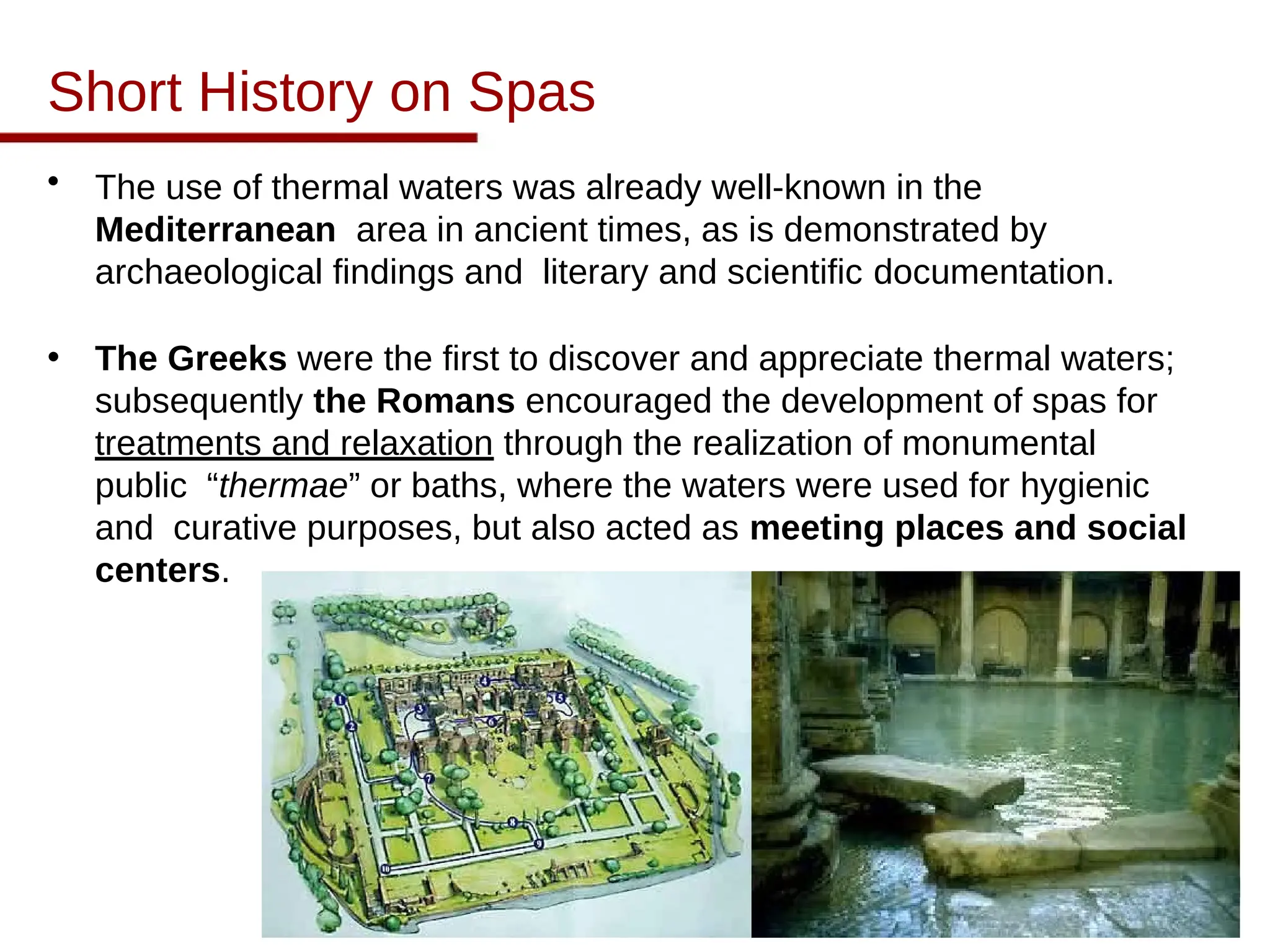
• The use of thermal waters was already well-known in the
Mediterranean area in ancient times, as is demonstrated by
archaeological findings and literary and scientific documentation.
• The Greeks were the first to discover and appreciate thermal waters;
subsequently the Romans encouraged the development of spas for
treatments and relaxation through the realization of monumental
public “thermae” or baths, where the waters were used for hygienic
and curative purposes, but also acted as meeting places and social
centers.
4.
Short History onSpas
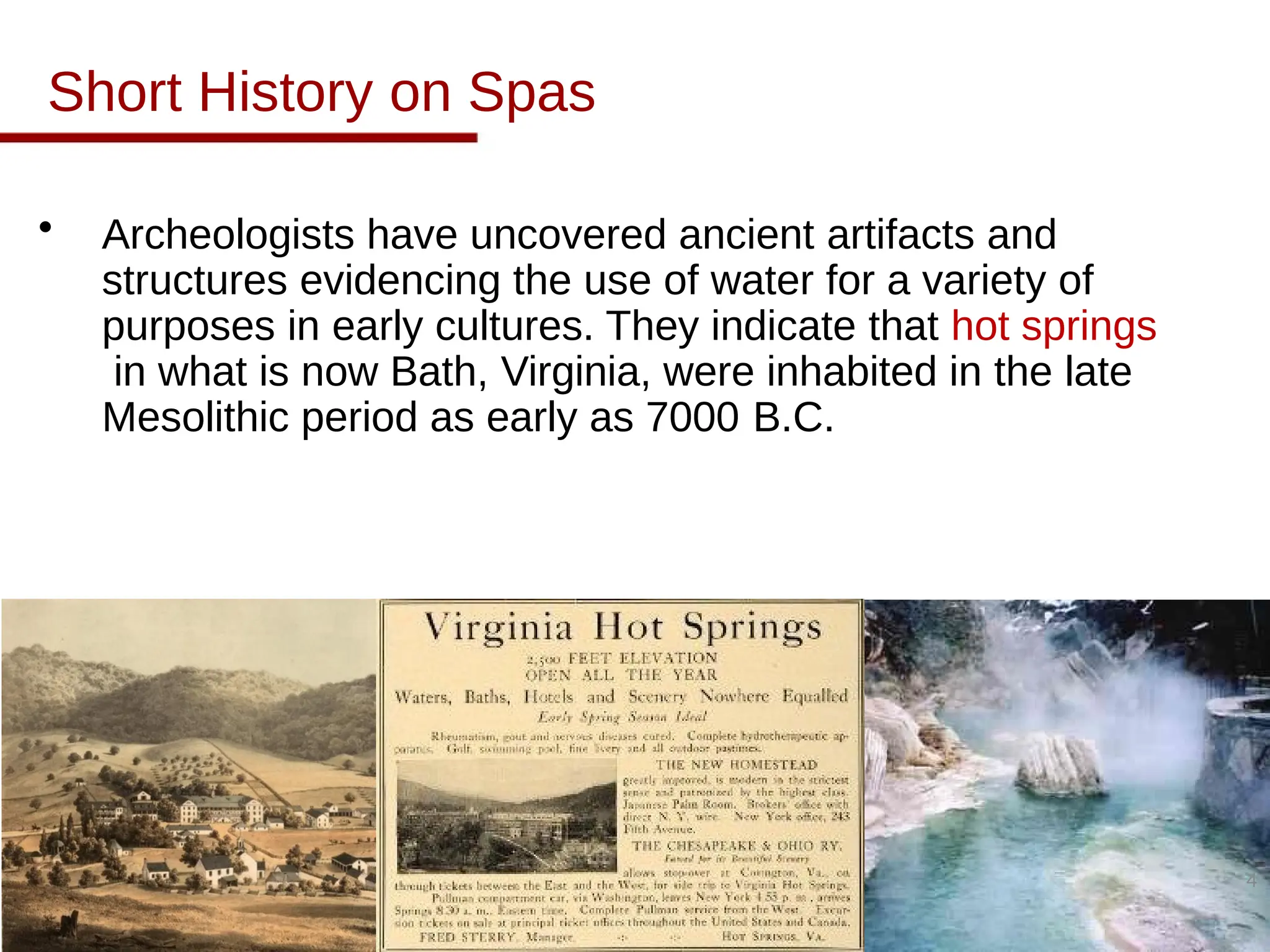
• Archeologists have uncovered ancient artifacts and
structures evidencing the use of water for a variety of
purposes in early cultures. They indicate that hot springs
in what is now Bath, Virginia, were inhabited in the late
Mesolithic period as early as 7000 B.C.
4
5.
Short History onSpas
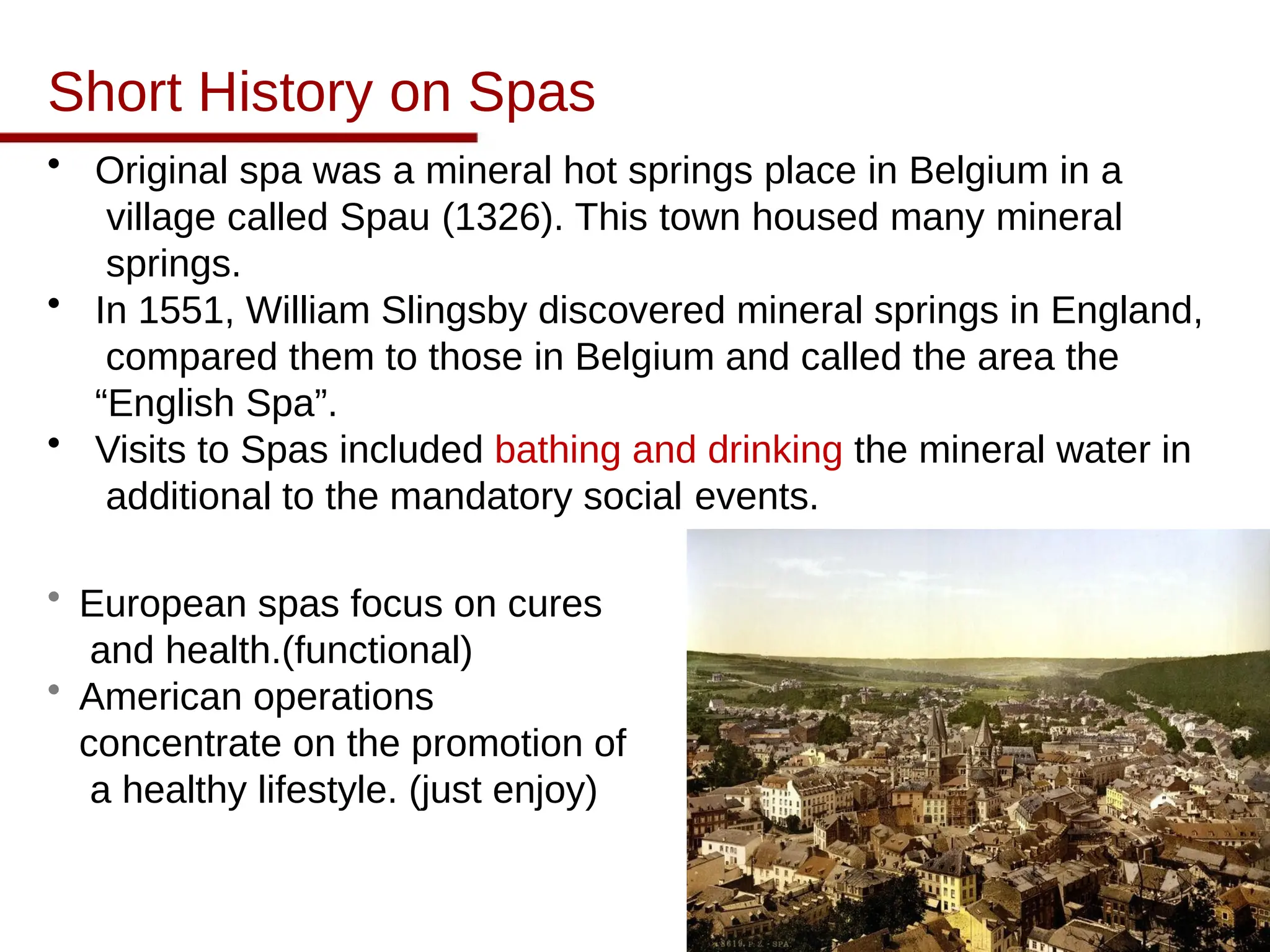
• Original spa was a mineral hot springs place in Belgium in a
village called Spau (1326). This town housed many mineral
springs.
• In 1551, William Slingsby discovered mineral springs in England,
compared them to those in Belgium and called the area the
“English Spa”.
• Visits to Spas included bathing and drinking the mineral water in
additional to the mandatory social events.
• European spas focus on cures
and health.(functional)
• American operations
concentrate on the promotion of
a healthy lifestyle. (just enjoy)
6.
Outline
• Types ofspas
• Wellness Trend & Wellness in China
• TCM
• Spa menu development
• Spa facility design
• Equipment needed in spas
• Basic treatment types
• Developing spa revenues
• Trends
7.
Types of Spas
DaySpa:
• A day spa is a business that offers a
variety of professionally administered
spa services to day-use clients.
• Day spas are open to the public and offer a la carte spa
services to customers who can enjoy one or two
individual treatments or a full day of treatments.
8.
Types of Spas
Resort/ Hotel Spa
• A resort/ hotel spa is a business that operates a division
of and within a resort or hotel.
• It provides professionally administered spa, wellness
and occasionally medical services primarily to guests of
the establishment.
• They serve mainly their vacation guests.
9.
Types of Spas
CruiseShip Spa
• Cruise ship spa is a spa that operates on board a cruise
ship and provides professionally administered spa and
wellness service to passengers.
• In comparison to resort spas, cruise spas are small in
number.
• Spa is one of the main amenities that a cruise ship
offers.
10.
Types of Spas
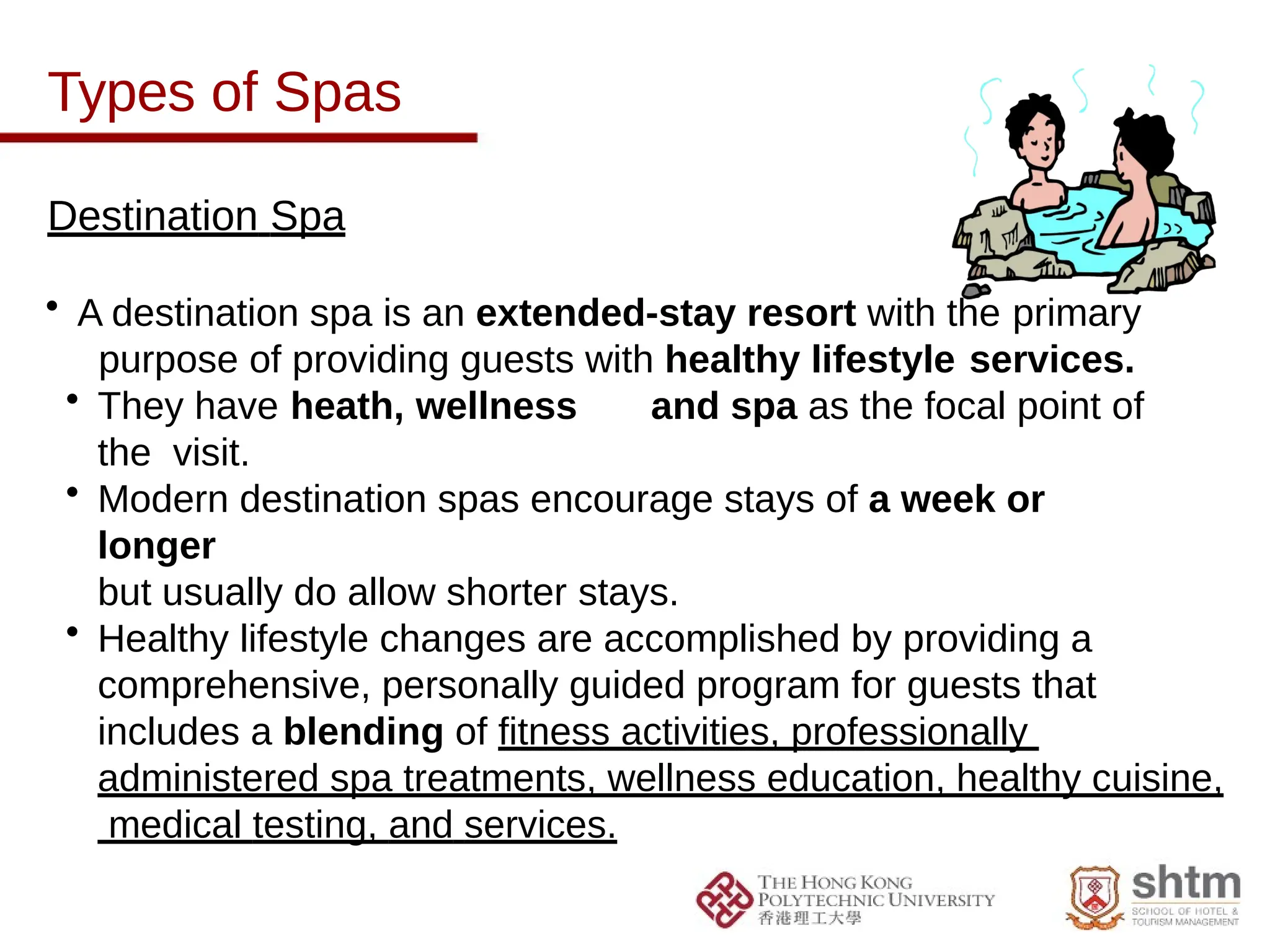
DestinationSpa
• A destination spa is an extended-stay resort with the primary
purpose of providing guests with healthy lifestyle services.
• They have heath, wellness and spa as the focal point of
the visit.
• Modern destination spas encourage stays of a week or
longer
but usually do allow shorter stays.
• Healthy lifestyle changes are accomplished by providing a
comprehensive, personally guided program for guests that
includes a blending of fitness activities, professionally
administered spa treatments, wellness education, healthy cuisine,
medical testing, and services.
11.
Types of Spas
ResidentialClub Spa
• A residential club spa is a residential lifestyle community with the
primary purpose of providing owners with a healthy living
environment.
• Spa communities allow residents to enjoy the spa lifestyle all
year long.
• Residential club spas are relatively new to the spa industry.
They offer home and condominium owners fitness activities,
professionally administered spa treatments, wellness education,
and healthy cuisine right in their “own backyard”.
12.
Types of Spas
•Although all spas focus on the well-being of their clients,
many
spa services also facilitate beauty and body maintenance.
• Day spas often integrate hair and nail services.
• Resort spas may offer body scrubs and makeup application.
• Medical spas may integrate hair removal, Botox, cosmetic
dentistry, and permanent cosmetic procedures.
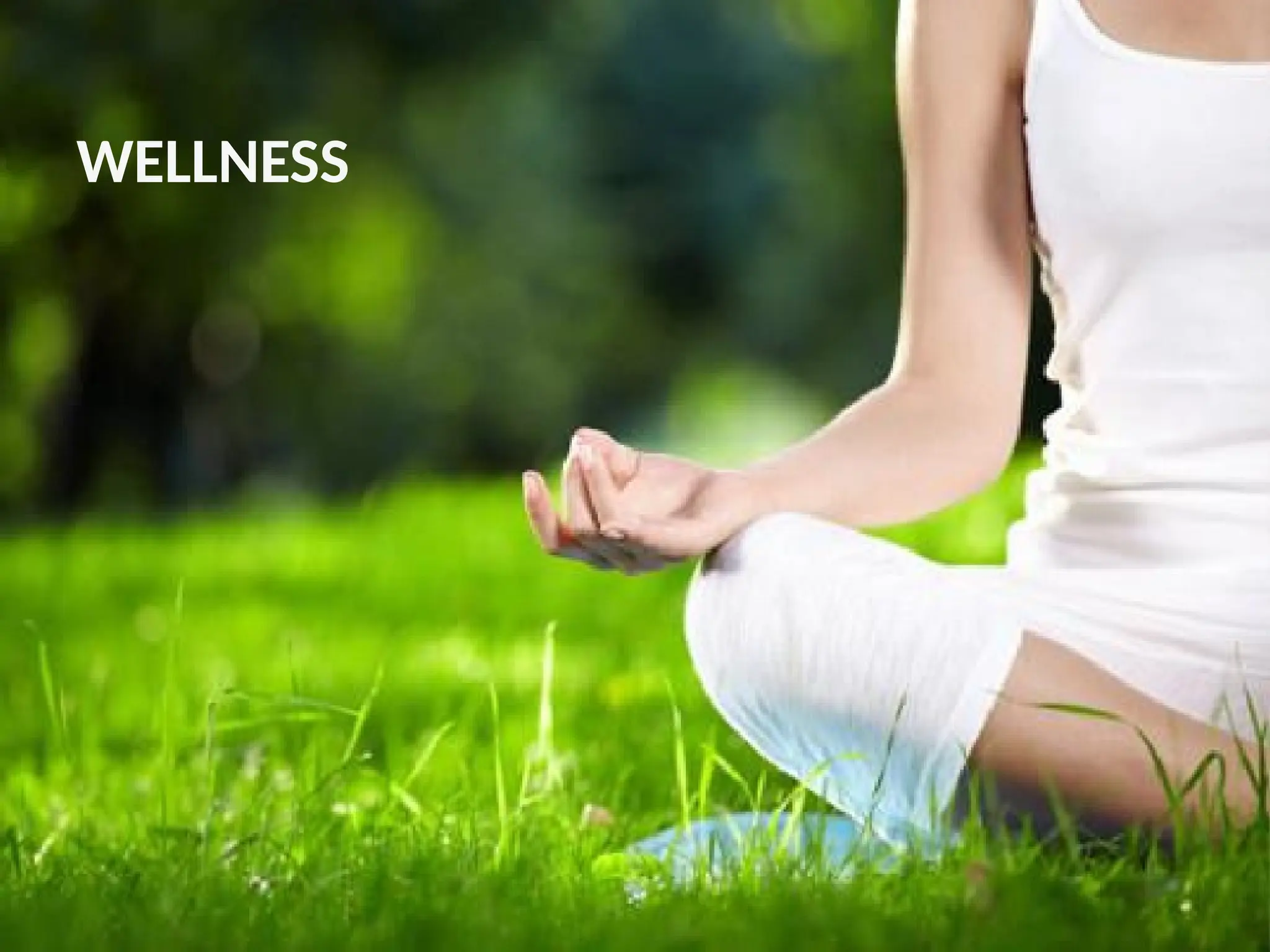
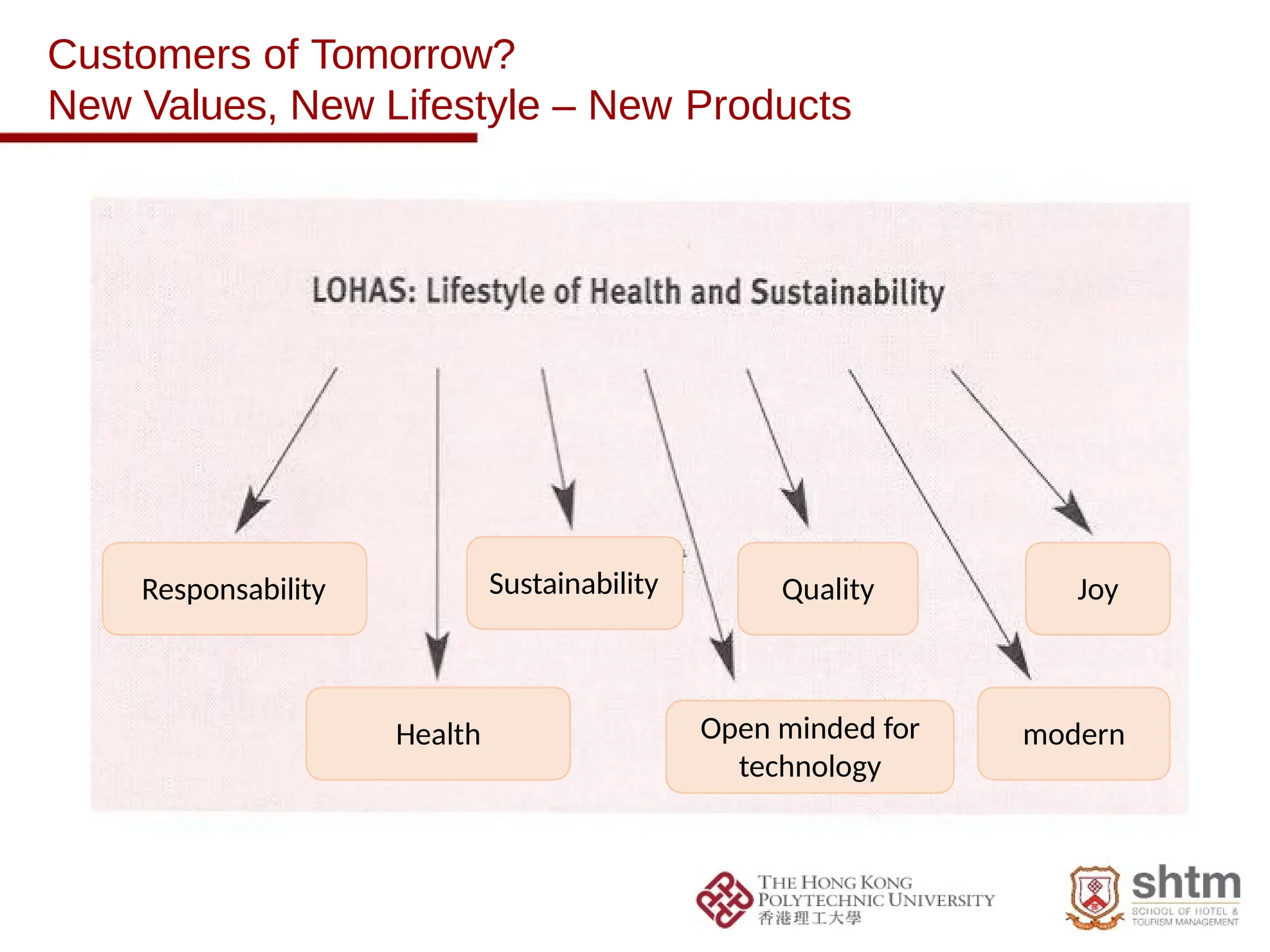
Wellness trend
• Healthtourism is a broad concept that incorporates both
medical and wellness tourism. Wellness tourism has become a
travel trend in recent years.
• The reasons behind this trend are mainly due to the more
health conscious of middle and upper class and the necessity in
coping with work stress.
17.
Wellness trend
• Theend of the twentieth century saw wellness become a mega
trend, which involves the preservation of health in the face of
the threats of stress, hunger and emerging diseases.
• Poor diet, low levels of activity and increased stress
characterize the modern way of life.
• Cancer is a leading cause of death worldwide, and the total
number of cases globally is increasing.
• There is a significant increase in the ageing population.
Wellness in China
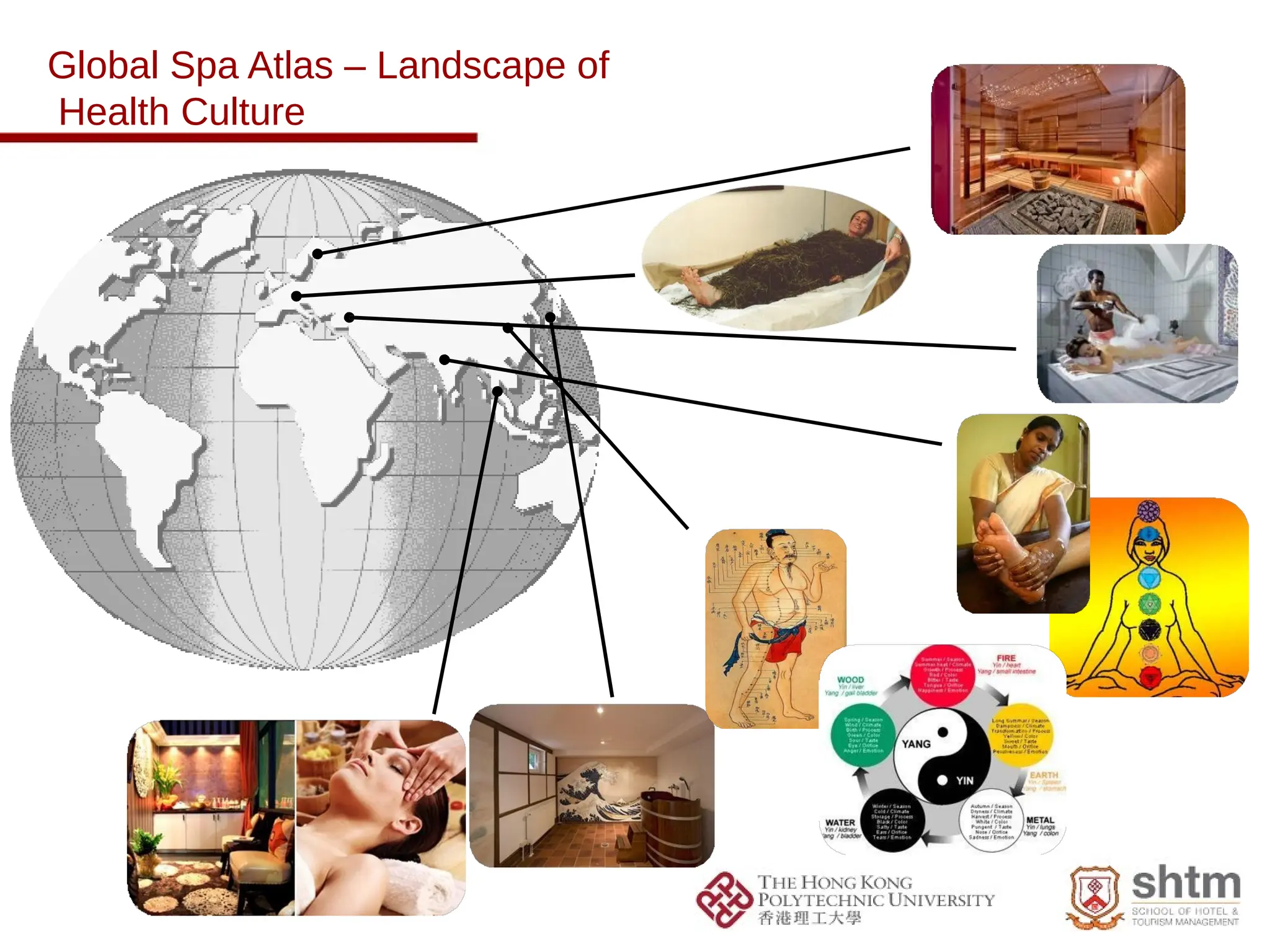
•Traditional Chinese wellness practices including herbal,
acupuncture, hot springs and Chinese medicine treatments and
modern wellness programs and centers are attracting many
people.
• Well-educated young professionals, especially women, are the
target market of wellness clubs.
• The desire to enhance personal health and the growing
awareness, knowledge and understanding across Asia of
diseases together have raised the level of interest in wellness
tourism in China.
20.
Wellness and TCM
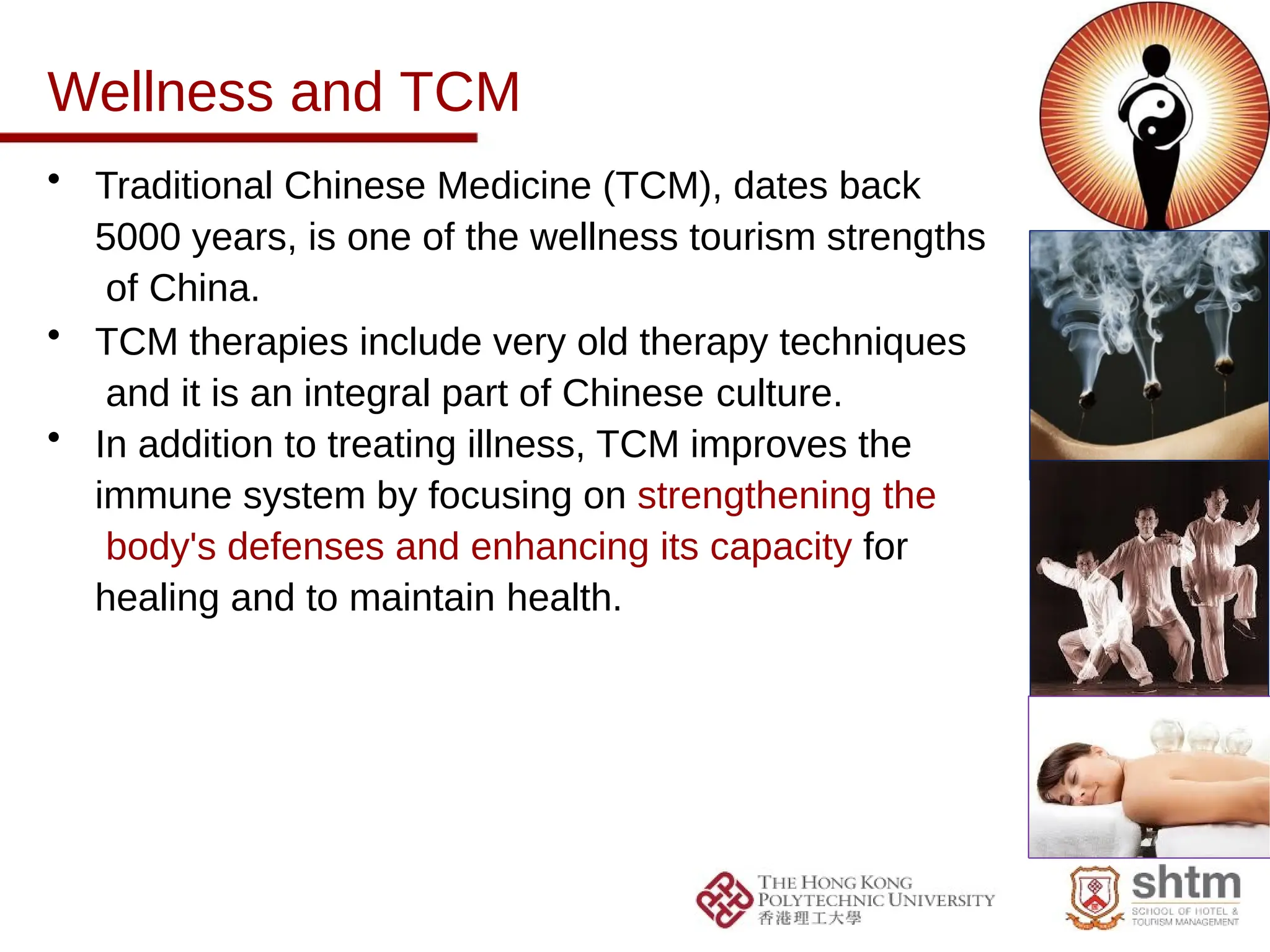
•Traditional Chinese Medicine (TCM), dates back
5000 years, is one of the wellness tourism strengths
of China.
• TCM therapies include very old therapy techniques
and it is an integral part of Chinese culture.
• In addition to treating illness, TCM improves the
immune system by focusing on strengthening the
body's defenses and enhancing its capacity for
healing and to maintain health.
21.
Wellness and TCM
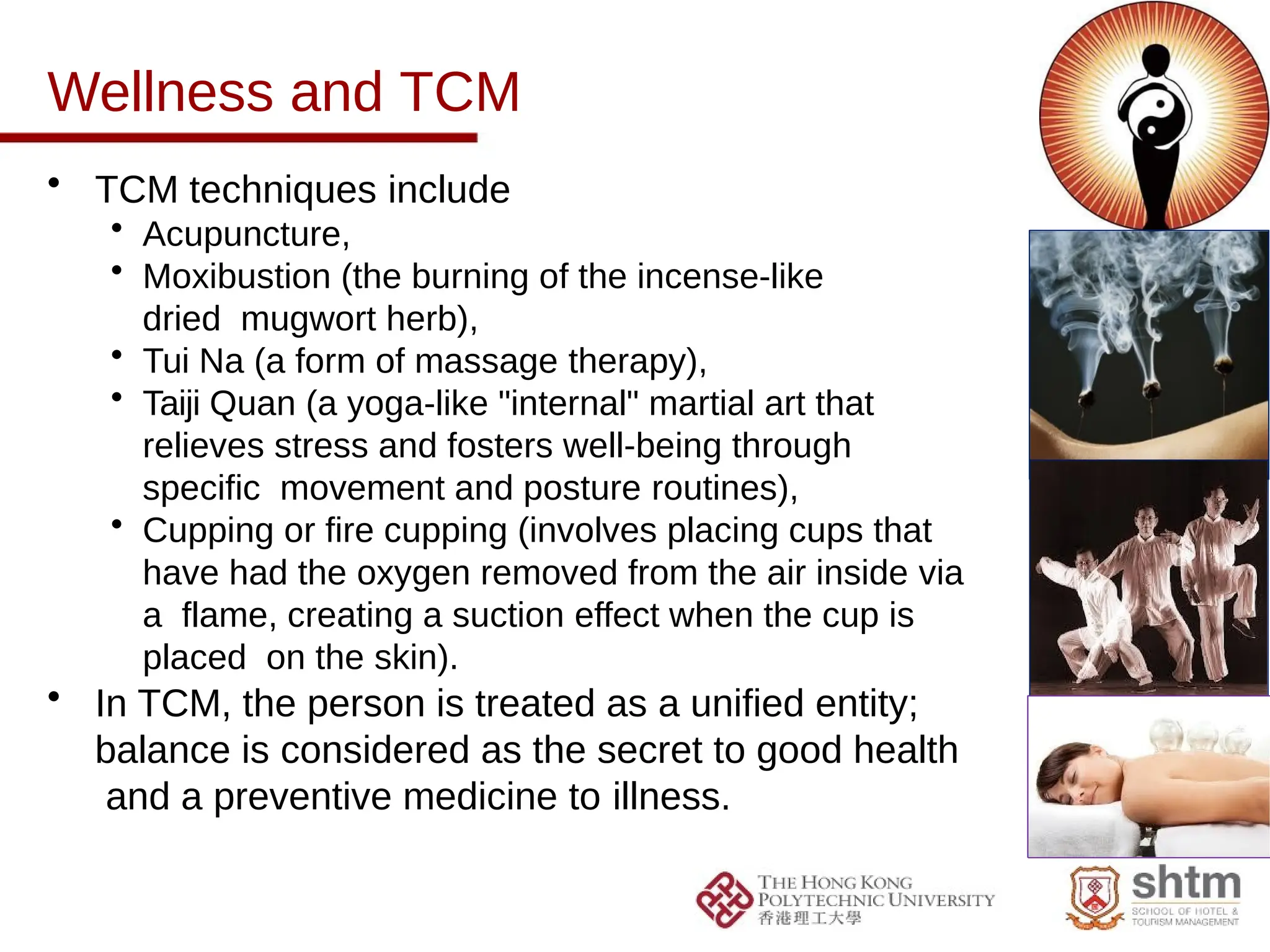
•TCM techniques include
• Acupuncture,
• Moxibustion (the burning of the incense-like
dried mugwort herb),
• Tui Na (a form of massage therapy),
• Taiji Quan (a yoga-like "internal" martial art that
relieves stress and fosters well-being through
specific movement and posture routines),
• Cupping or fire cupping (involves placing cups that
have had the oxygen removed from the air inside via
a flame, creating a suction effect when the cup is
placed on the skin).
• In TCM, the person is treated as a unified entity;
balance is considered as the secret to good health
and a preventive medicine to illness.
Spa Menu Development
•The goal is to create selection and variety that is attractive
to the target market, matches the spa vision and concept,
utilizes the staff effectively, and fits the space available at
the spa.
• It is important to know inflexibilities of your business:
• The facility is inflexible, you need to work with it
• Your primary competition is inflexible, because it is out of your
control.
• Positioning is important
• Need to be financially profitable.
24.
Spa Menu Development
•Considerations
• What is your spa vision and concept?
• Who is your target market?
• Who is your primary competition? How to differentiate from
others?
• There are many ways to make your spa stand out: a unique
concept or theme, enhancing your offerings etc.
• What type of space and equipment are available
• What type of employees do you anticipate needing to hire?
25.
Spa Menu Development
Sometips for spa menu development
• Keep it simple
• Select treatments that match the spa concept
• Select techniques that support rather than
compete with each other
• Be creative, offer a small number of
signature
services
• Offer services in range of prices
• Present services in an organized fashion and
on quality material
• Design menu and write descriptions with the
spa concept in mind
• Consider the length of treatments
• Create a format that will allow you to be
flexible, because the majority of the spas
change their menus every year.
26.
Spa Facility Design
•Once preliminary development tasks of defining the vision and
concept and setting the goals are complete, the design process
can start.
• All design projects follow the same general progression:
• Focusing in on space needs and defining preliminary layout
• Assembling a professional team
• Finding a location
• Refining the plan
• Identification of the site
• Development team work on construction phase
• Preparing for opening
27.
Spa Facility Design
•Site selection
Right location influence the success of the spa.
• Regional analysis - includes
gathering data about the off-site s
urroundings, both man-made and
natural to test the compatibility be
tween the business and its enviro
nment such as:
• Population composition
• Competition
• Regional accessibility
• Land uses (flooding, erosion,
population at the location, etc.)
• Regional influences
• Site analysis- focuses on
characteristics of the location itself.
• Availability (is the site obtainable?)
• Zoning and easements (is the
location zoned for commercial use
and not restrictive to services to be
offered by spa?
• Size of the site
• Site accessibility
• Utilities availability (water supply,
sewage, etc.)
• Land characteristics
• Adjacent land uses
• Support services (how close are
local)
區域分析 - 包括收集有
關人為和自然場外環境
的數據,以測試企業與
其環境之間的兼容性,
例如:
28.
Spa Facility Design
•Facility Design Team
• Architects –prepare and review all plans for
construction
• Interior Designers
• Electrical Engineers
• Mechanical Engineers
• Contractors or builders
• Specialty Contractors
• Acoustical Engineers
• IT and Audio-visual specialists
• Landscapers
• Kitchen Designers
• Health inspector
• Spa manager/consultant
29.
Spa Facility Design
Color
•Soft, muted color tones tend to be soothing, bright colors are more
stimulating
• Less is more: select only 4-5 colors
• When working with bold colors, use natural lighting and textures to
balance the space
• Choose colors that will still look new after a little wear
• Consider the common color associations:
Warm colors Red
Orange
Yellow
Stimulation, power, strength
Social, cheerful, bold
Soothing, enlightenment,
inspiration
Natural color White
Brown
Black
Purity, clean, safe, refreshing
Natural, safe, casual, earthy
Dramatic, mysterious, sophisticated
Cool colors Blue
Green
Purpl
e/pin
k
Tranquil, conservative, refreshing
Relaxing, calming, balancing
Peaceful, spiritual, creative
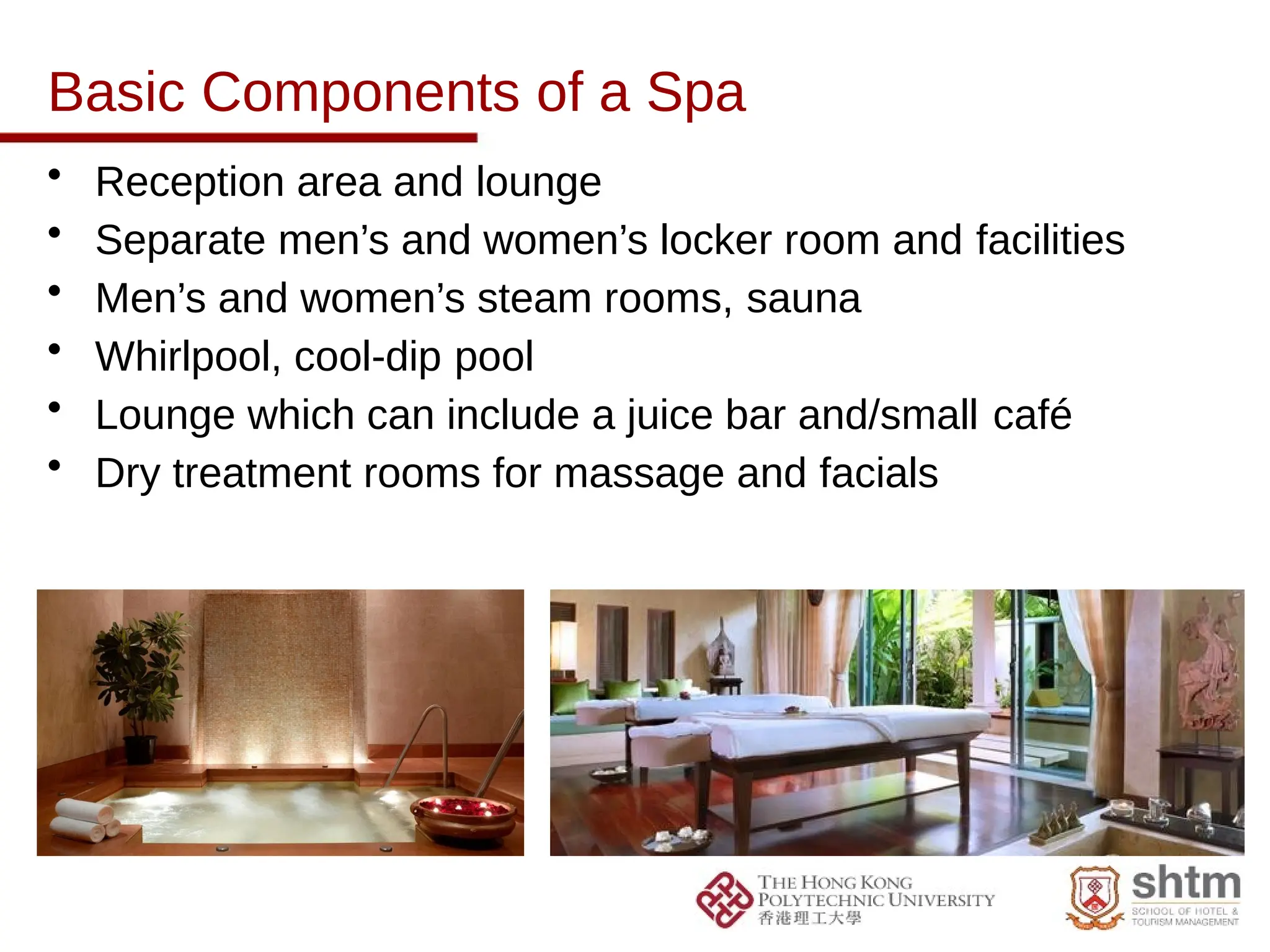
Basic Components ofa Spa
• Reception area and lounge
• Separate men’s and women’s locker room and facilities
• Men’s and women’s steam rooms, sauna
• Whirlpool, cool-dip pool
• Lounge which can include a juice bar and/small café
• Dry treatment rooms for massage and facials
32.
Basic Components ofa Spa
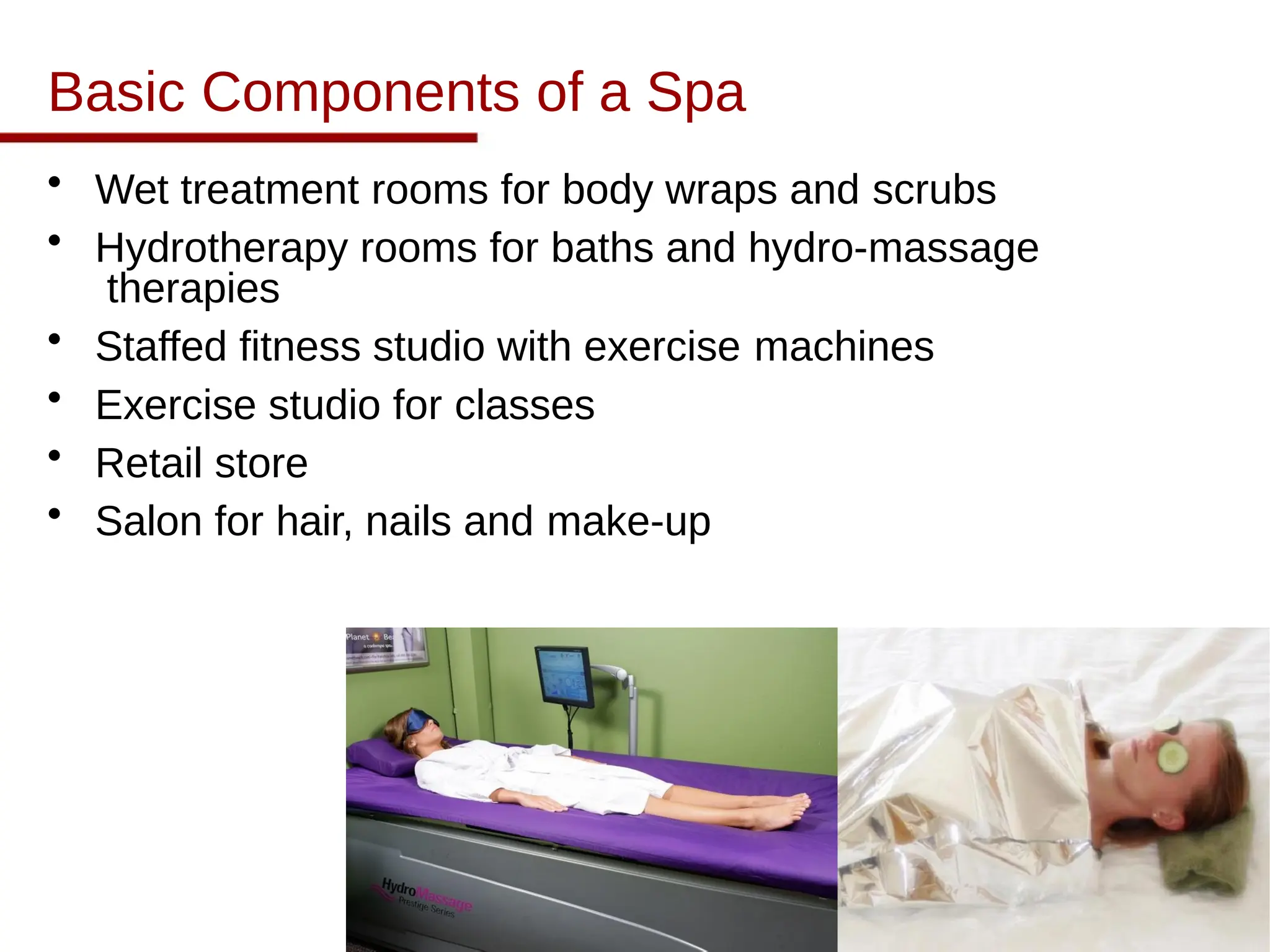
• Wet treatment rooms for body wraps and scrubs
• Hydrotherapy rooms for baths and hydro-massage
therapies
• Staffed fitness studio with exercise machines
• Exercise studio for classes
• Retail store
• Salon for hair, nails and make-up
33.
Equipment Needed ina Spa
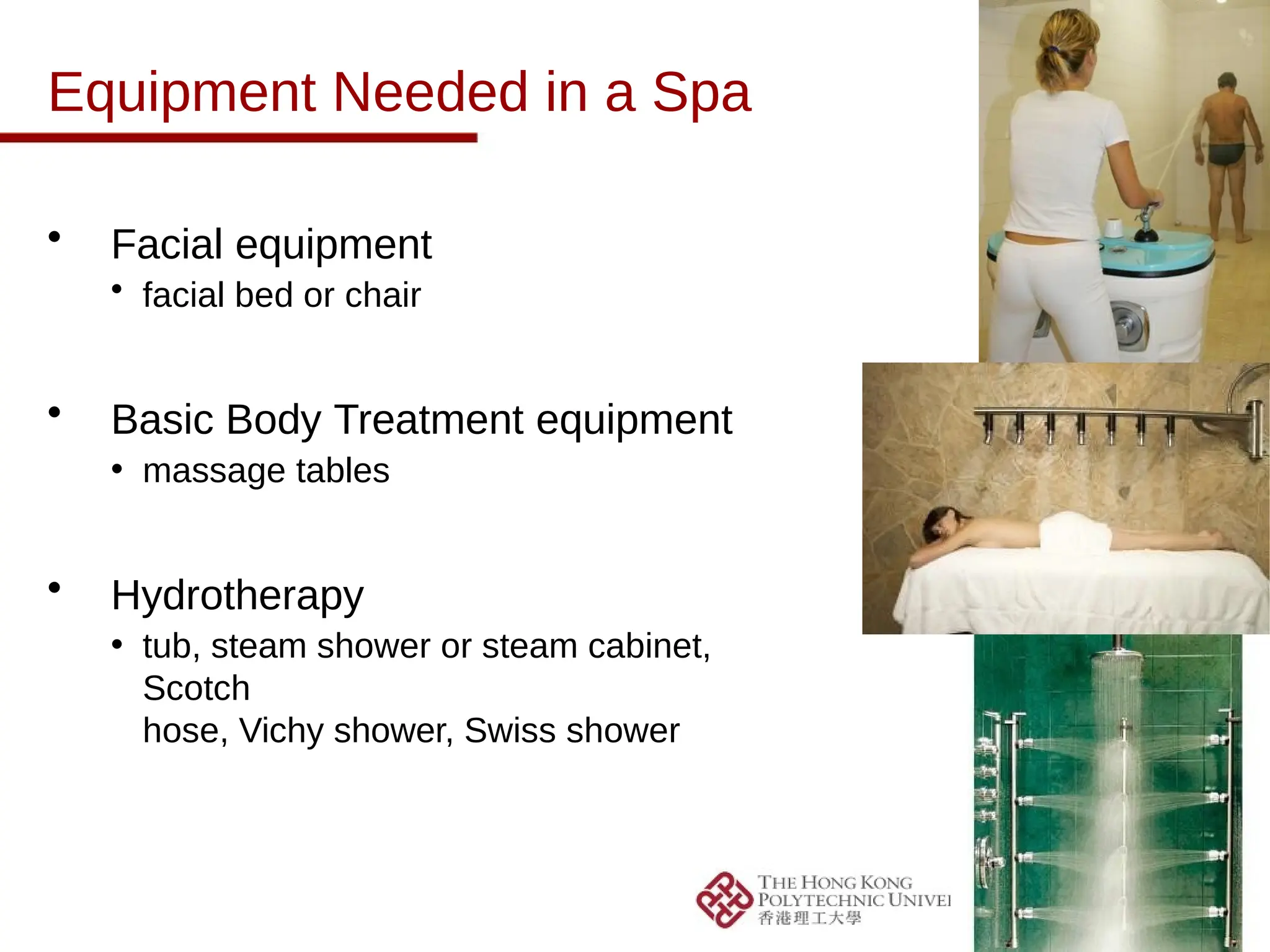
• Facial equipment
• facial bed or chair
• Basic Body Treatment equipment
• massage tables
• Hydrotherapy
• tub, steam shower or steam cabinet,
Scotch
hose, Vichy shower, Swiss shower
34.
Spa treatment types
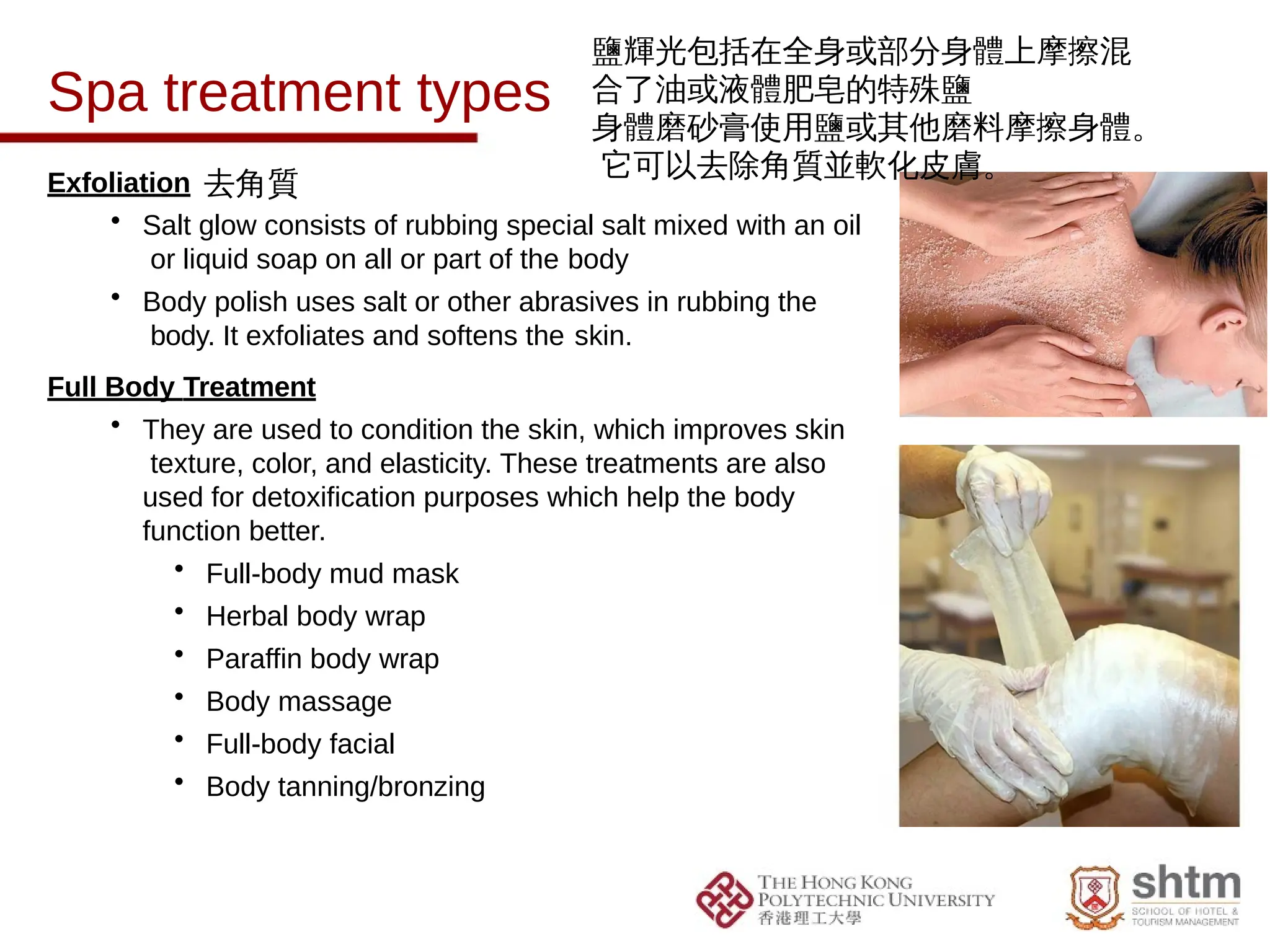
Exfoliation
•Salt glow consists of rubbing special salt mixed with an oil
or liquid soap on all or part of the body
• Body polish uses salt or other abrasives in rubbing the
body. It exfoliates and softens the skin.
Full Body Treatment
• They are used to condition the skin, which improves skin
texture, color, and elasticity. These treatments are also
used for detoxification purposes which help the body
function better.
• Full-body mud mask
• Herbal body wrap
• Paraffin body wrap
• Body massage
• Full-body facial
• Body tanning/bronzing
鹽輝光包括在全身或部分身體上摩擦混
合了油或液體肥皂的特殊鹽
身體磨砂膏使用鹽或其他磨料摩擦身體。
它可以去除角質並軟化皮膚。
去角質
35.
Spa treatment types
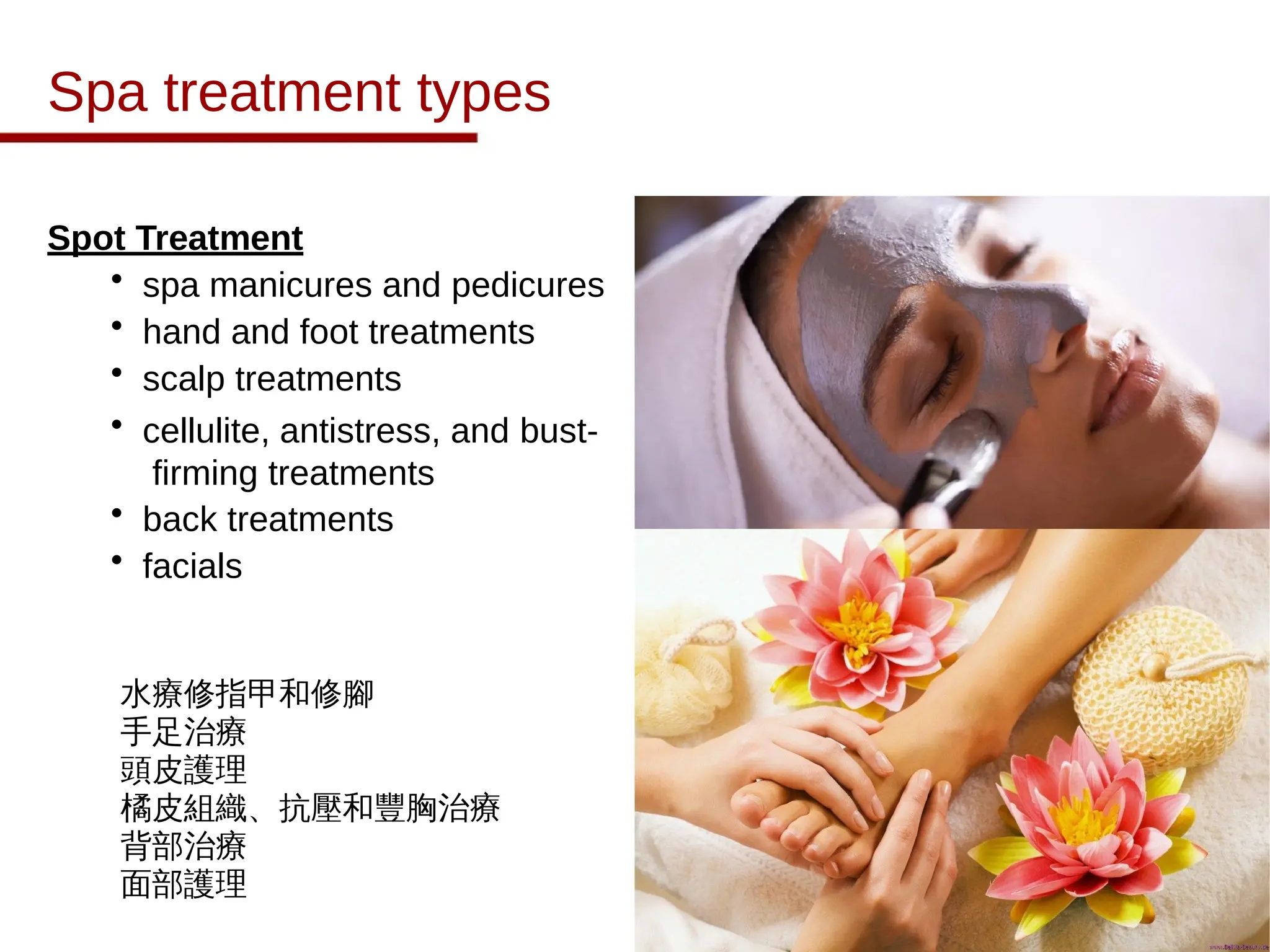
SpotTreatment
• spa manicures and pedicures
• hand and foot treatments
• scalp treatments
• cellulite, antistress, and bust-
firming treatments
• back treatments
• facials
水療修指甲和修腳
手足治療
頭皮護理
橘皮組織、抗壓和豐胸治療
背部治療
面部護理
36.
Spa treatment types
Watertherapy
Water helps blood circulate to specific areas of the body. Warm/hot water
dilates capillaries to improve the distribution of nutrients and oxygen to
organs and tissues. Cool/cold water constricts capillaries, reducing
swelling.
• Hydrotherapy (uses water for well-being)
• Balneotherapy (uses baths for beauty and therapeutic purposes)
• Thalassotherapy (uses mineral salts from sea water to help skin
cells take in more oxygen and draw toxins out of the body)
• Herbal Baths (uses natural herbs or essences for
therapeutic purposes)
• Aromatherapy Baths (uses oils for therapeutic purposes)
• Whirlpool Baths (therapeutic underwater massage)
37.
Developing Spa Revenues
•A la carte services
• Know which services are the most popular and the most
profitable. Categorize and code services according to type
(beauty, body, fitness, etc.)
• Packages
• Identify how each package contributes to profitability
• Memberships
• Identify how each category contributes to profitability
• Guests of members
• Identify what services they buy
• Gift certificates
• Show the breakdown by market segment and the amount spent
per
certificate
38.
Developing Spa Revenues
•Facility usage fee
• Consider that many resorts charge guests by the service used
• Retail
• Know which items what type of guests purchase and the
average amount each guest spends
• Hotel rooms
• Allocate the room portion of a spa package to the spa budget
• Food & Beverage
• Allocate the food portion of a spa package to the spa budget
Social Trends
• Lessfree time
• Individuals must be more selective about their activities
• Time efficiency is important
• More Stress
• Health concerns and health care
• Family togetherness
• Social spa going
• Protecting the environment
• Innovation and technology (equipment)
41.
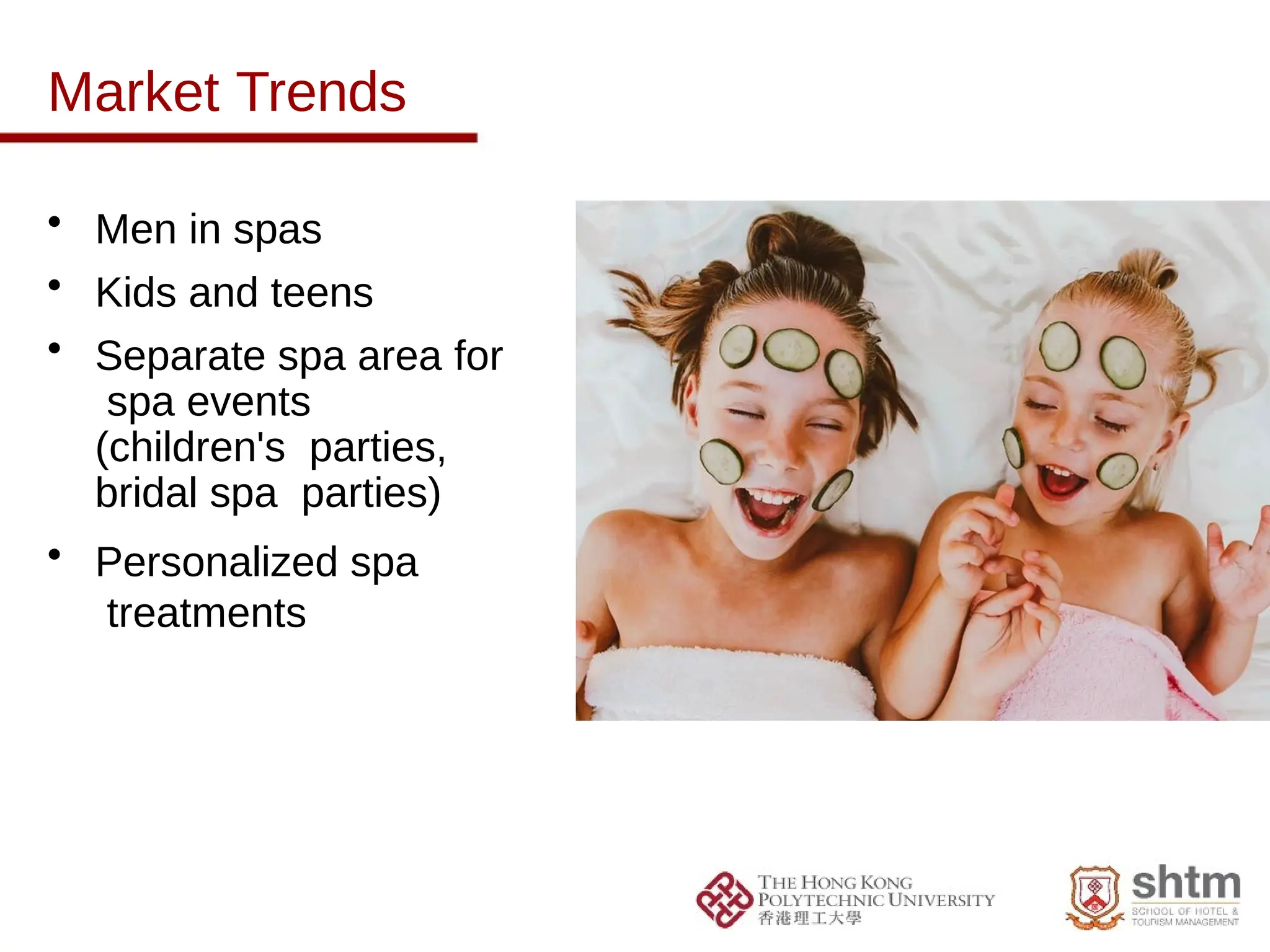
Market Trends
• Menin spas
• Kids and teens
• Separate spa area for
spa events
(children's parties,
bridal spa parties)
• Personalized spa
treatments
42.
Global problems ofthe spa industry
• Poor management of spas,
• Lack of accreditation,
• High fragmentation of the industry,
• Lack of trained personnel
• Non-standardized spa services and products
缺乏認可
行業高度分散