Practice
Week 3
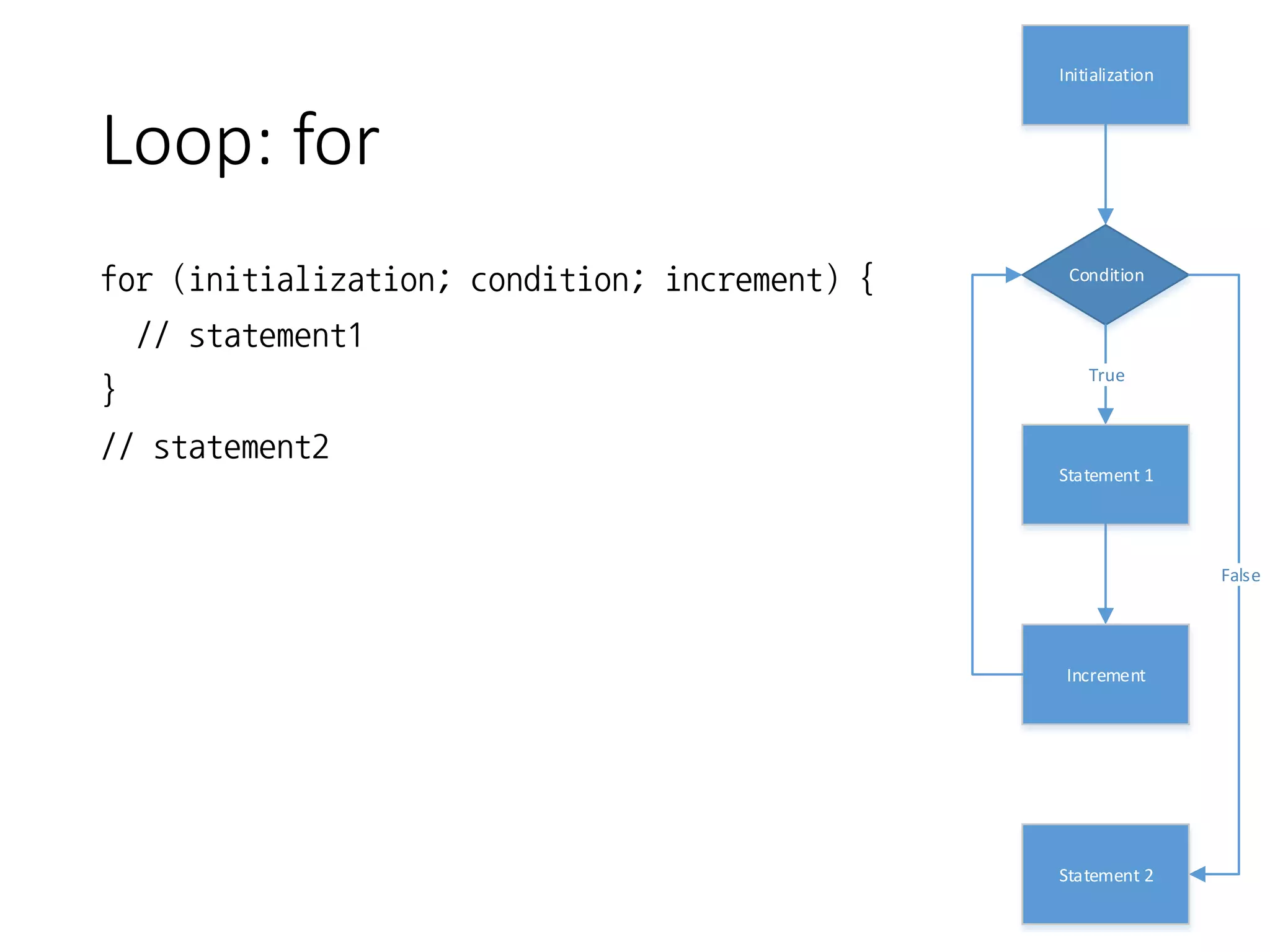
Loop: for
for (initialization; condition; increment) {
// statement1
}
// statement2
Initialization
Condition
True
Statement 1
Increment
False
Statement 2
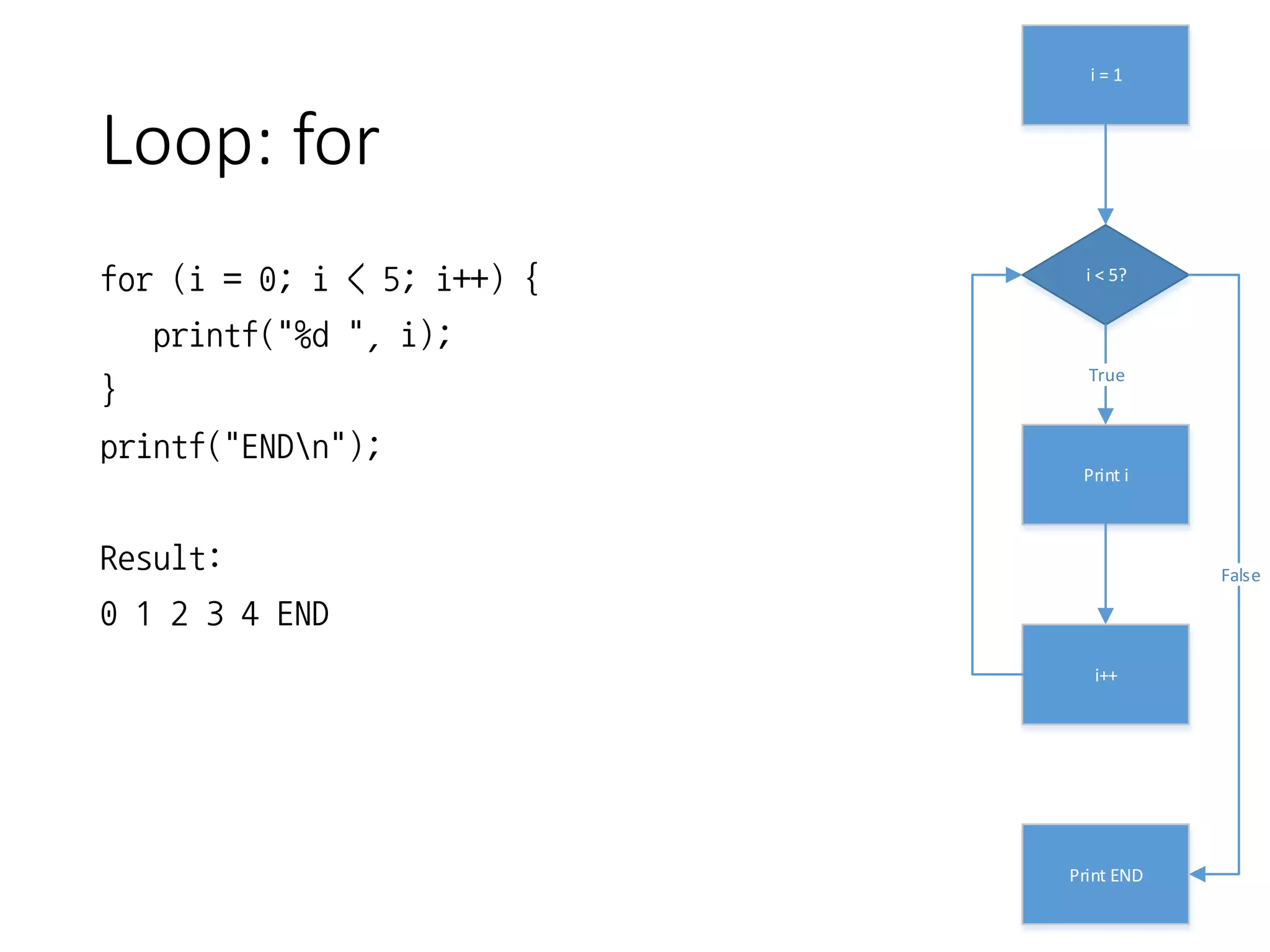
Loop: for
for (i = 0; i < 5; i++) {
printf("%d ", i);
}
printf("ENDn");
Result:
0 1 2 3 4 END
i = 1
i < 5?
True
Print i
i++
False
Print END
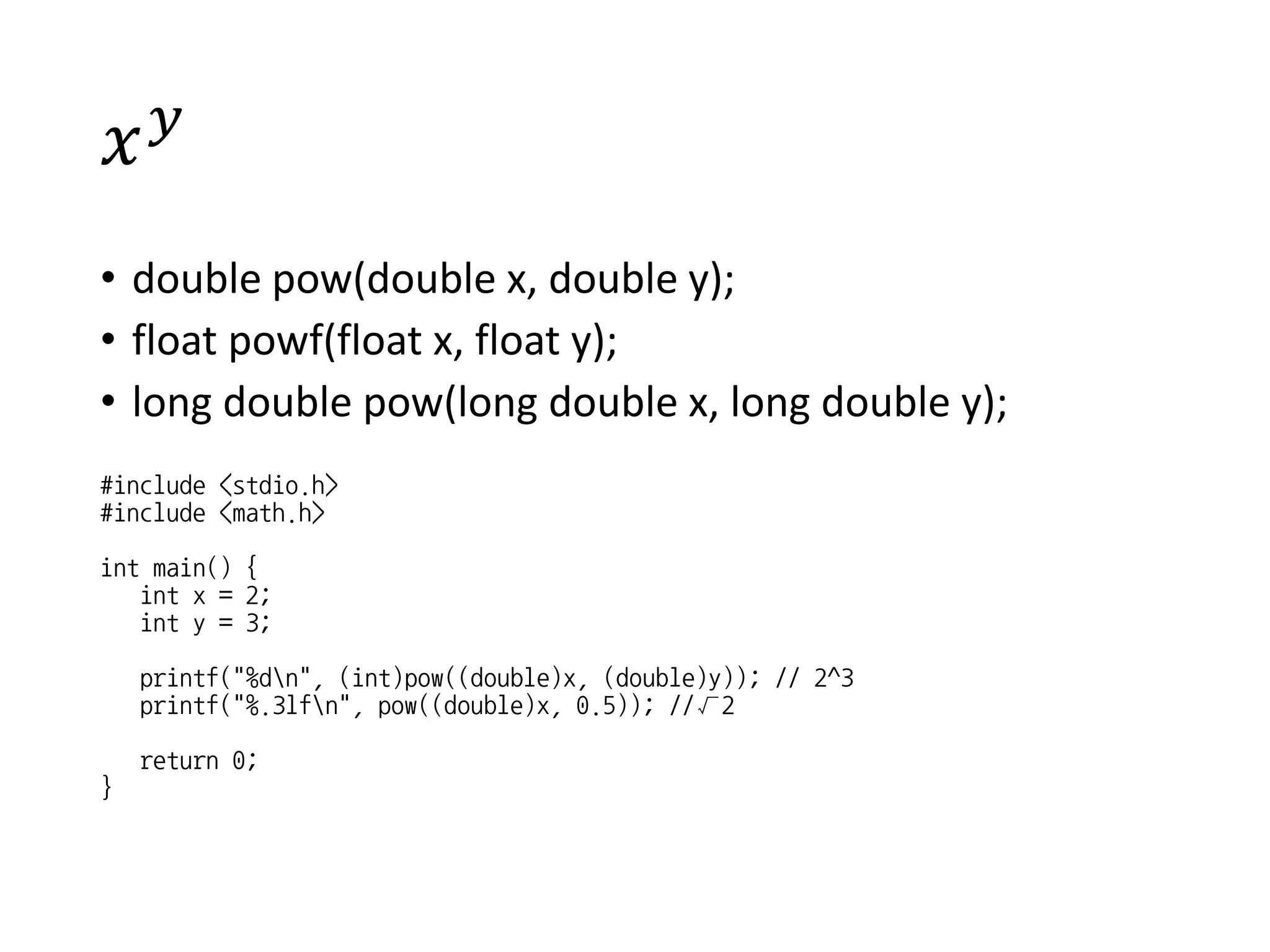
𝑥 𝑦
• double pow(double x, double y);
• float powf(float x, float y);
• long double pow(long double x, long double y);
#include <stdio.h>
#include <math.h>
int main() {
int x = 2;
int y = 3;
printf("%dn", (int)pow((double)x, (double)y)); // 2^3
printf("%.3lfn", pow((double)x, 0.5)); //√2
return 0;
}
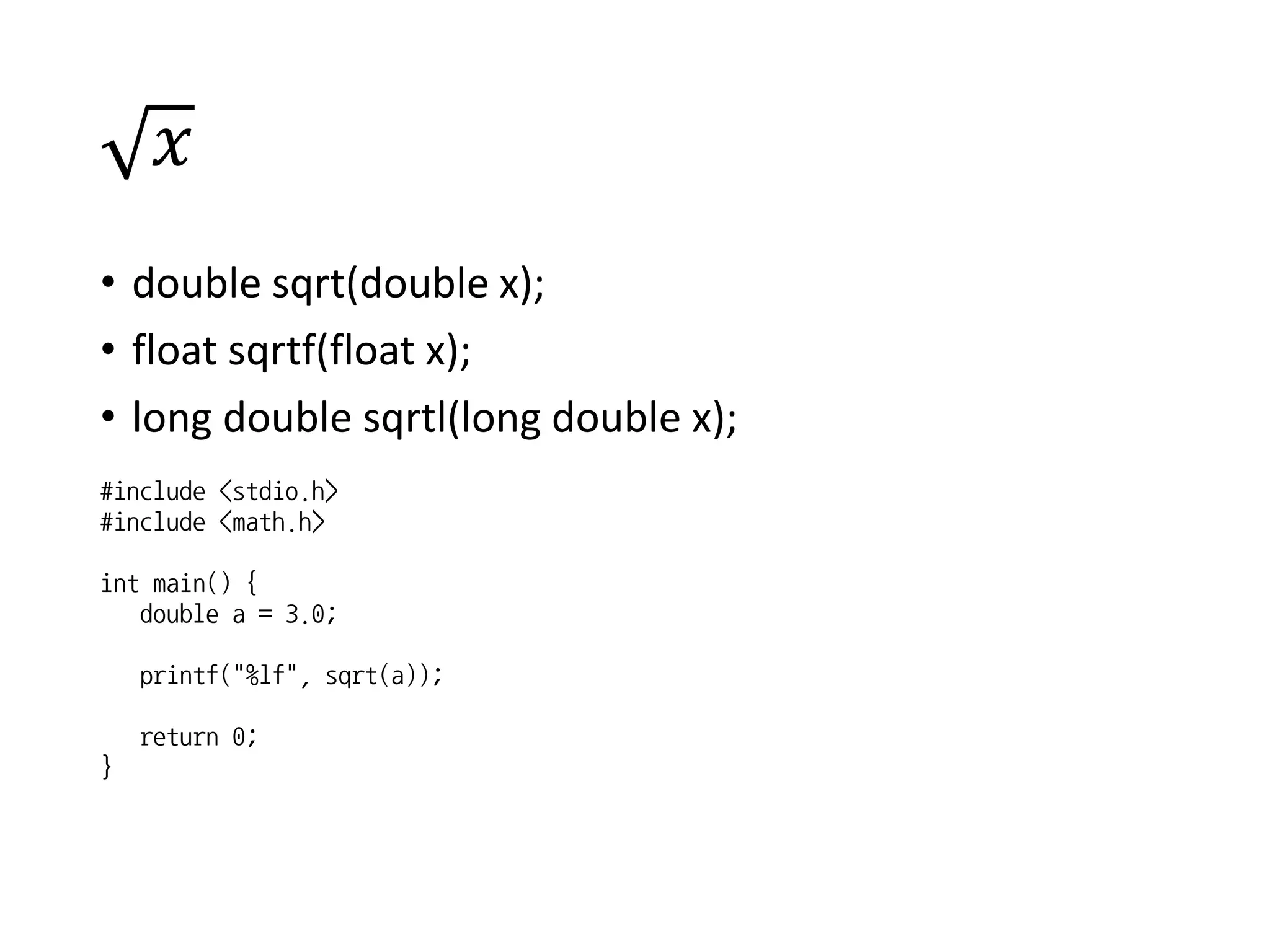
𝑥
• double sqrt(double x);
• float sqrtf(float x);
• long double sqrtl(long double x);
#include <stdio.h>
#include <math.h>
int main() {
double a = 3.0;
printf("%lf", sqrt(a));
return 0;
}
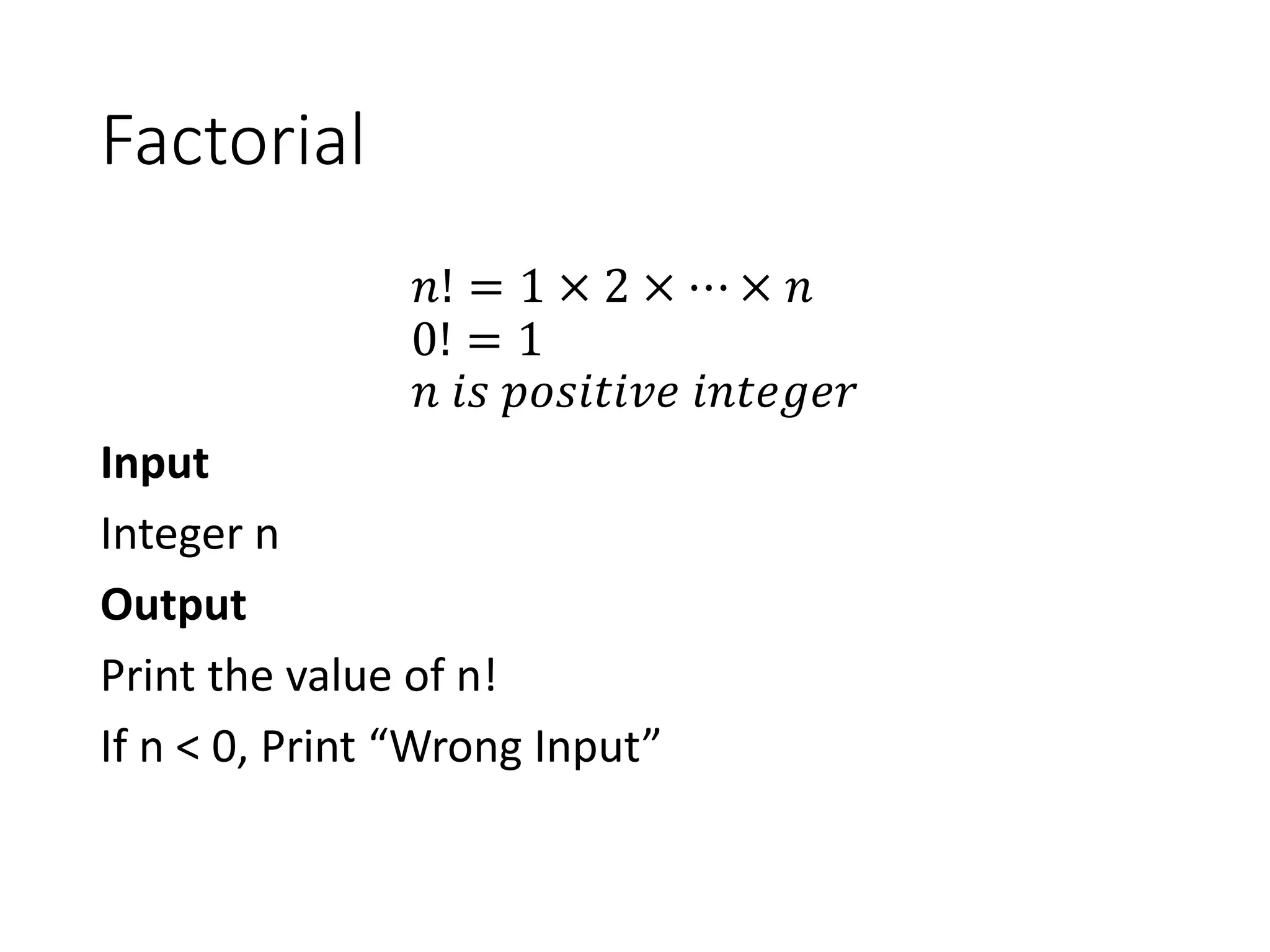
Factorial
𝑛! = 1 × 2 × ⋯ × 𝑛
0! = 1
𝑛 𝑖𝑠 𝑝𝑜𝑠𝑖𝑡𝑖𝑣𝑒 𝑖𝑛𝑡𝑒𝑔𝑒𝑟
Input
Integer n
Output
Print the value of n!
If n < 0, Print “Wrong Input”
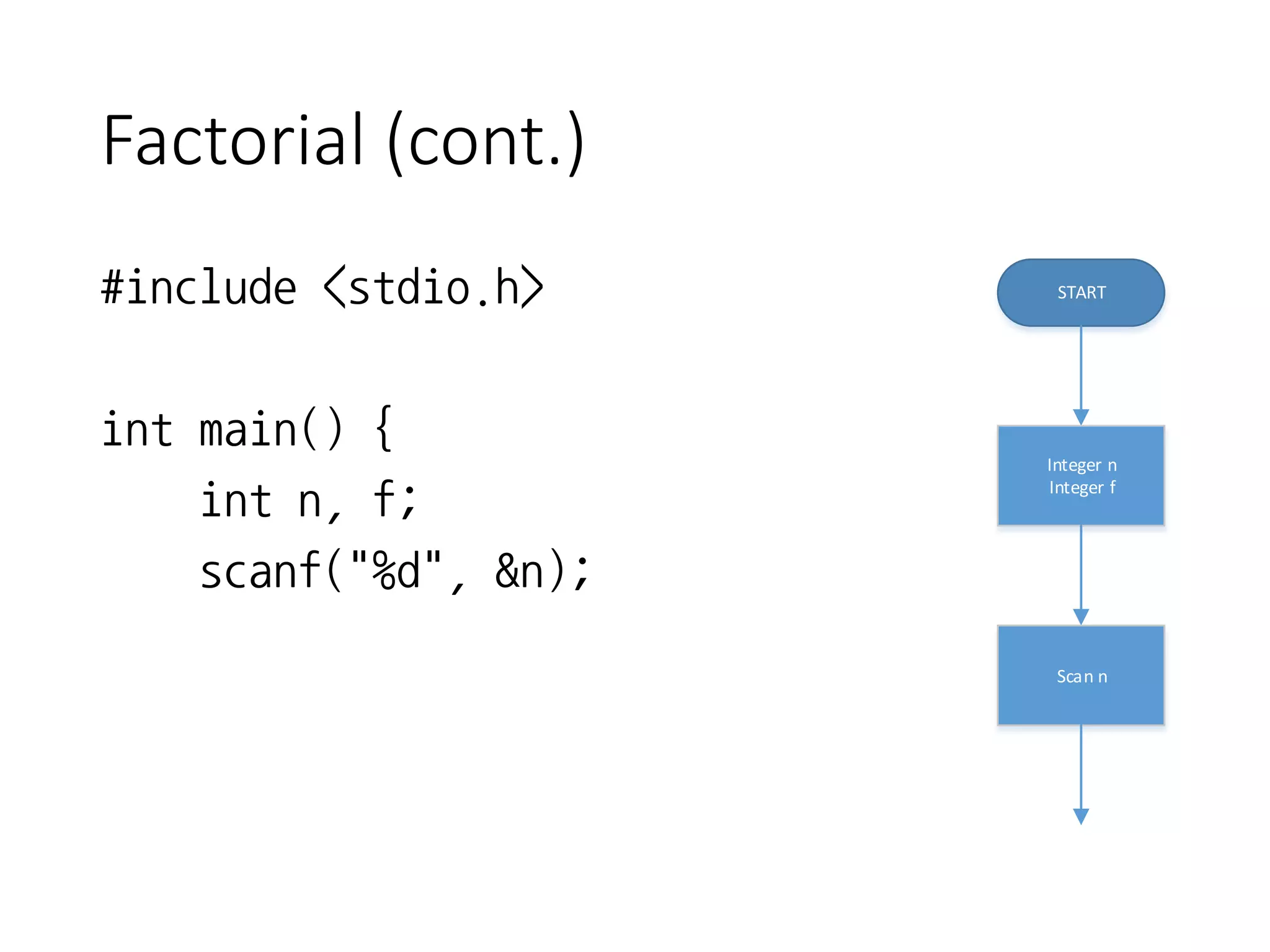
Factorial (cont.)
#include <stdio.h>
int main() {
int n, f;
scanf("%d", &n);
START
Integer n
Integer f
Scan n
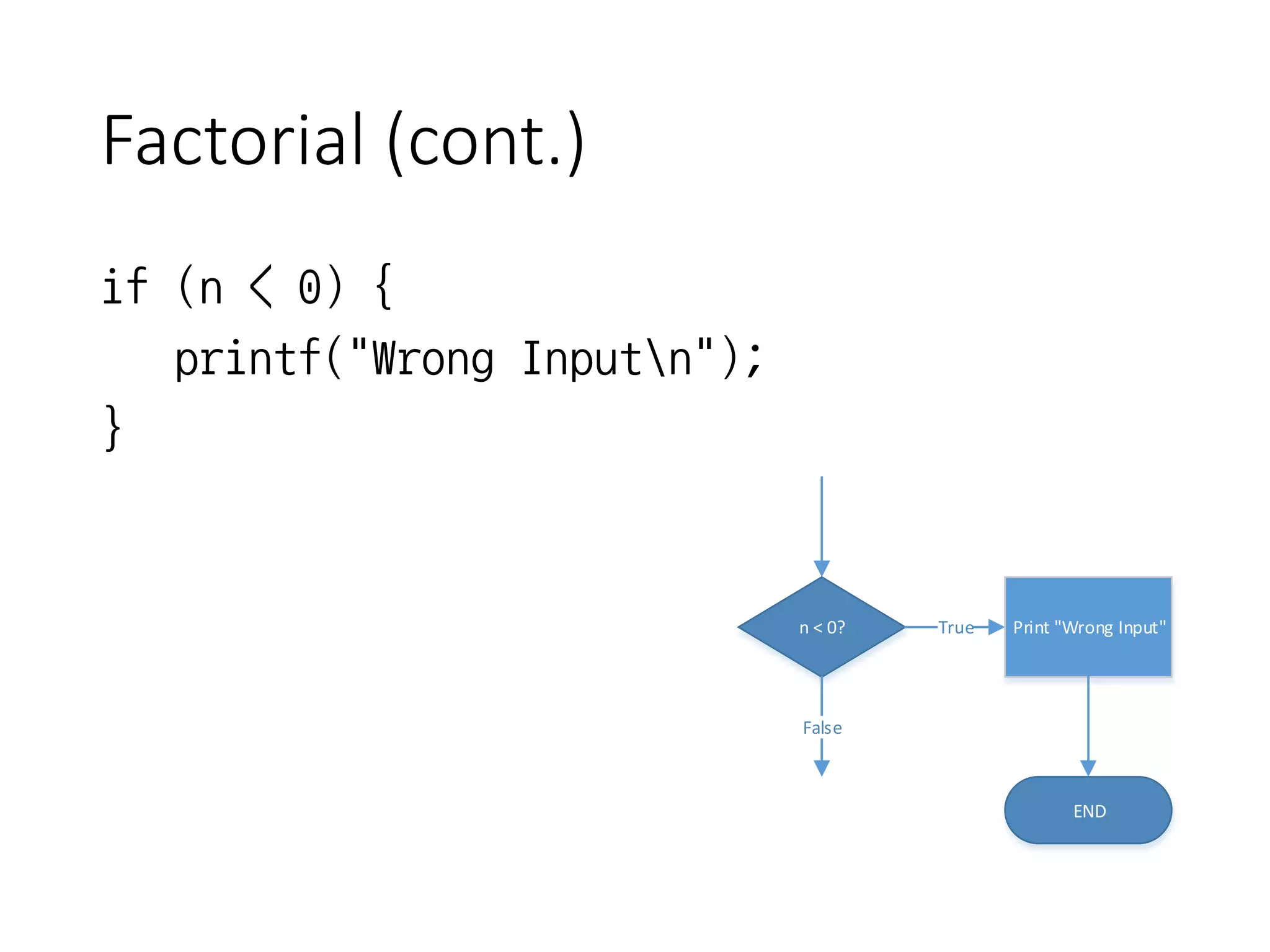
Factorial (cont.)
if (n < 0) {
printf("Wrong Inputn");
}
n < 0? True Print "Wrong Input"
END
False
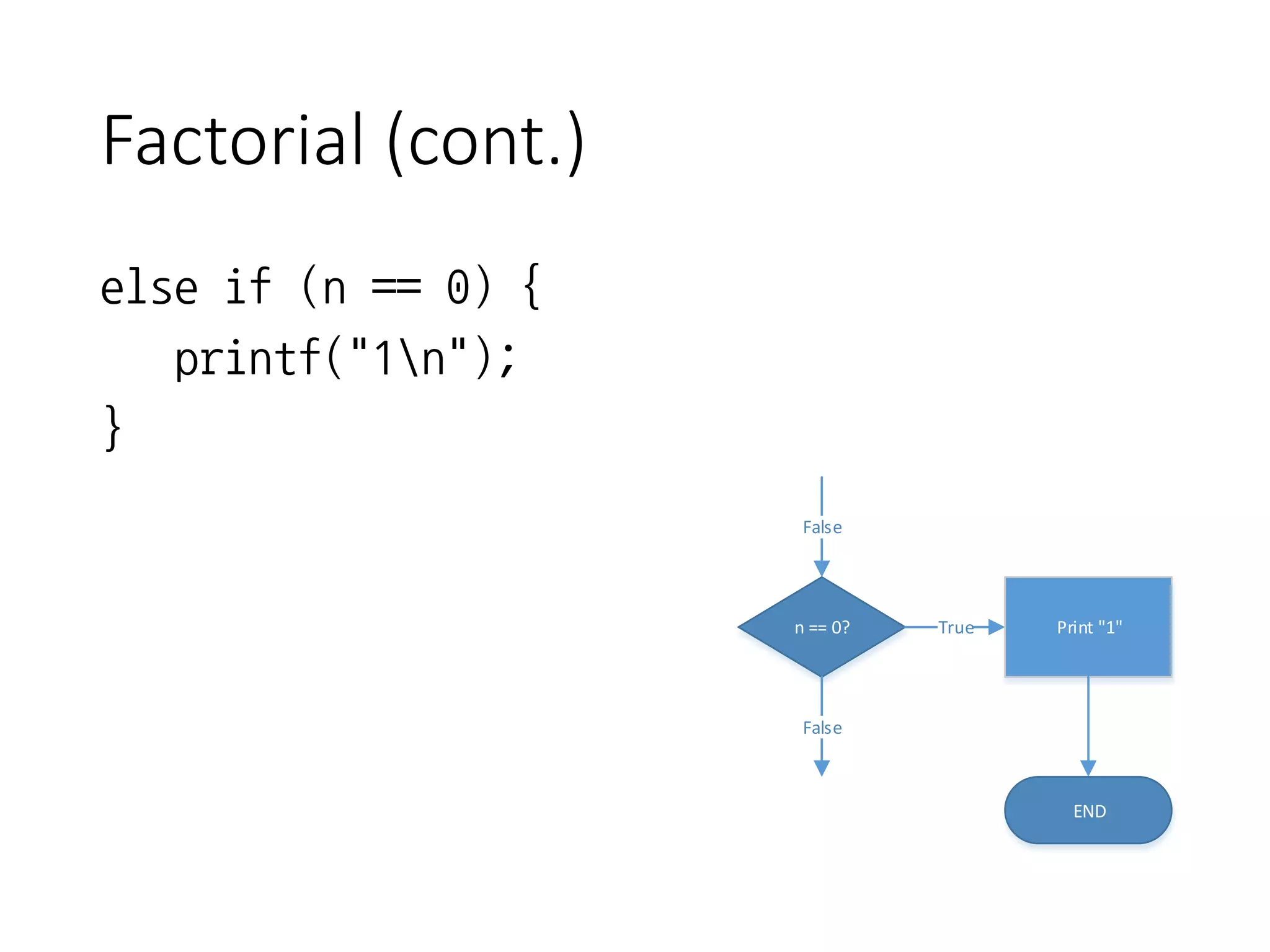
Factorial (cont.)
else if (n == 0) {
printf("1n");
}
False
n == 0? True Print "1"
False
END
Factorial (cont.)
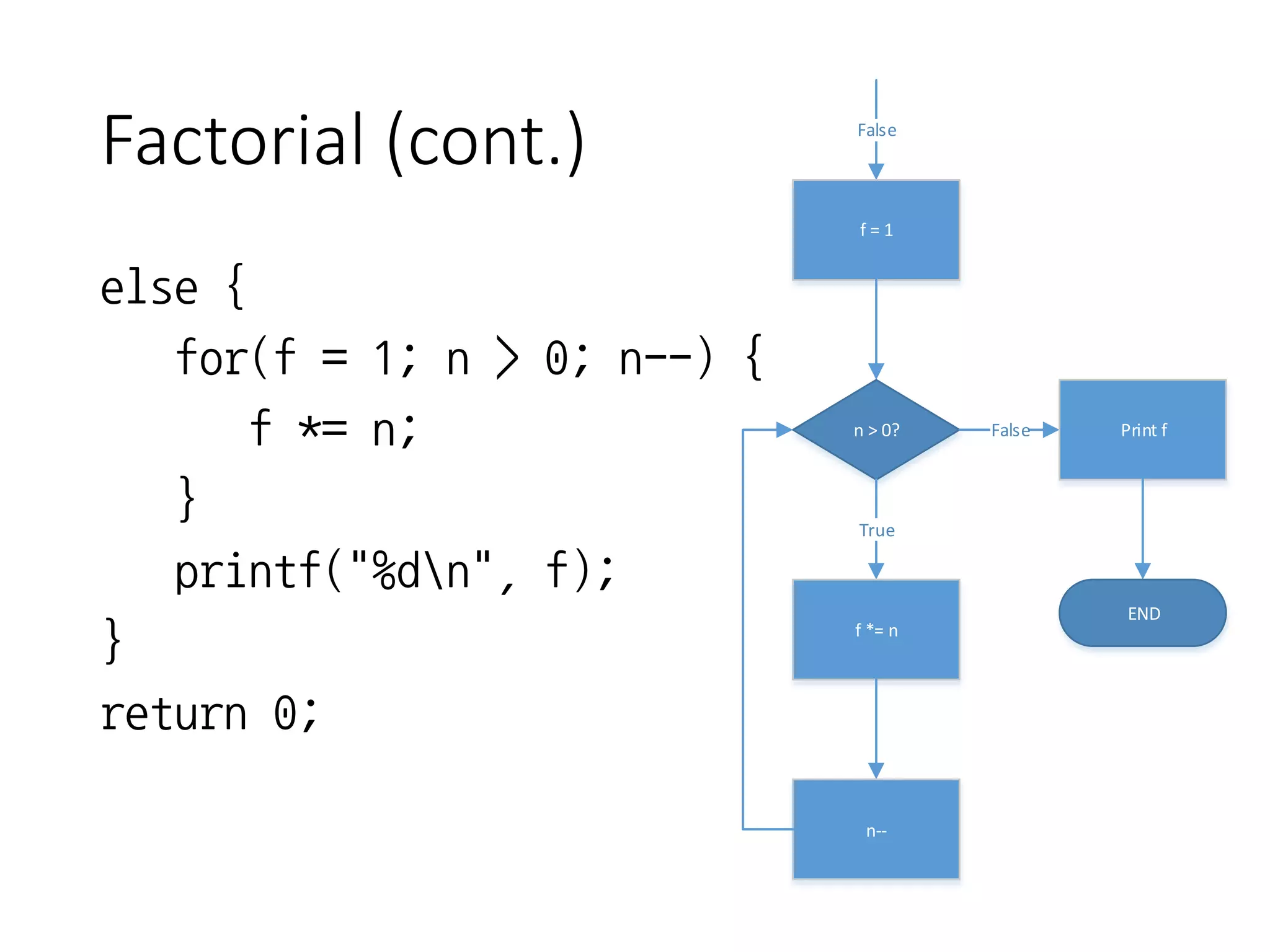
else {
for(f = 1; n > 0; n--) {
f *= n;
}
printf("%dn", f);
}
return 0;
False
f = 1
n > 0? False Print f
END
True
f *= n
n--
Factorial (cont.)
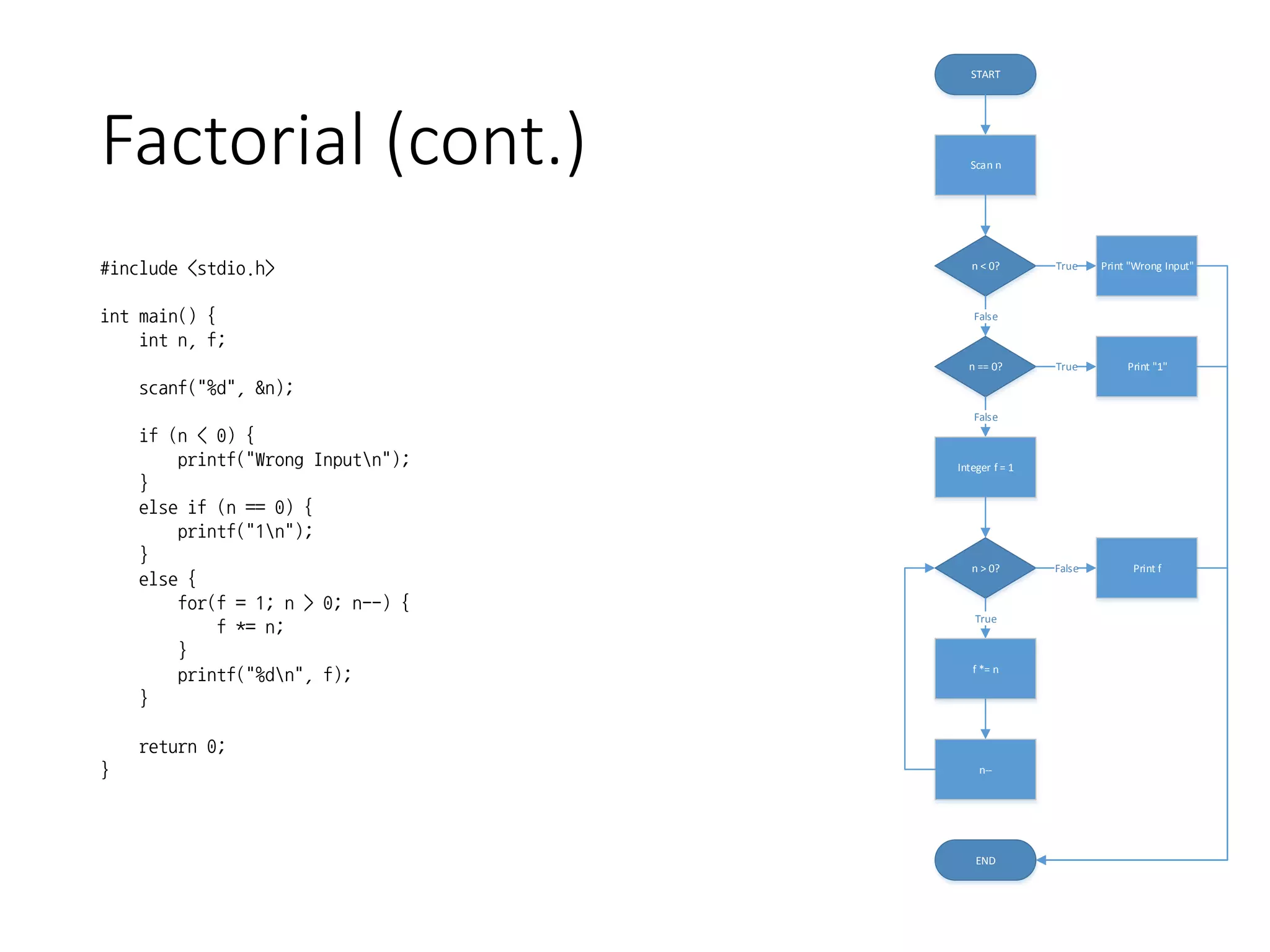
#include <stdio.h>
int main() {
int n, f;
scanf("%d", &n);
if (n < 0) {
printf("Wrong Inputn");
}
else if (n == 0) {
printf("1n");
}
else {
for(f = 1; n > 0; n--) {
f *= n;
}
printf("%dn", f);
}
return 0;
}
START
Scan n
n < 0?
False
n == 0? True Print "1"
True Print "Wrong Input"
False
Integer f = 1
n > 0?
True
f *= n
n--
False Print f
END
Factorial (cont.)
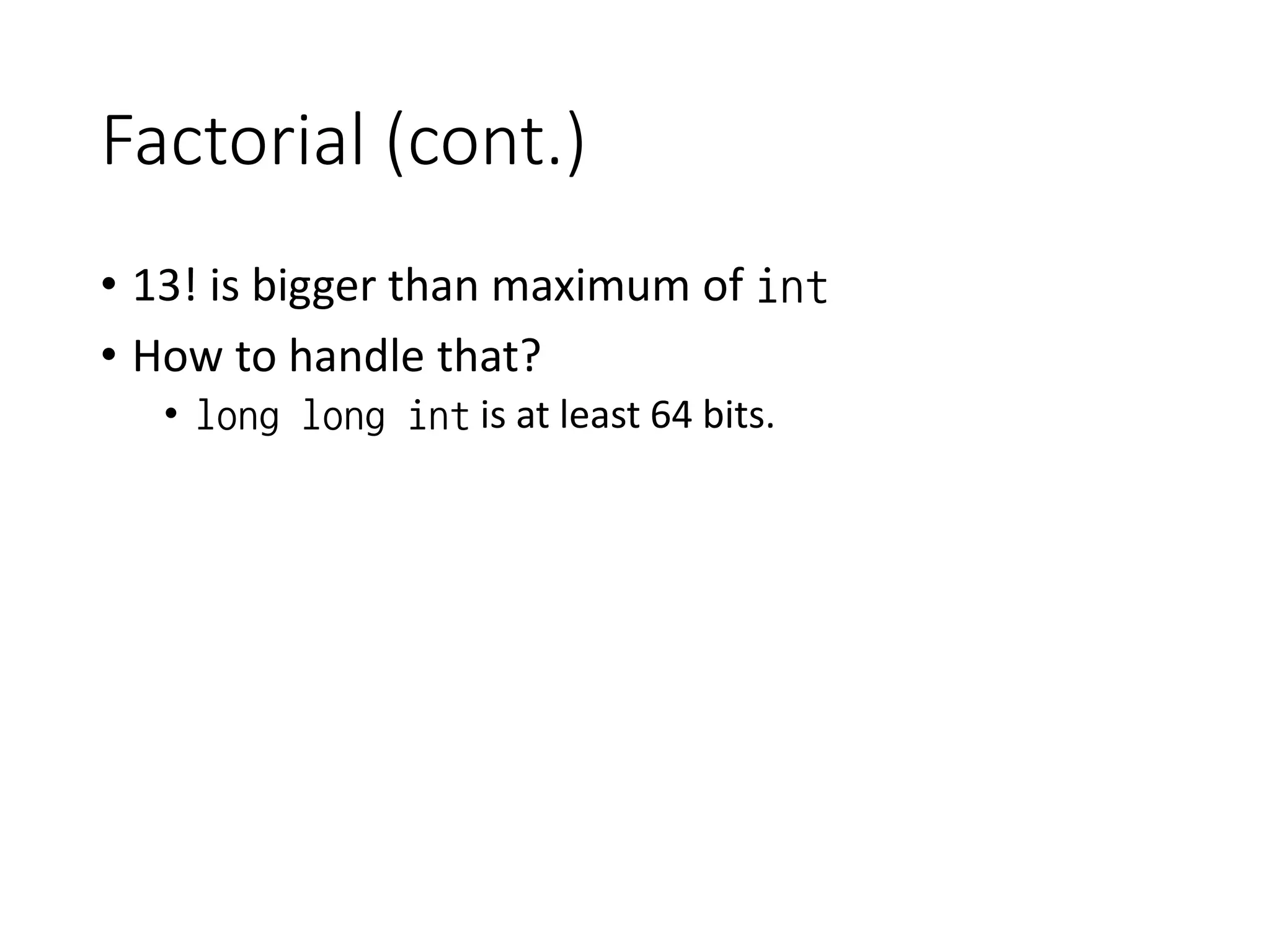
• 13! is bigger than maximum of int
• How to handle that?
• long long int is at least 64 bits.
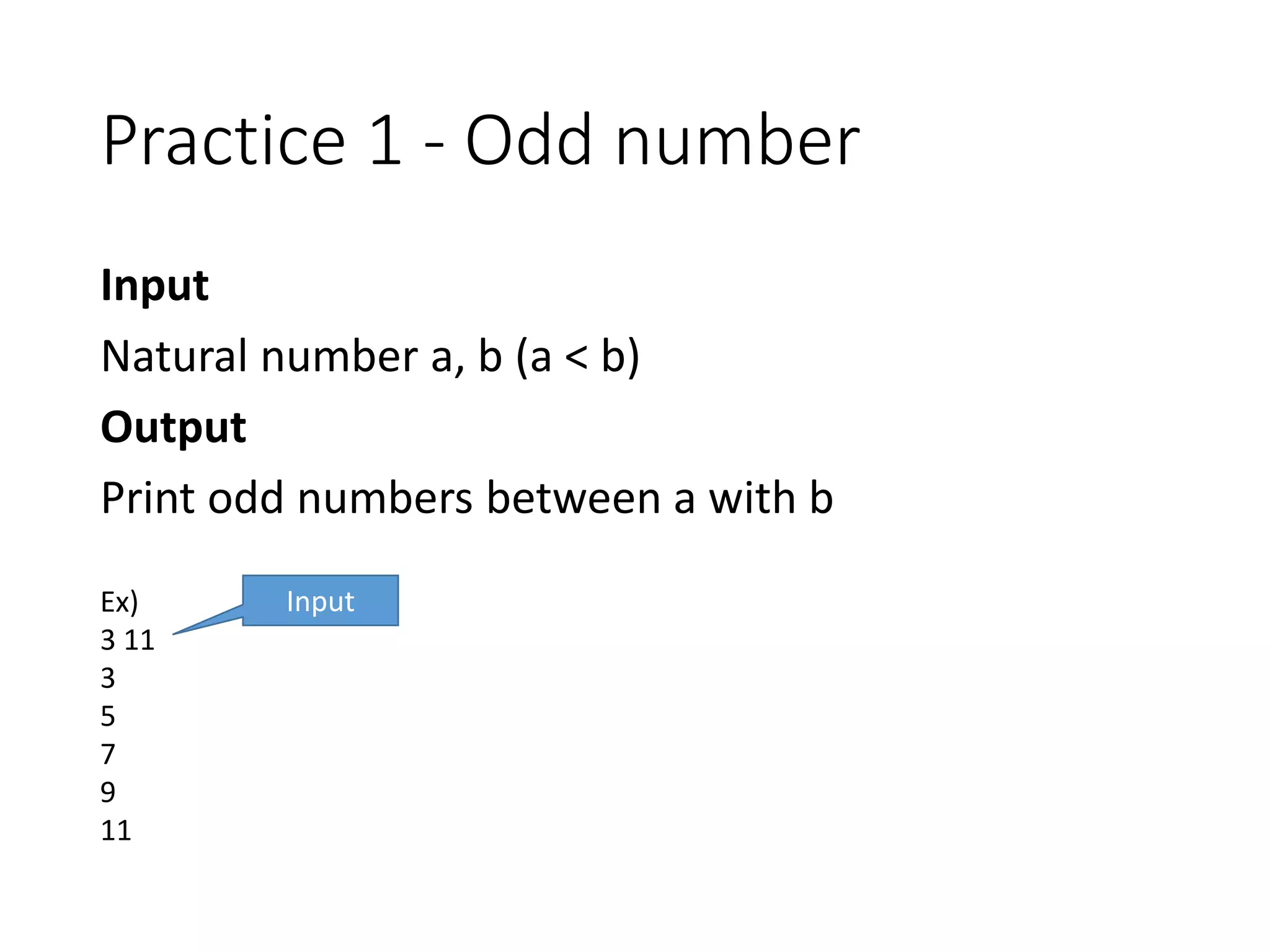
Practice 1 - Odd number
Input
Natural number a, b (a < b)
Output
Print odd numbers between a with b
Ex)
3 11
3
5
7
9
11
Input
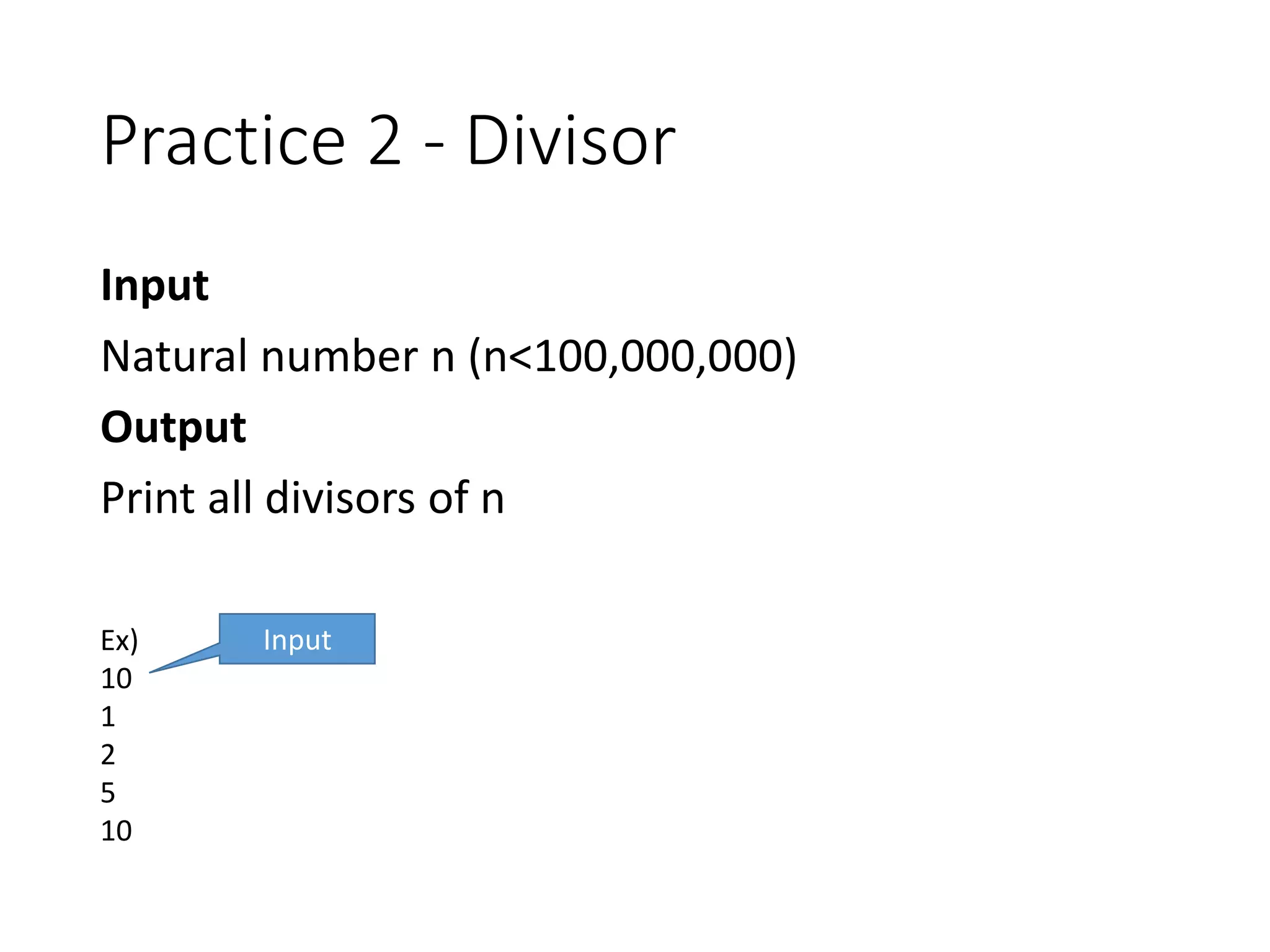
Practice 2 - Divisor
Input
Natural number n (n<100,000,000)
Output
Print all divisors of n
Ex)
10
1
2
5
10
Input
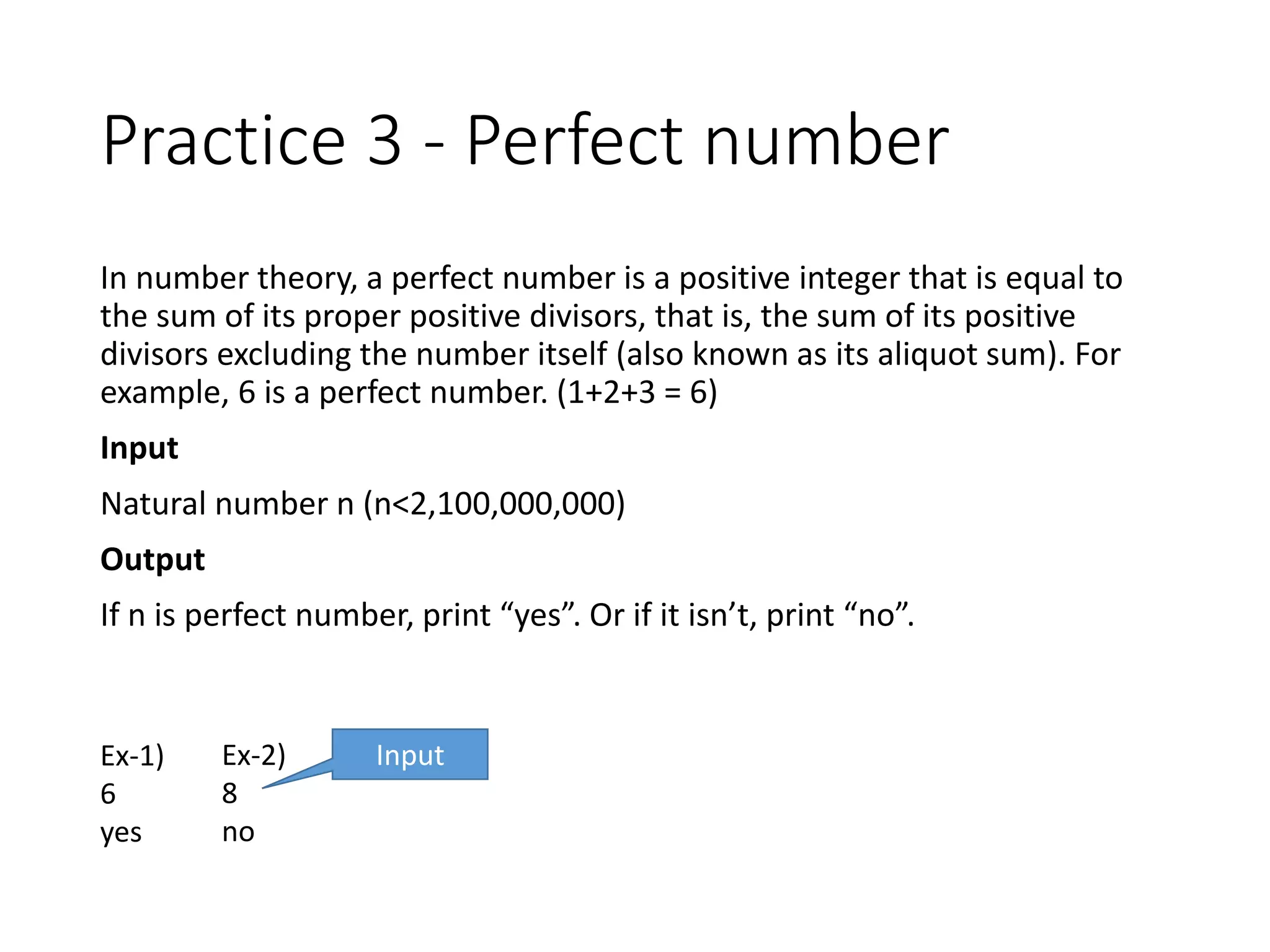
Practice 3 - Perfect number
In number theory, a perfect number is a positive integer that is equal to
the sum of its proper positive divisors, that is, the sum of its positive
divisors excluding the number itself (also known as its aliquot sum). For
example, 6 is a perfect number. (1+2+3 = 6)
Input
Natural number n (n<2,100,000,000)
Output
If n is perfect number, print “yes”. Or if it isn’t, print “no”.
Ex-1)
6
yes
Ex-2)
8
no
Input
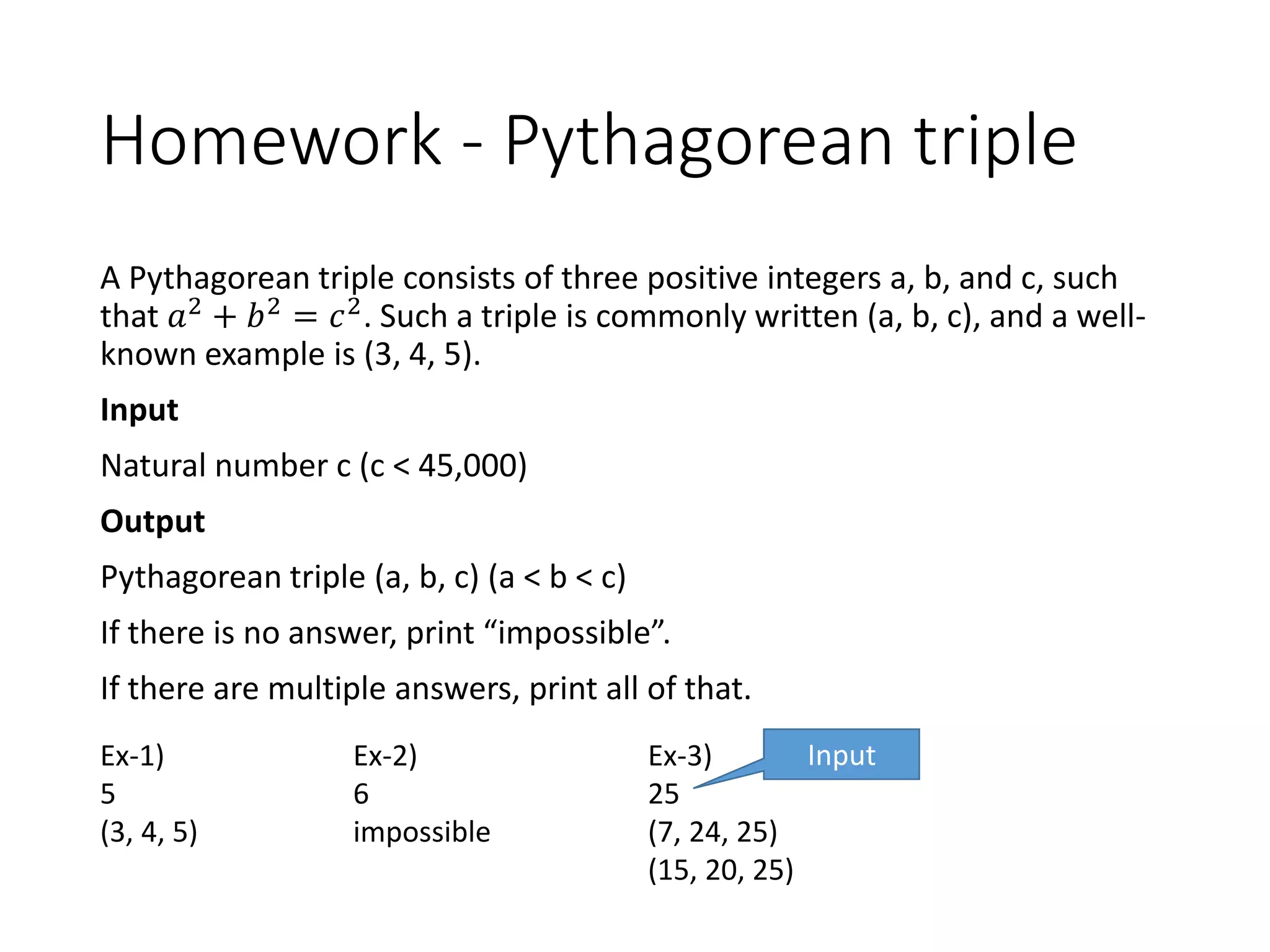
Homework - Pythagorean triple
A Pythagorean triple consists of three positive integers a, b, and c, such
that 𝑎2 + 𝑏2 = 𝑐2. Such a triple is commonly written (a, b, c), and a well-
known example is (3, 4, 5).
Input
Natural number c (c < 45,000)
Output
Pythagorean triple (a, b, c) (a < b < c)
If there is no answer, print “impossible”.
If there are multiple answers, print all of that.
Ex-1)
5
(3, 4, 5)
Ex-2)
6
impossible
Ex-3)
25
(7, 24, 25)
(15, 20, 25)
Input

Week3

  • 1.
  • 2.
    Loop: for for (initialization;condition; increment) { // statement1 } // statement2 Initialization Condition True Statement 1 Increment False Statement 2
  • 3.
    Loop: for for (i= 0; i < 5; i++) { printf("%d ", i); } printf("ENDn"); Result: 0 1 2 3 4 END i = 1 i < 5? True Print i i++ False Print END
  • 4.
    𝑥 𝑦 • doublepow(double x, double y); • float powf(float x, float y); • long double pow(long double x, long double y); #include <stdio.h> #include <math.h> int main() { int x = 2; int y = 3; printf("%dn", (int)pow((double)x, (double)y)); // 2^3 printf("%.3lfn", pow((double)x, 0.5)); //√2 return 0; }
  • 5.
    𝑥 • double sqrt(doublex); • float sqrtf(float x); • long double sqrtl(long double x); #include <stdio.h> #include <math.h> int main() { double a = 3.0; printf("%lf", sqrt(a)); return 0; }
  • 6.
    Factorial 𝑛! = 1× 2 × ⋯ × 𝑛 0! = 1 𝑛 𝑖𝑠 𝑝𝑜𝑠𝑖𝑡𝑖𝑣𝑒 𝑖𝑛𝑡𝑒𝑔𝑒𝑟 Input Integer n Output Print the value of n! If n < 0, Print “Wrong Input”
  • 7.
    Factorial (cont.) #include <stdio.h> intmain() { int n, f; scanf("%d", &n); START Integer n Integer f Scan n
  • 8.
    Factorial (cont.) if (n< 0) { printf("Wrong Inputn"); } n < 0? True Print "Wrong Input" END False
  • 9.
    Factorial (cont.) else if(n == 0) { printf("1n"); } False n == 0? True Print "1" False END
  • 10.
    Factorial (cont.) else { for(f= 1; n > 0; n--) { f *= n; } printf("%dn", f); } return 0; False f = 1 n > 0? False Print f END True f *= n n--
  • 11.
    Factorial (cont.) #include <stdio.h> intmain() { int n, f; scanf("%d", &n); if (n < 0) { printf("Wrong Inputn"); } else if (n == 0) { printf("1n"); } else { for(f = 1; n > 0; n--) { f *= n; } printf("%dn", f); } return 0; } START Scan n n < 0? False n == 0? True Print "1" True Print "Wrong Input" False Integer f = 1 n > 0? True f *= n n-- False Print f END
  • 12.
    Factorial (cont.) • 13!is bigger than maximum of int • How to handle that? • long long int is at least 64 bits.
  • 13.
    Practice 1 -Odd number Input Natural number a, b (a < b) Output Print odd numbers between a with b Ex) 3 11 3 5 7 9 11 Input
  • 14.
    Practice 2 -Divisor Input Natural number n (n<100,000,000) Output Print all divisors of n Ex) 10 1 2 5 10 Input
  • 15.
    Practice 3 -Perfect number In number theory, a perfect number is a positive integer that is equal to the sum of its proper positive divisors, that is, the sum of its positive divisors excluding the number itself (also known as its aliquot sum). For example, 6 is a perfect number. (1+2+3 = 6) Input Natural number n (n<2,100,000,000) Output If n is perfect number, print “yes”. Or if it isn’t, print “no”. Ex-1) 6 yes Ex-2) 8 no Input
  • 16.
    Homework - Pythagoreantriple A Pythagorean triple consists of three positive integers a, b, and c, such that 𝑎2 + 𝑏2 = 𝑐2. Such a triple is commonly written (a, b, c), and a well- known example is (3, 4, 5). Input Natural number c (c < 45,000) Output Pythagorean triple (a, b, c) (a < b < c) If there is no answer, print “impossible”. If there are multiple answers, print all of that. Ex-1) 5 (3, 4, 5) Ex-2) 6 impossible Ex-3) 25 (7, 24, 25) (15, 20, 25) Input