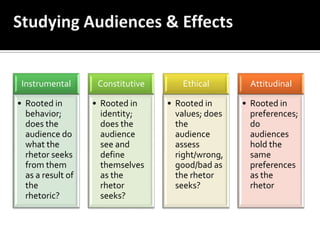
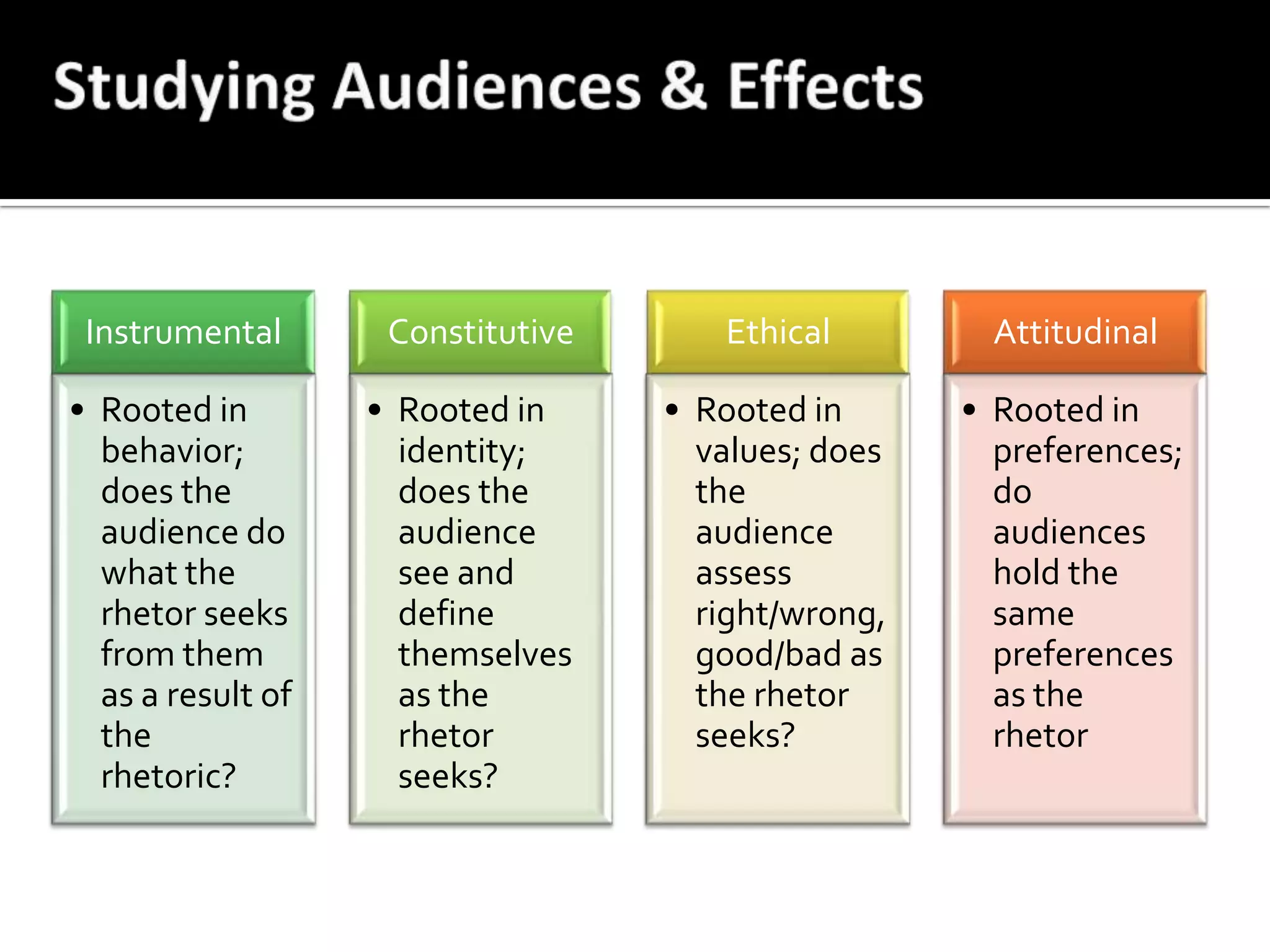



Studying Audiences & Effects
COMM 401Interpreting Strategic DiscourseWeek TwoArgument
Early Discussions of ArgumentAristotle—Non-artistic vs. artistic means of persuasion.Aristotle—3 means of persuasionEthosPathosLogosAristotle—EnthymemeCicero (Rhetorica ad Herennium)—5 parts to a complete argument:The propositionThe reasonThe proof of the reasonThe embellishmentThe résumé (conclusion)
Classical Rhetorical Canon of Invention (Inventio)Logical proofStasis—locating the starting point of the case/debate.Stasis of factStasis of definitionStasis of qualityEthical proofRomans expanded the Aristotelian conception of ethos.Includes all of a speaker’s life/character.Quintilian—a good man speaking well.Goodness becomes the hallmark of Roman conceptions of ethos.Pathetic proofReinforcement for logos.Roman development: Quintilian’s theory of humor—both content and delivery.
The Ramistic ShiftThe split between logic (argument/invention) and rhetoric (style & delivery) was brought about through the education reforms of Peter Ramus (1515-1572).Ramus was an educational reformer. Argued for an educational system different from the liberal arts model, where rhetoric was one of the seven liberal arts.Split persists for centuries.
Whately on Rhetorical ArgumentFocus on argumentation resurfaces in the works of Richard Whately (1787-1863).Whately limits the scope of rhetoric to argumentationRhetoric is less concerned with invention/discovery and more with managementA priori argument: cause to effectArgument from sign: effect to a conditionThree different types of testimony:Undesigned—genuine and simple in orientationNegative testimony—the inability of an advocate to counter/respond to contradiction or refutationConcurrent—several witnesses who don’t interact affirm a similar conclusion
Whately on Rhetorical ArgumentPresumption: “preoccupation of the ground.”A proposition “must stand good till some sufficient reason is adduced against it.”Burden of Proof: rests with the rhetor seeking to refute the presumption.
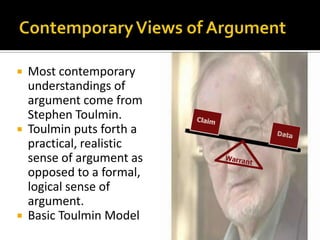
Contemporary Views of ArgumentMost contemporary understandings of argument come from Stephen Toulmin.Toulmin puts forth a practical, realistic sense of argument as opposed to a formal, logical sense of argument.Basic Toulmin Model
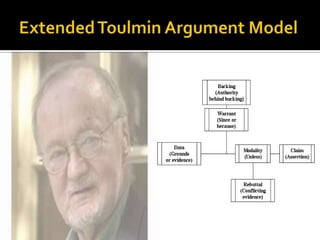
Extended Toulmin Argument Model
The Parts of the Toulmin ModelClaims can appear anywhere in the argument or they may be implied (in which case you must identify them by inference).  The claim organizes the entire argument; everything else in the argument is related to the claim.The data for the claim provides the evidence, reasoning, opinions, examples, and factual information about the claim that make it possible for the reader to accept it.  Support is always explicitly stated and will not have to be inferred.  It can appear either before or after the claim and is required to be acceptable and convincing.Qualifier/Modality: Arguments are not expected to demonstrate certainties.  Instead, they usually only establish probabilities.  Claims are qualified to meet anticipated objections of an audience.Backing: Evidence provided to make warrants acceptable to audiences.
The Parts of the Toulmin ModelWarrants are the assumptions, general principles, widely held values, commonly accepted beliefs and appeals to human motives that are important parts of any argument.  They are not written out as part of the argument, which allows an audience a sense of participation in the argument and thus, they are more likely to buy the argument.  The audience supplies warrants; if the audience accepts them, the argument is convincing.  Warrants are culture bound; they represent the values, beliefs and training typical of individual cultures.  They represent the psychology of an argument, in the sense that they reveal the unspoken beliefs and values of the author and invite the reader to examine his or her own beliefs and make comparisons.  Warrants link the support to the claim by enabling the audience to accept or justify particular evidence as proof of a particular claim.  They also establish links between the author and the audience; shared warrants result in successfully establishing common ground.Rebuttals establish what is wrong, invalid or unacceptable about an argument, and may also prevent counter-arguments or new arguments which represent entirely different perspectives or points-of-view on the issue.  Rebuttals may appear as answers to arguments that have already been stated, or the author may anticipate an audience’s rebuttal and include answers to possible objections before they are stated.
Example of Toulmin Model of ArgumentCongress should ban animal research (Claim #1) because animals are tortured in experiments that have no necessary benefit for humans such as the testing of cosmetics (Data). The well being of animals is more important than the profits of the cosmetics industry (Warrant). Only Congress has the authority to make such a law (Warrant) because the corporations can simply move from state to state to avoid legal penalties (Backing). Of course, this ban should not apply to medical research (Qualifier). A law to ban all research would go too far (Rebuttal). So, the law would probably (qualifier) have to be carefully written to define the kinds of research intended (claim #2).
COMM 401Interpreting Strategic DiscourseWeek TwoMedia/Mediation
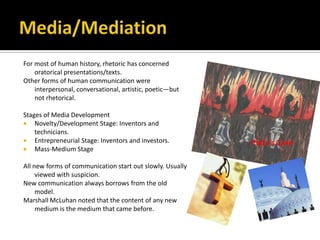
Media/MediationFor most of human history, rhetoric has concerned oratorical presentations/texts.Other forms of human communication were interpersonal, conversational, artistic, poetic—but not rhetorical.Stages of Media DevelopmentNovelty/Development Stage: Inventors and technicians.Entrepreneurial Stage: Inventors and investors.Mass-Medium StageAll new forms of communication start out slowly. Usually viewed with suspicion.New communication always borrows from the old model.Marshall McLuhan noted that the content of any new medium is the medium that came before.Plato’s Cave
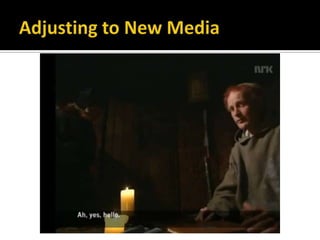
Adjusting to New Media
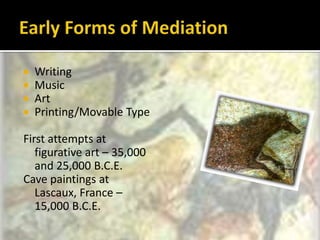
Early Forms of MediationWritingMusicArtPrinting/Movable TypeFirst attempts at figurative art – 35,000 and 25,000 B.C.E.Cave paintings at Lascaux, France – 15,000 B.C.E.
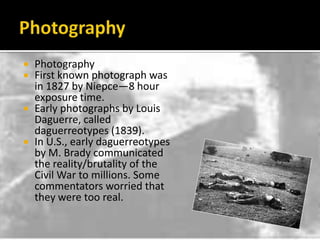
PhotographyPhotographyFirst known photograph was in 1827 by Niepce—8 hour exposure time.Early photographs by Louis Daguerre, called daguerreotypes (1839).In U.S., early daguerreotypes by M. Brady communicated the reality/brutality of the Civil War to millions. Some commentators worried that they were too real.
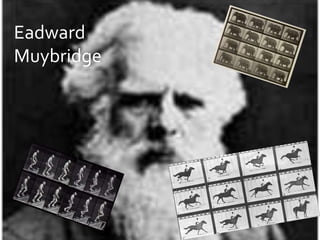
EadwardMuybridge
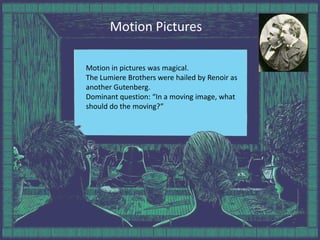
Motion PicturesMotion in pictures was magical.The Lumiere Brothers were hailed by Renoir as another Gutenberg.Dominant question: “In a moving image, what should do the moving?”
Lumiere Films
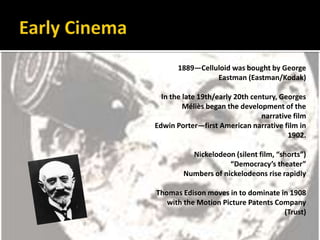
Early Cinema1889—Celluloid was bought by George Eastman (Eastman/Kodak)In the late 19th/early 20th century, Georges Méliès began the development of the narrative filmEdwin Porter—first American narrative film in 1902.Nickelodeon (silent film, “shorts”)“Democracy’s theater”Numbers of nickelodeons rise rapidlyThomas Edison moves in to dominate in 1908 with the Motion Picture Patents Company (Trust)
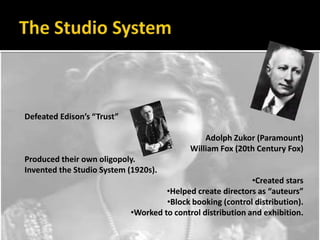
The Studio SystemDefeated Edison’s “Trust”Adolph Zukor (Paramount)William Fox (20th Century Fox)Produced their own oligopoly.Invented the Studio System (1920s).Created stars
Helped create directors as “auteurs”
Block booking (control distribution).
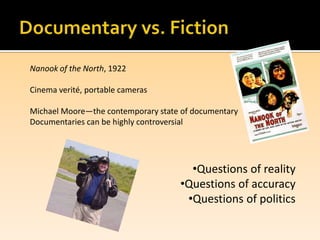
Worked to control distribution and exhibition.Documentary vs. FictionNanook of the North, 1922Cinema verité, portable camerasMichael Moore—the contemporary state of documentaryDocumentaries can be highly controversialQuestions of reality
Questions of accuracy
Questions of politicsAmerican Time Capsule
From Film to TVDemographic changes after WWII:Average marriage age drops to 19Families start earlierBaby boom and staying home with kidsBy the mid-1950s TV replaces radio and movies for family entertainmentMovies develop technologies: CinemaScope; Technicolor; etc.
From Film to TVChildren (4-6), when asked what they liked best: fathers or TV—54% chose TV.TV is 50 years old.It took only 8 years for TV to “penetrate” American homes.TV is on an average of 8 hours a day.Most of the world’s people devote half their leisure time to TV.
From Film to TVTelevision represented the merger of motion picture technology with broadcasting technology.Telegraphs (1840s) and telephones (1870s) were examples of narrowcast communication media. Both were also dependent upon wired transmission.
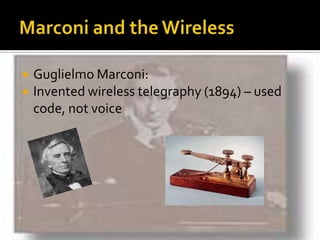
Marconi and the WirelessGuglielmo Marconi: Invented wireless telegraphy (1894) – used code, not voice
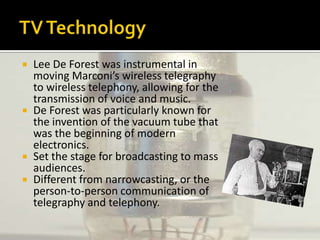
TV TechnologyLee De Forest was instrumental in moving Marconi’s wireless telegraphy to wireless telephony, allowing for the transmission of voice and music.De Forest was particularly known for the invention of the vacuum tube that was the beginning of modern electronics.Set the stage for broadcasting to mass audiences.Different from narrowcasting, or the person-to-person communication of telegraphy and telephony.

Week two part II

  • 1.
  • 4.
    COMM 401Interpreting StrategicDiscourseWeek TwoArgument
  • 6.
    Early Discussions ofArgumentAristotle—Non-artistic vs. artistic means of persuasion.Aristotle—3 means of persuasionEthosPathosLogosAristotle—EnthymemeCicero (Rhetorica ad Herennium)—5 parts to a complete argument:The propositionThe reasonThe proof of the reasonThe embellishmentThe résumé (conclusion)
  • 7.
    Classical Rhetorical Canonof Invention (Inventio)Logical proofStasis—locating the starting point of the case/debate.Stasis of factStasis of definitionStasis of qualityEthical proofRomans expanded the Aristotelian conception of ethos.Includes all of a speaker’s life/character.Quintilian—a good man speaking well.Goodness becomes the hallmark of Roman conceptions of ethos.Pathetic proofReinforcement for logos.Roman development: Quintilian’s theory of humor—both content and delivery.
  • 8.
    The Ramistic ShiftThesplit between logic (argument/invention) and rhetoric (style & delivery) was brought about through the education reforms of Peter Ramus (1515-1572).Ramus was an educational reformer. Argued for an educational system different from the liberal arts model, where rhetoric was one of the seven liberal arts.Split persists for centuries.
  • 9.
    Whately on RhetoricalArgumentFocus on argumentation resurfaces in the works of Richard Whately (1787-1863).Whately limits the scope of rhetoric to argumentationRhetoric is less concerned with invention/discovery and more with managementA priori argument: cause to effectArgument from sign: effect to a conditionThree different types of testimony:Undesigned—genuine and simple in orientationNegative testimony—the inability of an advocate to counter/respond to contradiction or refutationConcurrent—several witnesses who don’t interact affirm a similar conclusion
  • 10.
    Whately on RhetoricalArgumentPresumption: “preoccupation of the ground.”A proposition “must stand good till some sufficient reason is adduced against it.”Burden of Proof: rests with the rhetor seeking to refute the presumption.
  • 11.
    Contemporary Views ofArgumentMost contemporary understandings of argument come from Stephen Toulmin.Toulmin puts forth a practical, realistic sense of argument as opposed to a formal, logical sense of argument.Basic Toulmin Model
  • 12.
  • 13.
    The Parts ofthe Toulmin ModelClaims can appear anywhere in the argument or they may be implied (in which case you must identify them by inference). The claim organizes the entire argument; everything else in the argument is related to the claim.The data for the claim provides the evidence, reasoning, opinions, examples, and factual information about the claim that make it possible for the reader to accept it. Support is always explicitly stated and will not have to be inferred. It can appear either before or after the claim and is required to be acceptable and convincing.Qualifier/Modality: Arguments are not expected to demonstrate certainties. Instead, they usually only establish probabilities. Claims are qualified to meet anticipated objections of an audience.Backing: Evidence provided to make warrants acceptable to audiences.
  • 14.
    The Parts ofthe Toulmin ModelWarrants are the assumptions, general principles, widely held values, commonly accepted beliefs and appeals to human motives that are important parts of any argument. They are not written out as part of the argument, which allows an audience a sense of participation in the argument and thus, they are more likely to buy the argument. The audience supplies warrants; if the audience accepts them, the argument is convincing. Warrants are culture bound; they represent the values, beliefs and training typical of individual cultures. They represent the psychology of an argument, in the sense that they reveal the unspoken beliefs and values of the author and invite the reader to examine his or her own beliefs and make comparisons. Warrants link the support to the claim by enabling the audience to accept or justify particular evidence as proof of a particular claim. They also establish links between the author and the audience; shared warrants result in successfully establishing common ground.Rebuttals establish what is wrong, invalid or unacceptable about an argument, and may also prevent counter-arguments or new arguments which represent entirely different perspectives or points-of-view on the issue. Rebuttals may appear as answers to arguments that have already been stated, or the author may anticipate an audience’s rebuttal and include answers to possible objections before they are stated.
  • 15.
    Example of ToulminModel of ArgumentCongress should ban animal research (Claim #1) because animals are tortured in experiments that have no necessary benefit for humans such as the testing of cosmetics (Data). The well being of animals is more important than the profits of the cosmetics industry (Warrant). Only Congress has the authority to make such a law (Warrant) because the corporations can simply move from state to state to avoid legal penalties (Backing). Of course, this ban should not apply to medical research (Qualifier). A law to ban all research would go too far (Rebuttal). So, the law would probably (qualifier) have to be carefully written to define the kinds of research intended (claim #2).
  • 16.
    COMM 401Interpreting StrategicDiscourseWeek TwoMedia/Mediation
  • 17.
    Media/MediationFor most ofhuman history, rhetoric has concerned oratorical presentations/texts.Other forms of human communication were interpersonal, conversational, artistic, poetic—but not rhetorical.Stages of Media DevelopmentNovelty/Development Stage: Inventors and technicians.Entrepreneurial Stage: Inventors and investors.Mass-Medium StageAll new forms of communication start out slowly. Usually viewed with suspicion.New communication always borrows from the old model.Marshall McLuhan noted that the content of any new medium is the medium that came before.Plato’s Cave
  • 18.
  • 19.
    Early Forms ofMediationWritingMusicArtPrinting/Movable TypeFirst attempts at figurative art – 35,000 and 25,000 B.C.E.Cave paintings at Lascaux, France – 15,000 B.C.E.
  • 20.
    PhotographyPhotographyFirst known photographwas in 1827 by Niepce—8 hour exposure time.Early photographs by Louis Daguerre, called daguerreotypes (1839).In U.S., early daguerreotypes by M. Brady communicated the reality/brutality of the Civil War to millions. Some commentators worried that they were too real.
  • 21.
  • 22.
    Motion PicturesMotion inpictures was magical.The Lumiere Brothers were hailed by Renoir as another Gutenberg.Dominant question: “In a moving image, what should do the moving?”
  • 23.
  • 24.
    Early Cinema1889—Celluloid wasbought by George Eastman (Eastman/Kodak)In the late 19th/early 20th century, Georges Méliès began the development of the narrative filmEdwin Porter—first American narrative film in 1902.Nickelodeon (silent film, “shorts”)“Democracy’s theater”Numbers of nickelodeons rise rapidlyThomas Edison moves in to dominate in 1908 with the Motion Picture Patents Company (Trust)
  • 25.
    The Studio SystemDefeatedEdison’s “Trust”Adolph Zukor (Paramount)William Fox (20th Century Fox)Produced their own oligopoly.Invented the Studio System (1920s).Created stars
  • 26.
    Helped create directorsas “auteurs”
  • 27.
  • 28.
    Worked to controldistribution and exhibition.Documentary vs. FictionNanook of the North, 1922Cinema verité, portable camerasMichael Moore—the contemporary state of documentaryDocumentaries can be highly controversialQuestions of reality
  • 29.
  • 30.
  • 31.
    From Film toTVDemographic changes after WWII:Average marriage age drops to 19Families start earlierBaby boom and staying home with kidsBy the mid-1950s TV replaces radio and movies for family entertainmentMovies develop technologies: CinemaScope; Technicolor; etc.
  • 32.
    From Film toTVChildren (4-6), when asked what they liked best: fathers or TV—54% chose TV.TV is 50 years old.It took only 8 years for TV to “penetrate” American homes.TV is on an average of 8 hours a day.Most of the world’s people devote half their leisure time to TV.
  • 33.
    From Film toTVTelevision represented the merger of motion picture technology with broadcasting technology.Telegraphs (1840s) and telephones (1870s) were examples of narrowcast communication media. Both were also dependent upon wired transmission.
  • 34.
    Marconi and theWirelessGuglielmo Marconi: Invented wireless telegraphy (1894) – used code, not voice
  • 35.
    TV TechnologyLee DeForest was instrumental in moving Marconi’s wireless telegraphy to wireless telephony, allowing for the transmission of voice and music.De Forest was particularly known for the invention of the vacuum tube that was the beginning of modern electronics.Set the stage for broadcasting to mass audiences.Different from narrowcasting, or the person-to-person communication of telegraphy and telephony.
  • 36.
    The Development ofBroadcastingRCA, in 1926, purchased AT&T’s telephone group network to form the National Broadcasting Company (NBC)The began the affiliate system of programming—a national network broadcasting to local affiliates who would also provide their own programming.RCA’s monopoly was eventually subject to anti-trust moves by the government.In the 1940s, NBC-blue was sold and became ABC.
  • 37.
    Understanding Media"Any hotmedium allows of less participation than a cool one, as a lecture makes for less participation than a seminar, and a book for less than a dialogue."
  • 38.
    The Current MediaLandscapeHow would you describe the role of mediation on contemporary strategic discourse?What are your primary patterns of communication consumption? How are the messages you consume mediated?How does your media consumption differ from those who were media consumers 50 years ago?How will media consumers 50 years from now encounter strategic discourse differently from you?