1
Cloud Computing -Practical
Dr. Sudip Misra
Associate Professor
Department of Computer Science and Technology
IIT Kharagpur
Email: smisra@sit.iitkgp.ernet.in
Website: http://cse.iitkgp.ac.in/~smisra/
Introduction to Internet of Things
N
P
T
E
L
2.
Contents
Introduction toOpenstack
Components
Installation
Creating a key‐pair and manage security group
Launce Instances
Creating an image
Accessing and Communicating with instances
2
Introduction to Internet of Things
N
P
T
E
L
3.
Introduction to Openstack
A software to create a cloud unfrastructure
Launched as a joint project of Rackspace Hosting and NASA in 2010
Opensource
Presently many companies are contributing to openstack
Eg. IBM, CISCO, HP, Dell, Vmware, Redhat, suse, Rackspace hosting
It has a very large community
Can be used to develop private cloud or public cloud
Versions:
Austin, Bexar, Cactus, Diablo, Essex, Folsom, Grizzly, Havana, Icehouse, Juno,
Kilo, Liberty, Mitaka, Newton, Ocata (Latest)
3
Introduction to Internet of Things
N
P
T
E
L
Components contd.
Keystone
Identity service
Provides authentication and authorization
Horizon
Dashboard
GUI of the software
Provides overview of the other components
5
Introduction to Internet of Things
N
P
T
E
L
6.
Components contd.
Nova
Compute service
Where you launce your instances
Glance
Image service
Discovering, registering, retrieving the VM
Snapshots
6
Introduction to Internet of Things
N
P
T
E
L
7.
Components contd.
Swift
Object storage
Helps in storing data safely, cheaply and efficiently
Neutron
Provides networking service
Enables the other services to communicate with each other
Make your own network
7
Introduction to Internet of Things
N
P
T
E
L
8.
Components contd.
Cinder
Block storage
Virtualizes the management of block service
Heat
Orchestration
Ceilometer
Billing
What service you are using
How long are you using
8
Introduction to Internet of Things
N
P
T
E
L
9.
Installation
Can beinstalled manually or using scripts like Devstack
We will use devstack
Steps:
Install git ( sudo apt‐get install git )
Clone devstack ( git clone https://git.openstack.org/openstack‐
dev/devstack )
Go to devstack directory ( cd devstack )
9
Introduction to Internet of Things
N
P
T
E
L
10.
Installation contd.
Openlocal.conf file and paste the following and save the file
ADMIN_PASSWORD=<YOUR PASSWORD>
DATABASE_PASSWORD =<YOUR PASSWORD>
RABBIT_PASSWORD =<YOUR PASSWORD>
SERVICE_PASSWORD =<YOUR PASSWORD>
HOST_IP=<the IP of your PC>
Run the stack.sh file ( ./stack.sh)
For uninstallation, go to devstack directory and run unstack.sh file
10
Introduction to Internet of Things
N
P
T
E
L
1
Sensor-Cloud-Part I
Sensor-as-a-Service
Dr. SudipMisra
Associate Professor
Department of Computer Science and Engineering
IIT Kharagpur
Email: smisra@sit.iitkgp.ernet.in
Website: http://cse.iitkgp.ac.in/~smisra/
Introduction to Internet of Things
N
P
T
E
L
14.
2
Introduction
It isnot mere integration of sensors and cloud computing
It is not only “dumping the sensor data into cloud”
Cloud
Cloud
Introduction to Internet of Things
N
P
T
E
L
15.
3
Wireless Sensor Networks(WSNs): Recap
Contain sensor nodes which sense some physical phenomena from the
environment
Transmit the sensed data (through wireless communication) to a centralized
unit, commonly known as Sink node
The communication between Sink node and other sensor nodes in the
network may be single/multi‐hop
Sink node further process data
Introduction to Internet of Things
N
P
T
E
L
16.
4
Wireless Sensor Networks(WSNs): Recap
Sensing unit
Processing unit
Communication unit
Major Components of a
Sensor Node
Sink
Wireless Sensor Networks
Applications
Target Tracking
Wildlife Monitoring
Healthcare
Industrial Applications
Smart Home
Smart City
Agriculture
…
Introduction to Internet of Things
N
P
T
E
L
17.
5
Cloud Computing: Recap
An architecture which provides on‐demand computing resources
Advantages
Elasticity: Scaling up/down
Pay‐per‐use: Payment for the resource as per requirement
Self Service: Resource can be accessed by self
Introduction to Internet of Things
N
P
T
E
L
7
Cloud Computing: Services
Software‐as‐a‐Service (SaaS)
A third party provides a host application over internet
Example: Microsoft Office 365
Platform‐as‐a‐Service (PaaS)
Provide a platform to develop and run applications
Example: Windows Azure
Infrastructure‐as‐a‐Service (IaaS)
Provide computing resources
Example: Storage space
Introduction to Internet of Things
N
P
T
E
L
20.
8
Virtualization Concept
Onecomputer host appears as many computers‐concept of Virtual Machine
(VM)
Improve IT throughput and costs by using physical resources as a pool from
which virtual resources can be allocated.
Benefit
Sharing of resources: Same resource can be shared, in turn cost reduction
Encapsulation: A complete computing environment
Independence: Runs independently of underlying hardware
Portability: VM Migration
Introduction to Internet of Things
N
P
T
E
L
21.
9
Limitations of WSNs
Procurement
Price
Right vendor
Types of sensor integrated with it
Deployment
Right way of deployment
Right place of deployment
Maintenance
Post deployment maintenance
Battery lifetime
Change of Requirement
An example
Today Tomorrow
Agriculture Smart Home
Result: Change in Sensor type, deployment
area, topology design, and many more….
Introduction to Internet of Things
N
P
T
E
L
22.
10
Sensor-Cloud: Introduction
Notonly the mere integration of cloud computing and sensor networks, but
sensor‐cloud is more than that
Concept of virtualization of sensor node
Pay‐per‐use
One sensor node/network appears as many
A stratum between sensor nodes and end‐users
Introduction to Internet of Things
N
P
T
E
L
23.
11
Difference with WSN
WSNSensor‐Cloud
Virtualization
WSN user
Aggregated data
Dedicated to a
single user
Multiple applications/
users
Serves multiple
applications
Sensor‐cloud
infrastructure
Source: S. Misra; S. Chatterjee; M. S. Obaidat, "On Theoretical Modeling of Sensor Cloud: A Paradigm Shift From Wireless Sensor Network," in IEEE
Systems Journal , vol.PP, no.99, pp.1-10
Introduction to Internet of Things
N
P
T
E
L
24.
12
Difference with WSN(Contd.)
Source: S. Misra; S. Chatterjee; M. S. Obaidat, "On Theoretical Modeling of Sensor Cloud: A Paradigm Shift From Wireless Sensor Network," in IEEE
Systems Journal , vol.PP, no.99, pp.1-10
Actors and Roles
Attributes WSN Sensor Cloud
Ownership WSN‐user Sensor‐owner
Deployment WSN‐user Sensor‐owner
Redeployment WSN‐user SCSP
Maintenances WSN‐user SCSP
Overhead WSN‐user SCSP
Usage WSN‐user End‐user
Introduction to Internet of Things
N
P
T
E
L
25.
13
Actors in Sensor-cloud
End‐users
Enjoy Se‐aaS through applications as per the requirements.
Unknown about what and which physical sensor is/are allocated to serve the
application
Sensor‐owner
Plays a role from business perspective.
They purchase physical sensor devices, deployed over different geographical
locations, and lend these devices to the sensor‐cloud
Sensor‐Cloud Service Provider (SCSP)
A business actor.
SCSP charges price from the end‐users as per their usage of Se‐aaS.
Introduction to Internet of Things
N
P
T
E
L
26.
14
Sensor-cloud: Architecture
End‐users:Registered themselves, selects
templates, and request for application(s)
Sensor‐owner: Deploy heterogeneous/
homogeneous physical sensor nodes over
different geographical location
SCSP: Plays managerial role
Introduction to Internet of Things
N
P
T
E
L
27.
15
Sensor-cloud: View
Real View
Source:S. Misra; S. Chatterjee; M. S. Obaidat, "On Theoretical Modeling of Sensor Cloud: A Paradigm Shift From Wireless Sensor Network," in IEEE
Systems Journal , vol.PP, no.99, pp.1-10
Introduction to Internet of Things
User organization view
Application 1
Application 2
User
organization
Browser
Interface
Data feed
Data feed Sensed
information
Template
display
Template specification
User Login
Xml
interpretation
Dynamic Scaling
On‐demand physical
sensor scheduling
Vast data storage and
specialized processing
Energy
management, QoS
Application
specific real‐time
data aggregation
Web
portal
Template
specification
Sensed
data
Heterogeneous
pool of physical
sensors
Interaction with
physical sensor
On‐demand
sensor data
N
P
T
E
L
28.
16
Work Flow ofSensor-Cloud
Introduction to Internet of Things
Compatible
sensor
scheduling,
allocation,
deallocation
Operations
request Create virtual
sensor instance
User
organization
SensorML
interpretor
Virtual Sensor
Manager
Virtual Sensor
Controller
Resource
Manger
Manage
operations
Response
Response
Data request
XML template Decode
Physical sensor definition,
Virtual sensor
Group definition
Client information
Metadata
Templates
Sensor
resource pool
(WSN)
Data retrieval
Data
aggregation
Data
provisioning
Delete
virtual sensor
Release
instance Release
resource
Source: S. Misra; S. Chatterjee; M. S.
Obaidat, "On Theoretical Modeling of
Sensor Cloud: A Paradigm Shift From
Wireless Sensor Network," in IEEE
Systems Journal , vol.PP, no.99, pp.1-10
N
P
T
E
L
29.
17
Case Study: TargetTracking
“We consider a WSN‐based target tracking application, in which a WSN owner
refuses to share the sensed information with an external body, even in
exchange of money. Consequently, any organization that wishes to detect
intrusion within a particular zone has to deploy its own WSN. This leads to a
long‐term investment due to costly network setup and maintenance
overheads. However, in a sensor‐cloud environment, the same organization
can use the same tracking application and still get the service without actually
owning the WSN”
Introduction to Internet of Things
Source: S. Misra; S. Chatterjee; M. S. Obaidat, "On Theoretical Modeling of Sensor Cloud: A Paradigm Shift From Wireless Sensor Network," in IEEE
Systems Journal , vol.PP, no.99, pp.1-10
N
P
T
E
L
1
Sensor-Cloud-Part II
Sensor-as-a-Service
Dr. SudipMisra
Associate Professor
Department of Computer Science and Engineering
IIT Kharagpur
Email: smisra@sit.iitkgp.ernet.in
Website: http://cse.iitkgp.ac.in/~smisra/
Introduction to Internet of Things
N
P
T
E
L
32.
2
Management Issues inSensor-Cloud
Optimal Composition of virtual sensor nodes
Data Caching
Optimal Pricing
Introduction to Internet of Things
N
P
T
E
L
33.
3
Optimal Composition ofVirtual Sensor
Source: S. Chatterjee and S. Misra, “Dynamic Optimal Composition of a Virtual Sensor for Efficient Virtualization Within Sensor‐cloud”,
IEEE ICC 2015.
Introduction to Internet of Things
N
P
T
E
L
34.
4
Introduction
Efficient virtualizationof the physical sensor nodes
An optimal composition of VSs
Consider same geographic region: CoV‐I
Spanning across multiple regions: CoV‐II
Introduction to Internet of Things
Source: S. Chatterjee and S. Misra, “Dynamic Optimal Composition of a Virtual Sensor for Efficient Virtualization Within Sensor‐cloud”,
IEEE ICC 2015.
N
P
T
E
L
35.
5
Why Composition ofVirtual Sensor?
Resource‐constrained sensor nodes
Dynamic change in sensor conditions
The composition of virtual sensors are non‐traditional
Introduction to Internet of Things
Source: S. Chatterjee and S. Misra, “Dynamic Optimal Composition of a Virtual Sensor for Efficient Virtualization Within Sensor‐cloud”,
IEEE ICC 2015.
N
P
T
E
L
36.
6
CoV-I: Formation ofVirtual Sensor
Optimal formation of Virtual
Sensor (VS)
Homogeneous sensor nodes
within same geographical
boundary
Introduction to Internet of Things
VS
Source: S. Chatterjee and S. Misra, "Optimal composition of a virtual sensor
for efficient virtualization within sensor‐cloud," 2015 IEEE International
Conference on Communications (ICC), London, 2015, pp. 448‐453
N
P
T
E
L
37.
7
CoV-II: Formation ofVirtual Sensor Group
Formation of Virtual Sensor
Group (VSG)
Heterogeneous physical sensor
nodes across different
geographical locations
Introduction to Internet of Things
VS1 VS2 VS3
VSG
Source: S. Chatterjee and S. Misra, "Optimal composition of a virtual sensor
for efficient virtualization within sensor‐cloud," 2015 IEEE International
Conference on Communications (ICC), London, 2015, pp. 448‐453
N
P
T
E
L
38.
8
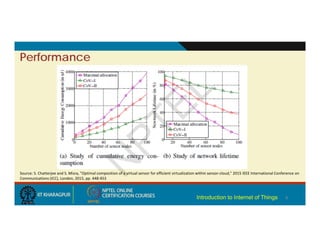
Performance
Introduction to Internetof Things
Source: S. Chatterjee and S. Misra, "Optimal composition of a virtual sensor for efficient virtualization within sensor‐cloud," 2015 IEEE International Conference on
Communications (ICC), London, 2015, pp. 448‐453
N
P
T
E
L
39.
9
Dynamic and AdaptiveData Caching Mechanism
Source: S. Chatterjee, S. Misra, “Dynamic and Adaptive Data Caching Mechanism for Virtualization within Sensor‐Cloud”, IEEE ANTS 2014.
Introduction to Internet of Things
N
P
T
E
L
40.
10
Introduction
Introduces internaland external caching mechanisms
Ensures efficiency in resource utilization
Flexible with the varied rate of change of the physical environment
Introduction to Internet of Things
Source: S. Chatterjee, S. Misra, “Dynamic and Adaptive Data Caching Mechanism for Virtualization within Sensor‐Cloud”, IEEE ANTS 2014.
N
P
T
E
L
41.
11
Why Caching inSensor-Cloud?
End‐users request for the sensed information through a Web‐interface
Allocation of physical sensor nodes and virtualization takes place
Physical sensor nodes continuously sense and transmit data to sensor‐cloud
Introduction to Internet of Things
Source: S. Chatterjee, S. Misra, “Dynamic and Adaptive Data Caching Mechanism for Virtualization within Sensor‐Cloud”, IEEE ANTS 2014.
N
P
T
E
L
42.
12
Why Caching inSensor-Cloud? (Contd.)
Practically, in some cases, the change in environmental condition are
significantly slow
Due to the slow change in environment, the sensed data of physical sensors
unaltered
In such a situation, unnecessary sensing causes energy consumption
Introduction to Internet of Things
Source: S. Chatterjee, S. Misra, “Dynamic and Adaptive Data Caching Mechanism for Virtualization within Sensor‐Cloud”, IEEE ANTS 2014.
N
P
T
E
L
43.
13
External and InternalCaching Mechanism
Internal Cache (IC)
Handles requests from end‐user
Takes decision whether the data should be provided directly to the end
user or is it required to re‐cache the data from external cache
External Cache (EC)
After every certain interval data are required to re‐cache
Initially, few data are used to be transmitted to IC
Introduction to Internet of Things
Source: S. Chatterjee, S. Misra, “Dynamic and Adaptive Data Caching Mechanism for Virtualization within Sensor‐Cloud”, IEEE ANTS 2014.
N
P
T
E
L
44.
14
Architecture of Caching
ExistingArchitecture Cache‐enabled Architecture
Introduction to Internet of Things
App1 App2 Appn
Sensor‐Cloud
Resource
pooling
. . .
App1 App2 Appn
. . .
EC
IC
Sensor‐Cloud
Source: S. Chatterjee, S. Misra, “Dynamic and Adaptive Data Caching Mechanism for Virtualization within Sensor‐Cloud”, IEEE ANTS 2014.
N
P
T
E
L
45.
15
Performance
Introduction to Internetof Things
Source: S. Chatterjee, S. Misra, “Dynamic and Adaptive Data Caching Mechanism for Virtualization within Sensor‐Cloud”, IEEE ANTS 2014.
N
P
T
E
L
46.
16
Dynamic Optimal Pricingfor Sensor-Cloud
Infrastructure
Source: S. Chatterjee, R. Ladia, and S. Misra, “Dynamic Optimal Pricing for Heterogeneous Service‐Oriented Architecture of Sensor‐Cloud
Infrastructure”, IEEE TSC 2017.
Introduction to Internet of Things
N
P
T
E
L
47.
17
Introduction
Existing schemesconsider homogeneity of service (e.g. for IaaS, SaaS)
No scheme for SeaaS.
The proposed pricing scheme comprises of two components:
Pricing attributed to hardware (pH)
Pricing attributed to Infrastructure (pI)
Goal of the proposed pricing scheme:
Maximizing profit of SCSP
Maximizing profit of sensor owner
End users’ satisfaction
Introduction to Internet of Things
N
P
T
E
L
48.
18
Pricing in Sensor-Cloud
Introductionto Internet of Things
Base
Station
Web Portal
Sensor‐Cloud
Pricing and negotiation
Set of sensor owner
Set of end users
N
P
T
E
L
49.
19
Focus on
Maximizingthe profit made by SCSP
Optimal pricing to the end‐users
End users satisfaction
Pricing attributed to hardware (pH)
Deals with usage of physical sensor nodes
Pricing attribute to infrastructure (pI)
Deals with the price associated with infrastructure of sensor‐cloud
Introduction to Internet of Things
N
P
T
E
L
50.
20
References
Madoka Yuriyamaand Takayuki Kushida , “Sensor‐Cloud Infrastructure ‐ Physical Sensor Management with
Virtualized Sensors on Cloud Computing”, Research Report , IBM Research ‐ Tokyo IBM Japan, Ltd., 2010
(http://domino.research.ibm.com/library/cyberdig.nsf/papers/70E4CC6AD71F2418852577670016F2DE/$File
/RT0897.pdf)
S. Chatterjee, R. Ladia and S. Misra, "Dynamic Optimal Pricing for Heterogeneous Service‐Oriented
Architecture of Sensor‐Cloud Infrastructure," in IEEE Transactions on Services Computing, vol. 10, no. 2, pp.
203‐216, 2017
S. Chatterjee and S. Misra, "Optimal composition of a virtual sensor for efficient virtualization within sensor‐
cloud," 2015 IEEE International Conference on Communications (ICC), London, 2015, pp. 448‐453
S. Misra; S. Chatterjee; M. S. Obaidat, "On Theoretical Modeling of Sensor Cloud: A Paradigm Shift From
Wireless Sensor Network," in IEEE Systems Journal , vol.PP, no.99, pp.1‐10
Introduction to Internet of Things
N
P
T
E
L
1
Fog Computing –Part I
Dr. Sudip Misra
Associate Professor
Department of Computer Science and Technology
IIT Kharagpur
Email: smisra@sit.iitkgp.ernet.in
Website: http://cse.iitkgp.ac.in/~smisra/
Introduction to Internet of Things
N
P
T
E
L
53.
Fog computingor fogging is a term coined by CISCO.
The idea of fog computing is to extend the cloud nearer to the IoT devices.
The primary aim: solve the problems faced by cloud computing during IoT
data processing.
an intermediate layer between cloud and devices.
2
Introduction
Introduction to Internet of Things
N
P
T
E
L
Introduction (contd.)
40%of the whole worlds data will come from sensors alone by 2020.
90% of the world’s data were generated only during the period of last two
years.
2.5 quintillion bytes of data is generated per day.
total expenditure on IoT devices will be $1.7 Trillion by 2020
4
Introduction to Internet of Things
N
P
T
E
L
56.
Introduction (contd.)
thetotal number of connected vehicles worldwide will be 250 millions by
2020.
there will be more than 30 billion IoT devices
The amount of data generated by IoT devices is simply huge.
5
Introduction to Internet of Things
N
P
T
E
L
57.
Why Fog Computing
The ability of the current cloud model is insufficient to handle the
requirements of IoT.
Issues are:
Volume
Latency
Bandwidth
6
Introduction to Internet of Things
N
P
T
E
L
58.
Why Fog Computing(contd.)
7
Cloud
Sends data
for analysis
and storage
Sends back
command or
action
required
Fig.1: Present day cloud model
Devices
Introduction to Internet of Things
N
P
T
E
L
59.
Why Fog Computing(contd.)
8
Data Volume:
By 2020, about 50 billion devices will be online.
Presently billions of devices produce exabytes of data everyday.
Device density is still increasing everyday.
Current cloud model is unable to process this amount of data.
Introduction to Internet of Things
N
P
T
E
L
60.
Why Fog Computing(contd.)
9
Cloud
Private firms Factories
Airplane firms
Private firms, Factories,
airplane companies produces
colossus amount of data
everyday
Current cloud model cannot
store all these data
Data need to be filtered
Storing data
Introduction to Internet of Things
N
P
T
E
L
61.
10
Why Fog Computing(contd.)
Latency
Time taken by a data packet for a round trip
An important aspect for handing a time sensitive data.
If edge devices send time sensitive data to cloud for analysis and wait
for the cloud to give a proper action, then it can lead to many
unwanted results.
While handling time sensitive data, a millisecond can make a huge
differences.
Introduction to Internet of Things
N
P
T
E
L
62.
Sending time‐sensitivedata to cloud for
analysis
Latency = +
+
where T = Time
Latency will be increased
When the action reaches the device,
accident may have already
occured
Why Fog Computing (contd.)
11
Cloud
Analysis of
data
Appropriate
action
Sending time
sensitive data for
analysis
Introduction to Internet of Things
N
P
T
E
L
63.
Why Fog Computing(contd.)
Bandwidth:
Bit‐rate of data during transmission
If all the data generated by IoT devices are sent to cloud for storage
and analysis, then, the traffic generated by these devices will be
simply gigantic.
consumes almost all the bandwidths.
Handling this kind of traffic will be simply a very hard task.
12
Introduction to Internet of Things
N
P
T
E
L
64.
Why Fog Computing(contd.)
13
Cloud
Billions of devices consuming bandwidth
If all the devices become online even IPv6
will not be able to provide facility to all
the devices
Data may be confidential which the firms
do not want to share online
Sending data for
analysis and
storage
Appropriate
action
Introduction to Internet of Things
N
P
T
E
L
65.
Requirements of IoT
14
Reduce latency of data:
Appropriate actions at the right time prevents major accidents machine failure
etc.
A minute delay while taking a decision makes a huge difference
Latency can be reduced by analyzing the data close to the data source
Introduction to Internet of Things
N
P
T
E
L
66.
Requirements of IoT(contd.)
Data security:
IoT data must be secured and protected from the intruders.
Data are required to be monitored 24x7
An appropriate action should be taken before the attack causes major
harm to the network
15
Introduction to Internet of Things
N
P
T
E
L
67.
Requirements of IoT(contd.)
Operation reliability:
The data generated from IoT devices are used to solve real time
problem
Integrity and availability of the data must be guaranteed
Unavailability and tampering of data can be hazardous
16
Introduction to Internet of Things
N
P
T
E
L
68.
Requirements of IoT(contd.)
Processing of data at respective suitable place:
Data can be divided into three types based on sensitivity
time sensitive data
less time sensitive data
data which are not time sensitive
Extremely time sensitive data should be analyzed very near to the data
source
Data which are not time sensitive will be analyzed in the cloud.
17
Introduction to Internet of Things
N
P
T
E
L
69.
Requirements of IoT(contd.)
Monitor data across large geographical area:
The location of connected IoT devices can be spread across a large
geographical region
E.g. monitoring the railway track of a country or a state
the devices are exposed to the harsh environments condition
18
Introduction to Internet of Things
N
P
T
E
L
70.
When should weuse fog
If the data should ne analyze with fraction of second
If there are huge number of devices
If the devices are separated by a large geographical distance
If the devices are needed to be subjected to extreme conditions
19
Introduction to Internet of Things
N
P
T
E
L
1
Fog Computing –Part II
Dr. Sudip Misra
Associate Professor
Department of Computer Science and Technology
IIT Kharagpur
Email: smisra@sit.iitkgp.ernet.in
Website: http://cse.iitkgp.ac.in/~smisra/
Introduction to Internet of Things
N
P
T
E
L
73.
Architecture of Fog
Cloud services are extended to IoT devices through fog
Fog is a layer between cloud and IoT devices
many fog nodes can be present
Sensor data are processed in the fog before it is sent to the cloud
Reduces latency, save bandwidth and save the storage of the cloud
2
Introduction to Internet of Things
N
P
T
E
L
Fog nodes
Characteristicsfor a fog node:
Storage ‐ To give transient storage
Computing facility
‐ To process the data before it is sent to cloud
‐ To take quick decisions
Network connectivity ‐ To connect with IoT devices, other fog nodes
and cloud
4
Introduction to Internet of Things
N
P
T
E
L
76.
Fog nodes (contd.)
E.g. ‐ routers, embedded servers, switches, video surveillance cameras,
etc.
deployable anywhere inside the network.
Each fog nodes have their aggregate fog node.
5
Introduction to Internet of Things
N
P
T
E
L
77.
Working of Fog
Three types of data
Very time‐sensitive data
Less time‐sensitive data
Data which are not time‐sensitive
Fog nodes works according to the type of data they receive.
An IoT application should be installed to each fog nodes
6
Introduction to Internet of Things
N
P
T
E
L
78.
Working of Fog(contd.)
7
Devices
Cloud
Nearest
Fog Node
Aggregate fog
node
Action
Sends the summary for
historical analysis and
storage
Sends the summary for
historical analysis and
storage
Sends the summary for historical analysis and storage
Non‐time‐sensitive
data
Less time‐sensitive
data
Ingest data
If time‐sensitive
data then take
immediate action
Fig : Working of fog
Introduction to Internet of Things
N
P
T
E
L
79.
Working of Fog(contd.)
The nearest fog node ingest the data from the devices.
Most time‐sensitive data
Data which should be analyzed within fraction of a second
Analyze at the nearest node itself
Sends the decision or action to the devices
Sends and stores the summary to cloud for future analysis
8
Introduction to Internet of Things
N
P
T
E
L
80.
Working of Fog(contd.)
Less time‐sensitive data
Data which can be analyzed after seconds or minutes
Are sent to the aggregate node for analysis
After analysis, the aggregate node send the decision or action to the
device through the nearest node
The aggregate node sends the summary to cloud for storage and
future analysis.
9
Introduction to Internet of Things
N
P
T
E
L
81.
Working of Fog(contd.)
Non‐time‐sensitive data
Data which can be wait for hours, days, weeks
Sent to cloud for storage and future analysis.
Those summaries from fog nodes can be considered as less time
sensitive data.
10
Introduction to Internet of Things
N
P
T
E
L
82.
Working of Fog(contd.)
11
Fog node closest to
devices
Fog aggregate nodes Cloud
Analysis duration Fraction of second Seconds to minutes Hours to weeks
IoT data storage
duration
Transient Hour, days Months to years
Geographical
coverage
Very local Wider Global
Introduction to Internet of Things
N
P
T
E
L
83.
Advantages of Fog
Security
Provides better security
Fog nodes can use the same security policy
Low operation cost
Data are processed in the fog nodes before sending to cloud
Reduces the bandwidth consumption
12
Introduction to Internet of Things
N
P
T
E
L
84.
Advantages of Fog(contd.)
Reduces unwanted accidents
Latency will be reduce during decision making
Quick decision making
Better privacy
Every industry can analyze their data locally
Store confidential data in their local servers
Send only those data which can be shared to the cloud
13
Introduction to Internet of Things
N
P
T
E
L
85.
Advantages of Fog(contd.)
Business agility
Fog application can be easily developed according to tools available
Can be deployed anywhere we need
Can be programed according to the customer’s need
Support mobility
Nodes can be mobile
Nodes can join and leave the network anytime
14
Introduction to Internet of Things
N
P
T
E
L
86.
Advantages of Fog(contd.)
Deployable in remote places
Can be deployed in remote places
Can be subjected to harsh environmental conditions
Under sea, railway tracks, vehicles, factory floor etc
Better data handling
Can operate with less bandwidth
Data can be analyzed locally
Reduce the risk of latency
15
Introduction to Internet of Things
N
P
T
E
L
87.
Applications of Fog
Real time health analysis
Patients with chronic illness can be monitored in real time
Stroke patients
Analyze the data real time
During emergency, alerts the respective doctors immediately
Historical data analysis can predict future dangers of the patient
16
Introduction to Internet of Things
N
P
T
E
L
88.
Applications of Fog(contd.)
Intelligence power efficient system
Power efficient
Reports detail power consumption report everyday
Suggest economical power usage plan
17
Introduction to Internet of Things
N
P
T
E
L
89.
Applications of Fog(contd.)
Real time rail monitoring
Fog nodes can be deployed to railway tracks
Real time monitoring of the track conditions
For high speed train, sending the data in cloud for analysis is inefficient
Fog nodes provide fast data analysis
Improve safety and reliability
18
Introduction to Internet of Things
N
P
T
E
L
90.
Applications of Fog(contd.)
Pipeline optimization
Gas and oils are transported through pipelines
Real time monitoring of pressure, flow, compressor is necessary
Terabytes of data are created
Sending all this data to cloud for analysis and storage is not efficient
Network latency is not acceptable
Fog is a solution
19
Introduction to Internet of Things
N
P
T
E
L
91.
Applications of Fog(contd.)
Real time wind mill and turbine analysis
Wind direction and speed analysis can increase output
Data can be monitored real time
20
Introduction to Internet of Things
N
P
T
E
L
92.
Challenges
Power consumption
Fog use addition nodes
Power consumption is higher than centralized cloud
Data Security
Data generating nodes are distributed
Providing authentication and authorization system for the whole nodes is
not an easy task
Reliability
Maintaining data integrity and availability for millions of nodes is difficult
failure of a node cannot affect the network
21
Introduction to Internet of Things
N
P
T
E
L
93.
Challenges (contd.)
Faulttolerance
Failure of a node should be immediately fixed
Individual failure should not affect the whole scenario
Real time analysis
Real time analysis is a primary requirement for minimizing latency
Dynamic analysis and decision making reduces danger and increase output
Monitor huge number of nodes is not easy
22
Introduction to Internet of Things
N
P
T
E
L
94.
Challenges (contd.)
Programmingarchitecture
Fog nodes may be mobile
Nodes can connect and leave the network when necessary
Many data processing frameworks are statically configured
These frameworks cannot provide proper scalability and flexibility
23
Introduction to Internet of Things
N
P
T
E
L
95.
Conclusion
Fog isa perfect partner for cloud and IoT
Solves the primary problems faced by cloud while handling IoT data
Benefits extends from an individual person to huge firms
Provides real time analysis and monitoring
24
Introduction to Internet of Things
N
P
T
E
L
96.
References
Amir VahidDastjerdi, Rajkumar Buyya, Fog Computing: Helping the Internet of Things
realize its potential, IEEE Fog computing, August 2016
CISCO white paper, Fog Computing and the Internet of Things: Extend the Cloud to
Where the Things Are, 2015
R System white paper, Fog Computing for Big Data analytics, October 2016
Redowan Mahmud,Rajkumar Buyya, Fog Computing: A Taxonomy, Survey and future
Directions,Cornell University Library, November 2016
http://www.businessinsider.in/THE‐INTERNET‐OF‐EVERYTHING‐2015‐SLIDE‐
DECK/articleshow/45695215.cms
http://www.gartner.com/newsroom/id/2970017
https://www.uschamberfoundation.org/bhq/big‐data‐and‐what‐it‐means
https://www.afcea.org/content/?q=node/12239
25
Introduction to Internet of Things
N
P
T
E
L