The Accounting Equation and
Financial Transaction
Worksheet
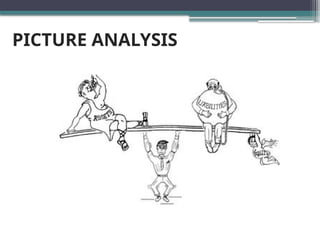
PICTURE ANALYSIS
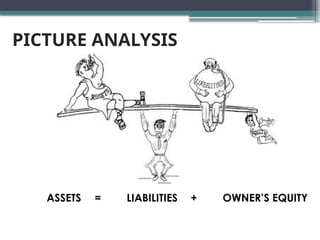
PICTURE ANALYSIS
ASSETS = LIABILITIES + OWNER’S EQUITY
Are your liabilities significantly
higher than your assets?
THE ACCOUNTING EQUATION
The most basic tool of accounting. This equation presents
the resources controlled by the enterprise, the present
obligations of the enterprise, and the residual interest in
the assets.
ASSETS = LIABILITIES+ OWNER’S EQUITY
It also helps measure the
profitability of your business.
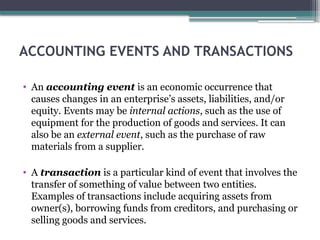
ACCOUNTING EVENTS AND TRANSACTIONS
• An accounting event is an economic occurrence that
causes changes in an enterprise’s assets, liabilities, and/or
equity. Events may be internal actions, such as the use of
equipment for the production of goods and services. It can
also be an external event, such as the purchase of raw
materials from a supplier.
• A transaction is a particular kind of event that involves the
transfer of something of value between two entities.
Examples of transactions include acquiring assets from
owner(s), borrowing funds from creditors, and purchasing or
selling goods and services.
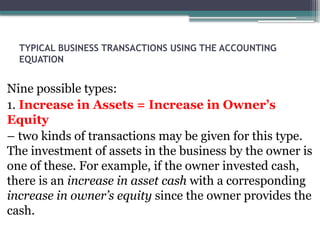
TYPICAL BUSINESS TRANSACTIONS USING THE ACCOUNTING
EQUATION
Nine possible types:
1. Increase in Assets = Increase in Owner’s
Equity
– two kinds of transactions may be given for this type.
The investment of assets in the business by the owner is
one of these. For example, if the owner invested cash,
there is an increase in asset cash with a corresponding
increase in owner’s equity since the owner provides the
cash.
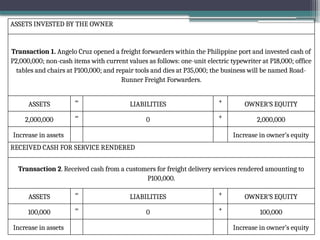
ASSETS INVESTED BY THE OWNER
Transaction 1. Angelo Cruz opened a freight forwarders within the Philippine port and invested cash of
P2,000,000; non-cash items with current values as follows: one-unit electric typewriter at P18,000; office
tables and chairs at P100,000; and repair tools and dies at P35,000; the business will be named Road-
Runner Freight Forwarders.
ASSETS = LIABILITIES + OWNER’S EQUITY
2,000,000 = 0 + 2,000,000
Increase in assets Increase in owner’s equity
RECEIVED CASH FOR SERVICE RENDERED
Transaction 2. Received cash from a customers for freight delivery services rendered amounting to
P100,000.
ASSETS = LIABILITIES + OWNER’S EQUITY
100,000 = 0 + 100,000
Increase in assets Increase in owner’s equity
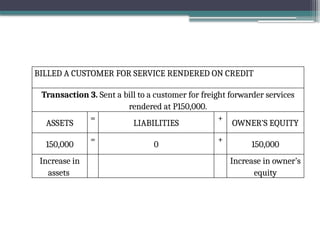
BILLED A CUSTOMER FOR SERVICE RENDERED ON CREDIT
Transaction 3. Sent a bill to a customer for freight forwarder services
rendered at P150,000.
ASSETS
=
LIABILITIES
+
OWNER’S EQUITY
150,000
=
0
+
150,000
Increase in
assets
Increase in owner’s
equity
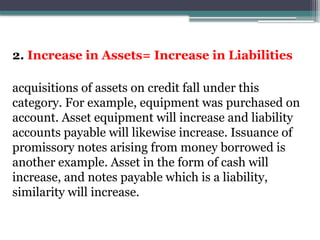
2. Increase in Assets= Increase in Liabilities
acquisitions of assets on credit fall under this
category. For example, equipment was purchased on
account. Asset equipment will increase and liability
accounts payable will likewise increase. Issuance of
promissory notes arising from money borrowed is
another example. Asset in the form of cash will
increase, and notes payable which is a liability,
similarity will increase.
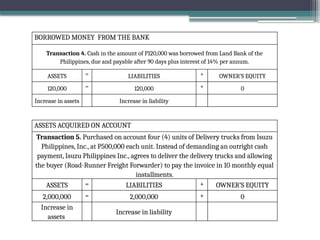
BORROWED MONEY FROM THE BANK
Transaction 4. Cash in the amount of P120,000 was borrowed from Land Bank of the
Philippines, due and payable after 90 days plus interest of 14% per annum.
ASSETS = LIABILITIES + OWNER’S EQUITY
120,000 = 120,000 + 0
Increase in assets Increase in liability
ASSETS ACQUIRED ON ACCOUNT
Transaction 5. Purchased on account four (4) units of Delivery trucks from Isuzu
Philippines, Inc., at P500,000 each unit. Instead of demanding an outright cash
payment, Isuzu Philippines Inc., agrees to deliver the delivery trucks and allowing
the buyer (Road-Runner Freight Forwarder) to pay the invoice in 10 monthly equal
installments.
ASSETS = LIABILITIES + OWNER’S EQUITY
2,000,000 = 2,000,000 + 0
Increase in
assets
Increase in liability
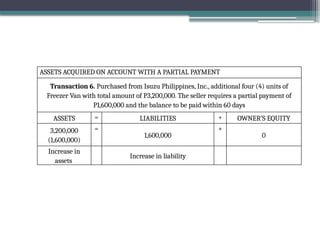
ASSETS ACQUIRED ON ACCOUNT WITH A PARTIAL PAYMENT
Transaction 6. Purchased from Isuzu Philippines, Inc., additional four (4) units of
Freezer Van with total amount of P3,200,000. The seller requires a partial payment of
P1,600,000 and the balance to be paid within 60 days
ASSETS = LIABILITIES + OWNER’S EQUITY
3,200,000
(1,600,000)
=
1,600,000
+
0
Increase in
assets
Increase in liability
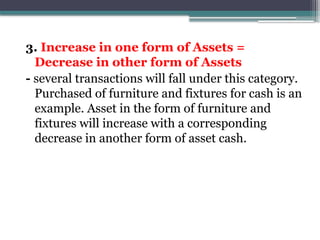
3. Increase in one form of Assets =
Decrease in other form of Assets
- several transactions will fall under this category.
Purchased of furniture and fixtures for cash is an
example. Asset in the form of furniture and
fixtures will increase with a corresponding
decrease in another form of asset cash.
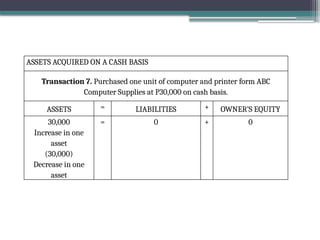
ASSETS ACQUIRED ON A CASH BASIS
Transaction 7. Purchased one unit of computer and printer form ABC
Computer Supplies at P30,000 on cash basis.
ASSETS = LIABILITIES + OWNER’S EQUITY
30,000
Increase in one
asset
(30,000)
Decrease in one
asset
= 0 + 0
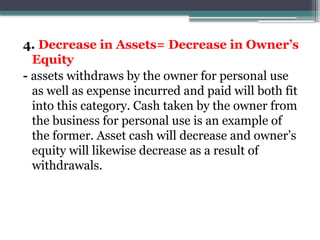
4. Decrease in Assets= Decrease in Owner’s
Equity
- assets withdraws by the owner for personal use
as well as expense incurred and paid will both fit
into this category. Cash taken by the owner from
the business for personal use is an example of
the former. Asset cash will decrease and owner’s
equity will likewise decrease as a result of
withdrawals.
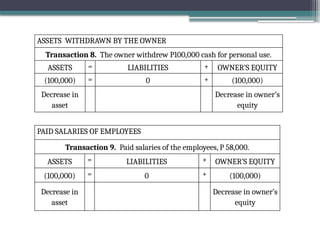
ASSETS WITHDRAWN BY THE OWNER
Transaction 8. The owner withdrew P100,000 cash for personal use.
ASSETS = LIABILITIES + OWNER’S EQUITY
(100,000) = 0 + (100,000)
Decrease in
asset
Decrease in owner’s
equity
PAID SALARIES OF EMPLOYEES
Transaction 9. Paid salaries of the employees, P 58,000.
ASSETS = LIABILITIES + OWNER’S EQUITY
(100,000) = 0 + (100,000)
Decrease in
asset
Decrease in owner’s
equity
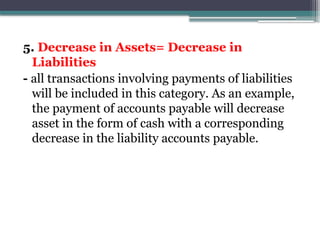
5. Decrease in Assets= Decrease in
Liabilities
- all transactions involving payments of liabilities
will be included in this category. As an example,
the payment of accounts payable will decrease
asset in the form of cash with a corresponding
decrease in the liability accounts payable.
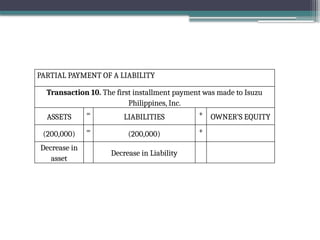
PARTIAL PAYMENT OF A LIABILITY
Transaction 10. The first installment payment was made to Isuzu
Philippines, Inc.
ASSETS = LIABILITIES + OWNER’S EQUITY
(200,000) = (200,000) +
Decrease in
asset
Decrease in Liability
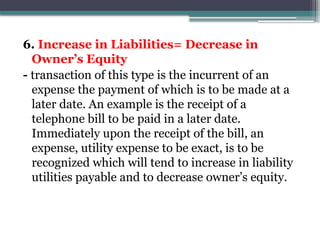
6. Increase in Liabilities= Decrease in
Owner’s Equity
- transaction of this type is the incurrent of an
expense the payment of which is to be made at a
later date. An example is the receipt of a
telephone bill to be paid in a later date.
Immediately upon the receipt of the bill, an
expense, utility expense to be exact, is to be
recognized which will tend to increase in liability
utilities payable and to decrease owner’s equity.
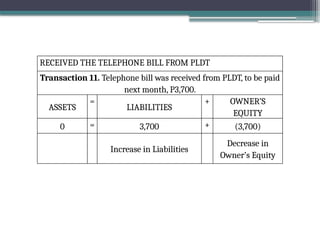
RECEIVED THE TELEPHONE BILL FROM PLDT
Transaction 11. Telephone bill was received from PLDT, to be paid
next month, P3,700.
ASSETS
=
LIABILITIES
+ OWNER’S
EQUITY
0 = 3,700 + (3,700)
Increase in Liabilities
Decrease in
Owner’s Equity
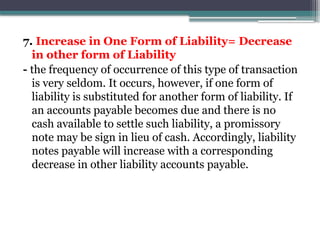
7. Increase in One Form of Liability= Decrease
in other form of Liability
- the frequency of occurrence of this type of transaction
is very seldom. It occurs, however, if one form of
liability is substituted for another form of liability. If
an accounts payable becomes due and there is no
cash available to settle such liability, a promissory
note may be sign in lieu of cash. Accordingly, liability
notes payable will increase with a corresponding
decrease in other liability accounts payable.
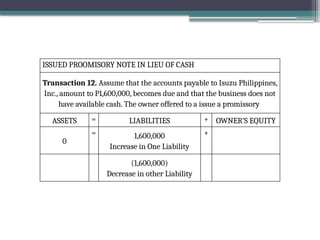
ISSUED PROOMISORY NOTE IN LIEU OF CASH
Transaction 12. Assume that the accounts payable to Isuzu Philippines,
Inc., amount to P1,600,000, becomes due and that the business does not
have available cash. The owner offered to a issue a promissory
ASSETS = LIABILITIES + OWNER’S EQUITY
0
= 1,600,000
Increase in One Liability
+
(1,600,000)
Decrease in other Liability
• 8. Increase in Owner’s Equity= Decrease in
Liabilities
• - reclassification of creditor’s equity will fit into this
category. In a corporation, convertible bonds which is
a liability, may be converted and replaced by shares of
stocks, an element of owner’s equity. If the
bondholder, which is a creditor, exercises the option
and converted the bonds into stock, the bondholder
becomes stockholder. As a result, the company’s
liability is decreased and stockholders’ equity is
increased.
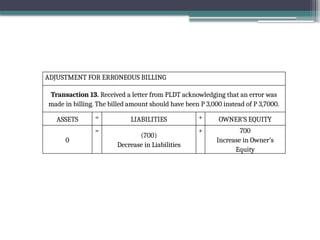
ADJUSTMENT FOR ERRONEOUS BILLING
Transaction 13. Received a letter from PLDT acknowledging that an error was
made in billing. The billed amount should have been P 3,000 instead of P 3,7000.
ASSETS = LIABILITIES + OWNER’S EQUITY
0
=
(700)
Decrease in Liabilities
+ 700
Increase in Owner’s
Equity
9. Increase in on form of Owner’s Equity=
Decrease in other form of Owner’s Equity
- this type of transaction may involve a transfer of
one owner’s equity to another owner’s equity.
The reclassification of one type of revenue to
another type is an example of this category.
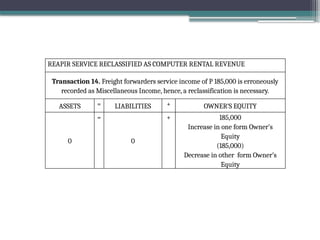
REAPIR SERVICE RECLASSIFIED AS COMPUTER RENTAL REVENUE
Transaction 14. Freight forwarders service income of P 185,000 is erroneously
recorded as Miscellaneous Income, hence, a reclassification is necessary.
ASSETS = LIABILITIES + OWNER’S EQUITY
0
=
0
+ 185,000
Increase in one form Owner’s
Equity
(185,000)
Decrease in other form Owner’s
Equity
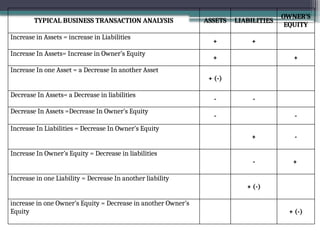
TYPICAL BUSINESS TRANSACTION ANALYSIS ASSETS LIABILITIES
OWNER’S
EQUITY
Increase in Assets = increase in Liabilities
+ +
Increase In Assets= Increase in Owner’s Equity
+ +
Increase In one Asset = a Decrease In another Asset
+ (-)
Decrease In Assets= a Decrease in liabilities
- -
Decrease In Assets =Decrease In Owner’s Equity
- -
Increase In Liabilities = Decrease In Owner’s Equity
+ -
Increase In Owner’s Equity = Decrease in liabilities
- +
Increase in one Liability = Decrease In another liability
+ (-)
increase in one Owner’s Equity = Decrease in another Owner’s
Equity + (-)

WEEK-5 ACCOUNTING-EQUATION presentation.pptx

  • 1.
    The Accounting Equationand Financial Transaction Worksheet
  • 2.
  • 3.
    PICTURE ANALYSIS ASSETS =LIABILITIES + OWNER’S EQUITY
  • 4.
    Are your liabilitiessignificantly higher than your assets?
  • 5.
    THE ACCOUNTING EQUATION Themost basic tool of accounting. This equation presents the resources controlled by the enterprise, the present obligations of the enterprise, and the residual interest in the assets. ASSETS = LIABILITIES+ OWNER’S EQUITY It also helps measure the profitability of your business.
  • 6.
    ACCOUNTING EVENTS ANDTRANSACTIONS • An accounting event is an economic occurrence that causes changes in an enterprise’s assets, liabilities, and/or equity. Events may be internal actions, such as the use of equipment for the production of goods and services. It can also be an external event, such as the purchase of raw materials from a supplier. • A transaction is a particular kind of event that involves the transfer of something of value between two entities. Examples of transactions include acquiring assets from owner(s), borrowing funds from creditors, and purchasing or selling goods and services.
  • 7.
    TYPICAL BUSINESS TRANSACTIONSUSING THE ACCOUNTING EQUATION Nine possible types: 1. Increase in Assets = Increase in Owner’s Equity – two kinds of transactions may be given for this type. The investment of assets in the business by the owner is one of these. For example, if the owner invested cash, there is an increase in asset cash with a corresponding increase in owner’s equity since the owner provides the cash.
  • 8.
    ASSETS INVESTED BYTHE OWNER Transaction 1. Angelo Cruz opened a freight forwarders within the Philippine port and invested cash of P2,000,000; non-cash items with current values as follows: one-unit electric typewriter at P18,000; office tables and chairs at P100,000; and repair tools and dies at P35,000; the business will be named Road- Runner Freight Forwarders. ASSETS = LIABILITIES + OWNER’S EQUITY 2,000,000 = 0 + 2,000,000 Increase in assets Increase in owner’s equity RECEIVED CASH FOR SERVICE RENDERED Transaction 2. Received cash from a customers for freight delivery services rendered amounting to P100,000. ASSETS = LIABILITIES + OWNER’S EQUITY 100,000 = 0 + 100,000 Increase in assets Increase in owner’s equity
  • 9.
    BILLED A CUSTOMERFOR SERVICE RENDERED ON CREDIT Transaction 3. Sent a bill to a customer for freight forwarder services rendered at P150,000. ASSETS = LIABILITIES + OWNER’S EQUITY 150,000 = 0 + 150,000 Increase in assets Increase in owner’s equity
  • 10.
    2. Increase inAssets= Increase in Liabilities acquisitions of assets on credit fall under this category. For example, equipment was purchased on account. Asset equipment will increase and liability accounts payable will likewise increase. Issuance of promissory notes arising from money borrowed is another example. Asset in the form of cash will increase, and notes payable which is a liability, similarity will increase.
  • 11.
    BORROWED MONEY FROMTHE BANK Transaction 4. Cash in the amount of P120,000 was borrowed from Land Bank of the Philippines, due and payable after 90 days plus interest of 14% per annum. ASSETS = LIABILITIES + OWNER’S EQUITY 120,000 = 120,000 + 0 Increase in assets Increase in liability ASSETS ACQUIRED ON ACCOUNT Transaction 5. Purchased on account four (4) units of Delivery trucks from Isuzu Philippines, Inc., at P500,000 each unit. Instead of demanding an outright cash payment, Isuzu Philippines Inc., agrees to deliver the delivery trucks and allowing the buyer (Road-Runner Freight Forwarder) to pay the invoice in 10 monthly equal installments. ASSETS = LIABILITIES + OWNER’S EQUITY 2,000,000 = 2,000,000 + 0 Increase in assets Increase in liability
  • 12.
    ASSETS ACQUIRED ONACCOUNT WITH A PARTIAL PAYMENT Transaction 6. Purchased from Isuzu Philippines, Inc., additional four (4) units of Freezer Van with total amount of P3,200,000. The seller requires a partial payment of P1,600,000 and the balance to be paid within 60 days ASSETS = LIABILITIES + OWNER’S EQUITY 3,200,000 (1,600,000) = 1,600,000 + 0 Increase in assets Increase in liability
  • 13.
    3. Increase inone form of Assets = Decrease in other form of Assets - several transactions will fall under this category. Purchased of furniture and fixtures for cash is an example. Asset in the form of furniture and fixtures will increase with a corresponding decrease in another form of asset cash.
  • 14.
    ASSETS ACQUIRED ONA CASH BASIS Transaction 7. Purchased one unit of computer and printer form ABC Computer Supplies at P30,000 on cash basis. ASSETS = LIABILITIES + OWNER’S EQUITY 30,000 Increase in one asset (30,000) Decrease in one asset = 0 + 0
  • 15.
    4. Decrease inAssets= Decrease in Owner’s Equity - assets withdraws by the owner for personal use as well as expense incurred and paid will both fit into this category. Cash taken by the owner from the business for personal use is an example of the former. Asset cash will decrease and owner’s equity will likewise decrease as a result of withdrawals.
  • 16.
    ASSETS WITHDRAWN BYTHE OWNER Transaction 8. The owner withdrew P100,000 cash for personal use. ASSETS = LIABILITIES + OWNER’S EQUITY (100,000) = 0 + (100,000) Decrease in asset Decrease in owner’s equity PAID SALARIES OF EMPLOYEES Transaction 9. Paid salaries of the employees, P 58,000. ASSETS = LIABILITIES + OWNER’S EQUITY (100,000) = 0 + (100,000) Decrease in asset Decrease in owner’s equity
  • 17.
    5. Decrease inAssets= Decrease in Liabilities - all transactions involving payments of liabilities will be included in this category. As an example, the payment of accounts payable will decrease asset in the form of cash with a corresponding decrease in the liability accounts payable.
  • 18.
    PARTIAL PAYMENT OFA LIABILITY Transaction 10. The first installment payment was made to Isuzu Philippines, Inc. ASSETS = LIABILITIES + OWNER’S EQUITY (200,000) = (200,000) + Decrease in asset Decrease in Liability
  • 19.
    6. Increase inLiabilities= Decrease in Owner’s Equity - transaction of this type is the incurrent of an expense the payment of which is to be made at a later date. An example is the receipt of a telephone bill to be paid in a later date. Immediately upon the receipt of the bill, an expense, utility expense to be exact, is to be recognized which will tend to increase in liability utilities payable and to decrease owner’s equity.
  • 20.
    RECEIVED THE TELEPHONEBILL FROM PLDT Transaction 11. Telephone bill was received from PLDT, to be paid next month, P3,700. ASSETS = LIABILITIES + OWNER’S EQUITY 0 = 3,700 + (3,700) Increase in Liabilities Decrease in Owner’s Equity
  • 21.
    7. Increase inOne Form of Liability= Decrease in other form of Liability - the frequency of occurrence of this type of transaction is very seldom. It occurs, however, if one form of liability is substituted for another form of liability. If an accounts payable becomes due and there is no cash available to settle such liability, a promissory note may be sign in lieu of cash. Accordingly, liability notes payable will increase with a corresponding decrease in other liability accounts payable.
  • 22.
    ISSUED PROOMISORY NOTEIN LIEU OF CASH Transaction 12. Assume that the accounts payable to Isuzu Philippines, Inc., amount to P1,600,000, becomes due and that the business does not have available cash. The owner offered to a issue a promissory ASSETS = LIABILITIES + OWNER’S EQUITY 0 = 1,600,000 Increase in One Liability + (1,600,000) Decrease in other Liability
  • 23.
    • 8. Increasein Owner’s Equity= Decrease in Liabilities • - reclassification of creditor’s equity will fit into this category. In a corporation, convertible bonds which is a liability, may be converted and replaced by shares of stocks, an element of owner’s equity. If the bondholder, which is a creditor, exercises the option and converted the bonds into stock, the bondholder becomes stockholder. As a result, the company’s liability is decreased and stockholders’ equity is increased.
  • 24.
    ADJUSTMENT FOR ERRONEOUSBILLING Transaction 13. Received a letter from PLDT acknowledging that an error was made in billing. The billed amount should have been P 3,000 instead of P 3,7000. ASSETS = LIABILITIES + OWNER’S EQUITY 0 = (700) Decrease in Liabilities + 700 Increase in Owner’s Equity
  • 25.
    9. Increase inon form of Owner’s Equity= Decrease in other form of Owner’s Equity - this type of transaction may involve a transfer of one owner’s equity to another owner’s equity. The reclassification of one type of revenue to another type is an example of this category.
  • 26.
    REAPIR SERVICE RECLASSIFIEDAS COMPUTER RENTAL REVENUE Transaction 14. Freight forwarders service income of P 185,000 is erroneously recorded as Miscellaneous Income, hence, a reclassification is necessary. ASSETS = LIABILITIES + OWNER’S EQUITY 0 = 0 + 185,000 Increase in one form Owner’s Equity (185,000) Decrease in other form Owner’s Equity
  • 27.
    TYPICAL BUSINESS TRANSACTIONANALYSIS ASSETS LIABILITIES OWNER’S EQUITY Increase in Assets = increase in Liabilities + + Increase In Assets= Increase in Owner’s Equity + + Increase In one Asset = a Decrease In another Asset + (-) Decrease In Assets= a Decrease in liabilities - - Decrease In Assets =Decrease In Owner’s Equity - - Increase In Liabilities = Decrease In Owner’s Equity + - Increase In Owner’s Equity = Decrease in liabilities - + Increase in one Liability = Decrease In another liability + (-) increase in one Owner’s Equity = Decrease in another Owner’s Equity + (-)

Editor's Notes

  • #2 Financial statements tell us how a business is performing. They are the final product of the accounting process. But how do we arrive at the items and amounts that make up the financial statements? The most basic tool of accounting is the accounting equation. This equation presents the resources controlled by the enterprise, the present obligations of the enterprise, and the residual interest in the assets. It states that assets must always equal liabilities and owner's equity. The basic accounting model is:  
  • #3 Financial statements tell us how a business is performing. They are the final product of the accounting process. But how do we arrive at the items and amounts that make up the financial statements? The most basic tool of accounting is the accounting equation. This equation presents the resources controlled by the enterprise, the present obligations of the enterprise, and the residual interest in the assets. It states that assets must always equal liabilities and owner's equity. The basic accounting model is: