Strategy and Human
Resource Planning
William Wendy Ary,
M.Sc., QWP
Agenda
1. Strategic Planning and Human
Resource Planning
2. Visi,Misi, dan Nilai
3. Analisis Eksternal
4. Analisis Internal
5. Memformulasi strategi
6. Mengeksekusi strategi
perusahaan
7. Evaluasi
Overview
“People are our most important asset.” – Percayakah anda dengan pernyataan ini?
Penyataan klise diatas sering dijumpai pada laporan tahunan perusahan dan sebenarnya jauh
dari realita yang sesunggunya. Masih banyak yang mengganggap karyawan sebagai beban.
Namun, pandangan ini perlahan mulai berubah. 92% CFO menilai bahwa human capital
mempengaruhi customer service perusahaan, 82% mengatakan mempengaruhi profit, dan
72% mengatakan mempengaruhi inovasi.
Bahkan perusahaan kecil juga menyadari bahwa karyawan mereka merupakan kunci kreasi
dan stabilitas perusahaan di era yang penuh dengan persaingan masa kini dan masa depan.
Strategic Planning and
Human Resource
Planning
Strategic Planning and Human Resource
Planning
Strategic planning adalah berbagai prosedur pembuatan Keputusan mengenai target dan
strategi perusahaan jangka panjang. Aktivitas ini memposisikan perusahaan agar memastikan
keberlangsungan jangka panjang, menciptakan nilai, dan bertumbuh.
Human Resource Planning (HRP) adalah proses mengantisipasi dan menyediakan pergerakan
kedalam, didalam, dan diluar kepada orang – orang di dalam perusahaan. Tujuan utamanya
adalah menolong manajer mengoptimalkan potensi para karyawanannya.
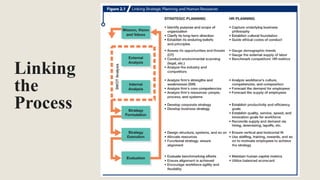
Strategic human resource management adalah kombinasi antara strategic planning dan HRP.
Ini dapat dilihat sebagai pola pendistribusian dan aktivitas sumber daya manusia yang
memampukan perusahaan untuk mencapai tujuan organisasinya.
Linking
the
Process
Visi,Misi, dan Nilai
Misi,Visi, dan Nilai
Misi (Mission) adalah tujuan awal organisasi beserta cakupan
seluruh operasionalnya.
Visi (Strategic vision) adalah sebuah pernyataan mengenai kemana
perusahaan bergerak dan menjadi apa di masa depan.
Nilai inti (Core Values) adalah beberapa kepercayaan teguh dan
prinsip yang menuntun Keputusan sebuah perusahaan dan
membentuk dasar dari budaya korporasi perusahaan tersebut.
Membentuk Sebuah Pernyataan Misi
1. What is my organization’s reason for being? What need do we fulfill that isn’t already
being met by another firm or could be met better?
2. For whom will the firm fulfill the need? Who are our customers?
3. Where is our market and our customers? Where will operate? Locally, regionally,
nationally, or globally?
4. What core values do the people in my organization share as part of our mission?
5. How do these values differentiate us from other companies?
Peran HR dalam Membangun dan Memperkuat
Misi, Visi, dan Nilai Perusahaan
HR managers help embody the firm’s mission, vision, and values within the organization by
what they say and what they do:
• By communicating the mission, vision, and values frequently, both informally and formally,
via verbal and written communications such as employee meetings, emails, newsletters,
bulletin s boards, the firm’s website, the annual report, and employee orientations.
• By recruiting and hiring employees whose values are consistent with the organization.
• By translating the mission, vision, and values into job descriptions and specific behaviors
and recognizing and rewarding employees based on them
Analisis Eksternal
Analisis Eksternal
On an ongoing basis, they analyze external opportunities and threats, and they compare
them to their strengths and weaknesses. A SWOT analysis is a simple way to summarize the
major facts and forecasts derived from external and internal analyses
Environmental scanning is the systematic monitoring of major external forces influencing the
organization, including forces in the business environment—which is sometimes called the
remote environment—and the competitive environment.
Lingkungan Bisnis
Business environment is factors in the external environment that a firm cannot directly control
but that can affect its strategy and performance.
• Economic Changes
• Ecological Changes
• Technological Changes
• Demographic and Social Changes
• Legal and Regulatory Changes
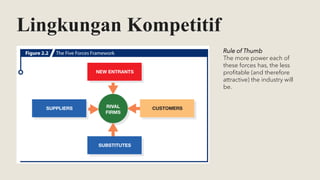
Lingkungan Kompetitif
Rule of Thumb
The more power each of
these forces has, the less
profitable (and therefore
attractive) the industry will
be.
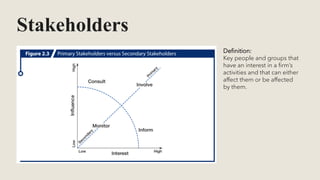
Stakeholders
Definition:
Key people and groups that
have an interest in a firm’s
activities and that can either
affect them or be affected
by them.
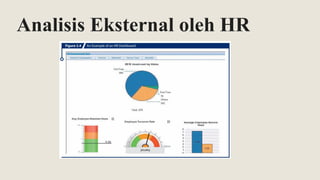
Analisis Eksternal oleh HR
Benchmarking is the process of looking at your practices and performance in a given area and
comparing them with those of other companies. The target company for benchmarking does not
need to be a competitor.
• Sources of information about the changes in a firm’s external environment, particularly the
external supply of labor, are invaluable for both operational and strategic reasons. HRP, in turn,
has to focus on both.
• Similarly, with a “maturing” workforce, HRP must consider the implications for their recruitment
and replacement policies.
• The analysis of the external labor market is aided by published documents.
• Conducting an external labor analysis also includes gauging the talent in your own industry
• The HR benchmarks, or metrics, a firm collects fall into two basic categories: human capital
metrics and HR metrics. Human capital metrics assess aspects of the workforce, whereas HR
metrics assess the performance of the HR function itself.
• Simply gathering competitive intelligence and benchmarking will not give a firm a competitive
advantage
Analisis Eksternal oleh HR
Analisis Internal
Core Capabilities
Core capabilities are abilities that distinguish an organization from its competitors and create
value to customers.
Value creation is what a firm adds to a product or service by virtue of making it; the amount of
benefits provided by the product or service once the costs of making it are subtracted.
Core capabilities can consist of a combination of three resources: (1) processes, (2) systems
(technologies), and (3) people
Sustaining a Competitive Advantage through
People
1. The resources must be valuable
2. The resources must be rare
3. The resources must be difficult to imitate
4. The resources must be organized
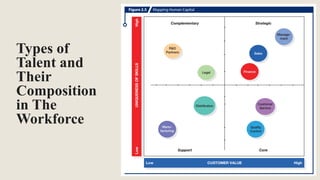
Types of
Talent and
Their
Composition
in The
Workforce
Corporate Culture
Cultural audits are audits of the culture and quality of work life in an organization. Cultural
audits can help firms decide the strategic investments and maneuvers to which their cultures
lend themselves.
To conduct a cultural audit, employees can be surveyed about such things as the company’s
norms, values, relationships, leadership style, communication practices, recruitment and
evaluation practices, measurements, pay and benefit programs, and the like.
The goals:
1. To determine whether these practices hinder or support the organization’s purpose.
2. To determine whether there are different groups, or subcultures, within the organization
that have distinctly different views about the nature of the work and how it should be
done.
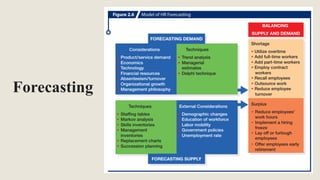
Forecasting
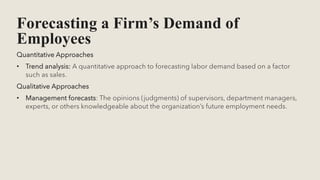
Forecasting a Firm’s Demand of
Employees
Quantitative Approaches
• Trend analysis: A quantitative approach to forecasting labor demand based on a factor
such as sales.
Qualitative Approaches
• Management forecasts: The opinions (judgments) of supervisors, department managers,
experts, or others knowledgeable about the organization’s future employment needs.
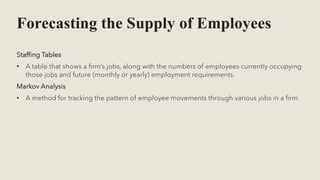
Forecasting the Supply of Employees
Staffing Tables
• A table that shows a firm’s jobs, along with the numbers of employees currently occupying
those jobs and future (monthly or yearly) employment requirements.
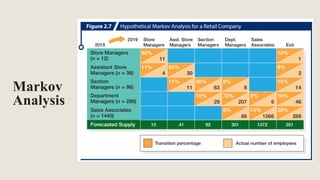
Markov Analysis
• A method for tracking the pattern of employee movements through various jobs in a firm.
Markov
Analysis
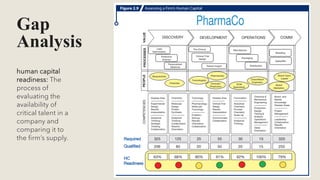
Gap
Analysis
human capital
readiness: The
process of
evaluating the
availability of
critical talent in a
company and
comparing it to
the firm’s supply.
Memformulasi strategi
Corporate Strategy
• Growth and Diversification
HR planning is vital to these decisions because achieving growth requires three related elements:
(1) increased employee productivity, (2) a larger number of employees, and (3) employees
developing or acquiring new skills.
• Mergers and Acquisitions
However, many mergers end up being risky transactions because they do not go well (measured
by return on investment, shareholder value, and the like). Often the failure is due to cultural
inconsistencies, as well as conflicts among the managers of each firm.
• Strategic Alliances and Joint Ventures
HR plays a vital role in assessing the compatibility of the would-be partners’ cultures and potential
problems. As the alliance is formed, HR helps select key executives and develops teamwork across
the respective workforces. In addition, HR is typically involved in the design of performance
assessment and mutual incentives for the alliance.
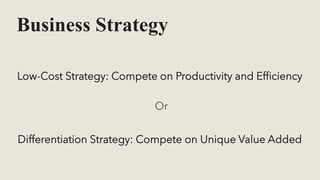
Business Strategy
Low-Cost Strategy: Compete on Productivity and Efficiency
Or
Differentiation Strategy: Compete on Unique Value Added
HR Strategy
• A firm’s HR strategy must work in tandem with its corporate and business strategies.
• The firm must focus on all of its talent, including support employees, contractors,
temporary employees, and complementary partners and how they mesh with one another.
Mengeksekusi strategi
perusahaan
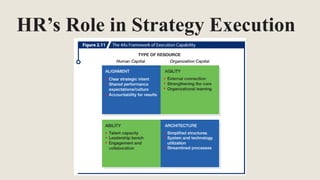
HR’s Role in Strategy Execution
• Remaining Agile
Coordination agility is the ability to rapidly reallocate resources to new or changing needs.
Resource agility, in contrast, results from having resources that can be used in different ways and people who can
perform different functions in different ways.
• Reconciling Supply and Demand
To meet their HR demands, organizations have many staffing options at their disposal.
If its labor shortages are acute, a company may have to make special efforts to develop talent from the ground up.
When forecasts show a surplus of employees, organizations often restrict their hiring, reduce their employees’ work
hours or furlough them, and consider layoffs
Organizations must be constantly prepared to exit and enter new lines of business, restructure, outsource, offshore,
and sometimes downsize either because they have too many employees or because their employees have the
wrong skill sets.
Employers also often recognize the seniority of employees who are not unionized, though.
When firms are downsizing, HR managers must ensure that the decision-making process does not violate any laws,
of which there are many.
Evaluasi
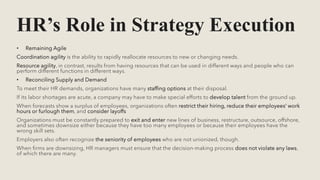
Evaluating a
Firm’s
Strategic
Alignment
Vertikal Fit/Alignment
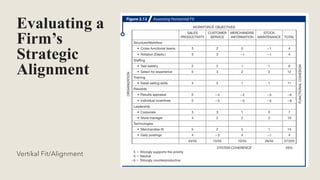
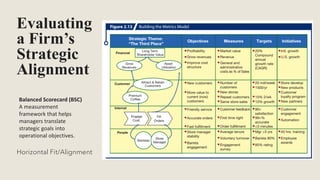
Evaluating
a Firm’s
Strategic
Alignment
Horizontal Fit/Alignment
Balanced Scorecard (BSC)
A measurement
framework that helps
managers translate
strategic goals into
operational objectives.
Terima Kasih William Wendy Ary,
M.Sc., QWP

Week 2 - Strategy and Human Resource Planning.pdf

  • 1.
    Strategy and Human ResourcePlanning William Wendy Ary, M.Sc., QWP
  • 2.
    Agenda 1. Strategic Planningand Human Resource Planning 2. Visi,Misi, dan Nilai 3. Analisis Eksternal 4. Analisis Internal 5. Memformulasi strategi 6. Mengeksekusi strategi perusahaan 7. Evaluasi
  • 3.
    Overview “People are ourmost important asset.” – Percayakah anda dengan pernyataan ini? Penyataan klise diatas sering dijumpai pada laporan tahunan perusahan dan sebenarnya jauh dari realita yang sesunggunya. Masih banyak yang mengganggap karyawan sebagai beban. Namun, pandangan ini perlahan mulai berubah. 92% CFO menilai bahwa human capital mempengaruhi customer service perusahaan, 82% mengatakan mempengaruhi profit, dan 72% mengatakan mempengaruhi inovasi. Bahkan perusahaan kecil juga menyadari bahwa karyawan mereka merupakan kunci kreasi dan stabilitas perusahaan di era yang penuh dengan persaingan masa kini dan masa depan.
  • 4.
  • 5.
    Strategic Planning andHuman Resource Planning Strategic planning adalah berbagai prosedur pembuatan Keputusan mengenai target dan strategi perusahaan jangka panjang. Aktivitas ini memposisikan perusahaan agar memastikan keberlangsungan jangka panjang, menciptakan nilai, dan bertumbuh. Human Resource Planning (HRP) adalah proses mengantisipasi dan menyediakan pergerakan kedalam, didalam, dan diluar kepada orang – orang di dalam perusahaan. Tujuan utamanya adalah menolong manajer mengoptimalkan potensi para karyawanannya. Strategic human resource management adalah kombinasi antara strategic planning dan HRP. Ini dapat dilihat sebagai pola pendistribusian dan aktivitas sumber daya manusia yang memampukan perusahaan untuk mencapai tujuan organisasinya.
  • 6.
  • 7.
  • 8.
    Misi,Visi, dan Nilai Misi(Mission) adalah tujuan awal organisasi beserta cakupan seluruh operasionalnya. Visi (Strategic vision) adalah sebuah pernyataan mengenai kemana perusahaan bergerak dan menjadi apa di masa depan. Nilai inti (Core Values) adalah beberapa kepercayaan teguh dan prinsip yang menuntun Keputusan sebuah perusahaan dan membentuk dasar dari budaya korporasi perusahaan tersebut.
  • 9.
    Membentuk Sebuah PernyataanMisi 1. What is my organization’s reason for being? What need do we fulfill that isn’t already being met by another firm or could be met better? 2. For whom will the firm fulfill the need? Who are our customers? 3. Where is our market and our customers? Where will operate? Locally, regionally, nationally, or globally? 4. What core values do the people in my organization share as part of our mission? 5. How do these values differentiate us from other companies?
  • 10.
    Peran HR dalamMembangun dan Memperkuat Misi, Visi, dan Nilai Perusahaan HR managers help embody the firm’s mission, vision, and values within the organization by what they say and what they do: • By communicating the mission, vision, and values frequently, both informally and formally, via verbal and written communications such as employee meetings, emails, newsletters, bulletin s boards, the firm’s website, the annual report, and employee orientations. • By recruiting and hiring employees whose values are consistent with the organization. • By translating the mission, vision, and values into job descriptions and specific behaviors and recognizing and rewarding employees based on them
  • 11.
  • 12.
    Analisis Eksternal On anongoing basis, they analyze external opportunities and threats, and they compare them to their strengths and weaknesses. A SWOT analysis is a simple way to summarize the major facts and forecasts derived from external and internal analyses Environmental scanning is the systematic monitoring of major external forces influencing the organization, including forces in the business environment—which is sometimes called the remote environment—and the competitive environment.
  • 13.
    Lingkungan Bisnis Business environmentis factors in the external environment that a firm cannot directly control but that can affect its strategy and performance. • Economic Changes • Ecological Changes • Technological Changes • Demographic and Social Changes • Legal and Regulatory Changes
  • 14.
    Lingkungan Kompetitif Rule ofThumb The more power each of these forces has, the less profitable (and therefore attractive) the industry will be.
  • 15.
    Stakeholders Definition: Key people andgroups that have an interest in a firm’s activities and that can either affect them or be affected by them.
  • 16.
    Analisis Eksternal olehHR Benchmarking is the process of looking at your practices and performance in a given area and comparing them with those of other companies. The target company for benchmarking does not need to be a competitor. • Sources of information about the changes in a firm’s external environment, particularly the external supply of labor, are invaluable for both operational and strategic reasons. HRP, in turn, has to focus on both. • Similarly, with a “maturing” workforce, HRP must consider the implications for their recruitment and replacement policies. • The analysis of the external labor market is aided by published documents. • Conducting an external labor analysis also includes gauging the talent in your own industry • The HR benchmarks, or metrics, a firm collects fall into two basic categories: human capital metrics and HR metrics. Human capital metrics assess aspects of the workforce, whereas HR metrics assess the performance of the HR function itself. • Simply gathering competitive intelligence and benchmarking will not give a firm a competitive advantage
  • 17.
  • 18.
  • 19.
    Core Capabilities Core capabilitiesare abilities that distinguish an organization from its competitors and create value to customers. Value creation is what a firm adds to a product or service by virtue of making it; the amount of benefits provided by the product or service once the costs of making it are subtracted. Core capabilities can consist of a combination of three resources: (1) processes, (2) systems (technologies), and (3) people
  • 20.
    Sustaining a CompetitiveAdvantage through People 1. The resources must be valuable 2. The resources must be rare 3. The resources must be difficult to imitate 4. The resources must be organized
  • 21.
  • 22.
    Corporate Culture Cultural auditsare audits of the culture and quality of work life in an organization. Cultural audits can help firms decide the strategic investments and maneuvers to which their cultures lend themselves. To conduct a cultural audit, employees can be surveyed about such things as the company’s norms, values, relationships, leadership style, communication practices, recruitment and evaluation practices, measurements, pay and benefit programs, and the like. The goals: 1. To determine whether these practices hinder or support the organization’s purpose. 2. To determine whether there are different groups, or subcultures, within the organization that have distinctly different views about the nature of the work and how it should be done.
  • 23.
  • 24.
    Forecasting a Firm’sDemand of Employees Quantitative Approaches • Trend analysis: A quantitative approach to forecasting labor demand based on a factor such as sales. Qualitative Approaches • Management forecasts: The opinions (judgments) of supervisors, department managers, experts, or others knowledgeable about the organization’s future employment needs.
  • 25.
    Forecasting the Supplyof Employees Staffing Tables • A table that shows a firm’s jobs, along with the numbers of employees currently occupying those jobs and future (monthly or yearly) employment requirements. Markov Analysis • A method for tracking the pattern of employee movements through various jobs in a firm.
  • 26.
  • 27.
    Gap Analysis human capital readiness: The processof evaluating the availability of critical talent in a company and comparing it to the firm’s supply.
  • 28.
  • 29.
    Corporate Strategy • Growthand Diversification HR planning is vital to these decisions because achieving growth requires three related elements: (1) increased employee productivity, (2) a larger number of employees, and (3) employees developing or acquiring new skills. • Mergers and Acquisitions However, many mergers end up being risky transactions because they do not go well (measured by return on investment, shareholder value, and the like). Often the failure is due to cultural inconsistencies, as well as conflicts among the managers of each firm. • Strategic Alliances and Joint Ventures HR plays a vital role in assessing the compatibility of the would-be partners’ cultures and potential problems. As the alliance is formed, HR helps select key executives and develops teamwork across the respective workforces. In addition, HR is typically involved in the design of performance assessment and mutual incentives for the alliance.
  • 30.
    Business Strategy Low-Cost Strategy:Compete on Productivity and Efficiency Or Differentiation Strategy: Compete on Unique Value Added
  • 31.
    HR Strategy • Afirm’s HR strategy must work in tandem with its corporate and business strategies. • The firm must focus on all of its talent, including support employees, contractors, temporary employees, and complementary partners and how they mesh with one another.
  • 32.
  • 33.
    HR’s Role inStrategy Execution
  • 34.
    HR’s Role inStrategy Execution • Remaining Agile Coordination agility is the ability to rapidly reallocate resources to new or changing needs. Resource agility, in contrast, results from having resources that can be used in different ways and people who can perform different functions in different ways. • Reconciling Supply and Demand To meet their HR demands, organizations have many staffing options at their disposal. If its labor shortages are acute, a company may have to make special efforts to develop talent from the ground up. When forecasts show a surplus of employees, organizations often restrict their hiring, reduce their employees’ work hours or furlough them, and consider layoffs Organizations must be constantly prepared to exit and enter new lines of business, restructure, outsource, offshore, and sometimes downsize either because they have too many employees or because their employees have the wrong skill sets. Employers also often recognize the seniority of employees who are not unionized, though. When firms are downsizing, HR managers must ensure that the decision-making process does not violate any laws, of which there are many.

  • 35.
  • 36.
  • 37.
    Evaluating a Firm’s Strategic Alignment Horizontal Fit/Alignment BalancedScorecard (BSC) A measurement framework that helps managers translate strategic goals into operational objectives.
  • 38.
    Terima Kasih WilliamWendy Ary, M.Sc., QWP