Seamless API
Integration:
Migrating from webMethods
to MuleSoft
Migrating from webMethods to MuleSoft
Copyright © 2023 ProwessSoft. All rights reserved. 2
Contents
1 Abstract....................................................................................................................................3
2 Introduction ............................................................................................................................3
2.1 Understanding webMethods and MuleSoft..............................................................3
2.2 Why Migration ...............................................................................................................4
3 Migration Strategies.............................................................................................................6
3.1 Assessment and Planning.............................................................................................6
3.2 Data Migration...............................................................................................................7
3.3 Incremental Migration Approach................................................................................7
3.4 Additional Considerations............................................................................................7
4 Challenges in Migration.......................................................................................................8
4.1 Technical Challenges:....................................................................................................8
4.1.1 Data Mapping and Transformation.....................................................................8
4.1.2 Connectivity and Protocol Support......................................................................8
4.1.3 Legacy System Integration.....................................................................................8
4.2 Organizational Challenges...........................................................................................9
4.2.1 Stakeholder Alignment ...........................................................................................9
4.2.2 Resource Allocation.................................................................................................9
4.2.3 Change Management..............................................................................................9
5 Case Study ............................................................................................................................ 10
6 Conclusion ............................................................................................................................ 12
7 Contributors......................................................................................................................... 13
8 About Prowess .................................................................................................................... 13
Table of Figures
Figure 1 webMethods Vs MuleSoft ...............................................................................................3
Figure 2 Data Migration Strategies................................................................................................6
Migrating from webMethods to MuleSoft
Copyright © 2023 ProwessSoft. All rights reserved. 3
1 Abstract
The purpose of this whitepaper is to explore the stratagies and complexities associated with the transition
from webMethods to MuleSoft for API integration. This whitepaper serves as your comprehensive guide,
navigating the challenges of this transition with proven strategies and industry best practices. We've
leveraged real-world experiences and expert insights to equip you with the knowledge to confidently
execute your migration project.
2 Introduction
The ability to seamlessly exchange data and coordinate workflows between different systems is crucial for
any organization, regardless of its technological dependence. API integration platforms play a central role
in achieving this by providing a foundation for efficient communication and process automation. Choosing
the right platform is key to ensuring smooth data flow and well-orchestrated workflows.
Amidst this backdrop, organizations find themselves contemplating migration from legacy systems like
webMethods to modern solutions like MuleSoft. The motivation behind this shift is multifold, ranging from
the need for enhanced scalability and agility to keeping pace with evolving technological standards. As
organizations embark on this migration journey, they seek comprehensive guidance to navigate the
intricacies of the process.
In this whitepaper, we'll explore the migration landscape, from the hurdles you might encounter to the best
practices that pave the way for success. With this comprehensive analysis, you'll be empowered to make
informed choices and navigate a smooth migration journey.
2.1 Understanding webMethods and MuleSoft
Image Credit: https://hkrtrainings.com/webmethods-vs-mulesoft
Figure 1webMethods Vs MuleSoft
Migrating from webMethods to MuleSoft
Copyright © 2023 ProwessSoft. All rights reserved. 4
An enduring presence in the integration landscape, webMethods has established itself as a reliable and
longstanding solution for data connectivity and system coordination. At its core, webMethods provides a
robust infrastructure for seamless connectivity, enabling enterprises to integrate disparate systems,
applications, and data sources. Key features include its extensive set of integration adapters, which
facilitate connectivity with a wide range of systems and protocols, as well as its powerful workflow engine
for orchestrating complex integration processes. Furthermore, webMethods offers advanced features such
as B2B integration, API management, and real-time monitoring and analytics, empowering organizations to
streamline their business processes and drive operational efficiency.
In contrast, the MuleSoft Anypoint Platform represents a modern approach to integration, built around the
concept of API-led connectivity. At the heart of the Anypoint Platform lies its comprehensive set of key
components, each designedto address specific integration needs. In addition to Anypoint Studio, a powerful
graphical interface for building integrations, Anypoint Exchange is a centralized repository for discovering
and reusing integration assets, and Anypoint Runtime Manager is a centralized management console for
deploying and monitoring integrations.
Moreover, MuleSoft's architecture is based on a lightweight, scalable runtime engine known as Mule
Runtime, which forms the foundation for building robust, scalable integrations. The platform's API-led
connectivityapproachemphasizesthecreationandreuseofAPIsasbuildingblocksforintegration,enabling
organizations to achieve greater agility and flexibility in their integration initiatives.
Overall, while webMethods offers a mature and feature-rich integration platform, MuleSoft's Anypoint
platform provides a modern and agile approach to integration, centred around API-led connectivity.
Understanding the core features and capabilities of both platforms is crucial for organizations looking to
select the right integration solution that aligns with their business objectives and integration requirements.
Whether leveraging the extensive capabilities of webMethods or embracing the agility of MuleSoft,
organizations can enable themselves to achieve seamless connectivity and drive digital transformation
initiatives effectively.
2.2 Why Migration
Migration from one integration platform to another is a strategic decision often driven by various factors.
In the realm of API integration, organizations frequently contemplate shifting from legacy systems like
webMethods to more modern solutions like MuleSoft. Let's delve into why migration becomes imperative
and the pain points encountered by webMethods users.
Pain Points Encountered while Implementing webMethods:
1. Complexity:
Configuring and maintaining webMethods can be intricate and time-consuming. BPM, B2B, and API-
Management require additional tools, on-prem installation, and configuration to the main webMethods
component, which increases workload.
MuleSoft offers a more streamlined and intuitive approach, reducing complexity and making integration
tasks manageable.
Migrating from webMethods to MuleSoft
Copyright © 2023 ProwessSoft. All rights reserved. 5
2. Scalability:
As businesses expand, webMethods may struggle to scale effectively.
MuleSoft provides a highly scalable architecture, accommodating increasing data volumes and user
demands without compromising performance.
3. Flexibility:
MuleSoft's Anypoint Platform offers greater flexibility compared to webMethods.
It supports a wide range of integration patterns, protocols, and data formats, enabling organizations to
adapt to changing business requirements more easily.
4. Cost:
webMethods may incur high licencing and maintenance costs.
MuleSoft's pricing model may offer better value for money, particularly for organizations aiming to reduce
their total cost of ownership for integration solutions.
5. Developer Productivity:
Visual interfaces, reusable components, and built-in testing boost developer productivity in MuleSoft's
Dataweave-powered development environment. Dataweave empowers developers with robust
transformation capabilities that allow efficient manipulation and precise transformation of data with
unmatched flexibility. MuleSoft also comes with a lot of out of the box connectors that substatially reduce
the development time and complexity.
6. API Management:
MuleSoft's Anypoint platform includes robust API management features that facilitate the design,
publication, security, and analysis of APIs effectively.
To summarize, migrating to MuleSoft from webMethods addresses these pain points, providing
organizations with a modern, flexible, and cost-effective solution for their integration needs. Creating
opportunities for enhanced scalability, agility, and innovation in the digital landscape unlocks new
opportunities.
Migration from webMethods to MuleSoft signifies a strategic move towards modernization and agility in
API integration. By addressing the pain points encountered with legacy systems and leveraging the
capabilities ofmodern platforms likeMuleSoft,organizations can position themselves forfuturegrowth and
innovation. Embracing migration helps them to streamline operations, enhance connectivity, and drive
digital transformation initiatives effectively.
Migrating from webMethods to MuleSoft
Copyright © 2023 ProwessSoft. All rights reserved. 6
3 Migration Strategies
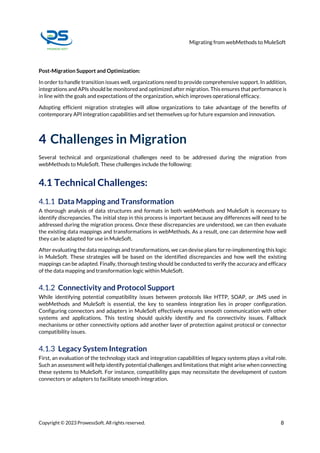
Migration strategies play a pivotal role in the seamless transition from legacy systems to modern platforms
like MuleSoft. The following section delves into the critical components of migration strategy development:
Figure 2 Data migration strategies
3.1 Assessment and Planning
Inventory of Existing APIs and Integrations:
Keeping a comprehensive list of all the APIs, dependencies, and integrations in your webMethods
ecosystem is essential. This list should include all the important information, including endpoints, protocols,
data formats, and business logic. By documenting this inventory thoroughly, you establish a reliable
reference point for understanding the intricacies of your current system architecture.
Analysis of Dependencies and Workflows:
Identifying dependencies among APIs and integrations is crucial for assessing migration complexity
effectively. Analyzing workflow patterns enables strategic prioritization of tasks to minimize disruptions.
Categorizing APIs based on their criticality aids in identifying and tackling the most urgent migration tasks
first.
Migrating from webMethods to MuleSoft
Copyright © 2023 ProwessSoft. All rights reserved. 7
3.2 Data Migration
Strategies for Migrating Data Mappings:
Aligning schemas between webMethods and MuleSoft facilitates the visualization of data flow and the
detection of any disparities necessitating transformation. Craft methodologies for converting data formats
and ensuring data integrity throughout the migration process. Employ tools or scripts to streamline
repetitive data mapping and transformation tasks whenever feasible.
Ensuring Data Integrity During Migration:
Implementing robust security measures, such as data validation checks and error handling procedures, is
necessary to safeguard data integrity during migration and maintain the integrity of transferred data.
Validation tests conducted at each stage of the migration process serve to detect and rectify any potential
data inconsistencies or errors promptly, ensuring the accuracy and reliability of the migrated data.
3.3 Incremental Migration Approach
Phased Migration Plan:
The phased migration plan entails several necessary steps to ensure a smooth and organized transition.
Firstly, it involves breaking down the migration process into manageable phases or milestones, guided by
the prioritization established during the initial assessment. Secondly, clear objectives, timelines, and
deliverables are defined for each phase, facilitating effective progress tracking. Lastly, resources are
allocated, and responsibilities are assigned meticulously to guarantee the seamless execution of each
migration phase, minimizing disruptions and maximizing efficiency.
Testing and Validation in Each Phase:
Manytestsandchecksaredoneduringmigrationtoensureasmoothtransition.Testenvironmentssimulate
real-world conditions to verify migrated APIs and integrations' functionality and performance. In addition,
timely feedback is collected from stakeholders and end-users to continuously improve the migration
strategy and address any concerns that may arise.
3.4 Additional Considerations
Compatibility and Integration with MuleSoft Components:
Existing webMethods infrastructure requires being tested against MuleSoft components to determine
compatibility and integration. This evaluation ensures a seamless integration process, minimizing
disruptions and maximizing efficiency. Additionally, exploring the functionality provided by MuleSoft
components like Anypoint MQ, Anypoint Platform, and Anypoint Studio enables optimization of the
migration process by leveraging their capabilities effectively.
Training and Knowledge Transfer:
Trainingandinformation transfershouldbe an integralpartofmigrationactivities.To teach teamsMuleSoft
technologies and best practices, organizations must provide extensive training. Also important is
encouraging team members to share knowledge and collaborate. By sharing knowledge, teams can simplify
the migration process and succeed with MuleSoft.
Migrating from webMethods to MuleSoft
Copyright © 2023 ProwessSoft. All rights reserved. 8
Post-Migration Support and Optimization:
In order to handle transition issues well, organizations need to provide comprehensive support. In addition,
integrations and APIs should be monitored and optimized after migration. This ensures that performance is
in line with the goals and expectations of the organization, which improves operational efficacy.
Adopting efficient migration strategies will allow organizations to take advantage of the benefits of
contemporary API integration capabilities and set themselves up for future expansion and innovation.
4 Challenges in Migration
Several technical and organizational challenges need to be addressed during the migration from
webMethods to MuleSoft. These challenges include the following:
4.1 Technical Challenges:
4.1.1 Data Mapping and Transformation
A thorough analysis of data structures and formats in both webMethods and MuleSoft is necessary to
identify discrepancies. The initial step in this process is important because any differences will need to be
addressed during the migration process. Once these discrepancies are understood, we can then evaluate
the existing data mappings and transformations in webMethods. As a result, one can determine how well
they can be adapted for use in MuleSoft.
After evaluating the data mappings and transformations, we can devise plans for re-implementing this logic
in MuleSoft. These strategies will be based on the identified discrepancies and how well the existing
mappings can be adapted. Finally, thorough testing should be conducted to verify the accuracy and efficacy
of the data mapping and transformation logic within MuleSoft.
4.1.2 Connectivity and Protocol Support
While identifying potential compatibility issues between protocols like HTTP, SOAP, or JMS used in
webMethods and MuleSoft is essential, the key to seamless integration lies in proper configuration.
Configuring connectors and adapters in MuleSoft effectively ensures smooth communication with other
systems and applications. This testing should quickly identify and fix connectivity issues. Fallback
mechanisms or other connectivity options add another layer of protection against protocol or connector
compatibility issues.
4.1.3 Legacy System Integration
First, an evaluation of the technology stack and integration capabilities of legacy systems plays a vital role.
Such an assessment will help identify potential challenges and limitations that might arise when connecting
these systems to MuleSoft. For instance, compatibility gaps may necessitate the development of custom
connectors or adapters to facilitate smooth integration.
Migrating from webMethods to MuleSoft
Copyright © 2023 ProwessSoft. All rights reserved. 9
After the integration process is completed, compatibility testing is required. Comprehensive testing
ensures that MuleSoft and legacy systems integrate seamlessly, allowing for quick fixes to integration
issues. Modernizing legacy systems to meet MuleSoft's integration standards can reduce complexity over
time. Modernization improves system maintainability and streamlines future integrations.
4.2 Organizational Challenges
4.2.1 Stakeholder Alignment
Stakeholders from various departments and levels need to be involved in order to comprehend migration
concerns and goals. A clear communication plan should convey migration plans, objectives, and benefits to
align and support stakeholders. Migration management requires feedback mechanisms to address
stakeholder concerns and refine migration strategies. Comprehensive training and resources are critical as
they allow stakeholders to clearly understand migration, participate effectively, and gain support.
4.2.2 Resource Allocation
In order to support the migration project, it is necessary to conduct a thorough validation of resource
requirements, including staffing, financial concerns, and infrastructure requirements. A carefully
constructed resource plan that outlines roles, duties, and deadlines is essential for providing sufficient
support for every aspect of migration. Anticipating potential resource constraints or bottlenecks and
developing backup plans reduces risks and promotes the longevity of the project. Continued oversight of
resource use and optimization of allocation strategies contribute to increased efficiency over the course of
the migration project.
4.2.3 Change Management
The evaluation of the migration's potential effects on the organization's stakeholders, processes, and
systems is of the utmost importance. Across different communication channels, stakeholders should be
made aware of why the migration is taking place, its advantages, and any potential drawbacks. Effective
training and support programs are necessary to help staff adapt to the new MuleSoft environment. Setting
up feedback mechanisms to gather stakeholder input enables timely adjustments to change management
strategies based on evolving needs and concerns.
Technical teams, project managers, and stakeholders outside the organization have to deal with these
technical and organizational challenges. A smooth MuleSoft migration can be ensured by identifying and
resolving such barriers.
Migrating from webMethods to MuleSoft
Copyright © 2023 ProwessSoft. All rights reserved. 10
5 Case Study
Client Overview:
AUS-basedcompany,NorthAmerica'sleadingproviderofintegratedenvironmentalservices,partnerswith
communities to manage waste. Their mission is two-fold: minimize environmental impact and maximize
resource recovery, creating clean energy in the process. They offer tailored services to various customer
groups, operating a vast network of facilities for collecting, recycling, and converting waste to energy.
Requirements and Challenges:
The organization faced a critical need to modernize its integration landscape for enhanced agility and
scalability. Their existing integration platform, webMethods, posed limitations in adapting to dynamic
business requirements and leveraging cloud-based solutions. Recognizing the imperative to evolve, they
sought to transition their integration framework to MuleSoft, a cloud-native platform renowned for its
agility and robust capabilities.
Solutions Provided by Prowess:
Objectives
The company embarked on a strategic initiative to overhaul its integration infrastructure with the following
objectives in mind:
1. Establishing an API-led Architecture: Aimed to implement a cohesive API-led architecture to foster
reusability and streamline integration processes.
2. Enhancing Scalability: The application needed flexibility to scale up or down seamlessly in response to
evolving demand, a capability powered by MuleSoft's API management features.
3. Standardizing Implementations: Intended to standardize integration practices across its ecosystem,
ensuring operational consistency and efficiency.
Solutions
To achieve its objectives, Prowess Soft has supported the client in implementing a comprehensive
integration strategy leveraging MuleSoft's capabilities:
1. System Identification: A meticulous assessment was conducted to identify the various systems requiring
ecosystem integration.
2. Framework Development: Custom frameworks were developed to ensure uniformity in integration
implementations, enhancing operational efficiency and maintainability.
3. Integration with DataDog: The client was able to build integration with DataDog for comprehensive
logging and exception tracking, facilitating proactive issue resolution and performance optimization.
4. Handling Complex Integrations: The project addressed intricate integration scenarios involving IoT
systems, finance applications, logistics, and operational control systems (OCS), ensuring seamless
connectivity across diverse platforms.
Migrating from webMethods to MuleSoft
Copyright © 2023 ProwessSoft. All rights reserved. 11
5. Deployment Strategy: A robust blue-green deployment strategy was employed to minimize downtime
and ensure uninterrupted service delivery during migration.
6. Asynchronous Processing: In addition to REST services, the project implemented batch processing with a
reliable recovery mechanism to support asynchronous data processing requirements.
7. Implementation of resilience mechanisms: Circuit breaker mechanisms and health check endpoints were
incorporated to enhance system resilience and fault tolerance.
8. Leveraging Prowess WM2M Accelerator: The project extensively utilized the WM2M accelerator to
streamline integration by generating RAML data types from existing schema files, simplifying development
efforts, and accelerating time to market.
Value Proposition from Prowess
The client achieved significant business results by switching to MuleSoft, demonstrating a strategic
initiative to improve integration agility, scalability, and standardization. The successful migration facilitated
these outcomes:
1. Establishment of API-led Architecture: The client implemented an API-led architecture, promoting
reusability and agility in integration processes.
2. Enhanced Scalability: With MuleSoft's API management capabilities, the client gained the flexibility to
scale services dynamically, ensuring optimal resource utilization and responsiveness to changing demands.
3. Standardized Implementations: The adoption of MuleSoft facilitated standardized integration practices,
fostering consistency and efficiency across all operations.
This success story underscores the client's readiness for future growth and innovation in the dynamic
landscape of environmental services.
Business Outcomes
ProwessSoft, through its webMethods to MuleSoft migration services, provided the waste solutions
company with the following business outcomes:
1. Efficient Residential and Commercial Environmental Services: Seamless integration helped to efficiently
manage residential and commercial waste services, including trash and recycling pickup, bulk trash pickup,
roll-off dumpster rental, and drop-off locations.
2. Enhanced Service Flexibility: The transition to MuleSoft facilitated the expansion of service offerings to
include specialized solutions for various industries such as office, education, commercial property
management, restaurants, construction, demolition, manufacturing, and industrial sectors.
3. Improved Operational Agility: MuleSoft's agile integration capabilities allowed for swift adaptation to
changing business requirements, ensuring timely and responsive waste management services.
4. Streamlined Customer Experience: Integration across all service channels, including residential and
commercial pickups, drop-off locations, and specialized industry solutions, providing customers with a
seamless and consistent experience.
Migrating from webMethods to MuleSoft
Copyright © 2023 ProwessSoft. All rights reserved. 12
5. Optimized Resource Utilization: Efficient integration of services and resources, including waste pickup
schedules, drop-off locations, and dumpster rental services, resulting in optimal resource allocation and
utilization.
6. Scalability and Growth: MuleSoft's scalable platform supported the company's growth trajectory by
enabling seamless addition of new services, locations, and industry-specific solutions to meet evolving
customer demands.
6 Conclusion
Our detailed analysis examined the core features and capabilities of webMethods and MuleSoft,
recognizing each platform's strengths to the integration ecosystem. While MuleSoft is a contemporary,
agile approach based on API-driven connectivity, webMethods provides a more established and feature-
rich environment.
We also explored the common challenges webMethods users encounter, including complexity, scalability
limitations, and cost considerations. These factors often lead organizations to consider MuleSoft a more
streamlined, flexible, cost-effective integration solution. However, these challenges can be effectively
addressed and overcome with efficient migration strategies like thorough assessment and planning,
incremental migration approaches, and rigorous testing and validation.
Future Outlook and Emerging Trends
Looking ahead, the landscape of API integration continues to evolve rapidly, driven by advancements in
technology and shifts in business requirements. As organizations increasingly prioritize agility, scalability,
and innovation, the demand for modern integration platforms like MuleSoft is expected to grow.
Additionally, new trends like microservices architecture, containerization, and cloud-native development
are redefining the integration paradigm, influencing how organizations build, implement, and manage their
integration solutions. MuleSoft, with its API-driven connection approach and broad ecosystem of tools and
services, is well-positioned to handle these changing patterns and help enterprises to drive digital
transformation efforts effectively.
Future advancements in AI and machine learning are also poised to revolutionize API integration, enabling
organizations to leverage data-driven insights and automation capabilities to enhance connectivity,
optimize workflows, and drive business value.
Migrating from webMethods to MuleSoft
Copyright © 2023 ProwessSoft. All rights reserved. 13
7 Contributors
Manju Kaushik Suman Chatterjee Alisha Jain Pradeep Tallogu
Architect Senior Architect Architect Head of Integration-COE
8 About Prowess
ProwessSoft is dedicated to fostering scalable and sustainable businesses through a Total Integration
Experience. We utilize our distinctive cross-enterprise integration expertise to accelerate your digital
transformation journey and shape future-ready enterprises. For more information about ProwessSoft,
visit prowesssoft.com.
Connect with us:
connect@prowesssoft.com
Twitter | LinkedIn
Contact
Sales
Email: sales@prowesssoft.com
Hiring
Email: talent@prowesssoft.com

webmethods to MuleSoft Migration with ProwessSoft

  • 1.
  • 2.
    Migrating from webMethodsto MuleSoft Copyright © 2023 ProwessSoft. All rights reserved. 2 Contents 1 Abstract....................................................................................................................................3 2 Introduction ............................................................................................................................3 2.1 Understanding webMethods and MuleSoft..............................................................3 2.2 Why Migration ...............................................................................................................4 3 Migration Strategies.............................................................................................................6 3.1 Assessment and Planning.............................................................................................6 3.2 Data Migration...............................................................................................................7 3.3 Incremental Migration Approach................................................................................7 3.4 Additional Considerations............................................................................................7 4 Challenges in Migration.......................................................................................................8 4.1 Technical Challenges:....................................................................................................8 4.1.1 Data Mapping and Transformation.....................................................................8 4.1.2 Connectivity and Protocol Support......................................................................8 4.1.3 Legacy System Integration.....................................................................................8 4.2 Organizational Challenges...........................................................................................9 4.2.1 Stakeholder Alignment ...........................................................................................9 4.2.2 Resource Allocation.................................................................................................9 4.2.3 Change Management..............................................................................................9 5 Case Study ............................................................................................................................ 10 6 Conclusion ............................................................................................................................ 12 7 Contributors......................................................................................................................... 13 8 About Prowess .................................................................................................................... 13 Table of Figures Figure 1 webMethods Vs MuleSoft ...............................................................................................3 Figure 2 Data Migration Strategies................................................................................................6
  • 3.
    Migrating from webMethodsto MuleSoft Copyright © 2023 ProwessSoft. All rights reserved. 3 1 Abstract The purpose of this whitepaper is to explore the stratagies and complexities associated with the transition from webMethods to MuleSoft for API integration. This whitepaper serves as your comprehensive guide, navigating the challenges of this transition with proven strategies and industry best practices. We've leveraged real-world experiences and expert insights to equip you with the knowledge to confidently execute your migration project. 2 Introduction The ability to seamlessly exchange data and coordinate workflows between different systems is crucial for any organization, regardless of its technological dependence. API integration platforms play a central role in achieving this by providing a foundation for efficient communication and process automation. Choosing the right platform is key to ensuring smooth data flow and well-orchestrated workflows. Amidst this backdrop, organizations find themselves contemplating migration from legacy systems like webMethods to modern solutions like MuleSoft. The motivation behind this shift is multifold, ranging from the need for enhanced scalability and agility to keeping pace with evolving technological standards. As organizations embark on this migration journey, they seek comprehensive guidance to navigate the intricacies of the process. In this whitepaper, we'll explore the migration landscape, from the hurdles you might encounter to the best practices that pave the way for success. With this comprehensive analysis, you'll be empowered to make informed choices and navigate a smooth migration journey. 2.1 Understanding webMethods and MuleSoft Image Credit: https://hkrtrainings.com/webmethods-vs-mulesoft Figure 1webMethods Vs MuleSoft
  • 4.
    Migrating from webMethodsto MuleSoft Copyright © 2023 ProwessSoft. All rights reserved. 4 An enduring presence in the integration landscape, webMethods has established itself as a reliable and longstanding solution for data connectivity and system coordination. At its core, webMethods provides a robust infrastructure for seamless connectivity, enabling enterprises to integrate disparate systems, applications, and data sources. Key features include its extensive set of integration adapters, which facilitate connectivity with a wide range of systems and protocols, as well as its powerful workflow engine for orchestrating complex integration processes. Furthermore, webMethods offers advanced features such as B2B integration, API management, and real-time monitoring and analytics, empowering organizations to streamline their business processes and drive operational efficiency. In contrast, the MuleSoft Anypoint Platform represents a modern approach to integration, built around the concept of API-led connectivity. At the heart of the Anypoint Platform lies its comprehensive set of key components, each designedto address specific integration needs. In addition to Anypoint Studio, a powerful graphical interface for building integrations, Anypoint Exchange is a centralized repository for discovering and reusing integration assets, and Anypoint Runtime Manager is a centralized management console for deploying and monitoring integrations. Moreover, MuleSoft's architecture is based on a lightweight, scalable runtime engine known as Mule Runtime, which forms the foundation for building robust, scalable integrations. The platform's API-led connectivityapproachemphasizesthecreationandreuseofAPIsasbuildingblocksforintegration,enabling organizations to achieve greater agility and flexibility in their integration initiatives. Overall, while webMethods offers a mature and feature-rich integration platform, MuleSoft's Anypoint platform provides a modern and agile approach to integration, centred around API-led connectivity. Understanding the core features and capabilities of both platforms is crucial for organizations looking to select the right integration solution that aligns with their business objectives and integration requirements. Whether leveraging the extensive capabilities of webMethods or embracing the agility of MuleSoft, organizations can enable themselves to achieve seamless connectivity and drive digital transformation initiatives effectively. 2.2 Why Migration Migration from one integration platform to another is a strategic decision often driven by various factors. In the realm of API integration, organizations frequently contemplate shifting from legacy systems like webMethods to more modern solutions like MuleSoft. Let's delve into why migration becomes imperative and the pain points encountered by webMethods users. Pain Points Encountered while Implementing webMethods: 1. Complexity: Configuring and maintaining webMethods can be intricate and time-consuming. BPM, B2B, and API- Management require additional tools, on-prem installation, and configuration to the main webMethods component, which increases workload. MuleSoft offers a more streamlined and intuitive approach, reducing complexity and making integration tasks manageable.
  • 5.
    Migrating from webMethodsto MuleSoft Copyright © 2023 ProwessSoft. All rights reserved. 5 2. Scalability: As businesses expand, webMethods may struggle to scale effectively. MuleSoft provides a highly scalable architecture, accommodating increasing data volumes and user demands without compromising performance. 3. Flexibility: MuleSoft's Anypoint Platform offers greater flexibility compared to webMethods. It supports a wide range of integration patterns, protocols, and data formats, enabling organizations to adapt to changing business requirements more easily. 4. Cost: webMethods may incur high licencing and maintenance costs. MuleSoft's pricing model may offer better value for money, particularly for organizations aiming to reduce their total cost of ownership for integration solutions. 5. Developer Productivity: Visual interfaces, reusable components, and built-in testing boost developer productivity in MuleSoft's Dataweave-powered development environment. Dataweave empowers developers with robust transformation capabilities that allow efficient manipulation and precise transformation of data with unmatched flexibility. MuleSoft also comes with a lot of out of the box connectors that substatially reduce the development time and complexity. 6. API Management: MuleSoft's Anypoint platform includes robust API management features that facilitate the design, publication, security, and analysis of APIs effectively. To summarize, migrating to MuleSoft from webMethods addresses these pain points, providing organizations with a modern, flexible, and cost-effective solution for their integration needs. Creating opportunities for enhanced scalability, agility, and innovation in the digital landscape unlocks new opportunities. Migration from webMethods to MuleSoft signifies a strategic move towards modernization and agility in API integration. By addressing the pain points encountered with legacy systems and leveraging the capabilities ofmodern platforms likeMuleSoft,organizations can position themselves forfuturegrowth and innovation. Embracing migration helps them to streamline operations, enhance connectivity, and drive digital transformation initiatives effectively.
  • 6.
    Migrating from webMethodsto MuleSoft Copyright © 2023 ProwessSoft. All rights reserved. 6 3 Migration Strategies Migration strategies play a pivotal role in the seamless transition from legacy systems to modern platforms like MuleSoft. The following section delves into the critical components of migration strategy development: Figure 2 Data migration strategies 3.1 Assessment and Planning Inventory of Existing APIs and Integrations: Keeping a comprehensive list of all the APIs, dependencies, and integrations in your webMethods ecosystem is essential. This list should include all the important information, including endpoints, protocols, data formats, and business logic. By documenting this inventory thoroughly, you establish a reliable reference point for understanding the intricacies of your current system architecture. Analysis of Dependencies and Workflows: Identifying dependencies among APIs and integrations is crucial for assessing migration complexity effectively. Analyzing workflow patterns enables strategic prioritization of tasks to minimize disruptions. Categorizing APIs based on their criticality aids in identifying and tackling the most urgent migration tasks first.
  • 7.
    Migrating from webMethodsto MuleSoft Copyright © 2023 ProwessSoft. All rights reserved. 7 3.2 Data Migration Strategies for Migrating Data Mappings: Aligning schemas between webMethods and MuleSoft facilitates the visualization of data flow and the detection of any disparities necessitating transformation. Craft methodologies for converting data formats and ensuring data integrity throughout the migration process. Employ tools or scripts to streamline repetitive data mapping and transformation tasks whenever feasible. Ensuring Data Integrity During Migration: Implementing robust security measures, such as data validation checks and error handling procedures, is necessary to safeguard data integrity during migration and maintain the integrity of transferred data. Validation tests conducted at each stage of the migration process serve to detect and rectify any potential data inconsistencies or errors promptly, ensuring the accuracy and reliability of the migrated data. 3.3 Incremental Migration Approach Phased Migration Plan: The phased migration plan entails several necessary steps to ensure a smooth and organized transition. Firstly, it involves breaking down the migration process into manageable phases or milestones, guided by the prioritization established during the initial assessment. Secondly, clear objectives, timelines, and deliverables are defined for each phase, facilitating effective progress tracking. Lastly, resources are allocated, and responsibilities are assigned meticulously to guarantee the seamless execution of each migration phase, minimizing disruptions and maximizing efficiency. Testing and Validation in Each Phase: Manytestsandchecksaredoneduringmigrationtoensureasmoothtransition.Testenvironmentssimulate real-world conditions to verify migrated APIs and integrations' functionality and performance. In addition, timely feedback is collected from stakeholders and end-users to continuously improve the migration strategy and address any concerns that may arise. 3.4 Additional Considerations Compatibility and Integration with MuleSoft Components: Existing webMethods infrastructure requires being tested against MuleSoft components to determine compatibility and integration. This evaluation ensures a seamless integration process, minimizing disruptions and maximizing efficiency. Additionally, exploring the functionality provided by MuleSoft components like Anypoint MQ, Anypoint Platform, and Anypoint Studio enables optimization of the migration process by leveraging their capabilities effectively. Training and Knowledge Transfer: Trainingandinformation transfershouldbe an integralpartofmigrationactivities.To teach teamsMuleSoft technologies and best practices, organizations must provide extensive training. Also important is encouraging team members to share knowledge and collaborate. By sharing knowledge, teams can simplify the migration process and succeed with MuleSoft.
  • 8.
    Migrating from webMethodsto MuleSoft Copyright © 2023 ProwessSoft. All rights reserved. 8 Post-Migration Support and Optimization: In order to handle transition issues well, organizations need to provide comprehensive support. In addition, integrations and APIs should be monitored and optimized after migration. This ensures that performance is in line with the goals and expectations of the organization, which improves operational efficacy. Adopting efficient migration strategies will allow organizations to take advantage of the benefits of contemporary API integration capabilities and set themselves up for future expansion and innovation. 4 Challenges in Migration Several technical and organizational challenges need to be addressed during the migration from webMethods to MuleSoft. These challenges include the following: 4.1 Technical Challenges: 4.1.1 Data Mapping and Transformation A thorough analysis of data structures and formats in both webMethods and MuleSoft is necessary to identify discrepancies. The initial step in this process is important because any differences will need to be addressed during the migration process. Once these discrepancies are understood, we can then evaluate the existing data mappings and transformations in webMethods. As a result, one can determine how well they can be adapted for use in MuleSoft. After evaluating the data mappings and transformations, we can devise plans for re-implementing this logic in MuleSoft. These strategies will be based on the identified discrepancies and how well the existing mappings can be adapted. Finally, thorough testing should be conducted to verify the accuracy and efficacy of the data mapping and transformation logic within MuleSoft. 4.1.2 Connectivity and Protocol Support While identifying potential compatibility issues between protocols like HTTP, SOAP, or JMS used in webMethods and MuleSoft is essential, the key to seamless integration lies in proper configuration. Configuring connectors and adapters in MuleSoft effectively ensures smooth communication with other systems and applications. This testing should quickly identify and fix connectivity issues. Fallback mechanisms or other connectivity options add another layer of protection against protocol or connector compatibility issues. 4.1.3 Legacy System Integration First, an evaluation of the technology stack and integration capabilities of legacy systems plays a vital role. Such an assessment will help identify potential challenges and limitations that might arise when connecting these systems to MuleSoft. For instance, compatibility gaps may necessitate the development of custom connectors or adapters to facilitate smooth integration.
  • 9.
    Migrating from webMethodsto MuleSoft Copyright © 2023 ProwessSoft. All rights reserved. 9 After the integration process is completed, compatibility testing is required. Comprehensive testing ensures that MuleSoft and legacy systems integrate seamlessly, allowing for quick fixes to integration issues. Modernizing legacy systems to meet MuleSoft's integration standards can reduce complexity over time. Modernization improves system maintainability and streamlines future integrations. 4.2 Organizational Challenges 4.2.1 Stakeholder Alignment Stakeholders from various departments and levels need to be involved in order to comprehend migration concerns and goals. A clear communication plan should convey migration plans, objectives, and benefits to align and support stakeholders. Migration management requires feedback mechanisms to address stakeholder concerns and refine migration strategies. Comprehensive training and resources are critical as they allow stakeholders to clearly understand migration, participate effectively, and gain support. 4.2.2 Resource Allocation In order to support the migration project, it is necessary to conduct a thorough validation of resource requirements, including staffing, financial concerns, and infrastructure requirements. A carefully constructed resource plan that outlines roles, duties, and deadlines is essential for providing sufficient support for every aspect of migration. Anticipating potential resource constraints or bottlenecks and developing backup plans reduces risks and promotes the longevity of the project. Continued oversight of resource use and optimization of allocation strategies contribute to increased efficiency over the course of the migration project. 4.2.3 Change Management The evaluation of the migration's potential effects on the organization's stakeholders, processes, and systems is of the utmost importance. Across different communication channels, stakeholders should be made aware of why the migration is taking place, its advantages, and any potential drawbacks. Effective training and support programs are necessary to help staff adapt to the new MuleSoft environment. Setting up feedback mechanisms to gather stakeholder input enables timely adjustments to change management strategies based on evolving needs and concerns. Technical teams, project managers, and stakeholders outside the organization have to deal with these technical and organizational challenges. A smooth MuleSoft migration can be ensured by identifying and resolving such barriers.
  • 10.
    Migrating from webMethodsto MuleSoft Copyright © 2023 ProwessSoft. All rights reserved. 10 5 Case Study Client Overview: AUS-basedcompany,NorthAmerica'sleadingproviderofintegratedenvironmentalservices,partnerswith communities to manage waste. Their mission is two-fold: minimize environmental impact and maximize resource recovery, creating clean energy in the process. They offer tailored services to various customer groups, operating a vast network of facilities for collecting, recycling, and converting waste to energy. Requirements and Challenges: The organization faced a critical need to modernize its integration landscape for enhanced agility and scalability. Their existing integration platform, webMethods, posed limitations in adapting to dynamic business requirements and leveraging cloud-based solutions. Recognizing the imperative to evolve, they sought to transition their integration framework to MuleSoft, a cloud-native platform renowned for its agility and robust capabilities. Solutions Provided by Prowess: Objectives The company embarked on a strategic initiative to overhaul its integration infrastructure with the following objectives in mind: 1. Establishing an API-led Architecture: Aimed to implement a cohesive API-led architecture to foster reusability and streamline integration processes. 2. Enhancing Scalability: The application needed flexibility to scale up or down seamlessly in response to evolving demand, a capability powered by MuleSoft's API management features. 3. Standardizing Implementations: Intended to standardize integration practices across its ecosystem, ensuring operational consistency and efficiency. Solutions To achieve its objectives, Prowess Soft has supported the client in implementing a comprehensive integration strategy leveraging MuleSoft's capabilities: 1. System Identification: A meticulous assessment was conducted to identify the various systems requiring ecosystem integration. 2. Framework Development: Custom frameworks were developed to ensure uniformity in integration implementations, enhancing operational efficiency and maintainability. 3. Integration with DataDog: The client was able to build integration with DataDog for comprehensive logging and exception tracking, facilitating proactive issue resolution and performance optimization. 4. Handling Complex Integrations: The project addressed intricate integration scenarios involving IoT systems, finance applications, logistics, and operational control systems (OCS), ensuring seamless connectivity across diverse platforms.
  • 11.
    Migrating from webMethodsto MuleSoft Copyright © 2023 ProwessSoft. All rights reserved. 11 5. Deployment Strategy: A robust blue-green deployment strategy was employed to minimize downtime and ensure uninterrupted service delivery during migration. 6. Asynchronous Processing: In addition to REST services, the project implemented batch processing with a reliable recovery mechanism to support asynchronous data processing requirements. 7. Implementation of resilience mechanisms: Circuit breaker mechanisms and health check endpoints were incorporated to enhance system resilience and fault tolerance. 8. Leveraging Prowess WM2M Accelerator: The project extensively utilized the WM2M accelerator to streamline integration by generating RAML data types from existing schema files, simplifying development efforts, and accelerating time to market. Value Proposition from Prowess The client achieved significant business results by switching to MuleSoft, demonstrating a strategic initiative to improve integration agility, scalability, and standardization. The successful migration facilitated these outcomes: 1. Establishment of API-led Architecture: The client implemented an API-led architecture, promoting reusability and agility in integration processes. 2. Enhanced Scalability: With MuleSoft's API management capabilities, the client gained the flexibility to scale services dynamically, ensuring optimal resource utilization and responsiveness to changing demands. 3. Standardized Implementations: The adoption of MuleSoft facilitated standardized integration practices, fostering consistency and efficiency across all operations. This success story underscores the client's readiness for future growth and innovation in the dynamic landscape of environmental services. Business Outcomes ProwessSoft, through its webMethods to MuleSoft migration services, provided the waste solutions company with the following business outcomes: 1. Efficient Residential and Commercial Environmental Services: Seamless integration helped to efficiently manage residential and commercial waste services, including trash and recycling pickup, bulk trash pickup, roll-off dumpster rental, and drop-off locations. 2. Enhanced Service Flexibility: The transition to MuleSoft facilitated the expansion of service offerings to include specialized solutions for various industries such as office, education, commercial property management, restaurants, construction, demolition, manufacturing, and industrial sectors. 3. Improved Operational Agility: MuleSoft's agile integration capabilities allowed for swift adaptation to changing business requirements, ensuring timely and responsive waste management services. 4. Streamlined Customer Experience: Integration across all service channels, including residential and commercial pickups, drop-off locations, and specialized industry solutions, providing customers with a seamless and consistent experience.
  • 12.
    Migrating from webMethodsto MuleSoft Copyright © 2023 ProwessSoft. All rights reserved. 12 5. Optimized Resource Utilization: Efficient integration of services and resources, including waste pickup schedules, drop-off locations, and dumpster rental services, resulting in optimal resource allocation and utilization. 6. Scalability and Growth: MuleSoft's scalable platform supported the company's growth trajectory by enabling seamless addition of new services, locations, and industry-specific solutions to meet evolving customer demands. 6 Conclusion Our detailed analysis examined the core features and capabilities of webMethods and MuleSoft, recognizing each platform's strengths to the integration ecosystem. While MuleSoft is a contemporary, agile approach based on API-driven connectivity, webMethods provides a more established and feature- rich environment. We also explored the common challenges webMethods users encounter, including complexity, scalability limitations, and cost considerations. These factors often lead organizations to consider MuleSoft a more streamlined, flexible, cost-effective integration solution. However, these challenges can be effectively addressed and overcome with efficient migration strategies like thorough assessment and planning, incremental migration approaches, and rigorous testing and validation. Future Outlook and Emerging Trends Looking ahead, the landscape of API integration continues to evolve rapidly, driven by advancements in technology and shifts in business requirements. As organizations increasingly prioritize agility, scalability, and innovation, the demand for modern integration platforms like MuleSoft is expected to grow. Additionally, new trends like microservices architecture, containerization, and cloud-native development are redefining the integration paradigm, influencing how organizations build, implement, and manage their integration solutions. MuleSoft, with its API-driven connection approach and broad ecosystem of tools and services, is well-positioned to handle these changing patterns and help enterprises to drive digital transformation efforts effectively. Future advancements in AI and machine learning are also poised to revolutionize API integration, enabling organizations to leverage data-driven insights and automation capabilities to enhance connectivity, optimize workflows, and drive business value.
  • 13.
    Migrating from webMethodsto MuleSoft Copyright © 2023 ProwessSoft. All rights reserved. 13 7 Contributors Manju Kaushik Suman Chatterjee Alisha Jain Pradeep Tallogu Architect Senior Architect Architect Head of Integration-COE 8 About Prowess ProwessSoft is dedicated to fostering scalable and sustainable businesses through a Total Integration Experience. We utilize our distinctive cross-enterprise integration expertise to accelerate your digital transformation journey and shape future-ready enterprises. For more information about ProwessSoft, visit prowesssoft.com. Connect with us: connect@prowesssoft.com Twitter | LinkedIn Contact Sales Email: sales@prowesssoft.com Hiring Email: talent@prowesssoft.com