Weblogic Cluster
What is Cluster
A WebLogicServer cluster consistsof multipleWebLogicServer server instances
runningsimultaneously andworkingtogether toprovideincreasedscalability and
reliability. A cluster appearstoclientstobeasingleWebLogicServer instance.
Theserver instancesthatconstituteacluster canrunonthesamemachine, or belocated
ondifferentmachines. Youcanincreaseacluster'scapacity by addingadditional server
instancestothecluster onanexistingmachine, or youcanaddmachinestothecluster to
hosttheincremental server instances. Eachserver instanceinacluster mustrunthesame
versionof WebLogicServer.
Cluster-Domain Relation
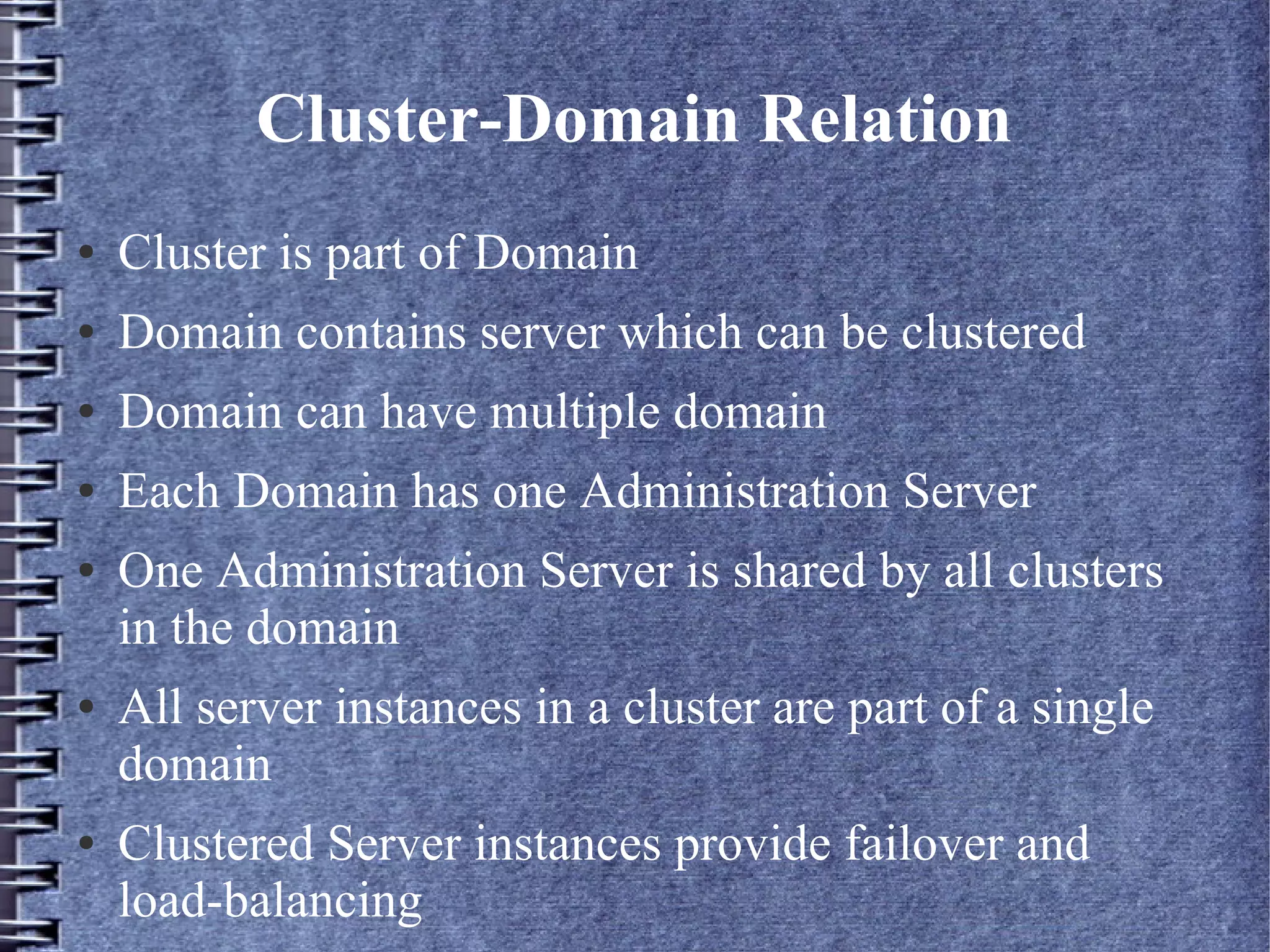
● Cluster is part of Domain
● Domain contains server which can be clustered
● Domain can have multiple domain
● Each Domain has one Administration Server
● One Administration Server is shared by all clusters
in the domain
● All server instances in a cluster are part of a single
domain
● Clustered Server instances provide failover and
load-balancing
Benifits of Clustering
● High Availability
● Scalability
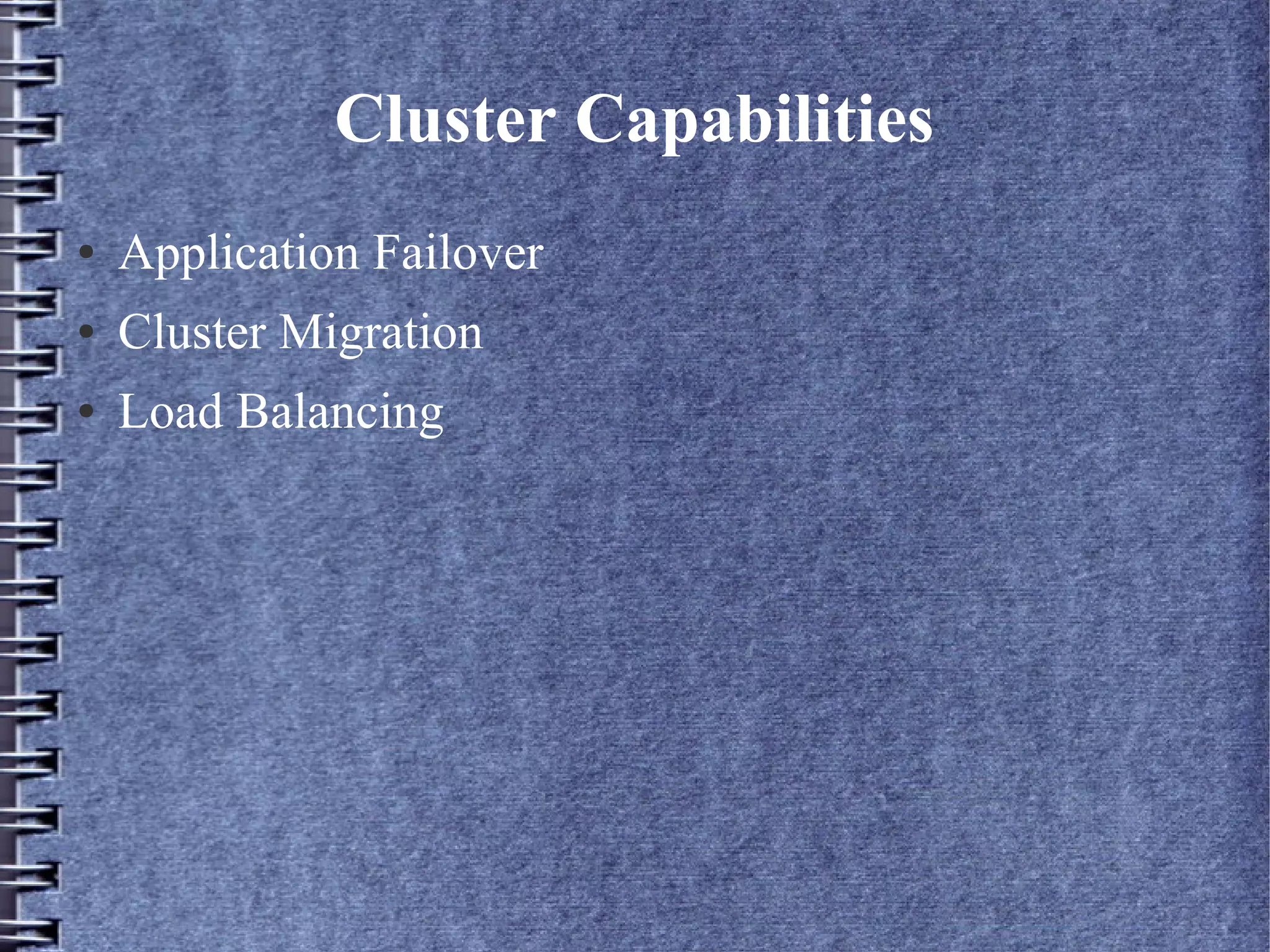
Cluster Capabilities
● Application Failover
● Cluster Migration
● Load Balancing
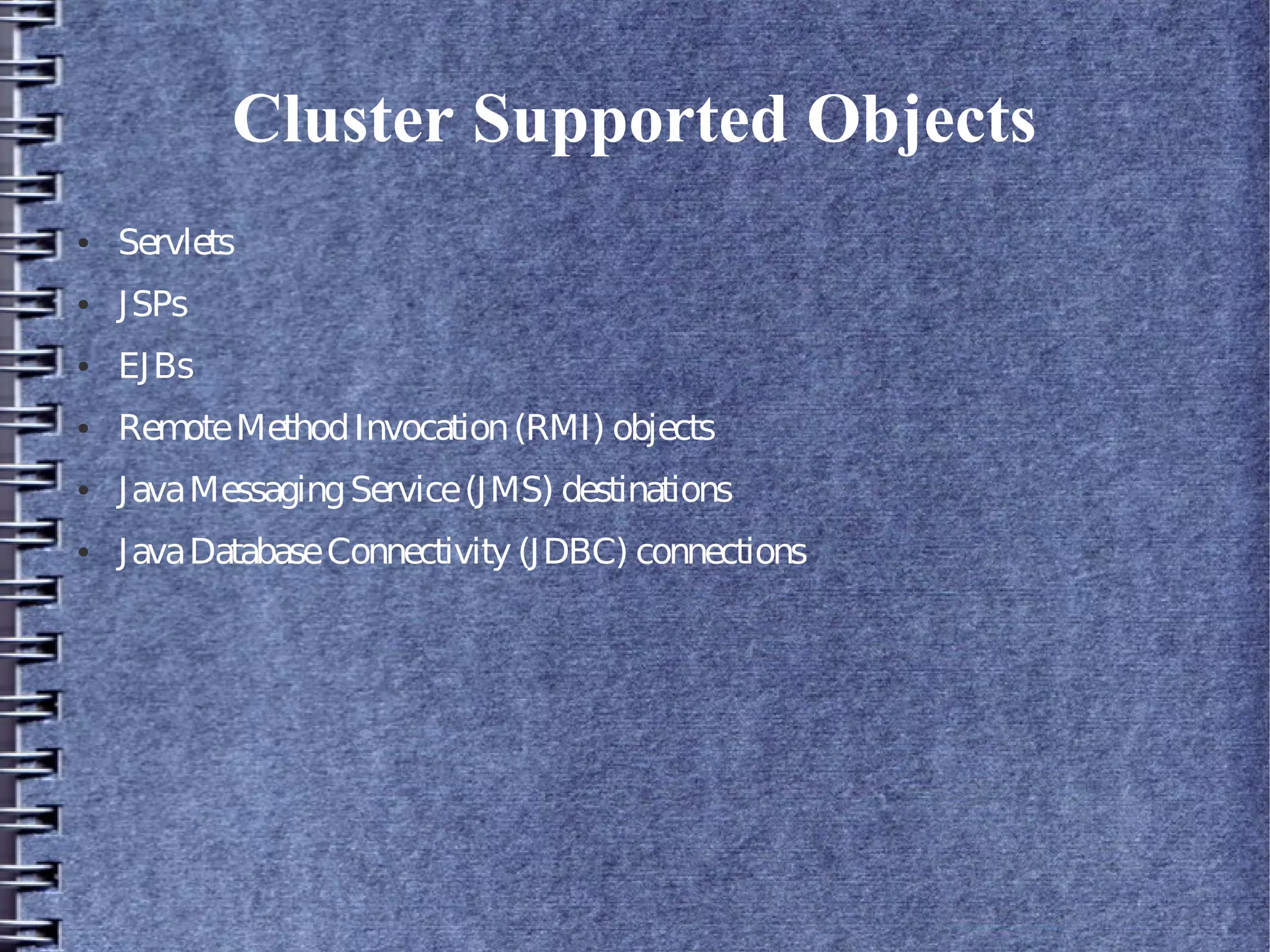
Cluster Supported Objects
● Servlets
● JSPs
● EJBs
● RemoteMethodInvocation(RMI) objects
● JavaMessagingService(JMS) destinations
● JavaDatabaseConnectivity (JDBC) connections
Cluster Unsupported Objects
■ Fileservicesincludingfileshares
■ Timeservices
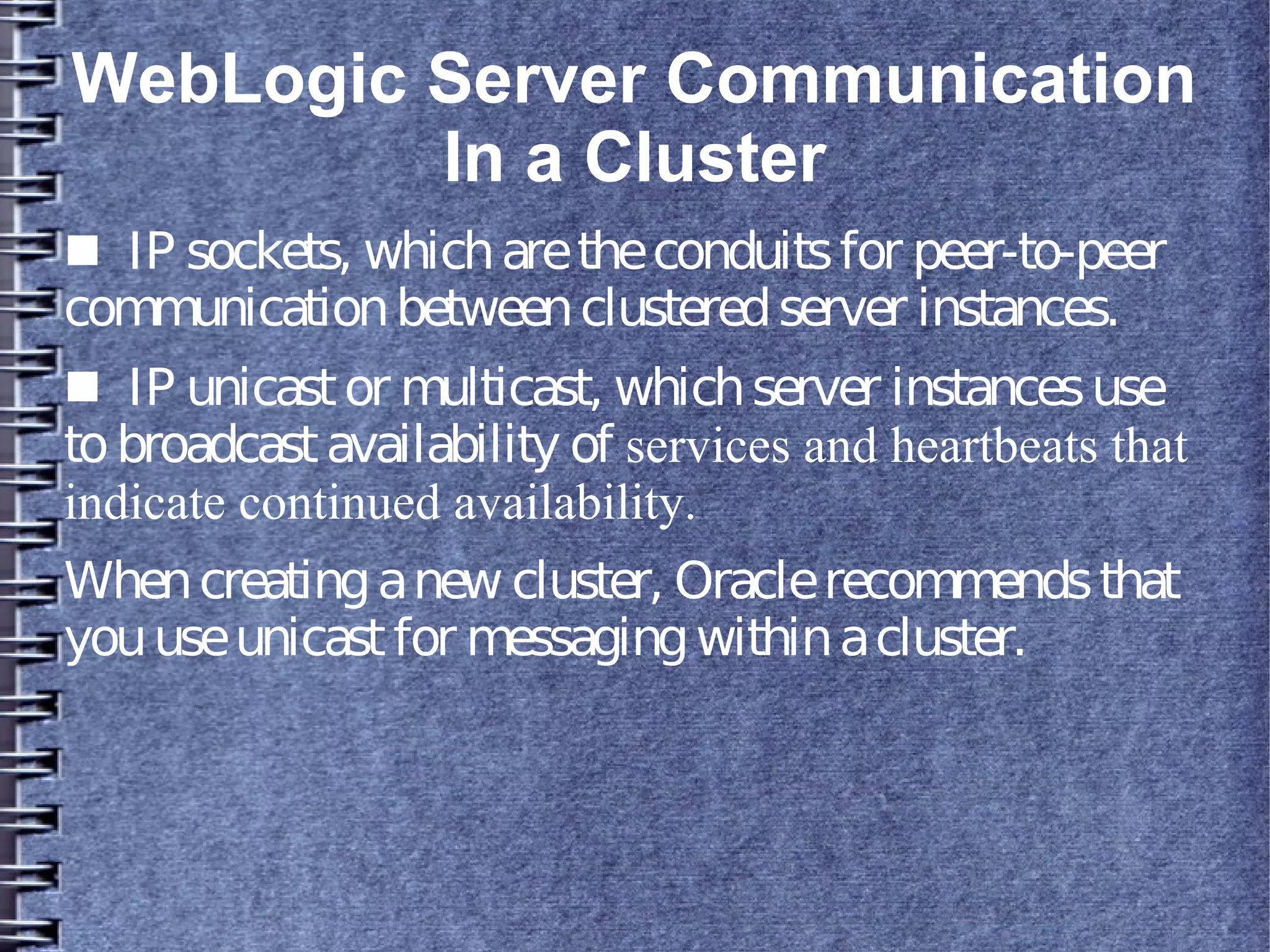
WebLogic Server Communication
In a Cluster
■ IP sockets, whicharetheconduitsfor peer-to-peer
communicationbetweenclusteredserver instances.
■ IP unicastor multicast, whichserver instancesuse
tobroadcastavailability of services and heartbeats that
indicate continued availability.
Whencreatinganew cluster, Oraclerecommendsthat
youuseunicastfor messagingwithinacluster.
Using IP Multicast for Backward
Compatibility
IP multicastisasimplebroadcasttechnology thatenablesmultipleapplicationsto"subscribe" toagivenIP
addressandportnumber andlistenfor messages.
IP multicastbroadcastsmessagestoapplications, butitdoesnotguaranteethatmessagesareactuallyreceived.
If anapplication'slocal multicastbuffer isfull, newmulticastmessagescannotbewrittentothebuffer andthe
applicationisnotnotifiedwhenmessagesare"dropped." Becauseof thislimitation, WebLogicServer
instancesallow for thepossibility thatthey may occasionallymissmessagesthatwerebroadcastover IP
multicast.
WebLogicServer usesIP multicastfor all one-to-many communicationsamongserver instancesinacluster.
Thiscommunicationincludes:
■ Cluster-wideJNDI updates—EachWebLogicServer instanceinacluster usesmulticasttoannouncethe
availability of clusteredobjectsthataredeployedor removedlocally. Eachserver instanceinthecluster
monitorstheseannouncementsandupdatesitslocal JNDI treetoreflectcurrentdeploymentsof clustered
objects.
■ Cluster heartbeats—EachWebLogicServer instanceinacluster usesmulticasttobroadcastregular
"heartbeat" messagesthatadvertiseitsavailability. Bymonitoringheartbeatmessages, server instancesina
cluster determinewhenaserver instancehasfailed. (Clusteredserver instancesalsomonitor IP socketsasa
moreimmediatemethodof determiningwhenaserver instancehasfailed.)
■ Clusterswithmanynodes—Multicastcommunicationistheoptionof choicefor clusterswithmany nodes.
One-to-Many Communication Using
Unicast
WebLogicServer providesanalternativetousing
multicasttohandlecluster messagingand
communications. Unicastconfigurationismucheasier
becauseitdoesnotrequirecrossnetwork configuration
thatmulticastrequires. Additionally, itreduces
potential network errorsthatcanoccur frommulticast
addressconflicts.
Peer-to-Peer Communication
Using IP Sockets
IP socketsprovideasimple, high-performancemechanismfor transferringmessagesanddata
betweentwoapplications. ClusteredWebLogic Server instancesuseIP socketsfor:
■ Accessingnon-clusteredobjectsdeployedtoanother clusteredserver instanceonadifferent
machine.
■ReplicatingHTTP sessionstatesandstateful sessionEJB statesbetweenaprimary and
secondary server instance.
■ Accessingclusteredobjectsthatresideonaremoteserver instance.
Proper socketconfigurationiscrucial totheperformanceof aWebLogic Server cluster. Two
factorsdeterminetheefficiency of socketcommunicationsinWebLogic Server:
■ Whether theserver instancehostsystemusesanativeor apure-Javasocketreader
implementation.
■ For systemsthatusepure-Javasocketreaders, whether theserver instanceisconfiguredtouse
enoughsocketreader threads.
Cluster-Wide JNDI Naming
Service
● Clientsof anon-clusteredWebLogicServer server instanceaccessobjectsand
servicesby usingaJNDI-compliantnamingservice. TheJNDI namingservice
containsalistof thepublic servicesthattheserver instanceoffers, organizedina
treestructure. A WebLogicServer instanceoffersanew serviceby bindingintothe
JNDI treeanamethatrepresentstheservice. Clientsobtaintheserviceby
connectingtotheserver instanceandlookinguptheboundnameof theservice.
● Server instancesinacluster utilizeacluster-wideJNDI tree. A cluster-wideJNDI
treeissimilar toasingleserver instanceJNDI tree, insofar asthetreecontainsalist
of availableservices. Inadditiontostoringthenamesof local services, however, the
cluster-wideJNDI treestorestheservicesofferedby clusteredobjects(EJBsand
RMI classes) fromother server instancesinthecluster.
● EachWebLogicServer instanceinacluster createsandmaintainsalocal copy of
thelogical cluster-wideJNDI tree. Thefollow sectionsdescribehow thecluster-
wideJNDI treeismaintained, andhow toavoidnamingconflictsthatcanoccur ina
clusteredenvironment.
Cluster Configuration
● Theconfig.xml fileisanXML documentthatdescribestheconfigurationof a
WebLogicServer domain. config.xml consistsof aseriesof XML elements.
TheDomainelementisthetop-level element, andall elementsintheDomain
descendfromtheDomainelement. TheDomainelementincludeschildelements,
suchastheServer, Cluster, andApplicationelements. Thesechildelementsmay
havechildrenof their own. For example, theServer elementincludesthechild
elementsWebServer, SSL andLog. TheApplicationelementincludesthechild
elementsEJBComponentandWebAppComponent.
● Eachelementhasoneor moreconfigurableattributes. Anattributedefinedin
config.dtd hasacorrespondingattributeintheconfigurationAPI. For
example, theServer elementhasaListenPort attribute, andlikewise, the
weblogic.management.configuration.ServerMBean hasa
ListenPort attribute. Configurableattributesarereadableandwritable, thatis,
ServerMBean hasagetListenPort andasetListenPort method.
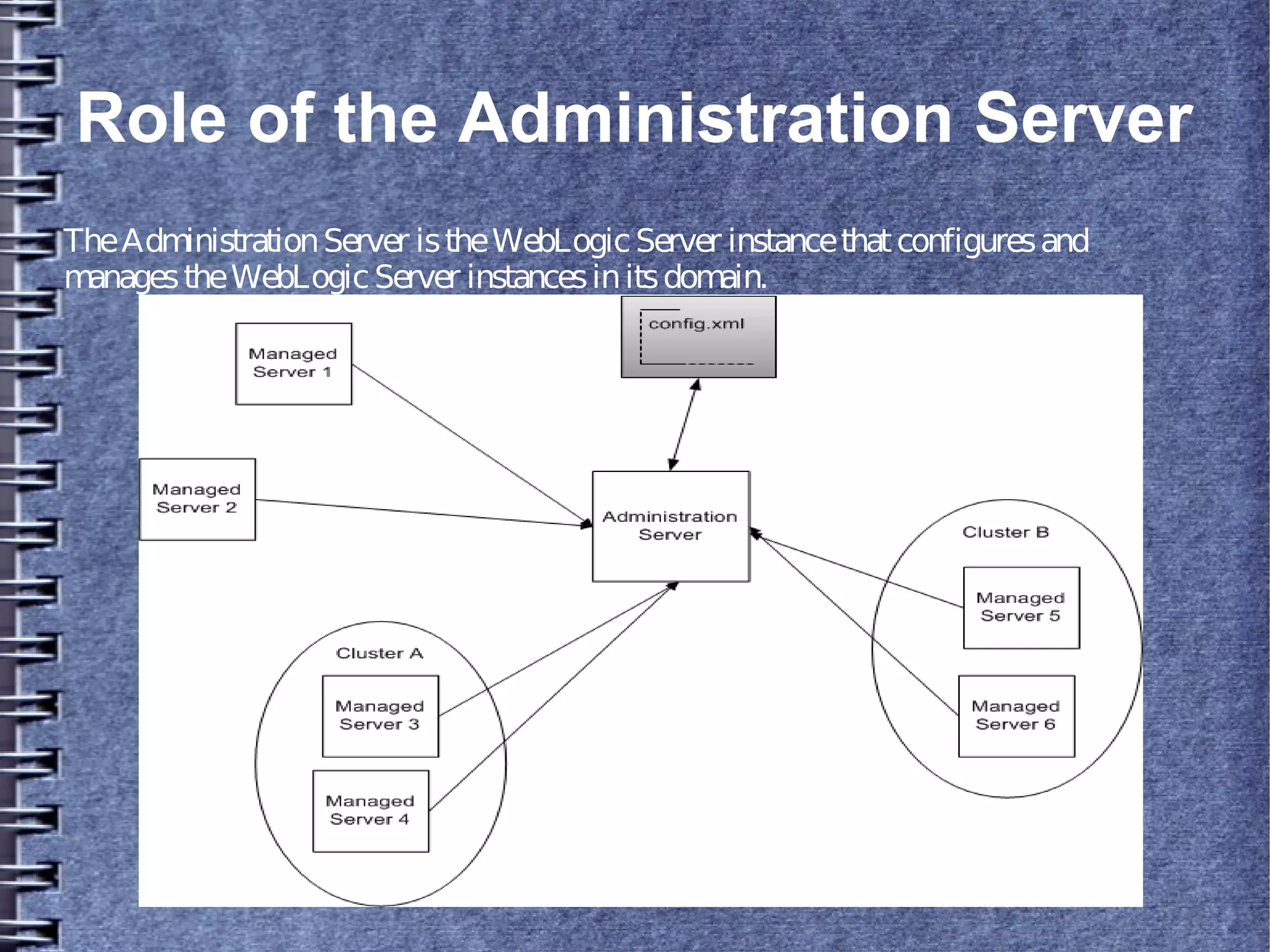
Role of the Administration Server
TheAdministrationServer istheWebLogicServer instancethatconfiguresand
managestheWebLogicServer instancesinitsdomain.
Dynamic Configuration
● WebLogicServer allowsyoutochangetheconfigurationattributesof domain
resourcesdynamically—whileserver instancesarerunning. Inmostcasesyoudo
notneedtorestarttheserver instancefor your changestotakeeffect. Whenan
attributeisreconfigured, thenew valueisimmediately reflectedinboththecurrent
run-timevalueof theattributeandthepersistentvaluestoredinconfig.xml.
● Notall configurationchangesareapplieddynamically. For example, if youchangea
ManagedServer'sListenPort value, thenew portwill notbeuseduntil thenext
timeyoustarttheManagedServer. Theupdatedvalueisstoredinconfig.xml,
buttheruntimevalueisnotaffected.
● TheAdministrationConsolevalidatesattributechanges, checkingfor out-of-range
errorsanddatatypemismatcherrors, anddisplaysanerror messagefor erroneous
entries. OncetheAdministrationConsolehasbeenstarted, if another process
capturesthelistenportassignedtotheAdministrationServer, youshouldstopthe
processthatcapturedtheport. If youarenotabletoremovetheprocessthat
capturedthelistenport, edittheconfig.xml filetochangetheListenPort
value.
Application Deployment in Cluster
● Weblogic.Deployer
● WSLT
● Admin Console
Two Phase Deployment
First Phase of Deployment
Duringthefirstphaseof deployment,
applicationcomponentsaredistributedtothe
targetserver instances, andtheplanned
deploymentisvalidatedtoensurethatthe
applicationcomponentscanbesuccessfully
deployed. Duringthisphase, user requeststo
theapplicationbeingdeployedarenotallowed.
Failuresencounteredduringthedistributionand
validationprocesswill resultinthedeployment
beingabortedonall server instances—
includingthoseuponwhichthevalidation
succeeded. Filesthathavebeenstagedwill not
beremoved; however, container-sidechanges
performedduringthepreparationwill be
reverted.
Second Phase of Deployment
After theapplicationcomponentshavebeen
distributedtotargetsandvalidated, they are
fully deployedonthetargetserver instances,
andthedeployedapplicationismadeavailable
toclients.
Whenafailureisencounteredduringthe
secondphaseof deployment, theserver starts
withoneof thefollowingbehaviors:
■ If afailureoccurswhiledeployingtothe
targetserver instances, theserver instancewill
startinADMIN state.
■ If cluster member failstodeploy an
application, theapplicationthatfailedto
deploy is made unavailable.
Guidelines for Deploying to a
Cluster
● Ideally, all ManagedServersinacluster shouldberunningandavailableduringthe
deploymentprocess. Deployingapplicationswhilesomemembersof thecluster are
unavailableisnotrecommended. Beforedeployingapplicationstoacluster, ensure,
if possible, thatall ManagedServersinthecluster arerunningandreachableby the
AdministrationServer.
● Cluster membershipshouldnotchangeduringthedeploymentprocess. After
initiatingdeployment, donot:
■ addor removeManagedServerstothetargetcluster
■ shutdownManagedServersinthetargetcluster
Load Balancing in a Cluster
■ "LoadBalancingfor ServletsandJSPs"
■ "LoadBalancingfor EJBsandRMI Objects"
■ "LoadBalancingfor JMS"
■ "LoadBalancingfor JDBC Connections"
LoadBalancingfor ServletsandJSPs
Load Balancing with a Proxy Plug-in
● The WebLogic proxy plug-in maintains a list of WebLogic Server
instances that host a clustered servlet or JSP, and forwards HTTP
requests to those instances on a round-robin basis.
● The plug-in also provides the logic necessary to locate the replica of a
client's HTTP session state if a WebLogic Server instance should fail.
● WebLogic Server supports the following Web servers and associated
proxy plug-ins:
■ WebLogic Server with the HttpClusterServlet
■ Netscape Enterprise Server with the Netscape
(proxy) plug-in
■ Apache with the Apache Server (proxy) plug-in
■ Microsoft Internet Information Server with the
Microsoft-IIS (proxy) plug-in
LoadBalancingfor ServletsandJSPs
Load Balancing HTTP Sessions with an External Load Balancer
· Passive Cookie Persistence
Passive cookie persistence enables WebLogic Server to write a cookie containing session parameter
information through the load balancer to the client. For information about the session cookie and how a
load balancer uses session parameter data to maintain the relationship between the client and the
primary WebLogic Server hosting a HTTP session state,
· Active Cookie Persistence
You can use certain active cookie persistence mechanisms with WebLogic Server clusters, provided the
load balancer does not modify the WebLogic Server cookie. WebLogic Server clusters do not support
active cookie persistence mechanisms that overwrite or modify the WebLogic HTTP session cookie. If
the load balancer's active cookie persistence mechanism works by adding its own cookie to the client
session, no additional configuration is required to use the load balancer with a WebLogic Server
cluster.
· SSL Persistence
When SSL persistence is used, the load balancer performs all encryption and decryption of data
between clients and the WebLogic Server cluster. The load balancer then uses the plain text cookie that
WebLogic Server inserts on the client to maintain an association between the client and a particular
server in the cluster.
Load Balancing for EJBs and RMI
Objects
Round-Robin Load Balancing● WebLogicServer usestheround-robinalgorithmasthedefaultloadbalancing
strategy for clusteredobjectstubswhennoalgorithmisspecified. Thisalgorithmis
supportedfor RMI objectsandEJBs. Itisalsothemethodusedby WebLogic proxy
plug-ins.
● Theround-robinalgorithmcyclesthroughalistof WebLogicServer instancesin
order.
● For clusteredobjects, theserver listconsistsof WebLogicServer instancesthathost
theclusteredobject. For proxy plug-ins, thelistconsistsof all WebLogicServer
instancesthathosttheclusteredservletor JSP.
● Theadvantagesof theround-robinalgorithmarethatitissimple, cheapandvery
predictable. Theprimary disadvantageisthatthereissomechanceof convoying.
● Convoyingoccurswhenoneserver issignificantly slower thantheothers. Because
replica-awarestubsor proxy plug-insaccesstheserversinthesameorder, aslow
server cancauserequeststo"synchronize" ontheserver, thenfollow other servers
inorder for futurerequests.
Load Balancing for EJBs and RMI
Objects
Weight-Based Load BalancingThisalgorithmappliesonly toEJB andRMI objectclustering.
Weight-basedloadbalancingimprovesontheround-robinalgorithmby takingintoaccountapre-
assignedweightfor eachserver. YoucanusetheServer >Configuration >Cluster pageinthe
AdministrationConsoletoassigneachserver inthecluster anumerical weightbetween1and100,
intheCluster Weight field. Thisvaluedetermineswhatproportionof theloadtheserver
will bear relativetoother servers. If all servershavethesameweight, they will eachbear anequal
proportionof theload. If oneserver hasweight50andall other servershaveweight100, the50-
weightserver will bear half asmuchasany other server. Thisalgorithmmakesitpossibletoapply
theadvantagesof theround-robinalgorithmtoclustersthatarenothomogeneous.
If youusetheweight-basedalgorithm, carefully determinetherelativeweightstoassigntoeach
server instance. Factorstoconsider include:
■ Theprocessingcapacity of theserver'shardwareinrelationshiptoother servers(for example,
thenumber andperformanceof CPUsdedicatedtoWebLogic Server).
■ Thenumber of non-clustered("pinned") objectseachserver hosts. If youchangethespecified
weightof aserver andrebootit, thenew weightinginformationispropagatedthroughoutthe
cluster viathereplica-awarestubs.
Load Balancing for EJBs and RMI
Objects
Random Load Balancing● Therandommethodof loadbalancingappliesonly toEJB andRMI object
clustering.
● Inrandomloadbalancing, requestsareroutedtoserversatrandom. Randomload
balancingisrecommendedonly for homogeneouscluster deployments, whereeach
server instancerunsonasimilarly configuredmachine. A randomallocationof
requestsdoesnotallow for differencesinprocessingpower amongthemachines
upon
● whichserver instancesrun. If amachinehostingserversinacluster hassignificantly
lessprocessingpower thanother machinesinthecluster, randomloadbalancing
will givethelesspowerful machineasmany requestsasitgivesmorepowerful
machines.
● Randomloadbalancingdistributesrequestsevenly acrossserver instancesinthe
cluster, increasingly soasthecumulativenumber of requestsincreases. Over asmall
number of requeststheloadmay notbebalancedexactly evenly.
● Disadvantagesof randomloadbalancingincludetheslightprocessingoverhead
incurredby generatingarandomnumber for eachrequest, andthepossibility that
theloadmay notbeevenly balancedover asmall number of requests.
Load Balancing for EJBs and RMI
Objects
Server Affinity Load Balancing Algorithms
● WebLogicServer providesthreeloadbalancingalgorithmsfor RMI objectsthat
provideserver affinity. Server affinity turnsoff loadbalancingfor external client
connections; instead, theclientconsidersitsexistingconnectionstoWebLogic
Server instanceswhenchoosingtheserver instanceonwhichtoaccessanobject. If
anobjectisconfiguredfor server affinity, theclient-sidestubattemptstochoosea
server instancetowhichitisalready connected, andcontinuestousethesame
server instancefor methodcalls. All stubsonthatclientattempttousethatserver
instance. If theserver instancebecomesunavailable, thestubsfail over, if possible,
toaserver instancetowhichtheclientisalready connected.
● Thepurposeof server affinity istominimizethenumber IP socketsopenedbetween
external Javaclientsandserver instancesinacluster. WebLogicServer
accomplishesthisby causingmethodcallsonobjectsto"stick" toanexisting
connection, insteadof beingloadbalancedamongtheavailableserver instances.
Withserver affinity algorithms, thelesscostly server-to-server connectionsarestill
load-balancedaccordingtotheconfiguredloadbalancingalgorithm—load
balancingisdisabledonly for external clientconnections.
Load Balancing for EJBs and RMI
Objects
Parameter-Based Routing for Clustered Objects
Parameter-basedroutingallowsyoutocontrol loadbalancingbehavior at
alower level. Any clusteredobjectcanbeassignedaCallRouter. This
isaclassthatiscalledbeforeeachinvocationwiththeparametersof the
call. TheCallRouter isfreetoexaminetheparametersandreturnthe
nameserver towhichthecall shouldberouted.
Load Balancing for EJBs and RMI
Objects
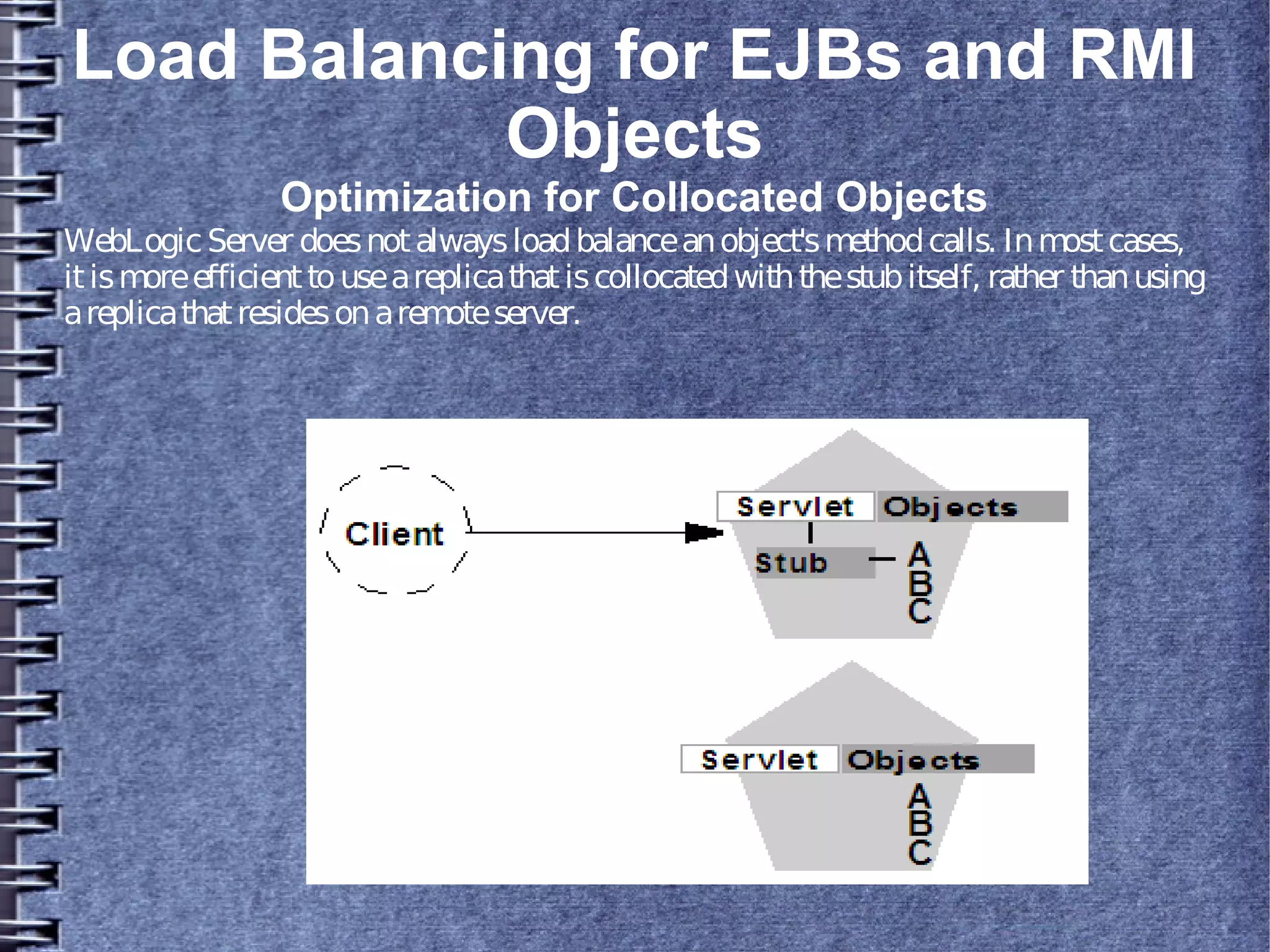
Optimization for Collocated Objects
WebLogicServer doesnotalwaysloadbalanceanobject'smethodcalls. Inmostcases,
itismoreefficienttouseareplicathatiscollocatedwiththestubitself, rather thanusing
areplicathatresidesonaremoteserver.
Load Balancing for JMS
Server Affinity for Distributed JMS Destinations
Server affinity issupportedfor JMS applicationsthatusethedistributeddestination
feature; thisfeatureisnotsupportedfor standalonedestinations. If youconfigureserver
affinity for JMS connectionfactories, aserver instancethatisloadbalancingconsumers
or producersacrossmultiplemembersof adistributeddestinationwill firstattemptto
loadbalanceacrossany destinationmembersthatarealsorunningonthesameserver
instance.
Load Balancing for JMS
Initial Context Affinity and Server Affinity for Client
Connections
● A systemadministrator canestablishloadbalancingof JMS destinationsacross
multipleserversinacluster by configuringmultipleJMS serversandusingtargets
toassignthemtothedefinedWebLogicServers. EachJMS server isdeployedon
exactly oneWebLogicServer andhandlesrequestsfor asetof destinations. During
theconfigurationphase, thesystemadministrator enablesloadbalancingby
specifyingtargetsfor JMS servers.
● A systemadministrator canestablishcluster-wide, transparentaccesstodestinations
fromany server inthecluster by configuringmultipleconnectionfactoriesand
usingtargetstoassignthemtoWebLogicServers. Eachconnectionfactory canbe
deployedonmultipleWebLogicServers.
Load Balancing for JMS
Initial Context Affinity and Server Affinity for Client
Connections
● TheapplicationusestheJavaNamingandDirectory Interface(JNDI) tolook upa
connectionfactory andcreateaconnectiontoestablishcommunicationwithaJMS
server. EachJMS server handlesrequestsfor asetof destinations. Requestsfor
destinationsnothandledby aJMS server areforwardedtotheappropriateserver.
● WebLogicServer providesserver affinity for clientconnections. If anapplication
hasaconnectiontoagivenserver instance, JMS will attempttoestablishnew JMS
connectionstothesameserver instance.
● Whencreatingaconnection, JMS will try firsttoachieveinitial contextaffinity. It
will attempttoconnecttothesameserver or serverstowhichaclientconnectedfor
itsinitial context, assumingthattheserver instanceisconfiguredfor thatconnection
factory. For example, if theconnectionfactory isconfiguredfor serversA andB,
buttheclienthasanInitialContextonserver C, thentheconnectionfactory will not
establishthenew connectionwithA, butwill choosebetweenserversB andC.
Load Balancing for JDBC
Connections
● Loadbalancingof JDBC connectionrequirestheuseof amulti datasource
configuredfor loadbalancing. Loadbalancingsupportisanoptionyoucanchoose
whenconfiguringamulti datasource.
● A loadbalancingmulti datasourceprovidesthehighavailablebehavior and, in
addition, balancestheloadamongthedatasourcesinthemulti datasource. A multi
datasourcehasanorderedlistof datasourcesitcontains. If youdonotconfigure
themulti datasourcefor loadbalancing, italwaysattemptstoobtainaconnection
fromthefirstdatasourceinthelist. Inaload-balancingmulti datasource, thedata
sourcesitcontainsareaccessedusingaround-robinscheme. Ineachsuccessive
clientrequestfor amulti datasourceconnection, thelistisrotatedsothefirstpool
tappedcyclesaroundthelist.
Load Balancing and Replication
■ "LoadBalancingfor ServletsandJSPs"
■ "LoadBalancingfor EJBsandRMI Objects"
■ "LoadBalancingfor JMS"
■ "LoadBalancingfor JDBC Connections"

Weblogic cluster

  • 1.
  • 2.
    What is Cluster AWebLogicServer cluster consistsof multipleWebLogicServer server instances runningsimultaneously andworkingtogether toprovideincreasedscalability and reliability. A cluster appearstoclientstobeasingleWebLogicServer instance. Theserver instancesthatconstituteacluster canrunonthesamemachine, or belocated ondifferentmachines. Youcanincreaseacluster'scapacity by addingadditional server instancestothecluster onanexistingmachine, or youcanaddmachinestothecluster to hosttheincremental server instances. Eachserver instanceinacluster mustrunthesame versionof WebLogicServer.
  • 3.
    Cluster-Domain Relation ● Clusteris part of Domain ● Domain contains server which can be clustered ● Domain can have multiple domain ● Each Domain has one Administration Server ● One Administration Server is shared by all clusters in the domain ● All server instances in a cluster are part of a single domain ● Clustered Server instances provide failover and load-balancing
  • 4.
    Benifits of Clustering ●High Availability ● Scalability
  • 5.
    Cluster Capabilities ● ApplicationFailover ● Cluster Migration ● Load Balancing
  • 6.
    Cluster Supported Objects ●Servlets ● JSPs ● EJBs ● RemoteMethodInvocation(RMI) objects ● JavaMessagingService(JMS) destinations ● JavaDatabaseConnectivity (JDBC) connections
  • 7.
    Cluster Unsupported Objects ■Fileservicesincludingfileshares ■ Timeservices
  • 8.
    WebLogic Server Communication Ina Cluster ■ IP sockets, whicharetheconduitsfor peer-to-peer communicationbetweenclusteredserver instances. ■ IP unicastor multicast, whichserver instancesuse tobroadcastavailability of services and heartbeats that indicate continued availability. Whencreatinganew cluster, Oraclerecommendsthat youuseunicastfor messagingwithinacluster.
  • 9.
    Using IP Multicastfor Backward Compatibility IP multicastisasimplebroadcasttechnology thatenablesmultipleapplicationsto"subscribe" toagivenIP addressandportnumber andlistenfor messages. IP multicastbroadcastsmessagestoapplications, butitdoesnotguaranteethatmessagesareactuallyreceived. If anapplication'slocal multicastbuffer isfull, newmulticastmessagescannotbewrittentothebuffer andthe applicationisnotnotifiedwhenmessagesare"dropped." Becauseof thislimitation, WebLogicServer instancesallow for thepossibility thatthey may occasionallymissmessagesthatwerebroadcastover IP multicast. WebLogicServer usesIP multicastfor all one-to-many communicationsamongserver instancesinacluster. Thiscommunicationincludes: ■ Cluster-wideJNDI updates—EachWebLogicServer instanceinacluster usesmulticasttoannouncethe availability of clusteredobjectsthataredeployedor removedlocally. Eachserver instanceinthecluster monitorstheseannouncementsandupdatesitslocal JNDI treetoreflectcurrentdeploymentsof clustered objects. ■ Cluster heartbeats—EachWebLogicServer instanceinacluster usesmulticasttobroadcastregular "heartbeat" messagesthatadvertiseitsavailability. Bymonitoringheartbeatmessages, server instancesina cluster determinewhenaserver instancehasfailed. (Clusteredserver instancesalsomonitor IP socketsasa moreimmediatemethodof determiningwhenaserver instancehasfailed.) ■ Clusterswithmanynodes—Multicastcommunicationistheoptionof choicefor clusterswithmany nodes.
  • 10.
    One-to-Many Communication Using Unicast WebLogicServerprovidesanalternativetousing multicasttohandlecluster messagingand communications. Unicastconfigurationismucheasier becauseitdoesnotrequirecrossnetwork configuration thatmulticastrequires. Additionally, itreduces potential network errorsthatcanoccur frommulticast addressconflicts.
  • 11.
    Peer-to-Peer Communication Using IPSockets IP socketsprovideasimple, high-performancemechanismfor transferringmessagesanddata betweentwoapplications. ClusteredWebLogic Server instancesuseIP socketsfor: ■ Accessingnon-clusteredobjectsdeployedtoanother clusteredserver instanceonadifferent machine. ■ReplicatingHTTP sessionstatesandstateful sessionEJB statesbetweenaprimary and secondary server instance. ■ Accessingclusteredobjectsthatresideonaremoteserver instance. Proper socketconfigurationiscrucial totheperformanceof aWebLogic Server cluster. Two factorsdeterminetheefficiency of socketcommunicationsinWebLogic Server: ■ Whether theserver instancehostsystemusesanativeor apure-Javasocketreader implementation. ■ For systemsthatusepure-Javasocketreaders, whether theserver instanceisconfiguredtouse enoughsocketreader threads.
  • 12.
    Cluster-Wide JNDI Naming Service ●Clientsof anon-clusteredWebLogicServer server instanceaccessobjectsand servicesby usingaJNDI-compliantnamingservice. TheJNDI namingservice containsalistof thepublic servicesthattheserver instanceoffers, organizedina treestructure. A WebLogicServer instanceoffersanew serviceby bindingintothe JNDI treeanamethatrepresentstheservice. Clientsobtaintheserviceby connectingtotheserver instanceandlookinguptheboundnameof theservice. ● Server instancesinacluster utilizeacluster-wideJNDI tree. A cluster-wideJNDI treeissimilar toasingleserver instanceJNDI tree, insofar asthetreecontainsalist of availableservices. Inadditiontostoringthenamesof local services, however, the cluster-wideJNDI treestorestheservicesofferedby clusteredobjects(EJBsand RMI classes) fromother server instancesinthecluster. ● EachWebLogicServer instanceinacluster createsandmaintainsalocal copy of thelogical cluster-wideJNDI tree. Thefollow sectionsdescribehow thecluster- wideJNDI treeismaintained, andhow toavoidnamingconflictsthatcanoccur ina clusteredenvironment.
  • 13.
    Cluster Configuration ● Theconfig.xmlfileisanXML documentthatdescribestheconfigurationof a WebLogicServer domain. config.xml consistsof aseriesof XML elements. TheDomainelementisthetop-level element, andall elementsintheDomain descendfromtheDomainelement. TheDomainelementincludeschildelements, suchastheServer, Cluster, andApplicationelements. Thesechildelementsmay havechildrenof their own. For example, theServer elementincludesthechild elementsWebServer, SSL andLog. TheApplicationelementincludesthechild elementsEJBComponentandWebAppComponent. ● Eachelementhasoneor moreconfigurableattributes. Anattributedefinedin config.dtd hasacorrespondingattributeintheconfigurationAPI. For example, theServer elementhasaListenPort attribute, andlikewise, the weblogic.management.configuration.ServerMBean hasa ListenPort attribute. Configurableattributesarereadableandwritable, thatis, ServerMBean hasagetListenPort andasetListenPort method.
  • 14.
    Role of theAdministration Server TheAdministrationServer istheWebLogicServer instancethatconfiguresand managestheWebLogicServer instancesinitsdomain.
  • 15.
    Dynamic Configuration ● WebLogicServerallowsyoutochangetheconfigurationattributesof domain resourcesdynamically—whileserver instancesarerunning. Inmostcasesyoudo notneedtorestarttheserver instancefor your changestotakeeffect. Whenan attributeisreconfigured, thenew valueisimmediately reflectedinboththecurrent run-timevalueof theattributeandthepersistentvaluestoredinconfig.xml. ● Notall configurationchangesareapplieddynamically. For example, if youchangea ManagedServer'sListenPort value, thenew portwill notbeuseduntil thenext timeyoustarttheManagedServer. Theupdatedvalueisstoredinconfig.xml, buttheruntimevalueisnotaffected. ● TheAdministrationConsolevalidatesattributechanges, checkingfor out-of-range errorsanddatatypemismatcherrors, anddisplaysanerror messagefor erroneous entries. OncetheAdministrationConsolehasbeenstarted, if another process capturesthelistenportassignedtotheAdministrationServer, youshouldstopthe processthatcapturedtheport. If youarenotabletoremovetheprocessthat capturedthelistenport, edittheconfig.xml filetochangetheListenPort value.
  • 16.
    Application Deployment inCluster ● Weblogic.Deployer ● WSLT ● Admin Console
  • 17.
    Two Phase Deployment FirstPhase of Deployment Duringthefirstphaseof deployment, applicationcomponentsaredistributedtothe targetserver instances, andtheplanned deploymentisvalidatedtoensurethatthe applicationcomponentscanbesuccessfully deployed. Duringthisphase, user requeststo theapplicationbeingdeployedarenotallowed. Failuresencounteredduringthedistributionand validationprocesswill resultinthedeployment beingabortedonall server instances— includingthoseuponwhichthevalidation succeeded. Filesthathavebeenstagedwill not beremoved; however, container-sidechanges performedduringthepreparationwill be reverted. Second Phase of Deployment After theapplicationcomponentshavebeen distributedtotargetsandvalidated, they are fully deployedonthetargetserver instances, andthedeployedapplicationismadeavailable toclients. Whenafailureisencounteredduringthe secondphaseof deployment, theserver starts withoneof thefollowingbehaviors: ■ If afailureoccurswhiledeployingtothe targetserver instances, theserver instancewill startinADMIN state. ■ If cluster member failstodeploy an application, theapplicationthatfailedto deploy is made unavailable.
  • 18.
    Guidelines for Deployingto a Cluster ● Ideally, all ManagedServersinacluster shouldberunningandavailableduringthe deploymentprocess. Deployingapplicationswhilesomemembersof thecluster are unavailableisnotrecommended. Beforedeployingapplicationstoacluster, ensure, if possible, thatall ManagedServersinthecluster arerunningandreachableby the AdministrationServer. ● Cluster membershipshouldnotchangeduringthedeploymentprocess. After initiatingdeployment, donot: ■ addor removeManagedServerstothetargetcluster ■ shutdownManagedServersinthetargetcluster
  • 19.
    Load Balancing ina Cluster ■ "LoadBalancingfor ServletsandJSPs" ■ "LoadBalancingfor EJBsandRMI Objects" ■ "LoadBalancingfor JMS" ■ "LoadBalancingfor JDBC Connections"
  • 20.
    LoadBalancingfor ServletsandJSPs Load Balancingwith a Proxy Plug-in ● The WebLogic proxy plug-in maintains a list of WebLogic Server instances that host a clustered servlet or JSP, and forwards HTTP requests to those instances on a round-robin basis. ● The plug-in also provides the logic necessary to locate the replica of a client's HTTP session state if a WebLogic Server instance should fail. ● WebLogic Server supports the following Web servers and associated proxy plug-ins: ■ WebLogic Server with the HttpClusterServlet ■ Netscape Enterprise Server with the Netscape (proxy) plug-in ■ Apache with the Apache Server (proxy) plug-in ■ Microsoft Internet Information Server with the Microsoft-IIS (proxy) plug-in
  • 21.
    LoadBalancingfor ServletsandJSPs Load BalancingHTTP Sessions with an External Load Balancer · Passive Cookie Persistence Passive cookie persistence enables WebLogic Server to write a cookie containing session parameter information through the load balancer to the client. For information about the session cookie and how a load balancer uses session parameter data to maintain the relationship between the client and the primary WebLogic Server hosting a HTTP session state, · Active Cookie Persistence You can use certain active cookie persistence mechanisms with WebLogic Server clusters, provided the load balancer does not modify the WebLogic Server cookie. WebLogic Server clusters do not support active cookie persistence mechanisms that overwrite or modify the WebLogic HTTP session cookie. If the load balancer's active cookie persistence mechanism works by adding its own cookie to the client session, no additional configuration is required to use the load balancer with a WebLogic Server cluster. · SSL Persistence When SSL persistence is used, the load balancer performs all encryption and decryption of data between clients and the WebLogic Server cluster. The load balancer then uses the plain text cookie that WebLogic Server inserts on the client to maintain an association between the client and a particular server in the cluster.
  • 22.
    Load Balancing forEJBs and RMI Objects Round-Robin Load Balancing● WebLogicServer usestheround-robinalgorithmasthedefaultloadbalancing strategy for clusteredobjectstubswhennoalgorithmisspecified. Thisalgorithmis supportedfor RMI objectsandEJBs. Itisalsothemethodusedby WebLogic proxy plug-ins. ● Theround-robinalgorithmcyclesthroughalistof WebLogicServer instancesin order. ● For clusteredobjects, theserver listconsistsof WebLogicServer instancesthathost theclusteredobject. For proxy plug-ins, thelistconsistsof all WebLogicServer instancesthathosttheclusteredservletor JSP. ● Theadvantagesof theround-robinalgorithmarethatitissimple, cheapandvery predictable. Theprimary disadvantageisthatthereissomechanceof convoying. ● Convoyingoccurswhenoneserver issignificantly slower thantheothers. Because replica-awarestubsor proxy plug-insaccesstheserversinthesameorder, aslow server cancauserequeststo"synchronize" ontheserver, thenfollow other servers inorder for futurerequests.
  • 23.
    Load Balancing forEJBs and RMI Objects Weight-Based Load BalancingThisalgorithmappliesonly toEJB andRMI objectclustering. Weight-basedloadbalancingimprovesontheround-robinalgorithmby takingintoaccountapre- assignedweightfor eachserver. YoucanusetheServer >Configuration >Cluster pageinthe AdministrationConsoletoassigneachserver inthecluster anumerical weightbetween1and100, intheCluster Weight field. Thisvaluedetermineswhatproportionof theloadtheserver will bear relativetoother servers. If all servershavethesameweight, they will eachbear anequal proportionof theload. If oneserver hasweight50andall other servershaveweight100, the50- weightserver will bear half asmuchasany other server. Thisalgorithmmakesitpossibletoapply theadvantagesof theround-robinalgorithmtoclustersthatarenothomogeneous. If youusetheweight-basedalgorithm, carefully determinetherelativeweightstoassigntoeach server instance. Factorstoconsider include: ■ Theprocessingcapacity of theserver'shardwareinrelationshiptoother servers(for example, thenumber andperformanceof CPUsdedicatedtoWebLogic Server). ■ Thenumber of non-clustered("pinned") objectseachserver hosts. If youchangethespecified weightof aserver andrebootit, thenew weightinginformationispropagatedthroughoutthe cluster viathereplica-awarestubs.
  • 24.
    Load Balancing forEJBs and RMI Objects Random Load Balancing● Therandommethodof loadbalancingappliesonly toEJB andRMI object clustering. ● Inrandomloadbalancing, requestsareroutedtoserversatrandom. Randomload balancingisrecommendedonly for homogeneouscluster deployments, whereeach server instancerunsonasimilarly configuredmachine. A randomallocationof requestsdoesnotallow for differencesinprocessingpower amongthemachines upon ● whichserver instancesrun. If amachinehostingserversinacluster hassignificantly lessprocessingpower thanother machinesinthecluster, randomloadbalancing will givethelesspowerful machineasmany requestsasitgivesmorepowerful machines. ● Randomloadbalancingdistributesrequestsevenly acrossserver instancesinthe cluster, increasingly soasthecumulativenumber of requestsincreases. Over asmall number of requeststheloadmay notbebalancedexactly evenly. ● Disadvantagesof randomloadbalancingincludetheslightprocessingoverhead incurredby generatingarandomnumber for eachrequest, andthepossibility that theloadmay notbeevenly balancedover asmall number of requests.
  • 25.
    Load Balancing forEJBs and RMI Objects Server Affinity Load Balancing Algorithms ● WebLogicServer providesthreeloadbalancingalgorithmsfor RMI objectsthat provideserver affinity. Server affinity turnsoff loadbalancingfor external client connections; instead, theclientconsidersitsexistingconnectionstoWebLogic Server instanceswhenchoosingtheserver instanceonwhichtoaccessanobject. If anobjectisconfiguredfor server affinity, theclient-sidestubattemptstochoosea server instancetowhichitisalready connected, andcontinuestousethesame server instancefor methodcalls. All stubsonthatclientattempttousethatserver instance. If theserver instancebecomesunavailable, thestubsfail over, if possible, toaserver instancetowhichtheclientisalready connected. ● Thepurposeof server affinity istominimizethenumber IP socketsopenedbetween external Javaclientsandserver instancesinacluster. WebLogicServer accomplishesthisby causingmethodcallsonobjectsto"stick" toanexisting connection, insteadof beingloadbalancedamongtheavailableserver instances. Withserver affinity algorithms, thelesscostly server-to-server connectionsarestill load-balancedaccordingtotheconfiguredloadbalancingalgorithm—load balancingisdisabledonly for external clientconnections.
  • 26.
    Load Balancing forEJBs and RMI Objects Parameter-Based Routing for Clustered Objects Parameter-basedroutingallowsyoutocontrol loadbalancingbehavior at alower level. Any clusteredobjectcanbeassignedaCallRouter. This isaclassthatiscalledbeforeeachinvocationwiththeparametersof the call. TheCallRouter isfreetoexaminetheparametersandreturnthe nameserver towhichthecall shouldberouted.
  • 27.
    Load Balancing forEJBs and RMI Objects Optimization for Collocated Objects WebLogicServer doesnotalwaysloadbalanceanobject'smethodcalls. Inmostcases, itismoreefficienttouseareplicathatiscollocatedwiththestubitself, rather thanusing areplicathatresidesonaremoteserver.
  • 28.
    Load Balancing forJMS Server Affinity for Distributed JMS Destinations Server affinity issupportedfor JMS applicationsthatusethedistributeddestination feature; thisfeatureisnotsupportedfor standalonedestinations. If youconfigureserver affinity for JMS connectionfactories, aserver instancethatisloadbalancingconsumers or producersacrossmultiplemembersof adistributeddestinationwill firstattemptto loadbalanceacrossany destinationmembersthatarealsorunningonthesameserver instance.
  • 29.
    Load Balancing forJMS Initial Context Affinity and Server Affinity for Client Connections ● A systemadministrator canestablishloadbalancingof JMS destinationsacross multipleserversinacluster by configuringmultipleJMS serversandusingtargets toassignthemtothedefinedWebLogicServers. EachJMS server isdeployedon exactly oneWebLogicServer andhandlesrequestsfor asetof destinations. During theconfigurationphase, thesystemadministrator enablesloadbalancingby specifyingtargetsfor JMS servers. ● A systemadministrator canestablishcluster-wide, transparentaccesstodestinations fromany server inthecluster by configuringmultipleconnectionfactoriesand usingtargetstoassignthemtoWebLogicServers. Eachconnectionfactory canbe deployedonmultipleWebLogicServers.
  • 30.
    Load Balancing forJMS Initial Context Affinity and Server Affinity for Client Connections ● TheapplicationusestheJavaNamingandDirectory Interface(JNDI) tolook upa connectionfactory andcreateaconnectiontoestablishcommunicationwithaJMS server. EachJMS server handlesrequestsfor asetof destinations. Requestsfor destinationsnothandledby aJMS server areforwardedtotheappropriateserver. ● WebLogicServer providesserver affinity for clientconnections. If anapplication hasaconnectiontoagivenserver instance, JMS will attempttoestablishnew JMS connectionstothesameserver instance. ● Whencreatingaconnection, JMS will try firsttoachieveinitial contextaffinity. It will attempttoconnecttothesameserver or serverstowhichaclientconnectedfor itsinitial context, assumingthattheserver instanceisconfiguredfor thatconnection factory. For example, if theconnectionfactory isconfiguredfor serversA andB, buttheclienthasanInitialContextonserver C, thentheconnectionfactory will not establishthenew connectionwithA, butwill choosebetweenserversB andC.
  • 31.
    Load Balancing forJDBC Connections ● Loadbalancingof JDBC connectionrequirestheuseof amulti datasource configuredfor loadbalancing. Loadbalancingsupportisanoptionyoucanchoose whenconfiguringamulti datasource. ● A loadbalancingmulti datasourceprovidesthehighavailablebehavior and, in addition, balancestheloadamongthedatasourcesinthemulti datasource. A multi datasourcehasanorderedlistof datasourcesitcontains. If youdonotconfigure themulti datasourcefor loadbalancing, italwaysattemptstoobtainaconnection fromthefirstdatasourceinthelist. Inaload-balancingmulti datasource, thedata sourcesitcontainsareaccessedusingaround-robinscheme. Ineachsuccessive clientrequestfor amulti datasourceconnection, thelistisrotatedsothefirstpool tappedcyclesaroundthelist.
  • 32.
    Load Balancing andReplication ■ "LoadBalancingfor ServletsandJSPs" ■ "LoadBalancingfor EJBsandRMI Objects" ■ "LoadBalancingfor JMS" ■ "LoadBalancingfor JDBC Connections"