Rules and Regulations Business Drivers for SOA-based Agile IT Presented by Adrian Bowles, Ph.D. Program Director, Regulatory Compliance Object Management Group [email_address] www.omg.org
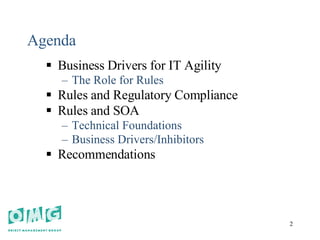
Agenda Business Drivers for IT Agility The Role for Rules Rules and Regulatory Compliance Rules and SOA Technical Foundations Business Drivers/Inhibitors Recommendations
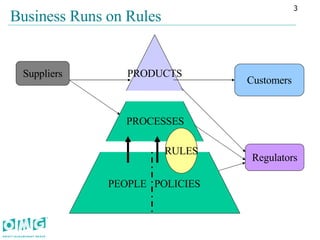
PRODUCTS Business Runs on Rules PROCESSES PEOPLE  POLICIES Suppliers Customers Regulators RULES
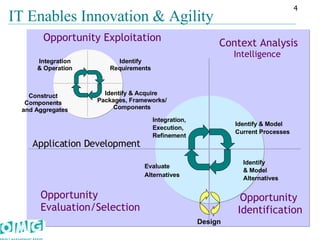
IT Enables Innovation & Agility Integration ,  Execution,  Refinement Identify & Model  Current Processes Identify  & Model  Alternatives  Evaluate  Alternatives Context Analysis Intelligence  Application Development Opportunity  Identification Opportunity Exploitation Design Identify Requirements Identify & Acquire  Packages, Frameworks/ Components Construct  Components  and Aggregates Integration & Operation Opportunity  Evaluation/Selection
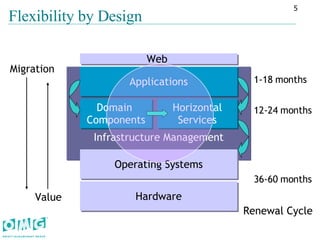
Flexibility by Design Migration Value Infrastructure Management Applications Operating Systems Horizontal Services Domain  Components Hardware Renewal Cycle 1-18 months Web  36-60 months 12-24 months
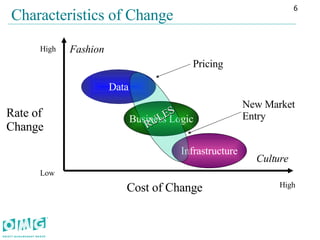
Characteristics of Change Rate of  Change Cost of Change Low High High Data Business Logic Infrastructure RULES Pricing New Market Entry Fashion Culture
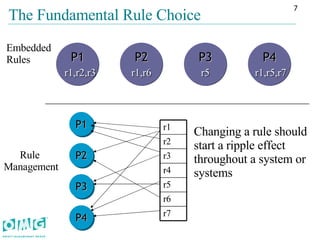
The Fundamental Rule Choice  P1 P2 P3 P4 Embedded Rules Rule  Management P1 P2 P3 P4 r1,r2,r3 Changing a rule should start a ripple effect throughout a system or systems r1,r6 r5 r1,r5,r7 r7 r6 r5 r4 r3 r2 r1
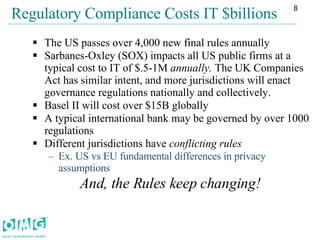
Regulatory Compliance Costs IT $billions  The US passes over 4,000 new final rules annually Sarbanes-Oxley (SOX) impacts all US public firms at a typical cost to IT of $.5-1M  annually.  The   UK Companies Act has similar intent, and more jurisdictions will enact governance regulations nationally and collectively. Basel II will cost over $15B globally A typical international bank may be governed by over 1000 regulations Different jurisdictions have  conflicting rules Ex. US vs EU fundamental differences in privacy assumptions And, the Rules keep changing!
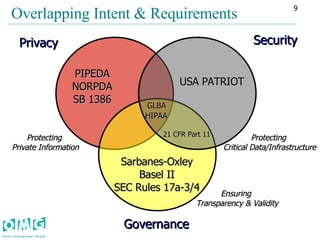
Overlapping Intent & Requirements  Governance Privacy Security Sarbanes-Oxley Basel II SEC Rules 17a-3/4 PIPEDA NORPDA SB 1386 USA PATRIOT HIPAA GLBA 21 CFR Part 11 Protecting  Critical Data/Infrastructure Protecting  Private Information Ensuring  Transparency & Validity
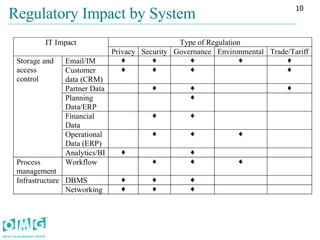
Regulatory Impact by System
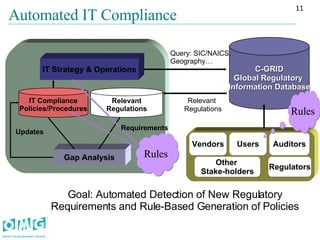
Automated IT Compliance C-GRID Global Regulatory  Information Database Query: SIC/NAICS, Geography… Relevant Regulations Relevant   Regulations IT Compliance Policies/Procedures Gap Analysis Updates Goal: Automated Detection of New Regulatory Requirements and Rule-Based Generation of Policies Other  Stake-holders Vendors Auditors Regulators Users IT Strategy & Operations Rules Requirements Rules
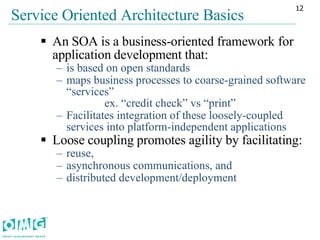
An SOA is a business-oriented framework for application development that: is based on open standards maps business processes to coarse-grained software “services” ex. “credit check” vs “print” Facilitates integration of these loosely-coupled services into platform-independent applications Loose coupling promotes agility by facilitating: reuse,  asynchronous communications, and  distributed development/deployment Service Oriented Architecture Basics
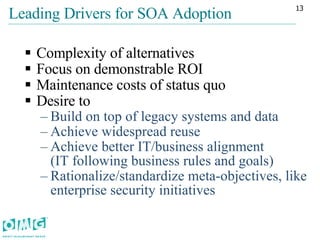
Leading Drivers for SOA Adoption Complexity of alternatives  Focus on demonstrable ROI Maintenance costs of status quo  Desire to  Build on top of legacy systems and data Achieve widespread reuse Achieve better IT/business alignment  (IT following business rules and goals) Rationalize/standardize meta-objectives, like enterprise security initiatives
Inhibitors to SOA Adoption Business Inter-firm collaboration still has cultural hurdles, but that’s where the biggest SOA benefits will be found SMB market tougher than large enterprise, which can benefit more from internal SOA projects (where complexity is a bigger factor) Un-integrated departmental/divisional web services projects may erroneously give SOA a bad reputation Up-front costs tied to business risk, currently an inhibitor to new initiatives Technical  Trade off between specificity and reusability makes it hard to justify initial efforts Wariness of immature standards and products
Architecture SOA as the  de facto  development approach, supported by increased use of modeling and simulation Rules engines as the default approach to capturing, managing and disclosing policies for business agility and compliance Regulations More global concern for security and privacy More stringent enforcement as the state of the practice matures New geo-specific regulations, will gradually converge Focus on data and storage - retention/recovery/provably accurate Improved & integrated dashboard and scorecard products What to Expect for the Rest of the Decade
Summary of Recommendations Applications and Architecture Isolate policy/rule processing to improve visibility and agility Adopt SOA as the underlying approach to component development and communications Compliance Factor requirements to leverage commonalities Find common rules and manage them together Eliminate redundancies in data, processes, and systems Automate Security & Auditing efforts Data, Procedures & Testing
Rules and Regulations Business Drivers for SOA-based Agile IT Presented by Adrian Bowles, Ph.D. Program Director, Regulatory Compliance Object Management Group [email_address] www.omg.org

Webinar Bowles

  • 1.
    Rules and RegulationsBusiness Drivers for SOA-based Agile IT Presented by Adrian Bowles, Ph.D. Program Director, Regulatory Compliance Object Management Group [email_address] www.omg.org
  • 2.
    Agenda Business Driversfor IT Agility The Role for Rules Rules and Regulatory Compliance Rules and SOA Technical Foundations Business Drivers/Inhibitors Recommendations
  • 3.
    PRODUCTS Business Runson Rules PROCESSES PEOPLE POLICIES Suppliers Customers Regulators RULES
  • 4.
    IT Enables Innovation& Agility Integration , Execution, Refinement Identify & Model Current Processes Identify & Model Alternatives Evaluate Alternatives Context Analysis Intelligence Application Development Opportunity Identification Opportunity Exploitation Design Identify Requirements Identify & Acquire Packages, Frameworks/ Components Construct Components and Aggregates Integration & Operation Opportunity Evaluation/Selection
  • 5.
    Flexibility by DesignMigration Value Infrastructure Management Applications Operating Systems Horizontal Services Domain Components Hardware Renewal Cycle 1-18 months Web 36-60 months 12-24 months
  • 6.
    Characteristics of ChangeRate of Change Cost of Change Low High High Data Business Logic Infrastructure RULES Pricing New Market Entry Fashion Culture
  • 7.
    The Fundamental RuleChoice P1 P2 P3 P4 Embedded Rules Rule Management P1 P2 P3 P4 r1,r2,r3 Changing a rule should start a ripple effect throughout a system or systems r1,r6 r5 r1,r5,r7 r7 r6 r5 r4 r3 r2 r1
  • 8.
    Regulatory Compliance CostsIT $billions The US passes over 4,000 new final rules annually Sarbanes-Oxley (SOX) impacts all US public firms at a typical cost to IT of $.5-1M annually. The UK Companies Act has similar intent, and more jurisdictions will enact governance regulations nationally and collectively. Basel II will cost over $15B globally A typical international bank may be governed by over 1000 regulations Different jurisdictions have conflicting rules Ex. US vs EU fundamental differences in privacy assumptions And, the Rules keep changing!
  • 9.
    Overlapping Intent &Requirements Governance Privacy Security Sarbanes-Oxley Basel II SEC Rules 17a-3/4 PIPEDA NORPDA SB 1386 USA PATRIOT HIPAA GLBA 21 CFR Part 11 Protecting Critical Data/Infrastructure Protecting Private Information Ensuring Transparency & Validity
  • 10.
  • 11.
    Automated IT ComplianceC-GRID Global Regulatory Information Database Query: SIC/NAICS, Geography… Relevant Regulations Relevant Regulations IT Compliance Policies/Procedures Gap Analysis Updates Goal: Automated Detection of New Regulatory Requirements and Rule-Based Generation of Policies Other Stake-holders Vendors Auditors Regulators Users IT Strategy & Operations Rules Requirements Rules
  • 12.
    An SOA isa business-oriented framework for application development that: is based on open standards maps business processes to coarse-grained software “services” ex. “credit check” vs “print” Facilitates integration of these loosely-coupled services into platform-independent applications Loose coupling promotes agility by facilitating: reuse, asynchronous communications, and distributed development/deployment Service Oriented Architecture Basics
  • 13.
    Leading Drivers forSOA Adoption Complexity of alternatives Focus on demonstrable ROI Maintenance costs of status quo Desire to Build on top of legacy systems and data Achieve widespread reuse Achieve better IT/business alignment (IT following business rules and goals) Rationalize/standardize meta-objectives, like enterprise security initiatives
  • 14.
    Inhibitors to SOAAdoption Business Inter-firm collaboration still has cultural hurdles, but that’s where the biggest SOA benefits will be found SMB market tougher than large enterprise, which can benefit more from internal SOA projects (where complexity is a bigger factor) Un-integrated departmental/divisional web services projects may erroneously give SOA a bad reputation Up-front costs tied to business risk, currently an inhibitor to new initiatives Technical Trade off between specificity and reusability makes it hard to justify initial efforts Wariness of immature standards and products
  • 15.
    Architecture SOA asthe de facto development approach, supported by increased use of modeling and simulation Rules engines as the default approach to capturing, managing and disclosing policies for business agility and compliance Regulations More global concern for security and privacy More stringent enforcement as the state of the practice matures New geo-specific regulations, will gradually converge Focus on data and storage - retention/recovery/provably accurate Improved & integrated dashboard and scorecard products What to Expect for the Rest of the Decade
  • 16.
    Summary of RecommendationsApplications and Architecture Isolate policy/rule processing to improve visibility and agility Adopt SOA as the underlying approach to component development and communications Compliance Factor requirements to leverage commonalities Find common rules and manage them together Eliminate redundancies in data, processes, and systems Automate Security & Auditing efforts Data, Procedures & Testing
  • 17.
    Rules and RegulationsBusiness Drivers for SOA-based Agile IT Presented by Adrian Bowles, Ph.D. Program Director, Regulatory Compliance Object Management Group [email_address] www.omg.org