Re-energising Governing of
Colleges and Training Providers
Module 2: Reporting, Decision Making &
Accountability
Introduction
After completing this module you will be able to:
•Review the style and quality of reporting to the
Governing Body, including reference to maths and
English.
•Test for two significant weaknesses in reporting to
the Governing Body.
•Consider how decisions are taken and recorded by
the Governing Body.
•Review basic accountability arrangements.
Effective Reporting
Informed decision making by Governors relies on effective reporting by senior
staff. But how do we define 'effective reporting?'
Which of the following characteristics would you use to judge reporting to the
Board:
•Timely
•Jargon free
•Abbreviations explained
•Clear report focus
•Brevity
•Use of relevant trend data, and use of relevant benchmarking data in relation to approved
college targets
•Financial implications
•Equality and diversity implications
•Learner implications
•Link to strategic plan and strategic risk implications
•Clear recommendation
Are there any more qualities of reporting that you would value?
Reflective Question
A standard report format could be useful for
Governors and senior staff for consistency, clarity,
brevity and focus.
What headings would you like to see in a
model report format?
 Add your answers to the Padlet
Suggested headings for a standard
report template
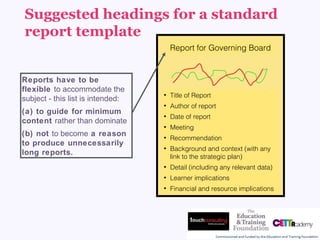
Report for Governing Board
• Title of Report
• Author of report
• Date of report
• Meeting
• Recommendation
• Background and context (with any
link to the strategic plan)
• Detail (including any relevant data)
• Learner implications
• Financial and resource implications 
Reports have to be
flexible to accommodate the
subject - this list is intended:
(a) to guide for minimum
content rather than dominate
(b) not to become a reason
to produce unnecessarily
long reports.
Maths & English Considerations
Government expectations for 16-18 year olds on
full time programmes (maths and English qualifications a
condition of funding for many students, on study programs
over 150 hours and without ‘good’ GCSE pass)
Government expectations for 16-18 year olds on
part time programmes (maths and English should
be included in part time courses to facilitate
learning)
Ofsted expectations (leaders and managers can
“sustain provision of very high quality, including in
English and Mathematics.” OfSTED 2016)
Aspects of Reporting
Discussion questions:
1.Are you familiar with the expression
‘data dumping’? What do you think it
means in relation to reporting?
2.What should replace ‘data dumping’?
3.Do you receive large amounts of paper
for meetings, particularly Board
meetings?
4.If the amount of paperwork is a
problem for you, why do you think you
have so much?
‘Data dumping’
• 'Data dumping' - data is added to a report with
little/ any reference to its usefulness, significance or
implications. 
• Agenda items can be just tables of data e.g.
learner success data or learner retention data or
building project monthly cash flow. 
• This is high risk governing as there is no
explanation, analysis, or management
interpretation for Governors to be guided by.
What Should Replace ‘Data
dumping’?
• Governors should be able to judge a report by
the professional analysis of data - why is the
data of importance and what actions or interventions
will derive from the data?
• Are aspects of the data of concern? If so,
why? If not, why is it being presented?
• Governors gain their confidence from the
quality of the interpretation of relevant data,
rather than from the data alone. 
Too much paperwork?
• When large amounts of paper are provided for
meetings, very few Governors have the time or
inclination to read all the paperwork
• They attend meetings without fully being aware of
the content of their papers.
• This is high risk governing as Governors will be
contributing without being informed by supporting written
material.
• The aim is to produce high quality, low density
paperwork for meetings of the Board. 
Why is there so much to read?
1. The auditors expect certain paperwork to seen by all Governors.
2. Some senior staff believe that certain paperwork is essential for all Governors.
3. All senior staff believe that certain paperwork is essential for all Governors.
4. The Clerk insists that certain paperwork is essential for all Governors.
5. The Chief Executive / Principal insists that certain paperwork is essential for all
Governors.
6. The Chair wants certain paperwork to be circulated to all Governors.
7. Certain Governors want full paperwork to be provided to all Governors.
8. One Governor wants full paperwork to be provided to all Governors.
9. The Funding agencies expect certain paperwork to be seen by all Governors.
10. Ofsted will expect full files of evidence of the Board's consideration of relevant 
items of business.
First consider where the source(s) of influence is regarding the amount
of paperwork for meetings. Now you need to test the validity of the
case.
Suggested Activity
Gain the Board's support for a review of paperwork.
Ask the Principal, Clerk and one Governor e.g. the
Chair of the Quality and
Standards Committee to undertake a review of 
the relevant paperwork with the intention to achieve
high quality, low density paperwork.
Informed Decision Making
How do you take decisions at meetings of the Board? Do
you actually know when you take a decision? How do
you know?
This is not a plea for voting on every item on 
the agenda; it is an encouragement to: 
•request clear recommendations in reports
and from any presentations to the Board; and
•make sure you agree the form of words
which will establish the decision, particularly if
it varies from the formal recommendation. 
Your Clerk will be skilled in preparing the
record of the meeting in draft minutes for the
Chair. 
Suggested Activity
The next time you receive Board minutes, list their
qualities, remembering that the minutes should be a
record of decisions taken and succinct detail
of the context which informed each decision.
Reflective Questions
1. Can you easily see the decisions of the Board in the way
the minutes are formatted?
2. Is the context which contributed to the decision of the
Board succinctly expressed for reference?
3. Do you closely read each set of approved draft minutes
prior to meetings to be confident to offer your approval
regarding accuracy and intention?
4. Are there ways in which the formatting of minutes could
help you see the record of transacted business more
clearly?
5. Can you suggest any improvements to the Board or
committee minutes you currently receive?
Accountability
Accountability is about seeking to achieve genuine and open
communication*. 
The nature of the communication includes:
•celebrating successes
•sharing proposals for changes
•joining to work with others to solve problems
•demonstrating a willingness to learn from mistakes
The starting point for accountability is the building of trust
and confidence through achieving compliance with the
legal and regulatory framework.
*Good Governance: A code for the voluntary and community sector (Second
edition 2010)
How will you know how compliant your organisation is with its primary
obligations, including that of providing maths and English to 16-18 year
olds as a condition of funding?
You might get:
•Statements from the Chief Executive, Director of Finance, Clerk to the
Corporation
•Reviews - internal college (incl. self assessment, annual H&S reports,
annual E&D reports), internal thematic reviews
•Reports - external verification of programmes, external review, e.g. by
auditors, consultants, OfSTED, finding agencies, preparation for the
financial statements
•Voices - students, staff, employers
•Policies & procedures - nominated governors, e.g. Safeguarding,
Equality, use of Whistleblowing Procedure, use of college solicitors in
employment litigation, reporting to the H&S Executive
Reflective Question
Complaints procedure
• A key procedure for Governor interest is the Complaints Procedure. 
• You should know that there is a Complaints Procedure as part of the
Quality Improvement Policy.
• You should, e.g. every six months, receive composite reports
summarising the nature of complaints and any management action to
address key issues.  
• The Audit and Risk Committee could test the Complaints Procedure
for its efficiency and impact. 
• Accountability can also include responsibilities to the wider
community through e.g. social cohesion, environmental impact, travel
and transport, health and well-being, economic success, democratic
and participation practices.
Reflective Questions
1. How do you think this wider accountability
is working now?
2. Consider what priorities might be (and
why) for the coming period?
3. Is there any connectivity between the
provision of maths and English and, e.g.
local secondary schools, employers, other
learning providers, relevant organisations
and agencies?
Suggested Activity
Acquire a copy of the Complaints Procedure (from
the Clerk to the Corporation) and consider how the
procedure would operate for a range of
concerns, e.g from: students, parents, employers,
residents living near the college / provider,
councillors and secondary schools.
Additional Activity and
Resources
• Maths and English policy background (video)
• Seven questions for Governors (+ video)
• Further guidance (GCSE Leadership & Governance
resource)
• Consolidation (Online Module 2)

Webcam mod2 18.01.17

  • 1.
    Re-energising Governing of Collegesand Training Providers Module 2: Reporting, Decision Making & Accountability
  • 2.
    Introduction After completing thismodule you will be able to: •Review the style and quality of reporting to the Governing Body, including reference to maths and English. •Test for two significant weaknesses in reporting to the Governing Body. •Consider how decisions are taken and recorded by the Governing Body. •Review basic accountability arrangements.
  • 3.
    Effective Reporting Informed decisionmaking by Governors relies on effective reporting by senior staff. But how do we define 'effective reporting?' Which of the following characteristics would you use to judge reporting to the Board: •Timely •Jargon free •Abbreviations explained •Clear report focus •Brevity •Use of relevant trend data, and use of relevant benchmarking data in relation to approved college targets •Financial implications •Equality and diversity implications •Learner implications •Link to strategic plan and strategic risk implications •Clear recommendation Are there any more qualities of reporting that you would value?
  • 4.
    Reflective Question A standardreport format could be useful for Governors and senior staff for consistency, clarity, brevity and focus. What headings would you like to see in a model report format?  Add your answers to the Padlet
  • 5.
    Suggested headings fora standard report template Report for Governing Board • Title of Report • Author of report • Date of report • Meeting • Recommendation • Background and context (with any link to the strategic plan) • Detail (including any relevant data) • Learner implications • Financial and resource implications  Reports have to be flexible to accommodate the subject - this list is intended: (a) to guide for minimum content rather than dominate (b) not to become a reason to produce unnecessarily long reports.
  • 6.
    Maths & EnglishConsiderations Government expectations for 16-18 year olds on full time programmes (maths and English qualifications a condition of funding for many students, on study programs over 150 hours and without ‘good’ GCSE pass) Government expectations for 16-18 year olds on part time programmes (maths and English should be included in part time courses to facilitate learning) Ofsted expectations (leaders and managers can “sustain provision of very high quality, including in English and Mathematics.” OfSTED 2016)
  • 7.
    Aspects of Reporting Discussionquestions: 1.Are you familiar with the expression ‘data dumping’? What do you think it means in relation to reporting? 2.What should replace ‘data dumping’? 3.Do you receive large amounts of paper for meetings, particularly Board meetings? 4.If the amount of paperwork is a problem for you, why do you think you have so much?
  • 8.
    ‘Data dumping’ • 'Datadumping' - data is added to a report with little/ any reference to its usefulness, significance or implications.  • Agenda items can be just tables of data e.g. learner success data or learner retention data or building project monthly cash flow.  • This is high risk governing as there is no explanation, analysis, or management interpretation for Governors to be guided by.
  • 9.
    What Should Replace‘Data dumping’? • Governors should be able to judge a report by the professional analysis of data - why is the data of importance and what actions or interventions will derive from the data? • Are aspects of the data of concern? If so, why? If not, why is it being presented? • Governors gain their confidence from the quality of the interpretation of relevant data, rather than from the data alone. 
  • 10.
    Too much paperwork? •When large amounts of paper are provided for meetings, very few Governors have the time or inclination to read all the paperwork • They attend meetings without fully being aware of the content of their papers. • This is high risk governing as Governors will be contributing without being informed by supporting written material. • The aim is to produce high quality, low density paperwork for meetings of the Board. 
  • 11.
    Why is thereso much to read? 1. The auditors expect certain paperwork to seen by all Governors. 2. Some senior staff believe that certain paperwork is essential for all Governors. 3. All senior staff believe that certain paperwork is essential for all Governors. 4. The Clerk insists that certain paperwork is essential for all Governors. 5. The Chief Executive / Principal insists that certain paperwork is essential for all Governors. 6. The Chair wants certain paperwork to be circulated to all Governors. 7. Certain Governors want full paperwork to be provided to all Governors. 8. One Governor wants full paperwork to be provided to all Governors. 9. The Funding agencies expect certain paperwork to be seen by all Governors. 10. Ofsted will expect full files of evidence of the Board's consideration of relevant  items of business. First consider where the source(s) of influence is regarding the amount of paperwork for meetings. Now you need to test the validity of the case.
  • 12.
    Suggested Activity Gain theBoard's support for a review of paperwork. Ask the Principal, Clerk and one Governor e.g. the Chair of the Quality and Standards Committee to undertake a review of  the relevant paperwork with the intention to achieve high quality, low density paperwork.
  • 13.
    Informed Decision Making Howdo you take decisions at meetings of the Board? Do you actually know when you take a decision? How do you know? This is not a plea for voting on every item on  the agenda; it is an encouragement to:  •request clear recommendations in reports and from any presentations to the Board; and •make sure you agree the form of words which will establish the decision, particularly if it varies from the formal recommendation.  Your Clerk will be skilled in preparing the record of the meeting in draft minutes for the Chair. 
  • 14.
    Suggested Activity The nexttime you receive Board minutes, list their qualities, remembering that the minutes should be a record of decisions taken and succinct detail of the context which informed each decision.
  • 15.
    Reflective Questions 1. Canyou easily see the decisions of the Board in the way the minutes are formatted? 2. Is the context which contributed to the decision of the Board succinctly expressed for reference? 3. Do you closely read each set of approved draft minutes prior to meetings to be confident to offer your approval regarding accuracy and intention? 4. Are there ways in which the formatting of minutes could help you see the record of transacted business more clearly? 5. Can you suggest any improvements to the Board or committee minutes you currently receive?
  • 16.
    Accountability Accountability is aboutseeking to achieve genuine and open communication*.  The nature of the communication includes: •celebrating successes •sharing proposals for changes •joining to work with others to solve problems •demonstrating a willingness to learn from mistakes The starting point for accountability is the building of trust and confidence through achieving compliance with the legal and regulatory framework. *Good Governance: A code for the voluntary and community sector (Second edition 2010)
  • 17.
    How will youknow how compliant your organisation is with its primary obligations, including that of providing maths and English to 16-18 year olds as a condition of funding? You might get: •Statements from the Chief Executive, Director of Finance, Clerk to the Corporation •Reviews - internal college (incl. self assessment, annual H&S reports, annual E&D reports), internal thematic reviews •Reports - external verification of programmes, external review, e.g. by auditors, consultants, OfSTED, finding agencies, preparation for the financial statements •Voices - students, staff, employers •Policies & procedures - nominated governors, e.g. Safeguarding, Equality, use of Whistleblowing Procedure, use of college solicitors in employment litigation, reporting to the H&S Executive Reflective Question
  • 18.
    Complaints procedure • Akey procedure for Governor interest is the Complaints Procedure.  • You should know that there is a Complaints Procedure as part of the Quality Improvement Policy. • You should, e.g. every six months, receive composite reports summarising the nature of complaints and any management action to address key issues.   • The Audit and Risk Committee could test the Complaints Procedure for its efficiency and impact.  • Accountability can also include responsibilities to the wider community through e.g. social cohesion, environmental impact, travel and transport, health and well-being, economic success, democratic and participation practices.
  • 19.
    Reflective Questions 1. Howdo you think this wider accountability is working now? 2. Consider what priorities might be (and why) for the coming period? 3. Is there any connectivity between the provision of maths and English and, e.g. local secondary schools, employers, other learning providers, relevant organisations and agencies?
  • 20.
    Suggested Activity Acquire acopy of the Complaints Procedure (from the Clerk to the Corporation) and consider how the procedure would operate for a range of concerns, e.g from: students, parents, employers, residents living near the college / provider, councillors and secondary schools.
  • 21.
    Additional Activity and Resources •Maths and English policy background (video) • Seven questions for Governors (+ video) • Further guidance (GCSE Leadership & Governance resource) • Consolidation (Online Module 2)