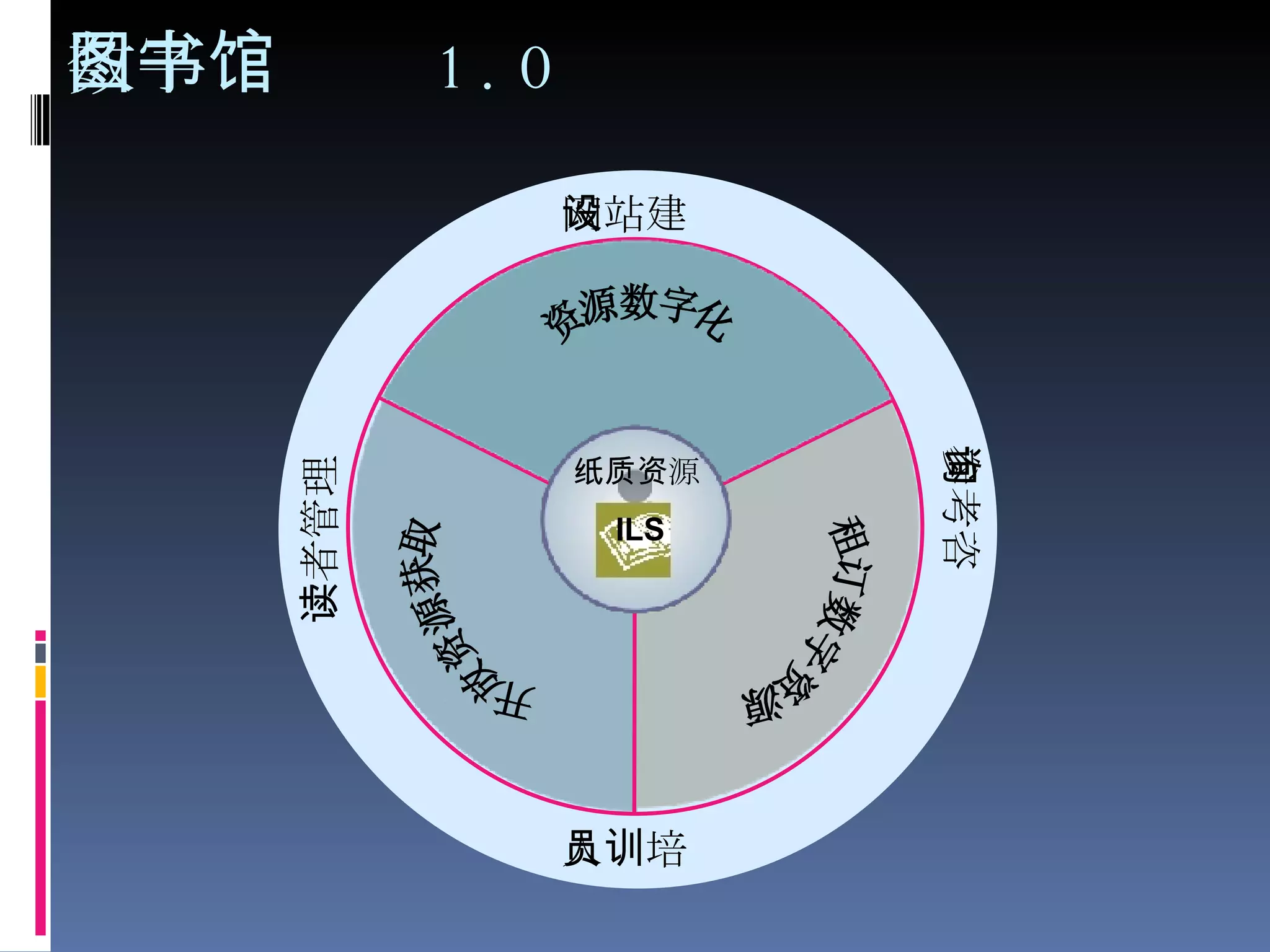
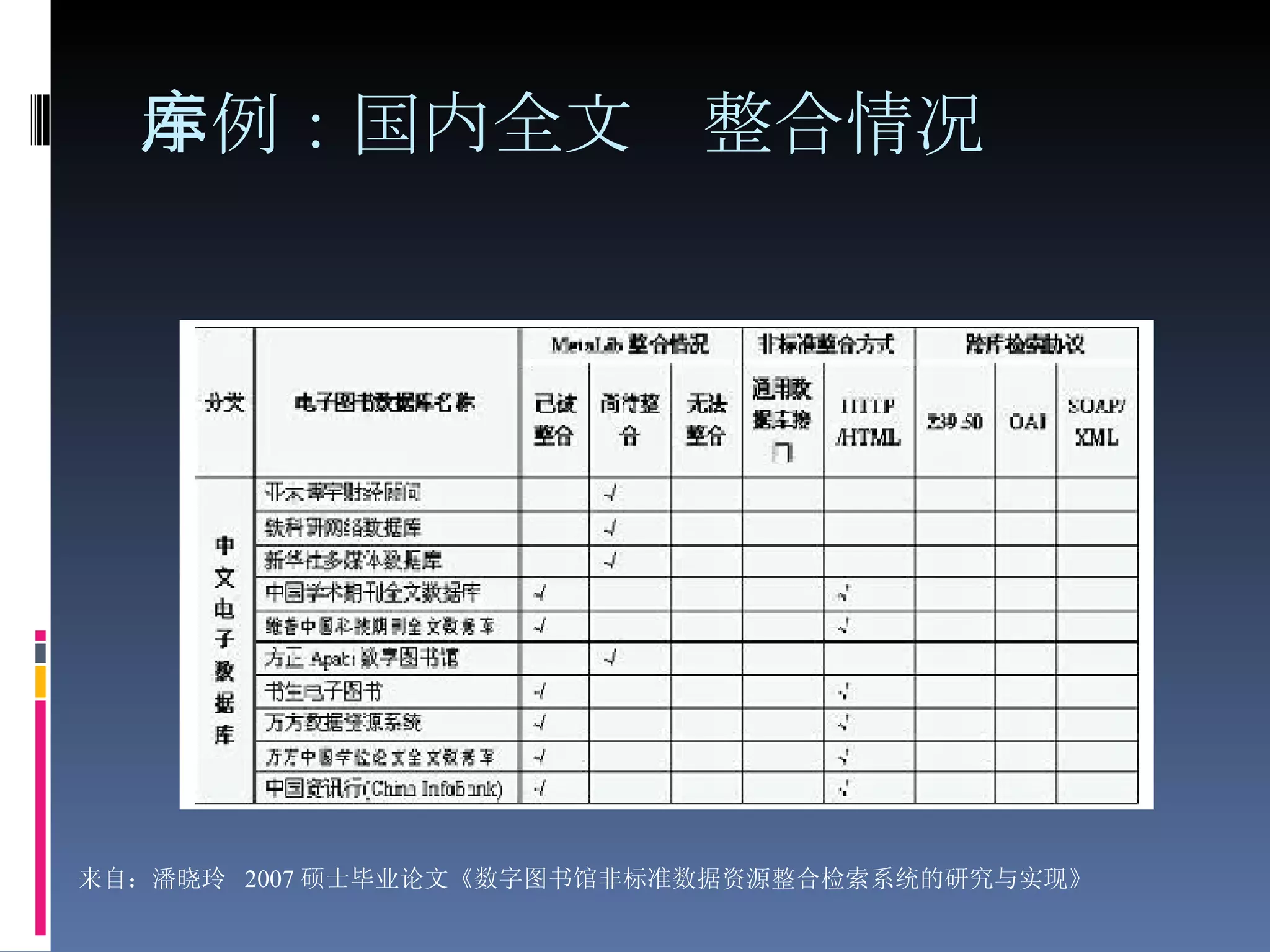
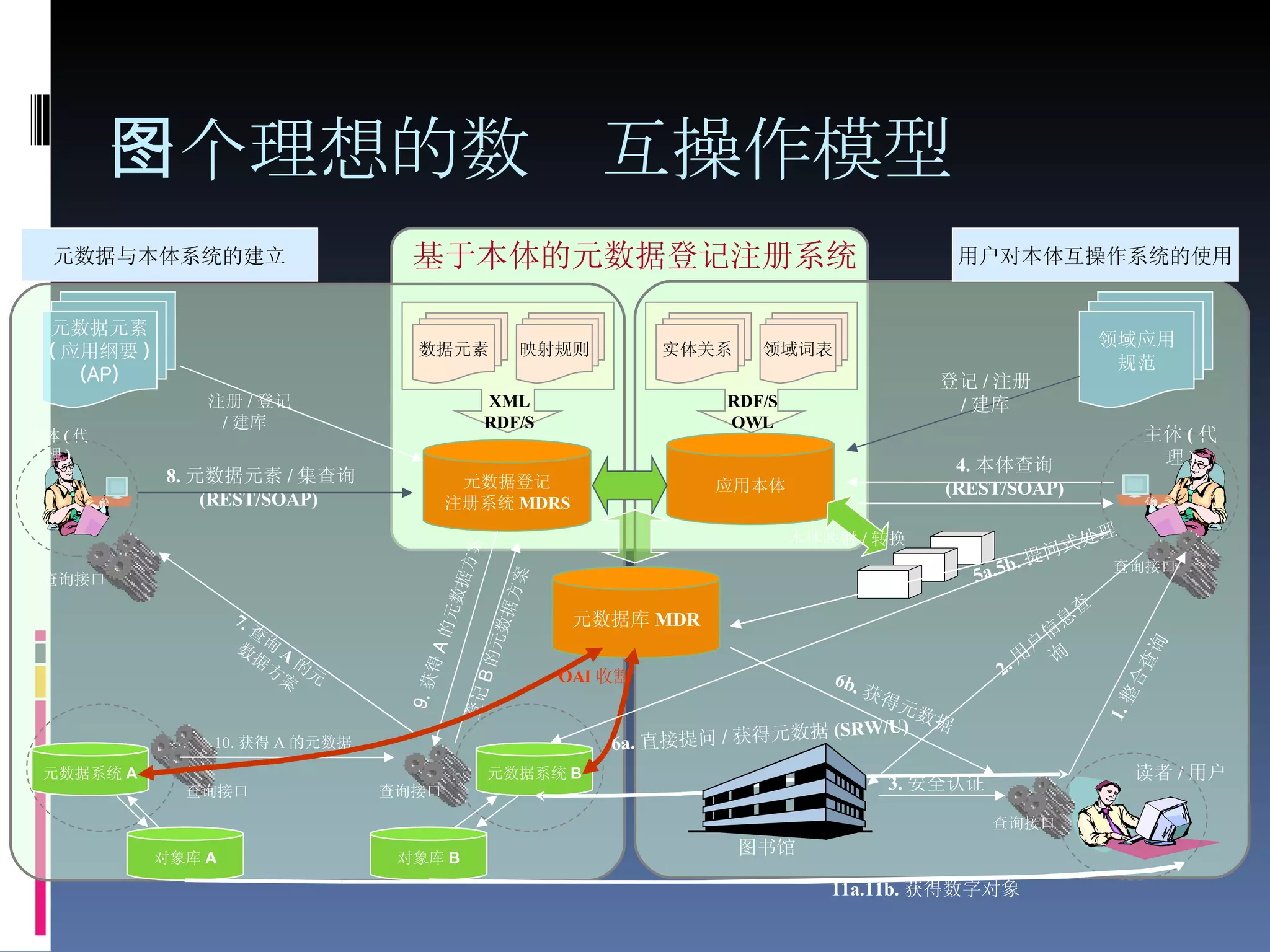
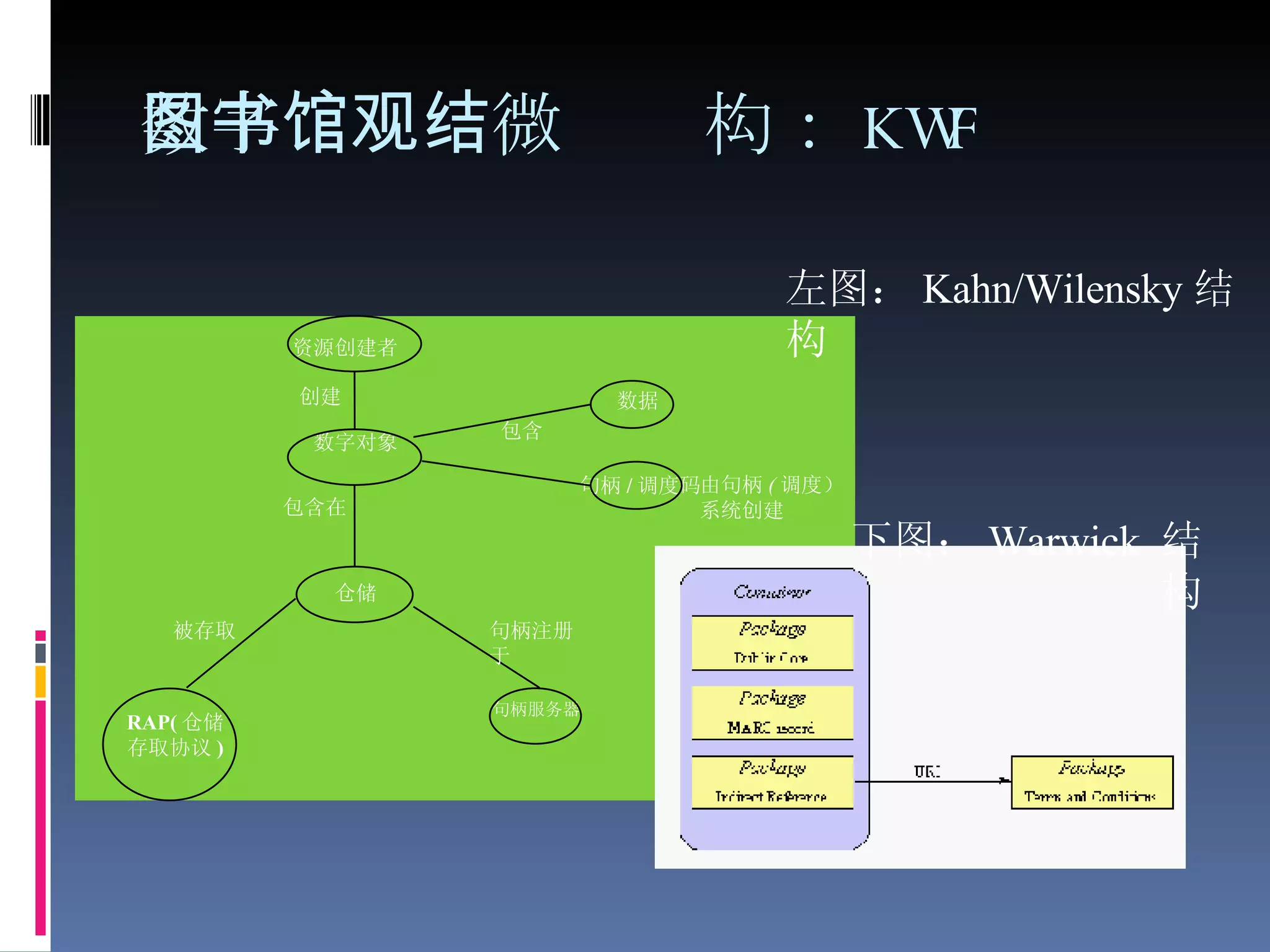
为什么要资源整合? 参照美国肯特州立大学的曾蕾教授摘译自 LorcanDempsey “ Terms and conditions ... libraries, subject terminologies and the web 2004 ” 改编。原文 http://www.oclc.org/research/presentations/dempsey/dewey_20040316.ppt
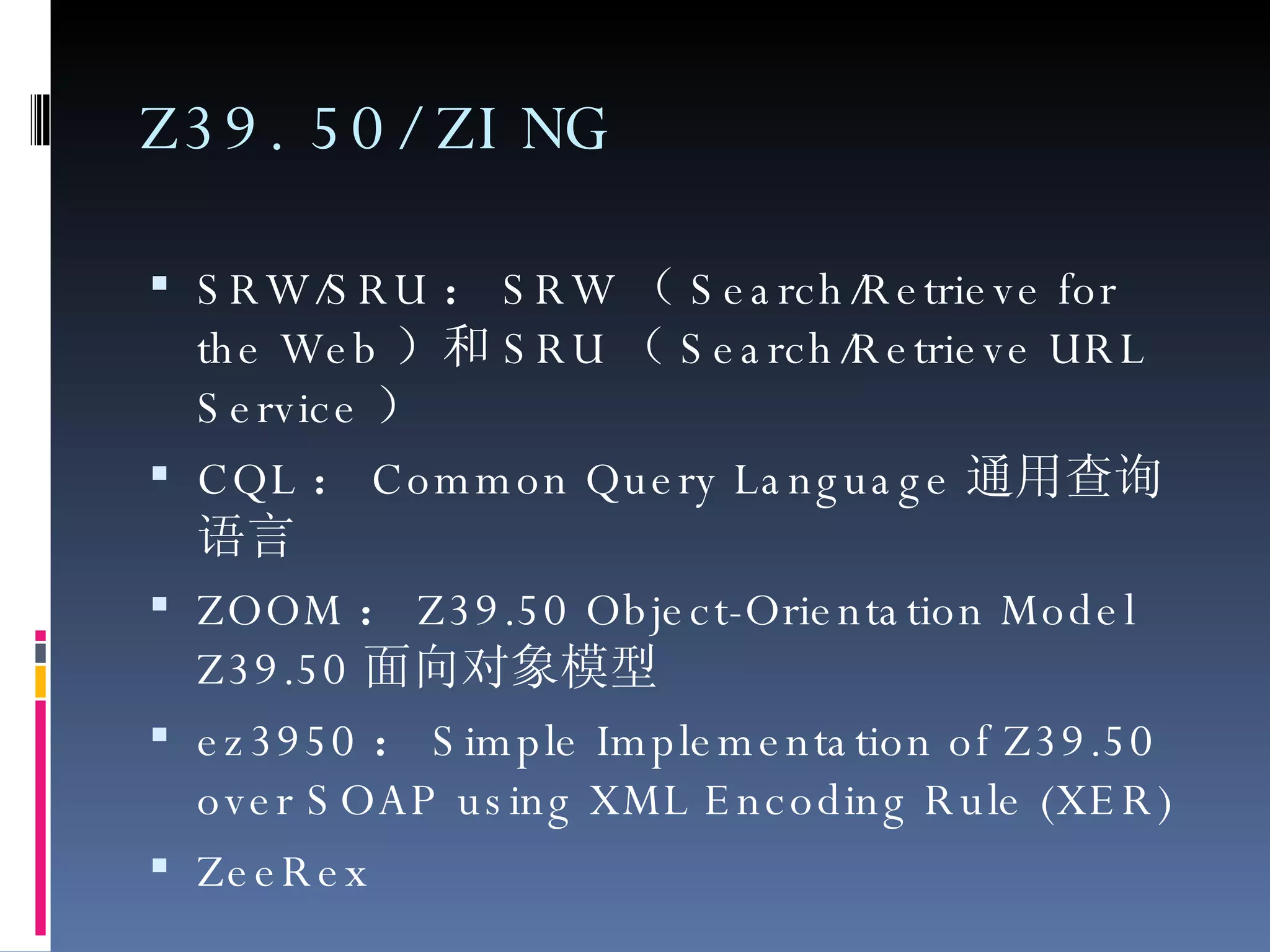
Z39.50/ZING SRW/SRU :SRW ( Search/Retrieve for the Web )和 SRU ( Search/Retrieve URL Service ) CQL : Common Query Language 通用查询语言 ZOOM : Z39.50 Object-Orientation Model Z39.50 面向对象模型 ez3950 : Simple Implementation of Z39.50 over SOAP using XML Encoding Rule (XER) ZeeRex
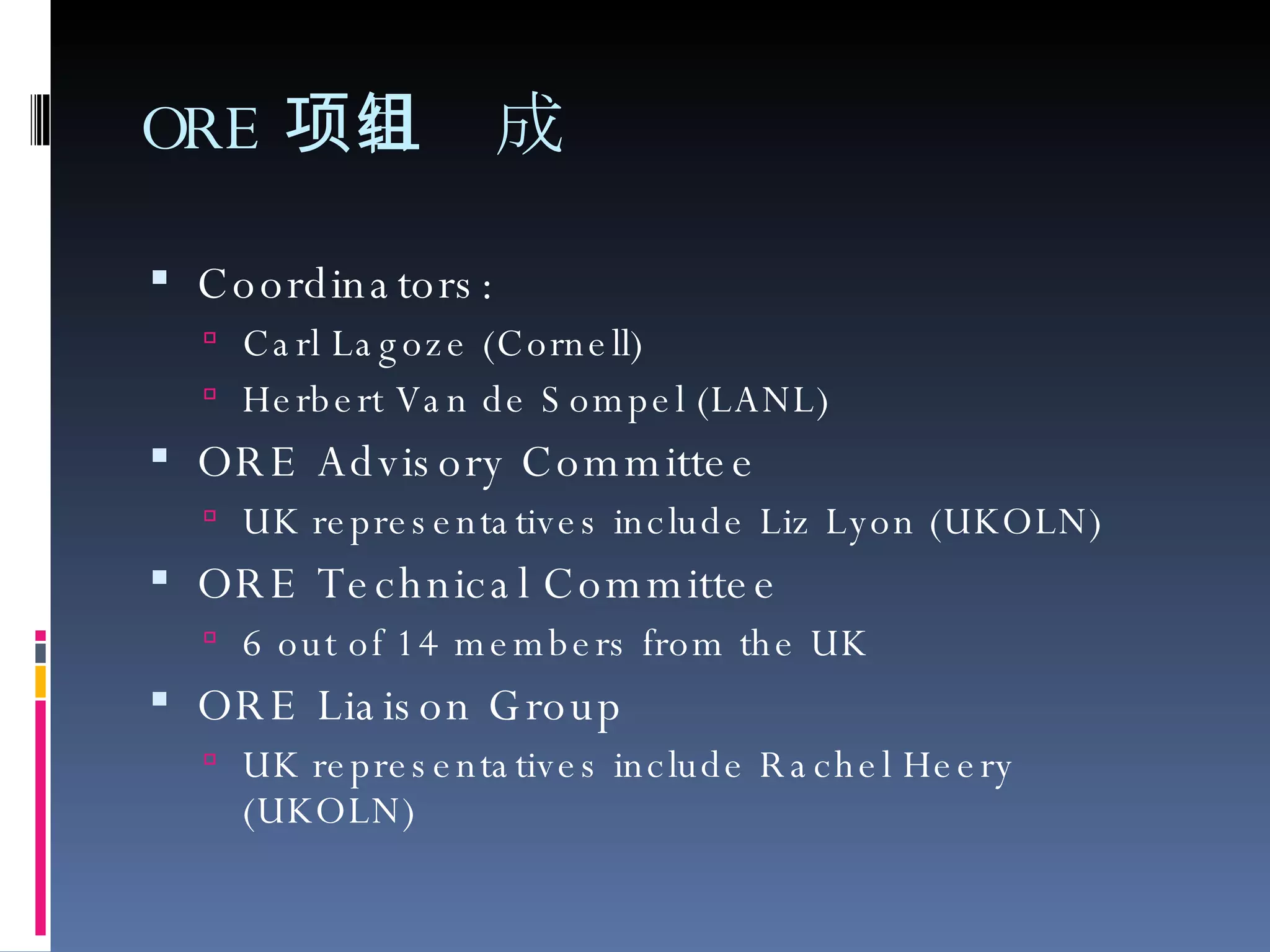
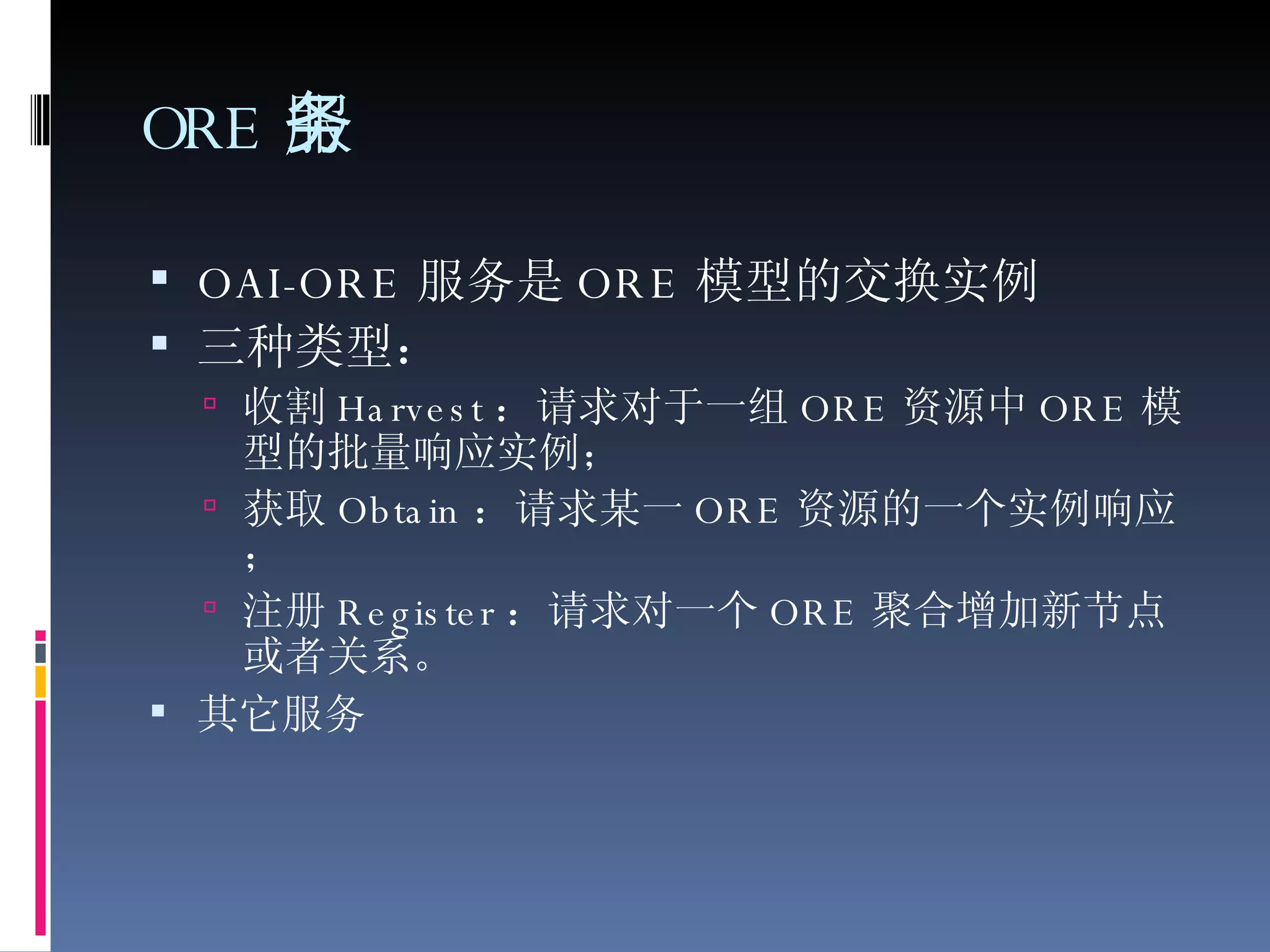
ORE 项目组成 Coordinators: Carl Lagoze (Cornell) Herbert Van de Sompel (LANL) ORE Advisory Committee UK representatives include Liz Lyon (UKOLN) ORE Technical Committee 6 out of 14 members from the UK ORE Liaison Group UK representatives include Rachel Heery (UKOLN)
17.
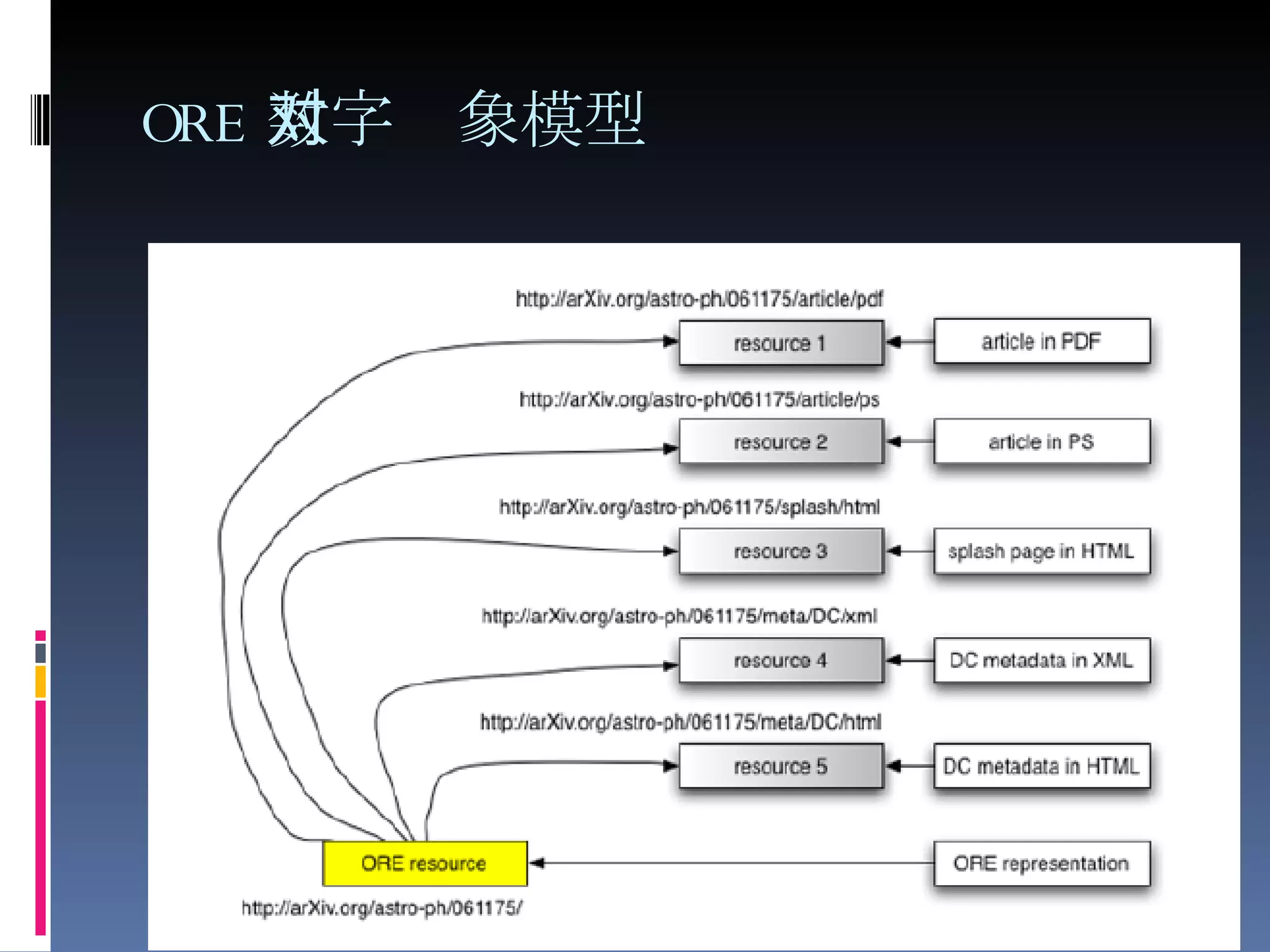
ORE 目标 开发一种标准和协议,使得复合数字对象能够跨越它们所属的资源库、代理或服务进行互操作。Develop, identify, and profile extensible standards and protocols to allow repositories, agents, and services to interoperate in the context of use and reuse of compound digital objects beyond the boundaries of the holding repositories.
18.
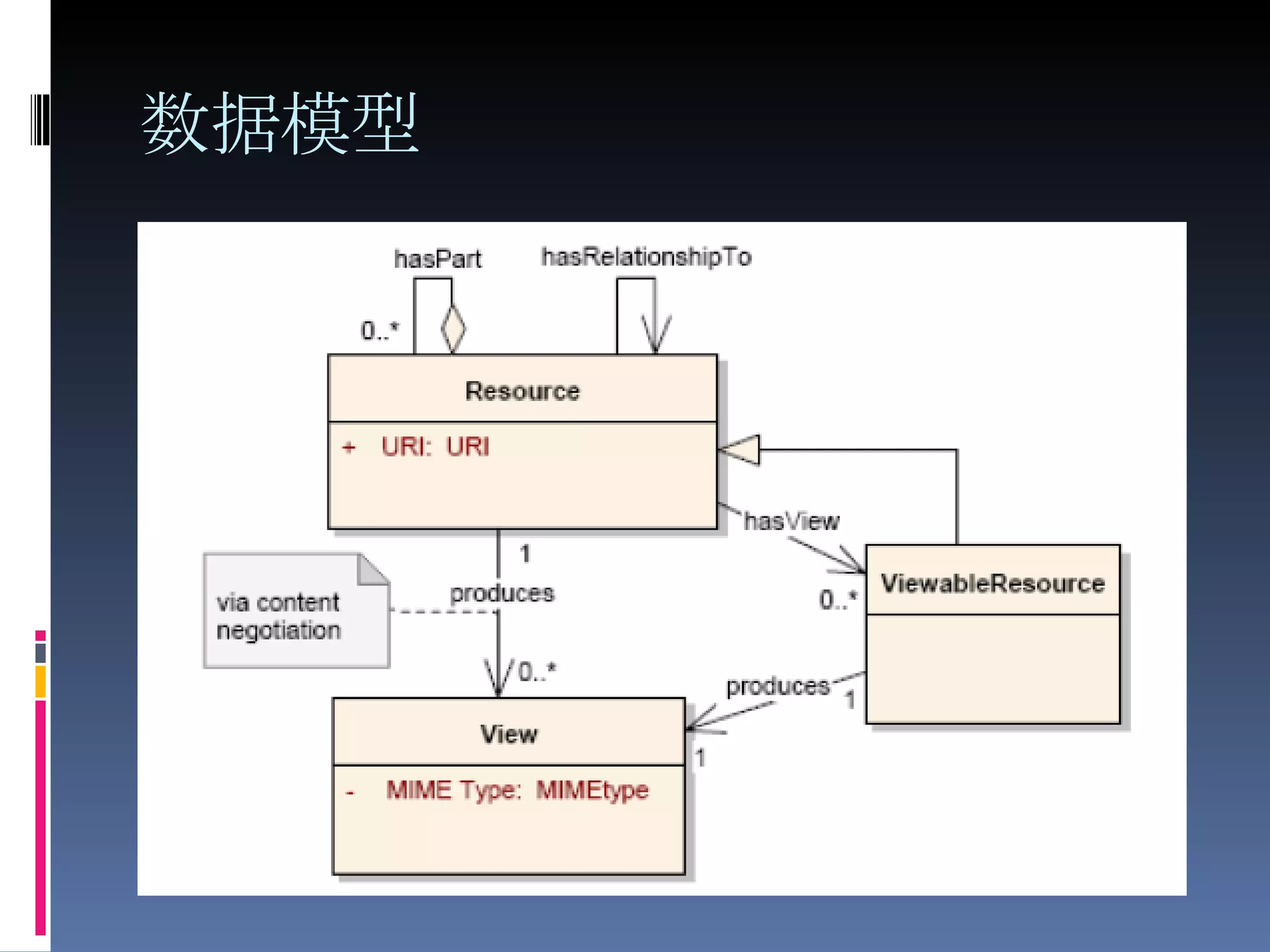
主要概念 复合数字对象 Compounddigital objects 具有一定联系的资源的聚集 (bounded aggregations of resources and their relationships ) 复合数字对象包括 : 视图( Views ) ( 即“表现 ( presentations) ” ) 组件( Components ) 上述复合数字对象、视图及组件都必须明确地标识或参照 ( unambiguously identified and referenced) ,即它们都是“资源”。
如何被 ORE 表示ORE resource “ the first-class identifiable object ” acts as the access point for service requests upon the aggregation formally expresses the boundaries of the aggregation ORE aggregation has a defined boundary, as expressed by the ORE resource and may have relationships to resources external to the aggregation the ORE aggregation is described by the ORE representation a formal description of the members of the ORE aggregation that makes up the ORE resource “ second-class objects ” identifiable only via the ORE resource that they represent
What We DoOnline 0% 10% 20% 30% 40% 50% 60% 70% 80% 90% 100% 93% Browsing 85% 77% 56% 51% Interacting 58% 45% 40% 21% 20% 15% 10% Total General Public Creating 28% 28% 20% 20% 17% 6% From: Lorcan Dempsey ’ s presentation e-mail Search Browse/ purchase items Browsed / purchase books IM Online banking Read a blog Online question service Used chat rooms Search/borrow from library site Read e-books Dating site Social networking Social media Created Web page/site Contributed other's site Blogged or online diary/journal Business-related social networking
33.
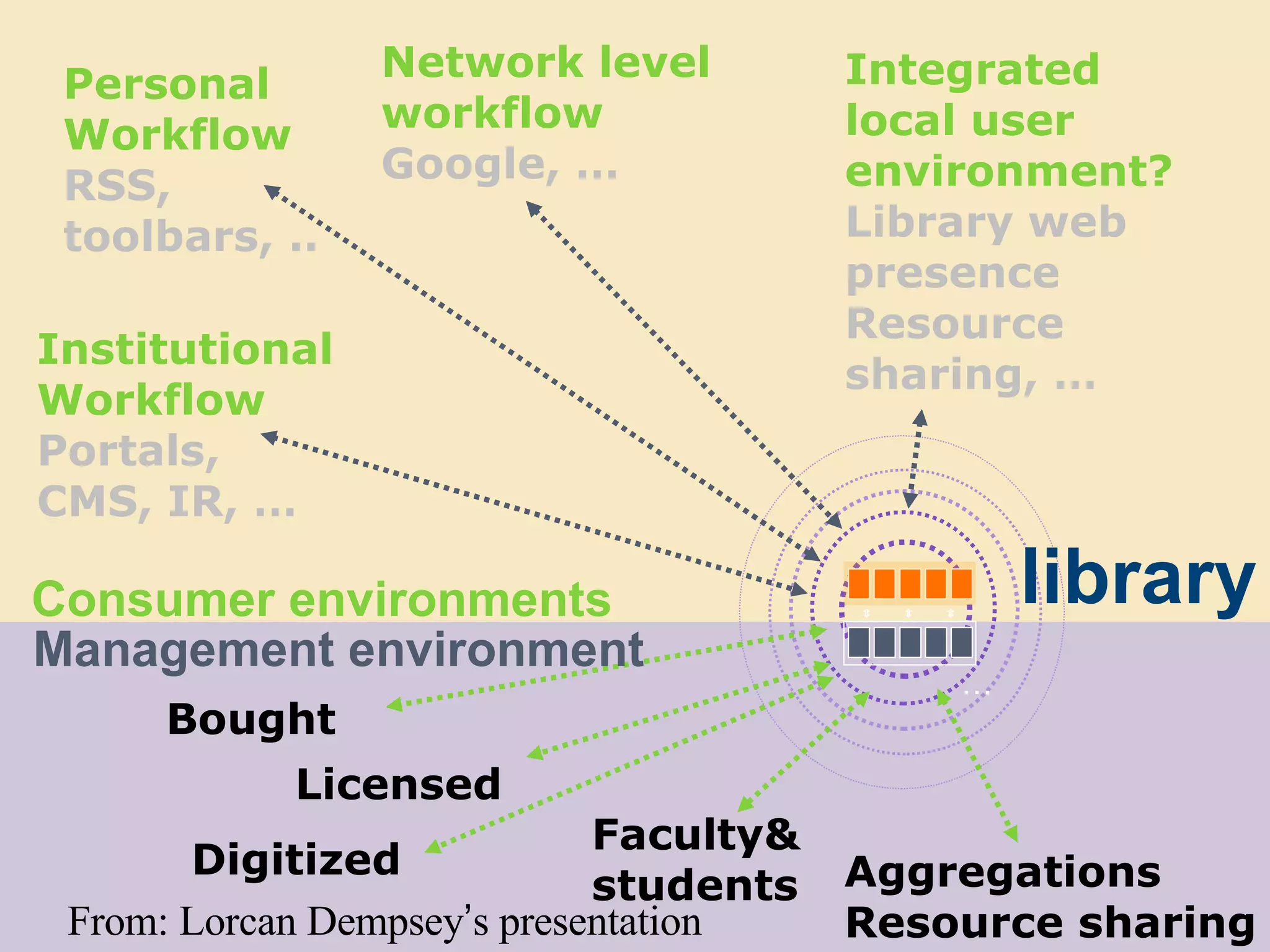
library Consumer environmentsManagement environment Licensed Bought Faculty& students Digitized Aggregations Resource sharing Integrated local user environment? Library web presence Resource sharing, … From: Lorcan Dempsey ’ s presentation … Institutional Workflow Portals, CMS, IR, … Personal Workflow RSS, toolbars, .. Network level workflow Google, …
Web 2.0 主要“原则”Web 作为平台 获得集体智慧 Collective Intelligence 以数据为核心 Data is the next “Intel Inside” 永远的测试版(由于定位于服务而非软件) 轻型商务模式 Lightweight business models 软件独立于设备 Software above the level of a single device 丰富的用户体验 RUE
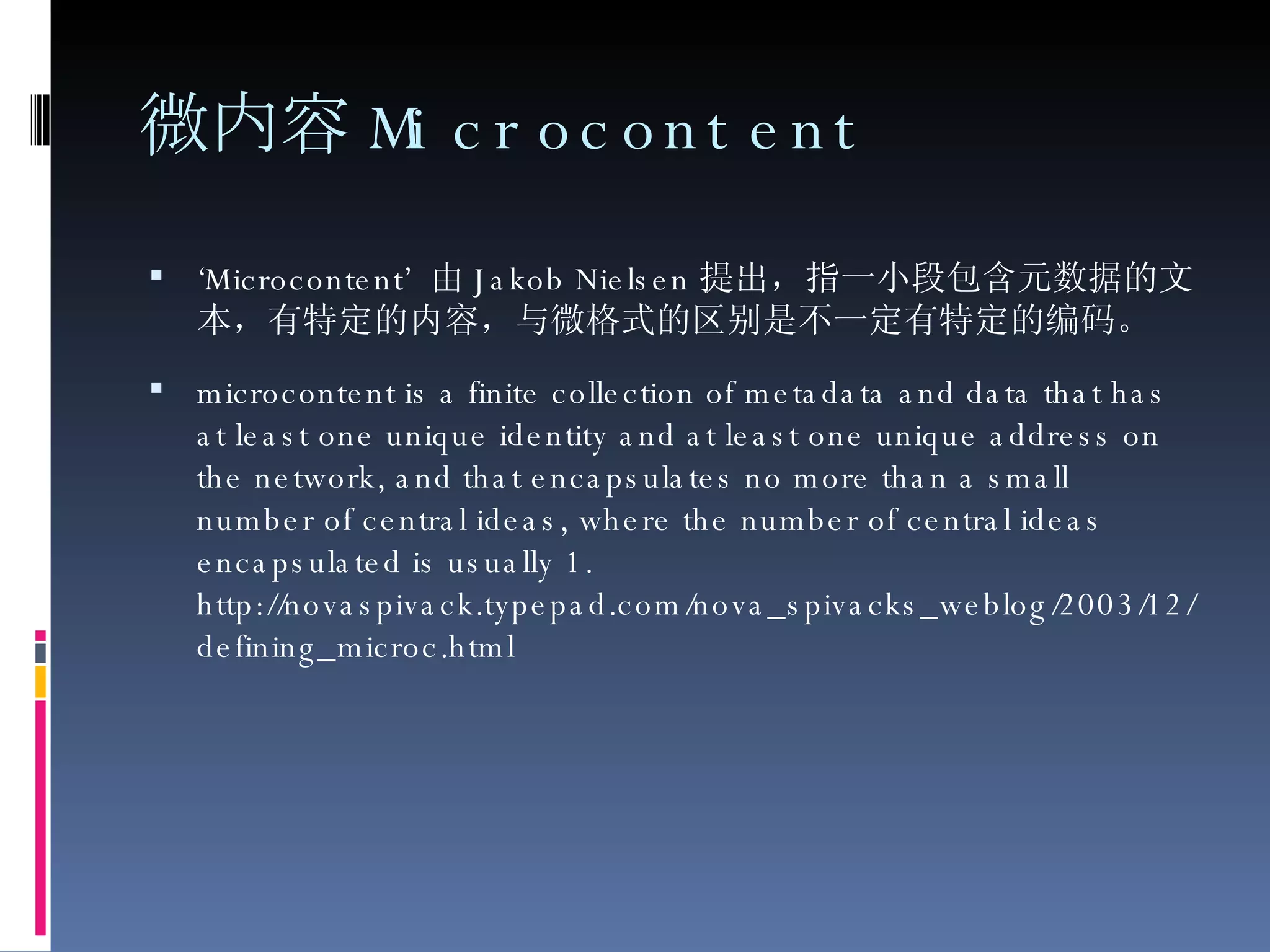
微内容 Microcontent ‘Microcontent’ 由 Jakob Nielsen 提出,指一小段包含元数据的文本,有特定的内容,与微格式的区别是不一定有特定的编码。 microcontent is a finite collection of metadata and data that has at least one unique identity and at least one unique address on the network, and that encapsulates no more than a small number of central ideas, where the number of central ideas encapsulated is usually 1. http://novaspivack.typepad.com/nova_spivacks_weblog/2003/12/defining_microc.html
45.
微资源的功能需求 微资源的产生(例如:做网络书签?); 微资源需要标识( permanent id ?); 微资源需要描述( metadata ); 微资源需要重组(聚合); 微资源的重用; 微资源的呈现( tag cloud ?); 微资源的管理和利用需要工具( flickr/del.icio.us/blinklist/365key… )。
46.
标签 Tag 的作用标示,为了查找。专指度高好还是低好?每个人都回折中。 指代,索引中指代原件 聚类,为了关联。 分面标引 集体智慧。
47.
民俗分类法 Folksonomy Folksonomy由 tag 组成。 Tag 在 folksonomy 中是微资源的指代物。 通过检出 tag 而检出微资源。 Tag 是平面的。 Tag 是随意的。 Tag 云图反映了 tag 的权重。
48.
Tag 可能的发展方向 Tag可以排序(除了目前的字顺和权重,还有多种形式,包括动态形式,如结合相关反馈、合作过滤、点击次数、甚至类 pagerank 等); Tag 可以层级化(层次关系,例如 del.icio.us 目前支持的 tag 类目); Tag 可以聚类(反映了资源之间的关系;经常在一起的 tag 具有较为密切的关系,等等); Tag 可以规范化(同义词、反义词归并指代;用代属分参关系标注等)。