Presented By: RAJNISH
240000613019
ICT
WEB MINING
CHAUDHARY BANSILAL UNIVERSITY
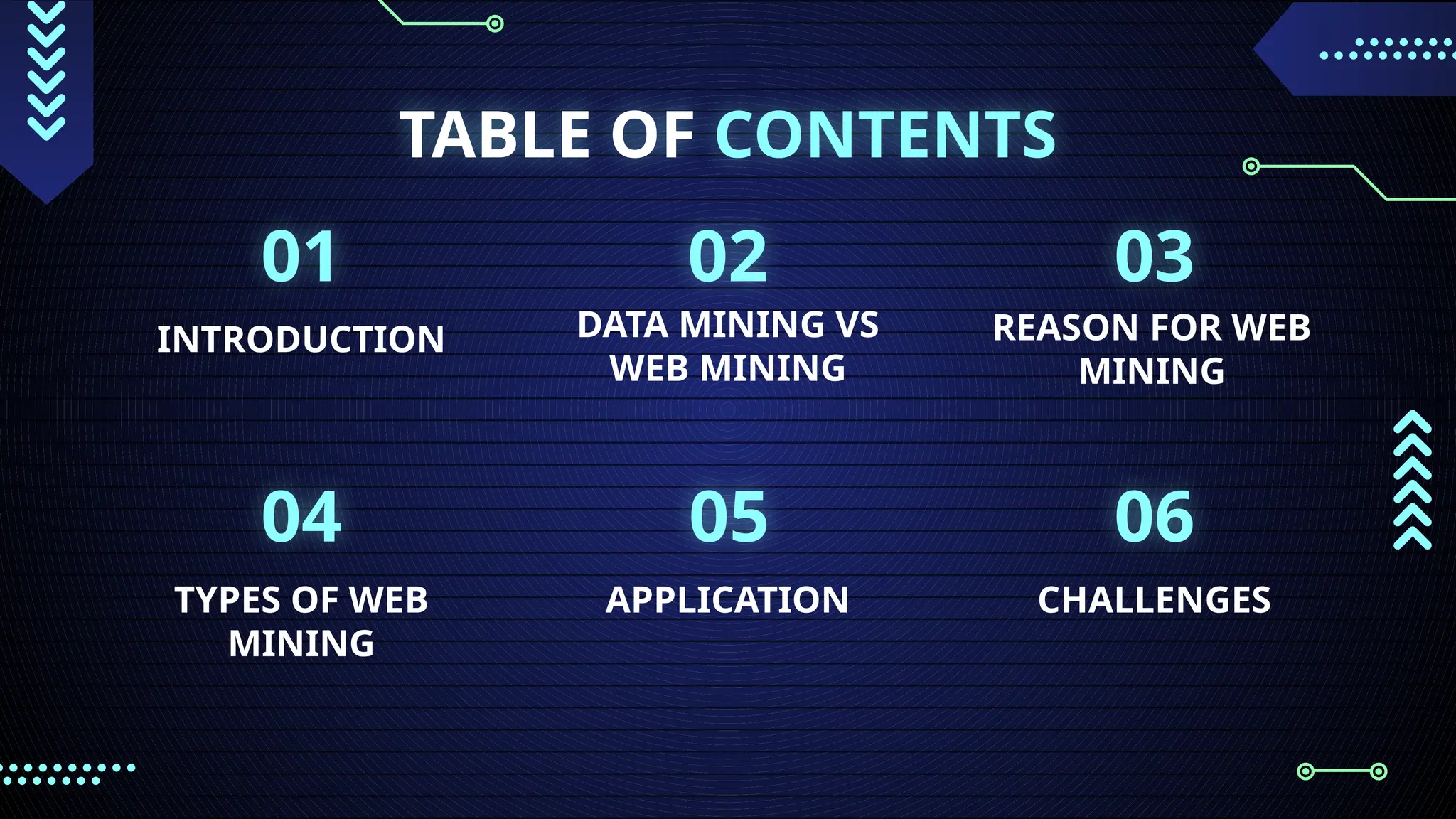
TABLE OF CONTENTS
INTRODUCTION
01
DATA MINING VS
WEB MINING
02
REASON FOR WEB
MINING
03
TYPES OF WEB
MINING
04
APPLICATION
05
CHALLENGES
06
WEB MINING
Web mining can be broadly defined as the discovery
and
analysis of useful information from the World Wide
Web.
The data is collected from the server, client and
database in
Web mining.
Web mining is a subset of data mining.
Web mining is the process of using data mining
techniques and algorithms to extract information
directly from the Web.
Data Mining
Data mining refers to the process
of discovering patterns, trends,
correlations, and useful
information from large datasets. It
involves techniques from
machine learning, statistics, and
database systems to uncover
hidden insights in data.
Web Mining
Web mining is a subfield of
data mining that focuses on
extracting useful patterns and
knowledge from the web. It
involves analyzing web data
such as user behavior, content
on web pages, and hyperlinks
between sites.
Data Mining VS Web Mining
WHY WE DO WEB MINING
• Web mining helps analyze how users interact with websites, such as what
pages they visit, how long they stay, and what actions they take
• Web mining helps analyze the structure and content of websites.
• Web mining is used to build recommendation systems (like those used by
Netflix, Amazon, and Spotify) by analyzing user preferences, browsing
history, and purchase behavior.
• Web mining helps identify user interests and demographics through
browsing history and online activity.
• Web mining techniques can be used to detect fraudulent behavior on
websites, such as unusual browsing patterns, fake reviews, or payment
fraud.
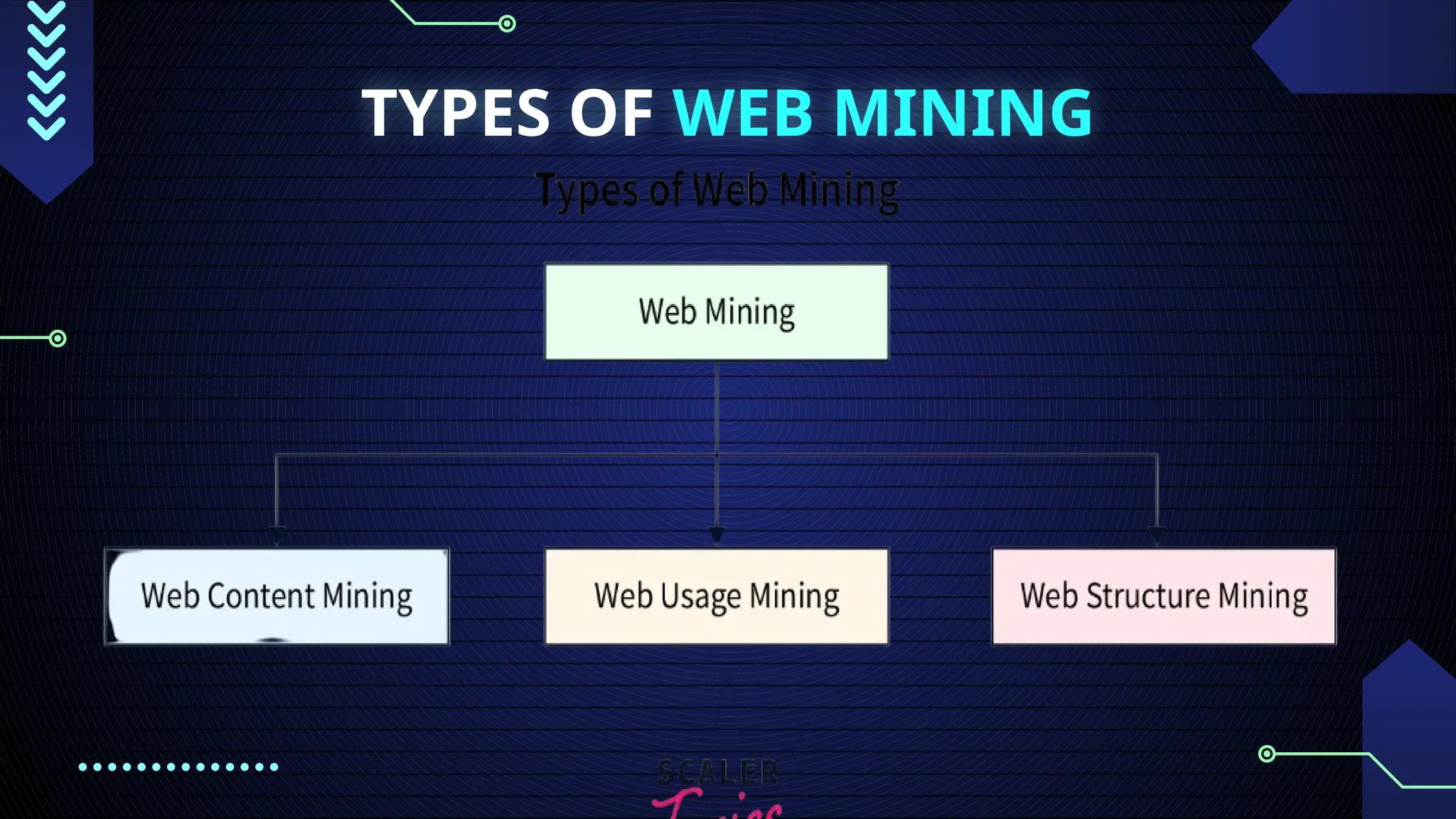
TYPES OF WEB MINING
WEB CONTENT MINING
• It is responsible for extracting and exploring
proper and relevant data from the content of
web pages
• Web Content Mining is the process of collecting
useful data from websites.
• Content mining mainly focuses on the “content
that are
stored in different web pages.
• This content may consist text, image, video,
sound or
WEB STRUCTURE MINING
• It is the process of extracting structural information
from the web.
• Webpages are linked together with the help of
HYPERLINK
• The linked pages have the related data to the main
web page.
• Connection of these web pages are called WEB
GRAPH
• After analyzing the web graph we can determine the
quality of information that are stored in these web
pages.
WEB USAGE MINING
• It is the application of data mining techniques to
discover
patterns using the Web to better understand and
meet the needs of the user.
Goal: To understand user behavior, preferences, and
patterns. This type is often used for personalization,
recommendations, and optimizing website designs
•Analyzing the sequence of pages visited to predict
what a user might do next.
•Grouping users into segments based on their
browsing behavior (e.g., frequent visitors vs.
occasional ones).
APPLICATION OF WEB MINING
• E-commerce Personalization - Amazon employs
a recommendation system that analyzes client
behaviour, including product views, searches, and
purchase history, to suggest personalized product
recommendations.
• Content Consumption Optimization: Netflix
tracks client behaviour, such as the movies and TV series
watched, time spent on content, and user ratings. Using
this data, it applies advanced algorithms to recommend
content that matches the viewer’s preferences.
APPLICATION OF WEB MINING
• Security and Crime investigation - Web mining
techniques are also used for protection of user system or
logging information against such cybercrimes as hacking
, internet fraud , fraudulent websites .
• E- Learning: Web mining can be used for improving
and enhancing the process of E-learning environments.
• Applications of web mining to e-learning are usually web
usage based.
• Machine learning techniques and web usage mining
enhance web based learning environments
CHALLENGES IN WEB MINING
The non-technical restrictions can be included
lack of management support-
• lack of required resources
• inadequate fund
The technical issues are
Incorrect Data
• Data may be incomplete and unavailable.
The lack of tools
Available tools only support one of the web mining
types such as classification or clustering.
REFRENCES
• Data Mining Book by Suman
Lata
• Greekofgreeks
• Google
• Chatgpt
DO YOU HAVE ANY QUESTION ?
THANKS!

WEB MININGG.pptx go to thw lab where we found ppt

  • 1.
    Presented By: RAJNISH 240000613019 ICT WEBMINING CHAUDHARY BANSILAL UNIVERSITY
  • 2.
    TABLE OF CONTENTS INTRODUCTION 01 DATAMINING VS WEB MINING 02 REASON FOR WEB MINING 03 TYPES OF WEB MINING 04 APPLICATION 05 CHALLENGES 06
  • 3.
    WEB MINING Web miningcan be broadly defined as the discovery and analysis of useful information from the World Wide Web. The data is collected from the server, client and database in Web mining. Web mining is a subset of data mining. Web mining is the process of using data mining techniques and algorithms to extract information directly from the Web.
  • 4.
    Data Mining Data miningrefers to the process of discovering patterns, trends, correlations, and useful information from large datasets. It involves techniques from machine learning, statistics, and database systems to uncover hidden insights in data. Web Mining Web mining is a subfield of data mining that focuses on extracting useful patterns and knowledge from the web. It involves analyzing web data such as user behavior, content on web pages, and hyperlinks between sites. Data Mining VS Web Mining
  • 5.
    WHY WE DOWEB MINING • Web mining helps analyze how users interact with websites, such as what pages they visit, how long they stay, and what actions they take • Web mining helps analyze the structure and content of websites. • Web mining is used to build recommendation systems (like those used by Netflix, Amazon, and Spotify) by analyzing user preferences, browsing history, and purchase behavior. • Web mining helps identify user interests and demographics through browsing history and online activity. • Web mining techniques can be used to detect fraudulent behavior on websites, such as unusual browsing patterns, fake reviews, or payment fraud.
  • 6.
  • 7.
    WEB CONTENT MINING •It is responsible for extracting and exploring proper and relevant data from the content of web pages • Web Content Mining is the process of collecting useful data from websites. • Content mining mainly focuses on the “content that are stored in different web pages. • This content may consist text, image, video, sound or
  • 8.
    WEB STRUCTURE MINING •It is the process of extracting structural information from the web. • Webpages are linked together with the help of HYPERLINK • The linked pages have the related data to the main web page. • Connection of these web pages are called WEB GRAPH • After analyzing the web graph we can determine the quality of information that are stored in these web pages.
  • 9.
    WEB USAGE MINING •It is the application of data mining techniques to discover patterns using the Web to better understand and meet the needs of the user. Goal: To understand user behavior, preferences, and patterns. This type is often used for personalization, recommendations, and optimizing website designs •Analyzing the sequence of pages visited to predict what a user might do next. •Grouping users into segments based on their browsing behavior (e.g., frequent visitors vs. occasional ones).
  • 10.
    APPLICATION OF WEBMINING • E-commerce Personalization - Amazon employs a recommendation system that analyzes client behaviour, including product views, searches, and purchase history, to suggest personalized product recommendations. • Content Consumption Optimization: Netflix tracks client behaviour, such as the movies and TV series watched, time spent on content, and user ratings. Using this data, it applies advanced algorithms to recommend content that matches the viewer’s preferences.
  • 11.
    APPLICATION OF WEBMINING • Security and Crime investigation - Web mining techniques are also used for protection of user system or logging information against such cybercrimes as hacking , internet fraud , fraudulent websites . • E- Learning: Web mining can be used for improving and enhancing the process of E-learning environments. • Applications of web mining to e-learning are usually web usage based. • Machine learning techniques and web usage mining enhance web based learning environments
  • 12.
    CHALLENGES IN WEBMINING The non-technical restrictions can be included lack of management support- • lack of required resources • inadequate fund The technical issues are Incorrect Data • Data may be incomplete and unavailable. The lack of tools Available tools only support one of the web mining types such as classification or clustering.
  • 13.
    REFRENCES • Data MiningBook by Suman Lata • Greekofgreeks • Google • Chatgpt
  • 14.
    DO YOU HAVEANY QUESTION ? THANKS!