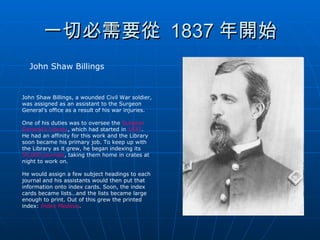
一切必需要從 1837年開始 John Shaw Billings John Shaw Billings, a wounded Civil War soldier, was assigned as an assistant to the Surgeon General’s office as a result of his war injuries. One of his duties was to oversee the Surgeon General’s Library , which had started in 1837 . He had an affinity for this work and the Library soon became his primary job. To keep up with the Library as it grew, he began indexing its 50,000 journals , taking them home in crates at night to work on. He would assign a few subject headings to each journal and his assistants would then put that information onto index cards. Soon, the index cards became lists…and the lists became large enough to print. Out of this grew the printed index: Index Medicus .
Index Medicus Medlars During Wolrd War II Frank Broadway Roger, then head librarian of the National Library of Medicine, found that he was unable to keep Index Medicus up-to-date and began to search for ways to mechanize the process. This put him into the spotlight of budding computer technologies. When the two blended, a new paradigm in information retrieval was born that permitted Index Medicus to be indexed by computers. This new system was called Medlars for Medical Literature and Retrieval System.
5.
Medlars PubMed For many years, MEDLINE provided access to those who could afford to purchase access to it. But as changes in society permitted more and more people to have access to home computers, it was decided by the National Library of Medicine, that the information within MEDLINE should be available to everyone, particularly since most of the research that funded the studies found within its articles had been funded with federal monies and belonged in the public domain. Thus, a public version of MEDLINE was created as a web-based resource and it was called Public Medline or PubMed. 不但網頁化了,而且也免費了 !!
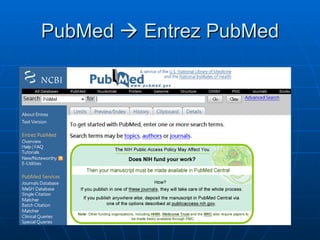
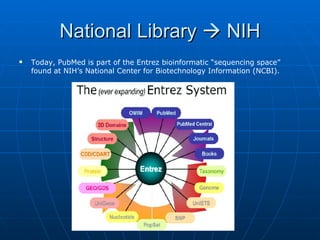
National Library NIH Today, PubMed is part of the Entrez bioinformatic “sequencing space” found at NIH’s National Center for Biotechnology Information (NCBI).