Panel:

Web Archiving –
Lessons and Potential
Abbie Grotke (Library of Congress)
Barbara Signori (Swiss National Library)
Clément Oury (Bibliothèque nationale de France)
Daniel Gomes (Portuguese Web Archive)
Mário J. Silva (INESC-ID)
Nuno Freire (European Library)
Lessons learned
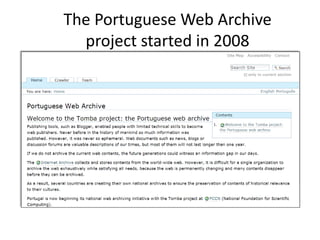
The Portuguese Web Archive
project started in 2008
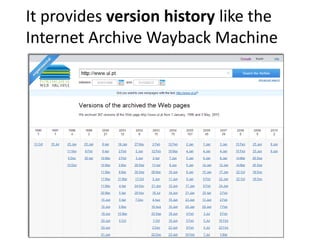
It provides version history like the
Internet Archive Wayback Machine
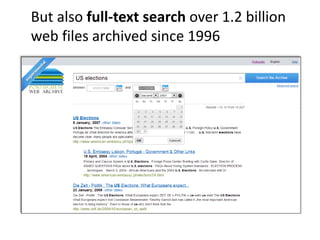
But also full-text search over 1.2 billion
web files archived since 1996
Acquiring web data
We needed to integrate third-party
collections archived before 2007
• An archive must have
“old stuff”
• Integration of
historical collections
– 1.9 TB from the
Internet Archive
between 1996 and
2007
– 600 MB CD ROM with
sites published in 1996
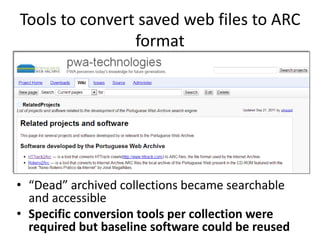
Tools to convert saved web files to ARC
format

• “Dead” archived collections became searchable
and accessible
• Specific conversion tools per collection were
required but baseline software could be reused

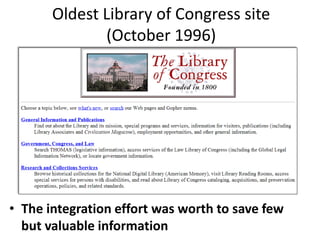
Oldest Library of Congress site
(October 1996)

• The integration effort was worth to save few
but valuable information
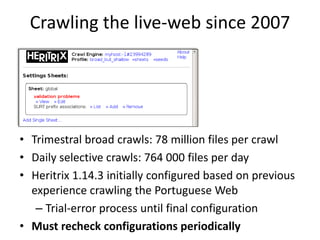
Crawling the live-web since 2007

• Trimestral broad crawls: 78 million files per crawl
• Daily selective crawls: 764 000 files per day
• Heritrix 1.14.3 initially configured based on previous
experience crawling the Portuguese Web
– Trial-error process until final configuration
• Must recheck configurations periodically
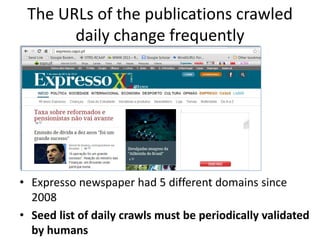
The URLs of the publications crawled
daily change frequently

• Expresso newspaper had 5 different domains since
2008
• Seed list of daily crawls must be periodically validated
by humans
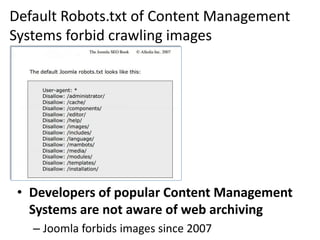
Default Robots.txt of Content Management
Systems forbid crawling images

• Developers of popular Content Management
Systems are not aware of web archiving
– Joomla forbids images since 2007
Attempt to raise awareness
• Contacted webmasters of the selected
publications by email
– Only 10% returned feedback

• None, raised any objection, just questions.
• Some, did not know they had robots exclusion
rules on their sites.
• Most, did not know what was a “web archive”.
• All, were satisfied from being selected as
representatives of our cultural heritage
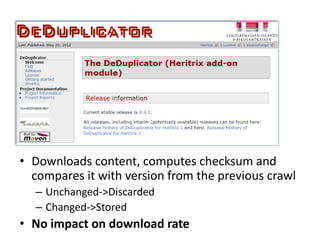
• Downloads content, computes checksum and
compares it with version from the previous crawl
– Unchanged->Discarded
– Changed->Stored

• No impact on download rate
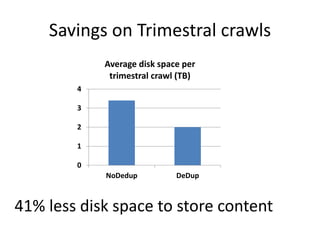
Savings on Trimestral crawls
Average disk space per
trimestral crawl (TB)
4
3
2
1
0
NoDedup

DeDup

41% less disk space to store content
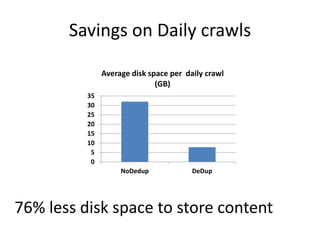
Savings on Daily crawls
Average disk space per daily crawl
(GB)
35
30
25
20
15
10
5
0
NoDedup

DeDup

76% less disk space to store content
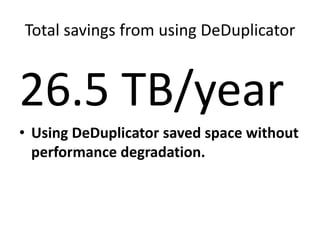
Total savings from using DeDuplicator

26.5 TB/year
• Using DeDuplicator saved space without
performance degradation.
Ranking the past Web
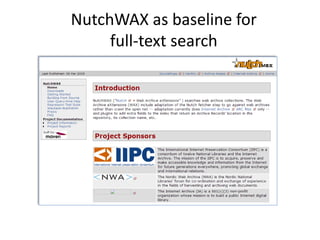
NutchWAX as baseline for
full-text search
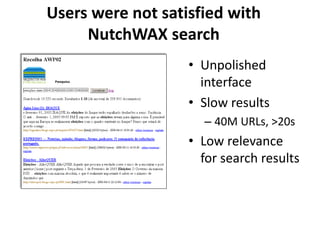
Users were not satisfied with
NutchWAX search
• Unpolished
interface
• Slow results
– 40M URLs, >20s

• Low relevance
for search results
Developed a new web archive
search system
• Quicker response times
• Improve relevance for search results
Had to build a Web Archive Information
Retrieval Test Collection: PWA9609
• To evaluate and improve relevance for search
results
• Corpus of documents from 1996 to 2009
– 255 million web pages (8.9 TB)
– 6 collections: Internet Archive, PWA broad crawls,
integrated collections

• Gold collection
– Query, relevant results
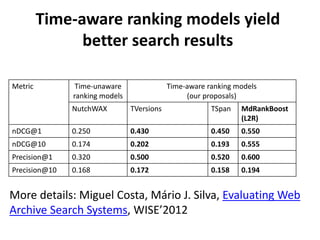
Time-aware ranking models yield
better search results
Metric

Time-unaware
ranking models

Time-aware ranking models
(our proposals)

NutchWAX

TVersions

TSpan

MdRankBoost
(L2R)

nDCG@1

0.250

0.430

0.450

0.550

nDCG@10

0.174

0.202

0.193

0.555

Precision@1

0.320

0.500

0.520

0.600

Precision@10

0.168

0.172

0.158

0.194

More details: Miguel Costa, Mário J. Silva, Evaluating Web
Archive Search Systems, WISE’2012
Designing user interface
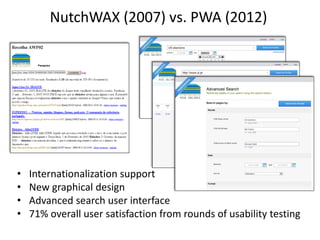
NutchWAX (2007) vs. PWA (2012)

•
•
•
•

Internationalization support
New graphical design
Advanced search user interface
71% overall user satisfaction from rounds of usability testing
Observations from usability testing
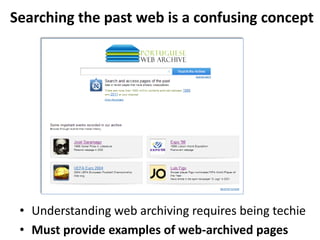
Searching the past web is a confusing concept

• Understanding web archiving requires being techie
• Must provide examples of web-archived pages
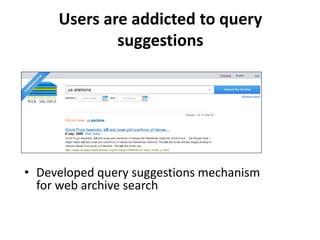
Users are addicted to query
suggestions

• Developed query suggestions mechanism
for web archive search
Users “google” the past and we have
to comply
• Users search web archives replicating their
behavior from live-web search engines
• Users input queries on the first input box that
they find
– Search system must identify query type (URL or
full-text) and present corresponding results

• Must provide additional tutorials and
contextual help to search the past web
Hardware
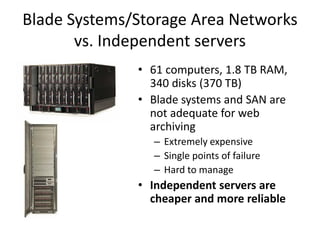
Blade Systems/Storage Area Networks
vs. Independent servers
• 61 computers, 1.8 TB RAM,
340 disks (370 TB)
• Blade systems and SAN are
not adequate for web
archiving
– Extremely expensive
– Single points of failure
– Hard to manage

• Independent servers are
cheaper and more reliable
Legal issues
Just concerns
•
•
•
•

Respect Robots Exclusion Protocol
1 year embargo
Proactively remove illicit content
Remove content on-demand by
authors
Potential as research
infrastructure
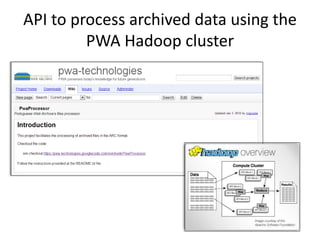
API to process archived data using the
PWA Hadoop cluster
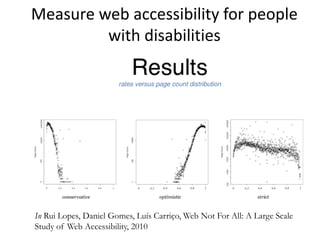
Measure web accessibility for people
with disabilities

In Rui Lopes, Daniel Gomes, Luís Carriço, Web Not For All: A Large Scale
Study of Web Accessibility, 2010
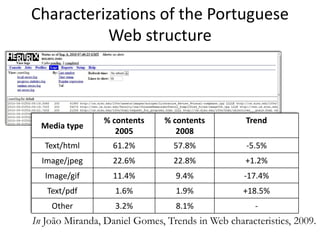
Characterizations of the Portuguese
Web structure

Media type

% contents
2005

% contents
2008

Trend

Text/html

61.2%

57.8%

-5.5%

Image/jpeg

22.6%

22.8%

+1.2%

Image/gif

11.4%

9.4%

-17.4%

Text/pdf

1.6%

1.9%

+18.5%

Other

3.2%

8.1%

-

In João Miranda, Daniel Gomes, Trends in Web characteristics, 2009.
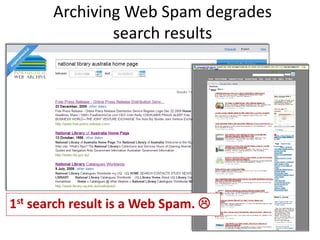
Archiving Web Spam degrades
search results

1st search result is a Web Spam. 
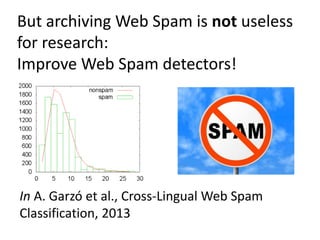
But archiving Web Spam is not useless
for research:
Improve Web Spam detectors!

In A. Garzó et al., Cross-Lingual Web Spam
Classification, 2013
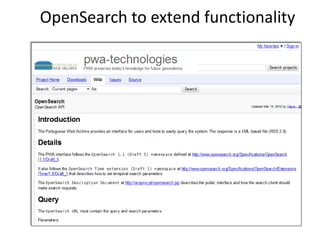
OpenSearch to extend functionality
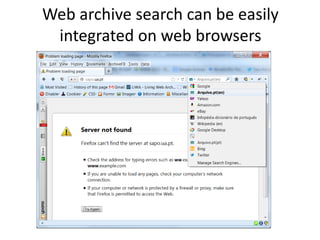
Web archive search can be easily
integrated on web browsers
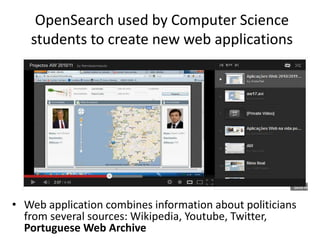
OpenSearch used by Computer Science
students to create new web applications

• Web application combines information about politicians
from several sources: Wikipedia, Youtube, Twitter,
Portuguese Web Archive
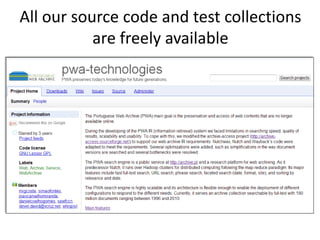
All our source code and test collections
are freely available
Conclusions
• Web archives are crucial infrastructures for
modern societies
• Must raise awareness about web archiving
among users and developers
• We need to collaborate
Panel discussion
1. How is your experience related to this work?
2. How could web archives be further improved?
3. How could web archives interact with libraries/other
cultural heritage organizations?
4. How to unfold the full potential of web archives as
research infrastructures?
5. Which innovative collaborations could be
established?
6. What is the role of web archiving in modern
societies?
7. …

Web Archiving – Lessons and Potential

  • 1.
    Panel: Web Archiving – Lessonsand Potential Abbie Grotke (Library of Congress) Barbara Signori (Swiss National Library) Clément Oury (Bibliothèque nationale de France) Daniel Gomes (Portuguese Web Archive) Mário J. Silva (INESC-ID) Nuno Freire (European Library)
  • 2.
  • 3.
    The Portuguese WebArchive project started in 2008
  • 4.
    It provides versionhistory like the Internet Archive Wayback Machine
  • 5.
    But also full-textsearch over 1.2 billion web files archived since 1996
  • 6.
  • 7.
    We needed tointegrate third-party collections archived before 2007 • An archive must have “old stuff” • Integration of historical collections – 1.9 TB from the Internet Archive between 1996 and 2007 – 600 MB CD ROM with sites published in 1996
  • 8.
    Tools to convertsaved web files to ARC format • “Dead” archived collections became searchable and accessible • Specific conversion tools per collection were required but baseline software could be reused
  • 9.
    Oldest Library ofCongress site (October 1996) • The integration effort was worth to save few but valuable information
  • 10.
    Crawling the live-websince 2007 • Trimestral broad crawls: 78 million files per crawl • Daily selective crawls: 764 000 files per day • Heritrix 1.14.3 initially configured based on previous experience crawling the Portuguese Web – Trial-error process until final configuration • Must recheck configurations periodically
  • 11.
    The URLs ofthe publications crawled daily change frequently • Expresso newspaper had 5 different domains since 2008 • Seed list of daily crawls must be periodically validated by humans
  • 12.
    Default Robots.txt ofContent Management Systems forbid crawling images • Developers of popular Content Management Systems are not aware of web archiving – Joomla forbids images since 2007
  • 13.
    Attempt to raiseawareness • Contacted webmasters of the selected publications by email – Only 10% returned feedback • None, raised any objection, just questions. • Some, did not know they had robots exclusion rules on their sites. • Most, did not know what was a “web archive”. • All, were satisfied from being selected as representatives of our cultural heritage
  • 14.
    • Downloads content,computes checksum and compares it with version from the previous crawl – Unchanged->Discarded – Changed->Stored • No impact on download rate
  • 15.
    Savings on Trimestralcrawls Average disk space per trimestral crawl (TB) 4 3 2 1 0 NoDedup DeDup 41% less disk space to store content
  • 16.
    Savings on Dailycrawls Average disk space per daily crawl (GB) 35 30 25 20 15 10 5 0 NoDedup DeDup 76% less disk space to store content
  • 17.
    Total savings fromusing DeDuplicator 26.5 TB/year • Using DeDuplicator saved space without performance degradation.
  • 18.
  • 19.
    NutchWAX as baselinefor full-text search
  • 20.
    Users were notsatisfied with NutchWAX search • Unpolished interface • Slow results – 40M URLs, >20s • Low relevance for search results
  • 21.
    Developed a newweb archive search system • Quicker response times • Improve relevance for search results
  • 22.
    Had to builda Web Archive Information Retrieval Test Collection: PWA9609 • To evaluate and improve relevance for search results • Corpus of documents from 1996 to 2009 – 255 million web pages (8.9 TB) – 6 collections: Internet Archive, PWA broad crawls, integrated collections • Gold collection – Query, relevant results
  • 23.
    Time-aware ranking modelsyield better search results Metric Time-unaware ranking models Time-aware ranking models (our proposals) NutchWAX TVersions TSpan MdRankBoost (L2R) nDCG@1 0.250 0.430 0.450 0.550 nDCG@10 0.174 0.202 0.193 0.555 Precision@1 0.320 0.500 0.520 0.600 Precision@10 0.168 0.172 0.158 0.194 More details: Miguel Costa, Mário J. Silva, Evaluating Web Archive Search Systems, WISE’2012
  • 24.
  • 25.
    NutchWAX (2007) vs.PWA (2012) • • • • Internationalization support New graphical design Advanced search user interface 71% overall user satisfaction from rounds of usability testing
  • 26.
  • 27.
    Searching the pastweb is a confusing concept • Understanding web archiving requires being techie • Must provide examples of web-archived pages
  • 28.
    Users are addictedto query suggestions • Developed query suggestions mechanism for web archive search
  • 29.
    Users “google” thepast and we have to comply • Users search web archives replicating their behavior from live-web search engines • Users input queries on the first input box that they find – Search system must identify query type (URL or full-text) and present corresponding results • Must provide additional tutorials and contextual help to search the past web
  • 30.
  • 31.
    Blade Systems/Storage AreaNetworks vs. Independent servers • 61 computers, 1.8 TB RAM, 340 disks (370 TB) • Blade systems and SAN are not adequate for web archiving – Extremely expensive – Single points of failure – Hard to manage • Independent servers are cheaper and more reliable
  • 32.
  • 34.
    Just concerns • • • • Respect RobotsExclusion Protocol 1 year embargo Proactively remove illicit content Remove content on-demand by authors
  • 35.
  • 36.
    API to processarchived data using the PWA Hadoop cluster
  • 37.
    Measure web accessibilityfor people with disabilities In Rui Lopes, Daniel Gomes, Luís Carriço, Web Not For All: A Large Scale Study of Web Accessibility, 2010
  • 38.
    Characterizations of thePortuguese Web structure Media type % contents 2005 % contents 2008 Trend Text/html 61.2% 57.8% -5.5% Image/jpeg 22.6% 22.8% +1.2% Image/gif 11.4% 9.4% -17.4% Text/pdf 1.6% 1.9% +18.5% Other 3.2% 8.1% - In João Miranda, Daniel Gomes, Trends in Web characteristics, 2009.
  • 39.
    Archiving Web Spamdegrades search results 1st search result is a Web Spam. 
  • 40.
    But archiving WebSpam is not useless for research: Improve Web Spam detectors! In A. Garzó et al., Cross-Lingual Web Spam Classification, 2013
  • 41.
    OpenSearch to extendfunctionality
  • 42.
    Web archive searchcan be easily integrated on web browsers
  • 43.
    OpenSearch used byComputer Science students to create new web applications • Web application combines information about politicians from several sources: Wikipedia, Youtube, Twitter, Portuguese Web Archive
  • 44.
    All our sourcecode and test collections are freely available
  • 45.
    Conclusions • Web archivesare crucial infrastructures for modern societies • Must raise awareness about web archiving among users and developers • We need to collaborate
  • 46.
    Panel discussion 1. Howis your experience related to this work? 2. How could web archives be further improved? 3. How could web archives interact with libraries/other cultural heritage organizations? 4. How to unfold the full potential of web archives as research infrastructures? 5. Which innovative collaborations could be established? 6. What is the role of web archiving in modern societies? 7. …