Web 3.0 Reasoning Using a Semantic Network J. Brooke Aker CEO  Expert System USA Web 3.0 Conference  January 26th
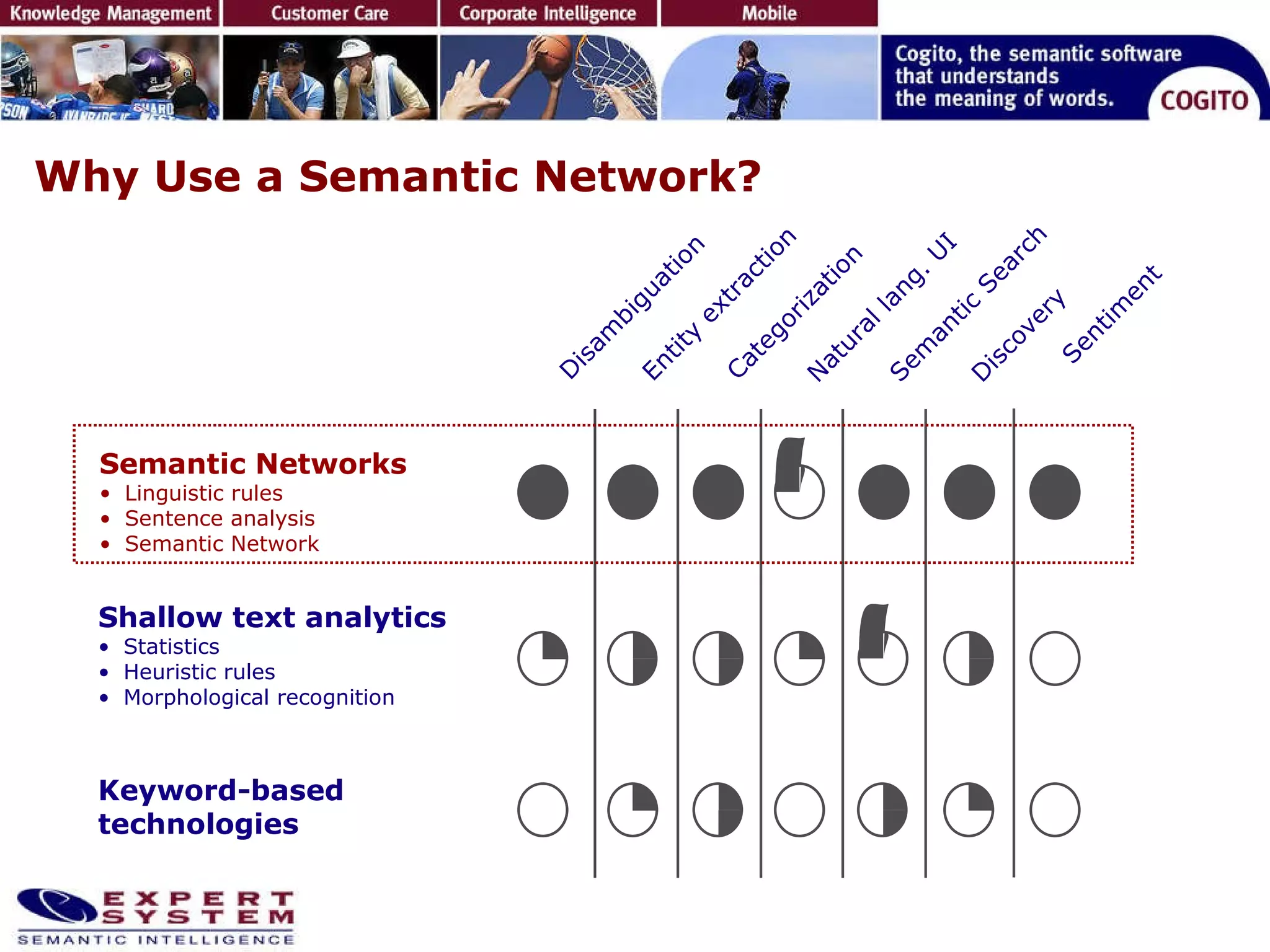
Why Use a Semantic Network? Semantic Networks Linguistic rules Sentence analysis Semantic Network Shallow text analytics Statistics Heuristic rules Morphological recognition Keyword-based technologies Disambiguation Entity extraction Categorization Natural lang. UI Semantic Search Discovery Sentiment
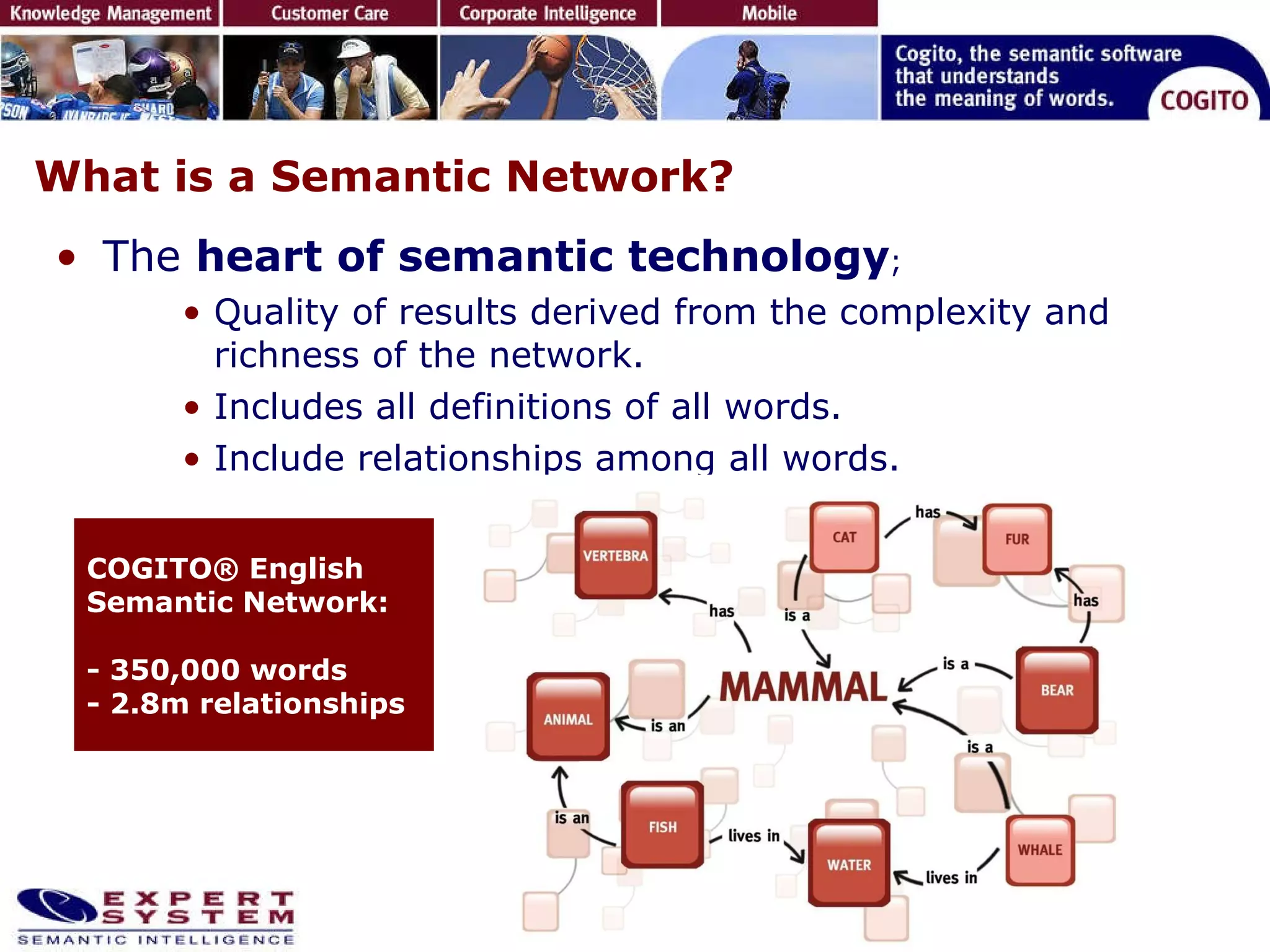
The  heart of semantic technology ; Quality of results derived from the complexity and richness of the network. Includes all definitions of all words. Include relationships among all words. What is a Semantic Network? COGITO® English Semantic Network: - 350,000 words - 2.8m relationships
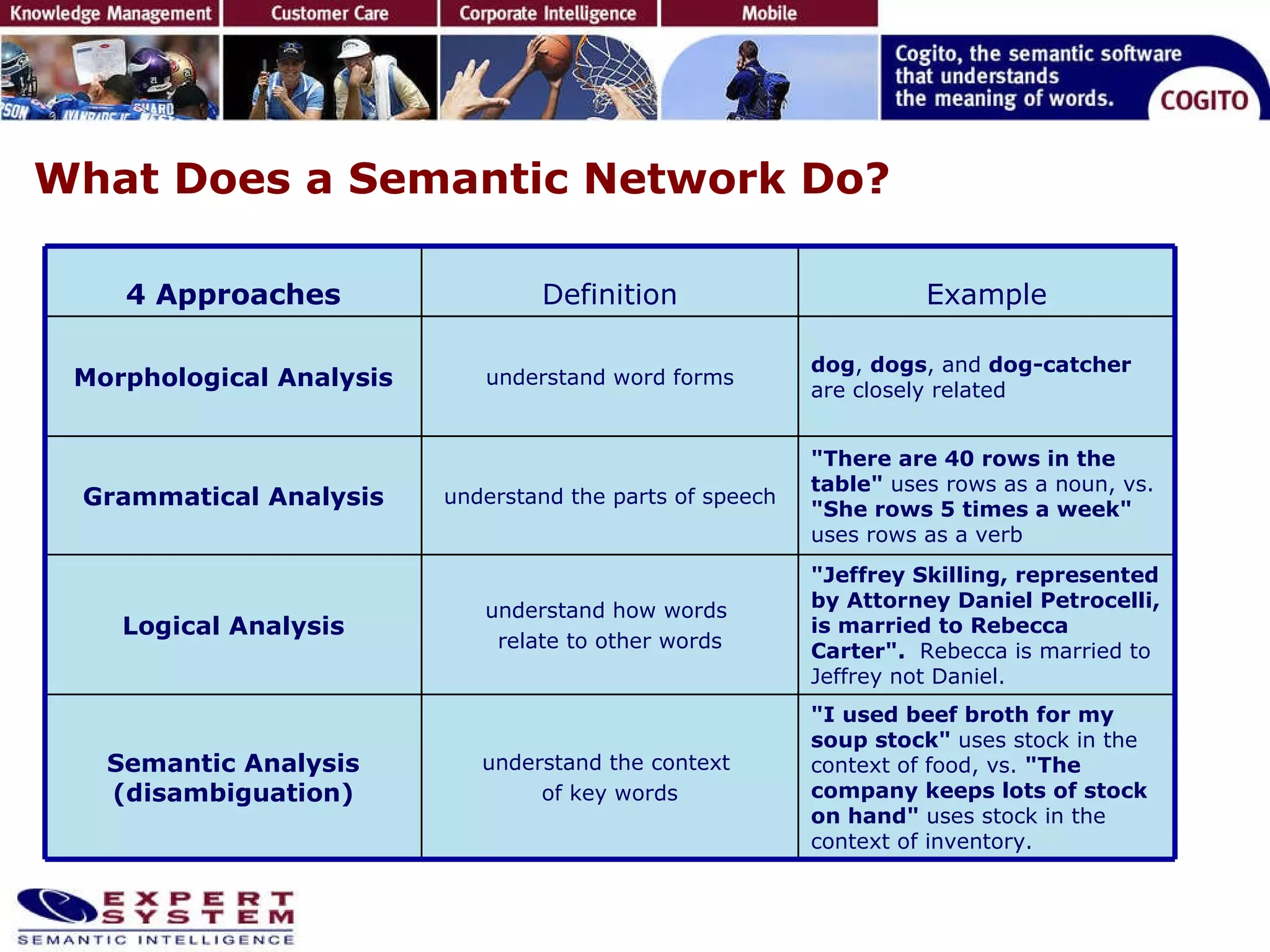
COGITO ®  : deep analysis What Does a Semantic Network Do? 4 Approaches Definition Example Morphological Analysis understand word forms dog ,  dogs , and  dog-catcher  are closely related Grammatical Analysis understand the parts of speech "There are 40 rows in the table"  uses rows as a noun, vs.  "She rows 5 times a week"  uses rows as a verb Logical Analysis understand how words  relate to other words "Jeffrey Skilling, represented by Attorney Daniel Petrocelli, is married to Rebecca Carter".   Rebecca is married to Jeffrey not Daniel.  Semantic Analysis (disambiguation) understand the context  of key words "I used beef broth for my soup stock"  uses stock in the context of food, vs.  "The company keeps lots of stock on hand"  uses stock in the context of inventory.
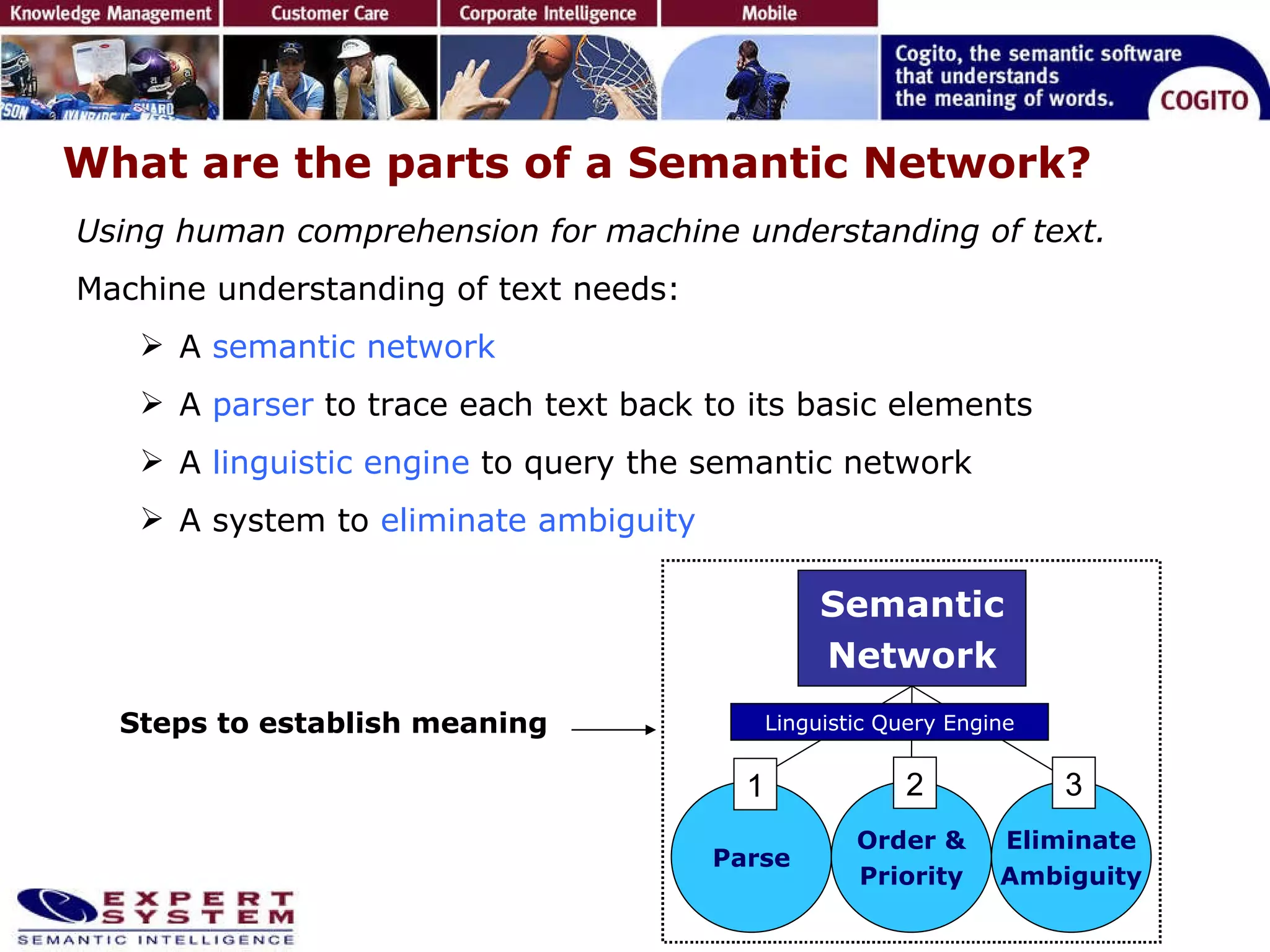
What are the parts of a Semantic Network? Using human comprehension for machine understanding of text. Machine understanding of text needs: A   semantic network A  parser   to trace each text back to its basic elements A  linguistic engine   to query the semantic network  A system to   eliminate   ambiguity Steps to establish meaning Semantic Network Parse Eliminate Ambiguity Order & Priority 1 2 3 Linguistic Query Engine
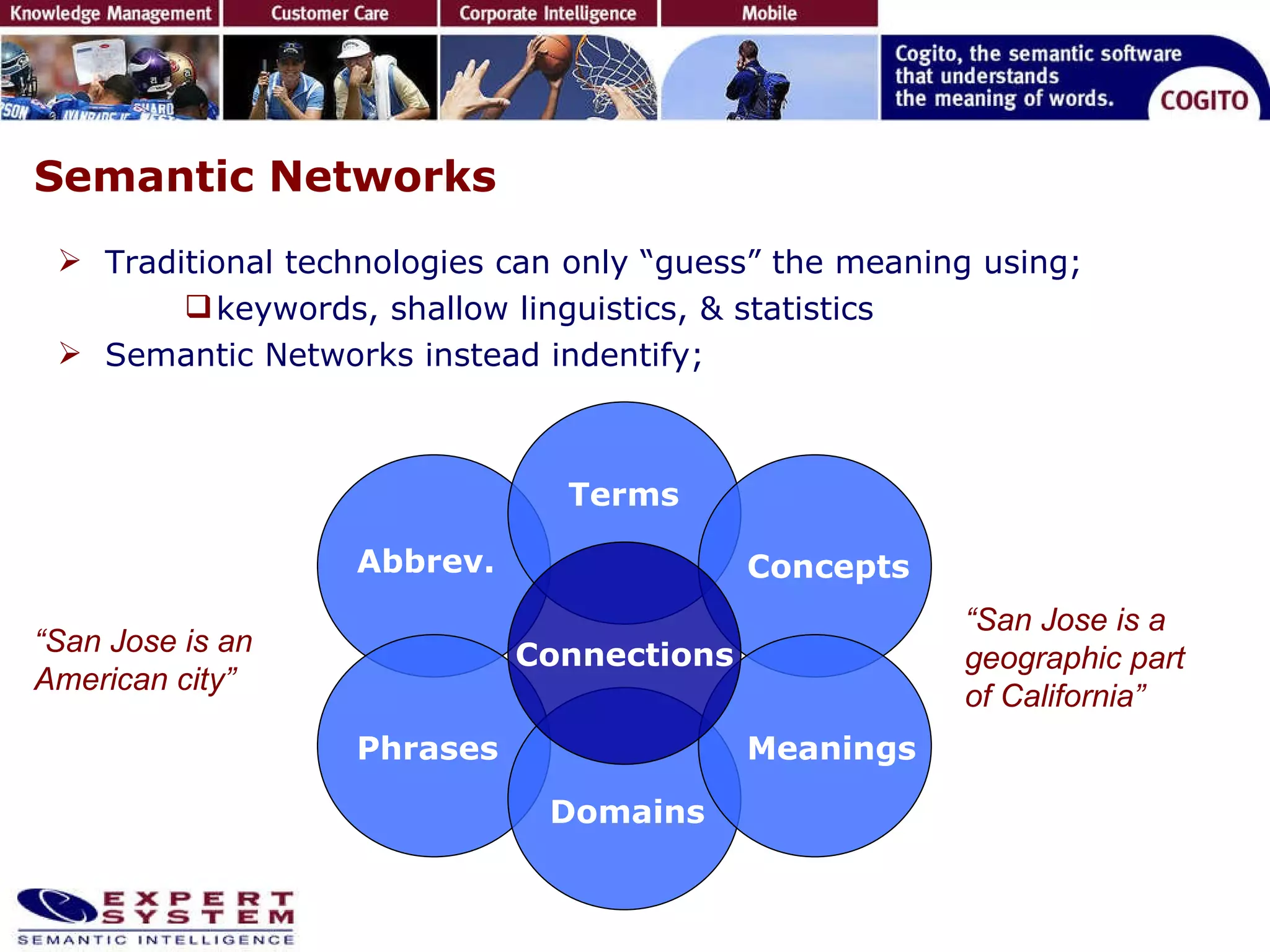
Semantic Networks Traditional technologies can only “guess” the meaning using;  keywords, shallow linguistics, & statistics Semantic Networks instead indentify; “ San Jose is an American city” “ San Jose is a geographic part  of California” Connections Concepts Terms Abbrev. Phrases Meanings Domains
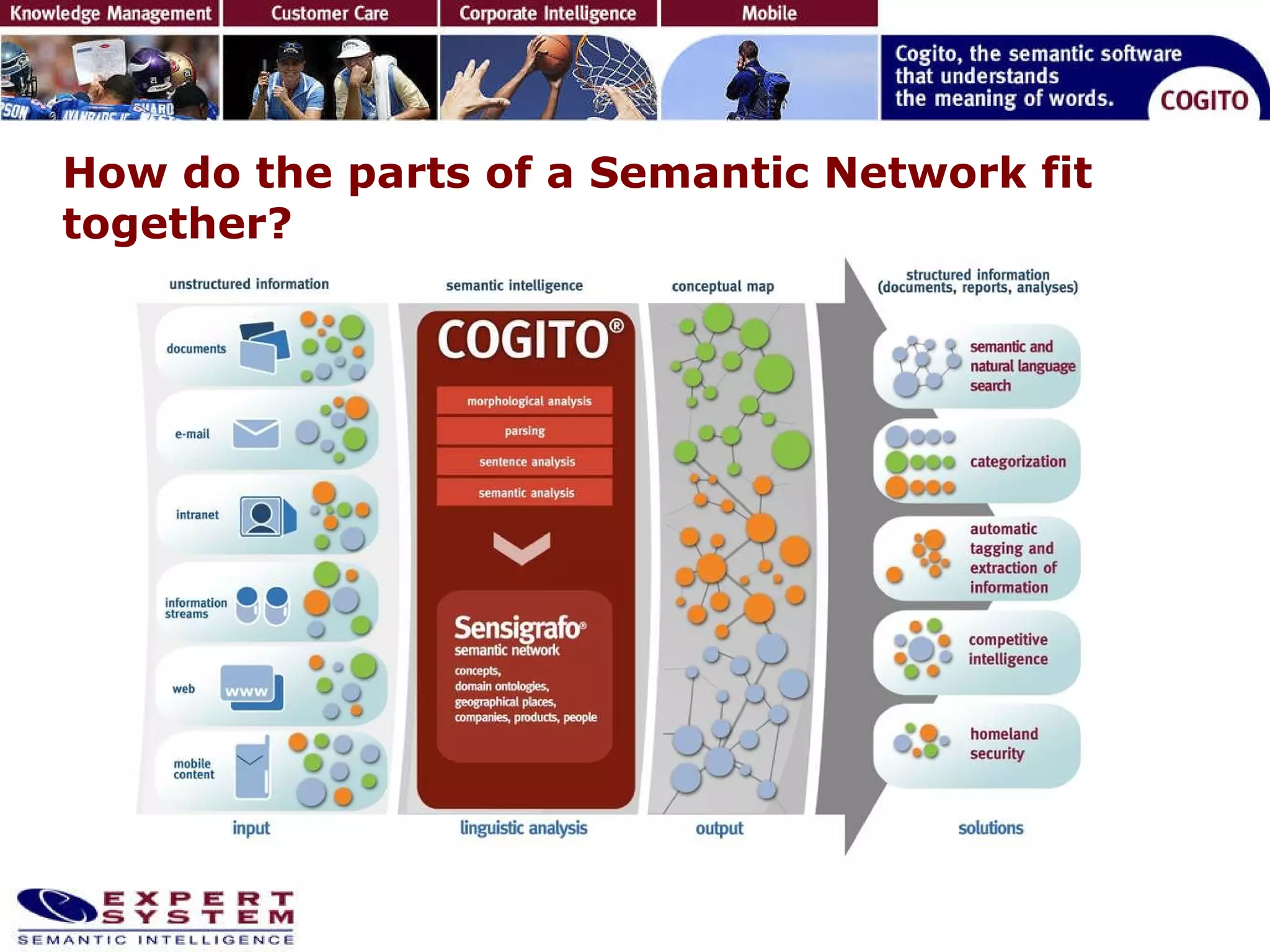
How do the parts of a Semantic Network fit together?
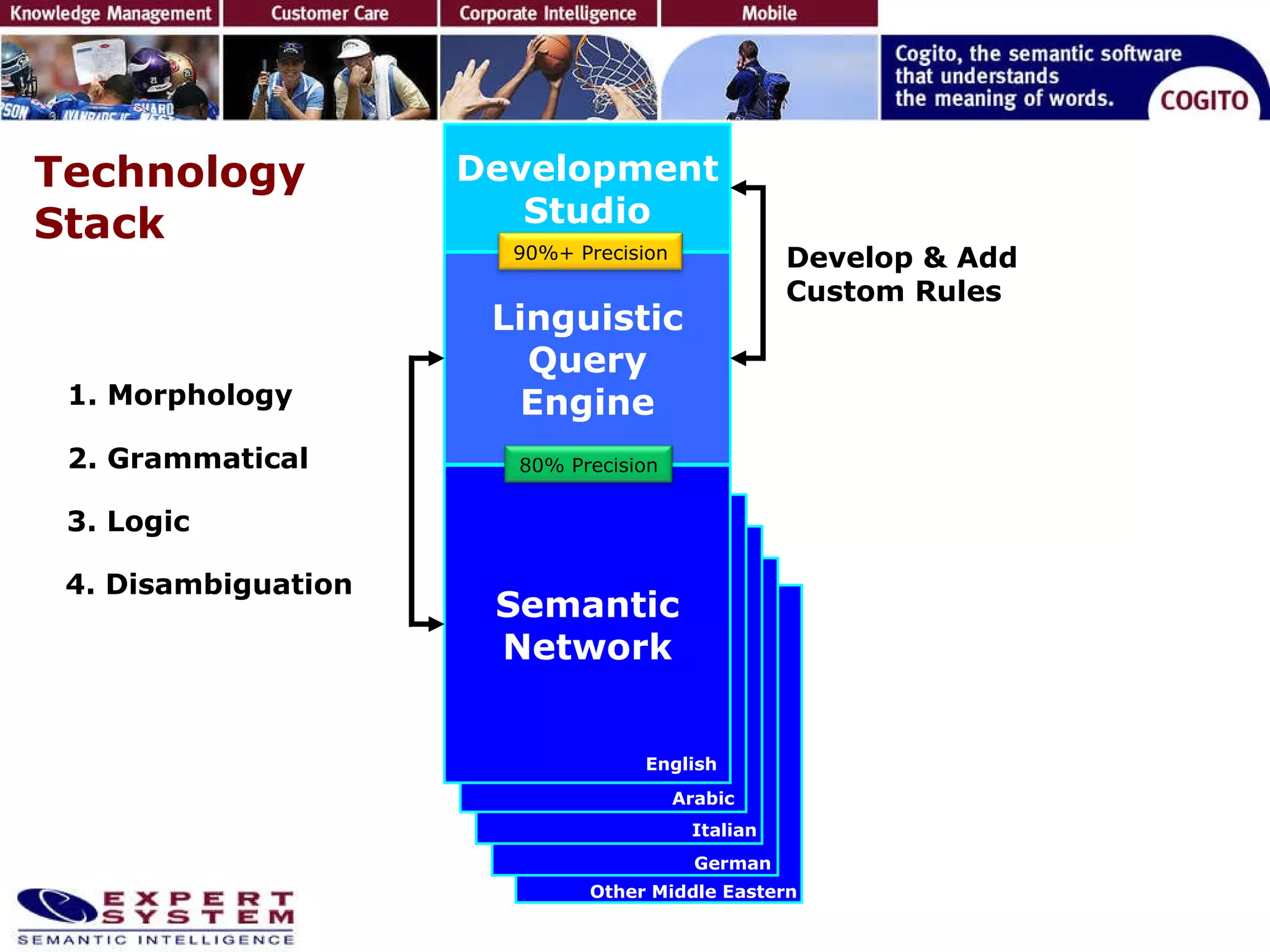
Technology  Stack  Semantic Network Semantic Network Semantic Network Semantic Network Semantic Network Linguistic Query Engine Development Studio English Arabic Italian German Other Middle Eastern 1. Morphology 2. Grammatical 4. Disambiguation Develop & Add Custom Rules 3. Logic 80% Precision 90%+ Precision
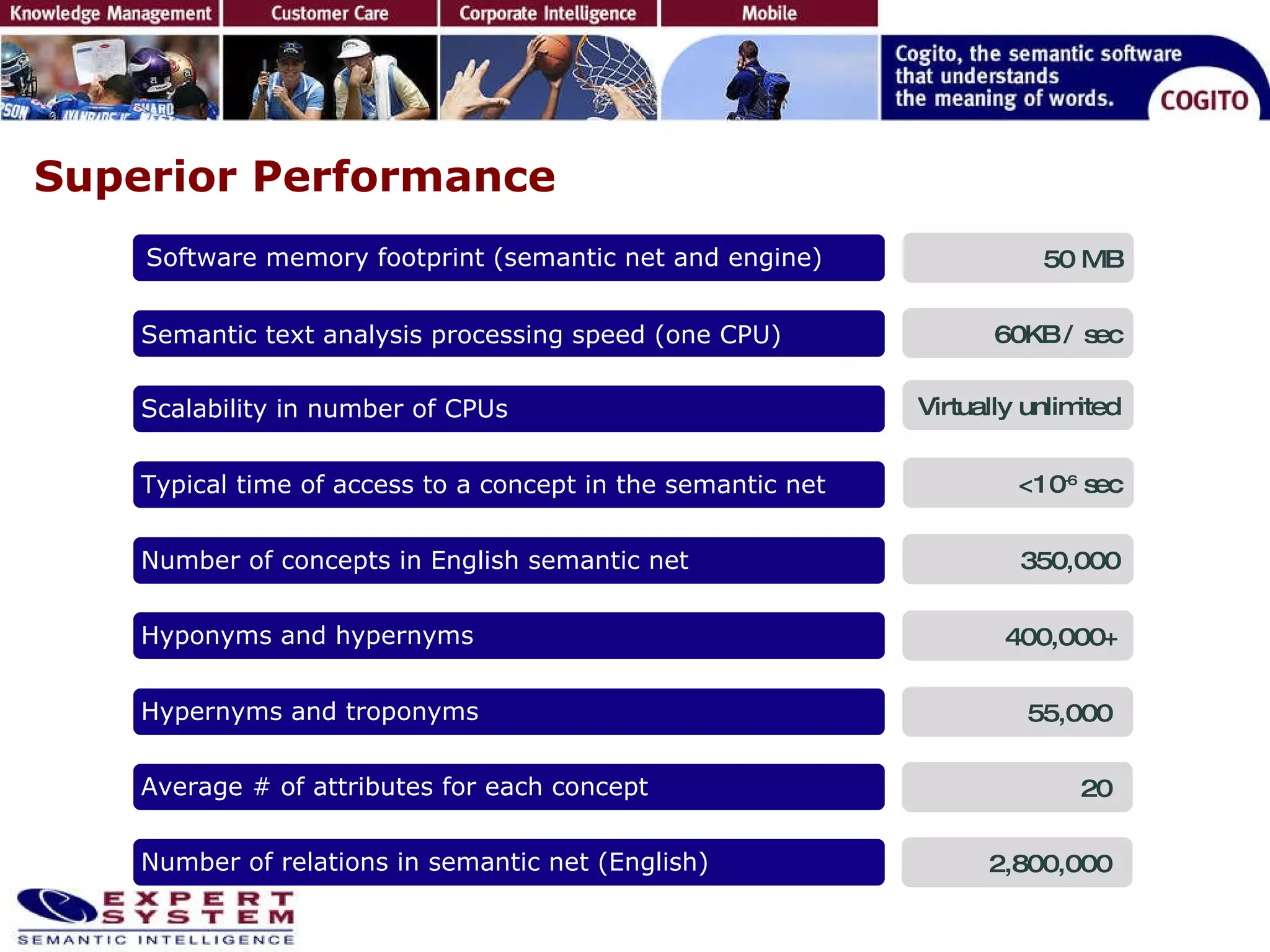
Superior Performance 60KB / sec <10 -6  sec Software memory footprint (semantic net and engine) 50 MB 350,000 400,000+ 55,000  20  2,800,000  Virtually unlimited  Semantic text analysis processing speed (one CPU) Scalability in number of CPUs Typical time of access to a concept in the semantic net Number of concepts in English semantic net Hyponyms and hypernyms Hypernyms and troponyms Average # of attributes for each concept Number of relations in semantic net (English)
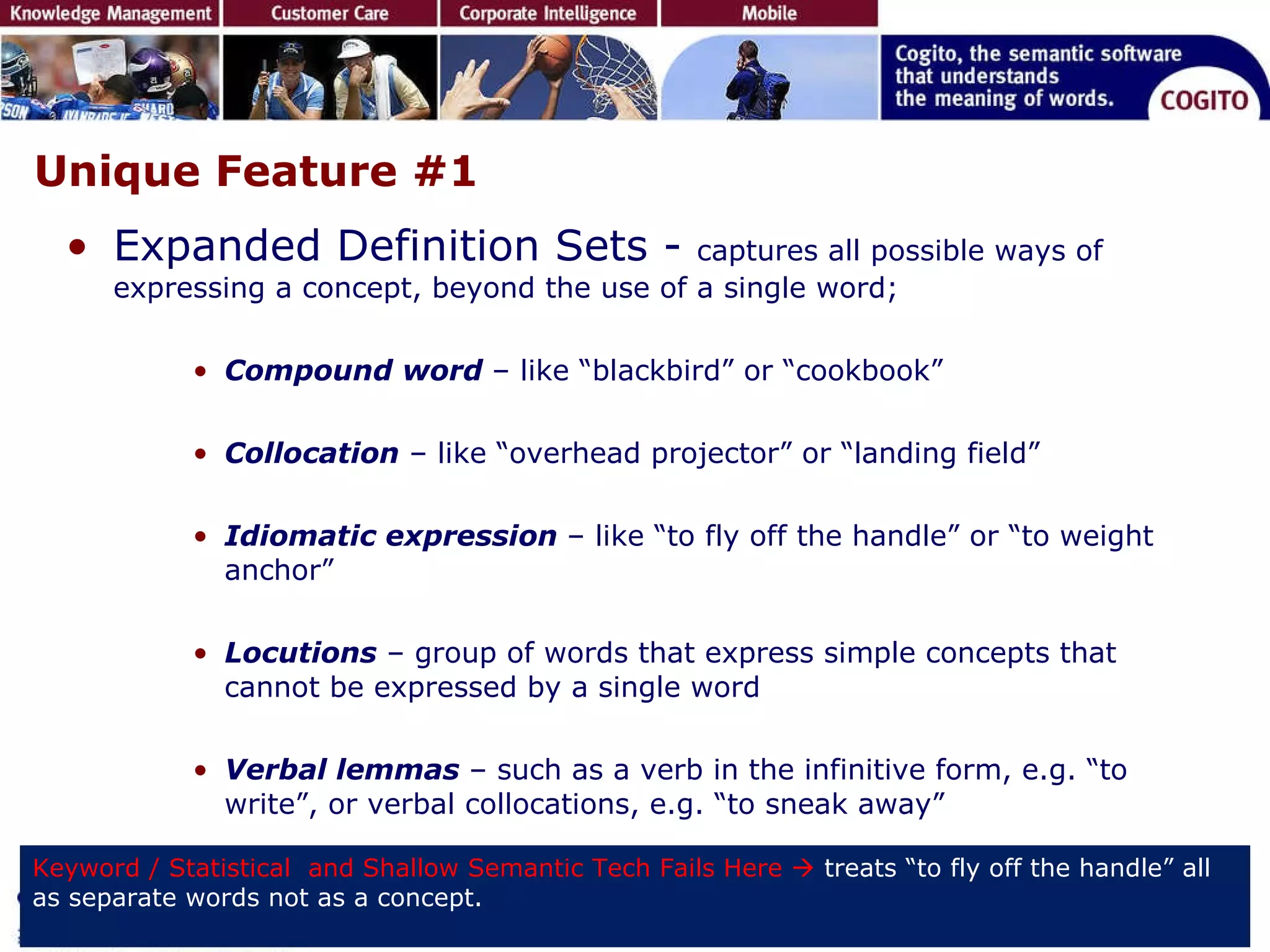
Unique Feature #1 Expanded Definition Sets -  captures all possible ways of expressing a concept, beyond the use of a single word; Compound word   – like “blackbird” or “cookbook” Collocation  – like “overhead projector” or “landing field” Idiomatic expression   – like “to fly off the handle” or “to weight anchor” Locutions  – group of words that express simple concepts that cannot be expressed by a single word Verbal lemmas   – such as a verb in the infinitive form, e.g. “to write”, or verbal collocations, e.g. “to sneak away” Keyword / Statistical  and Shallow Semantic Tech Fails Here     treats “to fly off the handle” all as separate words not as a concept.
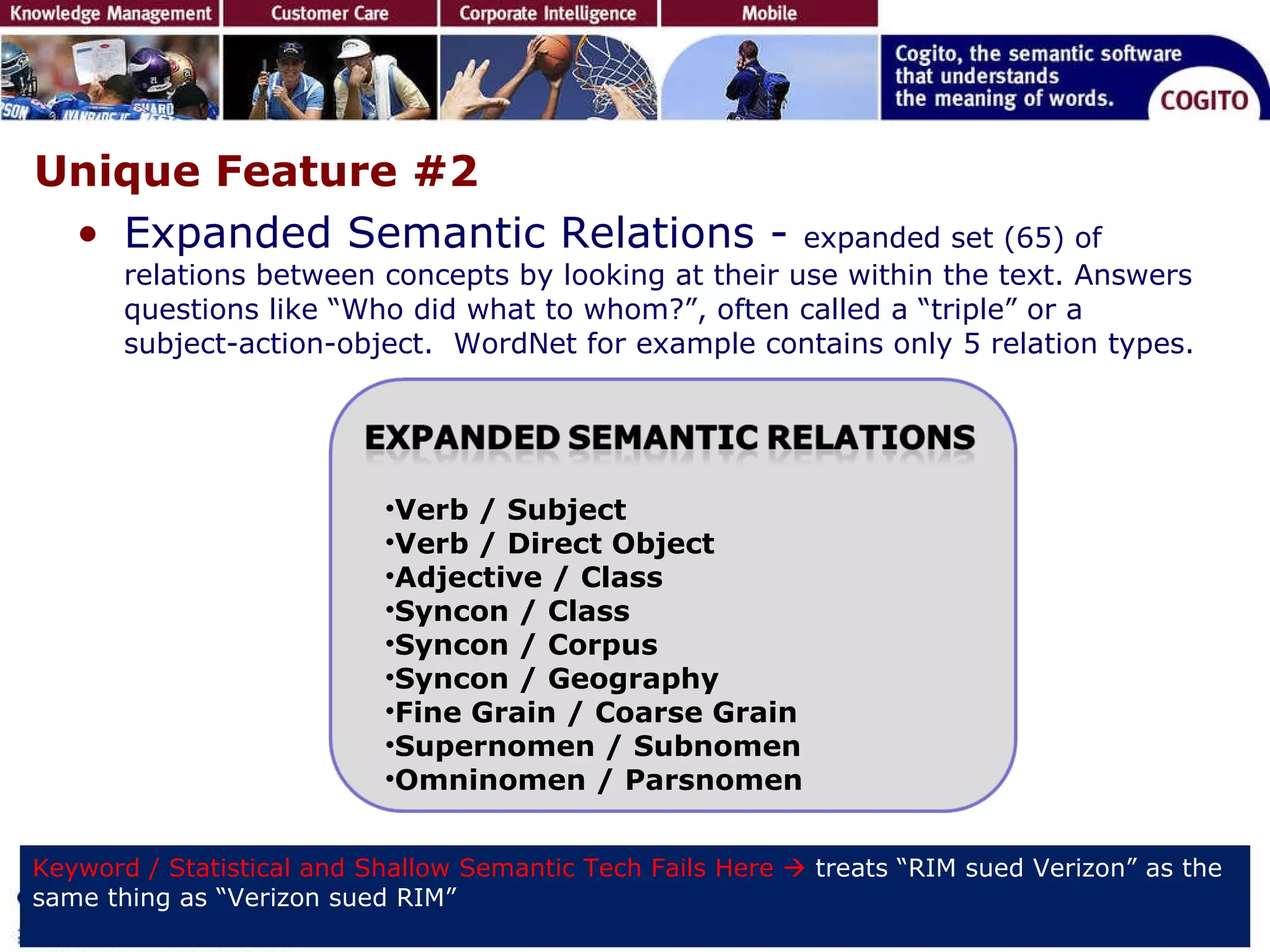
Unique Feature #2 Expanded Semantic Relations -  expanded set (65) of relations between concepts by looking at their use within the text. Answers questions like “Who did what to whom?”, often called a “triple” or a subject-action-object.  WordNet for example contains only 5 relation types.  Keyword / Statistical and Shallow Semantic Tech Fails Here     treats “RIM sued Verizon” as the same thing as “Verizon sued RIM” Verb / Subject Verb / Direct Object Adjective / Class Syncon / Class Syncon / Corpus Syncon / Geography Fine Grain / Coarse Grain Supernomen / Subnomen Omninomen / Parsnomen
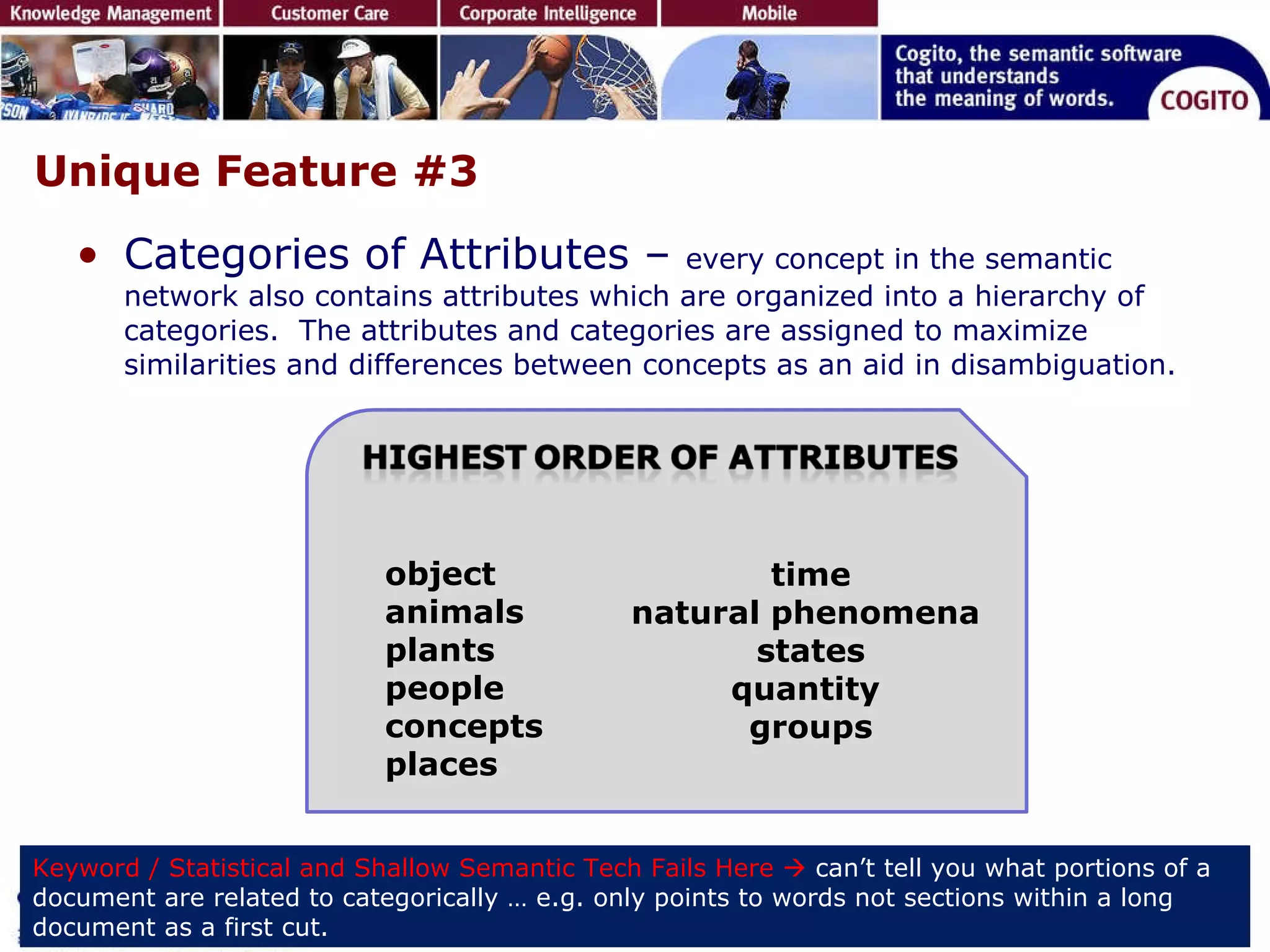
Unique Feature #3 Categories of Attributes –  every concept in the semantic network also contains attributes which are organized into a hierarchy of categories.  The attributes and categories are assigned to maximize similarities and differences between concepts as an aid in disambiguation.  Keyword / Statistical and Shallow Semantic Tech Fails Here     can’t tell you what portions of a document are related to categorically … e.g. only points to words not sections within a long document as a first cut.  object animals  plants people  concepts  places time natural phenomena  states quantity  groups
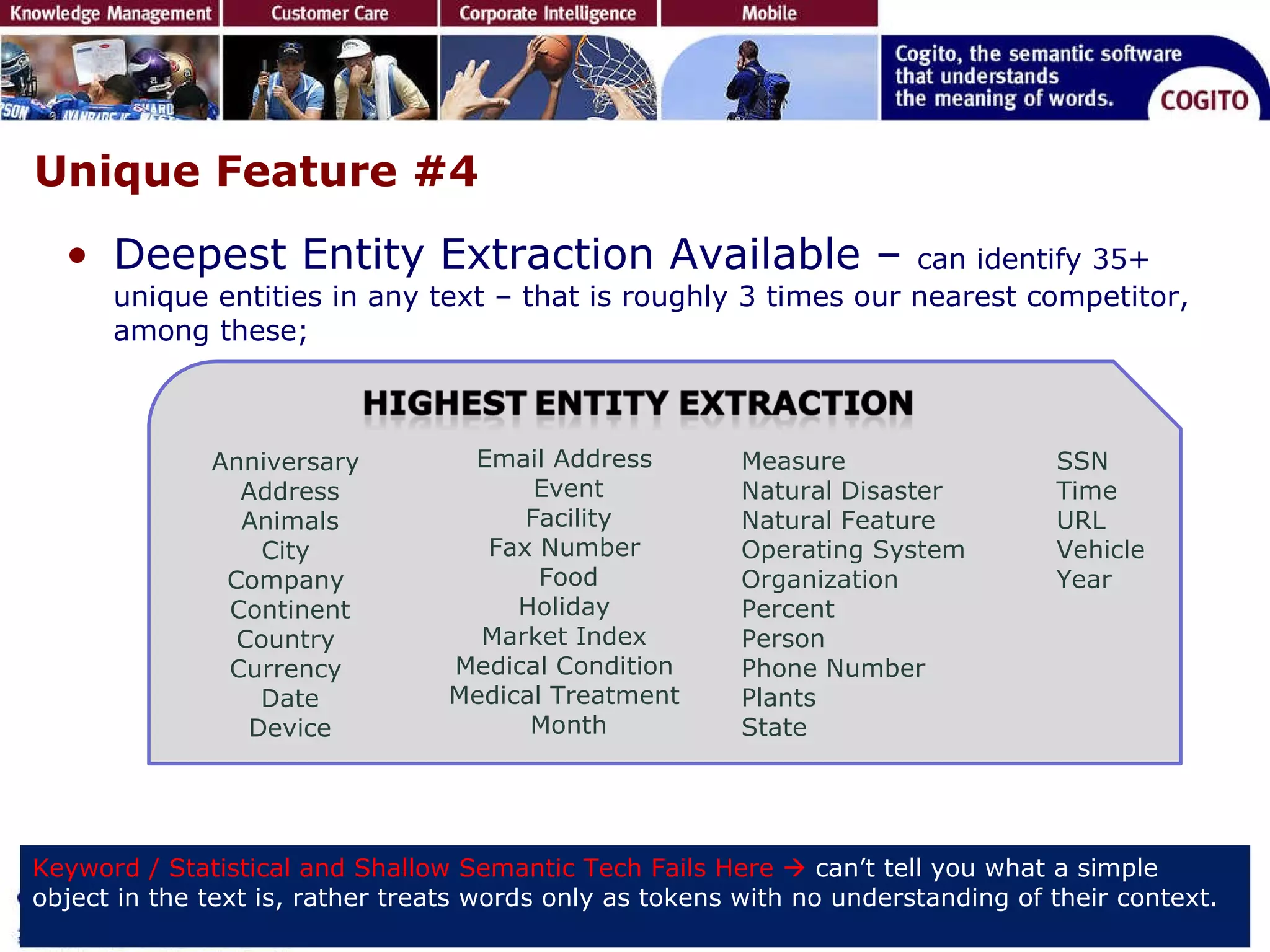
Unique Feature #4 Deepest Entity Extraction Available –  can identify 35+ unique entities in any text – that is roughly 3 times our nearest competitor, among these; Keyword / Statistical and Shallow Semantic Tech Fails Here     can’t tell you what a simple object in the text is, rather treats words only as tokens with no understanding of their context.  Anniversary  Address Animals City  Company  Continent Country  Currency  Date Device Email Address  Event Facility Fax Number  Food Holiday  Market Index  Medical Condition  Medical Treatment  Month Measure Natural Disaster  Natural Feature  Operating System  Organization  Percent Person  Phone Number  Plants State  SSN Time  URL Vehicle Year
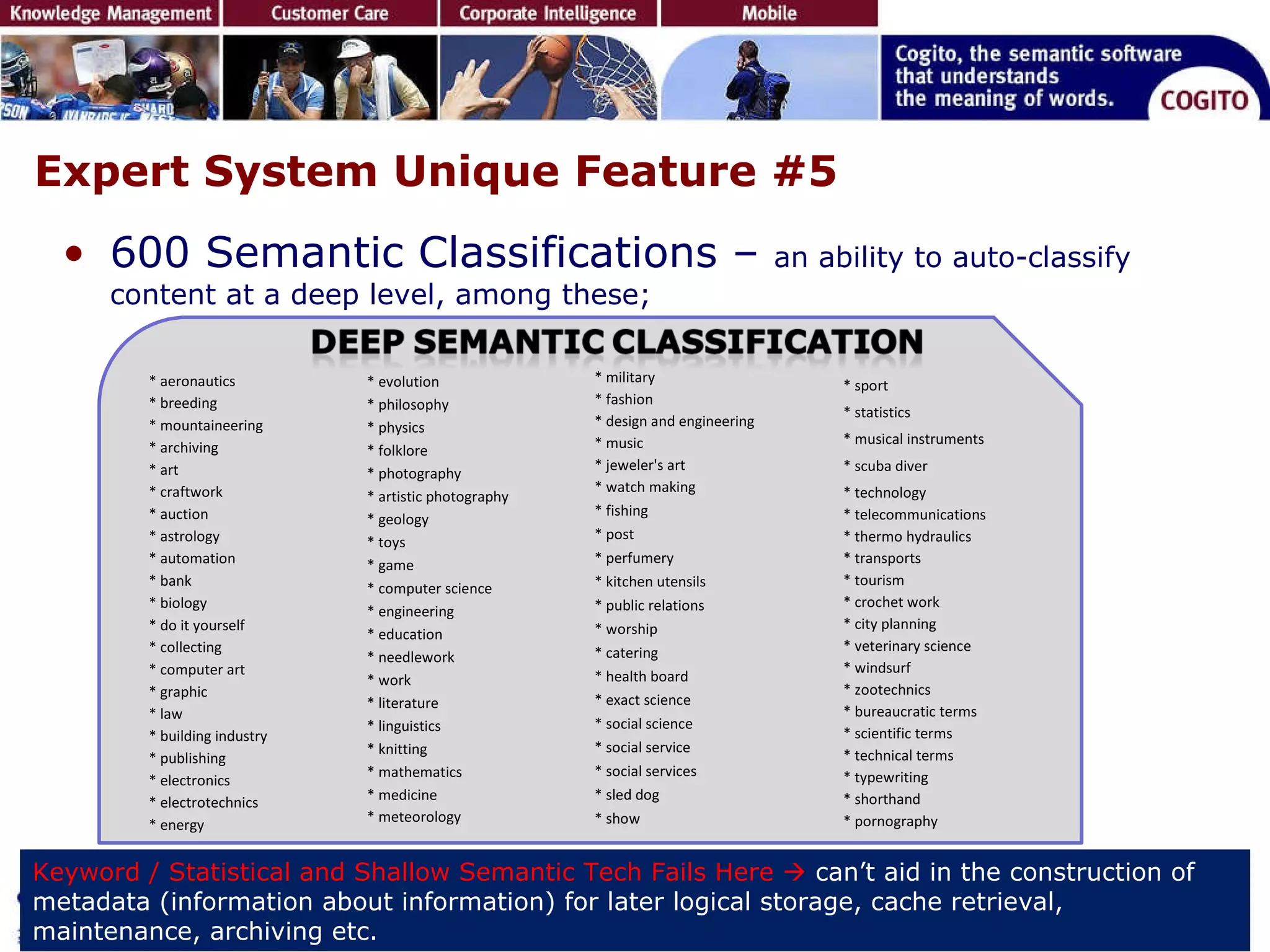
Expert System Unique Feature #5 600 Semantic Classifications –  an ability to auto-classify content at a deep level, among these; Keyword / Statistical and Shallow Semantic Tech Fails Here     can’t aid in the construction of metadata (information about information) for later logical storage, cache retrieval, maintenance, archiving etc.  * aeronautics * breeding * mountaineering * archiving * art * craftwork * auction * astrology * automation * bank * biology * do it yourself * collecting * computer art * graphic * law * building industry * publishing * electronics * electrotechnics * energy * evolution * philosophy * physics * folklore * photography * artistic photography * geology * toys * game * computer science * engineering * education * needlework * work * literature * linguistics * knitting * mathematics * medicine * meteorology * military * fashion * design and engineering * music * jeweler's art * watch making * fishing * post * perfumery * kitchen utensils * public relations * worship * catering * health board * exact science * social science * social service * social services * sled dog * show * sport   * statistics   * musical instruments   * scuba diver   * technology   * telecommunications * thermo hydraulics * transports * tourism * crochet work * city planning * veterinary science * windsurf * zootechnics * bureaucratic terms * scientific terms * technical terms * typewriting * shorthand * pornography
Who Uses Semantic Networks?
Thank you Brooke Aker CEO of Expert System US +1 860-614-2411  [email_address] www.expertsystem.net

Web 3 Expert System

  • 1.
    Web 3.0 ReasoningUsing a Semantic Network J. Brooke Aker CEO Expert System USA Web 3.0 Conference January 26th
  • 2.
    Why Use aSemantic Network? Semantic Networks Linguistic rules Sentence analysis Semantic Network Shallow text analytics Statistics Heuristic rules Morphological recognition Keyword-based technologies Disambiguation Entity extraction Categorization Natural lang. UI Semantic Search Discovery Sentiment
  • 3.
    The heartof semantic technology ; Quality of results derived from the complexity and richness of the network. Includes all definitions of all words. Include relationships among all words. What is a Semantic Network? COGITO® English Semantic Network: - 350,000 words - 2.8m relationships
  • 4.
    COGITO ® : deep analysis What Does a Semantic Network Do? 4 Approaches Definition Example Morphological Analysis understand word forms dog , dogs , and dog-catcher are closely related Grammatical Analysis understand the parts of speech &quot;There are 40 rows in the table&quot; uses rows as a noun, vs. &quot;She rows 5 times a week&quot; uses rows as a verb Logical Analysis understand how words relate to other words &quot;Jeffrey Skilling, represented by Attorney Daniel Petrocelli, is married to Rebecca Carter&quot;. Rebecca is married to Jeffrey not Daniel. Semantic Analysis (disambiguation) understand the context of key words &quot;I used beef broth for my soup stock&quot; uses stock in the context of food, vs. &quot;The company keeps lots of stock on hand&quot; uses stock in the context of inventory.
  • 5.
    What are theparts of a Semantic Network? Using human comprehension for machine understanding of text. Machine understanding of text needs: A semantic network A parser to trace each text back to its basic elements A linguistic engine to query the semantic network A system to eliminate ambiguity Steps to establish meaning Semantic Network Parse Eliminate Ambiguity Order & Priority 1 2 3 Linguistic Query Engine
  • 6.
    Semantic Networks Traditionaltechnologies can only “guess” the meaning using; keywords, shallow linguistics, & statistics Semantic Networks instead indentify; “ San Jose is an American city” “ San Jose is a geographic part of California” Connections Concepts Terms Abbrev. Phrases Meanings Domains
  • 7.
    How do theparts of a Semantic Network fit together?
  • 8.
    Technology Stack Semantic Network Semantic Network Semantic Network Semantic Network Semantic Network Linguistic Query Engine Development Studio English Arabic Italian German Other Middle Eastern 1. Morphology 2. Grammatical 4. Disambiguation Develop & Add Custom Rules 3. Logic 80% Precision 90%+ Precision
  • 9.
    Superior Performance 60KB/ sec <10 -6 sec Software memory footprint (semantic net and engine) 50 MB 350,000 400,000+ 55,000 20 2,800,000 Virtually unlimited Semantic text analysis processing speed (one CPU) Scalability in number of CPUs Typical time of access to a concept in the semantic net Number of concepts in English semantic net Hyponyms and hypernyms Hypernyms and troponyms Average # of attributes for each concept Number of relations in semantic net (English)
  • 10.
    Unique Feature #1Expanded Definition Sets - captures all possible ways of expressing a concept, beyond the use of a single word; Compound word – like “blackbird” or “cookbook” Collocation – like “overhead projector” or “landing field” Idiomatic expression – like “to fly off the handle” or “to weight anchor” Locutions – group of words that express simple concepts that cannot be expressed by a single word Verbal lemmas – such as a verb in the infinitive form, e.g. “to write”, or verbal collocations, e.g. “to sneak away” Keyword / Statistical and Shallow Semantic Tech Fails Here  treats “to fly off the handle” all as separate words not as a concept.
  • 11.
    Unique Feature #2Expanded Semantic Relations - expanded set (65) of relations between concepts by looking at their use within the text. Answers questions like “Who did what to whom?”, often called a “triple” or a subject-action-object. WordNet for example contains only 5 relation types. Keyword / Statistical and Shallow Semantic Tech Fails Here  treats “RIM sued Verizon” as the same thing as “Verizon sued RIM” Verb / Subject Verb / Direct Object Adjective / Class Syncon / Class Syncon / Corpus Syncon / Geography Fine Grain / Coarse Grain Supernomen / Subnomen Omninomen / Parsnomen
  • 12.
    Unique Feature #3Categories of Attributes – every concept in the semantic network also contains attributes which are organized into a hierarchy of categories. The attributes and categories are assigned to maximize similarities and differences between concepts as an aid in disambiguation. Keyword / Statistical and Shallow Semantic Tech Fails Here  can’t tell you what portions of a document are related to categorically … e.g. only points to words not sections within a long document as a first cut. object animals plants people concepts places time natural phenomena states quantity groups
  • 13.
    Unique Feature #4Deepest Entity Extraction Available – can identify 35+ unique entities in any text – that is roughly 3 times our nearest competitor, among these; Keyword / Statistical and Shallow Semantic Tech Fails Here  can’t tell you what a simple object in the text is, rather treats words only as tokens with no understanding of their context. Anniversary Address Animals City Company Continent Country Currency Date Device Email Address Event Facility Fax Number Food Holiday Market Index Medical Condition Medical Treatment Month Measure Natural Disaster Natural Feature Operating System Organization Percent Person Phone Number Plants State SSN Time URL Vehicle Year
  • 14.
    Expert System UniqueFeature #5 600 Semantic Classifications – an ability to auto-classify content at a deep level, among these; Keyword / Statistical and Shallow Semantic Tech Fails Here  can’t aid in the construction of metadata (information about information) for later logical storage, cache retrieval, maintenance, archiving etc. * aeronautics * breeding * mountaineering * archiving * art * craftwork * auction * astrology * automation * bank * biology * do it yourself * collecting * computer art * graphic * law * building industry * publishing * electronics * electrotechnics * energy * evolution * philosophy * physics * folklore * photography * artistic photography * geology * toys * game * computer science * engineering * education * needlework * work * literature * linguistics * knitting * mathematics * medicine * meteorology * military * fashion * design and engineering * music * jeweler's art * watch making * fishing * post * perfumery * kitchen utensils * public relations * worship * catering * health board * exact science * social science * social service * social services * sled dog * show * sport   * statistics   * musical instruments   * scuba diver   * technology   * telecommunications * thermo hydraulics * transports * tourism * crochet work * city planning * veterinary science * windsurf * zootechnics * bureaucratic terms * scientific terms * technical terms * typewriting * shorthand * pornography
  • 15.
  • 16.
    Thank you BrookeAker CEO of Expert System US +1 860-614-2411 [email_address] www.expertsystem.net