Semantic Networks
Definition
Semantic Net
• Form of knowledge representation
• Predicate logic alternative
• Labelled directed graph
• Components:
• Nodes – object or concept
• Links – relation between nodes.
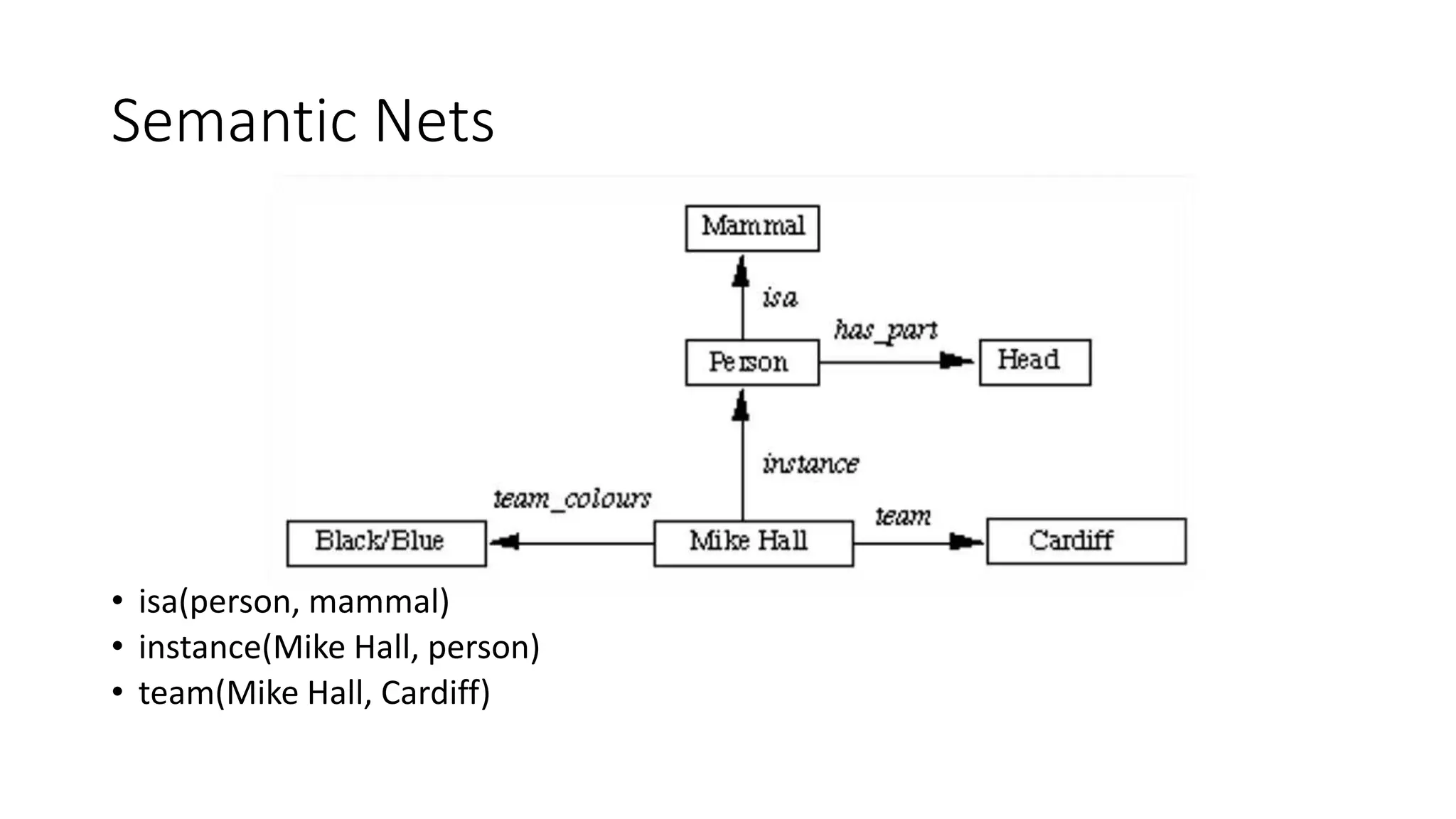
Semantic Nets
• isa(person, mammal)
• instance(Mike Hall, person)
• team(Mike Hall, Cardiff)
Kinds of Semantic Nets
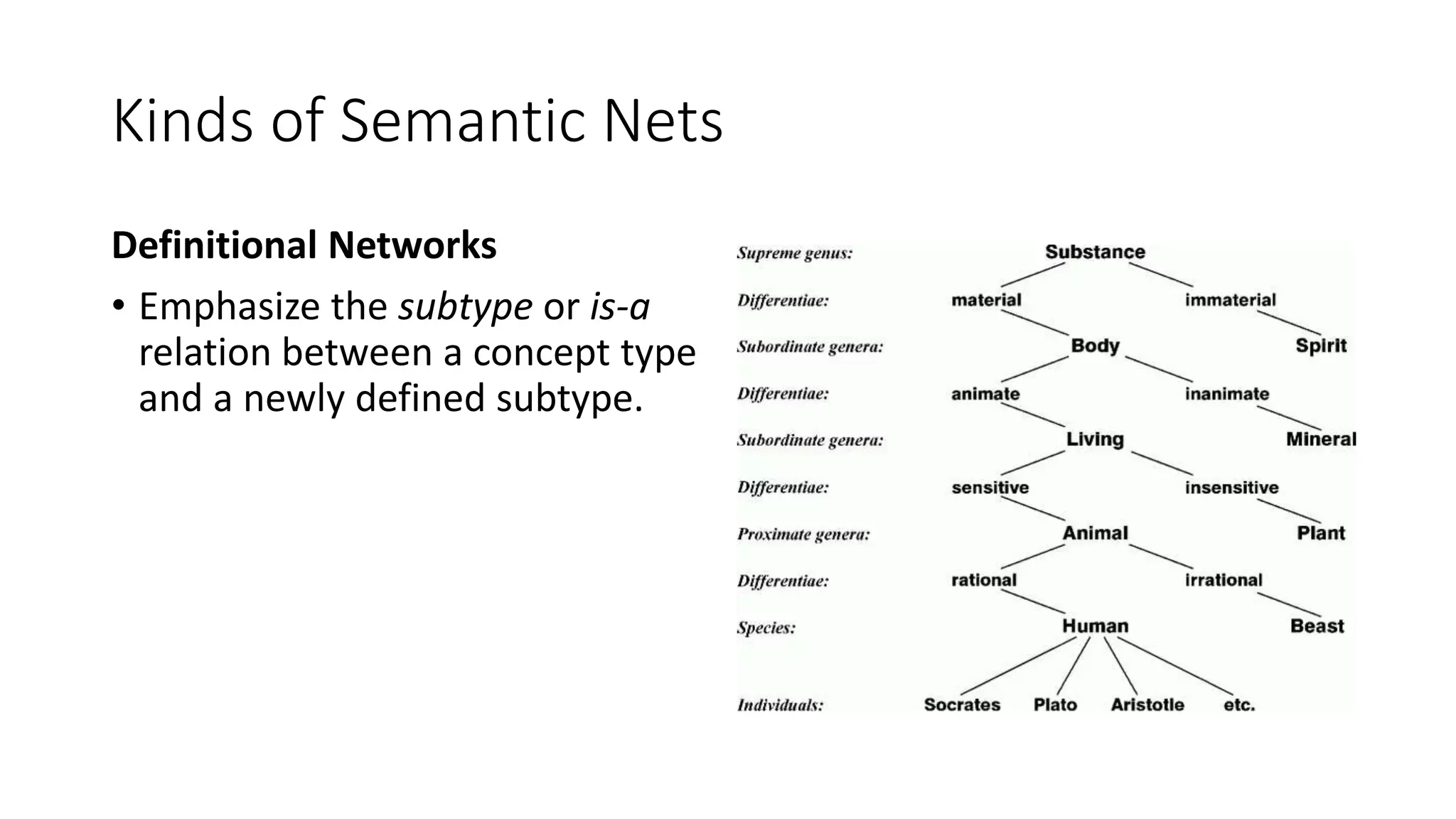
Definitional Networks
• Emphasize the subtype or is-a
relation between a concept type
and a newly defined subtype.
Kinds of Semantic Nets
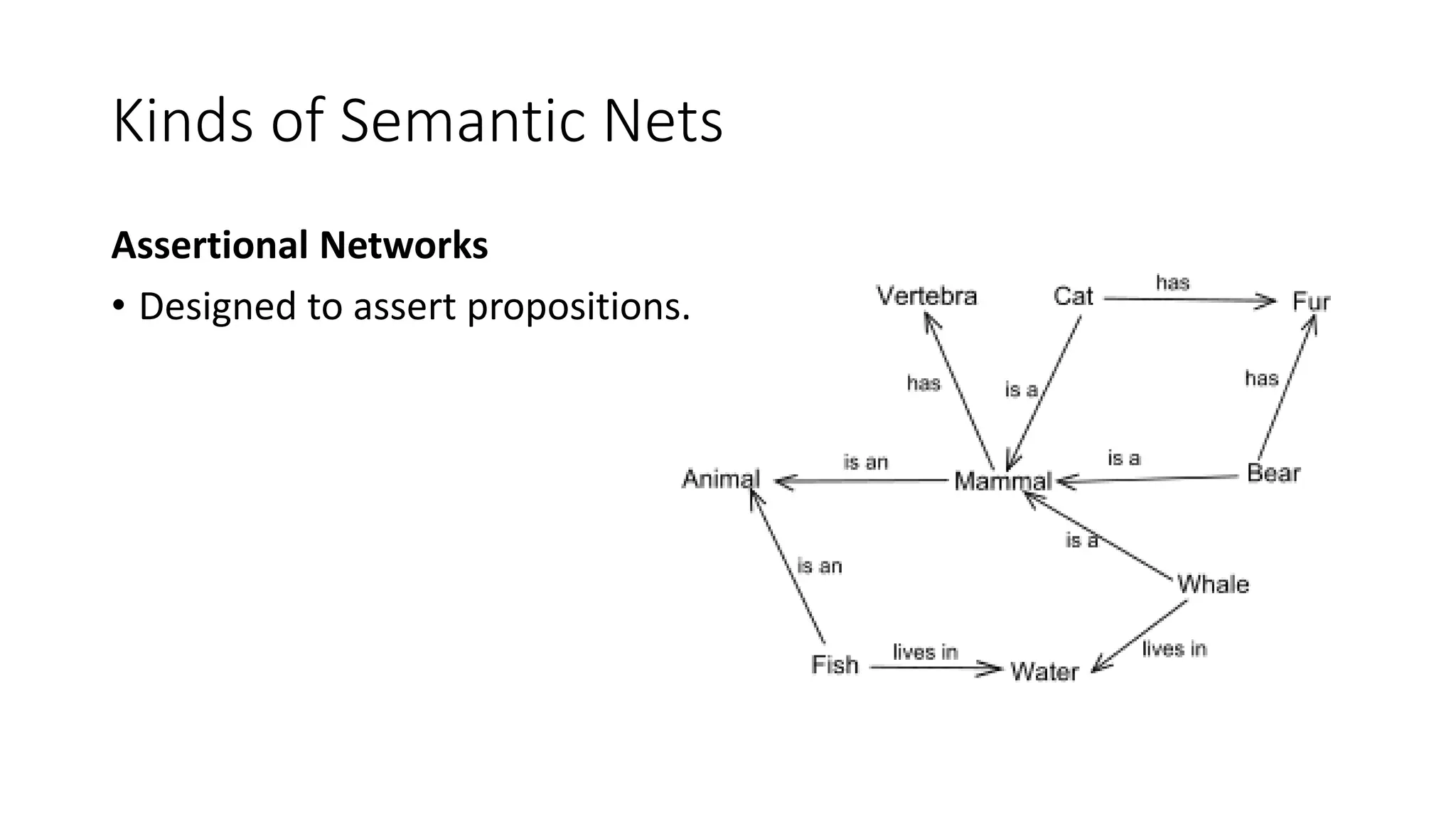
Assertional Networks
• Designed to assert propositions.
Kinds of Semantic Nets
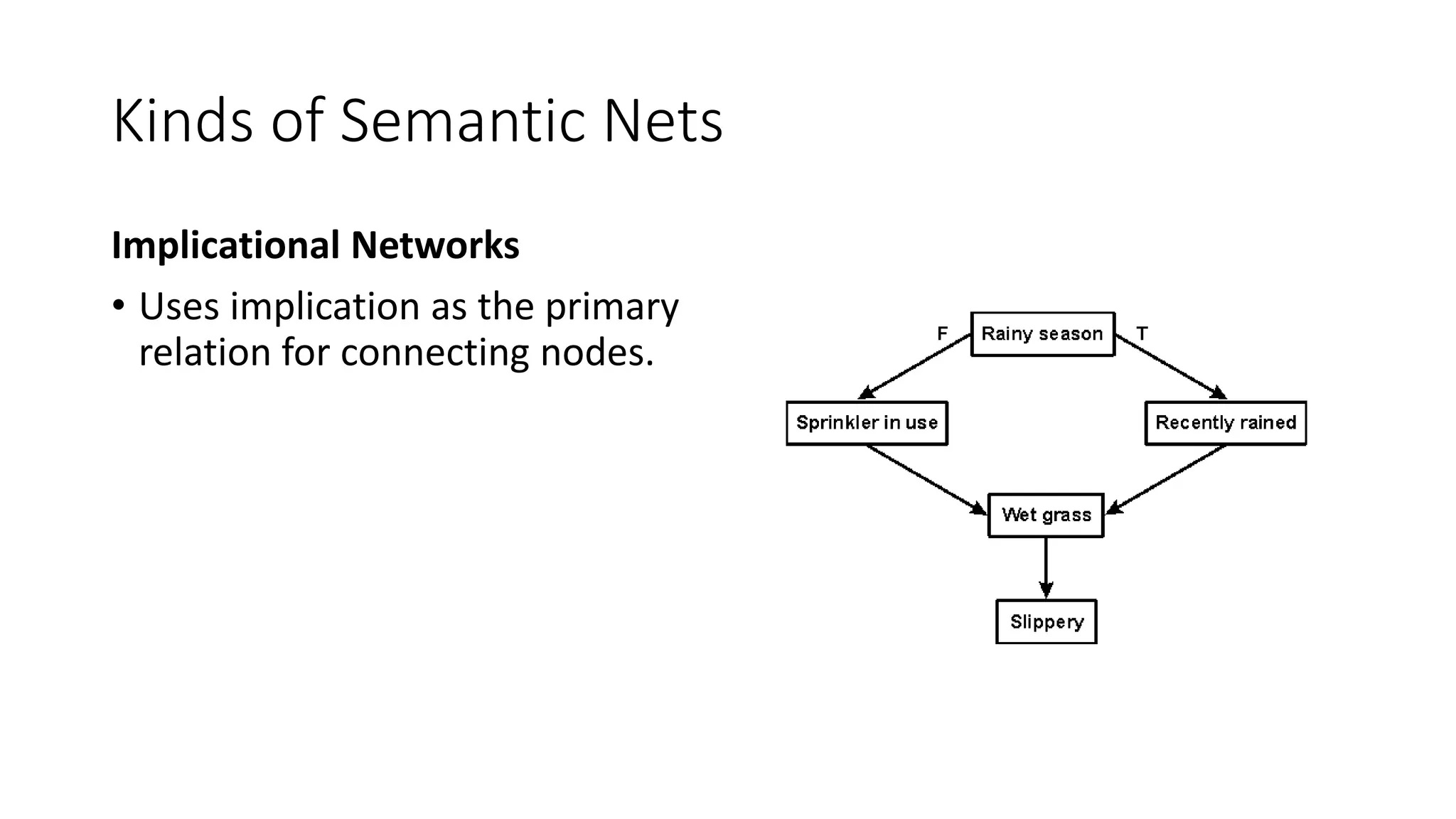
Implicational Networks
• Uses implication as the primary
relation for connecting nodes.
Kinds of Semantic Nets
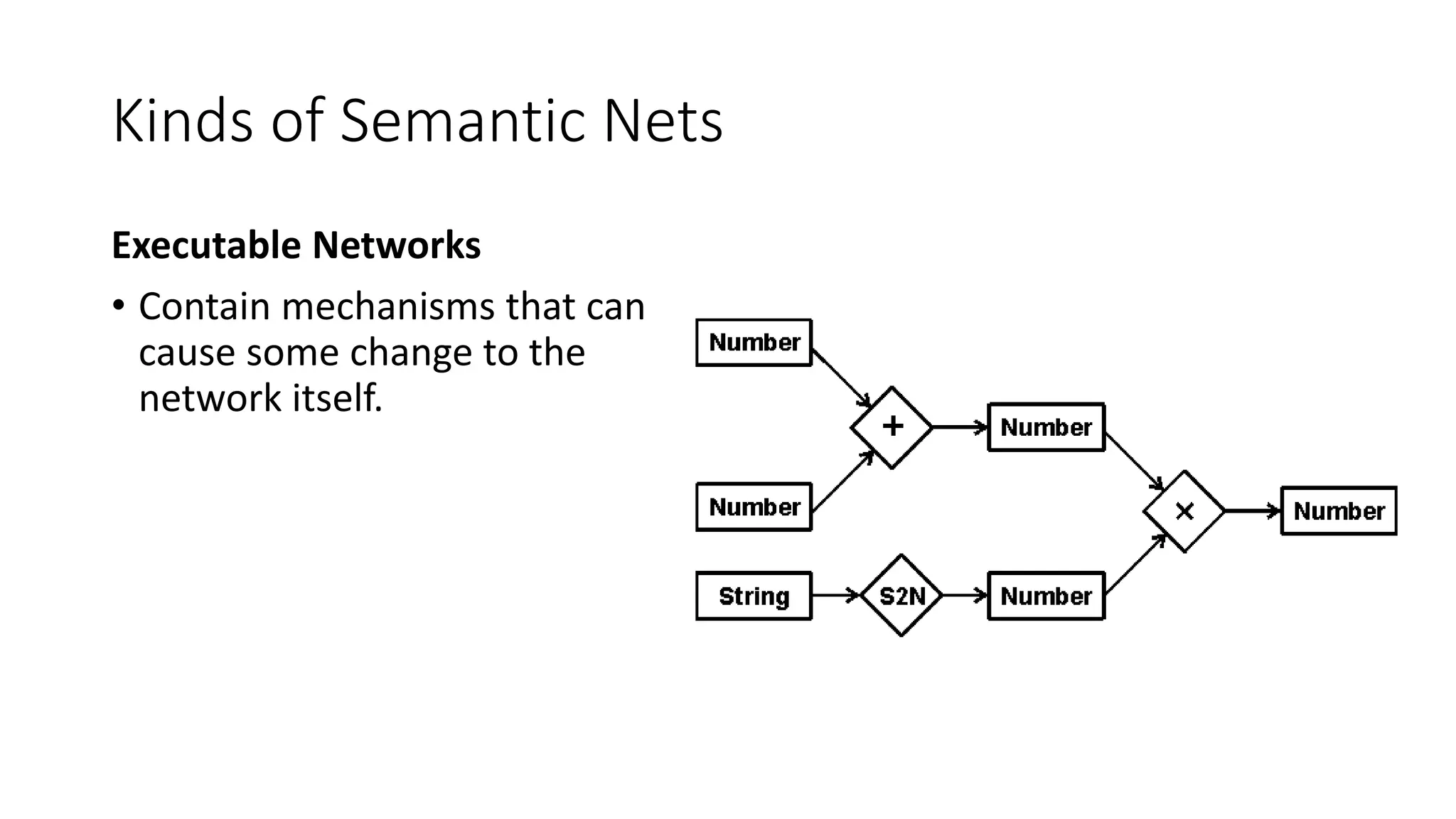
Executable Networks
• Contain mechanisms that can
cause some change to the
network itself.
Kinds of Semantic Nets
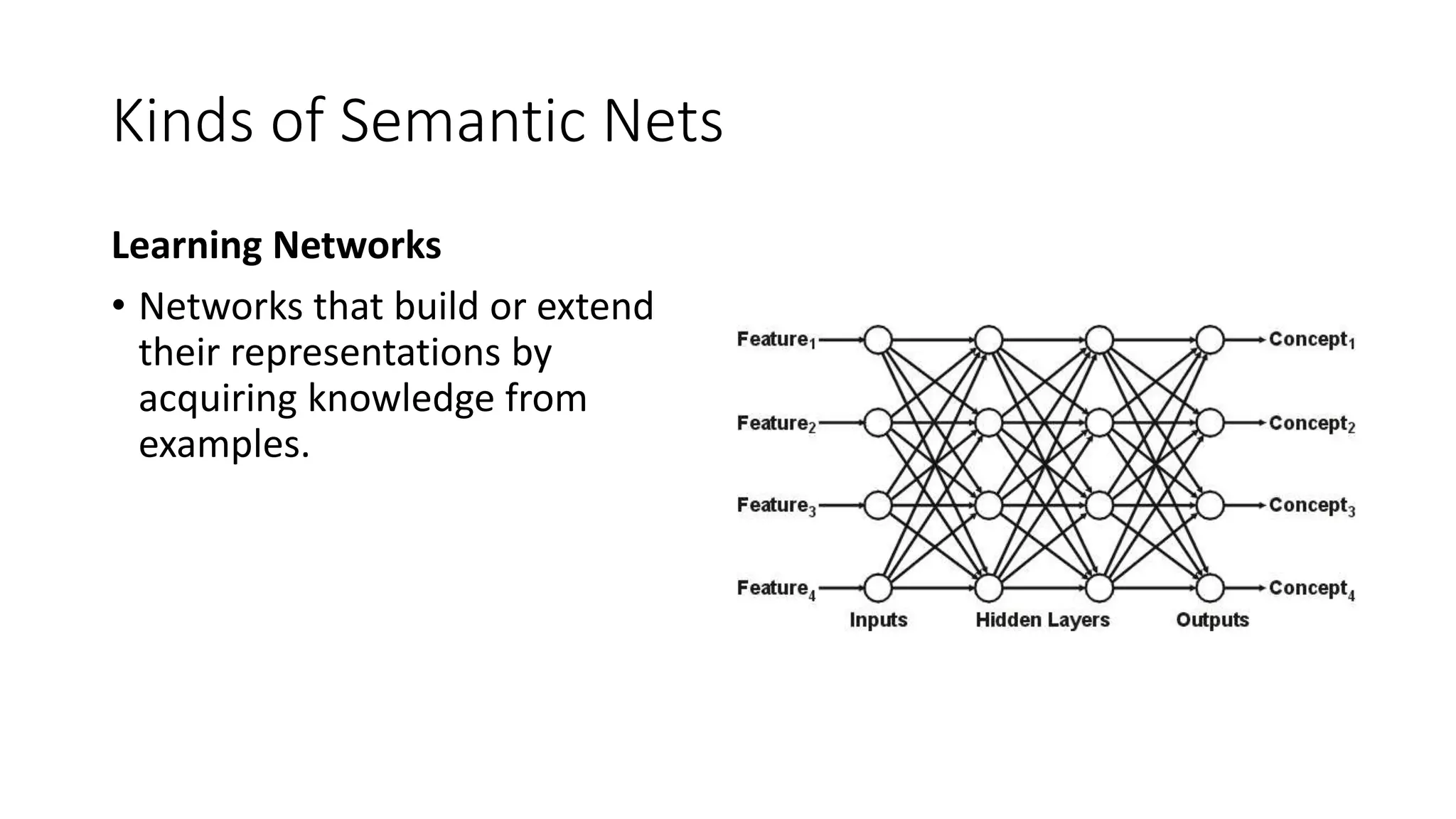
Learning Networks
• Networks that build or extend
their representations by
acquiring knowledge from
examples.
Kinds of Semantic Nets
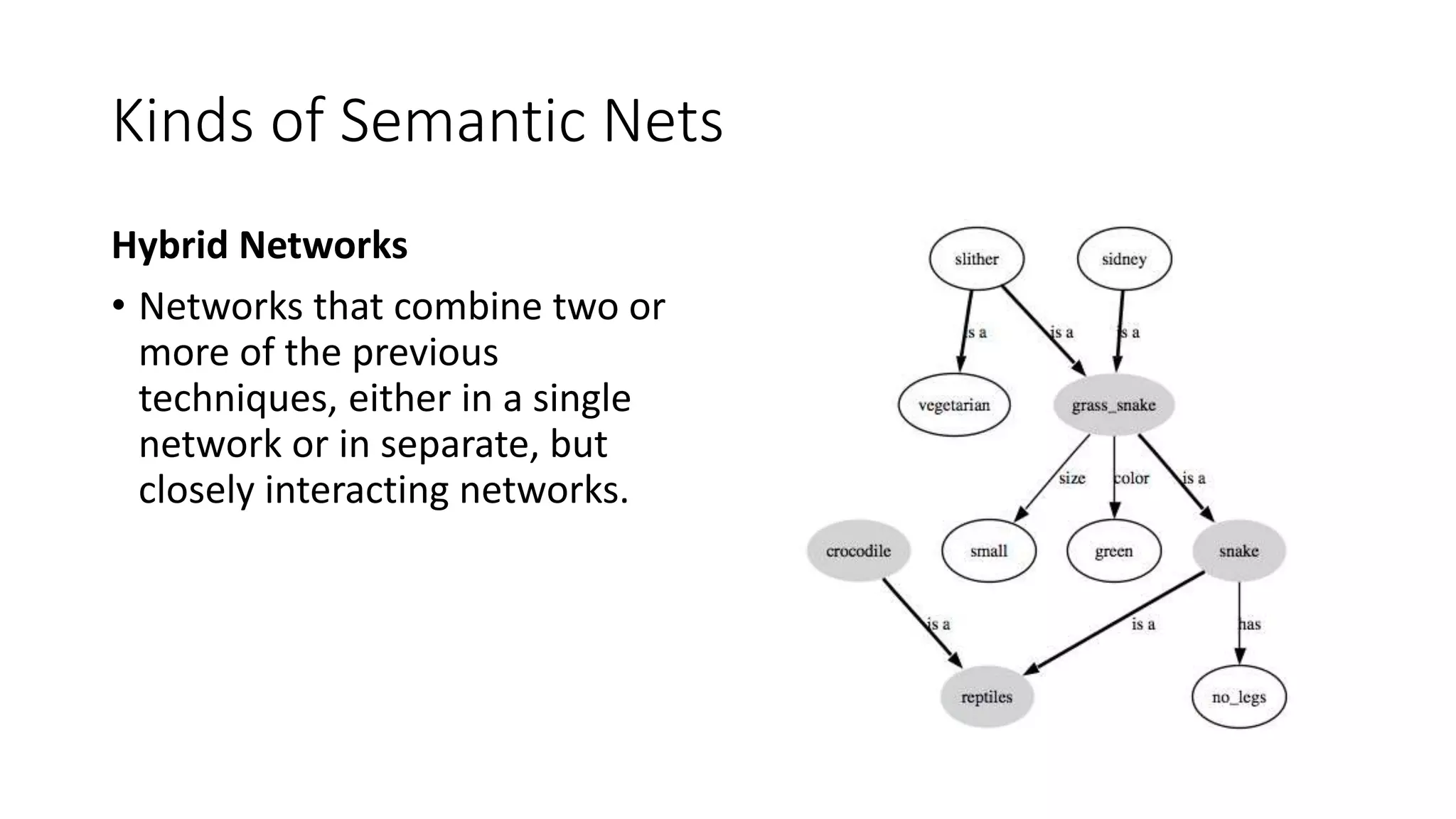
Hybrid Networks
• Networks that combine two or
more of the previous
techniques, either in a single
network or in separate, but
closely interacting networks.
Semantic Relations
• Antonymy - A is the opposite of B (Cold is the opposite of warm)
• Holonymy - B has A as a part of itself (Bedroom has bed)
• Homonymy - A and B, are expressed by the same symbol. (Both a financial
institution and a edge of a river are expressed by the word bank)
• Hypernymy - A is the superordinate of B. A is the general kind of B(Animal
is a hypernym of dog)
• Hyponymy or troponomy - A is a subordinate of B. A is a specific kind or
instance of B (Dog is a hyponym of animal)
• Meronymy - A is part of B (Engine is part of car)
• Synonymy - A denotes the same as B (Happy is synonym of blissful)
Common Semantic Relations
• There is no standard set of relations for semantic networks, but the following
relations are very common:
• INSTANCE: X is an INSTANCE of Y if X is a specific example of the general concept
Y.
• Example: Elvis is an INSTANCE of Human
• ISA: X ISA Y if X is a subset of the more general concept Y.
• Example: sparrow ISA bird
• HASPART: X HASPART Y if the concept Y is a part of the concept X. (Or this can be
any other property)
• Example: sparrow HASPART tail
Inheritance
• A key concept in semantic networks and can be represented naturally
by following ISA links.
• In general, if concept X has property P, then all concepts that are a
subset of X should also have property P.
Common Semantic Relations
• There is no standard set of relations for semantic networks, but the following
relations are very common:
• INSTANCE: X is an INSTANCE of Y if X is a specific example of the general concept
Y.
• Example: Elvis is an INSTANCE of Human
• ISA: X ISA Y if X is a subset of the more general concept Y.
• Example: sparrow ISA bird
• HASPART: X HASPART Y if the concept Y is a part of the concept X. (Or this can be
any other property)
• Example: sparrow HASPART tail
Converting to Semantic Net
Example
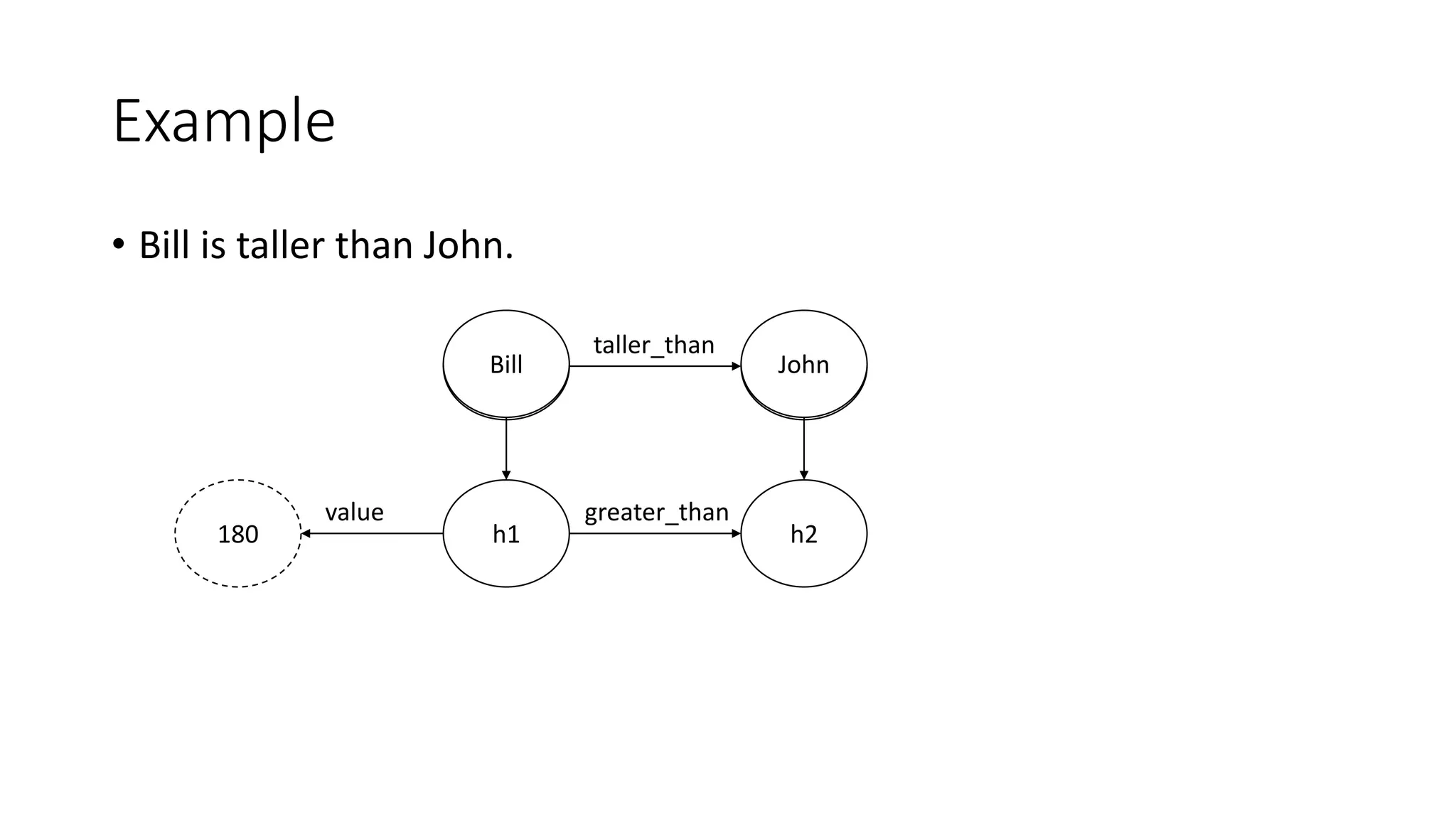
• Bill is taller than John.
Bill John
taller_than
Bill John
value
h1 h2
greater_than
180
nodes represent object, and arcs represent
relationships between those objects
Steps
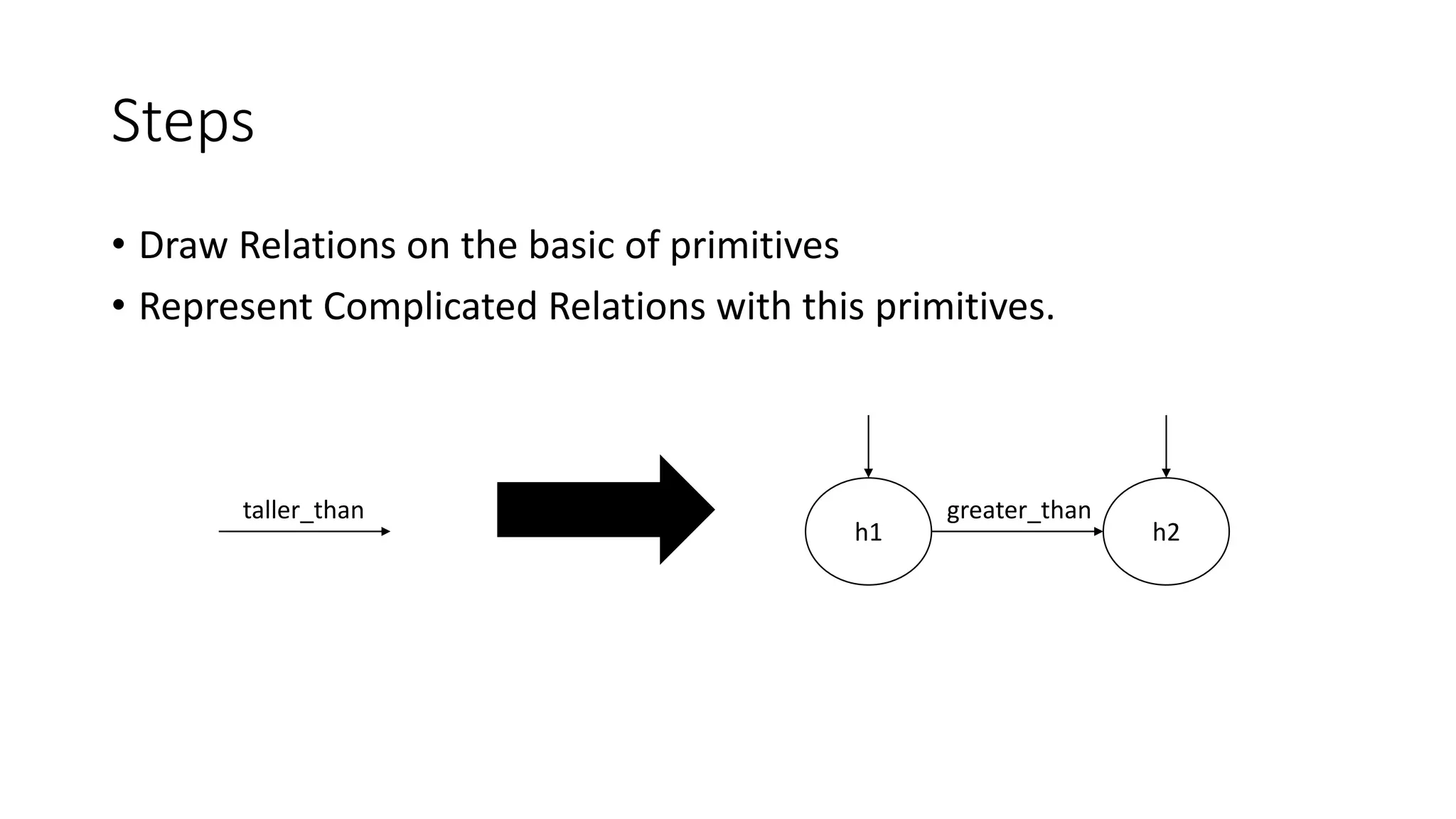
• Draw Relations on the basic of primitives
• Represent Complicated Relations with this primitives.
taller_than
h1 h2
greater_than
Reification
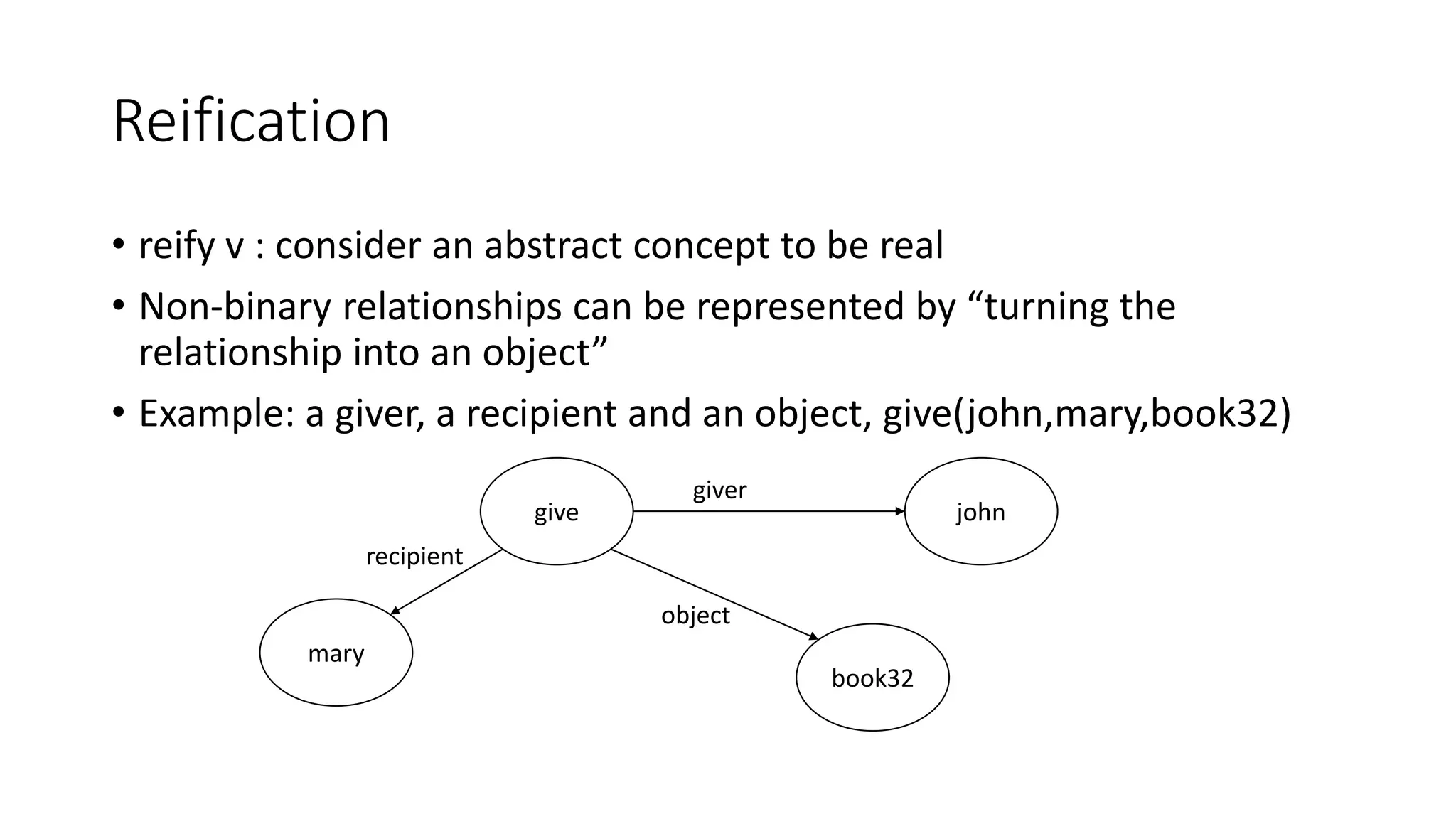
• reify v : consider an abstract concept to be real
• Non-binary relationships can be represented by “turning the
relationship into an object”
• Example: a giver, a recipient and an object, give(john,mary,book32)
give john
book32
mary
recipient
giver
object
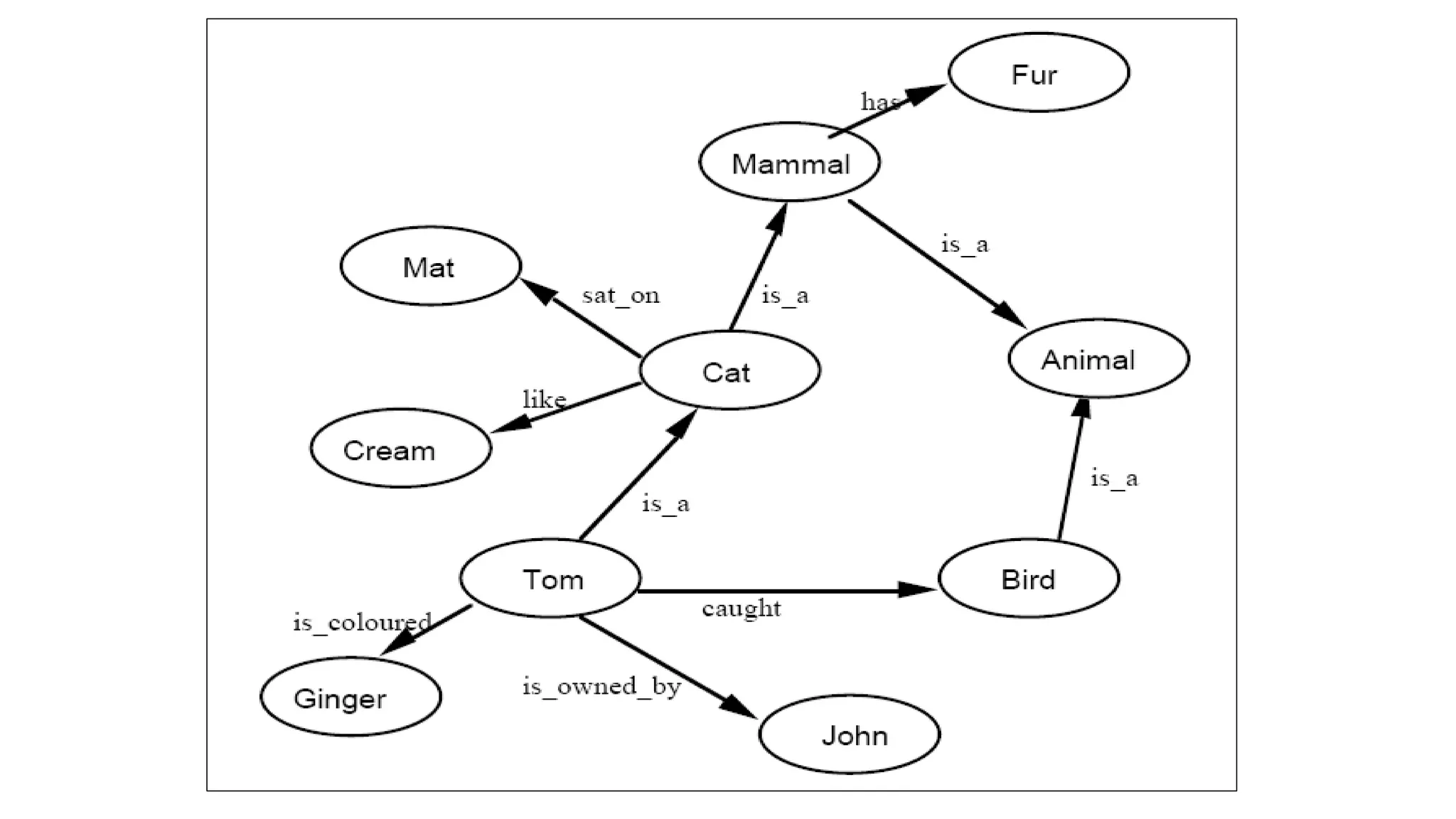
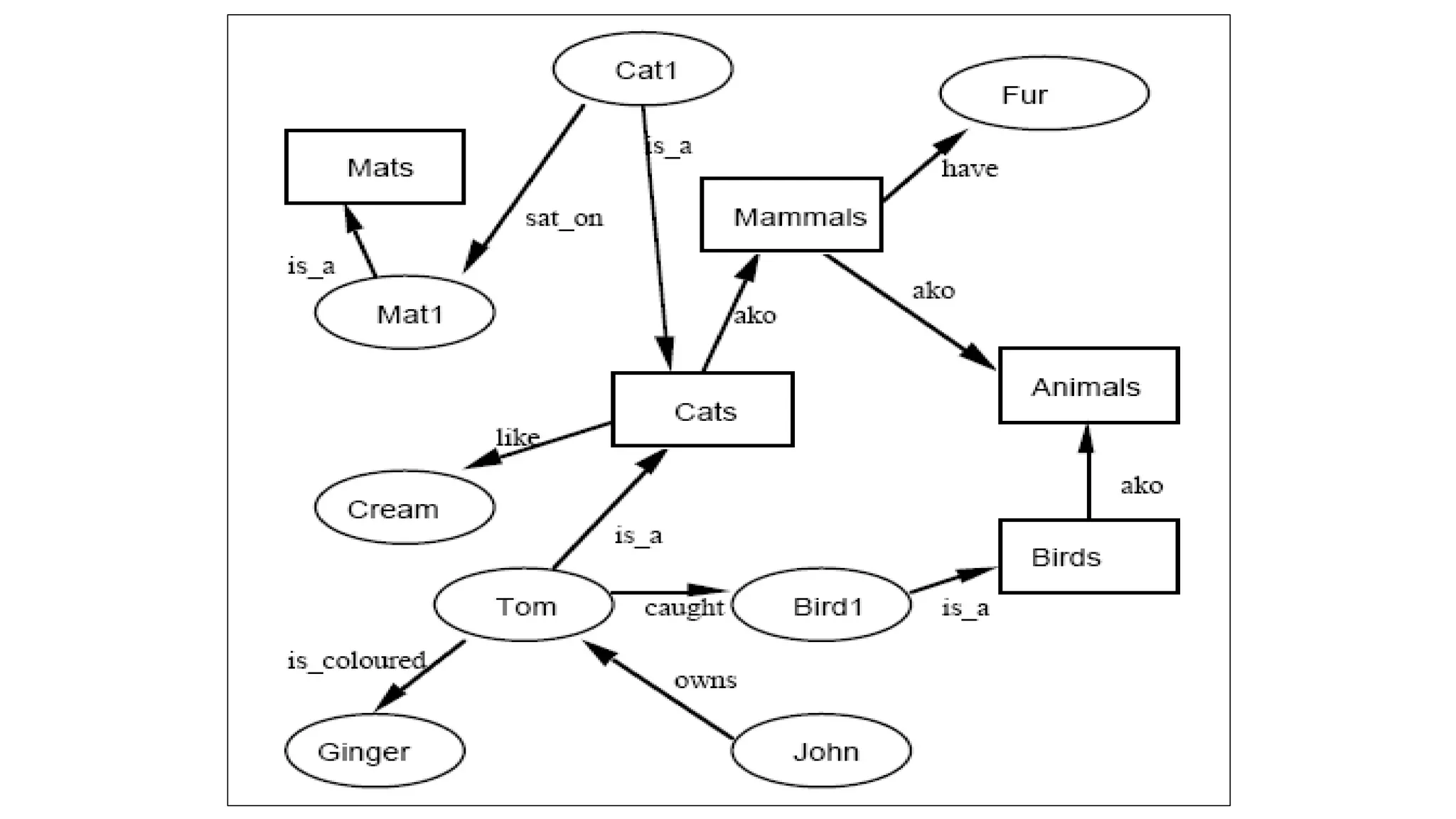
EXAMPLE
• Tom is a cat.
• Tom caught a bird.
• Tom is owned by John.
• Tom is ginger in colour.
• Cats like cream.
• The cat sat on the mat.
• A cat is a mammal.
• A bird is an animal.
• All mammals are animals.
• Mammals have fur.
Disadvantages of using Semantic
Nets
Disadvantages
• There is no standard definition of link names
• Semantic Nets are not intelligent, dependent on creator
• Links are not all alike in function or form, confusion in links that
asserts relationships and structural links.
• Undistinguished nodes that represent classes and that represent
individual objects.
• Links on objects represent only binary relations.
• Negation, disjunction and general non-taxonomic knowledge are not
easily expressed.
Advantages of using Semantic
Nets
Advantages
• Natural
• Modular
• Efficient
• Convey meaning in a transparent manner
• Simple
• Understandable
• Translatable to PROLOG w/o difficulty
References:
• http://www.jfsowa.com/pubs/semnet.htm

Semantic Networks

  • 1.
  • 2.
  • 3.
    Semantic Net • Formof knowledge representation • Predicate logic alternative • Labelled directed graph • Components: • Nodes – object or concept • Links – relation between nodes.
  • 4.
    Semantic Nets • isa(person,mammal) • instance(Mike Hall, person) • team(Mike Hall, Cardiff)
  • 5.
    Kinds of SemanticNets Definitional Networks • Emphasize the subtype or is-a relation between a concept type and a newly defined subtype.
  • 6.
    Kinds of SemanticNets Assertional Networks • Designed to assert propositions.
  • 7.
    Kinds of SemanticNets Implicational Networks • Uses implication as the primary relation for connecting nodes.
  • 8.
    Kinds of SemanticNets Executable Networks • Contain mechanisms that can cause some change to the network itself.
  • 9.
    Kinds of SemanticNets Learning Networks • Networks that build or extend their representations by acquiring knowledge from examples.
  • 10.
    Kinds of SemanticNets Hybrid Networks • Networks that combine two or more of the previous techniques, either in a single network or in separate, but closely interacting networks.
  • 11.
    Semantic Relations • Antonymy- A is the opposite of B (Cold is the opposite of warm) • Holonymy - B has A as a part of itself (Bedroom has bed) • Homonymy - A and B, are expressed by the same symbol. (Both a financial institution and a edge of a river are expressed by the word bank) • Hypernymy - A is the superordinate of B. A is the general kind of B(Animal is a hypernym of dog) • Hyponymy or troponomy - A is a subordinate of B. A is a specific kind or instance of B (Dog is a hyponym of animal) • Meronymy - A is part of B (Engine is part of car) • Synonymy - A denotes the same as B (Happy is synonym of blissful)
  • 12.
    Common Semantic Relations •There is no standard set of relations for semantic networks, but the following relations are very common: • INSTANCE: X is an INSTANCE of Y if X is a specific example of the general concept Y. • Example: Elvis is an INSTANCE of Human • ISA: X ISA Y if X is a subset of the more general concept Y. • Example: sparrow ISA bird • HASPART: X HASPART Y if the concept Y is a part of the concept X. (Or this can be any other property) • Example: sparrow HASPART tail
  • 13.
    Inheritance • A keyconcept in semantic networks and can be represented naturally by following ISA links. • In general, if concept X has property P, then all concepts that are a subset of X should also have property P.
  • 14.
    Common Semantic Relations •There is no standard set of relations for semantic networks, but the following relations are very common: • INSTANCE: X is an INSTANCE of Y if X is a specific example of the general concept Y. • Example: Elvis is an INSTANCE of Human • ISA: X ISA Y if X is a subset of the more general concept Y. • Example: sparrow ISA bird • HASPART: X HASPART Y if the concept Y is a part of the concept X. (Or this can be any other property) • Example: sparrow HASPART tail
  • 15.
  • 16.
    Example • Bill istaller than John. Bill John taller_than Bill John value h1 h2 greater_than 180
  • 17.
    nodes represent object,and arcs represent relationships between those objects
  • 18.
    Steps • Draw Relationson the basic of primitives • Represent Complicated Relations with this primitives. taller_than h1 h2 greater_than
  • 19.
    Reification • reify v: consider an abstract concept to be real • Non-binary relationships can be represented by “turning the relationship into an object” • Example: a giver, a recipient and an object, give(john,mary,book32) give john book32 mary recipient giver object
  • 20.
    EXAMPLE • Tom isa cat. • Tom caught a bird. • Tom is owned by John. • Tom is ginger in colour. • Cats like cream. • The cat sat on the mat. • A cat is a mammal. • A bird is an animal. • All mammals are animals. • Mammals have fur.
  • 23.
  • 24.
    Disadvantages • There isno standard definition of link names • Semantic Nets are not intelligent, dependent on creator • Links are not all alike in function or form, confusion in links that asserts relationships and structural links. • Undistinguished nodes that represent classes and that represent individual objects. • Links on objects represent only binary relations. • Negation, disjunction and general non-taxonomic knowledge are not easily expressed.
  • 25.
    Advantages of usingSemantic Nets
  • 26.
    Advantages • Natural • Modular •Efficient • Convey meaning in a transparent manner • Simple • Understandable • Translatable to PROLOG w/o difficulty
  • 27.

Editor's Notes

  • #4 Computer implementations of semantic networks were first developed for AI and machine translation Earlier versions have long been used in philosophy, psychology and linguistics
  • #6 Definitional networks The resulting network, also called a generalization or subsumption hierarchy, supports the rule of inheritance for copying properties defined for a supertype to all of its subtypes. Since definitions are true by definition, the information in these networks is often assumed to be necessarily true.
  • #7 Assertional networks Unlike definitional networks, the information in an assertional network is assumed to be contingently true, unless it is explicitly marked with a modal operator. Some assertional netwoks have been proposed as models of the conceptual structures underlying natural language semantics.
  • #8 Implicational networks may be used to represent patterns of beliefs, causality, or inferences.
  • #9 Executable networks Includes some mechanism which can perform inferences, pass messages, or search for patterns and associations include some mechanism, such as marker passing (pass information from node to node) or attached procedures (programs associated with nodes perform actions on that node or on proximate nodes), graph transformations (modify graphs in various ways)
  • #10 Learning networks build or extend their representations by acquiring knowledge from examples. The new knowledge may change the old network by adding and deleting nodes and arcs or by modifying numerical values, called weights, associated with the nodes and arcs.