Wealth Management Lending
A safe approach to increasing your loan book.
Wealth Management Lending – Grow your loan book
LEGAL NOTICE
The information in this document is subject to change without notice and does not represent a
commitment on the part of Rockall Technologies. Rockall Technologies has taken reasonable care in
the production of this document to provide accuracy and precision but do not accept any
responsibility for any errors that may appear in this document.
The software described in this document is furnished under a license and may be used only in
accordance with the terms of such license.

Copyright © 2012 by Rockall Technologies. All rights reserved.

The copyright of this work is vested in Rockall Technologies and the documentation is issued in
confidence for the purposes only for which it is supplied. It must not be reproduced in whole or in
part or used for tendering or manufacturing purposes except under an agreement or with the
consent in writing of Rockall Technologies and then only on the condition that this notice is included
in any such reproduction. No information as to the contents or subject matter of this document or
any part thereof arising directly or indirectly there from shall be given orally or in writing or
communicated in any manner whatsoever to any third party being an individual firm or company or
any employee thereof without the prior consent in writing of Rockall Technologies.

DOCUMENTATION FEEDBACK
Rockall Technologies values your feedback on any aspect of our documentation. Please feel free to
email your comments or suggestions to our documentation section:

documentation@rockalltech.com

© 2012 Rockall Technologies Confidential

Page 2 of 12
Wealth Management Lending – Grow your loan book

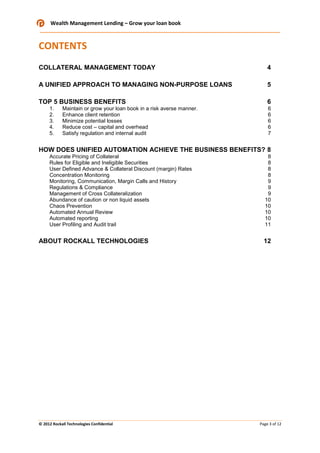
CONTENTS
COLLATERAL MANAGEMENT TODAY

4

A UNIFIED APPROACH TO MANAGING NON-PURPOSE LOANS

5

TOP 5 BUSINESS BENEFITS

6

1.
2.
3.
4.
5.

Maintain or grow your loan book in a risk averse manner.
Enhance client retention
Minimize potential losses
Reduce cost – capital and overhead
Satisfy regulation and internal audit

6
6
6
6
7

HOW DOES UNIFIED AUTOMATION ACHIEVE THE BUSINESS BENEFITS? 8
Accurate Pricing of Collateral
Rules for Eligible and Ineligible Securities
User Defined Advance & Collateral Discount (margin) Rates
Concentration Monitoring
Monitoring, Communication, Margin Calls and History
Regulations & Compliance
Management of Cross Collateralization
Abundance of caution or non liquid assets
Chaos Prevention
Automated Annual Review
Automated reporting
User Profiling and Audit trail

ABOUT ROCKALL TECHNOLOGIES

© 2012 Rockall Technologies Confidential

8
8
8
8
9
9
9
10
10
10
10
11

12

Page 3 of 12
Wealth Management Lending – Grow your loan book

Collateral Management Today
The management of non-purpose loans is presenting financial institutions with significant
challenges. However, the advent of automated and integrated collateral management systems not
only addresses these challenges but also creates opportunities for lenders to reduce risk and costs
and grow their loan books.
Today many financial institutions deal with multiple disconnected systems to manage non-purpose
loans (sometimes known as accommodation loans or Stock based Loans). A non-purpose loan is a
loan issued by a retail/private/wealth bank typically collateralized by a portfolio, or multiple
portfolios, of liquid assets such as equities, bonds, futures, warrants, commercial paper and cash,
usually held at the brokerage or trust division of the bank or a 3rd party bank. The collateralization
of these is often managed manually or semi-manually with a series of spread sheets or rudimentary
systems. Institutions must establish positions, make ‘margin’ calls, and apply different
discount/haircut rates to get precise pricing for collateral. This is a highly manual effort that is very
inefficient and is open to risk.
The proper management of a large number of non-purpose loans requires an institution to operate a
fully automated and integrated unified collateral management system that calculates position in real
time (or near to real time). With a unified system managing its loan book, a financial institution can
protect itself from loss and can enhance the way it services non-purpose loans. Rockall developed
its STOC software to provide that exact capability for financial institutions.
Institutions that want to grow their loan book and institutions that have a significant book of nonpurpose loans already and want to manage their risk more efficiently from a people and capital
requirement perspective need to consider improving their technology. The organisations that have
already addressed the challenge are achieving their goals by using a unified approach to managing
collateral.

© 2012 Rockall Technologies Confidential

Page 4 of 12
Wealth Management Lending – Grow your loan book

A unified approach to managing Non-Purpose Loans
A unified approach to managing collateral and non-purpose loans brings together all of the
processes for managing customer positions into a single solution, including:
–
–
–
–
–
–
–

loans (commitments or outstanding balances),
collateral eligibility rules and collateral discounting rules (haircuts),
position monitoring (LTV/Margin),
regulations (e.g. Reg W 23 a/b. Reg U),
resolution management,
relationship management; and
credit review

A unified solution consists of a central system that allows for the configuration of business rules, has
workflow capabilities, and integrates with other systems in the organization.
•
•
•

•

It links to the key external systems such as trust and brokerage systems, loan origination
and/or loan servicing and exposure systems as well as cash deposit systems.
It calculates discounted (haircut) value of collateral based on user defined rules which are
based on bank policy and can be adjusted / customized for individual customers and
exposures.
It brings client exposure and collateral data together, including cross collateral positions, so
client positions (e.g. out of margin, concentration breaches) can be tracked automatically. In
simple terms it monitors the LTV (loan to value) position. It also facilitates speedy and safe
credit reviews.
It supports regulatory monitoring such as Reg 23W a/b and Reg U.

© 2012 Rockall Technologies Confidential

Page 5 of 12
Wealth Management Lending – Grow your loan book

Top 5 Business Benefits
1. Maintain or grow your loan book in a risk averse manner.
A unified solution that provides the up-to-date value of collateral vs exposure enables a financial
institution to grow its loan book first and foremost by proactively offering risk averse loans to its
client base. Many organizations only reluctantly sell non-purpose loans as they have to treat them as
non-secured loans. Using a unified solution that provides the up-to-date value of collateral vs
exposure enables a financial institution to grow its loan book by proactively selling risk averse loans.
Automated collateral-value data enables the institution to track loan to value (LTV) ratios easily, so it
can lend on a low risk basis. With the data and monitoring provided by a unified system, an
organization can seriously leverage securities portfolios to proactively sell non-purpose loans with
minimal risk.
2.

Enhance client retention

In some situations a financial institution’s clients are looking to sell portfolios or part of their
portfolio in order to raise capital. If an institution can offer a low risk alternative that uses these
portfolios as collateral for loans, it will retain clients both from a brokerage point of view and
potentially from a retail banking perspective. The key is to ensure that a financial institution retains
clients and does not have its clients selling portfolios unnecessarily to raise capital.
3.

Minimize potential losses

As a financial institution’s loan book grows, significant management oversight is needed the risk
increases, both monetary and reputation. Without a quality tracking system, a financial institution is
exposed to losses. With the comprehensive tracking and alert functionality of a unified system, an
institution can quickly react to potential loss and significantly minimize the institution’s risk.
4.

Reduce cost – capital and overhead

With a unified solution a financial institution will reduce Loss Given Default (LGD) by being in a
position to treat non purpose loans as fully secured loans. This will in turn reduce the capital
provision requirement and effectively reduce the cost of the loans. The finding across the market is
that without a unified system this type of lending is that quite often treated as unsecured and hence
more expensive from a capital provision perspective.
Also with real time monitoring the organization can ensure the default is kept to a minimum by
proactively working with clients where default is threatened.
The efficiency of a unified solution also results in significant cost savings arising from the reduced
manual effort in establishing positions and carrying out credit reviews.

© 2012 Rockall Technologies Confidential

Page 6 of 12
Wealth Management Lending – Grow your loan book

5.

Satisfy regulation and internal audit

With a unified solution addressing the key regulations Reg H, Reg 23W a/b and Reg U a financial
institution will avoid unsatisfactory audit findings.

© 2012 Rockall Technologies Confidential

Page 7 of 12
Wealth Management Lending – Grow your loan book

How does unified automation achieve the business benefits?
Accurate Pricing of Collateral

Having accurate pricing of a client’s collateral is critical. A unified solution pulls pricing from
brokerage or account sources or external sources such as Bloomberg and Reuters to get up-to-date
information to calculate the actual value of the collateral. Typically, the customer has some
connection to trust or brokerage data. Through the unified approach, all of this data is in one place.
Then the data from these feeds is used to calculate timely up-to-date value of the collateral. This
allows the institution to track margin positions and customer positions automatically.
Rules for Eligible and Ineligible Securities

With a unified solution financial institutions can set up rules that define what is acceptable and what
is unacceptable collateral. Customer portfolios often contain securities that are deemed ineligible,
such as low dollar value assets (e.g. Stocks < $5), and without automated tracking a financial
institution can inadvertently allocate value to these assets which in turn will yield a misleading
overall position.
User Defined Advance & Collateral Discount (margin) Rates

It is highly recommended that any financial institution with a large number of non-purpose loans
should deploy a solution that allows for fine grain control of advanced rates or haircuts. Defining
advance rates or haircuts at a granular level controls how a security can be valued from a margin
perspective. A financial institution can apply haircuts to various asset types and the asset typing
should be flexible and extendable. For instance there can be multiple types of Bills/Bonds (e.g.
Maturing in greater than 5 year or less than 5 years) or Equities (stock price greater than $5 or less
than $5 ) or municipals or exchange traded funds or corporate bonds and many more. Over and
above asset typing the ability to examine the attributes of an asset is important. For instance, for
bonds, different haircuts can be applied based on the ratings or even maturity of the bonds.
Most organizations like to treat some private clients on a customized basis whereby they may wish
to apply different (from standard policy) eligibility rules or advance rates or haircuts based on the
relationship with the client. A quality collateral solution should provide for this.
Concentration Monitoring

It is important that a portfolio does not have an over concentration of a single asset type or types in
the event that there is a market dip for that asset type which can result in a sudden under
collateralized position. There should be the ability to monitor the concentration of an Asset Type
within a loan and the ability to measure concentration within a single portfolio or across multiple
portfolios. There should also be the ability to apply a cap to ensure that no asset type or CUSIP can
exceed a percentage of overall value.

© 2012 Rockall Technologies Confidential

Page 8 of 12
Wealth Management Lending – Grow your loan book
Monitoring, Communication, Margin Calls and History

A key benefit of a unified solution is monitoring. A good unified system measures the loan-to-value
position and flags if a case is out of margin or if the value of the collateral after the haircut or
discount is not covering the exposure. Monitoring by the unified solution also comes into play with
clients that frequently border on margin. For these cases a financial institution can set up watch lists.
As the client nears the margin position or the out-of-margin position, an alert is generated.
The system provides the financial institution with the information to inform their clients of why they
are out of margin, exactly what has occurred, and how many times they have been out of margin in
the past.
It is critical that a financial institution is on top of a “margin call” in real time so each client can be
contacted and fully apprised of the situation. A unified solution can automatically make margin calls
either by sending an alert to an employee at the financial institution to contact the client or by
sending a notification directly to the client. Some financial institutions prefer to be prompted so
they can make an interactive, personal call, while other institutions prefer to have the system
automatically issue an email to the client outlining the position of the collateral.
As we know, good accurate and clear communication with a client, especially in difficult situations, is
very important. Good communication means having all of the information that is required readily
available. In addition, a good unified solution automatically generates the required correspondence
and sends it via email or prepares it to be sent via standard mail.
Regulations & Compliance

Other processes that would be managed by a unified solution are regulations and communication.
The key regulatory aspects of non-purpose loans are Regulation U for margin loans, and Regulation
W 23 a/b for loans made to directors or loans that involve stock of an organization. Another
important regulation in the United States is Supervisory LTV [loan to value], which is basically
reporting on LTV. A unified approach can be configured to react on an exceptions-basis to issues
that involve these regulations.
Management of Cross Collateralization

Another key aspect of full automation is managing cross collateralization, which is quite prevalent in
the wealth management/commercial lending world. Cross collateralization is a situation that occurs
when one piece of collateral or one portfolio is securing multiple loans. It is important that collateral
that is securing multiple loans does not inadvertently get released when one loan is paid down. It is
also important that the allocation of collateral to each loan is managed according to the policy of the
bank e.g. seniority of loan, age of loan, highest value loan.

© 2012 Rockall Technologies Confidential

Page 9 of 12
Wealth Management Lending – Grow your loan book

Abundance of caution or non liquid assets

In some cases a non purpose loan can be secured by non liquid collateral assets, e.g. Real Estate,
Vehicles, Vessels, UCC’s etc., as well as liquid collateral. Often the non liquid collateral is taken as
abundance of caution but nevertheless its value must be monitored.
Chaos Prevention

One of the critical aspects of having a unified solution is to ensure that if there is a significant market
dip, like the one that occurred in 2008, that chaos does not occur.
A good fully automated and integrated unified solution tracks the entire loan book and provides
triage. In other words, it identifies the highest risk cases (high risk clients or high risk in terms of
value), and monitors those cases to ensure that the higher risk items are resolved first.
For example, one of our clients had a very significant loan book, and before they implemented our
system, there was absolute chaos in terms of trying to track the overall position of the institution’s
loan book. Since our system has been installed, their ability to react quickly to market problems
[fluctuations/dips] minimizes their risk. As a result, their losses have been very small. Of course,
there are going to be losses if portfolios decrease significantly in value, but the ability to react
quickly allows the institution to control its liability.
Automated Annual Review

Another aspect of a good automated system is that it will allow cases to be reviewed efficiently and
effectively on a periodic basis, often annually. For example, it used to take one of our customers
nearly a full day to do a full review of a client with non-purpose loans. Now, using a unified
collateral management system, it is taking them on average 1 hour.
Automated reporting

Every organization needs overall risk reporting. With a unified solution comprehensive reports can
be generated automatically and directed at the appropriate people, for example, operations people
or senior management.

© 2012 Rockall Technologies Confidential

Page 10 of 12
Wealth Management Lending – Grow your loan book
User Profiling and Audit trail

Often an organization will attempt to manage its Non Purpose loan book with rudimentary tools
such as spread sheets or basic disconnected systems. This type of approach does not allow an
organization control what people can do. For example, as mentioned earlier, a typical wealth
management / private clients group will want to treat some clients on a customized basis and have
different rules on eligibility and discounting of collateral for these clients. However, a lender will
want to control who can change such business rules and a quality system will provide for this.
In this regard a quality system should include the following features:
–
–
–
–

Control on business rules update, data update and access to specific application
functions.
user profiling controls.
trace of user activity to ensure adherence to procedures.
record all user activity from an update and process perspective to ensure a full audit is
available.

© 2012 Rockall Technologies Confidential

Page 11 of 12
Wealth Management Lending – Grow your loan book

About Rockall Technologies
Rockall Technologies is a market leader in solutions for collateral management. Our global, blue chip
client base will attest to the value of using our solutions and expertise. Through using our solution
STOC (Systematic Tracking of Collateral) they have achieved significant growth in a low cost, risk
averse manner, while at the same time easily meeting the demands of regulation and compliance.
Rockall has been delivering quality advice and solutions to the market and its clients for over 12
years. In particular, our solution addresses all of the challenges relating to processing non-purpose
loans, as outlined in this document.

© 2012 Rockall Technologies Confidential

Page 12 of 12

A safe approach to growing your loan book in wealth management

  • 1.
    Wealth Management Lending Asafe approach to increasing your loan book.
  • 2.
    Wealth Management Lending– Grow your loan book LEGAL NOTICE The information in this document is subject to change without notice and does not represent a commitment on the part of Rockall Technologies. Rockall Technologies has taken reasonable care in the production of this document to provide accuracy and precision but do not accept any responsibility for any errors that may appear in this document. The software described in this document is furnished under a license and may be used only in accordance with the terms of such license. Copyright © 2012 by Rockall Technologies. All rights reserved. The copyright of this work is vested in Rockall Technologies and the documentation is issued in confidence for the purposes only for which it is supplied. It must not be reproduced in whole or in part or used for tendering or manufacturing purposes except under an agreement or with the consent in writing of Rockall Technologies and then only on the condition that this notice is included in any such reproduction. No information as to the contents or subject matter of this document or any part thereof arising directly or indirectly there from shall be given orally or in writing or communicated in any manner whatsoever to any third party being an individual firm or company or any employee thereof without the prior consent in writing of Rockall Technologies. DOCUMENTATION FEEDBACK Rockall Technologies values your feedback on any aspect of our documentation. Please feel free to email your comments or suggestions to our documentation section: documentation@rockalltech.com © 2012 Rockall Technologies Confidential Page 2 of 12
  • 3.
    Wealth Management Lending– Grow your loan book CONTENTS COLLATERAL MANAGEMENT TODAY 4 A UNIFIED APPROACH TO MANAGING NON-PURPOSE LOANS 5 TOP 5 BUSINESS BENEFITS 6 1. 2. 3. 4. 5. Maintain or grow your loan book in a risk averse manner. Enhance client retention Minimize potential losses Reduce cost – capital and overhead Satisfy regulation and internal audit 6 6 6 6 7 HOW DOES UNIFIED AUTOMATION ACHIEVE THE BUSINESS BENEFITS? 8 Accurate Pricing of Collateral Rules for Eligible and Ineligible Securities User Defined Advance & Collateral Discount (margin) Rates Concentration Monitoring Monitoring, Communication, Margin Calls and History Regulations & Compliance Management of Cross Collateralization Abundance of caution or non liquid assets Chaos Prevention Automated Annual Review Automated reporting User Profiling and Audit trail ABOUT ROCKALL TECHNOLOGIES © 2012 Rockall Technologies Confidential 8 8 8 8 9 9 9 10 10 10 10 11 12 Page 3 of 12
  • 4.
    Wealth Management Lending– Grow your loan book Collateral Management Today The management of non-purpose loans is presenting financial institutions with significant challenges. However, the advent of automated and integrated collateral management systems not only addresses these challenges but also creates opportunities for lenders to reduce risk and costs and grow their loan books. Today many financial institutions deal with multiple disconnected systems to manage non-purpose loans (sometimes known as accommodation loans or Stock based Loans). A non-purpose loan is a loan issued by a retail/private/wealth bank typically collateralized by a portfolio, or multiple portfolios, of liquid assets such as equities, bonds, futures, warrants, commercial paper and cash, usually held at the brokerage or trust division of the bank or a 3rd party bank. The collateralization of these is often managed manually or semi-manually with a series of spread sheets or rudimentary systems. Institutions must establish positions, make ‘margin’ calls, and apply different discount/haircut rates to get precise pricing for collateral. This is a highly manual effort that is very inefficient and is open to risk. The proper management of a large number of non-purpose loans requires an institution to operate a fully automated and integrated unified collateral management system that calculates position in real time (or near to real time). With a unified system managing its loan book, a financial institution can protect itself from loss and can enhance the way it services non-purpose loans. Rockall developed its STOC software to provide that exact capability for financial institutions. Institutions that want to grow their loan book and institutions that have a significant book of nonpurpose loans already and want to manage their risk more efficiently from a people and capital requirement perspective need to consider improving their technology. The organisations that have already addressed the challenge are achieving their goals by using a unified approach to managing collateral. © 2012 Rockall Technologies Confidential Page 4 of 12
  • 5.
    Wealth Management Lending– Grow your loan book A unified approach to managing Non-Purpose Loans A unified approach to managing collateral and non-purpose loans brings together all of the processes for managing customer positions into a single solution, including: – – – – – – – loans (commitments or outstanding balances), collateral eligibility rules and collateral discounting rules (haircuts), position monitoring (LTV/Margin), regulations (e.g. Reg W 23 a/b. Reg U), resolution management, relationship management; and credit review A unified solution consists of a central system that allows for the configuration of business rules, has workflow capabilities, and integrates with other systems in the organization. • • • • It links to the key external systems such as trust and brokerage systems, loan origination and/or loan servicing and exposure systems as well as cash deposit systems. It calculates discounted (haircut) value of collateral based on user defined rules which are based on bank policy and can be adjusted / customized for individual customers and exposures. It brings client exposure and collateral data together, including cross collateral positions, so client positions (e.g. out of margin, concentration breaches) can be tracked automatically. In simple terms it monitors the LTV (loan to value) position. It also facilitates speedy and safe credit reviews. It supports regulatory monitoring such as Reg 23W a/b and Reg U. © 2012 Rockall Technologies Confidential Page 5 of 12
  • 6.
    Wealth Management Lending– Grow your loan book Top 5 Business Benefits 1. Maintain or grow your loan book in a risk averse manner. A unified solution that provides the up-to-date value of collateral vs exposure enables a financial institution to grow its loan book first and foremost by proactively offering risk averse loans to its client base. Many organizations only reluctantly sell non-purpose loans as they have to treat them as non-secured loans. Using a unified solution that provides the up-to-date value of collateral vs exposure enables a financial institution to grow its loan book by proactively selling risk averse loans. Automated collateral-value data enables the institution to track loan to value (LTV) ratios easily, so it can lend on a low risk basis. With the data and monitoring provided by a unified system, an organization can seriously leverage securities portfolios to proactively sell non-purpose loans with minimal risk. 2. Enhance client retention In some situations a financial institution’s clients are looking to sell portfolios or part of their portfolio in order to raise capital. If an institution can offer a low risk alternative that uses these portfolios as collateral for loans, it will retain clients both from a brokerage point of view and potentially from a retail banking perspective. The key is to ensure that a financial institution retains clients and does not have its clients selling portfolios unnecessarily to raise capital. 3. Minimize potential losses As a financial institution’s loan book grows, significant management oversight is needed the risk increases, both monetary and reputation. Without a quality tracking system, a financial institution is exposed to losses. With the comprehensive tracking and alert functionality of a unified system, an institution can quickly react to potential loss and significantly minimize the institution’s risk. 4. Reduce cost – capital and overhead With a unified solution a financial institution will reduce Loss Given Default (LGD) by being in a position to treat non purpose loans as fully secured loans. This will in turn reduce the capital provision requirement and effectively reduce the cost of the loans. The finding across the market is that without a unified system this type of lending is that quite often treated as unsecured and hence more expensive from a capital provision perspective. Also with real time monitoring the organization can ensure the default is kept to a minimum by proactively working with clients where default is threatened. The efficiency of a unified solution also results in significant cost savings arising from the reduced manual effort in establishing positions and carrying out credit reviews. © 2012 Rockall Technologies Confidential Page 6 of 12
  • 7.
    Wealth Management Lending– Grow your loan book 5. Satisfy regulation and internal audit With a unified solution addressing the key regulations Reg H, Reg 23W a/b and Reg U a financial institution will avoid unsatisfactory audit findings. © 2012 Rockall Technologies Confidential Page 7 of 12
  • 8.
    Wealth Management Lending– Grow your loan book How does unified automation achieve the business benefits? Accurate Pricing of Collateral Having accurate pricing of a client’s collateral is critical. A unified solution pulls pricing from brokerage or account sources or external sources such as Bloomberg and Reuters to get up-to-date information to calculate the actual value of the collateral. Typically, the customer has some connection to trust or brokerage data. Through the unified approach, all of this data is in one place. Then the data from these feeds is used to calculate timely up-to-date value of the collateral. This allows the institution to track margin positions and customer positions automatically. Rules for Eligible and Ineligible Securities With a unified solution financial institutions can set up rules that define what is acceptable and what is unacceptable collateral. Customer portfolios often contain securities that are deemed ineligible, such as low dollar value assets (e.g. Stocks < $5), and without automated tracking a financial institution can inadvertently allocate value to these assets which in turn will yield a misleading overall position. User Defined Advance & Collateral Discount (margin) Rates It is highly recommended that any financial institution with a large number of non-purpose loans should deploy a solution that allows for fine grain control of advanced rates or haircuts. Defining advance rates or haircuts at a granular level controls how a security can be valued from a margin perspective. A financial institution can apply haircuts to various asset types and the asset typing should be flexible and extendable. For instance there can be multiple types of Bills/Bonds (e.g. Maturing in greater than 5 year or less than 5 years) or Equities (stock price greater than $5 or less than $5 ) or municipals or exchange traded funds or corporate bonds and many more. Over and above asset typing the ability to examine the attributes of an asset is important. For instance, for bonds, different haircuts can be applied based on the ratings or even maturity of the bonds. Most organizations like to treat some private clients on a customized basis whereby they may wish to apply different (from standard policy) eligibility rules or advance rates or haircuts based on the relationship with the client. A quality collateral solution should provide for this. Concentration Monitoring It is important that a portfolio does not have an over concentration of a single asset type or types in the event that there is a market dip for that asset type which can result in a sudden under collateralized position. There should be the ability to monitor the concentration of an Asset Type within a loan and the ability to measure concentration within a single portfolio or across multiple portfolios. There should also be the ability to apply a cap to ensure that no asset type or CUSIP can exceed a percentage of overall value. © 2012 Rockall Technologies Confidential Page 8 of 12
  • 9.
    Wealth Management Lending– Grow your loan book Monitoring, Communication, Margin Calls and History A key benefit of a unified solution is monitoring. A good unified system measures the loan-to-value position and flags if a case is out of margin or if the value of the collateral after the haircut or discount is not covering the exposure. Monitoring by the unified solution also comes into play with clients that frequently border on margin. For these cases a financial institution can set up watch lists. As the client nears the margin position or the out-of-margin position, an alert is generated. The system provides the financial institution with the information to inform their clients of why they are out of margin, exactly what has occurred, and how many times they have been out of margin in the past. It is critical that a financial institution is on top of a “margin call” in real time so each client can be contacted and fully apprised of the situation. A unified solution can automatically make margin calls either by sending an alert to an employee at the financial institution to contact the client or by sending a notification directly to the client. Some financial institutions prefer to be prompted so they can make an interactive, personal call, while other institutions prefer to have the system automatically issue an email to the client outlining the position of the collateral. As we know, good accurate and clear communication with a client, especially in difficult situations, is very important. Good communication means having all of the information that is required readily available. In addition, a good unified solution automatically generates the required correspondence and sends it via email or prepares it to be sent via standard mail. Regulations & Compliance Other processes that would be managed by a unified solution are regulations and communication. The key regulatory aspects of non-purpose loans are Regulation U for margin loans, and Regulation W 23 a/b for loans made to directors or loans that involve stock of an organization. Another important regulation in the United States is Supervisory LTV [loan to value], which is basically reporting on LTV. A unified approach can be configured to react on an exceptions-basis to issues that involve these regulations. Management of Cross Collateralization Another key aspect of full automation is managing cross collateralization, which is quite prevalent in the wealth management/commercial lending world. Cross collateralization is a situation that occurs when one piece of collateral or one portfolio is securing multiple loans. It is important that collateral that is securing multiple loans does not inadvertently get released when one loan is paid down. It is also important that the allocation of collateral to each loan is managed according to the policy of the bank e.g. seniority of loan, age of loan, highest value loan. © 2012 Rockall Technologies Confidential Page 9 of 12
  • 10.
    Wealth Management Lending– Grow your loan book Abundance of caution or non liquid assets In some cases a non purpose loan can be secured by non liquid collateral assets, e.g. Real Estate, Vehicles, Vessels, UCC’s etc., as well as liquid collateral. Often the non liquid collateral is taken as abundance of caution but nevertheless its value must be monitored. Chaos Prevention One of the critical aspects of having a unified solution is to ensure that if there is a significant market dip, like the one that occurred in 2008, that chaos does not occur. A good fully automated and integrated unified solution tracks the entire loan book and provides triage. In other words, it identifies the highest risk cases (high risk clients or high risk in terms of value), and monitors those cases to ensure that the higher risk items are resolved first. For example, one of our clients had a very significant loan book, and before they implemented our system, there was absolute chaos in terms of trying to track the overall position of the institution’s loan book. Since our system has been installed, their ability to react quickly to market problems [fluctuations/dips] minimizes their risk. As a result, their losses have been very small. Of course, there are going to be losses if portfolios decrease significantly in value, but the ability to react quickly allows the institution to control its liability. Automated Annual Review Another aspect of a good automated system is that it will allow cases to be reviewed efficiently and effectively on a periodic basis, often annually. For example, it used to take one of our customers nearly a full day to do a full review of a client with non-purpose loans. Now, using a unified collateral management system, it is taking them on average 1 hour. Automated reporting Every organization needs overall risk reporting. With a unified solution comprehensive reports can be generated automatically and directed at the appropriate people, for example, operations people or senior management. © 2012 Rockall Technologies Confidential Page 10 of 12
  • 11.
    Wealth Management Lending– Grow your loan book User Profiling and Audit trail Often an organization will attempt to manage its Non Purpose loan book with rudimentary tools such as spread sheets or basic disconnected systems. This type of approach does not allow an organization control what people can do. For example, as mentioned earlier, a typical wealth management / private clients group will want to treat some clients on a customized basis and have different rules on eligibility and discounting of collateral for these clients. However, a lender will want to control who can change such business rules and a quality system will provide for this. In this regard a quality system should include the following features: – – – – Control on business rules update, data update and access to specific application functions. user profiling controls. trace of user activity to ensure adherence to procedures. record all user activity from an update and process perspective to ensure a full audit is available. © 2012 Rockall Technologies Confidential Page 11 of 12
  • 12.
    Wealth Management Lending– Grow your loan book About Rockall Technologies Rockall Technologies is a market leader in solutions for collateral management. Our global, blue chip client base will attest to the value of using our solutions and expertise. Through using our solution STOC (Systematic Tracking of Collateral) they have achieved significant growth in a low cost, risk averse manner, while at the same time easily meeting the demands of regulation and compliance. Rockall has been delivering quality advice and solutions to the market and its clients for over 12 years. In particular, our solution addresses all of the challenges relating to processing non-purpose loans, as outlined in this document. © 2012 Rockall Technologies Confidential Page 12 of 12