Download to read offline
![+
Fraction of protons [H ]/Ne
The ionosphere near the
F-region peak is made up
of O+ and electrons. At
higher altitudes the
composition can be a mix
of O+, H+, and He+. The
sum of these 3 equals the
number of electrons. This
plot is a range-time
diagram (from 400 to
1100 km in height on the
vertical axis) and 2000
(or 8pm) to 0600 the next
day in Atlantic standard
time. The color scale
ranges from 0% H+ (blue)
to 100% (red). The height
where [H+]/Ne is equal
to 50% is the transition
region.
!2](https://image.slidesharecdn.com/wd-131120163439-phpapp01/85/A-few-words-about-Arecibo-topside-measurements-2-320.jpg)
![+
Fraction of Helium ions [He ]/Ne
Helium ions
tend to form a
layer during the
night at an
altitude near
the transition
region.
!3](https://image.slidesharecdn.com/wd-131120163439-phpapp01/85/A-few-words-about-Arecibo-topside-measurements-3-320.jpg)
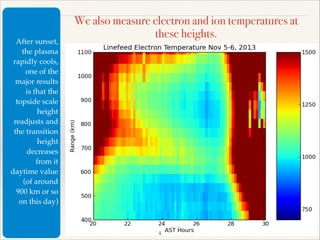
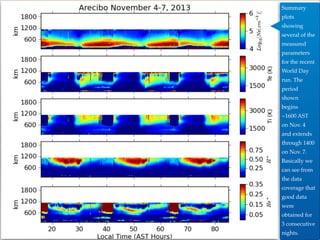

The document summarizes ionosphere measurements made by the Arecibo Observatory from 400 to 1100 km in altitude. It shows the fraction of hydrogen and helium ions relative to electrons over time, with hydrogen ions dominating below the transition region and both species present above. After sunset, plasma cooling causes the transition height to decrease from its daytime altitude of around 900 km. In addition to ion composition, the Observatory also measures electron and ion temperatures in the region.


