 Background
 Why the ITRs are important
 The need to revise the ITRs
 Preparatory process
 Some key proposals
 Expectations for WCIT-12
 Useful information and links
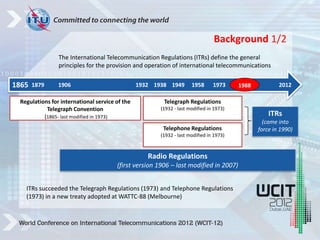
The International Telecommunication Regulations (ITRs) define the general
principles for the provision and operation of international telecommunications
1865 1988
ITRs
(came into
force in 1990)
Regulations for international service of the
Telegraph Convention
(1865- last modified in 1973)
Telephone Regulations
(1932 - last modified in 1973)
Radio Regulations
(first version 1906 – last modified in 2007)
1906 1973
1958
1949
1938
1879 1932
Telegraph Regulations
(1932 - last modified in 1973)
2012
ITRs succeeded the Telegraph Regulations (1973) and Telephone Regulations
(1973) in a new treaty adopted at WATTC-88 (Melbourne)
Background 1/2
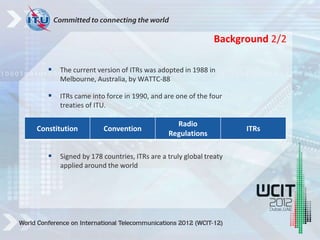
 The current version of ITRs was adopted in 1988 in
Melbourne, Australia, by WATTC-88
 ITRs came into force in 1990, and are one of the four
treaties of ITU.
 Signed by 178 countries, ITRs are a truly global treaty
applied around the world
Constitution Convention
Radio
Regulations
ITRs
Background 2/2
 Background
 Why the ITRs are important
 The need to revise the ITRs
 Preparatory process
 Some key proposals
 Expectations for WCIT-12
 Useful information and links
The ITRs …
 Establish general principles relating to the
provision and operation of international
telecoms
 Facilitate global interconnection and
interoperability
 Underpin harmonious development and
efficient operation of technical facilities
 Promote efficiency, usefulness, and availability
of international telecommunication services
 Treaty-level provisions are required with
respect to international telecommunication
networks and services
Why the ITRs are important
 Background
 Why the ITRs are important
 The need to revise the ITRs
 Preparatory process
 Some key proposals
 Expectations for WCIT-12
 Useful information and links
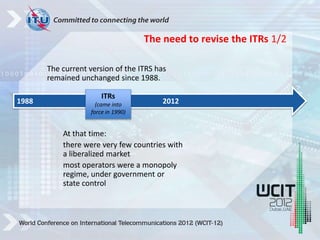
The current version of the ITRS has
remained unchanged since 1988.
At that time:
there were very few countries with
a liberalized market
most operators were a monopoly
regime, under government or
state control
1988 2012
ITRs
(came into
force in 1990)
The need to revise the ITRs 1/2
 The international telecom
environment has significantly
evolved, both from the technical
and policy perspectives, and
continues to evolve rapidly
 Advances in technology mean an
increased use of IP-enabled
infrastructure and applications:
opportunities and challenges
for the ICT sector
 As technology evolves, Member
States are evaluating their policy
and regulatory approaches to
ensure an enabling environment
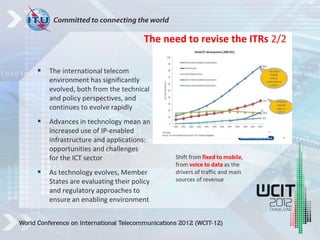
Shift from fixed to mobile,
from voice to data as the
drivers of traffic and main
sources of revenue
The need to revise the ITRs 2/2
 Background
 Why the ITRs are important
 The need to revise the ITRs
 Preparatory process
 Some key proposals
 Expectations for WCIT-12
 Useful information and links
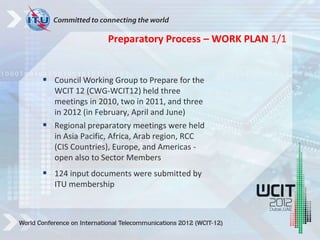
 Council Working Group to Prepare for the
WCIT 12 (CWG-WCIT12) held three
meetings in 2010, two in 2011, and three
in 2012 (in February, April and June)
 Regional preparatory meetings were held
in Asia Pacific, Africa, Arab region, RCC
(CIS Countries), Europe, and Americas -
open also to Sector Members
 124 input documents were submitted by
ITU membership
Preparatory Process – WORK PLAN 1/1
 Background
 Why the ITRs are important
 The need to revise the ITRs
 Preparatory process
 Some key proposals
 Expectations for WCIT-12
 Useful information and links
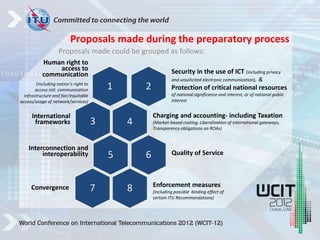
Proposals made could be grouped as follows:
Convergence
Human right to
access to
communication
(including nation’s right to
access intl. communication
infrastructure and fair/equitable
access/usage of network/services)
Charging and accounting- including Taxation
(Market-based costing, Liberalization of international gateways,
Transparency obligations on ROAs)
Quality of Service
Security in the use of ICT (including privacy
and unsolicited electronic communication), &
Protection of critical national resources
of national significance and interest, or of national public
interest
Interconnection and
interoperability
International
frameworks
Enforcement measures
(including possible binding effect of
certain ITU Recommendations)
2
1
3
6
5
7 8
4
Proposals made during the preparatory process
 Key issues raised:
 What core principles should
guide discussions?
 Do some provisions belong
elsewhere? (e.g. ITU
Constitution/Convention, ITU-T
Recommendations)
 What provisions should be
added to cover new issues?
Key Issues
 Mobile roaming
 Misuse and fraud
 Taxation
 Transparency of routing
 New general principles on economic issues
 Allowing differentiated traffic management
 Cooperation on cybersecurity
 Cooperation to combat spam
All to be implemented by national authorities
Some key proposals
 Transparency of prices for users
 Price levels
 Draft ITU-T Recommendation D.98
 OECD Recommendations
Proposals: Mobile Roaming
 Preventing misuse/hijacking of numbering resources
 According to GSMA, numbering resource misuse
is a key factor in fraud perpetrated against
mobile networks and their customers
 It is used for fraudulent and artificial inflation of
traffic
 Combating fraud
 Transmission of calling party identification/origin
identification
Proposals: Misuse and Fraud
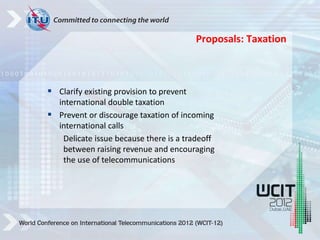
 Clarify existing provision to prevent
international double taxation
 Prevent or discourage taxation of incoming
international calls
Delicate issue because there is a tradeoff
between raising revenue and encouraging
the use of telecommunications
Proposals: Taxation
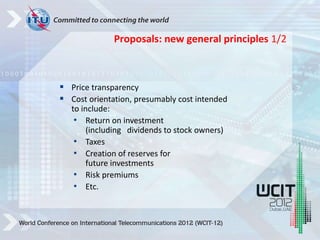
 Price transparency
 Cost orientation, presumably cost intended
to include:
• Return on investment
(including dividends to stock owners)
• Taxes
• Creation of reserves for
future investments
• Risk premiums
• Etc.
Proposals: new general principles 1/2
 Foster investment in high-bandwidth
infrastructure
 Adequate return on investment in
infrastructure
 Compensation for traffic carried
 Compensation for traffic terminated
Proposals: new general principles 2/2
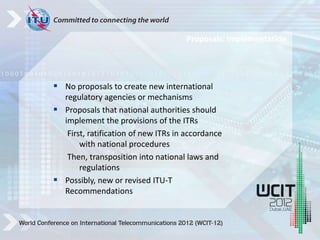
 No proposals to create new international
regulatory agencies or mechanisms
 Proposals that national authorities should
implement the provisions of the ITRs
First, ratification of new ITRs in accordance
with national procedures
Then, transposition into national laws and
regulations
 Possibly, new or revised ITU-T
Recommendations
Proposals: implementation
 Background
 Why the ITRs are important
 The need to revise the ITRs
 Preparatory process
 Some key proposals
 Expectations for WCIT-12
 Useful information and links
 WCIT-12 presents key opportunities to increase
positive collaboration between countries
 Help countries to reach new levels of economic and
social development by means of efficient ICT
services
 Make ITRs relevant, and valuable to the full
membership, so that they address and alleviate
many current concerns
 Sector Members usually participate as part of
national delegations
Expectations for WCIT-12
 Background
 Why the ITRs are important
 The need to revise the ITRs
 Preparatory process
 Some proposals of potential interest to ETNO
 Expectations for WCIT-12
 Useful information and links
Further information available at:
WCIT Newsroom:
http://www.itu.int/en/wcit-12/Pages/newsroom.aspx
CWG-WCIT12:
http://www.itu.int/council/groups/cwg-wcit12/index.html
2007 Background document:
http://www.itu.int/md/T05-ITR.EG-INF-0002/en
Useful information and links
Paul Conneally
Head, Communications & Partnership Promotion
paul.conneally@itu.int
THANKS

WCIT-12-presentation.pptx

  • 6.
     Background  Whythe ITRs are important  The need to revise the ITRs  Preparatory process  Some key proposals  Expectations for WCIT-12  Useful information and links
  • 7.
    The International TelecommunicationRegulations (ITRs) define the general principles for the provision and operation of international telecommunications 1865 1988 ITRs (came into force in 1990) Regulations for international service of the Telegraph Convention (1865- last modified in 1973) Telephone Regulations (1932 - last modified in 1973) Radio Regulations (first version 1906 – last modified in 2007) 1906 1973 1958 1949 1938 1879 1932 Telegraph Regulations (1932 - last modified in 1973) 2012 ITRs succeeded the Telegraph Regulations (1973) and Telephone Regulations (1973) in a new treaty adopted at WATTC-88 (Melbourne) Background 1/2
  • 8.
     The currentversion of ITRs was adopted in 1988 in Melbourne, Australia, by WATTC-88  ITRs came into force in 1990, and are one of the four treaties of ITU.  Signed by 178 countries, ITRs are a truly global treaty applied around the world Constitution Convention Radio Regulations ITRs Background 2/2
  • 9.
     Background  Whythe ITRs are important  The need to revise the ITRs  Preparatory process  Some key proposals  Expectations for WCIT-12  Useful information and links
  • 10.
    The ITRs … Establish general principles relating to the provision and operation of international telecoms  Facilitate global interconnection and interoperability  Underpin harmonious development and efficient operation of technical facilities  Promote efficiency, usefulness, and availability of international telecommunication services  Treaty-level provisions are required with respect to international telecommunication networks and services Why the ITRs are important
  • 11.
     Background  Whythe ITRs are important  The need to revise the ITRs  Preparatory process  Some key proposals  Expectations for WCIT-12  Useful information and links
  • 12.
    The current versionof the ITRS has remained unchanged since 1988. At that time: there were very few countries with a liberalized market most operators were a monopoly regime, under government or state control 1988 2012 ITRs (came into force in 1990) The need to revise the ITRs 1/2
  • 13.
     The internationaltelecom environment has significantly evolved, both from the technical and policy perspectives, and continues to evolve rapidly  Advances in technology mean an increased use of IP-enabled infrastructure and applications: opportunities and challenges for the ICT sector  As technology evolves, Member States are evaluating their policy and regulatory approaches to ensure an enabling environment Shift from fixed to mobile, from voice to data as the drivers of traffic and main sources of revenue The need to revise the ITRs 2/2
  • 14.
     Background  Whythe ITRs are important  The need to revise the ITRs  Preparatory process  Some key proposals  Expectations for WCIT-12  Useful information and links
  • 15.
     Council WorkingGroup to Prepare for the WCIT 12 (CWG-WCIT12) held three meetings in 2010, two in 2011, and three in 2012 (in February, April and June)  Regional preparatory meetings were held in Asia Pacific, Africa, Arab region, RCC (CIS Countries), Europe, and Americas - open also to Sector Members  124 input documents were submitted by ITU membership Preparatory Process – WORK PLAN 1/1
  • 16.
     Background  Whythe ITRs are important  The need to revise the ITRs  Preparatory process  Some key proposals  Expectations for WCIT-12  Useful information and links
  • 17.
    Proposals made couldbe grouped as follows: Convergence Human right to access to communication (including nation’s right to access intl. communication infrastructure and fair/equitable access/usage of network/services) Charging and accounting- including Taxation (Market-based costing, Liberalization of international gateways, Transparency obligations on ROAs) Quality of Service Security in the use of ICT (including privacy and unsolicited electronic communication), & Protection of critical national resources of national significance and interest, or of national public interest Interconnection and interoperability International frameworks Enforcement measures (including possible binding effect of certain ITU Recommendations) 2 1 3 6 5 7 8 4 Proposals made during the preparatory process
  • 18.
     Key issuesraised:  What core principles should guide discussions?  Do some provisions belong elsewhere? (e.g. ITU Constitution/Convention, ITU-T Recommendations)  What provisions should be added to cover new issues? Key Issues
  • 19.
     Mobile roaming Misuse and fraud  Taxation  Transparency of routing  New general principles on economic issues  Allowing differentiated traffic management  Cooperation on cybersecurity  Cooperation to combat spam All to be implemented by national authorities Some key proposals
  • 20.
     Transparency ofprices for users  Price levels  Draft ITU-T Recommendation D.98  OECD Recommendations Proposals: Mobile Roaming
  • 21.
     Preventing misuse/hijackingof numbering resources  According to GSMA, numbering resource misuse is a key factor in fraud perpetrated against mobile networks and their customers  It is used for fraudulent and artificial inflation of traffic  Combating fraud  Transmission of calling party identification/origin identification Proposals: Misuse and Fraud
  • 22.
     Clarify existingprovision to prevent international double taxation  Prevent or discourage taxation of incoming international calls Delicate issue because there is a tradeoff between raising revenue and encouraging the use of telecommunications Proposals: Taxation
  • 23.
     Price transparency Cost orientation, presumably cost intended to include: • Return on investment (including dividends to stock owners) • Taxes • Creation of reserves for future investments • Risk premiums • Etc. Proposals: new general principles 1/2
  • 24.
     Foster investmentin high-bandwidth infrastructure  Adequate return on investment in infrastructure  Compensation for traffic carried  Compensation for traffic terminated Proposals: new general principles 2/2
  • 25.
     No proposalsto create new international regulatory agencies or mechanisms  Proposals that national authorities should implement the provisions of the ITRs First, ratification of new ITRs in accordance with national procedures Then, transposition into national laws and regulations  Possibly, new or revised ITU-T Recommendations Proposals: implementation
  • 26.
     Background  Whythe ITRs are important  The need to revise the ITRs  Preparatory process  Some key proposals  Expectations for WCIT-12  Useful information and links
  • 27.
     WCIT-12 presentskey opportunities to increase positive collaboration between countries  Help countries to reach new levels of economic and social development by means of efficient ICT services  Make ITRs relevant, and valuable to the full membership, so that they address and alleviate many current concerns  Sector Members usually participate as part of national delegations Expectations for WCIT-12
  • 28.
     Background  Whythe ITRs are important  The need to revise the ITRs  Preparatory process  Some proposals of potential interest to ETNO  Expectations for WCIT-12  Useful information and links
  • 29.
    Further information availableat: WCIT Newsroom: http://www.itu.int/en/wcit-12/Pages/newsroom.aspx CWG-WCIT12: http://www.itu.int/council/groups/cwg-wcit12/index.html 2007 Background document: http://www.itu.int/md/T05-ITR.EG-INF-0002/en Useful information and links
  • 30.
    Paul Conneally Head, Communications& Partnership Promotion paul.conneally@itu.int THANKS