COGNITIVE COMPUTING-FUTURE
OF FINANCIAL SERVICES
Prachi Asthana
Business Analyst
(IBM India)
ABSTRACT
 Today’s information challenge is leading towards adapting to Cognitive
computing and AI since the unstructured data is growing way faster than
structured data which in coming 5 years will grow to 800%
 The presentation hence proposes a plan to compete with the help of
Watson against Humans to demonstrate technology
 It introduces the advantages and ways to introduce Watson to Financial
services targeting, Retail banking, Investment and retirement planning,
institutional trading and decision support
AGENDA
 Current Scenario
 Watson: Cognitive computing tool
 Watson Infrastructure
 Watson Virtual Agent & its key features
 Watson Virtual Agent Components
 Why Watson in Financial firms
 Facts and Recent Implementations
 Integration of Watson with Customer Applications
 Examples of pattern in Banking
 Take Aways
CURRENT SCENARIO
 Need manual monitoring and Data analysis of complex information
spread across various industries including Financial firms.
 Use of legacy systems preventing the Financial firms from providing
innovative products and meeting current customer expectations
 Steep effort, time and cost of every implementation and strategy
 No readily available structured data to be interpreted by machine
learning.
WATSON: COGNITIVE COMPUTING TOOL
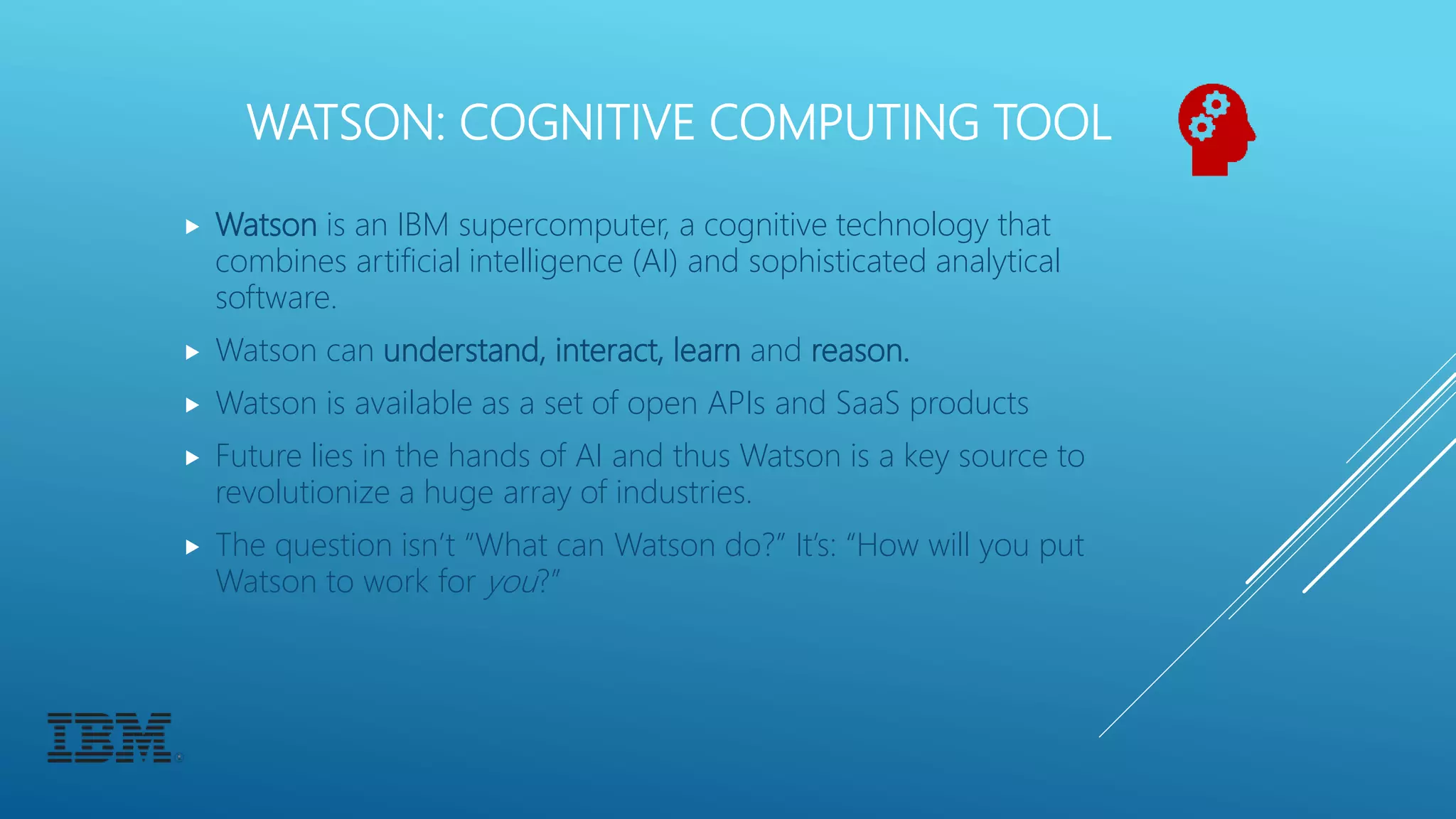
 Watson is an IBM supercomputer, a cognitive technology that
combines artificial intelligence (AI) and sophisticated analytical
software.
 Watson can understand, interact, learn and reason.
 Watson is available as a set of open APIs and SaaS products
 Future lies in the hands of AI and thus Watson is a key source to
revolutionize a huge array of industries.
 The question isn’t “What can Watson do?” It’s: “How will you put
Watson to work for you?”
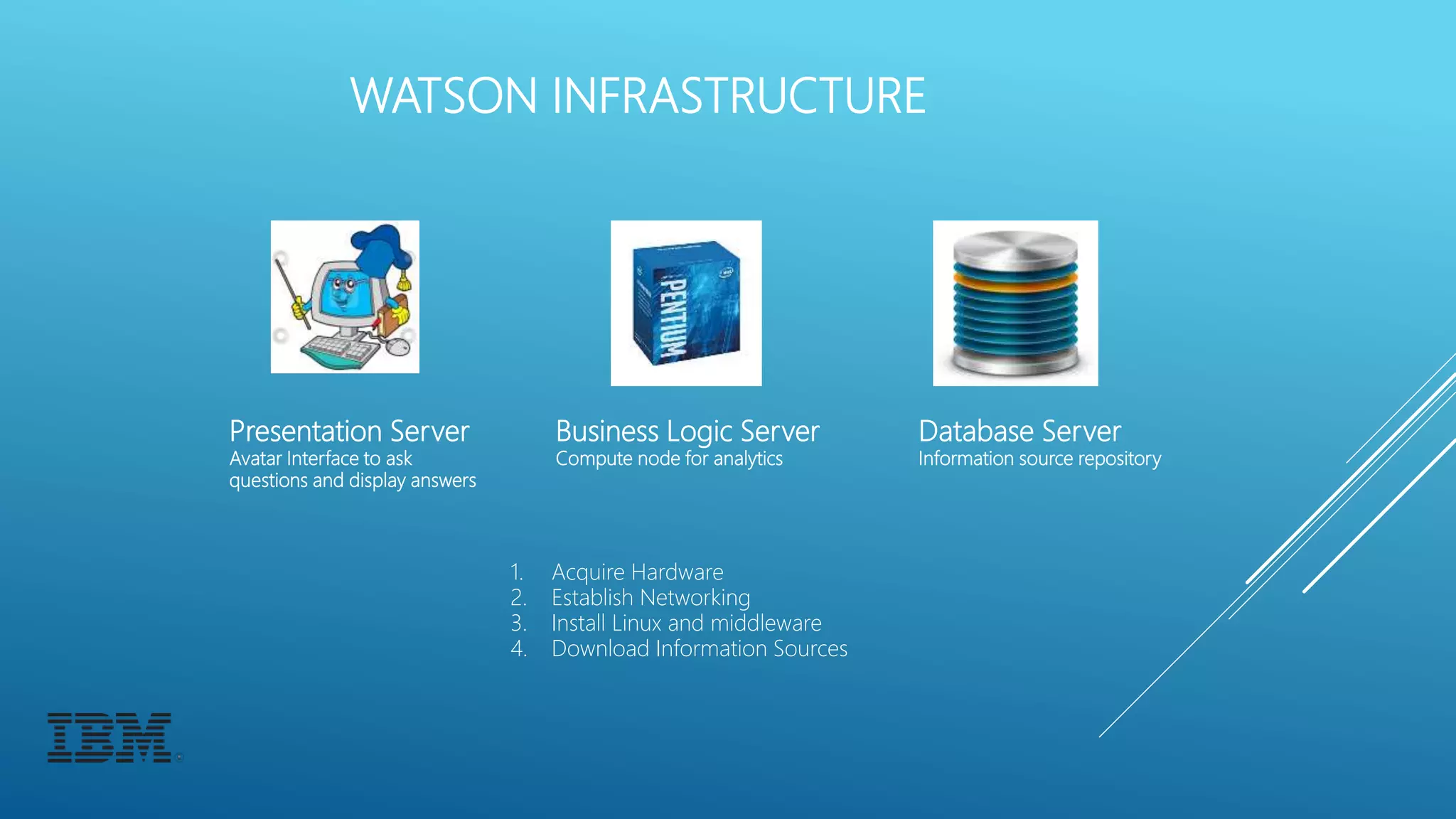
WATSON INFRASTRUCTURE
Presentation Server
Avatar Interface to ask
questions and display answers
Business Logic Server
Compute node for analytics
Database Server
Information source repository
1. Acquire Hardware
2. Establish Networking
3. Install Linux and middleware
4. Download Information Sources
WATSON VIRTUAL AGENT-KEY FEATURES
 It’s a new way to provide automated services to your customers. It offers a
cognitive, conversational self-service experience that can provide answers
and take action.
 Pre-trained industry & domain knowledge
 Personalized configuration
 Engagement metrics dashboard
 User friendly tooling
 Self service delivered by bots
 Deep analytic capabilities
 Up and running in no time
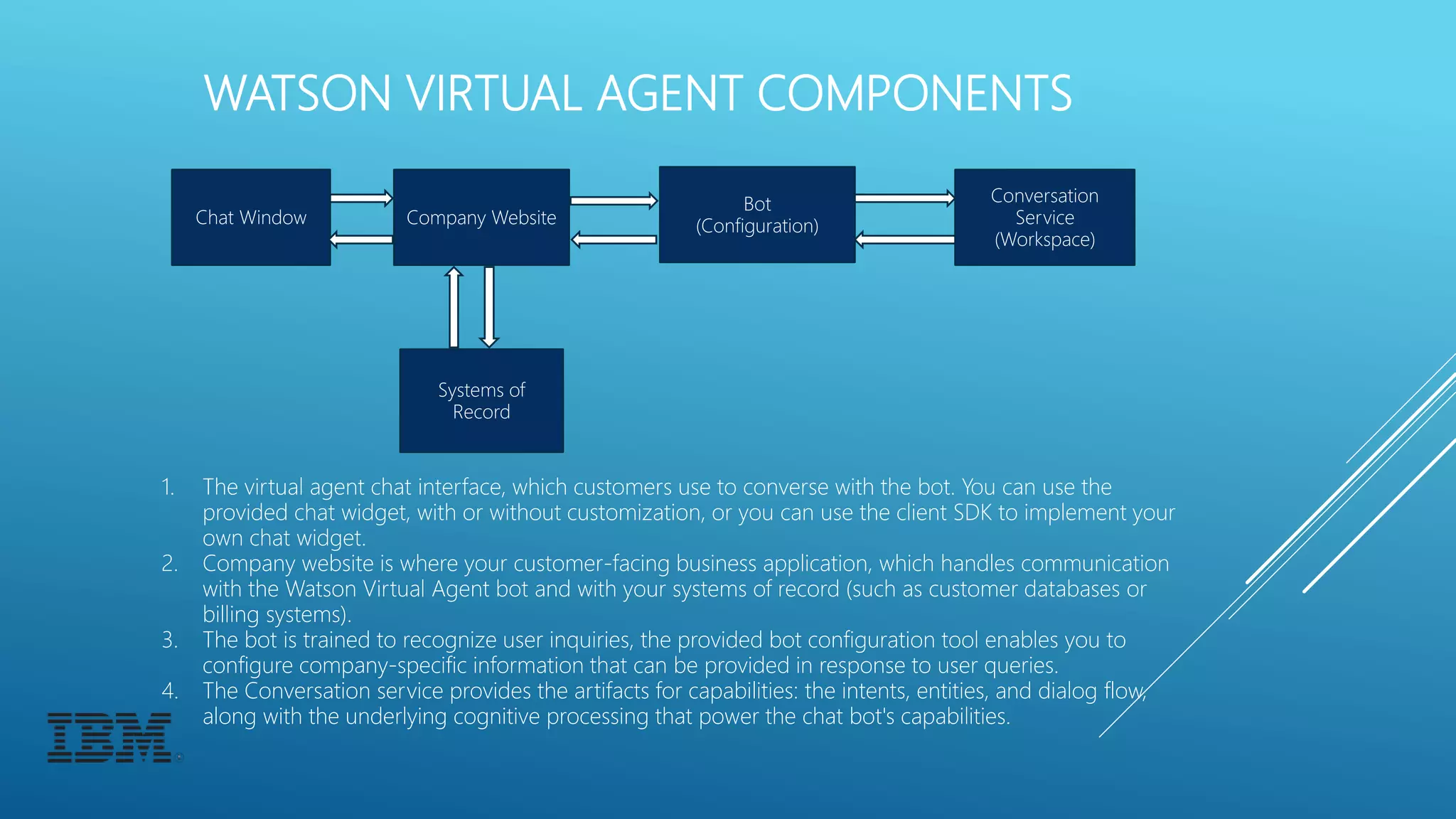
WATSON VIRTUAL AGENT COMPONENTS
Conversation
Service
(Workspace)
Bot
(Configuration)Company WebsiteChat Window
Systems of
Record
1. The virtual agent chat interface, which customers use to converse with the bot. You can use the
provided chat widget, with or without customization, or you can use the client SDK to implement your
own chat widget.
2. Company website is where your customer-facing business application, which handles communication
with the Watson Virtual Agent bot and with your systems of record (such as customer databases or
billing systems).
3. The bot is trained to recognize user inquiries, the provided bot configuration tool enables you to
configure company-specific information that can be provided in response to user queries.
4. The Conversation service provides the artifacts for capabilities: the intents, entities, and dialog flow,
along with the underlying cognitive processing that power the chat bot's capabilities.
WHY WATSON IN FINANCIAL FIRMS?
 Understands natural language of human speech resulting in faster and
precise resolution of customer query
 Adapts and learns from human selections and responses which can help
firms to redirect selected products to targeted audience
 Generates and evaluates hypothesis for better outcomes which can save
human efforts on analyzing the success of future projects and products
saving monetary loss
 It is built on massively parallel probabilistic evidence-based architecture
which makes it highly efficient and accurate
FACTS AND RECENT
IMPLEMENTATIONS
FACTS AND RECENT IMPLEMENTATIONS
 In September 2016, Condé Nast partnered with Influential to use IBM Watson to help build
informed social media campaigns for its brands. The software built by IBM and Influential, a
'data-first influencer platform' offers Condé Nast customers (such as the New Yorker and
Vogue) insight into who to target their campaigns towards and what celebrities would make
good brand ambassadors
 In September 2016, IBM Watson signed a 10-year contract with Harrow Council to bring
Watson Care Manager to support individuals in the UK. This will allow individuals and
caregivers to quickly choose the most appropriate healthcare provider, determined by their
allocated personal budget.
 Standard Bank uses IBM Watson to speed handling of customer queries, allowing it to
identify customers quickly so they can respond in faster time.
 In April 2016, IBM Watson partnered with the American Cancer Society to create a virtual
adviser that uses machine learning to offer patients personalized information and relevant
advice to give, the advisor will look at the patient's type of cancer, its stage and their
previous treatments enabling patients to ask questions in natural language and receive
audio responses.
INTEGRATION OF WATSON WITH CUSTOMER
APPLICATIONS
 Watson can “help analyze customer needs” agenda of putting the customers
first.
 In the benefit of customers, with Watson, we can uncover the patterns that
reveal customer’s individual needs, preferences and intentions
 We earn permission to become part of customer’s life and renew loyalty
 We can have a 360 degree view that analytics can provide
 Seize the opportunity as they arise by making the right offer at the right time
 Process vast amounts of up-to-the-minute financial, economic, product and
client data
 Provide rapid and personalized banking solutions
 Its deep content-analytics, natural language processing and Evidence-based
learning with how the company interacts with customers to advance digital
banking
EXAMPLES OF PATTERN IN BANKING
 Likelihood of overdrafts is high in the youth segment
 Watson selects customer whose cash flow pattern raises likelihood of
overdraft
 Watson engages with bank to help provide the customer with best
overdraft offer
 With the help of Watson, bank adds value to the relationship by
suggesting tools like predictive alerts to help customer manage his
finances
 All is done much more efficiently with cognitive computing reducing the
manual monitoring incredibly.
KEY TAKE AWAYS
 Make Cognitive Computing our foremost strategy for upcoming releases
 Leverage existing data - integrate with Watson and analyze the accuracy
of results
 Open invite to all teams to try Watson
THANKYOU

Watson cognitive computing future of financial services

  • 1.
    COGNITIVE COMPUTING-FUTURE OF FINANCIALSERVICES Prachi Asthana Business Analyst (IBM India)
  • 2.
    ABSTRACT  Today’s informationchallenge is leading towards adapting to Cognitive computing and AI since the unstructured data is growing way faster than structured data which in coming 5 years will grow to 800%  The presentation hence proposes a plan to compete with the help of Watson against Humans to demonstrate technology  It introduces the advantages and ways to introduce Watson to Financial services targeting, Retail banking, Investment and retirement planning, institutional trading and decision support
  • 3.
    AGENDA  Current Scenario Watson: Cognitive computing tool  Watson Infrastructure  Watson Virtual Agent & its key features  Watson Virtual Agent Components  Why Watson in Financial firms  Facts and Recent Implementations  Integration of Watson with Customer Applications  Examples of pattern in Banking  Take Aways
  • 4.
    CURRENT SCENARIO  Needmanual monitoring and Data analysis of complex information spread across various industries including Financial firms.  Use of legacy systems preventing the Financial firms from providing innovative products and meeting current customer expectations  Steep effort, time and cost of every implementation and strategy  No readily available structured data to be interpreted by machine learning.
  • 5.
    WATSON: COGNITIVE COMPUTINGTOOL  Watson is an IBM supercomputer, a cognitive technology that combines artificial intelligence (AI) and sophisticated analytical software.  Watson can understand, interact, learn and reason.  Watson is available as a set of open APIs and SaaS products  Future lies in the hands of AI and thus Watson is a key source to revolutionize a huge array of industries.  The question isn’t “What can Watson do?” It’s: “How will you put Watson to work for you?”
  • 6.
    WATSON INFRASTRUCTURE Presentation Server AvatarInterface to ask questions and display answers Business Logic Server Compute node for analytics Database Server Information source repository 1. Acquire Hardware 2. Establish Networking 3. Install Linux and middleware 4. Download Information Sources
  • 7.
    WATSON VIRTUAL AGENT-KEYFEATURES  It’s a new way to provide automated services to your customers. It offers a cognitive, conversational self-service experience that can provide answers and take action.  Pre-trained industry & domain knowledge  Personalized configuration  Engagement metrics dashboard  User friendly tooling  Self service delivered by bots  Deep analytic capabilities  Up and running in no time
  • 8.
    WATSON VIRTUAL AGENTCOMPONENTS Conversation Service (Workspace) Bot (Configuration)Company WebsiteChat Window Systems of Record 1. The virtual agent chat interface, which customers use to converse with the bot. You can use the provided chat widget, with or without customization, or you can use the client SDK to implement your own chat widget. 2. Company website is where your customer-facing business application, which handles communication with the Watson Virtual Agent bot and with your systems of record (such as customer databases or billing systems). 3. The bot is trained to recognize user inquiries, the provided bot configuration tool enables you to configure company-specific information that can be provided in response to user queries. 4. The Conversation service provides the artifacts for capabilities: the intents, entities, and dialog flow, along with the underlying cognitive processing that power the chat bot's capabilities.
  • 9.
    WHY WATSON INFINANCIAL FIRMS?  Understands natural language of human speech resulting in faster and precise resolution of customer query  Adapts and learns from human selections and responses which can help firms to redirect selected products to targeted audience  Generates and evaluates hypothesis for better outcomes which can save human efforts on analyzing the success of future projects and products saving monetary loss  It is built on massively parallel probabilistic evidence-based architecture which makes it highly efficient and accurate
  • 10.
  • 11.
    FACTS AND RECENTIMPLEMENTATIONS  In September 2016, Condé Nast partnered with Influential to use IBM Watson to help build informed social media campaigns for its brands. The software built by IBM and Influential, a 'data-first influencer platform' offers Condé Nast customers (such as the New Yorker and Vogue) insight into who to target their campaigns towards and what celebrities would make good brand ambassadors  In September 2016, IBM Watson signed a 10-year contract with Harrow Council to bring Watson Care Manager to support individuals in the UK. This will allow individuals and caregivers to quickly choose the most appropriate healthcare provider, determined by their allocated personal budget.  Standard Bank uses IBM Watson to speed handling of customer queries, allowing it to identify customers quickly so they can respond in faster time.  In April 2016, IBM Watson partnered with the American Cancer Society to create a virtual adviser that uses machine learning to offer patients personalized information and relevant advice to give, the advisor will look at the patient's type of cancer, its stage and their previous treatments enabling patients to ask questions in natural language and receive audio responses.
  • 12.
    INTEGRATION OF WATSONWITH CUSTOMER APPLICATIONS  Watson can “help analyze customer needs” agenda of putting the customers first.  In the benefit of customers, with Watson, we can uncover the patterns that reveal customer’s individual needs, preferences and intentions  We earn permission to become part of customer’s life and renew loyalty  We can have a 360 degree view that analytics can provide  Seize the opportunity as they arise by making the right offer at the right time  Process vast amounts of up-to-the-minute financial, economic, product and client data  Provide rapid and personalized banking solutions  Its deep content-analytics, natural language processing and Evidence-based learning with how the company interacts with customers to advance digital banking
  • 13.
    EXAMPLES OF PATTERNIN BANKING  Likelihood of overdrafts is high in the youth segment  Watson selects customer whose cash flow pattern raises likelihood of overdraft  Watson engages with bank to help provide the customer with best overdraft offer  With the help of Watson, bank adds value to the relationship by suggesting tools like predictive alerts to help customer manage his finances  All is done much more efficiently with cognitive computing reducing the manual monitoring incredibly.
  • 14.
    KEY TAKE AWAYS Make Cognitive Computing our foremost strategy for upcoming releases  Leverage existing data - integrate with Watson and analyze the accuracy of results  Open invite to all teams to try Watson
  • 15.