WATER
POLLUTION
GROUP V
ARE YOU READY?
EUTROPHICATION
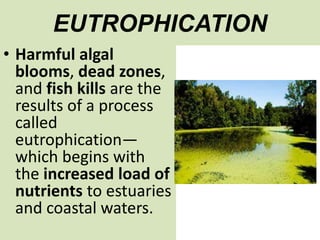
• Harmful algal
blooms, dead zones,
and fish kills are the
results of a process
called
eutrophication—
which begins with
the increased load of
nutrients to estuaries
and coastal waters.
FISH KILL
• A `fish kill’ usually happens when there is
an increase in concentration of organic
nutrients in bodies of water. This
condition causes algal bloom and growth
of aquatic plant. When the algae die, they
sink to the process of decomposition
proceeds. This process uses up oxygen
and as a result, aquatic animals die due
to lack of oxygen.
BIOLOGICAL
MAGNIFICATION
•BIOLOGICAL MAGNIFICATION
is the buildup of pollutants in
organisms at higher trophic
levels in a food chain.
AIR POLLUTION
WHAT IS AIR POLLUTION?
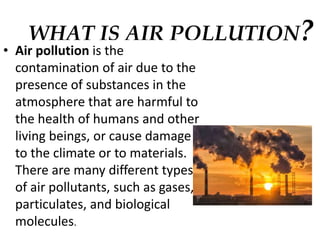
• Air pollution is the
contamination of air due to the
presence of substances in the
atmosphere that are harmful to
the health of humans and other
living beings, or cause damage
to the climate or to materials.
There are many different types
of air pollutants, such as gases,
particulates, and biological
molecules.
GREENHOUSE EFFECT
• Carbon dioxide acts like a blanket
over the Earth, holding in the heat
that would otherwise radiate back
into space. The trapping of heat by
gases in the earth’s atmosphere is
called the greenhouse effect.
WHAT IS WATER POLLUTION?
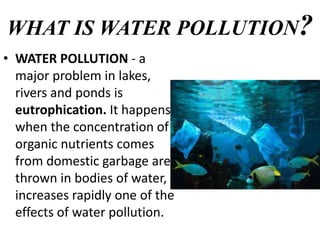
• WATER POLLUTION - a
major problem in lakes,
rivers and ponds is
eutrophication. It happens
when the concentration of
organic nutrients comes
from domestic garbage are
thrown in bodies of water,
increases rapidly one of the
effects of water pollution.
GLOBAL WARMING
• GLOBAL WARMING is an increase
in the earth’s temperature from
the rapid buildup of carbon
dioxide and other gases. This, in
turn, could change the world
climate patterns.
ECOSYSTEM
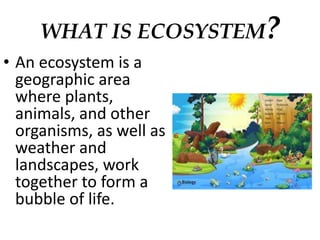
WHAT IS ECOSYSTEM?
• An ecosystem is a
geographic area
where plants,
animals, and other
organisms, as well as
weather and
landscapes, work
together to form a
bubble of life.
TYPES OF ECOSYSTEM
• The major types of ecosystems are forest,
desert, rain forest, grassland, tundra, savanna
and mountain ecosystem.
PHOTOSYNTHESIS
WHAT IS PHOTOSYNTHESIS?
• Photosynthesis is a process of food
making done by plants and other
autotrophic organisms. The presence
of chlorophyll enables these
organisms to make their own food.
Autotrophic organisms require light
energy, carbon dioxide (CH2), and
water (H2O) to make food (sugar).
PARTS OF CHLOROPLAST
•Outer and inner membranes
•Intermembrane space
•Stroma
•Thylakoids
…
• MESOPHYLL
• Mesophyll has the
most number of
chlorophyll.
• CHLOROPHYLL
• Chlorophyll absorbs
white light but it
look green because
white light consists
of three primary
colors: red, blur,
and green.
TWO STAGES OF
PHOTOSYNTHESIS
• LIGHT-DEPENDENT REACTION
• CALVIN CYCLE (DARK REACTION)
LIGHT-DEPENDENT
REACTION
• LIGHT-DEPENDENT REACTION
happens in the presence of light.
CALVIN CYCLE
(dark reaction)
• Calvin Cycle (dark reaction)
is light-independent phase
that takes place in the
stroma and converts carbon
dioxide (CO2) into sugar.
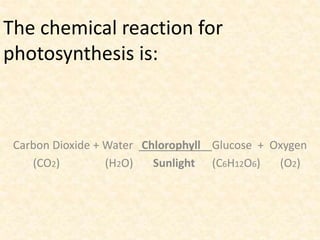
The chemical reaction for
photosynthesis is:
Carbon Dioxide + Water Chlorophyll Glucose + Oxygen
(CO2) (H2O) Sunlight (C6H12O6) (O2)
THANKYOU FOR
LISTENING <3

WATER POLLUTION.pptx

  • 1.
  • 2.
  • 3.
    EUTROPHICATION • Harmful algal blooms,dead zones, and fish kills are the results of a process called eutrophication— which begins with the increased load of nutrients to estuaries and coastal waters.
  • 4.
    FISH KILL • A`fish kill’ usually happens when there is an increase in concentration of organic nutrients in bodies of water. This condition causes algal bloom and growth of aquatic plant. When the algae die, they sink to the process of decomposition proceeds. This process uses up oxygen and as a result, aquatic animals die due to lack of oxygen.
  • 5.
    BIOLOGICAL MAGNIFICATION •BIOLOGICAL MAGNIFICATION is thebuildup of pollutants in organisms at higher trophic levels in a food chain.
  • 6.
  • 7.
    WHAT IS AIRPOLLUTION? • Air pollution is the contamination of air due to the presence of substances in the atmosphere that are harmful to the health of humans and other living beings, or cause damage to the climate or to materials. There are many different types of air pollutants, such as gases, particulates, and biological molecules.
  • 8.
    GREENHOUSE EFFECT • Carbondioxide acts like a blanket over the Earth, holding in the heat that would otherwise radiate back into space. The trapping of heat by gases in the earth’s atmosphere is called the greenhouse effect.
  • 9.
    WHAT IS WATERPOLLUTION? • WATER POLLUTION - a major problem in lakes, rivers and ponds is eutrophication. It happens when the concentration of organic nutrients comes from domestic garbage are thrown in bodies of water, increases rapidly one of the effects of water pollution.
  • 10.
    GLOBAL WARMING • GLOBALWARMING is an increase in the earth’s temperature from the rapid buildup of carbon dioxide and other gases. This, in turn, could change the world climate patterns.
  • 11.
  • 12.
    WHAT IS ECOSYSTEM? •An ecosystem is a geographic area where plants, animals, and other organisms, as well as weather and landscapes, work together to form a bubble of life.
  • 13.
    TYPES OF ECOSYSTEM •The major types of ecosystems are forest, desert, rain forest, grassland, tundra, savanna and mountain ecosystem.
  • 14.
  • 15.
    WHAT IS PHOTOSYNTHESIS? •Photosynthesis is a process of food making done by plants and other autotrophic organisms. The presence of chlorophyll enables these organisms to make their own food. Autotrophic organisms require light energy, carbon dioxide (CH2), and water (H2O) to make food (sugar).
  • 16.
    PARTS OF CHLOROPLAST •Outerand inner membranes •Intermembrane space •Stroma •Thylakoids
  • 17.
    … • MESOPHYLL • Mesophyllhas the most number of chlorophyll. • CHLOROPHYLL • Chlorophyll absorbs white light but it look green because white light consists of three primary colors: red, blur, and green.
  • 18.
    TWO STAGES OF PHOTOSYNTHESIS •LIGHT-DEPENDENT REACTION • CALVIN CYCLE (DARK REACTION)
  • 19.
  • 20.
    CALVIN CYCLE (dark reaction) •Calvin Cycle (dark reaction) is light-independent phase that takes place in the stroma and converts carbon dioxide (CO2) into sugar.
  • 21.
    The chemical reactionfor photosynthesis is: Carbon Dioxide + Water Chlorophyll Glucose + Oxygen (CO2) (H2O) Sunlight (C6H12O6) (O2)
  • 22.