
Ripsy Srivastava
Vikram Tuli

Great Lakes Institute Of
Management, Chennai
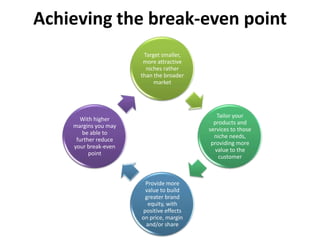
Achieving the break-even point
                       Target smaller,
                       more attractive
                        niches rather
                      than the broader
                           market


                                            Tailor your
      With higher
                                           products and
    margins you may
                                         services to those
       be able to
                                           niche needs,
     further reduce
                                          providing more
    your break-even
                                           value to the
          point
                                             customer


                       Provide more
                       value to build
                       greater brand
                        equity, with
                      positive effects
                      on price, margin
                       and/or share
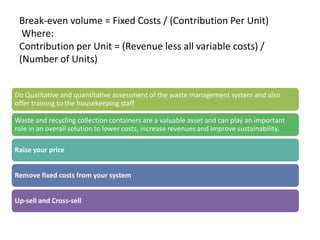
Break-even volume = Fixed Costs / (Contribution Per Unit)
  Where:
 Contribution per Unit = (Revenue less all variable costs) /
 (Number of Units)


Do Qualitative and quantitative assessment of the waste management system and also
offer training to the housekeeping staff

Waste and recycling collection containers are a valuable asset and can play an important
role in an overall solution to lower costs, increase revenues and improve sustainability.

Raise your price


Remove fixed costs from your system


Up-sell and Cross-sell
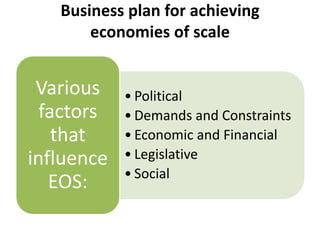
Business plan for achieving
       economies of scale


 Various    • Political
  factors   • Demands and Constraints
    that    • Economic and Financial
influence   • Legislative
            • Social
   EOS:
Political :
• Partnership working between tiers of
  government
• Transparency and public trust
• An integrated approach across waste streams
Demands and Constraints
• Within local authority boundaries, waste
  management optimisation assessments need to take
  into account the variations in geographical
  population spread.
• These assessments predominantly focus on
  reviewing differing technologies that will achieve
  similar performance targets at a given geographical
  scale.
• However they may also review a range of service
  integration and authority aggregation options.
Economic and Financial

Access to capital, be it public or private, in the form of
outside investments, loans,
grants, or subsidies, plays an important role both in
programme planning and realisation.
Legislative Factors
• Rapidly changing legislative environment needs to
  be considered in evaluating opportunities for
  economies of scale as it makes the development of
  long-term, larger waste management facilities higher
  risk and less attractive.
• These changes on legislation might affect the supply
  of waste feedstock or the markets for end products
  from waste processes and therefore the financial
  performance of any technology.
Social Considerations

The development of public awareness programmes,
involving the public in the ecision-making processes
Aggregation across Urban, Suburban and Rural
communities
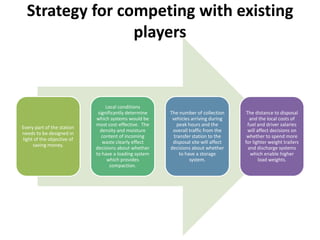
Strategy for competing with existing
                 players


                                 Local conditions
                             significantly determine   The number of collection      The distance to disposal
                            which systems would be      vehicles arriving during       and the local costs of
                            most cost-effective. The       peak hours and the         fuel and driver salaries
Every part of the station
                              density and moisture      overall traffic from the      will affect decisions on
needs to be designed in
                               content of incoming       transfer station to the     whether to spend more
light of the objective of
                               waste clearly effect     disposal site will affect   for lighter weight trailers
     saving money.
                            decisions about whether    decisions about whether        and discharge systems
                            to have a loading system        to have a storage          which enable higher
                                  which provides                 system.                    load weights.
                                   compaction.
Waste Management not considered an important component of Sustainability


Several constraints which restrict this development are –

Technical Constraints

• Solid waste generated is dumped at many undesignated sites (e.g., open areas, water
  channels, streets, etc.). As a result, improving the disposal site, have little impact on
  the overall solid waste management effectiveness.
• The low collection coverage is a bottleneck in the overall solid waste management
  system in the city
• The lack of research and development activities in developing countries leads to the
  selection of inappropriate technology in terms of the local climatic and physical
  conditions, financial and human resource capabilities, and social or cultural
  acceptability.
Financial Constraints

• Solid waste management is given a very low priority in developing countries, except
  perhaps in capital and large cities. As a result, very limited funds are provided to the
  solid waste management sector by the governments
• In addition to the limited funds, many local governments in developing countries lack
  good financial management and planning.
• over 90% of the annual budget provided for solid waste management gets used up
  within the first six months

Institutional Constraints

• There are often no clear roles/functions of the various national agencies defined in
  relation to solid waste management and also no single agency or committee
  designated to coordinate their projects and activities.
• The lack of effective legislation for solid waste management, which is a norm in most
  developing countries, is partially responsible for the roles/functions of the relevant
  national agencies not being clearly defined and the lack of coordination among them
• An enhanced economy enables more funds to be allocated for solid waste
  management, providing a more sustainable financial basis
Economic Constraints

• An enhanced economy enables more funds to be allocated for solid waste
  management, providing a more sustainable financial basis
• The weak industry base for recycling activities is a common constraint for the
  improvement of solid waste management in developing countries


Social Constraints

•  Negative perception of people regarding the work which involves the handling of
  waste or unwanted material
• Insufficient resources available in the government sector
• The lack of public awareness and school education about the importance of proper
  solid waste management for health and well-being of people severely restricts the use
  of community-based approaches in developing countries.
Sales and Marketing plan for different client segment


Publicity: Send news releases to all of the major newspapers in Karnataka. Publication of
news articles about Waste Wise Management and Consultancy recycling will lend great
credibility and be an excellent way to let all target markets know about this new,
innovative business and the solutions it provides for municipalities , industries and users
of compost or fertilizers. Similarly seeking publicity in the form of news stories from local
(Bengaluru) radio and television stations.

Advertising: Utilize direct mail and face-to-face promotional strategies to raise
awareness about WWMC’s products and services in the target markets. Newspaper
advertising may also be used. Radio and television ads are not certain, we will evaluate
their effectiveness before further implementation.

Internet: Building content heavy website geared toward educating potential customers
about the benefits of our products and services. All literature, business cards, etc. will
include the necessary details of the company

Alliances: Forming alliances with fertilizer manufacturers to use our product in their
fertilizer and/or distribute our product for us.
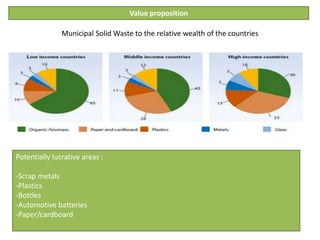
Value proposition

               Municipal Solid Waste to the relative wealth of the countries


Potentially lucrative areas :

-Scrap metals
-Plastics
-Bottles
-Automotive batteries
-Paper/cardboard
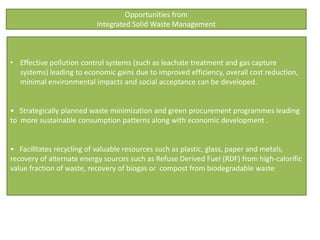
Opportunities from
                          Integrated Solid Waste Management


• Effective pollution control systems (such as leachate treatment and gas capture
  systems) leading to economic gains due to improved efficiency, overall cost reduction,
  minimal environmental impacts and social acceptance can be developed.


• Strategically planned waste minimization and green procurement programmes leading
to more sustainable consumption patterns along with economic development .


• Facilitates recycling of valuable resources such as plastic, glass, paper and metals,
recovery of alternate energy sources such as Refuse Derived Fuel (RDF) from high-calorific
value fraction of waste, recovery of biogas or compost from biodegradable waste
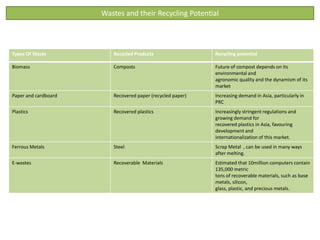
Wastes and their Recycling Potential


Types Of Waste           Recycled Products                  Recycling potential

Biomass                  Composts                           Future of compost depends on its
                                                            environmental and
                                                            agronomic quality and the dynamism of its
                                                            market
Paper and cardboard      Recovered paper (recycled paper)   Increasing demand in Asia, particularly in
                                                            PRC
Plastics                 Recovered plastics                 Increasingly stringent regulations and
                                                            growing demand for
                                                            recovered plastics in Asia, favouring
                                                            development and
                                                            internationalization of this market.
Ferrous Metals           Steel                              Scrap Metal , can be used in many ways
                                                            after melting.
E-wastes                 Recoverable Materials              Estimated that 10million computers contain
                                                            135,000 metric
                                                            tons of recoverable materials, such as base
                                                            metals, silicon,
                                                            glass, plastic, and precious metals.
Attracting Investments from Financial Partners


Environment - The environment affects all aspects of our lives, from the air we
breathe, to the way we power our homes, to the parklands in which we play.
Waste Management companies is committed to helping provide renewable
resources to reduce our dependence on fossil fuels, and to conserving and
maintaining wetlands, wildlife habitats and green spaces for people's
enjoyment. Understanding the importance of the environment, Waste
Management supports organizations and programs that preserve and/or
enhance natural resources.

Green Economy for Developing Countries – UNEP’s green economy status

Advanced technology and Tools used by Developed Nations – Business
Perspective and inclination.

Green Jobs in Renewable Energy – Job prospects.

Waste management case vikram tuli

  • 1.
    Ripsy Srivastava Vikram Tuli GreatLakes Institute Of Management, Chennai
  • 2.
    Achieving the break-evenpoint Target smaller, more attractive niches rather than the broader market Tailor your With higher products and margins you may services to those be able to niche needs, further reduce providing more your break-even value to the point customer Provide more value to build greater brand equity, with positive effects on price, margin and/or share
  • 3.
    Break-even volume =Fixed Costs / (Contribution Per Unit) Where: Contribution per Unit = (Revenue less all variable costs) / (Number of Units) Do Qualitative and quantitative assessment of the waste management system and also offer training to the housekeeping staff Waste and recycling collection containers are a valuable asset and can play an important role in an overall solution to lower costs, increase revenues and improve sustainability. Raise your price Remove fixed costs from your system Up-sell and Cross-sell
  • 4.
    Business plan forachieving economies of scale Various • Political factors • Demands and Constraints that • Economic and Financial influence • Legislative • Social EOS:
  • 5.
    Political : • Partnershipworking between tiers of government • Transparency and public trust • An integrated approach across waste streams
  • 6.
    Demands and Constraints •Within local authority boundaries, waste management optimisation assessments need to take into account the variations in geographical population spread. • These assessments predominantly focus on reviewing differing technologies that will achieve similar performance targets at a given geographical scale. • However they may also review a range of service integration and authority aggregation options.
  • 7.
    Economic and Financial Accessto capital, be it public or private, in the form of outside investments, loans, grants, or subsidies, plays an important role both in programme planning and realisation.
  • 8.
    Legislative Factors • Rapidlychanging legislative environment needs to be considered in evaluating opportunities for economies of scale as it makes the development of long-term, larger waste management facilities higher risk and less attractive. • These changes on legislation might affect the supply of waste feedstock or the markets for end products from waste processes and therefore the financial performance of any technology.
  • 9.
    Social Considerations The developmentof public awareness programmes, involving the public in the ecision-making processes Aggregation across Urban, Suburban and Rural communities
  • 10.
    Strategy for competingwith existing players Local conditions significantly determine The number of collection The distance to disposal which systems would be vehicles arriving during and the local costs of most cost-effective. The peak hours and the fuel and driver salaries Every part of the station density and moisture overall traffic from the will affect decisions on needs to be designed in content of incoming transfer station to the whether to spend more light of the objective of waste clearly effect disposal site will affect for lighter weight trailers saving money. decisions about whether decisions about whether and discharge systems to have a loading system to have a storage which enable higher which provides system. load weights. compaction.
  • 11.
    Waste Management notconsidered an important component of Sustainability Several constraints which restrict this development are – Technical Constraints • Solid waste generated is dumped at many undesignated sites (e.g., open areas, water channels, streets, etc.). As a result, improving the disposal site, have little impact on the overall solid waste management effectiveness. • The low collection coverage is a bottleneck in the overall solid waste management system in the city • The lack of research and development activities in developing countries leads to the selection of inappropriate technology in terms of the local climatic and physical conditions, financial and human resource capabilities, and social or cultural acceptability.
  • 12.
    Financial Constraints • Solidwaste management is given a very low priority in developing countries, except perhaps in capital and large cities. As a result, very limited funds are provided to the solid waste management sector by the governments • In addition to the limited funds, many local governments in developing countries lack good financial management and planning. • over 90% of the annual budget provided for solid waste management gets used up within the first six months Institutional Constraints • There are often no clear roles/functions of the various national agencies defined in relation to solid waste management and also no single agency or committee designated to coordinate their projects and activities. • The lack of effective legislation for solid waste management, which is a norm in most developing countries, is partially responsible for the roles/functions of the relevant national agencies not being clearly defined and the lack of coordination among them • An enhanced economy enables more funds to be allocated for solid waste management, providing a more sustainable financial basis
  • 13.
    Economic Constraints • Anenhanced economy enables more funds to be allocated for solid waste management, providing a more sustainable financial basis • The weak industry base for recycling activities is a common constraint for the improvement of solid waste management in developing countries Social Constraints • Negative perception of people regarding the work which involves the handling of waste or unwanted material • Insufficient resources available in the government sector • The lack of public awareness and school education about the importance of proper solid waste management for health and well-being of people severely restricts the use of community-based approaches in developing countries.
  • 14.
    Sales and Marketingplan for different client segment Publicity: Send news releases to all of the major newspapers in Karnataka. Publication of news articles about Waste Wise Management and Consultancy recycling will lend great credibility and be an excellent way to let all target markets know about this new, innovative business and the solutions it provides for municipalities , industries and users of compost or fertilizers. Similarly seeking publicity in the form of news stories from local (Bengaluru) radio and television stations. Advertising: Utilize direct mail and face-to-face promotional strategies to raise awareness about WWMC’s products and services in the target markets. Newspaper advertising may also be used. Radio and television ads are not certain, we will evaluate their effectiveness before further implementation. Internet: Building content heavy website geared toward educating potential customers about the benefits of our products and services. All literature, business cards, etc. will include the necessary details of the company Alliances: Forming alliances with fertilizer manufacturers to use our product in their fertilizer and/or distribute our product for us.
  • 15.
    Value proposition Municipal Solid Waste to the relative wealth of the countries Potentially lucrative areas : -Scrap metals -Plastics -Bottles -Automotive batteries -Paper/cardboard
  • 16.
    Opportunities from Integrated Solid Waste Management • Effective pollution control systems (such as leachate treatment and gas capture systems) leading to economic gains due to improved efficiency, overall cost reduction, minimal environmental impacts and social acceptance can be developed. • Strategically planned waste minimization and green procurement programmes leading to more sustainable consumption patterns along with economic development . • Facilitates recycling of valuable resources such as plastic, glass, paper and metals, recovery of alternate energy sources such as Refuse Derived Fuel (RDF) from high-calorific value fraction of waste, recovery of biogas or compost from biodegradable waste
  • 17.
    Wastes and theirRecycling Potential Types Of Waste Recycled Products Recycling potential Biomass Composts Future of compost depends on its environmental and agronomic quality and the dynamism of its market Paper and cardboard Recovered paper (recycled paper) Increasing demand in Asia, particularly in PRC Plastics Recovered plastics Increasingly stringent regulations and growing demand for recovered plastics in Asia, favouring development and internationalization of this market. Ferrous Metals Steel Scrap Metal , can be used in many ways after melting. E-wastes Recoverable Materials Estimated that 10million computers contain 135,000 metric tons of recoverable materials, such as base metals, silicon, glass, plastic, and precious metals.
  • 18.
    Attracting Investments fromFinancial Partners Environment - The environment affects all aspects of our lives, from the air we breathe, to the way we power our homes, to the parklands in which we play. Waste Management companies is committed to helping provide renewable resources to reduce our dependence on fossil fuels, and to conserving and maintaining wetlands, wildlife habitats and green spaces for people's enjoyment. Understanding the importance of the environment, Waste Management supports organizations and programs that preserve and/or enhance natural resources. Green Economy for Developing Countries – UNEP’s green economy status Advanced technology and Tools used by Developed Nations – Business Perspective and inclination. Green Jobs in Renewable Energy – Job prospects.