Positive Thinking
Chapter 5
“Hope is not a dream, but a way of
making dreams become reality.”
Leo Suenens, Religious Leader
© 2010 McGraw-Hill Higher Education. All rights reserved.McGraw-Hill
5-2
Learning Objectives
• Define positive thinking and cite its benefits.
• List six habits that can help you become a more
positive thinker.
• Explain the link between positive thinking and good
health.
• Describe how self-defeating attitudes create a vicious
cycle.
• Define cognitive distortions and irrational beliefs and
give an example of each.
• Summarize the ABCDE method for overcoming
irrational beliefs.
5-3
Becoming A Positive Thinker
• Positive Thinking Focusing on what is good about
yourself, other people, and the world around you.
• Optimism The tendency to expect the best possible
outcome.
• Attitude A belief or opinion that predisposes you to act
in a certain way.
Success Secret
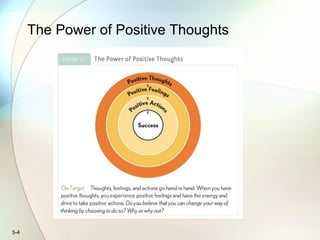
• Positive thoughts lead to positive feelings and actions.
5-4
The Power of Positive Thoughts
5-5
Negative Thinking And Pessimism
• Negative Thinking Focusing on the flaws and
problems in yourself, other people, and the world around
you.
• Pessimism The tendency to expect the worst possible
outcome.
Success Secret
• Negative thinking blocks you from taking risks, making
changes and expressing your real self.
Activity 24: Are You A Positive Thinker?
5-6
Adopting Positive Habits
• Look For The Good!
Personal Journal 5.1 Focusing on the Good.
• Choose Your Words
Make a habit of speaking positively to people.
• Surround Yourself With Positive People
Seek the company of positive people who share ideas.
• Accept, Don’t Judge
Strive to accept people as they are.
• Limit Complaints
Instead of complaining, take constructive action.
5-7
Adopting Positive Habits continued…
• Don’t Worry Worry is a major barrier to positive
thinking, and frequent worry harms your health.
Myth: “Worrying helps me prepare for action.”
Reality: Worrying drains your energy.
Myth: “Worrying helps me deal with my problems.”
Reality: Worrying is a substitute for dealing with your
problems.
Myth: “Worrying means I care.”
Reality: Caring and worrying are not the same.
5-8
When Faced With Worry, Strategize…
• Focus on solutions, not worst-case scenarios.
• Cope, don’t avoid. Take action!
• Share your worries. Talk with a friend.
• If you really can’t do anything about the situation, try to let
the worry go.
• Drown out the worry with positive affirmations.
• Channel your nervous energy into physical activity.
Activity 25: Banishing Worry
5-9
Your Thinking Style And Your Health
• Positive Thinking can make us mentally and physically
healthy.
• Negative Thinking can delay healing and cause us to
neglect our health.
• Depression An illness characterized by profound
feelings of sadness, hopelessness, and helplessness.
Success Secret
• Thinking well can make you well.
Personal Journal 5.2 Depression Self-Check
5-10
Getting Healthy
• Eat Right Use the free www.mypyramid.gov plan.
• Don’t eat for emotional reasons.
• Learn to read and understand nutrition labels
• Shop with a list—you’ll buy more nutritious foods.
• Try a variety of foods to make it easier to eat healthy.
• Get Moving
• Try to be physically active for at least 20 minutes each day.
• Vary your activities so you don’t get bored.
• Motivate yourself by learning about health and fitness.
• Set SMART exercise goals for yourself. If you get off track, just
start again.
Activity 26: What’s Your Health Attitude?
5-11
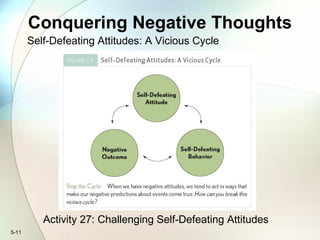
Conquering Negative Thoughts
Self-Defeating Attitudes: A Vicious Cycle
Activity 27: Challenging Self-Defeating Attitudes
5-12
Changing Your Attitude
Recognizing Distorted Thoughts 1
• Cognitive Distortion A self-critical, illogical pattern of
thought:
Examples:
• “I didn’t get an A on that exam. I’m a failure.”
• “My girlfriend broke up with me. Well, there goes my
last chance at happiness.”
Success Secret
• Learn to recognize your self-defeating attitudes and
turn them around into positive self-talk.
5-13
Recognizing Distorted Thoughts 2
• All-or-Nothing Thinking –success or all doom
• Overgeneralizing –if bad, all bad
• Filtering –blocking positive inputs
• Helpless Thinking –nothing will make a difference
• Self-Blame – blaming it all on yourself
• Personalizing –everything has to do with you
• Mind Reading –assuming everyone is thinking bad
thoughts.
5-14
Recognizing Distorted Thoughts 3
• Emotional Reasoning -assuming your negative thoughts
reflect the way things really are.
• Catastrophizing –exaggerating the negatives of a minor
event.
• Irrational Beliefs –distorted, self-destructive thoughts that
boil down to three faulty assumptions.
1. I must do well. (If I don’t, I’m worthless.)
2. You must treat me well. (If you don’t, you must be punished.)
3. The world must be easy. (If it isn’t, it’s intolerable.)
Personal Journal 5.3 From Irrational to Rational
5-15
Learning your ABCDEs
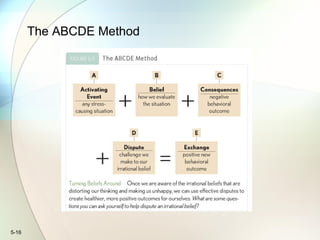
• Adding D and E to the ABC Model
• D stands for Dispute. When you have a negative,
irrational or exaggerated thought, ask yourself:
• Am I jumping to conclusions?
• Am I exaggerating?
• What evidence is there for this thought?
• Is it really as bad as it seems?
• Do I have all the facts?
5-16
The ABCDE Method
5-17
Practice Makes Perfect
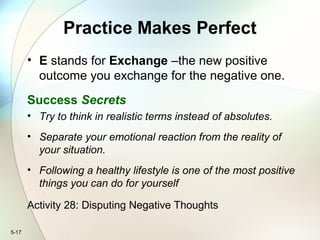
• E stands for Exchange –the new positive
outcome you exchange for the negative one.
Success Secrets
• Try to think in realistic terms instead of absolutes.
• Separate your emotional reaction from the reality of
your situation.
• Following a healthy lifestyle is one of the most positive
things you can do for yourself
Activity 28: Disputing Negative Thoughts

Waitley pofs ch5

  • 1.
    Positive Thinking Chapter 5 “Hopeis not a dream, but a way of making dreams become reality.” Leo Suenens, Religious Leader © 2010 McGraw-Hill Higher Education. All rights reserved.McGraw-Hill
  • 2.
    5-2 Learning Objectives • Definepositive thinking and cite its benefits. • List six habits that can help you become a more positive thinker. • Explain the link between positive thinking and good health. • Describe how self-defeating attitudes create a vicious cycle. • Define cognitive distortions and irrational beliefs and give an example of each. • Summarize the ABCDE method for overcoming irrational beliefs.
  • 3.
    5-3 Becoming A PositiveThinker • Positive Thinking Focusing on what is good about yourself, other people, and the world around you. • Optimism The tendency to expect the best possible outcome. • Attitude A belief or opinion that predisposes you to act in a certain way. Success Secret • Positive thoughts lead to positive feelings and actions.
  • 4.
    5-4 The Power ofPositive Thoughts
  • 5.
    5-5 Negative Thinking AndPessimism • Negative Thinking Focusing on the flaws and problems in yourself, other people, and the world around you. • Pessimism The tendency to expect the worst possible outcome. Success Secret • Negative thinking blocks you from taking risks, making changes and expressing your real self. Activity 24: Are You A Positive Thinker?
  • 6.
    5-6 Adopting Positive Habits •Look For The Good! Personal Journal 5.1 Focusing on the Good. • Choose Your Words Make a habit of speaking positively to people. • Surround Yourself With Positive People Seek the company of positive people who share ideas. • Accept, Don’t Judge Strive to accept people as they are. • Limit Complaints Instead of complaining, take constructive action.
  • 7.
    5-7 Adopting Positive Habitscontinued… • Don’t Worry Worry is a major barrier to positive thinking, and frequent worry harms your health. Myth: “Worrying helps me prepare for action.” Reality: Worrying drains your energy. Myth: “Worrying helps me deal with my problems.” Reality: Worrying is a substitute for dealing with your problems. Myth: “Worrying means I care.” Reality: Caring and worrying are not the same.
  • 8.
    5-8 When Faced WithWorry, Strategize… • Focus on solutions, not worst-case scenarios. • Cope, don’t avoid. Take action! • Share your worries. Talk with a friend. • If you really can’t do anything about the situation, try to let the worry go. • Drown out the worry with positive affirmations. • Channel your nervous energy into physical activity. Activity 25: Banishing Worry
  • 9.
    5-9 Your Thinking StyleAnd Your Health • Positive Thinking can make us mentally and physically healthy. • Negative Thinking can delay healing and cause us to neglect our health. • Depression An illness characterized by profound feelings of sadness, hopelessness, and helplessness. Success Secret • Thinking well can make you well. Personal Journal 5.2 Depression Self-Check
  • 10.
    5-10 Getting Healthy • EatRight Use the free www.mypyramid.gov plan. • Don’t eat for emotional reasons. • Learn to read and understand nutrition labels • Shop with a list—you’ll buy more nutritious foods. • Try a variety of foods to make it easier to eat healthy. • Get Moving • Try to be physically active for at least 20 minutes each day. • Vary your activities so you don’t get bored. • Motivate yourself by learning about health and fitness. • Set SMART exercise goals for yourself. If you get off track, just start again. Activity 26: What’s Your Health Attitude?
  • 11.
    5-11 Conquering Negative Thoughts Self-DefeatingAttitudes: A Vicious Cycle Activity 27: Challenging Self-Defeating Attitudes
  • 12.
    5-12 Changing Your Attitude RecognizingDistorted Thoughts 1 • Cognitive Distortion A self-critical, illogical pattern of thought: Examples: • “I didn’t get an A on that exam. I’m a failure.” • “My girlfriend broke up with me. Well, there goes my last chance at happiness.” Success Secret • Learn to recognize your self-defeating attitudes and turn them around into positive self-talk.
  • 13.
    5-13 Recognizing Distorted Thoughts2 • All-or-Nothing Thinking –success or all doom • Overgeneralizing –if bad, all bad • Filtering –blocking positive inputs • Helpless Thinking –nothing will make a difference • Self-Blame – blaming it all on yourself • Personalizing –everything has to do with you • Mind Reading –assuming everyone is thinking bad thoughts.
  • 14.
    5-14 Recognizing Distorted Thoughts3 • Emotional Reasoning -assuming your negative thoughts reflect the way things really are. • Catastrophizing –exaggerating the negatives of a minor event. • Irrational Beliefs –distorted, self-destructive thoughts that boil down to three faulty assumptions. 1. I must do well. (If I don’t, I’m worthless.) 2. You must treat me well. (If you don’t, you must be punished.) 3. The world must be easy. (If it isn’t, it’s intolerable.) Personal Journal 5.3 From Irrational to Rational
  • 15.
    5-15 Learning your ABCDEs •Adding D and E to the ABC Model • D stands for Dispute. When you have a negative, irrational or exaggerated thought, ask yourself: • Am I jumping to conclusions? • Am I exaggerating? • What evidence is there for this thought? • Is it really as bad as it seems? • Do I have all the facts?
  • 16.
  • 17.
    5-17 Practice Makes Perfect •E stands for Exchange –the new positive outcome you exchange for the negative one. Success Secrets • Try to think in realistic terms instead of absolutes. • Separate your emotional reaction from the reality of your situation. • Following a healthy lifestyle is one of the most positive things you can do for yourself Activity 28: Disputing Negative Thoughts