Volatilization
• Process of vaporization of solid and liquid to atmosphere.
Mechanisms of Volatilization:
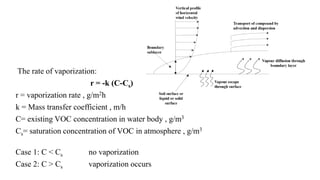
• Initially Vapour escapes through the air/liquid or air/solid interface
into the atmosphere boundary sublayer.
• Then Gas/Vapour diffuses through the boundary sublayer by molecular
and turbulent diffusion.
• The gaseous compound is transported away from the site by advection
and dispersion.
The rate of vaporization:
r = -k (C-Cs)
r = vaporization rate , g/m2h
k = Mass transfer coefficient , m/h
C= existing VOC concentration in water body , g/m3
Cs= saturation concentration of VOC in atmosphere , g/m3
Case 1: C < Cs no vaporization
Case 2: C > Cs vaporization occurs
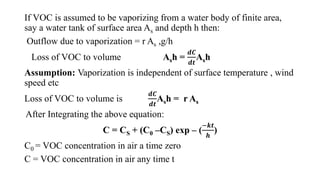
If VOC is assumed to be vaporizing from a water body of finite area,
say a water tank of surface area As and depth h then:
Outflow due to vaporization = r As ,g/h
Loss of VOC to volume Ash =
𝒅𝑪
𝒅𝒕
Ash
Assumption: Vaporization is independent of surface temperature , wind
speed etc
Loss of VOC to volume is
𝒅𝑪
𝒅𝒕
Ash = r As
After Integrating the above equation:
C = CS + (C0 –CS) exp – (
−𝒌𝒕
𝒉
)
C0 = VOC concentration in air a time zero
C = VOC concentration in air any time t
Example
Determine the time required for benzene (C6H6) and DDT (C14H9Cl5) to
vaporize to half their original concentrations from a wastewater treatment
plant holding tank of depth 2 m. The mass transfer coefficient for benzene
is 0.144 m/h and for DDT is 9.34 x 10⁻³ m/h. Values for transfer
coefficients are given in techobanoglous and Schroeber (1987).
Solution:
t1/2 = 0.69 h/k
For benzene,k= 0.144 m/h
DDT, k = 9.34 x 10⁻³ m/h
Therefore for benzene , t1/2 = 0.69 x
2
0.144
= 9.5 h
Therefore for DDT ,t1/2 = 0.69 x
2
9.34 x 10−3
= 147 h ( 6 days)

Volatilization.pptx

  • 1.
    Volatilization • Process ofvaporization of solid and liquid to atmosphere. Mechanisms of Volatilization: • Initially Vapour escapes through the air/liquid or air/solid interface into the atmosphere boundary sublayer. • Then Gas/Vapour diffuses through the boundary sublayer by molecular and turbulent diffusion. • The gaseous compound is transported away from the site by advection and dispersion.
  • 2.
    The rate ofvaporization: r = -k (C-Cs) r = vaporization rate , g/m2h k = Mass transfer coefficient , m/h C= existing VOC concentration in water body , g/m3 Cs= saturation concentration of VOC in atmosphere , g/m3 Case 1: C < Cs no vaporization Case 2: C > Cs vaporization occurs
  • 3.
    If VOC isassumed to be vaporizing from a water body of finite area, say a water tank of surface area As and depth h then: Outflow due to vaporization = r As ,g/h Loss of VOC to volume Ash = 𝒅𝑪 𝒅𝒕 Ash Assumption: Vaporization is independent of surface temperature , wind speed etc Loss of VOC to volume is 𝒅𝑪 𝒅𝒕 Ash = r As After Integrating the above equation: C = CS + (C0 –CS) exp – ( −𝒌𝒕 𝒉 ) C0 = VOC concentration in air a time zero C = VOC concentration in air any time t
  • 4.
    Example Determine the timerequired for benzene (C6H6) and DDT (C14H9Cl5) to vaporize to half their original concentrations from a wastewater treatment plant holding tank of depth 2 m. The mass transfer coefficient for benzene is 0.144 m/h and for DDT is 9.34 x 10⁻³ m/h. Values for transfer coefficients are given in techobanoglous and Schroeber (1987). Solution: t1/2 = 0.69 h/k For benzene,k= 0.144 m/h DDT, k = 9.34 x 10⁻³ m/h Therefore for benzene , t1/2 = 0.69 x 2 0.144 = 9.5 h Therefore for DDT ,t1/2 = 0.69 x 2 9.34 x 10−3 = 147 h ( 6 days)