Research data
LIBER Strategy
for libraries and
research data
Jeannette Frey
LIBER vice-president
Director BCU Lausanne
ExLibris Nordic Directors Meeting 2017, Oslo,
October 27, 2017
LIBER Strategy for
libraries and
research data
• The changing world of scholarly communication
• Authors and articles
• Peer review
• Open Access
• The user
• Big data
• Research data
• The new LIBER Strategy 2018-2022
• The vision statement
• The strategic directions
• The implementation plan – the changing role of the library
The changing world
of scholarly
communication
Authors and
articles
• Growth in the number of scientific publications in the
world – huge market
• Growing number of titles
• Growth in the number of articles even bigger than growth
of titles
• More authors
• Increasingly difficult to publish in high impact journals
• Threshold to enter the market is high for newly created
journals.
The changing world
of scholarly
communication
Peer-review
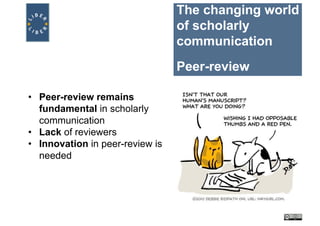
• Peer-review remains
fundamental in scholarly
communication
• Lack of reviewers
• Innovation in peer-review is
needed
The changing world
of scholarly
communication
Open Access
• More than 10’000 fully Open
Access journals listed on
DOAJ in 2017
• about 12 % of articles
published in OA
• 10-12 % of self-archived
copies.
The changing
world of scholarly
communication
The user
• 2017:
• 4 billions users of the Web
• 100 % UNIL students own a
computer
• 95 % own a portable
computer
• 99 % own a smartphone
• 6 % also own a tablet…
The changing
world of scholarly
communication
Big data
• Everyone produces lots of
data!
• Mass digitization by
publishers and libraries
creates data pools
• Native-digital e-journals
creates data pools
Research data
Research data
The challenges
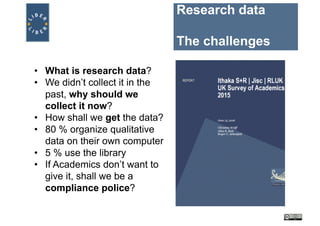
• What is research data?
• We didn’t collect it in the
past, why should we
collect it now?
• How shall we get the data?
• 80 % organize qualitative
data on their own computer
• 5 % use the library
• If Academics don’t want to
give it, shall we be a
compliance police?
Research data
Policy makers
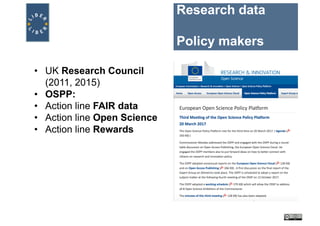
• UK Research Council
(2011, 2015)
• OSPP:
• Action line FAIR data
• Action line Open Science
• Action line Rewards
Research data
Data in libraries
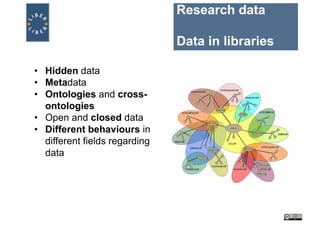
• Hidden data
• Metadata
• Ontologies and cross-
ontologies
• Open and closed data
• Different behaviours in
different fields regarding
data
Research data
Skills
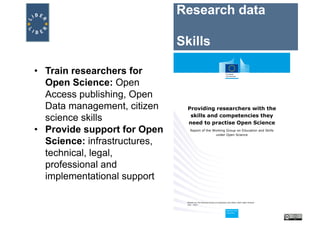
• Train researchers for
Open Science: Open
Access publishing, Open
Data management, citizen
science skills
• Provide support for Open
Science: infrastructures,
technical, legal,
professional and
implementational support
Written by The Working Group on Education and Skills under Open Science
July – 2017
Providing researchers with the
skills and competencies they
need to practise Open Science
Report of the Working Group on Education and Skills
under Open Science
Research data
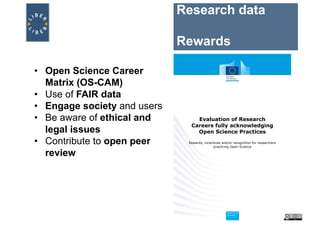
Rewards
• Open Science Career
Matrix (OS-CAM)
• Use of FAIR data
• Engage society and users
• Be aware of ethical and
legal issues
• Contribute to open peer
review
Evaluation of Research
Careers fully acknowledging
Open Science Practices
Rewards, incentives and/or recognition for researchers
practicing Open Science
LIBER Strategy
process 2018-2022
LIBER strategy
2018-2022
Vision statement
• In 2022:
• Open Access is predominant form of publishing
• Research data is findable, accessible,
interoperable and reusable (FAIR)
• Digital skills underpin an open and transparent
research life cycle
• Research infrastructure is participatory, tailored
and scaled to the needs of the diverse disciplines
• Cultural heritage of tomorrow is distilled from
today’s digital information
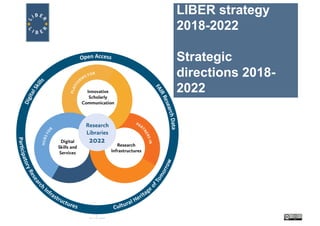
LIBER strategy
2018-2022
Strategic
directions 2018-
2022
Libraries as
platform for
innovative
Scholarly
communication
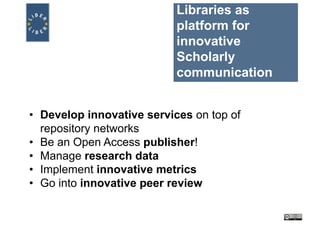
• Develop innovative services on top of
repository networks
• Be an Open Access publisher!
• Manage research data
• Implement innovative metrics
• Go into innovative peer review
Libraries as a hub
for Digital Skills
and Services
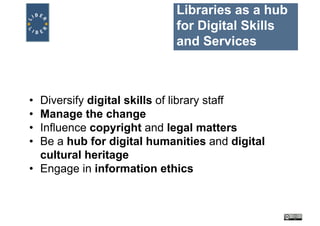
• Diversify digital skills of library staff
• Manage the change
• Influence copyright and legal matters
• Be a hub for digital humanities and digital
cultural heritage
• Engage in information ethics
Libraries
partnering in
Research
Infrastructure
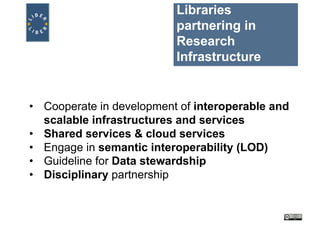
• Cooperate in development of interoperable and
scalable infrastructures and services
• Shared services & cloud services
• Engage in semantic interoperability (LOD)
• Guideline for Data stewardship
• Disciplinary partnership
09/11/2017 Bibliothèque cantonale et universitaire - Lausanne 20
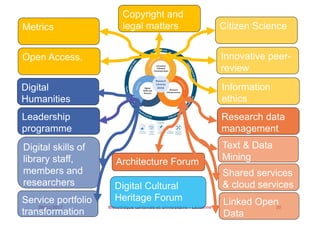
Text & Data
Mining
Leadership
programme
Open Access.
Metrics
Innovative peer-
review
Citizen Science
Digital skills of
library staff,
members and
researchers
Information
ethics
Research data
management
Digital
Humanities
Shared services
& cloud services
Linked Open
Data
Architecture Forum
Digital Cultural
Heritage ForumService portfolio
transformation
Copyright and
legal matters
New challenges,
new tasks
Leadership
programme
• Training new leaders:
• Permanent change management
• New technologies - innovation management
• New profiles… or train existing staff in new tasks
• Manage print & electronic resources with
shrinking budgets…
• Do the policy work
• Do the communication work
New challenges,
new tasks
Digital Humanities
• WG Digital Collections à Digital
Humanities
• Humanities require special attention (not
as digital as other domains)
• Define our role
• Enhance skills of library staff in DH
• Describe cooperation between libraries
and research communities
New challenges,
new tasks
Digital skills of
staff and
researchers
• Define the new services needed for students
and researchers
• Define new skills needed to provide these services
• Assessment and evaluation of success of new
services
• Define which old services could be disengaged
New challenges,
new tasks
Service portfolio
transformation
• Changing the service development
philosophy
• Foster service development philosophy
• Based on user-centred design
• Share best practices on agile development and
user engagement
New challenges,
new tasks
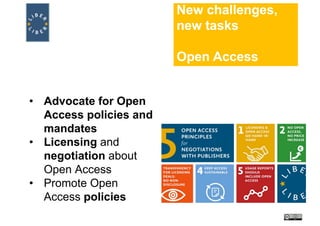
Open Access
• Advocate for Open
Access policies and
mandates
• Licensing and
negotiation about
Open Access
• Promote Open
Access policies
New challenges,
new tasks
Copyright and
legal matters
• Advocate for
research friendly
copyright reform
• Publishing
statements to be
reused by member
libraries in their
advocacy work
New challenges,
new tasks
Metrics
• Explore new metrics
• Provide guidance on
how to support metrics
• Organize workshops
on how to implement
new metrics
• Advocate for new
metrics
New challenges,
new tasks
Innovative peer-
review
• Investigate the landscape and the role of
libraries
• Analyse options: Open peer review, cascade
review, portable peer-review…
New challenges,
new tasks
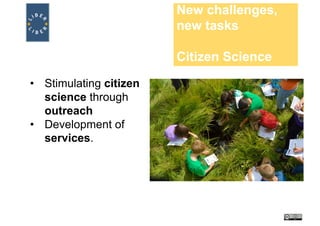
Citizen Science
• Stimulating citizen
science through
outreach
• Development of
services.
New challenges,
new tasks
Information ethics
• Information ethics:
• Libraries need to engage in and advocate for
development of information ethics in the interests
of the research community.
New challenges,
new tasks
Research data
management
• Building capacity
• Developing FAIR RDM policies
• Advocating for FAIR data
• Engaging in development of metadata standards
• Developing criteria and guidelines for Data
stewardship and data curation
New challenges,
new tasks
Text & Data Mining
• Develop best practice in supporting TDM e.g.
licencing, tools, data storage, visualisation
• Cooperate with research infrastructures which
enable your researchers to perform TDM
• Collect TDM methods
• Create educational programs for researchers
about TDM
New challenges,
new tasks
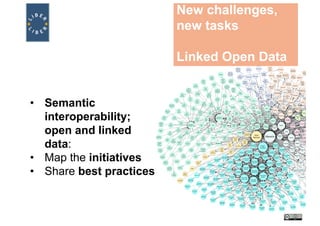
Linked Open Data
• Semantic
interoperability;
open and linked
data:
• Map the initiatives
• Share best practices
New challenges,
new tasks
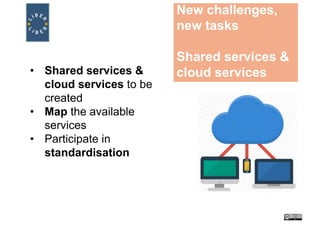
Shared services &
cloud services• Shared services &
cloud services to be
created
• Map the available
services
• Participate in
standardisation
There will be
plenty of changes!
• Not only technology: lots of
challenges are in
management and skills
• You will have to choose
your priorities!
• 2022, the age when OA is
predominant, data is
FAIR, everybody is
digitally skilled and
cultural heritage is digital
is near!
Thanks for your
attention!
Questions?
jeannette.frey@bcu.unil.ch
@jeannettefrey
@libereurope
www.libereurope.eu

LIBER Strategy for libraries and research data

  • 1.
    Research data LIBER Strategy forlibraries and research data Jeannette Frey LIBER vice-president Director BCU Lausanne ExLibris Nordic Directors Meeting 2017, Oslo, October 27, 2017
  • 2.
    LIBER Strategy for librariesand research data • The changing world of scholarly communication • Authors and articles • Peer review • Open Access • The user • Big data • Research data • The new LIBER Strategy 2018-2022 • The vision statement • The strategic directions • The implementation plan – the changing role of the library
  • 3.
    The changing world ofscholarly communication Authors and articles • Growth in the number of scientific publications in the world – huge market • Growing number of titles • Growth in the number of articles even bigger than growth of titles • More authors • Increasingly difficult to publish in high impact journals • Threshold to enter the market is high for newly created journals.
  • 4.
    The changing world ofscholarly communication Peer-review • Peer-review remains fundamental in scholarly communication • Lack of reviewers • Innovation in peer-review is needed
  • 5.
    The changing world ofscholarly communication Open Access • More than 10’000 fully Open Access journals listed on DOAJ in 2017 • about 12 % of articles published in OA • 10-12 % of self-archived copies.
  • 6.
    The changing world ofscholarly communication The user • 2017: • 4 billions users of the Web • 100 % UNIL students own a computer • 95 % own a portable computer • 99 % own a smartphone • 6 % also own a tablet…
  • 7.
    The changing world ofscholarly communication Big data • Everyone produces lots of data! • Mass digitization by publishers and libraries creates data pools • Native-digital e-journals creates data pools
  • 8.
  • 9.
    Research data The challenges •What is research data? • We didn’t collect it in the past, why should we collect it now? • How shall we get the data? • 80 % organize qualitative data on their own computer • 5 % use the library • If Academics don’t want to give it, shall we be a compliance police?
  • 10.
    Research data Policy makers •UK Research Council (2011, 2015) • OSPP: • Action line FAIR data • Action line Open Science • Action line Rewards
  • 11.
    Research data Data inlibraries • Hidden data • Metadata • Ontologies and cross- ontologies • Open and closed data • Different behaviours in different fields regarding data
  • 12.
    Research data Skills • Trainresearchers for Open Science: Open Access publishing, Open Data management, citizen science skills • Provide support for Open Science: infrastructures, technical, legal, professional and implementational support Written by The Working Group on Education and Skills under Open Science July – 2017 Providing researchers with the skills and competencies they need to practise Open Science Report of the Working Group on Education and Skills under Open Science
  • 13.
    Research data Rewards • OpenScience Career Matrix (OS-CAM) • Use of FAIR data • Engage society and users • Be aware of ethical and legal issues • Contribute to open peer review Evaluation of Research Careers fully acknowledging Open Science Practices Rewards, incentives and/or recognition for researchers practicing Open Science
  • 14.
  • 15.
    LIBER strategy 2018-2022 Vision statement •In 2022: • Open Access is predominant form of publishing • Research data is findable, accessible, interoperable and reusable (FAIR) • Digital skills underpin an open and transparent research life cycle • Research infrastructure is participatory, tailored and scaled to the needs of the diverse disciplines • Cultural heritage of tomorrow is distilled from today’s digital information
  • 16.
  • 17.
    Libraries as platform for innovative Scholarly communication •Develop innovative services on top of repository networks • Be an Open Access publisher! • Manage research data • Implement innovative metrics • Go into innovative peer review
  • 18.
    Libraries as ahub for Digital Skills and Services • Diversify digital skills of library staff • Manage the change • Influence copyright and legal matters • Be a hub for digital humanities and digital cultural heritage • Engage in information ethics
  • 19.
    Libraries partnering in Research Infrastructure • Cooperatein development of interoperable and scalable infrastructures and services • Shared services & cloud services • Engage in semantic interoperability (LOD) • Guideline for Data stewardship • Disciplinary partnership
  • 20.
    09/11/2017 Bibliothèque cantonaleet universitaire - Lausanne 20 Text & Data Mining Leadership programme Open Access. Metrics Innovative peer- review Citizen Science Digital skills of library staff, members and researchers Information ethics Research data management Digital Humanities Shared services & cloud services Linked Open Data Architecture Forum Digital Cultural Heritage ForumService portfolio transformation Copyright and legal matters
  • 21.
    New challenges, new tasks Leadership programme •Training new leaders: • Permanent change management • New technologies - innovation management • New profiles… or train existing staff in new tasks • Manage print & electronic resources with shrinking budgets… • Do the policy work • Do the communication work
  • 22.
    New challenges, new tasks DigitalHumanities • WG Digital Collections à Digital Humanities • Humanities require special attention (not as digital as other domains) • Define our role • Enhance skills of library staff in DH • Describe cooperation between libraries and research communities
  • 23.
    New challenges, new tasks Digitalskills of staff and researchers • Define the new services needed for students and researchers • Define new skills needed to provide these services • Assessment and evaluation of success of new services • Define which old services could be disengaged
  • 24.
    New challenges, new tasks Serviceportfolio transformation • Changing the service development philosophy • Foster service development philosophy • Based on user-centred design • Share best practices on agile development and user engagement
  • 25.
    New challenges, new tasks OpenAccess • Advocate for Open Access policies and mandates • Licensing and negotiation about Open Access • Promote Open Access policies
  • 26.
    New challenges, new tasks Copyrightand legal matters • Advocate for research friendly copyright reform • Publishing statements to be reused by member libraries in their advocacy work
  • 27.
    New challenges, new tasks Metrics •Explore new metrics • Provide guidance on how to support metrics • Organize workshops on how to implement new metrics • Advocate for new metrics
  • 28.
    New challenges, new tasks Innovativepeer- review • Investigate the landscape and the role of libraries • Analyse options: Open peer review, cascade review, portable peer-review…
  • 29.
    New challenges, new tasks CitizenScience • Stimulating citizen science through outreach • Development of services.
  • 30.
    New challenges, new tasks Informationethics • Information ethics: • Libraries need to engage in and advocate for development of information ethics in the interests of the research community.
  • 31.
    New challenges, new tasks Researchdata management • Building capacity • Developing FAIR RDM policies • Advocating for FAIR data • Engaging in development of metadata standards • Developing criteria and guidelines for Data stewardship and data curation
  • 32.
    New challenges, new tasks Text& Data Mining • Develop best practice in supporting TDM e.g. licencing, tools, data storage, visualisation • Cooperate with research infrastructures which enable your researchers to perform TDM • Collect TDM methods • Create educational programs for researchers about TDM
  • 33.
    New challenges, new tasks LinkedOpen Data • Semantic interoperability; open and linked data: • Map the initiatives • Share best practices
  • 34.
    New challenges, new tasks Sharedservices & cloud services• Shared services & cloud services to be created • Map the available services • Participate in standardisation
  • 35.
    There will be plentyof changes! • Not only technology: lots of challenges are in management and skills • You will have to choose your priorities! • 2022, the age when OA is predominant, data is FAIR, everybody is digitally skilled and cultural heritage is digital is near!
  • 36.