Visual C 2010 How to Program 4th Edition 1 29 pdf Paul Deitel
Visual C 2010 How to Program 4th Edition 1 29 pdf Paul Deitel
Visual C 2010 How to Program 4th Edition 1 29 pdf Paul Deitel
Visual C 2010 How to Program 4th Edition 1 29 pdf Paul Deitel
Visual C 2010 How to Program 4th Edition 1 29 pdf Paul Deitel
1.
Visual C 2010How to Program 4th Edition 1 29
pdf Paul Deitel download pdf
https://ebookultra.com/download/visual-c-2010-how-to-program-4th-
edition-1-29-pdf-paul-deitel/
Discover thousands of ebooks and textbooks at ebookultra.com
download your favorites today!
2.
Here are somerecommended products for you. Click the link to
download, or explore more at ebookultra.com
C How to Program With an Introduction to C Global Edition
Paul Deitel
https://ebookultra.com/download/c-how-to-program-with-an-introduction-
to-c-global-edition-paul-deitel/
C how to program Tenth Edition Deitel
https://ebookultra.com/download/c-how-to-program-tenth-edition-deitel/
Java How to Program Early Objects 10th ed Edition Deitel
https://ebookultra.com/download/java-how-to-program-early-
objects-10th-ed-edition-deitel/
Internet World Wide Web How to Program 2nd Edition Harvey
M. Deitel
https://ebookultra.com/download/internet-world-wide-web-how-to-
program-2nd-edition-harvey-m-deitel/
3.
C 2008 ForProgrammers Third Edition Deitel Developer
Series Deitel
https://ebookultra.com/download/c-2008-for-programmers-third-edition-
deitel-developer-series-deitel/
Starting out with Visual C 2010 2nd Edition Edition Tony
Gaddis
https://ebookultra.com/download/starting-out-with-visual-c-2010-2nd-
edition-edition-tony-gaddis/
C programming from problem analysis to program design 4th
ed Edition D S Malik
https://ebookultra.com/download/c-programming-from-problem-analysis-
to-program-design-4th-ed-edition-d-s-malik/
SharePoint 2010 How To 1st Edition Sagi
https://ebookultra.com/download/sharepoint-2010-how-to-1st-edition-
sagi/
Questions and Answers 4th Edition Paul C. Giannelli
https://ebookultra.com/download/questions-and-answers-4th-edition-
paul-c-giannelli/
5.
Visual C 2010How to Program 4th Edition 1 29 pdf Paul
Deitel Digital Instant Download
Author(s): Paul Deitel, Harvey Deitel
ISBN(s): 9780132151429, 0132151421
Edition: 4
File Details: PDF, 16.73 MB
Year: 2010
Language: english
7.
Welcome to theVisual C#® 2010 programming language and the world of Microsoft®
Windows® and Internet programming with Microsoft’s .NET platform!
This book focuses on software engineering best practices. At the heart of the book is
the Deitel signature “live-code approach.” Concepts are presented in the context of working
programs, rather than in code snippets. Each code example is accompanied by sample exe-
cutions. All the source code is available at www.deitel.com/books/vcsharp2010htp/ and
at the book’s Companion Website at www.pearsonhighered.com/deitel/.
As you read the book, if you have questions, send an e-mail to deitel@deitel.com;
we’ll respond promptly. For updates on this book and its supporting Visual C# software,
visit www.deitel.com/books/vcsharp2010htp/, follow us on Twitter (@deitel) and
Facebook (www.deitel.com/deitelfan), and subscribe to the Deitel® Buzz Online news-
letter (www.deitel.com/newsletter/subscribe.html).
New and Updated Features
Here are the updates we’ve made for Visual C#® 2010 How to Program, 4/e:
• Printed book contains core content; advanced chapters are online. The printed book
contains sufficient core content for most introductory Visual C# course sequences.
Several online chapters are included for more advanced courses and for profession-
als. These are available in searchable PDF format on the book’s password-protected
Companion Website—see the access card in the front of this book.
• The book’s Companion Website includes extensive VideoNotes in which co-
author Paul Deitel explains in detail most of the programs in the core chapters.
• Making a Difference exercises set. We encourage you to use computers and the
Internet to research and solve significant social problems. These new exercises are
meant to increase awareness and discussion of important issues the world is fac-
ing. We hope you’ll approach them with your own values, politics and beliefs.
• Up-to-date with Visual C# 2010, C# 4, the Visual Studio 2010 IDE and .NET
4. The C# language has been standardized internationally by ECMA and ISO.
The latest version of that language is referred to as C# 4. Microsoft’s implemen-
tation of this standard is referred to as Visual C# 2010.
• New language features. We cover new C# features, such as optional parameters,
named parameters, covariance and contravariance.
• Databases. We use Microsoft’s free SQL Server Express (which installs with the
free Visual C# Express) to teach the fundamentals of database programming.
Chapters 18, 19, 27 and 28 use database and LINQ fundamentals in the context
of an address-book desktop application, a web-based guestbook, a bookstore and
an airline reservation system.
Preface
Download at www.pin5i.com
8.
xviii Preface
• ASP.NET4. Microsoft’s .NET server-side technology, ASP.NET, enables you to
create robust, scalable web-based applications. In Chapter 19, you’ll build several
applications, including a web-based guestbook application that uses ASP.NET,
LINQ and a LinqDataSource to store data in a database and display data in a web
page. The chapter also discusses the ASP.NET Development Server for testing
your web applications on your local computer.
• We removed generic methods from Chapter 9 to make the code easier to under-
stand.
• The code will run on Windows 7, Windows Vista and Windows XP. We’ll post
any issues on www.deitel.com/books/vcsharp2010htp/.
• We introduce exception handling much earlier (Chapter 8) and integrated it in
subsequent chapters in which it had not been used previously. We also now
throw exceptions for invalid data received in the set accessors of properties.
• New design. The book has a new interior design that graphically organizes, clari-
fies and highlights the information, and enhances the book’s pedagogy. We used
italics extensively to emphasize important words, phrases and points in the text.
• We titled the programming exercises to help instructors tailor assignments.
Other features of Visual C# 2010 How to Program, 4/e include:
• We’ve provide instructors with solutions to the vast majority of the exercises. There
are a few large exercises marked “Project” for which solutions are not provided.
• We use LINQ (Language Integrated Query) to query files, databases, XML and
collections. The introductory LINQ chapter, Chapter 9, in the core printed book
is intentionally brief to encourage instructors to cover this important technology
early. The online chapters continue the discussion of LINQ.
• Local type inference. When you initialize a local variable in its declaration, you
can now omit the variable’s type—the compiler infers it from the initializer value.
• Object initializers. For new objects, you can use object initializer syntax (similar
to array initializer syntax) to assign values to the new object’s public properties
and public instance variables.
• We emphasize the IDE’s IntelliSense feature that helps you write code faster and
with fewer errors.
Our Text + Digital Approach to Content
We surveyed hundreds of instructors teaching Visual C# courses and learned that most
want a book with content focused on their introductory courses. With that in mind, we
moved various intermediate and advanced chapters to the web. Having this content in dig-
ital format makes it easily searchable, and gives us the ability to fix errata and add new con-
tent as appropriate. The book’s Companion Website at
(see the access card at the front of the book) contains the following chapters in searchable
PDF format:
www.pearsonhighered.com/deitel/
Download at www.pin5i.com
9.
Dependency Charts xix
•WPF (Windows Presentation Foundation) GUI, graphics and multimedia. We ex-
tend the core book’s GUI coverage in Chapters 24–25 with an introduction to
Windows Presentation Foundation (WPF)—Microsoft’s new framework that in-
tegrates GUI, graphics and multimedia capabilities. We implement a painting ap-
plication, a text editor, a color chooser, a book-cover viewer, a television video
player, various animations, and speech synthesis and recognition applications.
• ASP.NET 4 and ASP.NET AJAX. Chapter 27 extends Chapter 19’s ASP.NET
discussion with a case study on building a password-protected, web-based book-
store application. We also introduce ASP.NET AJAX controls and use them to
add AJAX functionality to web applications to improve their responsiveness.
• WCF (Windows Communication Foundation) Web Services. Web services en-
able you to package application functionality in a manner that turns the web into
a library of reusable services. In Chapter 28, we include case studies on building
an airline reservation web service, a blackjack web service and a math question
generator web service that’s called by a math tutor application.
• Silverlight. Chapter 29 introduces Silverlight, which enables you to create visu-
ally stunning, multimedia-intensive user interfaces for web applications. The
chapter presents powerful multimedia applications, including a weather viewer,
Flickr photo viewer, deep zoom book-cover collage and video viewer.
• Visual C# XML capabilities. Use of the Extensible Markup Language (XML) is ex-
ploding in the software-development industry and in e-business, and is pervasive
throughout the .NET platform. In Chapter 26, we use show how to programmat-
ically manipulate the elements of an XML document using LINQ to XML.
• Optional Case Study: Using the UML to Develop an Object-Oriented Design and
C# Implementation of an ATM. The UML™ (Unified Modeling Language™) is
the preferred graphical modeling language for designing object-oriented systems.
This edition includes an optional online case study on object-oriented design using
the UML (Chapters 30–31). We design and implement the software for a simple
automated teller machine (ATM). We analyze a typical requirements document
that specifies the system to be built. We determine the classes needed to implement
that system, the attributes the classes need to have, the behaviors the classes need to
exhibit and specify how the classes must interact with one another to meet the sys-
tem requirements. From the design we produce a working Visual C# implementa-
tion. We’ve presented this case study to professional audiences in C#, Java, Visual
Basic and C++. After seeing the case-study presentation, students report having a
“light-bulb moment”—the case study “ties it all together” for them and helps them
understand how objects in a larger system communicate with one another.
• Index. The online index includes the content from the printed book and the on-
line content. The printed book index covers only the printed material.
Dependency Charts
The charts in Figs. 1–2 show the dependencies among the chapters to help instructors plan
their syllabi. The printed book focuses on introductory course sequences (Fig. 1). The online
chapters include intermediate and advanced content for more advanced courses (Fig. 2).
Download at www.pin5i.com
10.
xx Preface
Fig. 1| Chapter dependency chart for the chapters in the printed book.
1 Introduction to Computers, the
Internet and Visual C#
3 Introduction to C# Applications
5 Control Statements: Part 1
6 Control Statements: Part 2
7 Methods: A Deeper Look
8 Arrays2
2 Dive Into® Visual C# 2010 Express
11 OOP: Inheritance
10 Classes and Objects:
A Deeper Look
12 OOP: Polymorphism, Interfaces
13 Exception Handling:
A Deeper look
14 GUI with Windows
Forms: Part 1
16 Strings
and Characters
17 Files and Streams3
20 Searching and Sorting
18 Databases
and LINQ5
19 Web App Development
with ASP.NET6
15 GUI with Windows
Forms: Part 2
21 Data Structures4
22 Generics
23 Collections
4 Introduction to Classes,
Objects, Methods and strings
Introduction to Visual C#
Fundamentals and
Object-Oriented Programming
Object-Oriented Programming:
A Deeper Look
Strings, Files and
Data Structures
Graphical User Interfaces
Database and Web
App Development
9 Introduction to LINQ and
the List Collection
1. See Fig. 2 for the online chapters.
2. Chapter 8 introduces exception handling.
3. Requires Sections 14.1–14.5.
4. Requires Sections 14.1–14.5 and 15.6.
5. Requires Sections 14.1–14.6 and 15.8.
6. Requires general GUI and event-handling knowledge (Sections 14.1–14.3).
Dependency Chart
for Print Chapters1
Download at www.pin5i.com
11.
Teaching Approach xxi
TeachingApproach
Visual C# 2010 How to Program, 4/e contains a rich collection of examples. We concen-
trate on building good software and stress program clarity.
Live-Code Approach. The book is loaded with “live-code” examples. Most new concepts
are presented in the context of complete working Visual C# applications, followed by one
or more executions showing program inputs and outputs. In the few cases where we use
snippets, we tested them in complete working programs then copied the code from the
program and pasted it into the book.
Syntax Shading. For readability, we syntax shade the code, similar to the way most inte-
grated-development environments and code editors syntax color the code. Our syntax-
shading conventions are:
Code Highlighting. We place gray rectangles around each program’s key code.
Fig. 2 | Chapter dependency chart for the online chapters.
comments appear like this
keywords appear like this
constants and literal values appear like this
all other code appears in black
9 Introduction to LINQ and
the List Collection
18 Databases and
LINQ to SQL
19 Web App Development
with ASP.NET
10 Classes and Objects:
A Deeper Look
11 OOP: Inheritance
Object-Oriented Programming Object-Oriented Design
Dependency Chart for
Online Chapters
30 ATM Case Study, Part 1:
Object-Oriented Design
with the UML
31 ATM Case Study, Part 2:
Implementing an
Object-Oriented Design
24 GUI with Windows
Presentation Foundation
25 WPF Graphics and Multimedia
WPF GUI and Graphics
Web App Development
26 XML and LINQ to XML1
27 Web App Development
with ASP.NET: A Deeper Look
28 WCF Web Services
29 Silverlight and
Rich Internet Applications
1. Chapter 26 depends on the introduction to XML in Chapter 24.
LINQ, Databases and Web
App Development
12 OOP: Polymorphism, Interfaces
Download at www.pin5i.com
12.
xxii Preface
Using Fontsfor Emphasis. We place the key terms and the index’s page reference for each
defining occurrence in bold text for easy reference. We emphasize on-screen components
in the bold Helvetica font (for example, the File menu) and Visual C# program text in the
Lucida font (for example, int count = 5).
Objectives. The opening quotes are followed by a list of chapter objectives.
Illustrations/Figures. Abundant tables, line drawings, UML diagrams, programs and pro-
gram outputs are included.
Programming Tips. We include programming tips to help you focus on important as-
pects of program development. These tips and practices represent the best we’ve gleaned
from a combined seven decades of programming and teaching experience.
Summary Bullets. We present a section-by-section, bullet-list summary of each chapter.
Terminology. We include an alphabetized list of the important terms defined in each chap-
ter.
Self-Review Exercises and Answers. Extensive self-review exercises and answers are includ-
ed for self-study.
Good Programming Practice
The Good Programming Practices call attention to techniques that will help you pro-
duce programs that are clearer, more understandable and more maintainable.
Common Programming Error
Pointing out these Common Programming Errors reduces the likelihood that you’ll
make them.
Error-Prevention Tip
These tips contain suggestions for exposing and removing bugs from your programs; many
of the tips describe aspects of Visual C# that prevent bugs from getting into programs.
Performance Tip
These tips highlight opportunities for making your programs run faster or minimizing the
amount of memory that they occupy.
Portability Tip
The Portability Tips help you write code that will run on a variety of platforms.
Software Engineering Observation
The Software Engineering Observations highlight architectural and design issues that
affect the construction of software systems, especially large-scale systems.
Look-and-Feel Observation
These observations help you design attractive, user-friendly graphical user interfaces that
conform to industry norms.
Download at www.pin5i.com
13.
Student Resources andSoftware xxiii
Exercises. Each chapter concludes with additional exercises including:
• simple recall of important terminology and concepts
• What’s wrong with this code?
• What does this code do?
• writing individual statements and small portions of methods and classes
• writing complete methods, classes and programs
• major projects.
Please do not write to us requesting access to the Pearson Instructor’s Resource Center
which contains the book’s instructor supplements, including the exercise solutions. Ac-
cess is limited strictly to college instructors teaching from the book. Instructors may ob-
tain access only through their Pearson representatives. Solutions are not provided for
“project” exercises. Check out our Programming Projects Resource Center for lots of ad-
ditional exercise and project possibilities (www.deitel.com/ProgrammingProjects/).
Index. We’ve included an extensive index for reference. Defining occurrences of key terms
are highlighted with a bold page number.
Student Resources and Software
This book includes the Microsoft® Visual Studio® 2010 Express Editions DVD, which
contains the Visual C#® 2010 Express Edition (and other Microsoft development tools).
These tools are also downloadable from
We wrote Visual C# 2010 How to Program using Visual C#® Express Edition. You can
learn more about Visual C#® at msdn.microsoft.com/vcsharp.
Deitel Online Resource Centers
Our website www.deitel.com provides Resource Centers on various topics of interest to
our readers (www.deitel.com/ResourceCenters.html). We’ve found many exceptional
resources online, including tutorials, documentation, software downloads, articles, blogs,
podcasts, videos, code samples, books, e-books and more—most are free. Some of the Re-
source Centers you might find helpful while studying this book are Visual C#, ASP.NET,
ASP.NET AJAX, LINQ, .NET, Silverlight, SQL Server, Web Services, Windows Com-
munication Foundation, Windows Presentation Foundation, Windows 7, UML, Code
Search Engines and Code Sites, Game Programming and Programming Projects.
Instructor Supplements
The following supplements are available to qualified instructors only through Pearson
Education’s Instructor Resource Center (www.pearsonhighered.com/irc):
• Solutions Manual with solutions to most of the end-of-chapter exercises.
• Test Item File of multiple-choice questions (approximately two per book section)
• PowerPoint® slides containing all the code and figures in the text, plus bulleted
items that summarize key points.
www.microsoft.com/express/Windows
Download at www.pin5i.com
14.
xxiv Preface
If you’renot a registered faculty member, contact your Pearson representative or visit
www.pearsonhighered.com/educator/replocator/.
CourseSmart Web Books
Today’s students and instructors have increasing demands on their time and money. Pear-
son has responded to that need by offering digital texts and course materials online
through CourseSmart. CourseSmart allows faculty to review course materials online, sav-
ing time and costs. It is also environmentally sound and offers students a high-quality dig-
ital version of the text for as much as 50% off the cost of a print copy of the text. Students
receive the same content offered in the print textbook enhanced by search, note-taking,
and printing tools. For more information, visit www.coursesmart.com.
Microsoft Developer Network Academic Alliance (MSDNAA) and
Microsoft DreamSpark
Microsoft Developer Network Academic Alliance (MSDNAA)—Free Microsoft Soft-
ware for Academic and Research Purposes
The MSDNAA provides free software for academic and research purposes. For software
direct to faculty, visit www.microsoft.com/faculty. For software for your department,
visit www.msdnaa.com.
Microsoft DreamSpark—Professional Developer and Designer Tools for Students
Microsoft provides many of its developer tools to students for free via a program called
DreamSpark (www.dreamspark.com). See the website for details on verifying your student
status so you take advantage of this program.
Acknowledgments
We’d like to thank Abbey Deitel and Barbara Deitel of Deitel & Associates, Inc., who de-
voted long hours of research and writing to this book.
We are fortunate to have worked on this project with the dedicated team of publishing
professionals at Pearson. We appreciate the guidance, savvy and energy of Michael Hirsch,
Editor-in-Chief of Computer Science. Carole Snyder recruited the book’s reviewers and
managed the review process. Kristine Carney designed the book’s cover. Bob Engelhardt
and Jeffrey Holcomb managed the book’s production.
Reviewers
We wish to acknowledge the efforts of our fourth edition reviewers. Adhering to a tight
schedule, they scrutinized the text and the programs and provided countless suggestions
for improving the presentation:
• Octavio Hernandez, Microsoft C# MVP, Advanced Bionics
• José Antonio González Seco, Parliament of Andalusia, Spain
• Zijiang Yang, Western Michigan University
Previous Edition Reviewers
Huanhui Hu (Microsoft Corporation), Narges Kasiri (Oklahoma State University),
Charles Liu (University of Texas at San Antonio), Dr. Hamid R. Nemati (The University
Download at www.pin5i.com
(Map 5.)
1. Ludlow,Kenton County.—In the Sunday Star of Washington, D.
C., for January 3, 1919, there appeared a reproduction of a
photograph of a tusk, believed to belong to a mastodon, which had
been found at Ludlow, opposite the lower end of Cincinnati. It was
unearthed by the steam shovel in the course of excavating for the
Southern Railroad, at a depth of 35 feet, in a gravel bank. It is
reported to have a length of 6 feet 10 inches and a diameter of 7
inches. A part of the distal end is missing. According to the
photograph, the tusk forms somewhat more than half the
circumference of a circle whose radius is about 23.5 inches. The
curvature and the thickness, as compared with the length, appear to
indicate that it belonged to a mastodon, but the identity is not
certain.
2. Bigbone Lick, Boone County.—At this place there have been
collected an almost incredible number of teeth, skulls, and other
bones of Mammut americanum; and these have been sent to many
museums of this country and Europe. While skulls are said to have
been found, no complete skeletons have ever been collected. In 1805,
Dr. B. S. Barton (Med. Phys. Jour. Phila., vol. I, pp. 154–159) wrote of
bones he had seen from this place. He quoted from a letter written by
John Bartram to James Logan. Some Shawanese Indians had
brought to Pittsburgh a tooth and a piece of tusk. They described a
head as having a long nose and a mouth on the underside. They
reported that there were at the Lick five whole skeletons; also a
shoulder-blade which, when stood on end, came to the shoulders of a
tall man. What they regarded as the long nose may be interpreted as
a tusk. Probably some tons of mastodon bones have been collected at
this place, but it is quite certain that nearly the whole of this
important material has been lost. Further reference to the locality, its
geology, and the species collected there will be made on pages 401 to
404, map 41.
3. Bluelick Springs, Nicholas County.—From an excavation made
at this place by Mr. Thomas W. Hunter, in an attempt to restore the
springs which supplied the once popular watering-place, there were
taken a large quantity of bones of various animals, perhaps as much
as two farm-wagon loads. The greater number of these bones
17.
belonged to themastodon. Portions of skulls were found, but no
complete skull. There were in the collection perhaps 100 mastodon
teeth and many tusks, but some of these may have belonged to
elephants. In some cases the tusks show at the distal end evidences
of abrasion by use. Several tusks are planed off on opposite sides, as
if they had lain buried in the bottom of a stream, had been worn
down flat by sand and gravel, and had then been turned over and
planed on the other side. In Mr. Hunter’s collection, seen by the
writer, there are small tusks, probably deciduous upper or lower
ones, which vary from 87 mm. to 115 mm. in length. Each one is
slightly flattened, and has an outer layer of hard dentine or possibly
enamel, which is smooth. When this has peeled off the underlying
dentine is grooved and ridged longitudinally. The transverse
diameters vary from 20 to about 27 mm. Some of these small tusks
are straight, others are slightly curved. On page 405 will be given a
list of the associated animals and remarks on the geology.
4. Harrisonville, Harrison County.—In the U. S. National
Museum is a lower left penultimate molar of a mastodon said to have
been found somewhere near this place. It was presented by Hon. M.
L. Ross, through Mr. R. L. Garner. No details are known. The village
mentioned is said to be near Cynthiana, but it is not on the maps at
hand.
5. Fayette County.—In Kentucky University there is a lower left
hindermost molar of a mastodon, labeled as having been found
somewhere in the county.
6. Drennon Springs, Henry County.—In 1881, Mr. G. K. Greene,
(2d Ann. Rep. Bur. Statist. and Geol. Indiana, 1880, p. 428) stated
that the collection of the State University of Indiana contains a
remarkably fine half of a lower jaw of a mastodon, found at the place
named. Nothing more is known about it. In 1831, C. S. Rafinesque
(Monthly Amer. Jour. Geol., vol. I, p. 354) wrote that “Drennon’s
Licks had bones and mounds,” indicating that at that early time fossil
bones had been found there.
7. Louisville, Jefferson County.—In 1835, Dr. Richard Harlan
(Med. and Phys. Res., p. 256) referred to statements made to the
effect that several mastodon skeletons had been found in digging the
canal around the falls of the Ohio, at Louisville. They were taken
from the river banks, at a depth of several feet beneath the present
18.
soil. It wasadded that several pairs of tusks were arranged in a circle
within which were remains of a fire and Indian tools. The authority
for this story is hardly what one could desire.
8. Smithland?, Livingston County.—In the Academy of Natural
Sciences at Philadelphia is a part of a lower left hindermost
mastodon molar, labeled as having been found at the mouth of
Cumberland River. It is credited to Dr. P. B. Goddard. No details
have been preserved. Smithland is at the mouth of Cumberland
River, but how far away from this town the tooth was found is not
known.
19.
FINDS OF ELEPHASPRIMIGENIUS IN
EASTERN NORTH AMERICA.
ONTARIO.
(Map 11.)
1. Toronto, York County.—In 1863 (Canad. Naturalist and Geol.,
vol. VIII, p. 399), Professor Alex. Winchell wrote that he had a cast of
a tooth found at Toronto, and thought by him to belong to Elephas
primigenius. The writer saw this cast at Ann Arbor, Michigan. It is
evidently a lower right penultimate molar of the species mentioned.
It is to be regretted that more information was not furnished as to
the exact locality and the beds; it would be of interest to know
whether it had been found in the interglacial deposits that occur
about Toronto.
2. Amaranth, Dufferin County.—In 1908 (Bull. Geol. Soc. Amer.,
vol. IX, p. 387), Dr. Robert Bell reported the finding of the greater
part of the skeleton of an elephant in a swamp in lot 9, range 7, of the
township of Amaranth. The tusk was said to be 14 feet long and 8
inches in diameter. The context indicates that the remains were
found at a moderate depth in shell marl.
In 1891 (Geol. Mag., dec. 3, vol. VIII, p. 504), Professor J. Hoyes
Panton reported the discovery, in 1890, of bones of a mammoth at
this place, impliedly in a bed of marl. There were 31 ribs, several
vertebræ, a tusk 12.66 feet long, with a portion broken off; also a
tooth weighing 16.75 pounds. From Mr. Simon Jelly, of Shelburne,
the writer learns that the bones reported to have been found at
Shelburne are the same as those reported from Amaranth. They had
20.
been exhumed byhis brother, John Jelly, and were taken to Owen
Sound and from there exhibited at county fairs for several years.
These bones, or a part of them, are at present in possession of Mr.
Alexander Duke, of San Diego, California. A photograph of the tusk
shows it has quite the length given for it. It is relatively slender, the
base having a diameter said to be 9.5 inches. It is spirally twisted in
the distal half. The atlas is present and stated to measure 16 by 9
inches. There is a small but distinct photograph of a hindermost
molar, apparently an upper one. The tooth is 16 inches long, 7 inches
high, and 3 inches wide. This is the length from the front of the
grinding-surface to the base behind. The plates are not worn to the
base in front. There appear to be 22 ridge-plates present, and 6 in a
4–inch line. The base of the tooth is straight; the ridge-plates curve
forward slightly as they ascend. The hyoid arch is preserved. The
writer regards the specimen as being a large individual of Elephas
primigenius.
This elephant lived after the Wisconsin ice-sheet had begun to
withdraw. According to Taylor’s map (Monogr. U. S. Geol. Surv., LIII,
plate XIX), this region had become cleared of ice while the basin of
Lake Ontario was still fully occupied by the glacier; but it is doubtful
that the animal could have lived there at that time.
21.
NEW YORK.
(Map 11.)
1.Minoa, Onondaga County.—Dr. Burnett Smith, of Syracuse
University, sent the writer photographs of a lower hindermost molar
of an elephant which, associated with a tusk, was found at this place,
8 miles east of Syracuse. Dr. Smith has ascertained that the tooth
and the tusk were dug up during the construction of the West Shore
Railroad. The tooth is quite certainly that of Elephas primigenius. It
is worn down to the base in front, but retains a part of its large
posterior root.
2. Williamson, Wayne County.—In the collection of Rochester
University is a lower left hindermost molar tooth found at this place.
Professor H. L. Fairchild informed the writer that the tooth was
found on the Iroquois beach, but whether on the northern or
southern side is not known.
3. Pittsford, Monroe County.—In 1842 (Zool. New York Mamm., p.
101, plate XXXII, fig. 2), J. E. De Kay described, under the name
Elephas americanus, a tooth found at Perinton, about 10 miles east
of Rochester and near Irondequoit River. A description of the
discovery and of the locality had been given in 1837 (Amer. Jour.
Sci., vol. XXXII, p. 377) by an anonymous writer. Two teeth and a tusk
had been found in a sandy bank on the stream mentioned while a
race was being made for a saw-mill. The tusk, and probably the teeth
also, lay at a depth of 4 feet. The exact locality was described as being
2 miles north of the crossing of Erie Canal. This is in reality
southeast of Rochester and near Pittsford. On page 59 is described a
tusk of a supposed mastodon found at Pittsford in 1830.
De Kay regarded the animal as belonging to an undescribed
species, but his name Elephas americanus had been applied to the
mastodon by Cuvier in 1799.
On examining Fairchild’s plates showing the recession of the
Wisconsin ice-sheet (Bull. 127, State Mus. New York) it will be seen
that the localities where the three specimens of Elephas primigenius
have been found are close to the south shore of the ancient Lake
22.
Iroquois. The animalscould not, therefore, have lived before the ice
had nearly or quite withdrawn into the basin of the present Lake
Ontario. They may have lived long after this, possibly up to, or near
to, the beginning of the Recent. It is to be noted further that the
locality of the molar tooth found at Williamson, Wayne County, is
closer to the shore of Iroquois Lake than is that of any of the
mastodons; so possibly this species existed somewhat longer than
did the mastodon.
4. Buffalo, Erie County.—From the director of the Buffalo Society
of Natural History, Dr. William L. Bryant, the writer has received
photographs of a right upper hindermost molar of Elephas
primigenius dredged from near the middle of Niagara River,
opposite Buffalo. The tooth is 275 mm. long and 100 mm. wide on
the worn surface. It is worn to near the base in front, but probably no
plates are wholly lost. There appear to be about 24 present. It
appears probable that the tooth had not been carried far after being
washed from its resting-place. Although it probably belongs to the
Wisconsin stage, there is a possibility that it was washed out of some
older Pleistocene deposit.
5. Queensbury, Warren County.—Mr. C. A. Hartnagel, assistant
State geologist of New York, informed the writer of the discovery,
some 60 years ago, of a tooth of an elephant near Queensbury,
situated near the southern end of Lake George. The tooth is labeled
as found on the John Harris farm. The nature of the deposit in which
it was buried is not known. It was found during the excavation of a
cellar, therefore at no great depth.
The tooth is a lower right hindermost molar, worn on only about 8
plates and not to the base in front. About 7 plates are missing from
the rear. There are present 17 ridge-plates. The length along the base
is 250 mm.; originally it must have been close to 350 mm. On a
lateral face there are only about 7 of the plates in a 100–mm. line.
Nevertheless, the writer regards the tooth as belonging to E.
primigenius. It is unusually long for the species; hence the plates are
thicker, quite as thick as some specimens of E. columbi. However,
the enamel, as shown on the worn face, is much thinner than that of
E. columbi and comparatively little folded. The plates are only
moderately concave on the hinder face. The height of the tooth at the
ninth plate is 140 mm.
23.
6. Lewiston, NiagaraCounty.—From Mr. C. A. Hartnagel the
writer received information of the finding of a tooth of an elephant at
Lewiston; and later the tooth was sent for examination. It proved to
belong to E. primigenius and to be the upper right hindermost
molar. Inasmuch as it is worn to the base in front and as the large
anterior root is missing, some plates, probably at least two, are
missing. There are 22 present. The tooth is worn back to the tenth
from the rear. The length, as the tooth is preserved, is 275 mm. The
height at the tenth plate from the rear is 160 mm., not including the
base of the roots. The greatest thickness is 85 mm. On the lateral face
are 9 plates in a 100–mm. line. The base of the tooth is straight; the
hinder border of the crown, arched.
Mr. Hartnagel stated that besides the tooth some fragments of
other teeth and two atlases were found at the same place. Evidently
more than one animal was present. The remains here described were
discovered at least 20 feet below the gravel-bed at that place and 80
feet below the level top of the terrace at points where it was not
eroded. The bones and teeth appear to have been scattered through a
bed of sediments at least 6 feet in thickness. The remains described
above were mentioned by Kindle and Taylor on page 13 of Folio 190
of the U. S. Geological Survey, but were referred to a mastodon. The
writers described the deposit in which the tooth was found. The
geological age was believed to be that of the Iroquois episode of the
Wisconsin.
24.
NEW JERSEY.
(Map 11.)
1.Trenton, Mercer County.—In the collection at Princeton
University is an upper right last molar of this species recorded as
having been found at Trenton. It was discovered in the bluff of
Delaware River, just outside the fence of the Riverview cemetery,
about 12 feet from the surface. The tooth was given to Dr. Marcus S.
Farr by Dr. C. C. Abbott, and to him by Dr. Ward, of Trenton. Dr.
Abbott was certain that it was found in the Trenton gravels. Further
mention will be made of this on page 304.
2. North Plainfield, Union County.—In Rutgers College is a
considerably weathered elephant tooth referred to this species. It was
found on Greenbrook road, 2 miles east of North Plainfield. There
are about 12 ridge-plates present in the specimen. This locality is on
the border of the Wisconsin drift moraine, and the elephant tooth
was probably buried in outwash from the moraine.
25.
PENNSYLVANIA.
(Map 11.)
1. Brookfield,Tioga County.—In the U. S. National Museum (No.
193) is a part of an upper molar of Elephas primigenius sent in 1889
by Mr. Ira Sayles, of Brookfield. It was found along the north fork of
Cowanesqua Creek. The hinder 13 plates are present. Mr. Sayles, in a
letter to the present writer, stated that originally the tooth had 8
more enamel plates. This would seem to indicate that the tooth is the
hindermost molar. Ten of the plates on the side of the tooth are
crossed by a line 100 mm. long. The animal probably belonged to the
Late Wisconsin stage.
2. Chadd’s Ford, Chester or Delaware County.—In the collection
of the Academy of Natural Sciences, Philadelphia, is a fragment of an
elephant tooth labeled as found in kaolin deposits owned by W. W.
Jeffries and G. B. Dillingham. The specimen was described by Leidy
(Proc. Phila. Acad., 1875, p. 121). In this fragment are six ridge-
plates, and a line crossing them measures 60 mm. The tooth appears
to have belonged to Elephas primigenius. Leidy stated that it had
been found lying on the kaolin bed, 8 feet below the surface.
In the same collection is a fragment of a tooth to be referred to E.
primigenius, consisting of three plates, apparently presented by I.
McClure. It is said to have been found in Chester County, but no
more exact locality was named.
3. Harvey’s, Greene County.—From Mr. Andrew J. Waychoff, of
Waynesburg, the writer has received for examination a lower jaw of a
young individual of Elephas primigenius found near the place
named. Professor Edwin Linton sent the information that it was
discovered in the bed of Gray’s Fork of Ten mile Creek, about 0.25
mile west of Graysville. In the jaw are the second true molars, right
and left, slightly worn. The length of each is 165 mm., the width 62
mm.
4. Lone Pine, Washington County.—From Professor Edwin Linton,
of Washington and Jefferson College, the writer received a
26.
photograph of anelephant tooth found at Lone Pine. This place is
located on Little Ten mile Creek, 7.25 miles southeast of Washington.
Professor Linton writes that a 100–mm. line crosses ten of the ridge-
plates on the side of the tooth. The photograph shows that there are
20 plates present, of which 12 are worn more or less.
5. Beaverdam, Erie County.—In 1828 (Amer. Jour. Sci., vol. XIV, p.
31), Mr. Jeremiah Van Rensselaer described a tooth which must have
been that of Elephas primigenius. It had been found near Lake Erie,
at a place called Beaverdam, near a small rivulet, and at a height of
600 feet above the lake. He stated that there were 13 layers of enamel
in a line 4.5 inches long. The tooth was sent to the Lyceum of Natural
History, New York, but was probably destroyed in a fire at the old
American Museum of Natural History.
27.
OHIO.
(Maps 11, 36.)
1.Waverly, Pike County.—In the U. S. National Museum is an
upper molar of an elephant said to have been found in a gravel-pit of
the Norfolk and Western Railroad, at Waverly. It was sent to the
Smithsonian Institution in 1900 by Mr. E. Sehon, who stated that the
tooth had been picked up along the railroad mentioned, about 30
miles south of Kenova, West Virginia, but that the gravel had been
loaded on the cars at Waverly. The tooth is believed to be the
hindermost milk molar. There are 10 plates in a line 100 mm. long.
The Pleistocene geological conditions at Waverly may to some extent
be learned by consulting Leverett’s paper forming Monograph XLI of
the U. S. Geological Survey, pages 101–104. There is a possibility that
this tooth was buried in gravels older than the last glacial stage.
2. Zanesville, Muskingum County.—In 1853 (Amer. Jour. Sci., ser.
2, vol. XV, pp. 146–147) is found a brief account of the discovery of
elephant remains at Zanesville. One tusk and four molars were
found. Two of the latter weighed (probably while wet) 20 pounds
each and two others 14 pounds each. They had been found on the
line of what was then called the Ohio Central Railroad and in the
eastern part of the city. At about the same time (Proc. Boston Soc.
Nat. Hist., vol. IV, p. 377) Warren exhibited a tooth of an elephant,
one of three received by him from Zanesville (misprinted Lanesville).
In the second edition of his monograph on “Mastodon giganteus”
Warren figured one of these teeth (his plate XXVIII). It was stated that
he had four of the teeth, all belonging to Elephas primigenius. These
are now in the American Museum of Natural History, New York. The
right upper hindermost molar is a fine large tooth. The large front
root is missing, as are quite certainly about 3 plates. There are now
28 present. The length along the nearly straight base is 335 mm. The
rear is high and arched. There are 9 plates in a 100–mm. line and the
enamel is little festooned. Foster, in 1857 (Proc. Amer. Assoc. Adv.
Sci., 10th meeting, p. 156), described the discovery and exhumation
of these remains, publishing a geological section illustrated by a
28.
figure. The elephantbed is 37 feet above the river and over 20 feet
from the surface. In the collection of the State University at
Columbus (No. 5296) is a fine upper hindermost molar of Elephas
primigenius credited to T. W. Lewis and said to have been found at
Zanesville. There are nine or ten plates in a 100–mm. line. Zanesville
is situated in the unglaciated part of the State; but outwash from
both the Illinoian and the Wisconsin glaciers has been deposited
along the river. For a knowledge of the Pleistocene epoch in that
region, Leverett’s work may be consulted (Monogr. U. S. Geol. Surv.,
vol. XLI, p. 158, plate II).
3. Duncan Falls, Muskingum County.—In the U. S. National
Museum (No. 308) is a tooth, apparently the first true molar, of
Elephas primigenius labeled as having been found on Salt Creek, in
the county named. Salt Creek is situated in the eastern part of the
county, flows southward, and empties into Muskingum River at
Duncan Falls. This tooth is probably the one mentioned by J. W.
Foster in 1857 (Proc. Amer. Assoc. Adv. Sci., 10th meeting, 1856, p.
158) as having been found near the mouth of Salt Creek and then
owned by Mr. A. C. Ross.
4. Millport, Columbiana County.—From Professor Edwin Linton,
of Washington and Jefferson College, Washington, Pennsylvania, the
writer received a letter stating that there is in that institution a tooth
of an elephant found in section 7 of Franklin Township (17 north,
range 3 west), apparently about 2 miles northeast of Millport and on
or near the stream Nancy Run. The locality is outside of the glaciated
area. Probably the animal had lived during the Wisconsin stage, but
there is a chance that it belonged to an earlier time.
5. Mount Healthy, Hamilton County.—In 1914, the writer received
the photograph of a skull of Elephas primigenius which was found
some years before at Mount Healthy. Professor N. M. Fenneman
informed the writer that it was discovered on the farm of Barney
Miller, in the bank of Whisky Run. Professor C. A. Hunt, of Mount
Healthy, has sent the information that it was found in the bed of
Taylor Creek, a branch of West Fork of Mill Creek, in the northeast
quarter of section 28, township 3, range 1, of the Miami purchase.
Taylor Creek is probably another name for Whisky Run. The skull
was met with in deep alluvial sediment. At the time of Professor
Hunt’s writing it was in the possession of Mr. Jacob Kismer, North
29.
Side, Cincinnati. In1920 it was purchased for the U. S. National
Museum (No. 10261).
The front of the skull is preserved from the vertex to the front of
the premaxilla. A part of one tusk, about 4 inches in diameter, is
present. An upper molar was detached and later lost or otherwise
disposed of. The one present has 10 ridge-plates in a 100–mm. line.
Leverett (Monogr. XLI, p. 283), in speaking of drift deposits in Mill
Creek Valley, stated that the greater part of the drift is Illinoian.
Professor Fenneman (Bull. 19, Geol. Surv. Ohio, p. 158) refers the
deposit to the Wisconsin stage.
15. Butler County.—In the collection of the Academy of Natural
Sciences at Philadelphia is an elephant tooth which is accredited to
W. S. Vaux and labeled as having been found in Butler County. The
tooth has now a length of 230 mm., but is worn down to the base in
front and the large anterior root is missing. The width is 105 mm. It
appears to be a large hindermost upper molar of E. primigenius.
Nothing more definite is known about the locality. The whole
country is covered with Wisconsin drift.
6. Dayton, Montgomery County.—In the collection of the Society
of Archæology and History at the University of Ohio is a tooth of
Elephas primigenius which, as reported by Professor W. C. Mills,
was found near the middle of the eastern boundary of Montgomery
County. This would not be far from Dayton. The locality is within the
area covered by Wisconsin drift and the animal lived probably not far
away from the foot of the retiring glacier.
7. Selma, Clark County.—In Earlham College, Richmond, Indiana,
are two upper last molars, right and left, said to have been collected
at Selma. There are nine ridge-plates in a line 100 mm. long. Nothing
is known regarding the geological conditions connected with the
discovery, except that the locality is within the Wisconsin area.
8. Versailles, Darke County.—In the U. S. National Museum is an
upper hindermost molar of Elephas primigenius (No. 4761),
recorded as found in Wayne Township, on the farm of Foster
Compton, in the northeast corner of the township. This would be
probably about 4 miles north of east of Versailles. The country is
level and was doubtless originally swampy. This tooth is apparently
the one mentioned by A. C. Lindemuth in 1878 (Geol. Surv. Ohio,
30.
vol. III, pt.1, p. 509). He stated that it had been picked up in the
creek bottom just north of Versailles.
Under this number may be recorded a tooth of E. primigenius
found many years ago by George H. Teaford, about 2 miles southeast
of Palestine, in Darke County, and now in the collection in the public
library at Greenville. It is a lower left hindermost molar. There are 20
plates present and evidently a few are missing from the front.
9. Jersey, Licking County.—In the collection of the Ohio State
University, Columbus, are two large teeth of Elephas primigenius
labeled as sent from this place and credited to D. D. Condit. The
length along the base of one of the teeth is 286 mm. There are nine
plates in a 100–mm. line and the enamel is unusually thin. This
locality is on the western border of the Wisconsin terminal moraine
and the animal belongs therefore to the Late Wisconsin stage.
10. Chicago, Huron County.—In the collection of the Society of
Archæology and History, at the University of Ohio, the writer has
seen a tooth of Elephas primigenius, labeled as having been found at
this place, which is located on or close to the Defiance moraine.
11. Kamms, Cuyahoga County.—About May 1, 1911, Mr. F. W.
Glenn, of Kamms, sent to the U. S. National Museum a photograph
of a tooth which the present writer identified as belonging to Elephas
primigenius. This town is about 4 miles from the shore of Lake Erie.
12. Cleveland, Cuyahoga County.—In the collection of Adelbert
College, Cleveland, is a lower jaw of Elephas primigenius which was
obtained here. Professor H. P. Cushing has furnished the writer
photographs of this jaw, which belonged to a young animal,
inasmuch as the hindermost milk molar had not wholly appeared
above the bone. Of this tooth, six ridge-plates were crossed by a line
50 mm. in length.
This jaw was found in 1909, in making a sewer, in hitherto
undisturbed materials, 22 feet from the surface. In the section at that
point is found 22 feet of sand resting on till, the latter being the
upper part of the glacial filling of the preglacial Cuyahoga Valley, 300
feet down to the rock. The jaw was at the base of the sands. Professor
Cushing regarded the jaw as older than old Lake Warren and
presumably as belonging to the time of Lake Whittlesey.
31.
13. New Berlin,Stark County.—At Heidelberg University, Tiffin,
Ohio, the writer has seen a well-preserved specimen of an upper
second true molar of Elephas primigenius found near New Berlin.
There were counted 16 ridge-plates, of which 11 are in a 100–mm.
line.
From Rev. J. P. Stahl, Alliance, Ohio, the writer has learned that
this tooth was found about a mile south of New Berlin, in a small
gravel hill along the Canton and New Berlin highway. The gravel was
being removed to make a road-bed. New Berlin is on the Grand River
moraine and the elephant belongs therefore to the Late Wisconsin
stage.
14. Amboy, Ashtabula County.—In the Buffalo, New York, Natural
History Society, the writer examined a tooth of Elephas primigenius,
discovered at this place. It is the front half of the right upper
hindermost molar. There are nine ridge-plates in a 100–mm. line. At
the same place, and probably under the same geological conditions,
were found teeth of Elephas columbi. These conditions will be
described on page 329.
15. See page 135.
32.
MICHIGAN.
(Map 11.)
1. ThreeOaks, Berrien County.—Mr. C. K. Warren, of Three Oaks,
has in his possession the upper and lower last molars, right and left,
of an elephant which appears to have been found somewhere in the
neighborhood of Three Oaks. These are large teeth and seem to the
writer to belong to E. primigenius. The left upper tooth is 300 mm.
long and 100 mm. wide. There are 22 plates. The tooth is worn back
to the fourteenth plate, 170 mm. high. There are only seven plates in
a 100–mm. line, but it must be taken into account that the tooth is a
large one for the species. The plates are parallel with one another and
the base of the tooth is straight. The enamel is thin.
One of the lower teeth has a length of 342 mm. The height at the
first unworn plate, about the fourteenth, is 135 mm. On the outer
face there are six plates in a 100–mm. line.
Not knowing exactly where these teeth were found or at what
depth, not much can be said regarding them. However, the region
about Three Oaks is occupied by Wisconsin drift and the animal
quite certainly lived during the Late Wisconsin stage.
As shown by the map of mastodons in Michigan (map 8), at least
three specimens of the American mastodon have been found in this
county. It is extremely probable that the two species lived together.
2. Eaton Rapids, Eaton County.—In the Michigan Agricultural
School, at East Lansing, is a lower jaw (No. 8260) of Elephas
primigenius, found at Eaton Rapids, on the Grand River. Dr. A. C.
Lane (Ann. Rep. Geol. Surv. Michigan for 1905, p. 553) says that it
was found 2 miles below the town. It was found in 1904 by Charles
H. Fry. The jaw contains a tooth on each side, and in front of each is
a socket for a missing tooth. Behind the tooth is a cavity in the jaw
for a succeeding tooth. The one present is taken to be the first true
molar. There are present 13, possibly 14, plates. The length of the
tooth is 123 mm., its width 51 mm. The enamel is thin and little
crinkled. The jaw is 100 mm. high at the rear of the tooth present.
33.
Eaton Rapids issituated on the Grand River, where the latter
breaks through the Charlotte morainic system. In this county there
have been found two mastodons, one about Belleview, the other in
the vicinity of Olivet.
34.
INDIANA.
(Map 11.)
In AreaCovered by Illinoian Drift.
1. Otter Creek Township, Vigo County.—In Ward’s Natural
History Establishment, Rochester, New York, the writer saw a pair of
upper second molars which, in 1885, were found in Otter Creek
Township. They were dug up on the farm of W. H. Stewart, while
making a ditch in low ground. From information received from Mr.
S. D. Humphrey, North Terre Haute, it appears that the locality is
not far from the common meeting-point of sections 8, 9, 16, 17 of
township 13 north, range 8 west. The complete tooth, the one of the
left side, had 22 plates and a front and a rear talon. The length was
248 mm., the width 96 mm. There were 10 plates in a line 100 mm.
long. This thinness of the plates is evidence as to the specific identity
of the animal.
2. Madison, Jefferson County.—The collection of the Academy of
Natural Sciences, at Philadelphia, contains a large lower last molar of
the right side, presented by Dr. Hallowell in 1840, and labeled as
coming from Madison. The length is 245 mm., and there are 9 plates
in 100 mm. This tooth was mentioned by Dr. Leidy in 1869. From the
information furnished one can conclude only that Elephas
primigenius once lived in southern Indiana.
3. Vevay, Switzerland County.—Professor E. Danglade, of the U.
S. Fish Commission, presented the U. S. National Museum a tooth
(No. 7913), apparently a second true molar, possibly the first, of E.
primigenius. There are 10 plates present. The tooth was found on the
shore of Ohio River about 1.5 miles below Vevay, having been
washed out of a gravel bank, and is much weathered. No exact
conclusions about the age of the tooth can be drawn from the known
facts.
35.
In Area Betweenthe Shelbyville and the Bloomington
Moraines.
10. Webster, Wayne County.—In the collection of Earlham College
are 2 elephant teeth, credited to Jehiel Bond and found on Nolands
Fork, near Webster, Wayne County. One is the second molar of the
right side of the upper jaw and is much worn; the other is the third
upper molar of apparently the same side and is but little worn. These
teeth were mentioned by the author in his report on the “Pleistocene
Vertebrata of Indiana” (33d Ann. Rep. Geol. Surv. Indiana, p. 750),
but he had not then determined to what species they belonged. A
renewed study shows that they certainly belong to Elephas
primigenius. With these teeth is a tusk which measures 1,800 mm.
along the convex curve.
Webster is situated south of the Bloomington moraine, in a tract of
country indicated by Leverett as covered by undulating drift, in part
morainic.
The greater part of this political township, made up apparently of
parts of townships numbered 13 north and ranges 8 and 9 west, is
occupied by outwash deposits laid down by the Wabash River and
brought from further north during the Wisconsin stage; but at
present, at least, it is impossible to assign the animal to any
particular division of that stage.
In Area North of Bloomington Moraine and South of
the Mississinawa Moraine and the Wabash River.
4. Windsor, Randolph County.—In the collection at Earlham
College, Richmond, Indiana, is a part of a tooth referred to this
species. It is either the last milk molar or the first true molar of the
right side of the lower jaw. There are present eleven plates and one
or more is missing from the rear. The length along the base is 100
mm., the width is 55 mm. There are six plates in a line 50 mm. long.
This tooth was found August 20, 1893, in the bed of Stony Creek,
near Windsor. According to Leverett’s glacial map of Indiana, this is
just south of the Union City moraine near its junction with the
Bloomington moraine. By what is known of the habits of this species
36.
it may havelived even when the glacial sheet was forming the Union
City moraine.
5. Winchester, Randolph County.—In the collection of Earlham
College is a lower molar of the right side, apparently the first, labeled
as found at Winchester. No details are furnished. Winchester lies on
the border of the Union City moraine and all the country about is
occupied by Wisconsin drift. It is quite certain, therefore, that this
mammoth lived at some time between the formation of the moraine
mentioned and the end of the Pleistocene epoch.
6. Fairmount, Grant County.—Here was found, in 1904, the nearly
complete skeleton of the mammoth mounted in the American
Museum of Natural History in New York City. It has been described
and figured by the writer (36th Ann. Rep. Geol. Surv. Indiana, p. 718,
figs. 63, 64; Iowa Geol. Surv., vol. XXIII, p. 396, fig. 133). It was found
on the farm of Mrs. Dora C. Gift, about 4 miles east of Fairmount.
The location is in the southeast quarter of section 23, township 23
north, range 8 east. This information has been furnished by Mr.
George Swisher, surveyor of Grant County.
This whole region is mapped by Leverett as being occupied by
ground moraine of till plains, and the animal must have lived after
the Wisconsin ice cleared away. A tract more or less morainic, an
extension of the Union City moraine, is indicated by Leverett on his
latest map as passing further south than Fairmount. At the earliest it
must have been after the withdrawal of the ice from the Union City
moraine that the animal lived. Considering the character of the
surrounding country, the nature of the deposit inclosing the
skeleton, and the depth at which it was buried, it might be supposed
that it was not long after the formation of the Union City moraine
that this elephant existed.
9. North Liberty, St. Joseph County.—From Professor A. M.
Kirsch, of Notre Dame University, the writer received a photograph
of an upper molar of Elephas primigenius found at New Liberty
about 1905. This tooth is worn to the base in front and to the fourth
plate from the rear. Evidently several plates are gone from the front.
Apparently 18 remain. The extreme length is 215 mm. The edges of
the plates, as seen on the side of the tooth present a sigmoid curve.
The enamel was evidently thin.
37.
In Area Northof Kankakee River.
8. Crown Point, Lake County.—Mr. G. W. Stose, of the U. S.
Geological Survey, informed the writer that about 1888 he helped in
exhuming some bones of an elephant near Crown Point, discovered
in the construction of a large ditch in township 34 north, range 8
west. The bones lay in a swamp clay at a depth of 8 to 10 feet. A part
of a tusk, one tooth, and one large bone were put in Guenther’s
Museum, Chicago. Another tooth (M3
) owned by Mr. Stose (No.
8067) was presented to the U. S. National Museum in 1914. It is
worn to the base in front; 22 plates remain. The length of the tooth is
285 mm., and the width 100 mm. There are 8 plates in a 100 mm.
line. The enamel is thin and little folded.
In Area Between the Wabash and Kankakee Rivers.
7. Near Francisville, Pulaski County.—The writer has received
from Mr. W. D. Pattison, of Winamac, Indiana, two photographs of a
tooth of an elephant which quite certainly belonged to Elephas
primigenius. The locality is in the southwest quarter of the southeast
quarter of section 20, township 30 north, range 4 west. According to
Leverett’s map, this is in a tract covered by Wisconsin ground
moraine and but little above the level of the Kankakee marshes, the
700–foot contour-line being not far away. Just west of the place is a
part of the Marseilles moraine. The spot must be very near
Metamonong Creek.
11. Rochester, Fulton County.—The American Museum of Natural
History, New York, has a well-preserved skull of Elephas
primigenius which had been exhumed in the vicinity of Rochester.
The exact locality is not known to the writer.
The specimen is supposed to have been a female. The tusks are
slender and only 700 mm. long. The hindermost upper molar is
present. It is 245 mm. long and 75 mm. wide. There are 10 plates in a
100–mm. line. There appear to be 25 or 26 plates present. The
second molar was still in use and about 130 mm. long. This was a
large elephant, the measurements falling only slightly below the
38.
specimen in thatmuseum which was obtained near Fairmount,
Grant County.
39.
ILLINOIS.
(Maps 11, 38.)
1.Cairo, Alexander County.—The collection of the Buffalo Society
of Natural History contains a tooth of an elephant, an upper left
second true molar, apparently belonging to Elephas primigenius. It
is reported to have been found at Cairo, at a depth of 95 feet below
the bed of Ohio River. It was probably discovered in preparing the
foundations of a railroad bridge. It has 15 ridge-plates, besides the
front and rear talons. The length of the base, in a straight line, is 156
mm. There are 10 plates in a line 100 mm. long, a number too great
for E. columbi. The tooth is unworn. It has suffered no injury, as
from being rolled along the river bed; hence the animal probably
died near where the tooth was found. It is impossible to assign the
tooth with certainty to any particular stage of Pleistocene times. It
seems most probable that the animal lived at the time the Illinoian
ice-sheet was only a few miles away; the depth at which it was buried
in the filling of the river channel appears to lend confirmation to this
view.
2. Ashland, Cass County.—In the U. S. National Museum (No.
2195) are some remains of an elephant, referred to Elephas
primigenius, found at Ashland in the spring of 1901. The remains
consist of pieces of one tusk, the symphysis of the lower jaw, the
right and left upper hindermost molars, the right lower last molar, a
fragment of the rear of a much-worn upper second molar, and
another of a correspondingly worn lower second molar. They were
found in tilling a farm near Ashland by Mr. J. W. Arnold, of
Jacksonville, Illinois.
The upper teeth resemble greatly those figured by the writer in his
report on the Pleistocene Mammalia of Iowa (Iowa Geol. Surv., vol.
XXIII, plate LIX); but the teeth from Ashland are more worn than
those found in Milwaukee. The last molars from Ashland are worn
back to about the eleventh ridge-plate, and the second molar is worn
so that only its rear portion remained. The length of the upper
molars is about 275 mm. The height of the eleventh plate is 185 mm.;
40.
the breadth ofthe grinding-surface is 90 mm. One or two of the
hinder plates are missing, but evidently there were at least 24. There
are 9 or 10 ridge-plates in a 100–mm. line on the worn surface;
farther towards the base 8 plates in the same space. The ridge-plates
are little bent; the enamel is thin and little sinuous in its way across
the worn surface of the tooth.
The lower last molar is 315 mm. long, 152 mm. high, and 85 mm.
wide. It is thus longer than the upper molars, slightly narrower, and
not so high.
A fragment of the hinder end of what appears to be the lower left
second molar shows 7 ridge-plates remaining. These form two series,
an inner and an outer, entirely separate from each other. This
condition is sometimes seen in little-worn teeth.
The geology of this region may be studied on the Tallula-
Springfield Folio, No. 188 of the U. S. Geological Survey. The Tallula
Quadrangle includes a narrow strip of the eastern border of Cass
County. Here the surface forms a nearly level prairie. According to
the geologists Shaw and Savage, the surface in the region next to
Cass County and much of the rest of the quadrangle is covered by a
blanket of loess. Its thickness varies from 4 to 20 feet; under this,
sometimes, in wells, is to be found a dark-colored ill-smelling
deposit, of no great thickness, which is believed to represent the
Sangamon stage. Underlying the loess everywhere is the Illinoian
drift.
As regards the geological age of the elephant described above, it is
quite certain that it lived after the Illinoian stage. It is quite probable,
too, that its teeth and bones were found in the loess which overlies
the Sangamon soil in some places in the quadrangle. This loess may
have accumulated during the Iowan glacial stage or during the
succeeding Peorian interglacial. Considering what we know about the
habits of Elephas primigenius, it appears most probable that the
animal in question passed its life during some part of the Iowan.
3. Kewanee, Henry County.—In the collection of the University of
Illinois, at Champaign, is a fragment of an upper molar of Elephas
primigenius, found at Kewanee. It was discovered in 1910, in making
an excavation for the National Tube Company, and was presented to
the university by Mr. J. E. Kemp, at that time engineer in charge of
the work of excavation. This gentleman has furnished very exact
41.
information regarding thediscovery of the tooth and the nature of
the deposits passed through.
Mr. Kemp himself saw the tooth taken out and states that it was
found at a depth of about 12 feet. As to the materials passed through,
Mr. Kemp writes:
“After the first 2 feet of soil carrying organic matter we have 5 feet of yellow clay
above the ground-water level, and below this approximately 3 feet of yellow clay
which becomes very soft unless carefully drained before working. This yellow clay
then merges into bluish clay, hard and better packed, going to a depth of
approximately 20 to 21 feet. At this level we meet with that black soil which is
known locally as ‘the chip yard’ and which contains vegetation and pieces of wood,
as you describe. This ‘chip yard’ is a softer stratum than the overlying blue clay and
caused difficulty in the excavation of a hole approximately 20 feet by 30 feet and
20 feet deep, as the vibration of the reciprocating engines in the building caused
the bottom to rise in little hillocks over night, and the last 2 feet of excavation had
to be dug out and 24 inches of concrete placed in the bottom, in order to preserve
the excavation.”
At Galva, 10 miles southwest of Kewanee, in cuttings along the
railroad, is found a section which illustrates the geological situation
at Kewanee (Monogr. XXXVIII, U. S. Geol. Surv., p. 126, plate X). There
is at the top 4 feet of loess, 1 foot of Sangamon soil, 4 feet of Illinoian
drift; in another section nearby there are 12 feet of loess, 2 feet of
Sangamon soil, and 40 feet of Illinoian drift.
Another section at Galva is described by Leverett (op. cit., p. 130).
The loess is 15 feet thick, beneath which is a mucky soil about 1 foot
in depth, which caps the Illinoian till sheet. In this soil a log about a
foot in diameter and several feet long was found embedded. Alden
and Leighton (Iowa Geol. Surv., vol. XXVI, p. 170) mention this
occurrence.
From these examples it becomes evident that the “chip bed” at
Kewanee is a Sangamon soil overlain by loess. The elephant tooth at
a depth of 12 feet must have been buried in the blue clay. This,
however, is probably the unweathered part of the loess. If so, the
mammoth tooth found at Kewanee is to be referred to the early
Peorian stage.
4. Penny’s Slough, Henry County.—In the collection of the
Davenport Academy of Science is a large upper left hindermost
molar tooth, labeled as having been found in Penny’s Slough. It is
very large, the length along the base being 357 mm. (about 14
42.
inches), and theheight of the eighteenth plate is 175 mm. There is an
unusual number of the plates, apparently 27. There are 7 plates in a
line 100 mm. long. The tooth is moderately worn. There are 2 large
roots in front and 2 rows of smaller ones behind these. The base is
straight and the plates little warped.
Mr. C. C. Martin, of Geneseo, Illinois, county surveyor of Henry
County, has informed the writer that Penny’s Slough is located in
sections 17, 18, 19, and 20 of township 18 north, range 3 east, in the
northern part of the county and on Rock River. On Leverett’s glacial
map of this region (Monogr. U. S. Geol. Surv., XXXVIII, plate VI) the
area is indicated as being occupied by sand and gravel plains and
terraces of Wisconsin age. It seems most probable that this elephant
lived when the Wisconsin glacier was not far away. However, there is
a variety of Pleistocene formations in that region and the elephant in
question may belong to the Iowan or to the Illinoian glacial stage.
5. Kendall County.—In the collection of the National Museum is a
plaster cast made from a tooth of Elephas primigenius, found
somewhere in Kendall County, but the present location of the
original tooth is not known. It had a length of 280 mm. along the
base. There appears to have been 20 plates, 8 in a 100–mm. line. The
tooth seems to have resembled greatly one of E. primigenius which
was brought from Alaska.
Kendall County is mostly occupied by moraines formed during the
Wisconsin stage of the Pleistocene, especially moraines which were
built up just before the retirement of the ice into the basin of Lake
Michigan. Probably the elephant which possessed the tooth lived
during the latter part of the Wisconsin stage.
43.
WISCONSIN.
(Map 11.)
1. Milwaukee.—Inthe Public Museum of Milwaukee are
considerable parts of a mammoth skeleton (No. 5351) found within
the limits of the city. These were secured in May 1898, in excavating
for a sewer along Cold Spring avenue and between Twenty-ninth and
Thirtieth streets. On learning of the discovery, Mr. George B. Turner,
then taxidermist of the Milwaukee Public Museum, afterwards chief
taxidermist in the U. S. National Museum, took charge of the
excavations for the skeleton. He furnished the writer with an account
of his work, giving a list of the bones, a plan of the area excavated,
and a section of the deposits passed through. A description of the
remains is given below:
Feet. Inches.
Filled-in materials 4 0
Clay and peat, mixed 1 0
Peat 1 3
Peat and clay, mixed 1 0
Peat, clay, and shells 1 0
Clear blue clay with the elephant bones at the bottom 4 6
Gravel and cobblestones undetermined.
As indicated in Turner’s sketch, the surface of the gravel and
stones sloped downward toward the north.
It will be seen that the bones were buried about 9 or 10 feet below
the natural surface of the ground. The head of the elephant was
directed toward the east, the hinder end toward the west. The parts
found were within a distance of 10 feet from east to west. Later the
excavations on each side of the sewer were extended eastward, as
shown on the plan, in an effort to find the skull, but without success,
and iron rods 10 feet long, in two sections, were driven their full
length horizontally everywhere around the excavation in the hope of
recovering the skull.
44.
For some timeafter the finding of these bones the theory prevailed
that they had belonged to an elephant of one of the circuses which
had made use of the ground near there. The fact that the lower jaw
was found, but not the upper jaw and the brain-case, and only a part
of the vertebræ and a part of the foot-bones, is sufficient to dispose of
this theory. Also, some of the bones lack the epiphyses. Besides this,
the elephant was neither the African nor the Asiatic species. It is
evident that the animal after dying had lain on the surface for some
time, so that the bones were somewhat scattered, perhaps by wolves
or waves, and some were injured by exposure to the weather.
The following is a list of the bones found: Lower jaw, 5 cervicals, 9
presacrals, 31 ribs, both scapulæ, both humeri, both ulnæ, both radii,
9 wristbones, 14 metacarpals and phalanges, 1 femur and a fragment
of the other, 2 tibiæ, 2 fibulæ, 17 metatarsals and phalanges.
It is evident that this elephant lived and died after the Lake
Michigan ice-lobe had withdrawn from that vicinity. It may,
however, not have been long after that withdrawal; for it is probable
that the muddy waters from the foot of that glacial lobe furnished the
blue clay which enveloped the bones. Later peat and muck and
mixtures of these with clay accumulated over the blue clay. The place
is within the area of what Alden has mapped as ground moraine of
Lake Michigan glacier. The occurrence of peat and shells seems to
show that there was a pond in which the elephant had been buried
and afterwards covered with clay and peat.
Under this number must be included the fine palate and teeth
found in excavating for a sewer on the South Side, at Milwaukee. The
record as to exact location, depth, and kind of materials overlying it
is missing. A description of it, with illustrations, was published by
the present writer in 1912 (Iowa Geol. Surv., vol. XXIII, p. 409, plate
LIX).
This individual probably had a history not greatly different from
that of the Cold Spring Avenue elephant.
45.
MARYLAND.
(Map 11.)
1. OxfordNeck, Talbot County.—In 1869, Cope (Proc. Amer.
Philos. Soc., vol. XI, p. 178) stated he had seen in the collection of the
Baltimore Academy of Natural Sciences two molars, the tusk,
maxillary and premaxillary bones, and parts of frontals, with
fragments of other bones, which he referred to Elephas americanus
Leidy. These, it is supposed, were remains of E. primigenius. Lucas
(Maryland Geol. Surv., Pliocene and Pleistocene, 1906, p. 164) refers
to these remains and identifies them as certainly those of E.
primigenius. He found a smaller tooth of this species which had
come from Oxford Neck. Leidy (Jour. Acad. Nat. Sci. Phila., vol. VII,
1869, p. 255) speaks of the teeth, tusks, and the other parts
mentioned above.
46.
VIRGINIA.
(Map 11.)
1. Saltville,Smyth County.—In 1914, Mr. H. D. Mount, of the
Mathieson Alkali Works, of Saltville, sent to the U. S. National
Museum some remains of an elephant, identified as Elephas
primigenius. These were found about 1896 in making an excavation
for the water reservoir. The most important parts sent are teeth,
whole or fragmentary, and appear to represent three or four
individuals. Among the teeth is a complete but considerably worn
upper left hindermost molar and an unworn upper second true
molar. The former indicates the presence of 23 ridge-plates; the
latter 16 of them. Remarks on this discovery and a list of all the
species secured will be found on page 352.
47.
Welcome to ourwebsite – the ideal destination for book lovers and
knowledge seekers. With a mission to inspire endlessly, we offer a
vast collection of books, ranging from classic literary works to
specialized publications, self-development books, and children's
literature. Each book is a new journey of discovery, expanding
knowledge and enriching the soul of the reade
Our website is not just a platform for buying books, but a bridge
connecting readers to the timeless values of culture and wisdom. With
an elegant, user-friendly interface and an intelligent search system,
we are committed to providing a quick and convenient shopping
experience. Additionally, our special promotions and home delivery
services ensure that you save time and fully enjoy the joy of reading.
Let us accompany you on the journey of exploring knowledge and
personal growth!
ebookultra.com







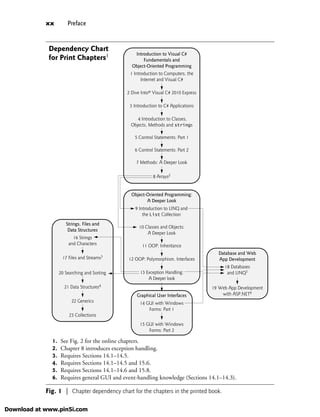
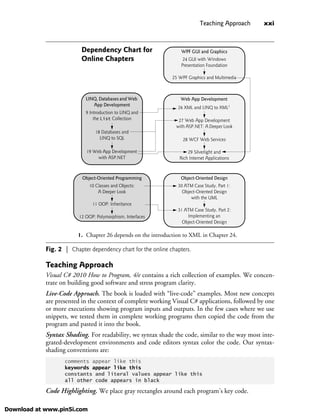
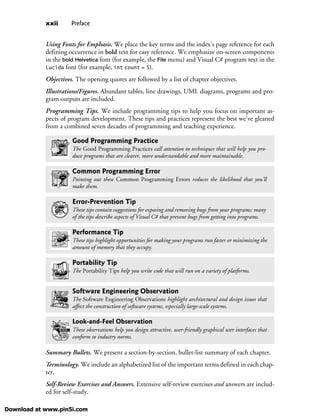
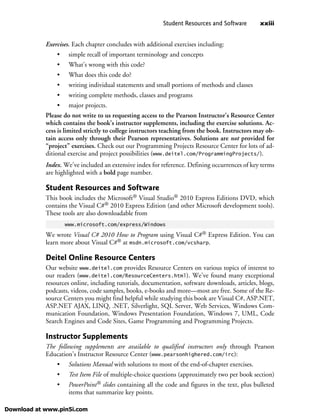






![[Ebooks PDF] download C How to Program 1ST Edition Harvey M. Deitel full chap...](https://cdn.slidesharecdn.com/ss_thumbnails/50876-241223092440-32e628ff-thumbnail.jpg?width=640&height=640&fit=bounds)


