Lesson Objectives
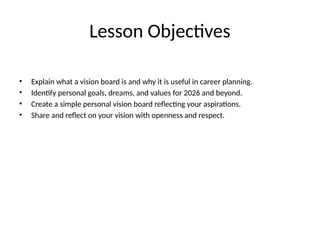
• Explainwhat a vision board is and why it is useful in career planning.
• Identify personal goals, dreams, and values for 2026 and beyond.
• Create a simple personal vision board reflecting your aspirations.
• Share and reflect on your vision with openness and respect.
3.
Materials Needed
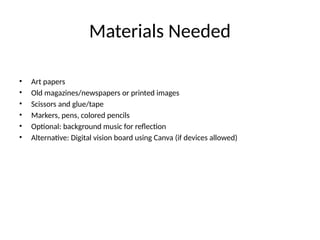
• Artpapers
• Old magazines/newspapers or printed images
• Scissors and glue/tape
• Markers, pens, colored pencils
• Optional: background music for reflection
• Alternative: Digital vision board using Canva (if devices allowed)
Opening Activity
• Think–Pair–ShareQuestion: 'When you think of yourself at the end of 2026, what
do you hope has changed or improved in your life?'
• Emphasize: 'Today is not about pressure—it’s about direction.'
6.
What is aVision Board?
• A visual representation of: who you want to become, what you want to achieve,
where you want to go in life.
• Helps clarify goals and motivates action.
• Career Connection: Successful people visualize goals and plan intentionally.
7.
Guided Reflection
• Whodo I want to become by the end of Grade 12 / 2026?
• What kind of student, professional, or person do I want to be?
• Goals in: Studies / career, Character / values, Family / relationships, Faith / purpose
/ service
8.
Activity Instructions
• Createsections or a free layout.
• Include: 3 images, 3 words or phrases, 1 personal statement (e.g., 'I am
becoming…').
• Represent: Career dreams, Skills to develop, Values to live by, Goals for 2026 and
beyond.
9.
Sharing & Synthesis
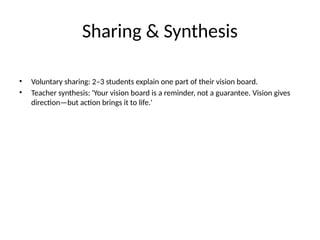
•Voluntary sharing: 2–3 students explain one part of their vision board.
• Teacher synthesis: 'Your vision board is a reminder, not a guarantee. Vision gives
direction—but action brings it to life.'
10.
Assessment & Assignment
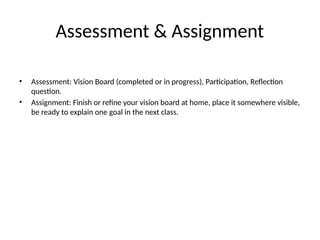
•Assessment: Vision Board (completed or in progress), Participation, Reflection
question.
• Assignment: Finish or refine your vision board at home, place it somewhere visible,
be ready to explain one goal in the next class.