VIRUS –
STRUCTURE AND
CLASSIFICATION
Dr. P. SARANRAJ
HEAD
DEPARTMENT OF MICROBIOLOGY
SACRED HEART COLLEGE (Autonomous)
TIRUPATTUR
E.mail: microsaranraj@gmail.com
VIRUSES
• Viruses are the smallest infectious agents
(ranging from about 20 nm to about 300 nm in
diameter)
• It contain only one kind of nucleic acid (RNA
or DNA) as their genome.
• Viruses are inert in the extracellular
environment; they replicate only in living cells,
being parasites at the genetic level.
• Viruses have a naked capsid or an envelope
morphology.
• Viruses are filterable agents.
• Viruses are obligate intracellular parasites.
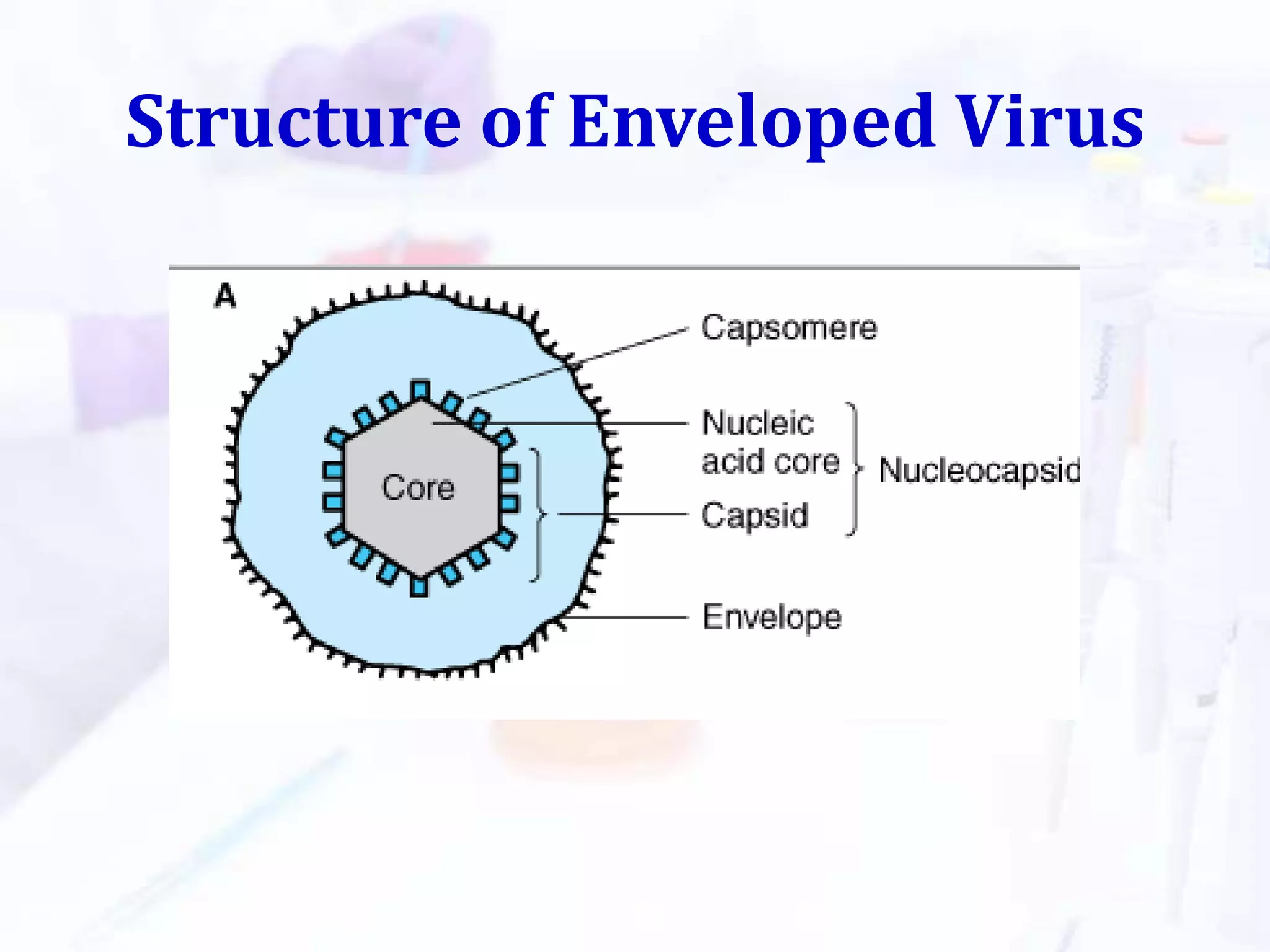
Structure of Enveloped Virus
• Capsid: The protein shell, or coat, that encloses the
nucleic acid genome.
• Capsomeres: Morphologic units seen in the
electron microscope on the surface of icosahedral
virus particles. Capsomeres represent clusters of
polypeptides, but the morphologic units do not
necessarily correspond to the chemically defined
structural units.
• Envelope: A lipid-containing membrane that
surrounds some virus particles. It is acquired
during viral maturation by a budding process
through a cellular membrane.
• Peplomers: Virus-encoded glycoproteins are
exposed on the surface of the envelope. These
projections are called peplomers.
• Nucleocapsid: The protein-nucleic acid complex
representing the packaged form of the viral
genome. The term is commonly used in cases
where the nucleocapsid is a substructure of a more
complex virus particle.
• Structural units: The basic protein building
blocks of the coat. They are usually a collection of
more than one nonidentical protein subunit. The
structural unit is often referred to as a protomer.
BALDIMORE CLASSIFICATION OF VIRUS
• I:dsDNA viruses (e.g. Adenoviruses, Herpesviruses
and Poxviruses)
• II: ssDNA viruses (+ strand or "sense") DNA
(e.g. Parvoviruses)
• III: dsRNA viruses (e.g. Reoviruses)
• IV: (+)ssRNA viruses (+ strand or sense) RNA
(e.g. Picornaviruses, Togaviruses)
• V: (−)ssRNA viruses (− strand or antisense) RNA
(e.g. Orthomyxoviruses, Rhabdoviruses)
• VI: ssRNA-RT viruses (+ strand or sense) RNA with DNA
intermediate in life-cycle (e.g. Retroviruses)
• VII: dsDNA-RT viruses DNA with RNA intermediate in life-
cycle (e.g. Hepadnaviruses)

Virus - Structure and Classification

  • 1.
    VIRUS – STRUCTURE AND CLASSIFICATION Dr.P. SARANRAJ HEAD DEPARTMENT OF MICROBIOLOGY SACRED HEART COLLEGE (Autonomous) TIRUPATTUR E.mail: microsaranraj@gmail.com
  • 2.
    VIRUSES • Viruses arethe smallest infectious agents (ranging from about 20 nm to about 300 nm in diameter) • It contain only one kind of nucleic acid (RNA or DNA) as their genome. • Viruses are inert in the extracellular environment; they replicate only in living cells, being parasites at the genetic level. • Viruses have a naked capsid or an envelope morphology. • Viruses are filterable agents. • Viruses are obligate intracellular parasites.
  • 3.
  • 4.
    • Capsid: Theprotein shell, or coat, that encloses the nucleic acid genome. • Capsomeres: Morphologic units seen in the electron microscope on the surface of icosahedral virus particles. Capsomeres represent clusters of polypeptides, but the morphologic units do not necessarily correspond to the chemically defined structural units. • Envelope: A lipid-containing membrane that surrounds some virus particles. It is acquired during viral maturation by a budding process through a cellular membrane.
  • 5.
    • Peplomers: Virus-encodedglycoproteins are exposed on the surface of the envelope. These projections are called peplomers. • Nucleocapsid: The protein-nucleic acid complex representing the packaged form of the viral genome. The term is commonly used in cases where the nucleocapsid is a substructure of a more complex virus particle. • Structural units: The basic protein building blocks of the coat. They are usually a collection of more than one nonidentical protein subunit. The structural unit is often referred to as a protomer.
  • 6.
    BALDIMORE CLASSIFICATION OFVIRUS • I:dsDNA viruses (e.g. Adenoviruses, Herpesviruses and Poxviruses) • II: ssDNA viruses (+ strand or "sense") DNA (e.g. Parvoviruses) • III: dsRNA viruses (e.g. Reoviruses) • IV: (+)ssRNA viruses (+ strand or sense) RNA (e.g. Picornaviruses, Togaviruses) • V: (−)ssRNA viruses (− strand or antisense) RNA (e.g. Orthomyxoviruses, Rhabdoviruses) • VI: ssRNA-RT viruses (+ strand or sense) RNA with DNA intermediate in life-cycle (e.g. Retroviruses) • VII: dsDNA-RT viruses DNA with RNA intermediate in life- cycle (e.g. Hepadnaviruses)