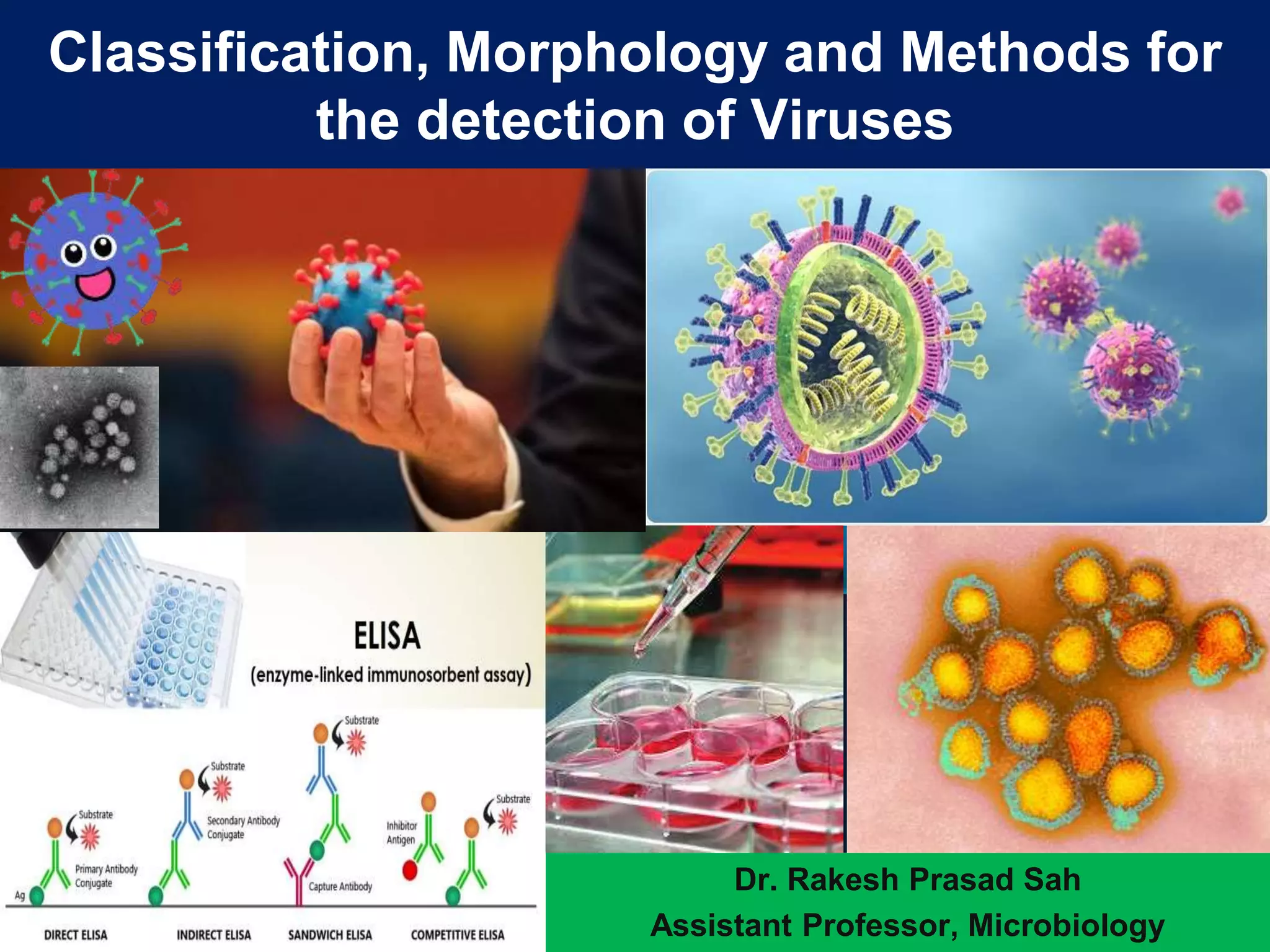


Classification, Morphology and Methods for
the detection of Viruses
Dr. Rakesh Prasad Sah
Assistant Professor, Microbiology
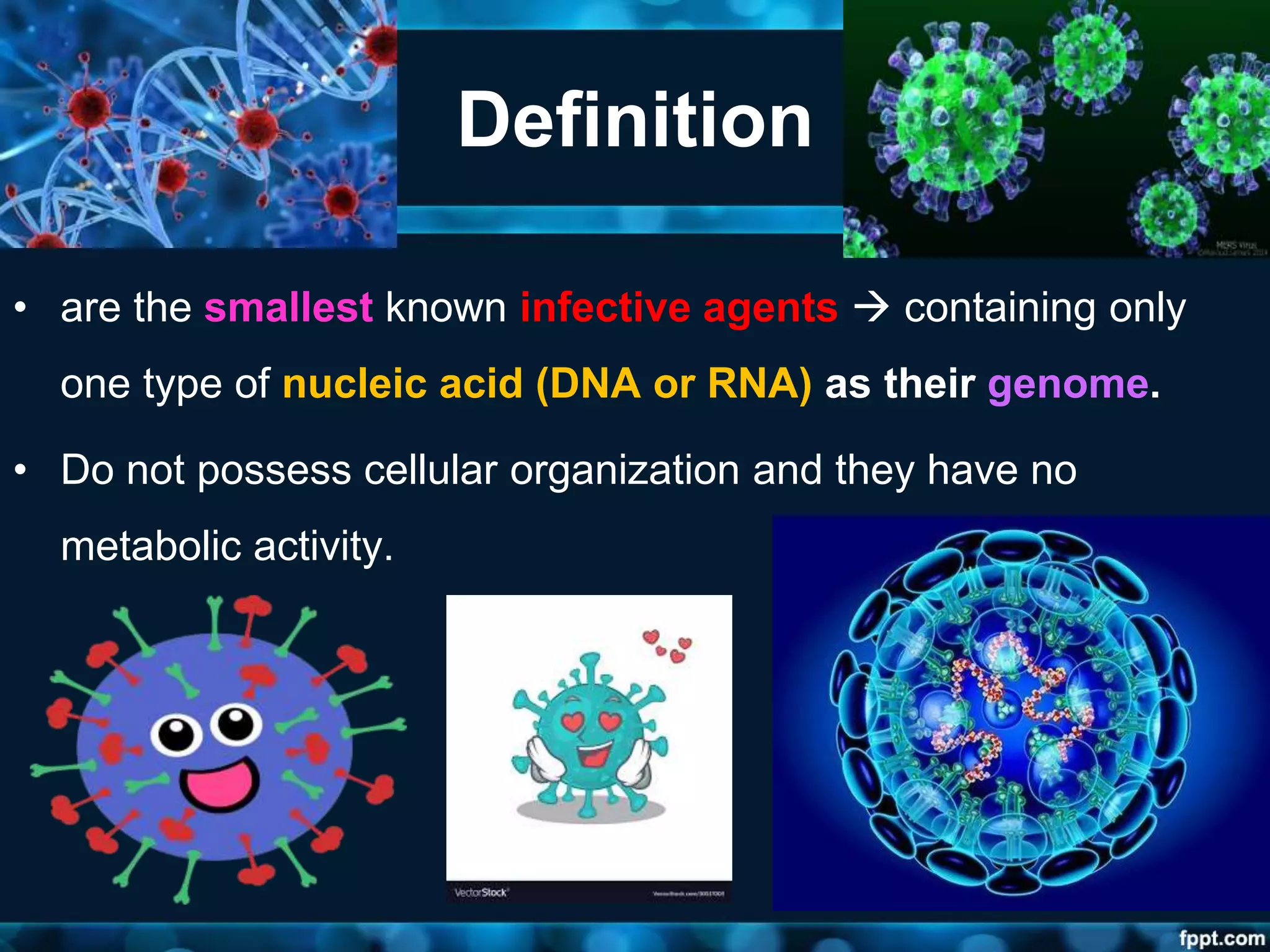
Definition
• are the smallest known infective agents  containing only
one type of nucleic acid (DNA or RNA) as their genome.
• Do not possess cellular organization and they have no
metabolic activity.
Properties of Viruses
• Do not have cellular organization.
• Contain only one type of nucleic acid; either DNA or RNA but
never both.
• Obligate intracellular parasites.
• Lack enzymes necessary for protein and nucleic acid synthesis
and are dependent for replicaton on the machinery of host cells.
• Multiply by a complex process and not by binary fission.
• Unaffected by antibacterial antibiotics.
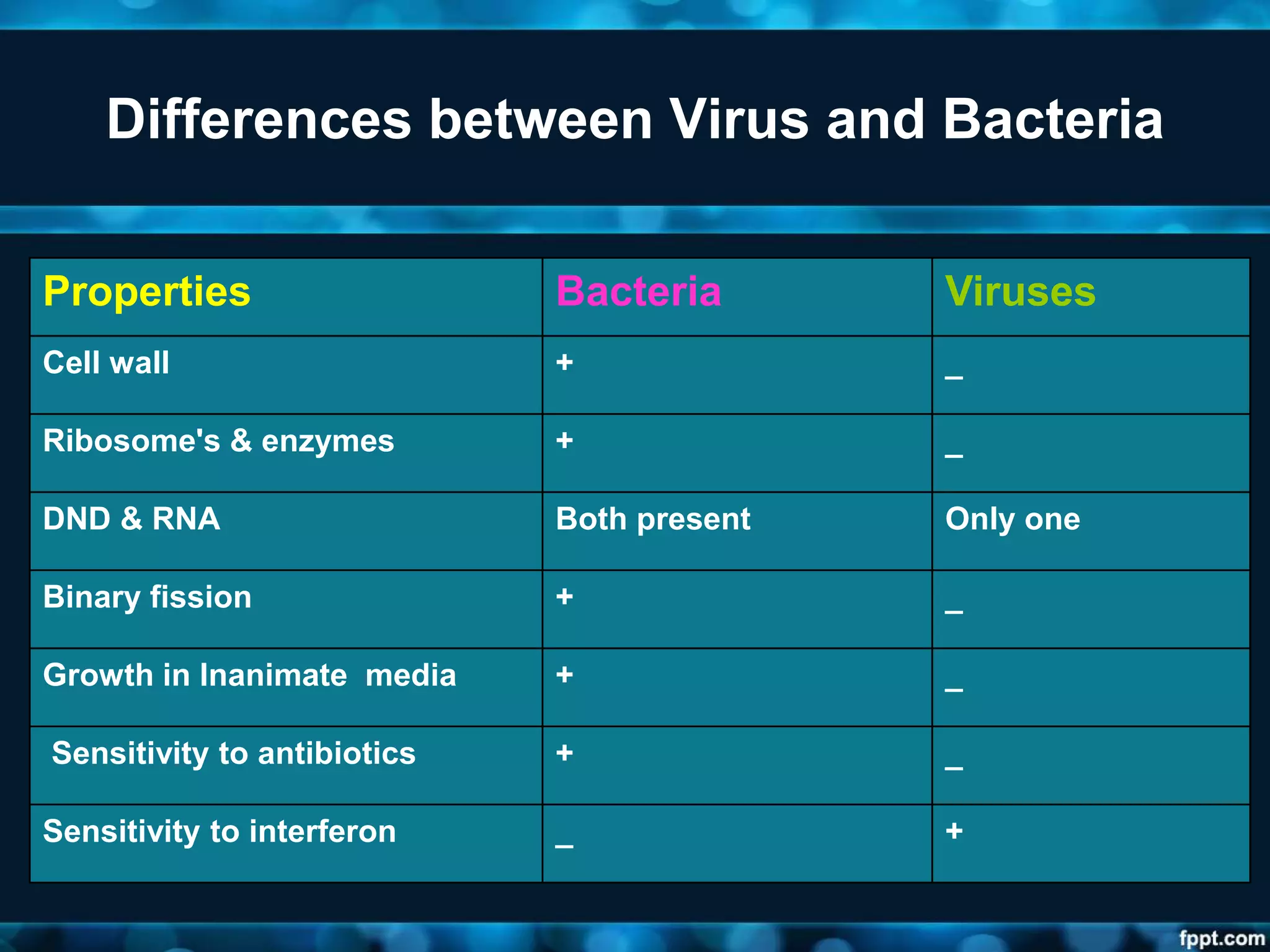
Differences between Virus and Bacteria
Properties Bacteria Viruses
Cell wall + _
Ribosome's & enzymes + _
DND & RNA Both present Only one
Binary fission + _
Growth in Inanimate media + _
Sensitivity to antibiotics + _
Sensitivity to interferon _ +
Morphology of Viruses
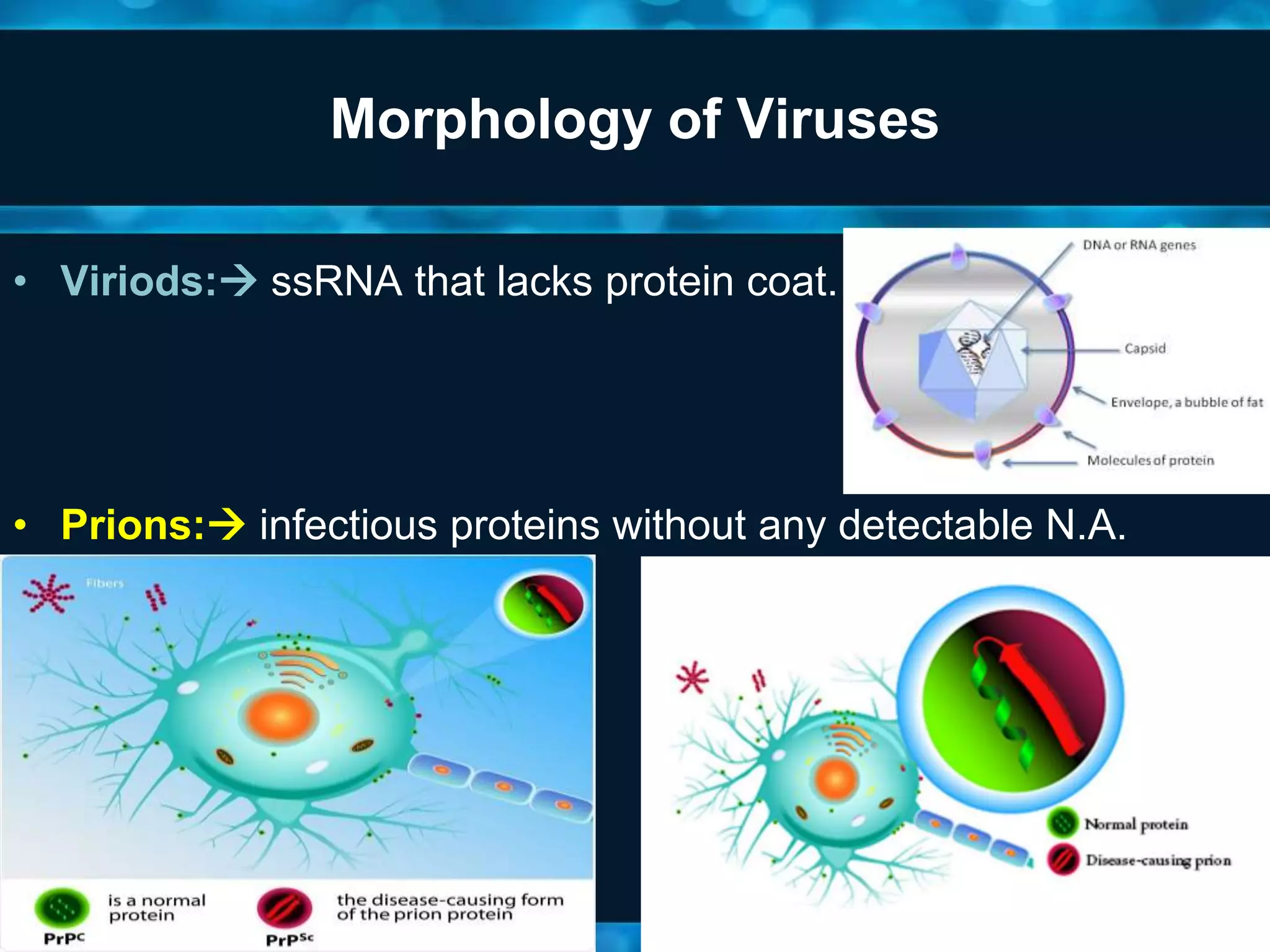
• Viriods: ssRNA that lacks protein coat.
• Prions: infectious proteins without any detectable N.A.
Morphology of Viruses
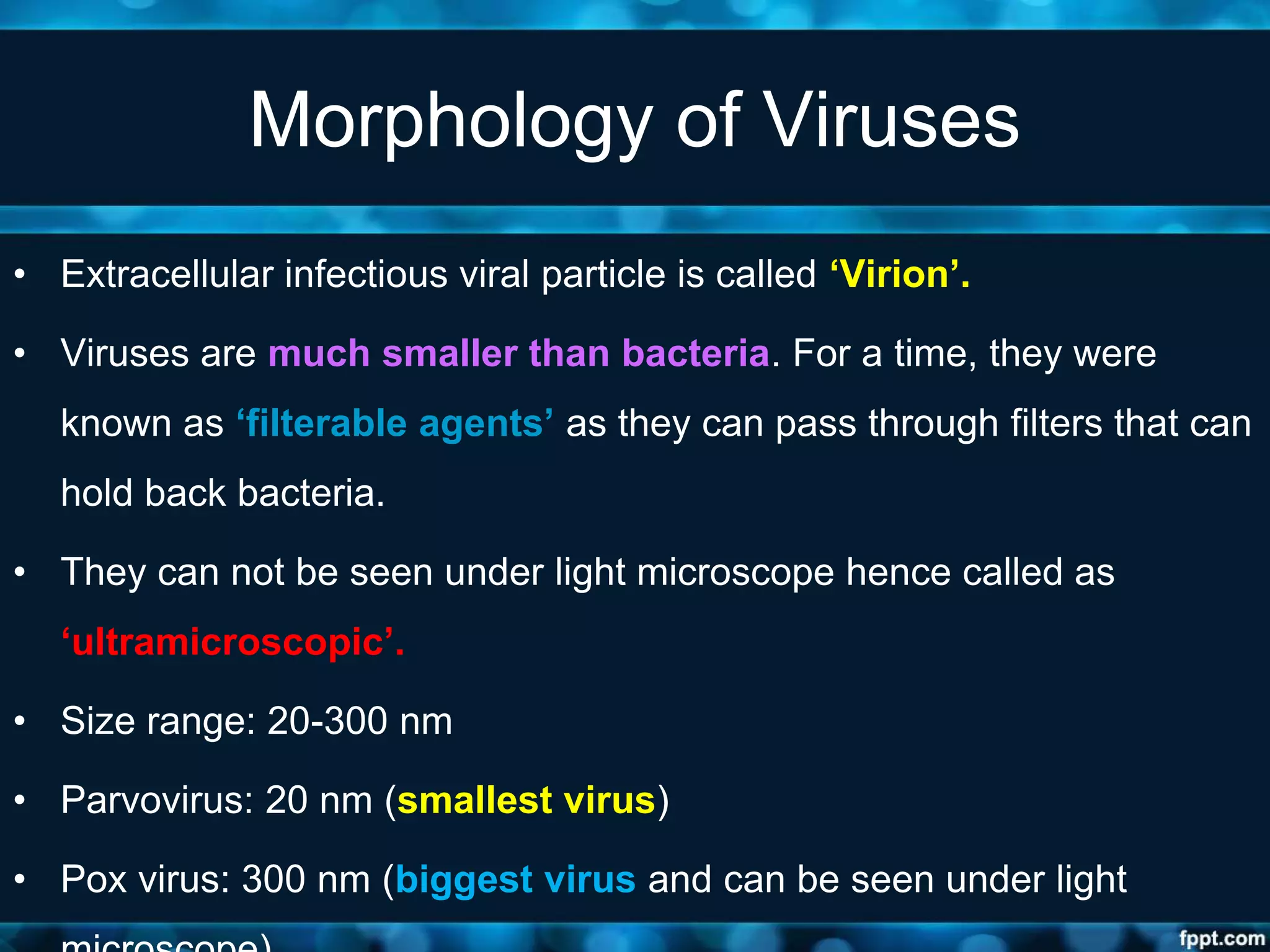
• Extracellular infectious viral particle is called ‘Virion’.
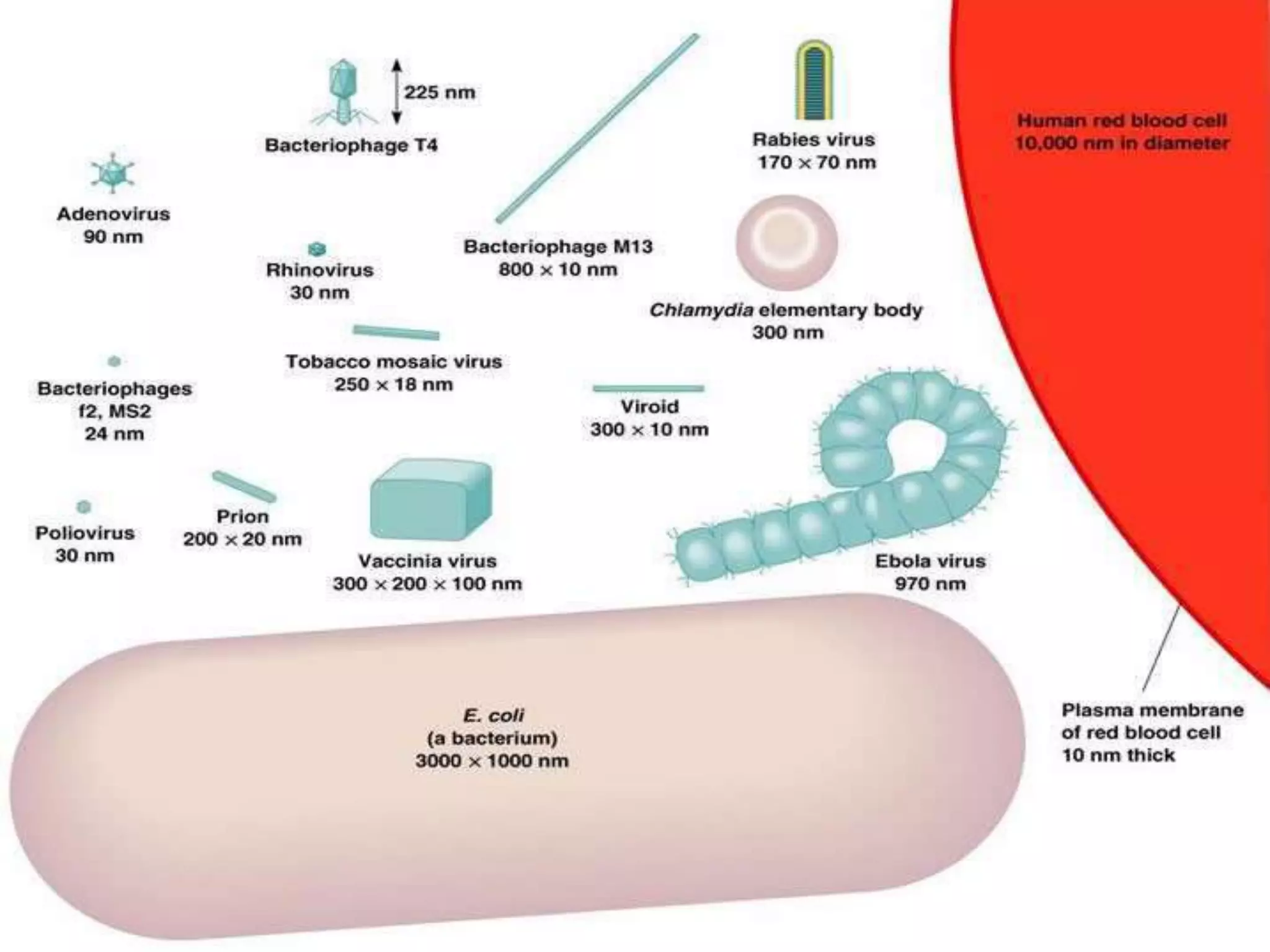
• Viruses are much smaller than bacteria. For a time, they were
known as ‘filterable agents’ as they can pass through filters that can
hold back bacteria.
• They can not be seen under light microscope hence called as
‘ultramicroscopic’.
• Size range: 20-300 nm
• Parvovirus: 20 nm (smallest virus)
• Pox virus: 300 nm (biggest virus and can be seen under light
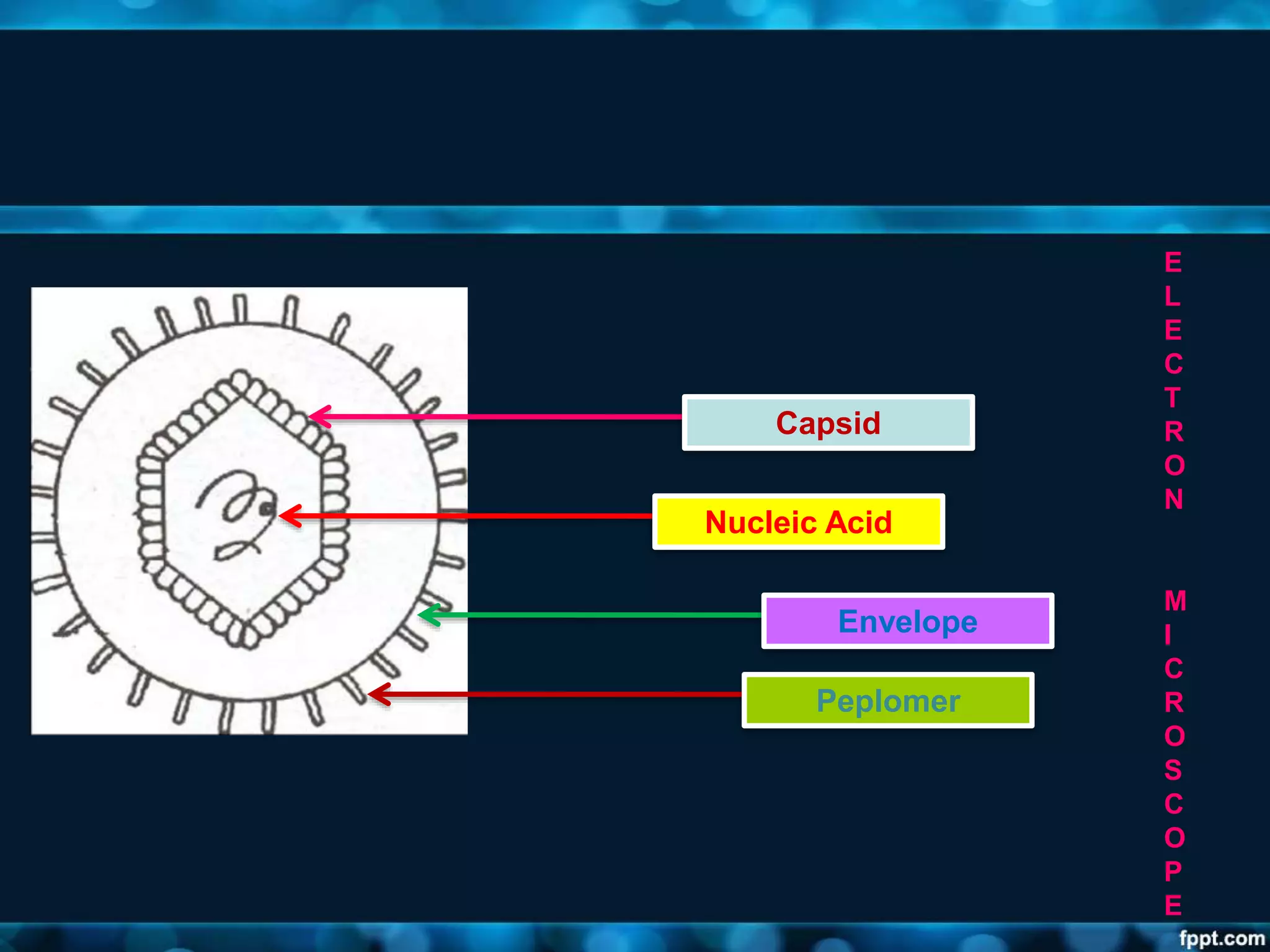
Capsid
Nucleic Acid
Envelope
Peplomer
E
L
E
C
T
R
O
N
M
I
C
R
O
S
C
O
P
E
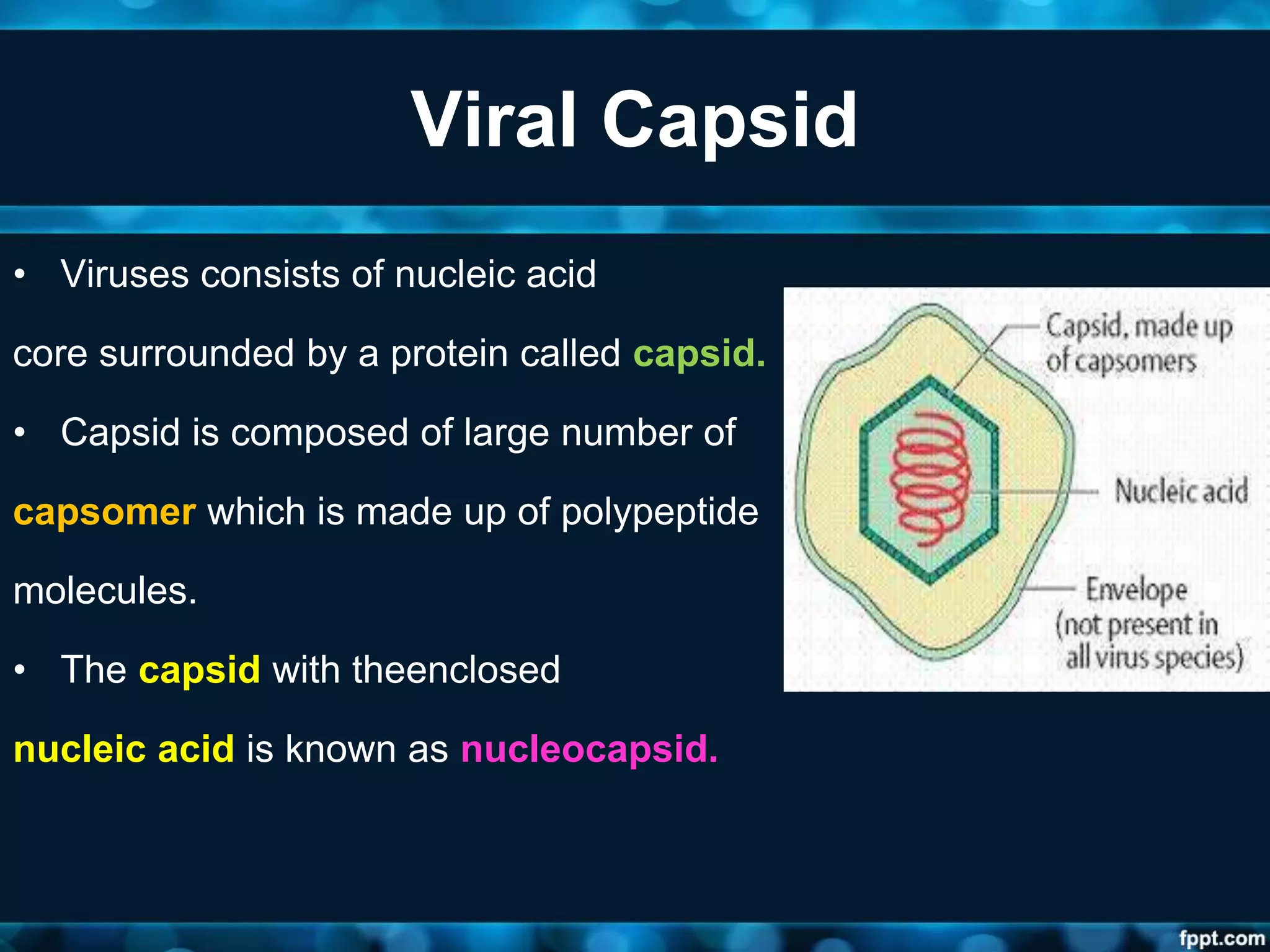
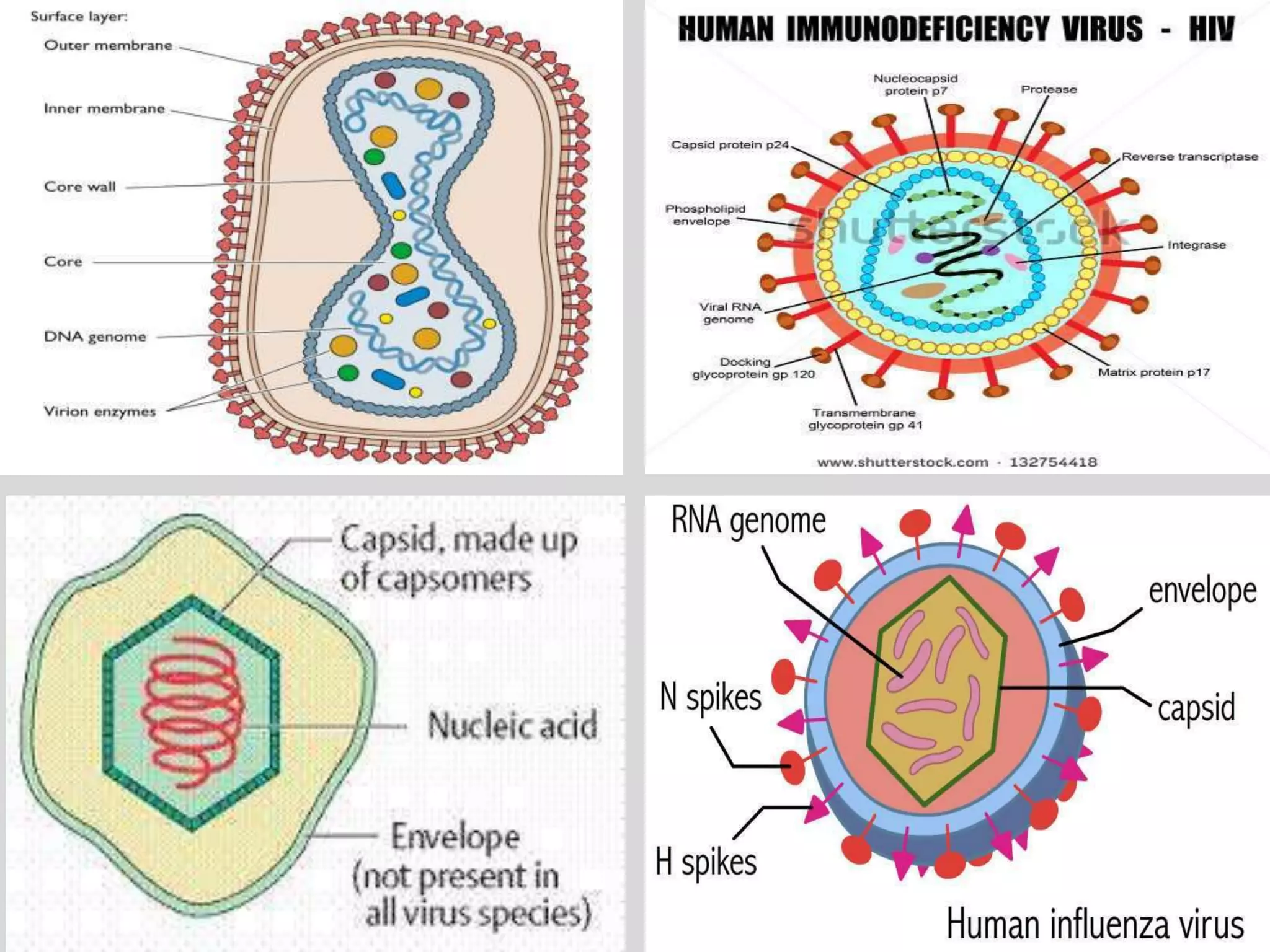
Viral Capsid
• Viruses consists of nucleic acid
core surrounded by a protein called capsid.
• Capsid is composed of large number of
capsomer which is made up of polypeptide
molecules.
• The capsid with theenclosed
nucleic acid is known as nucleocapsid.
Functions of Capsid
• It protects  viral genome from physical destruction & enzymatic
inactivation by nucleases in biological material.
• It provides  binding site which enable the virus to attach to
specific site on the host cell.
• It facilitates  assembly and packaging of viral genetic
information.
• It serves as a vehicle of transmission from host to another.
• It is antigenic and specific for each viruses
• It provides the structural symmetry to the virus particle.
Viral Symmetry
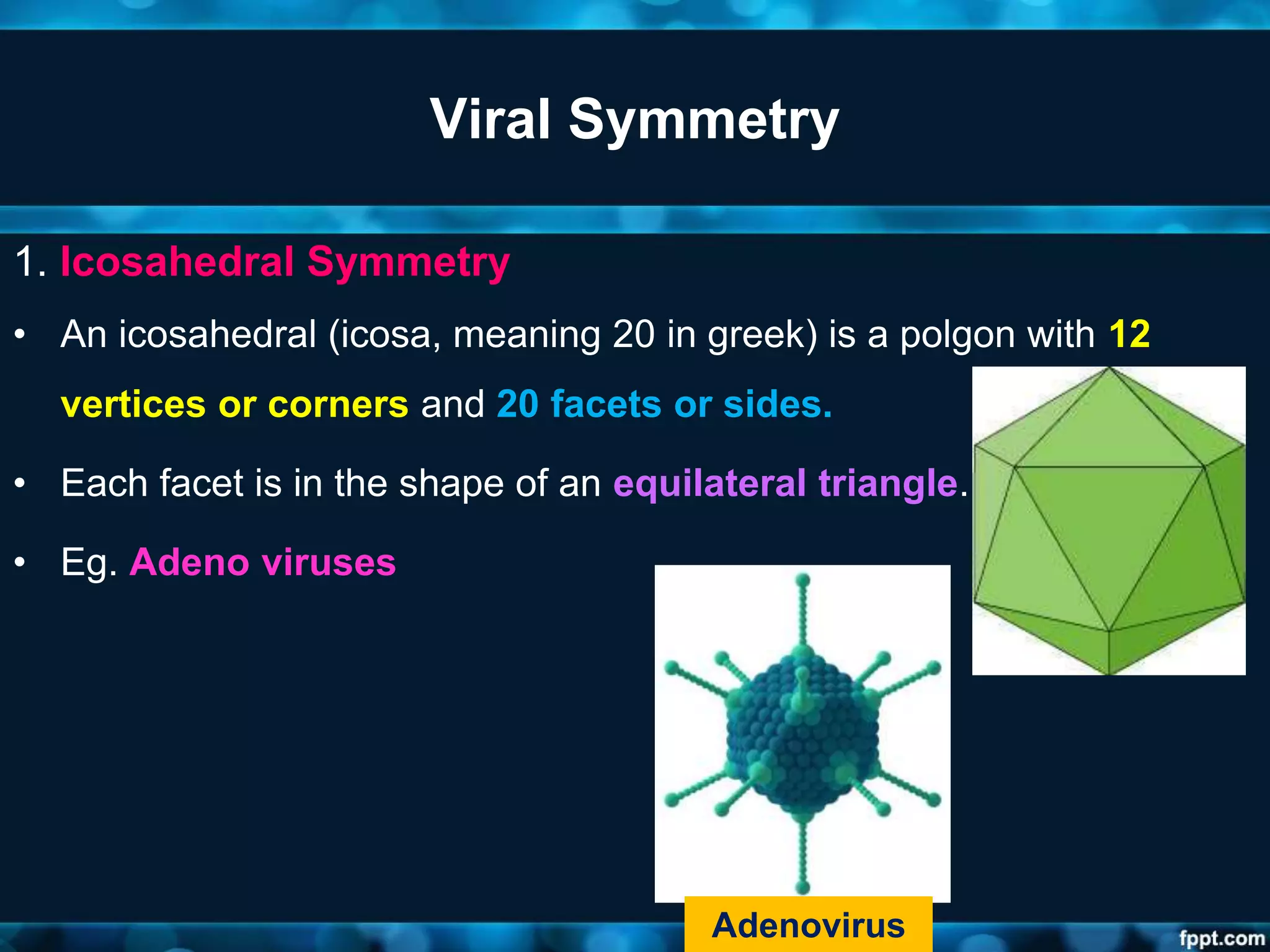
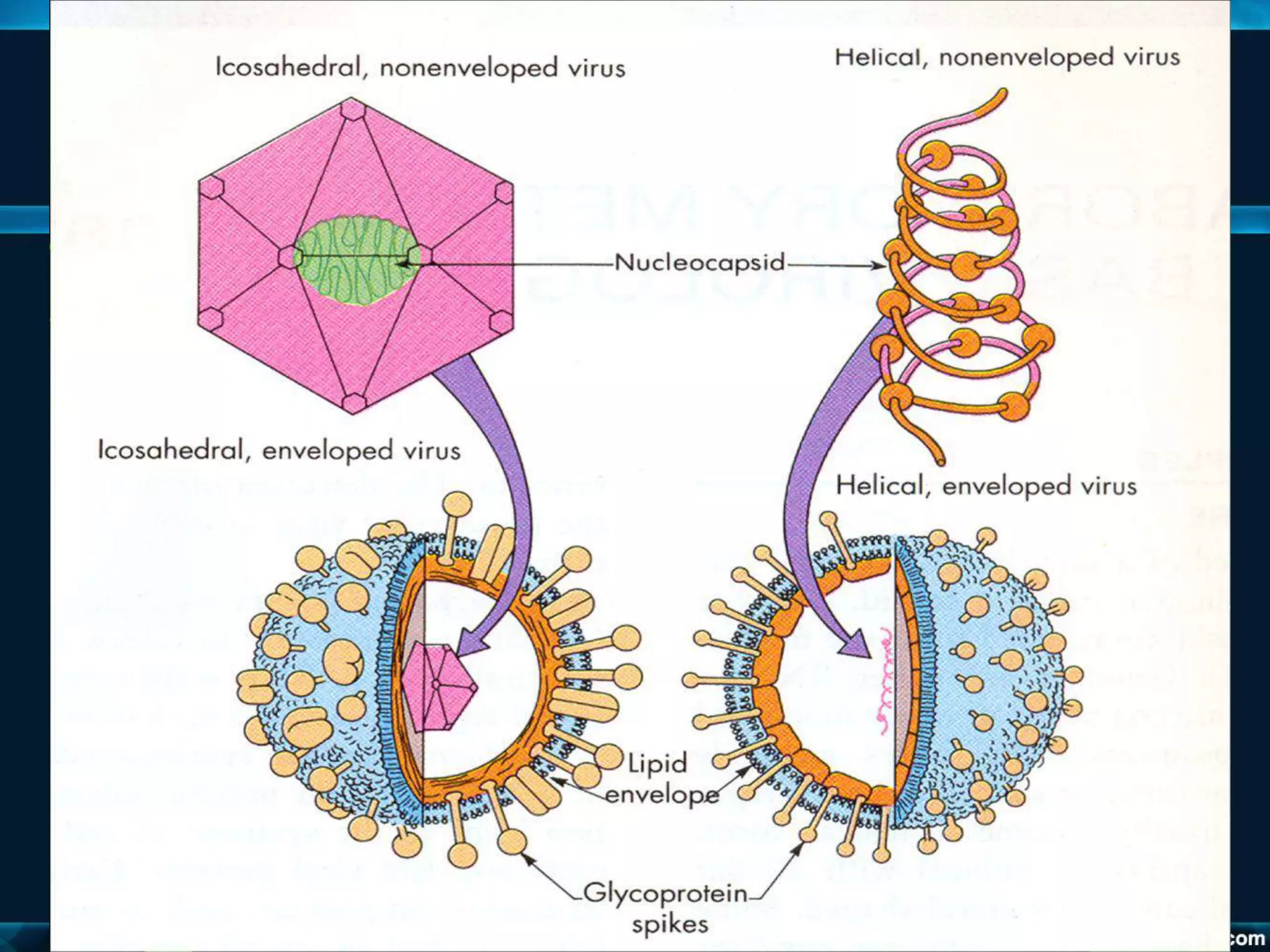
1. Icosahedral Symmetry
• An icosahedral (icosa, meaning 20 in greek) is a polgon with 12
vertices or corners and 20 facets or sides.
• Each facet is in the shape of an equilateral triangle.
• Eg. Adeno viruses
Adenovirus
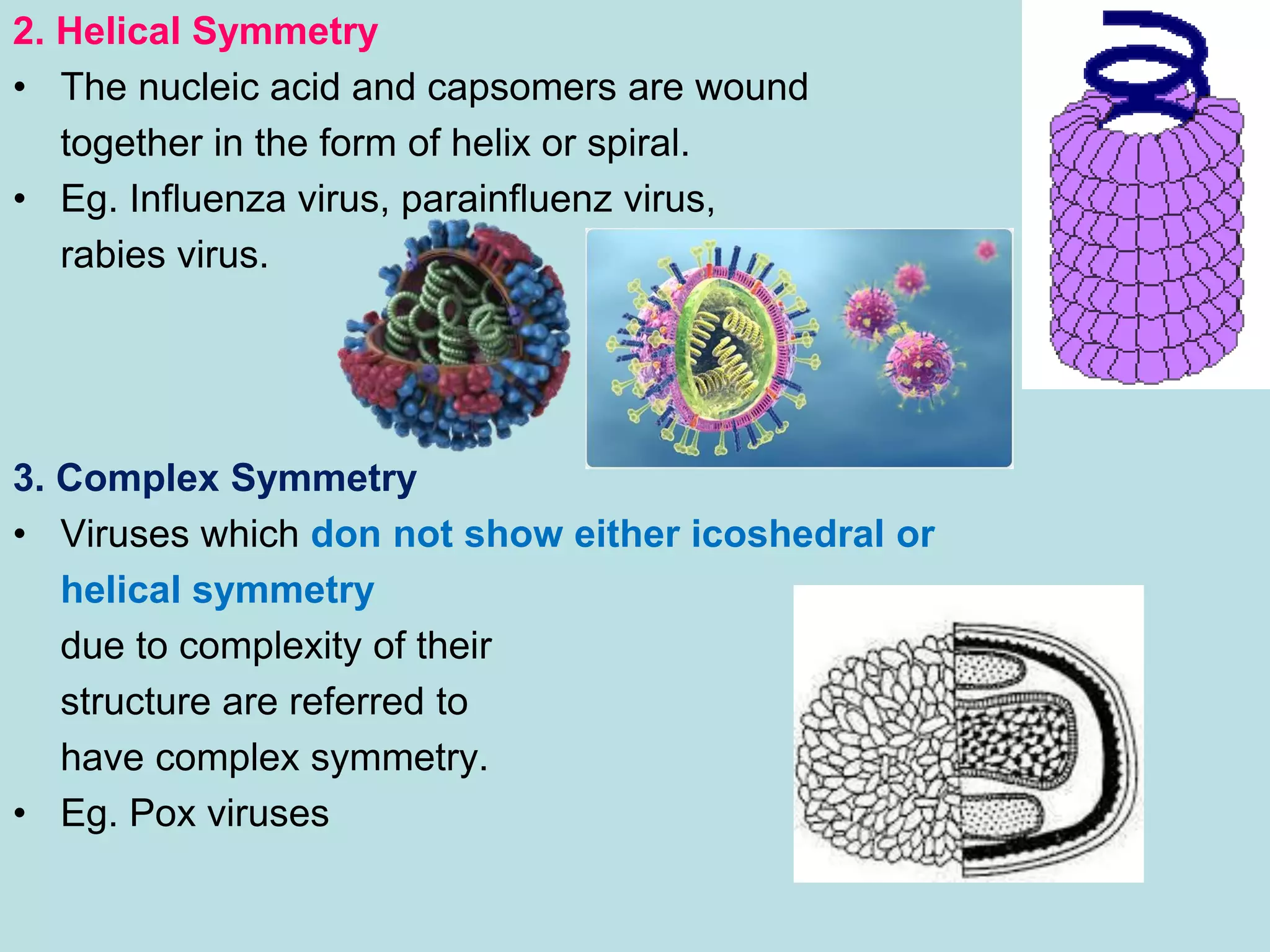
2. Helical Symmetry
• The nucleic acid and capsomers are wound
together in the form of helix or spiral.
• Eg. Influenza virus, parainfluenz virus,
rabies virus.
3. Complex Symmetry
• Viruses which don not show either icoshedral or
helical symmetry
due to complexity of their
structure are referred to
have complex symmetry.
• Eg. Pox viruses
Viral Envelope
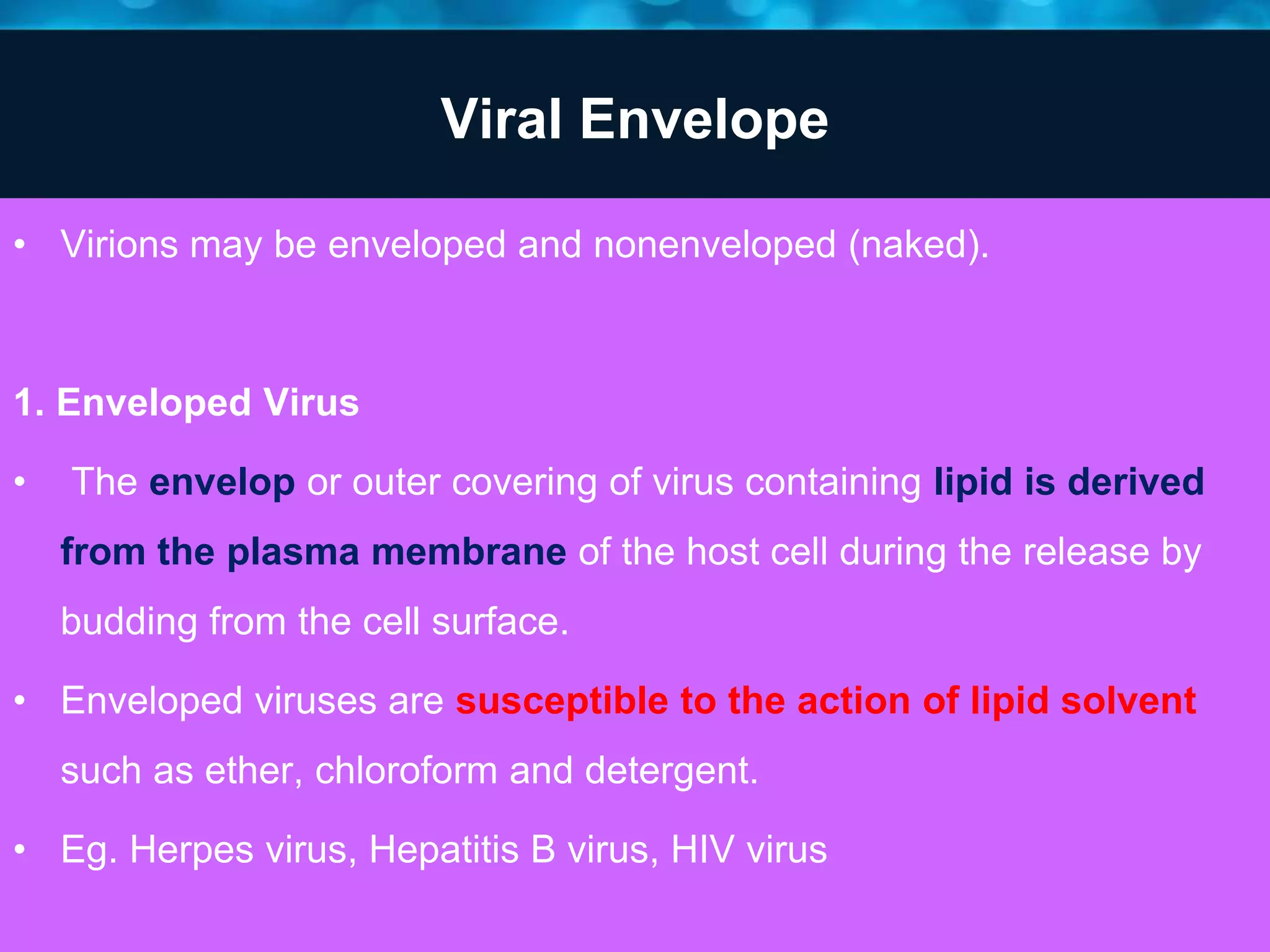
• Virions may be enveloped and nonenveloped (naked).
1. Enveloped Virus
• The envelop or outer covering of virus containing lipid is derived
from the plasma membrane of the host cell during the release by
budding from the cell surface.
• Enveloped viruses are susceptible to the action of lipid solvent
such as ether, chloroform and detergent.
• Eg. Herpes virus, Hepatitis B virus, HIV virus
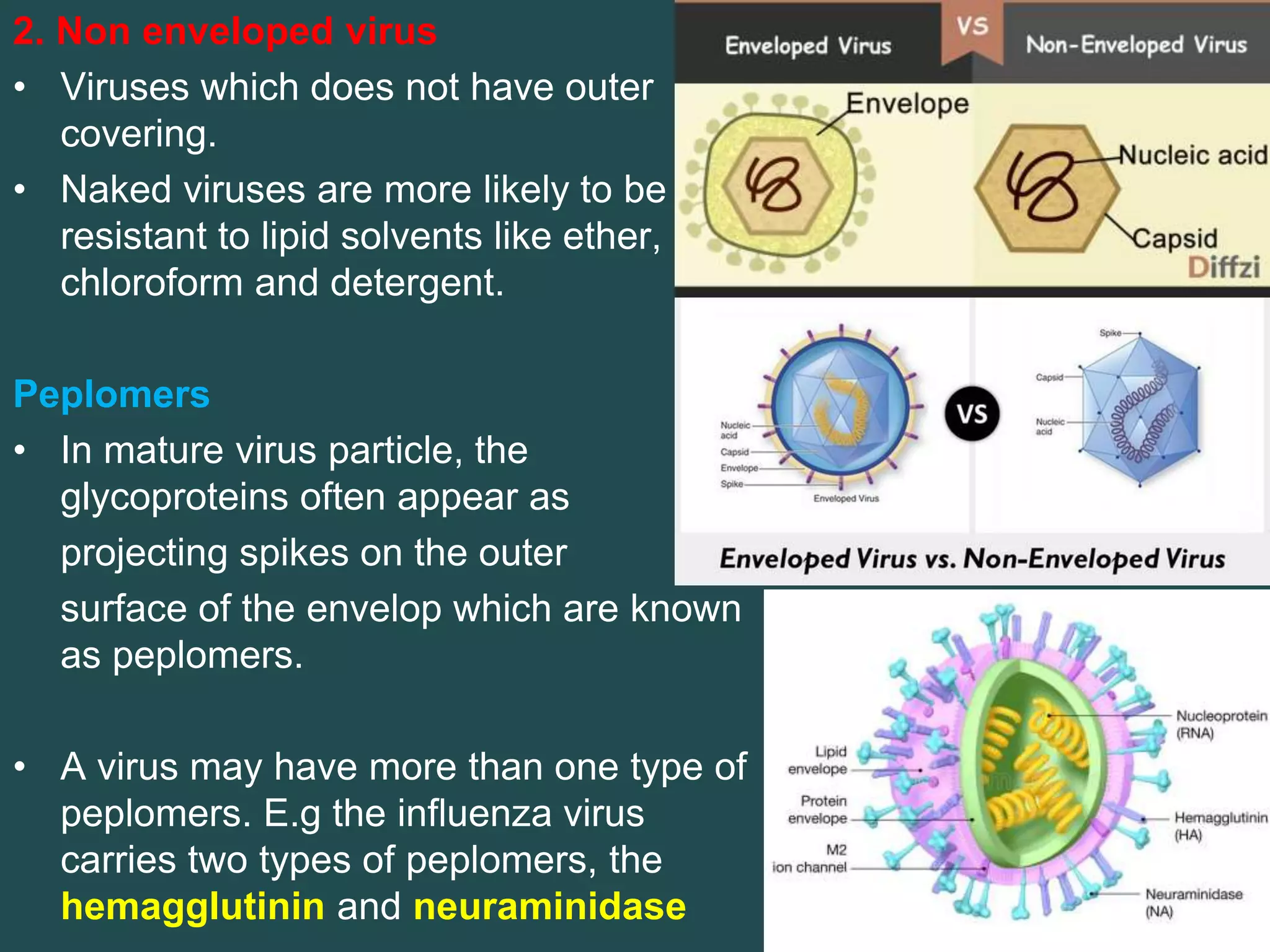
2. Non enveloped virus
• Viruses which does not have outer
covering.
• Naked viruses are more likely to be
resistant to lipid solvents like ether,
chloroform and detergent.
Peplomers
• In mature virus particle, the
glycoproteins often appear as
projecting spikes on the outer
surface of the envelop which are known
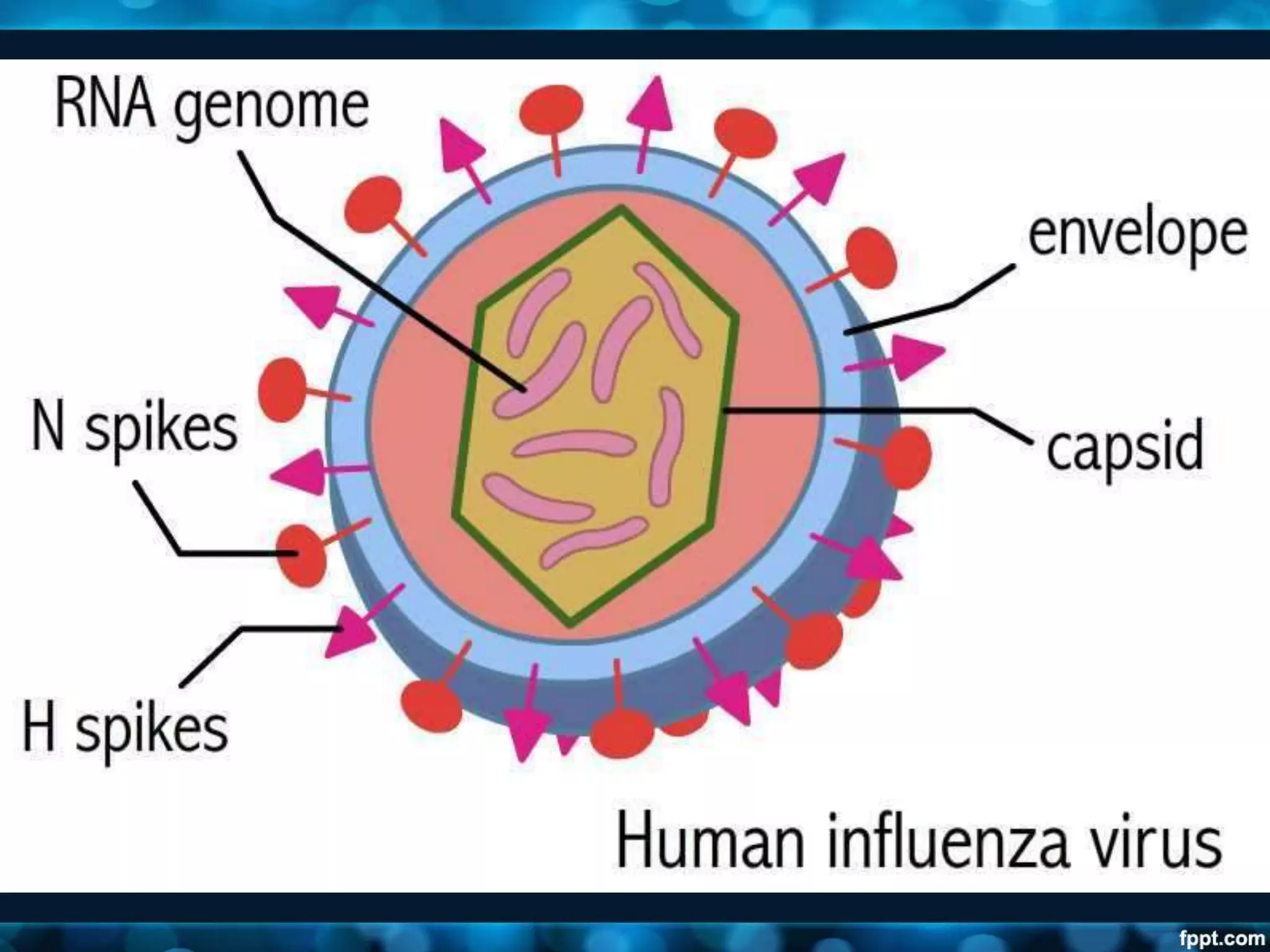
as peplomers.
• A virus may have more than one type of
peplomers. E.g the influenza virus
carries two types of peplomers, the
hemagglutinin and neuraminidase
Functions of Peplomers
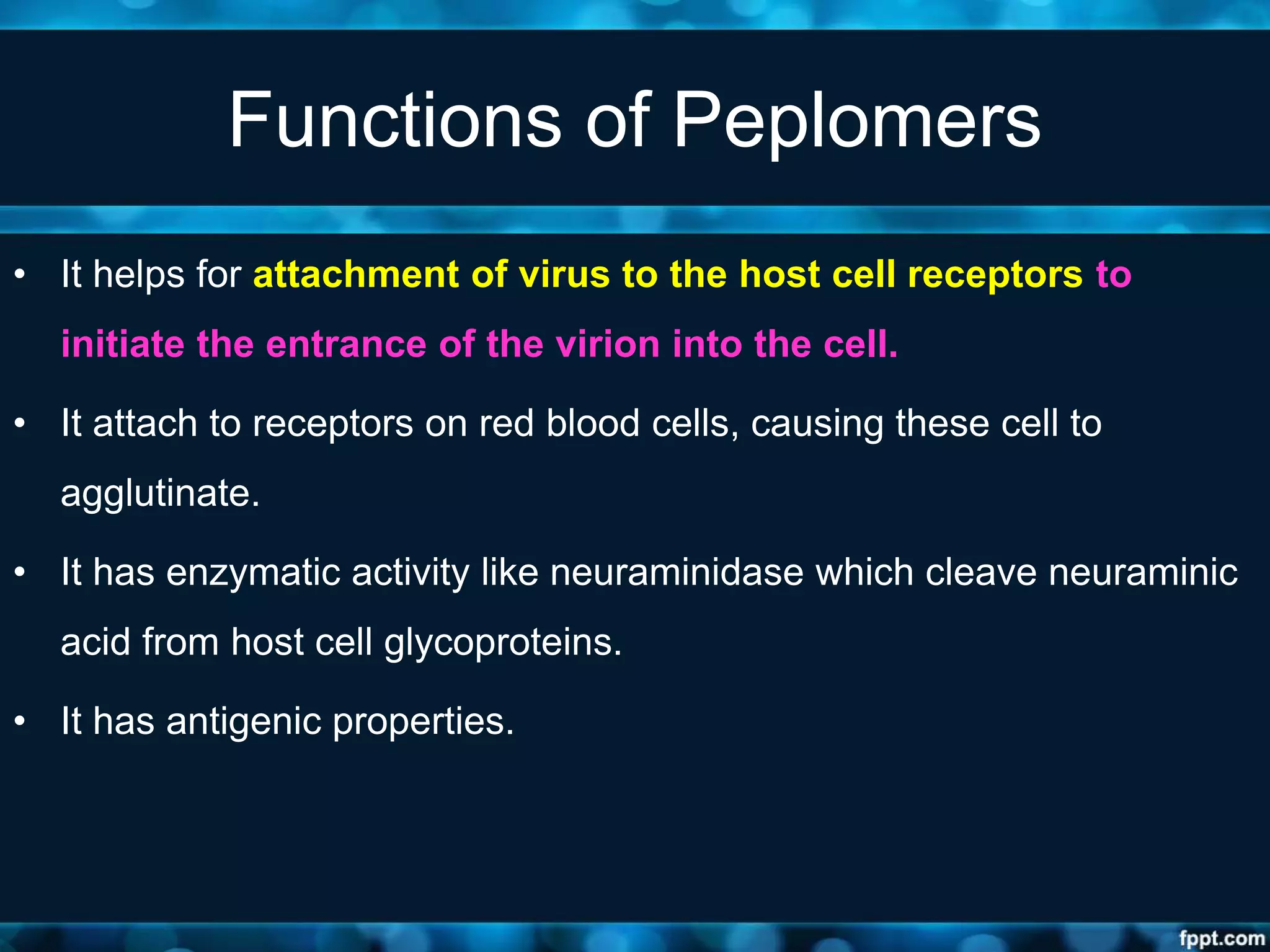
• It helps for attachment of virus to the host cell receptors to
initiate the entrance of the virion into the cell.
• It attach to receptors on red blood cells, causing these cell to
agglutinate.
• It has enzymatic activity like neuraminidase which cleave neuraminic
acid from host cell glycoproteins.
• It has antigenic properties.
Viral Nucleic Acids
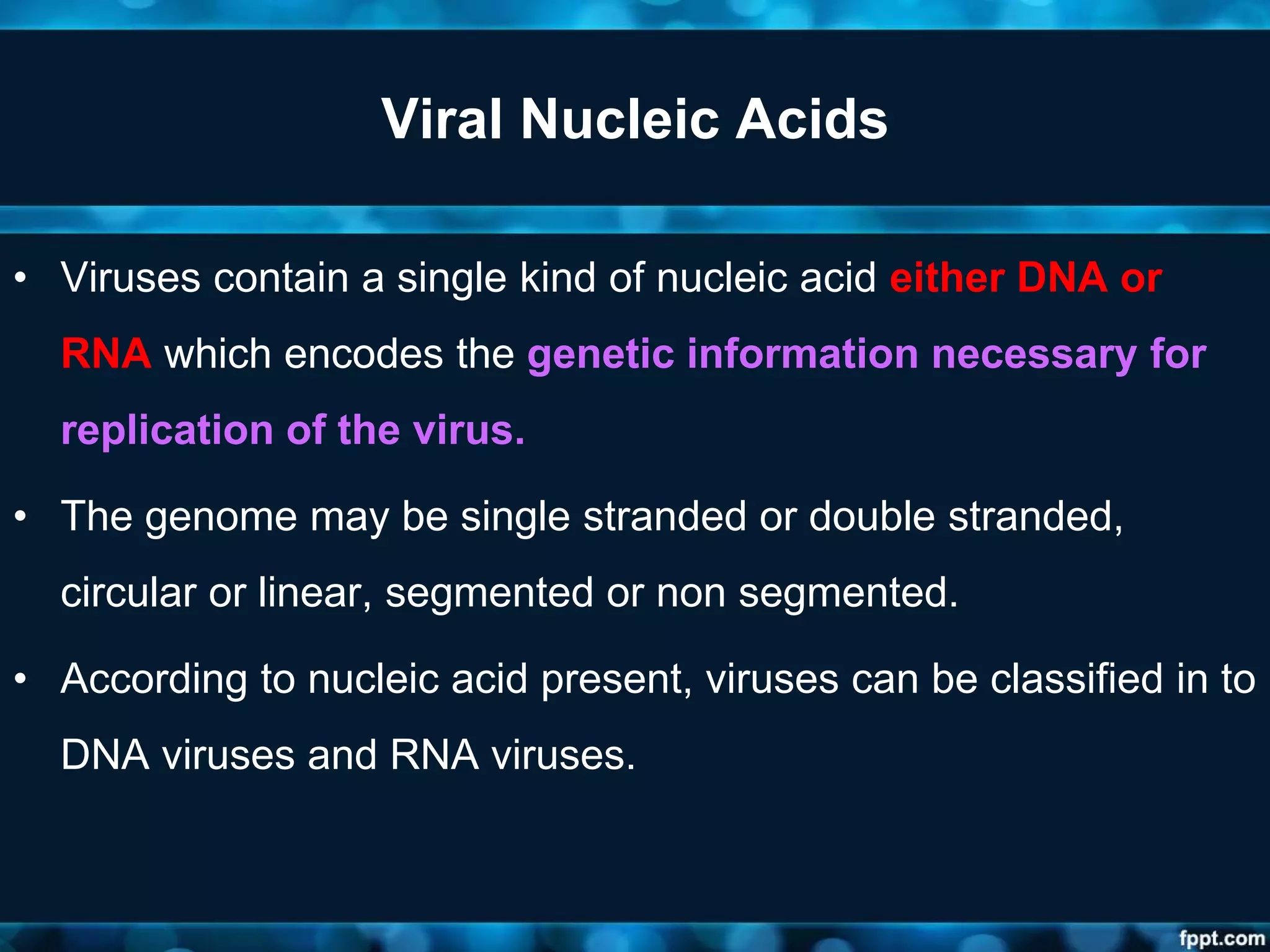
• Viruses contain a single kind of nucleic acid either DNA or
RNA which encodes the genetic information necessary for
replication of the virus.
• The genome may be single stranded or double stranded,
circular or linear, segmented or non segmented.
• According to nucleic acid present, viruses can be classified in to
DNA viruses and RNA viruses.
Classification of viruses
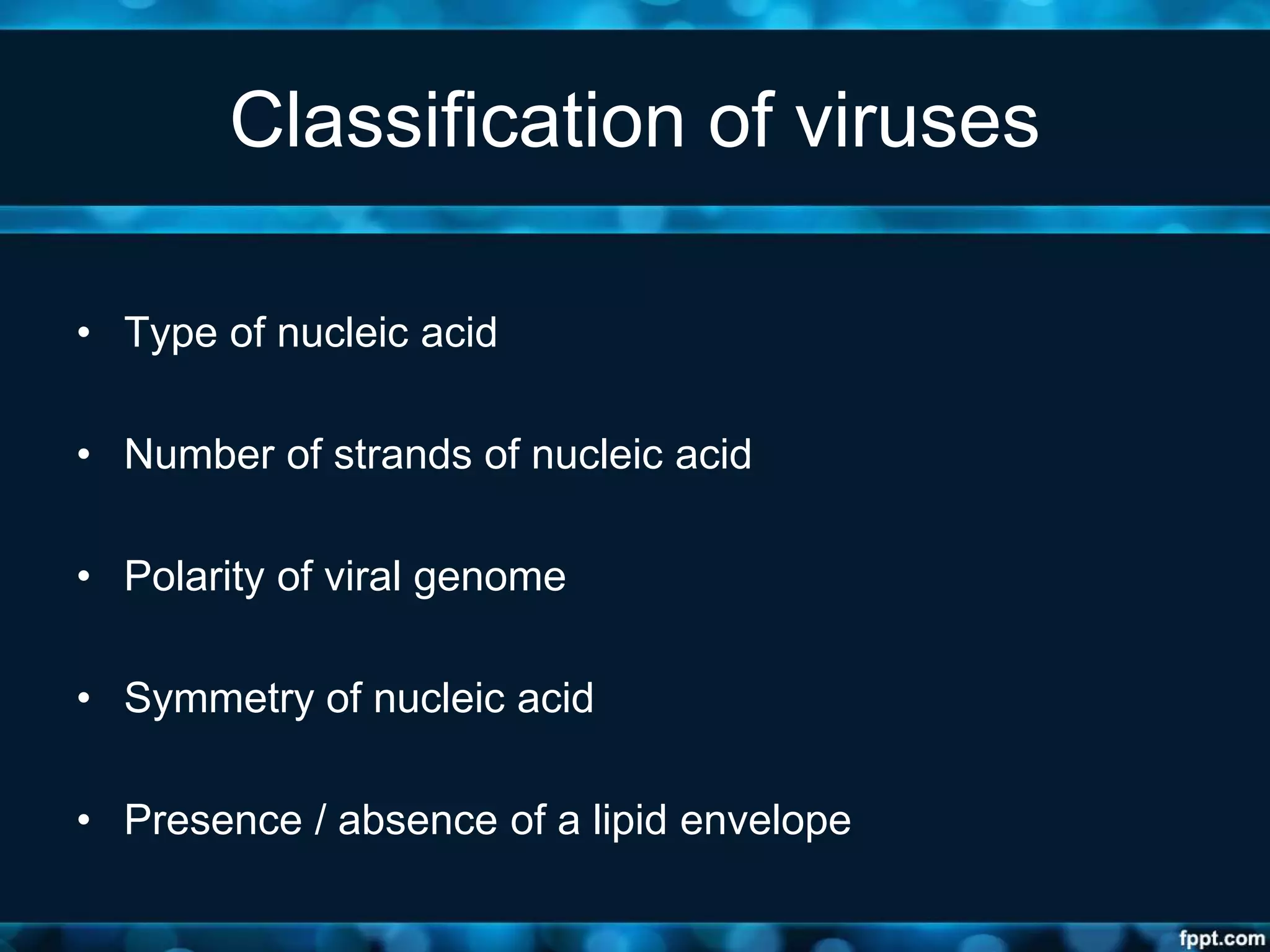
• Type of nucleic acid
• Number of strands of nucleic acid
• Polarity of viral genome
• Symmetry of nucleic acid
• Presence / absence of a lipid envelope
Classification of viruses
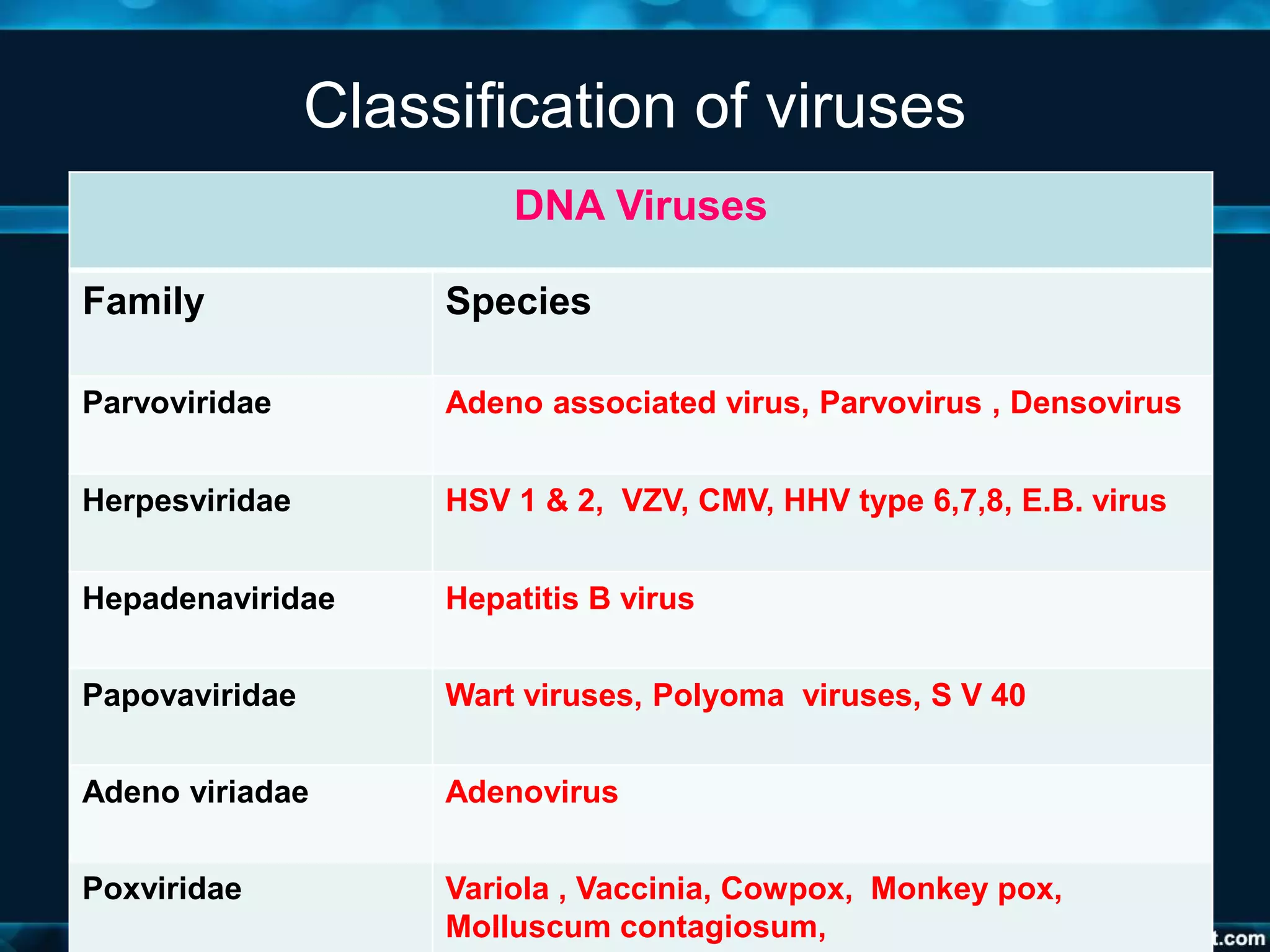
DNA Viruses
Family Species
Parvoviridae Adeno associated virus, Parvovirus , Densovirus
Herpesviridae HSV 1 & 2, VZV, CMV, HHV type 6,7,8, E.B. virus
Hepadenaviridae Hepatitis B virus
Papovaviridae Wart viruses, Polyoma viruses, S V 40
Adeno viriadae Adenovirus
Poxviridae Variola , Vaccinia, Cowpox, Monkey pox,
Molluscum contagiosum,
Classification of viruses
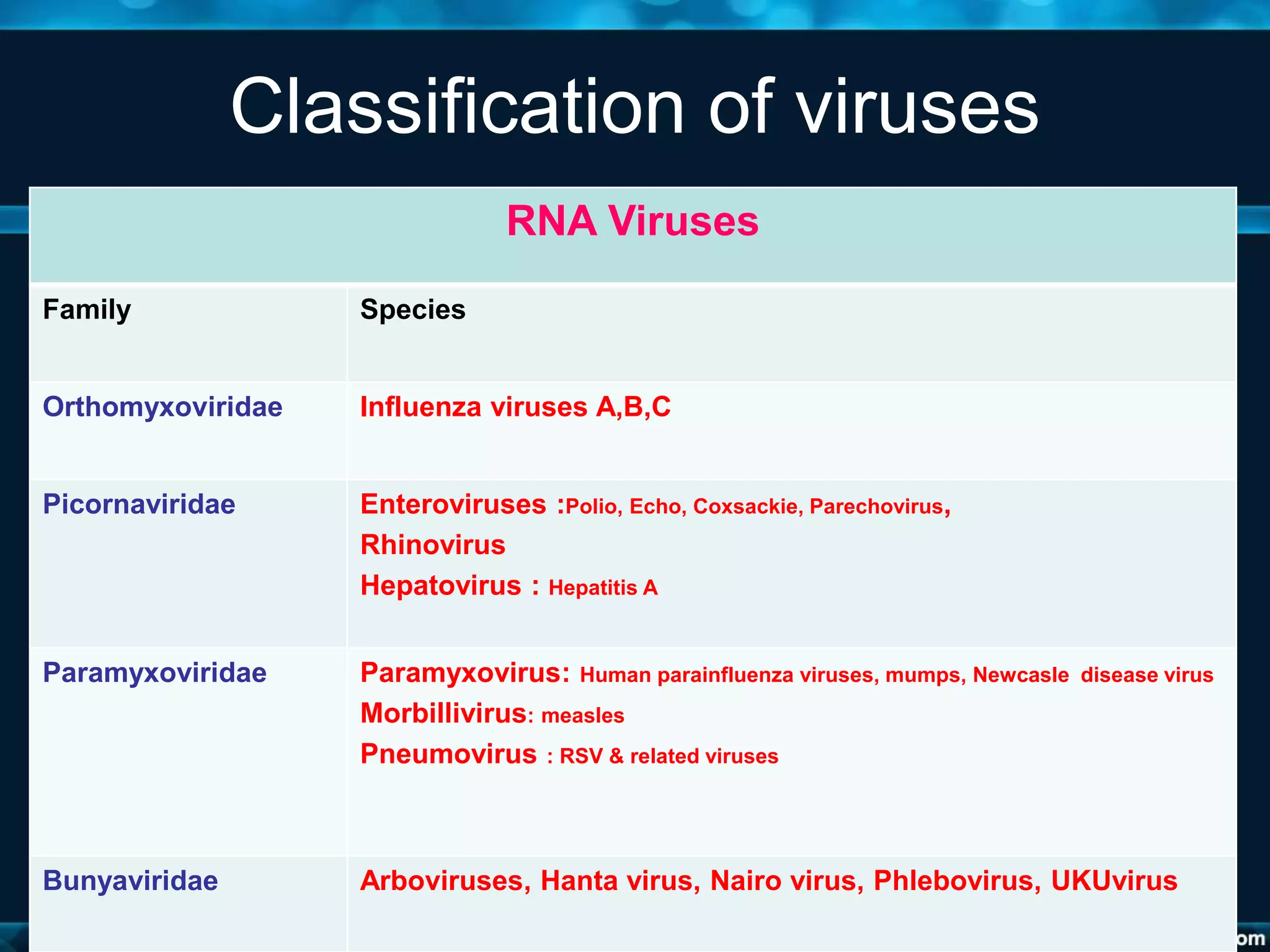
RNA Viruses
Family Species
Orthomyxoviridae Influenza viruses A,B,C
Picornaviridae Enteroviruses :Polio, Echo, Coxsackie, Parechovirus,
Rhinovirus
Hepatovirus : Hepatitis A
Paramyxoviridae Paramyxovirus: Human parainfluenza viruses, mumps, Newcasle disease virus
Morbillivirus: measles
Pneumovirus : RSV & related viruses
Bunyaviridae Arboviruses, Hanta virus, Nairo virus, Phlebovirus, UKUvirus
Classification of viruses
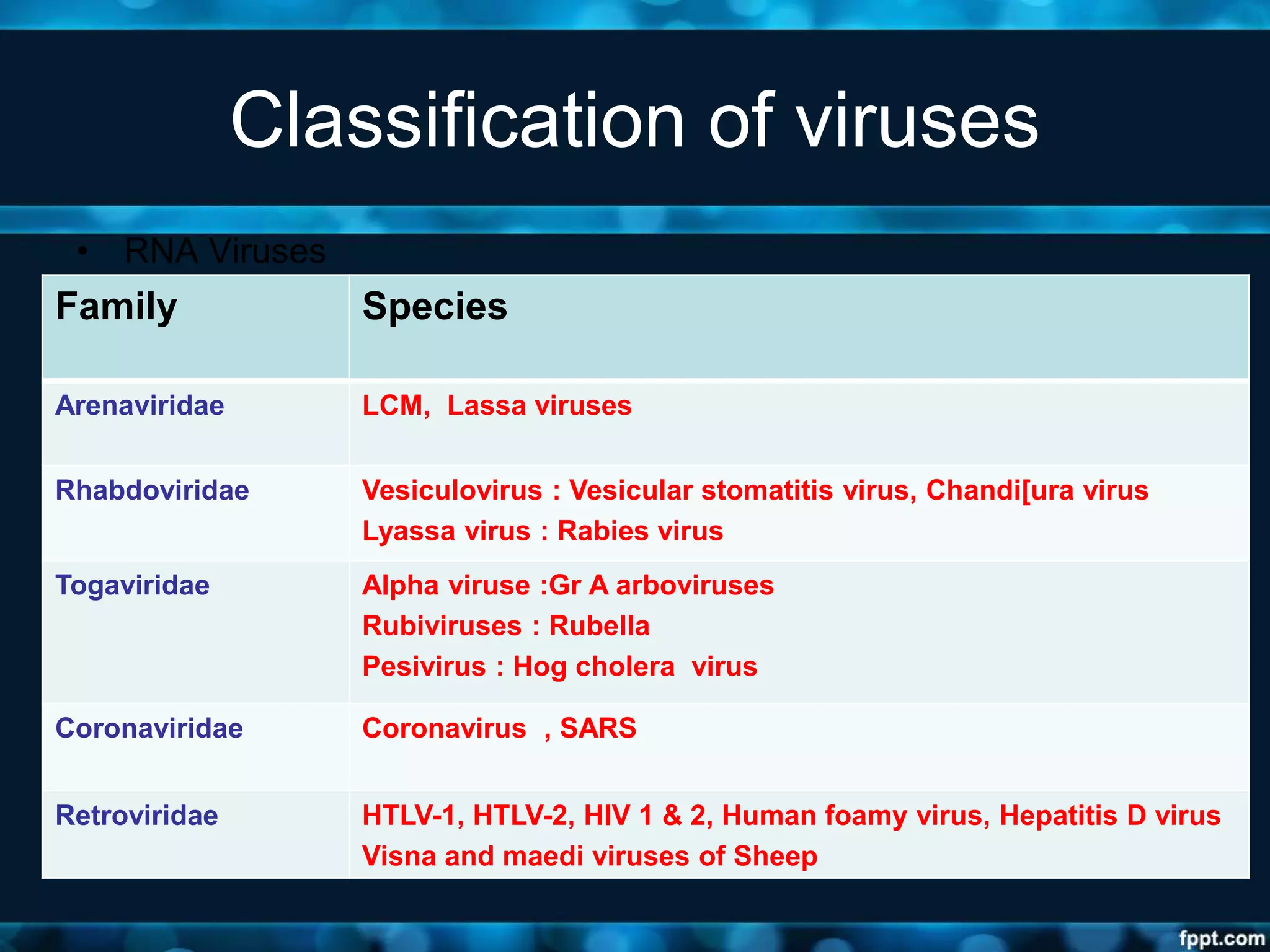
• RNA Viruses
Family Species
Arenaviridae LCM, Lassa viruses
Rhabdoviridae Vesiculovirus : Vesicular stomatitis virus, Chandi[ura virus
Lyassa virus : Rabies virus
Togaviridae Alpha viruse :Gr A arboviruses
Rubiviruses : Rubella
Pesivirus : Hog cholera virus
Coronaviridae Coronavirus , SARS
Retroviridae HTLV-1, HTLV-2, HIV 1 & 2, Human foamy virus, Hepatitis D virus
Visna and maedi viruses of Sheep
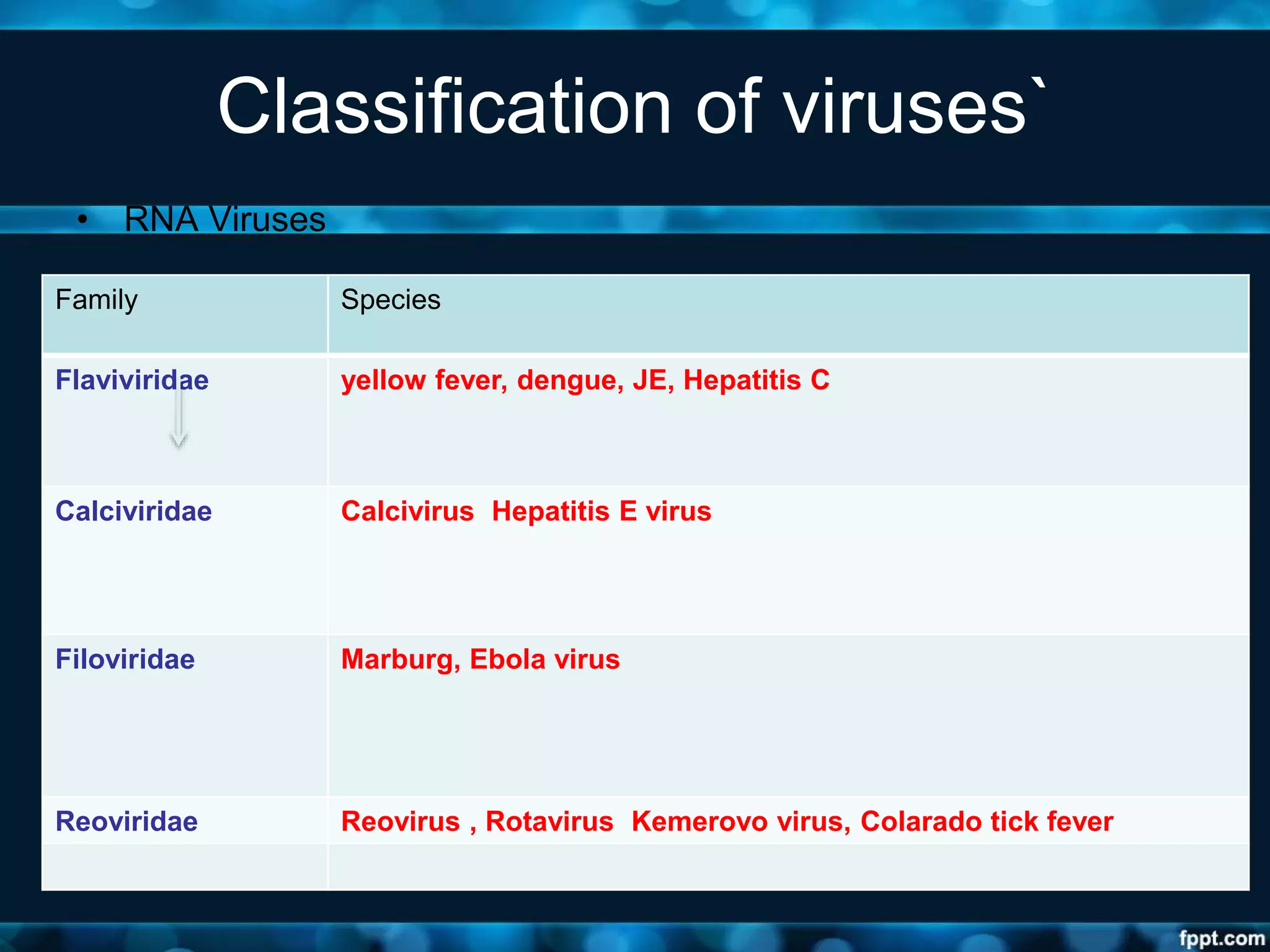
Classification of viruses`
• RNA Viruses
Family Species
Flaviviridae yellow fever, dengue, JE, Hepatitis C
Calciviridae Calcivirus Hepatitis E virus
Filoviridae Marburg, Ebola virus
Reoviridae Reovirus , Rotavirus Kemerovo virus, Colarado tick fever
Laboratory Diagnosis of Viral Infections
• For the proper management of certain diseases
– Rubella  first trimester  abortion is recommended.
– Baby born  HbsAg positive mother immunization at
birth (mandatory)
• Diagnosis
– E.g. Herpes viruses antiviral chemotherapy is available.
• Screening of blood donors (for HIV & Hep-B & others)
• Early detection of epidemics
– E.g. influenza, encephalitis, poliomyelitis etc  control
measures to prevent spread of inf.
• PEP (Post-exp prophylaxis)
– HIV, Hep-B
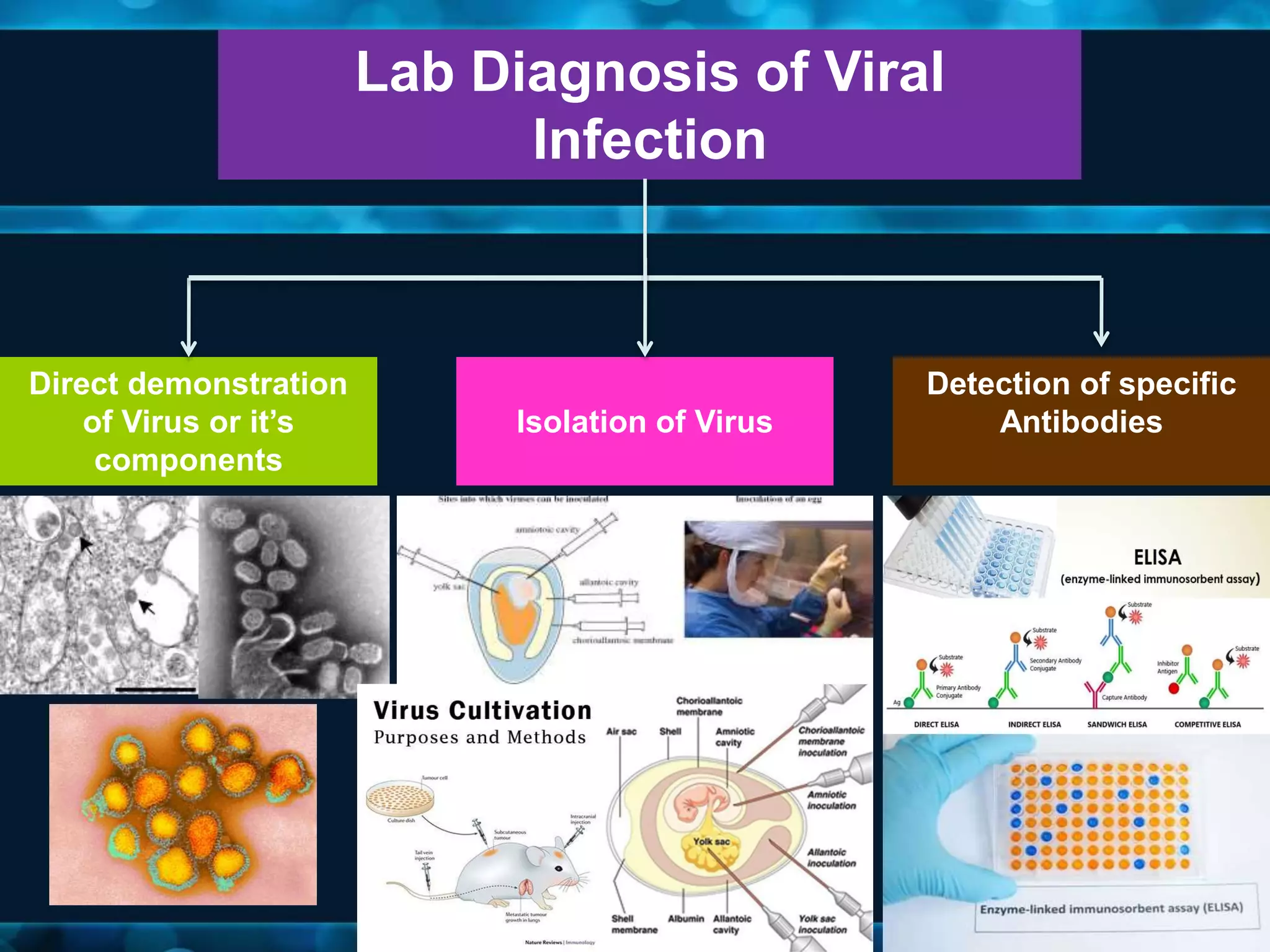
Lab Diagnosis of Viral
Infection
Direct demonstration
of Virus or it’s
components
Isolation of Virus
Detection of specific
Antibodies
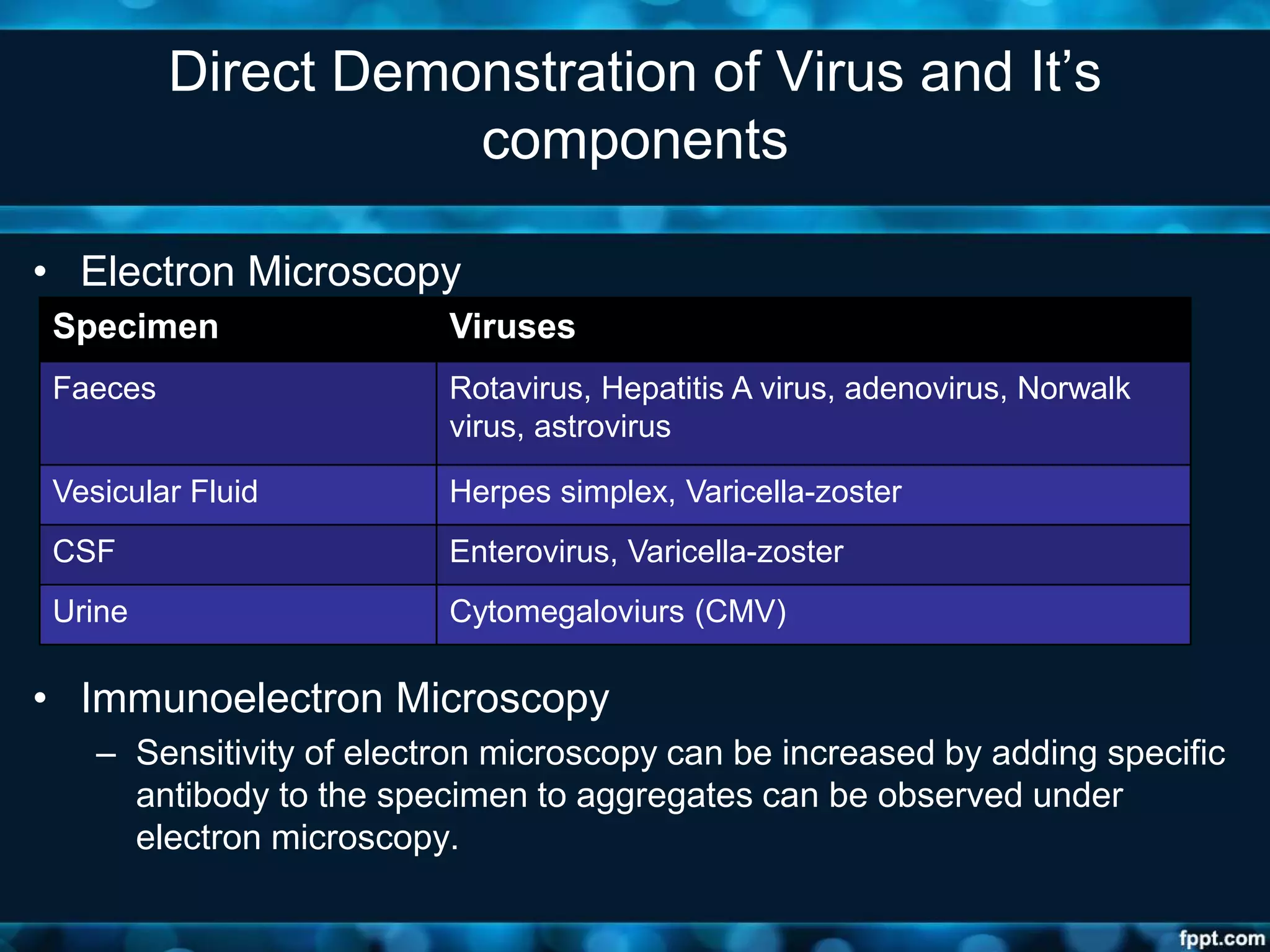
Direct Demonstration of Virus and It’s
components
• Electron Microscopy
• Immunoelectron Microscopy
– Sensitivity of electron microscopy can be increased by adding specific
antibody to the specimen to aggregates can be observed under
electron microscopy.
Specimen Viruses
Faeces Rotavirus, Hepatitis A virus, adenovirus, Norwalk
virus, astrovirus
Vesicular Fluid Herpes simplex, Varicella-zoster
CSF Enterovirus, Varicella-zoster
Urine Cytomegaloviurs (CMV)
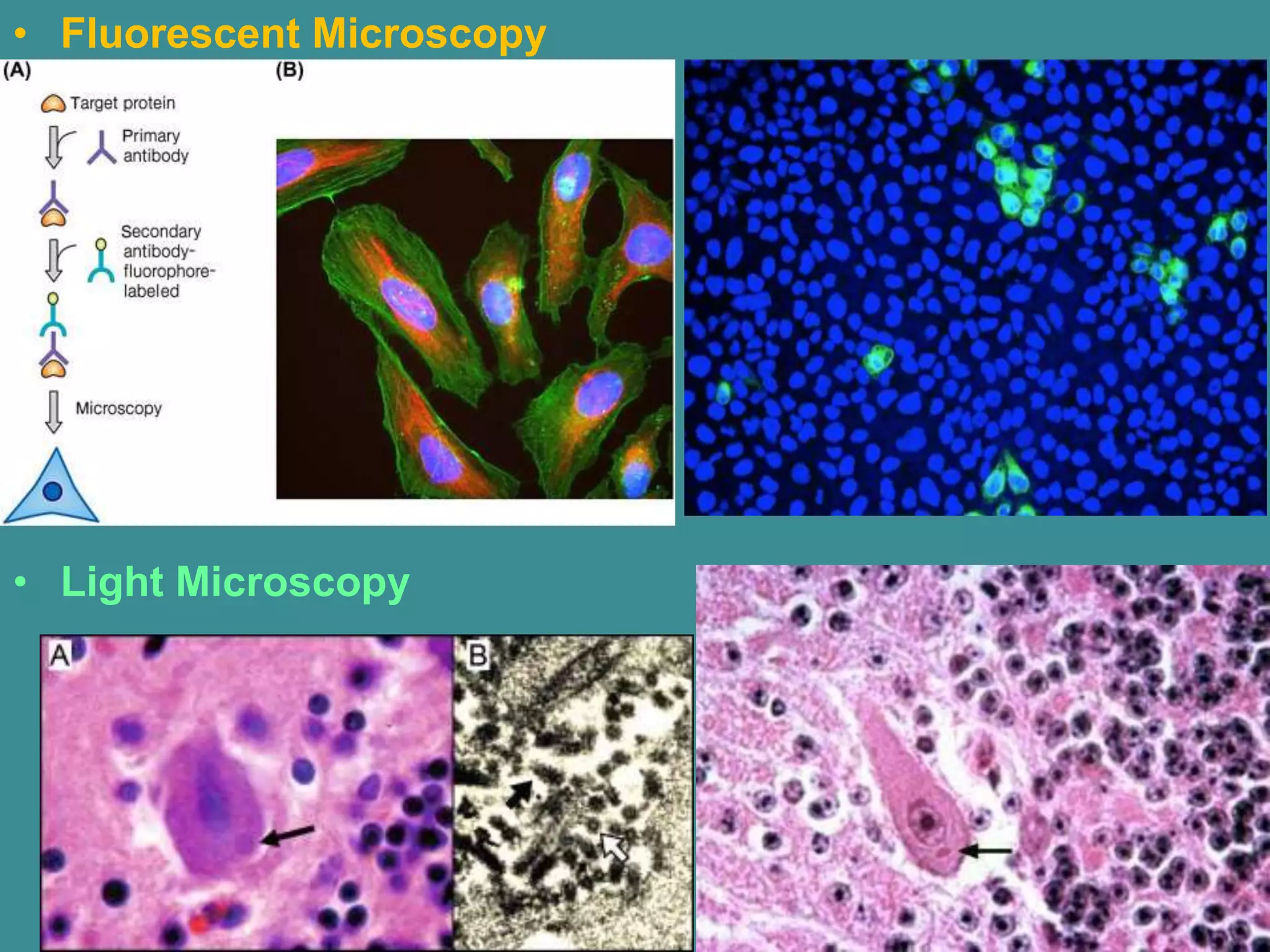
• Fluorescent Microscopy
• Light Microscopy
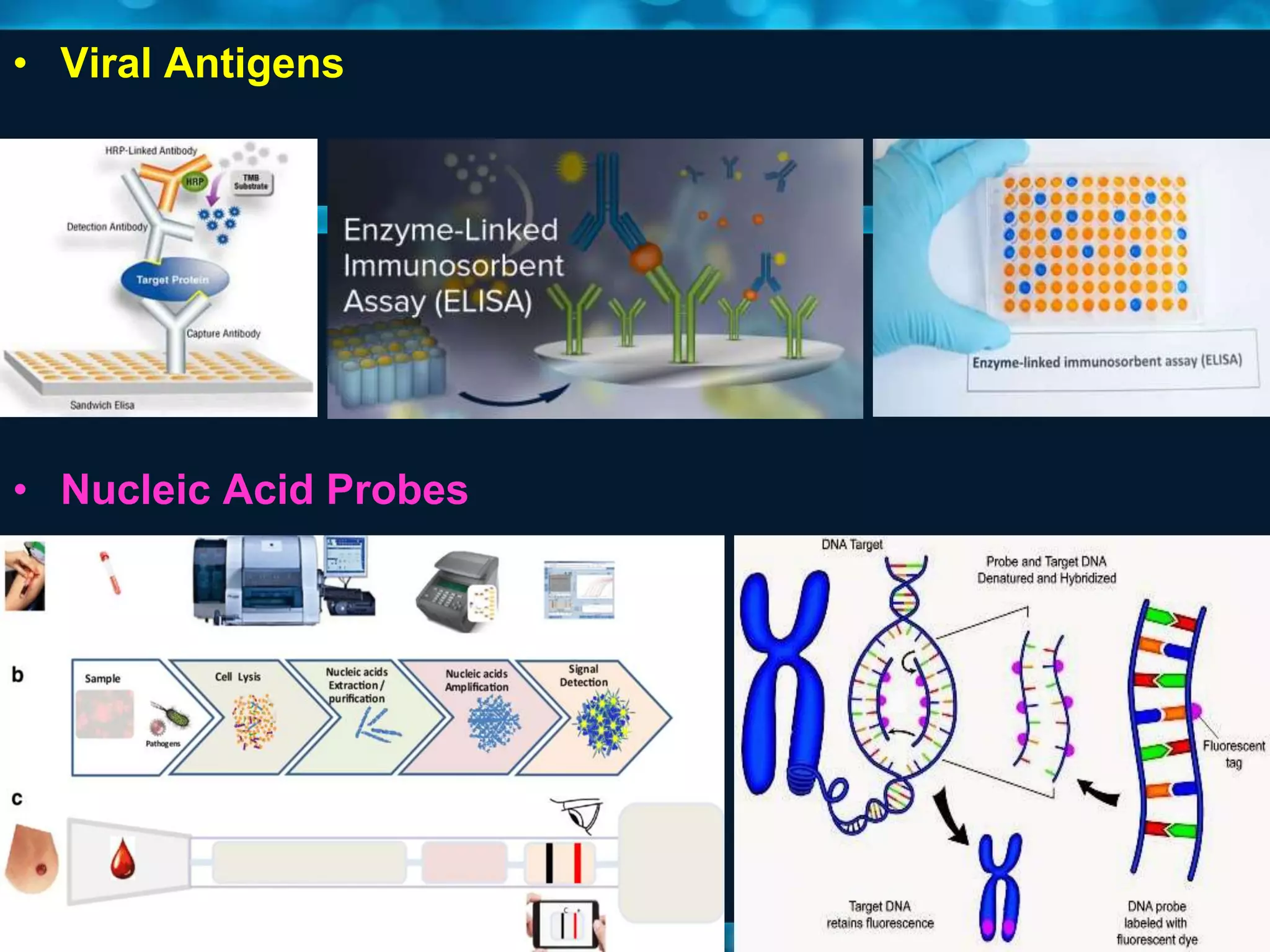
• Viral Antigens
• Nucleic Acid Probes
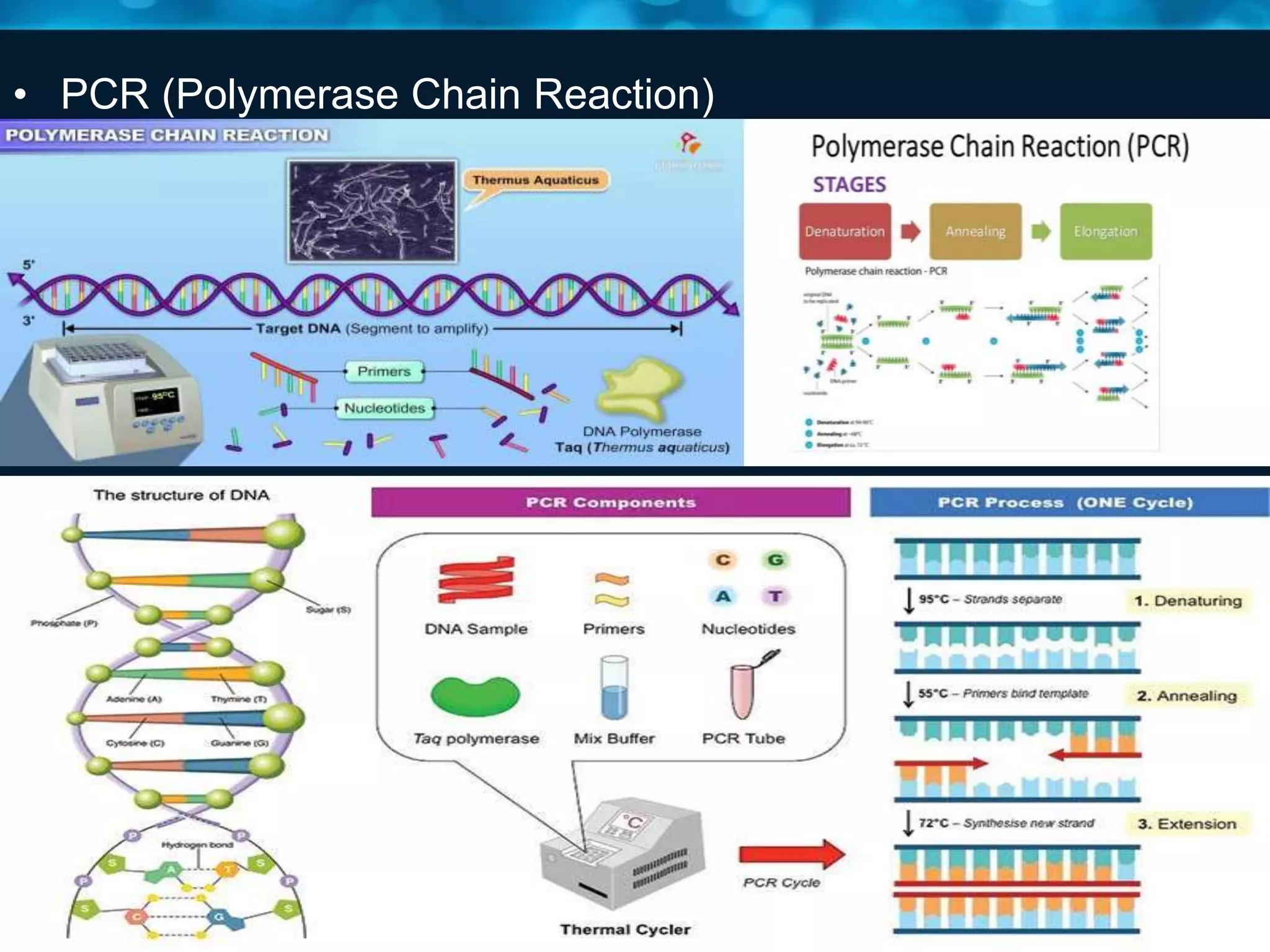
• PCR (Polymerase Chain Reaction)
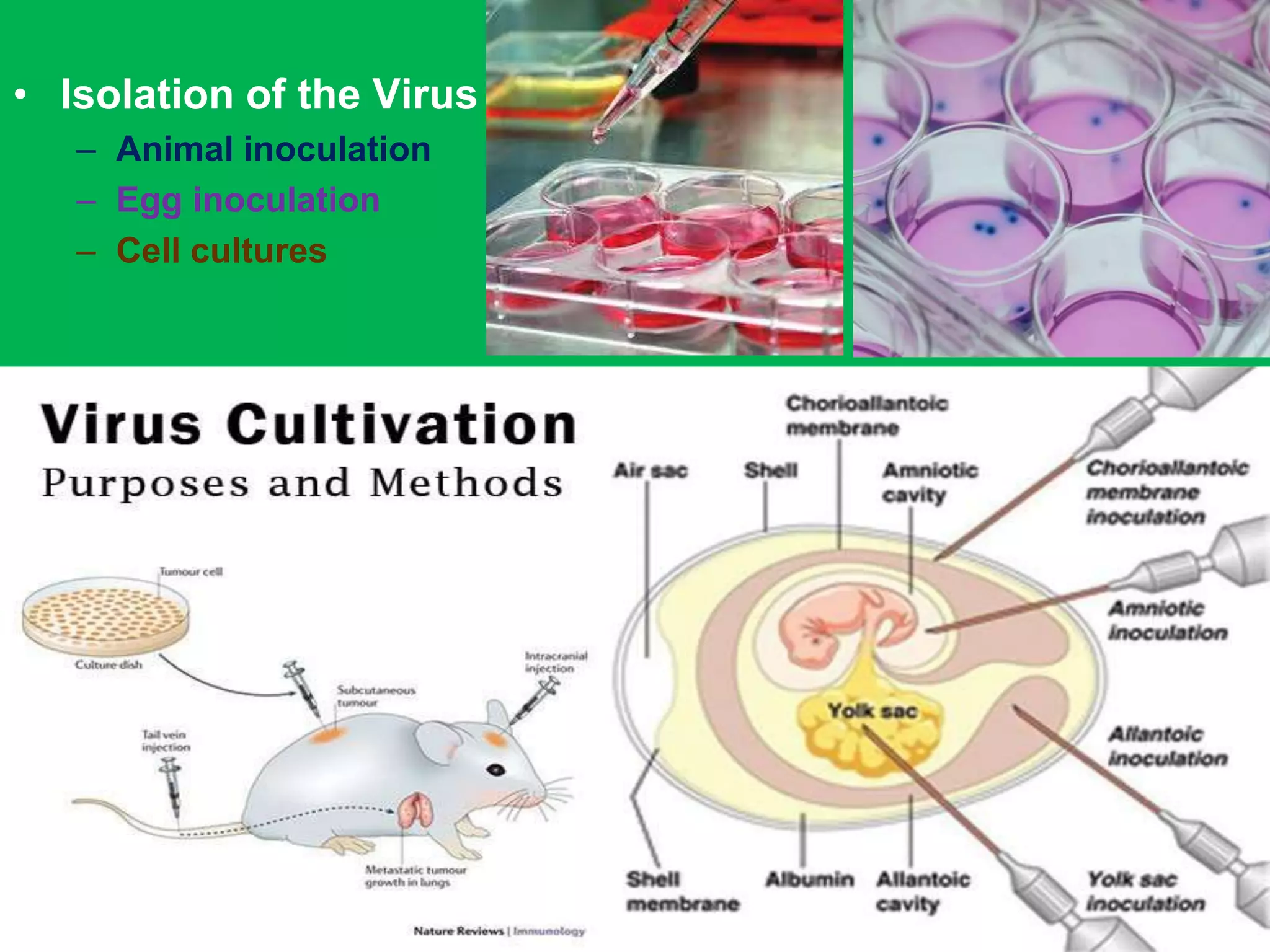
• Isolation of the Virus
– Animal inoculation
– Egg inoculation
– Cell cultures
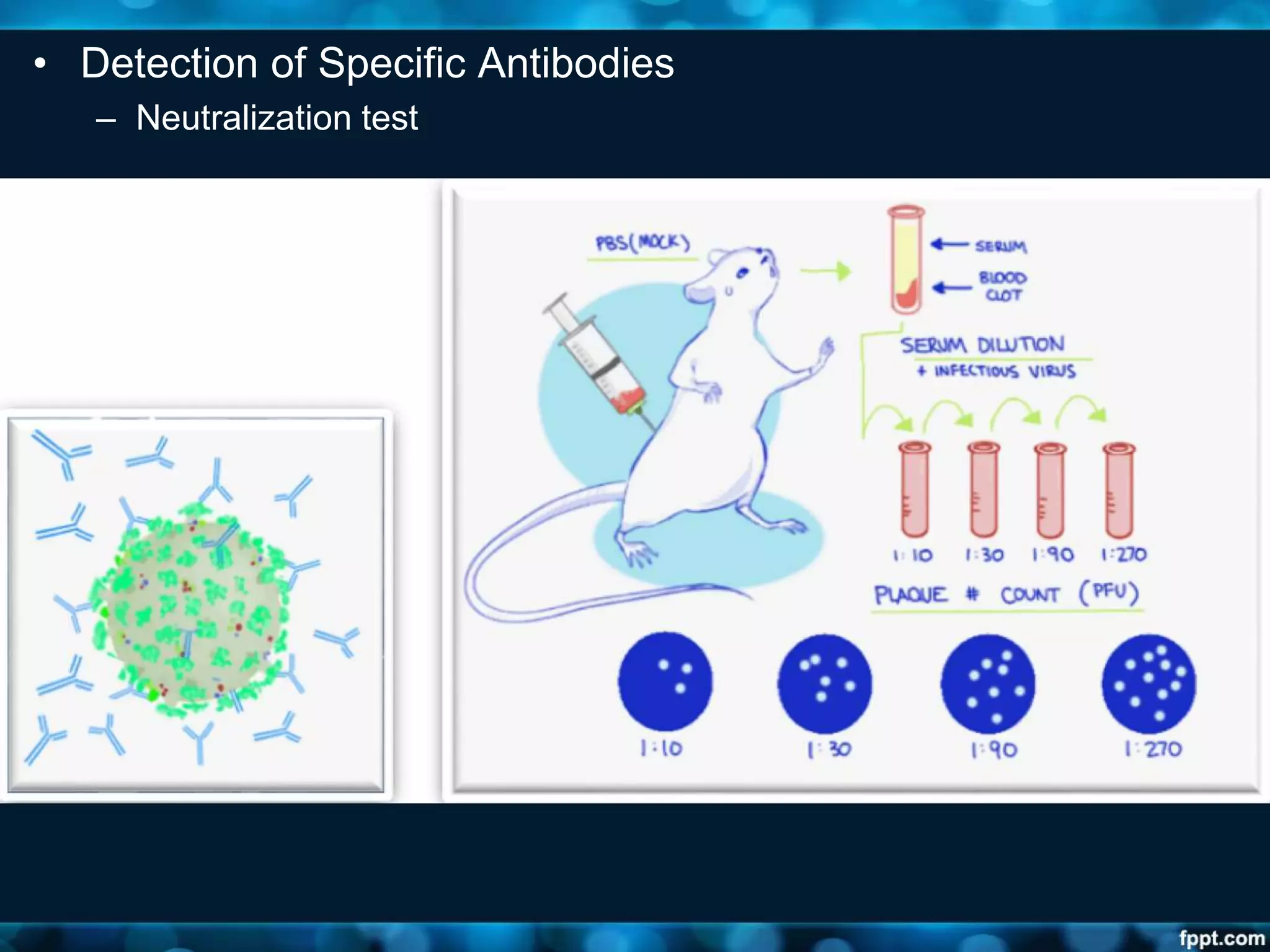
• Detection of Specific Antibodies
– Neutralization test
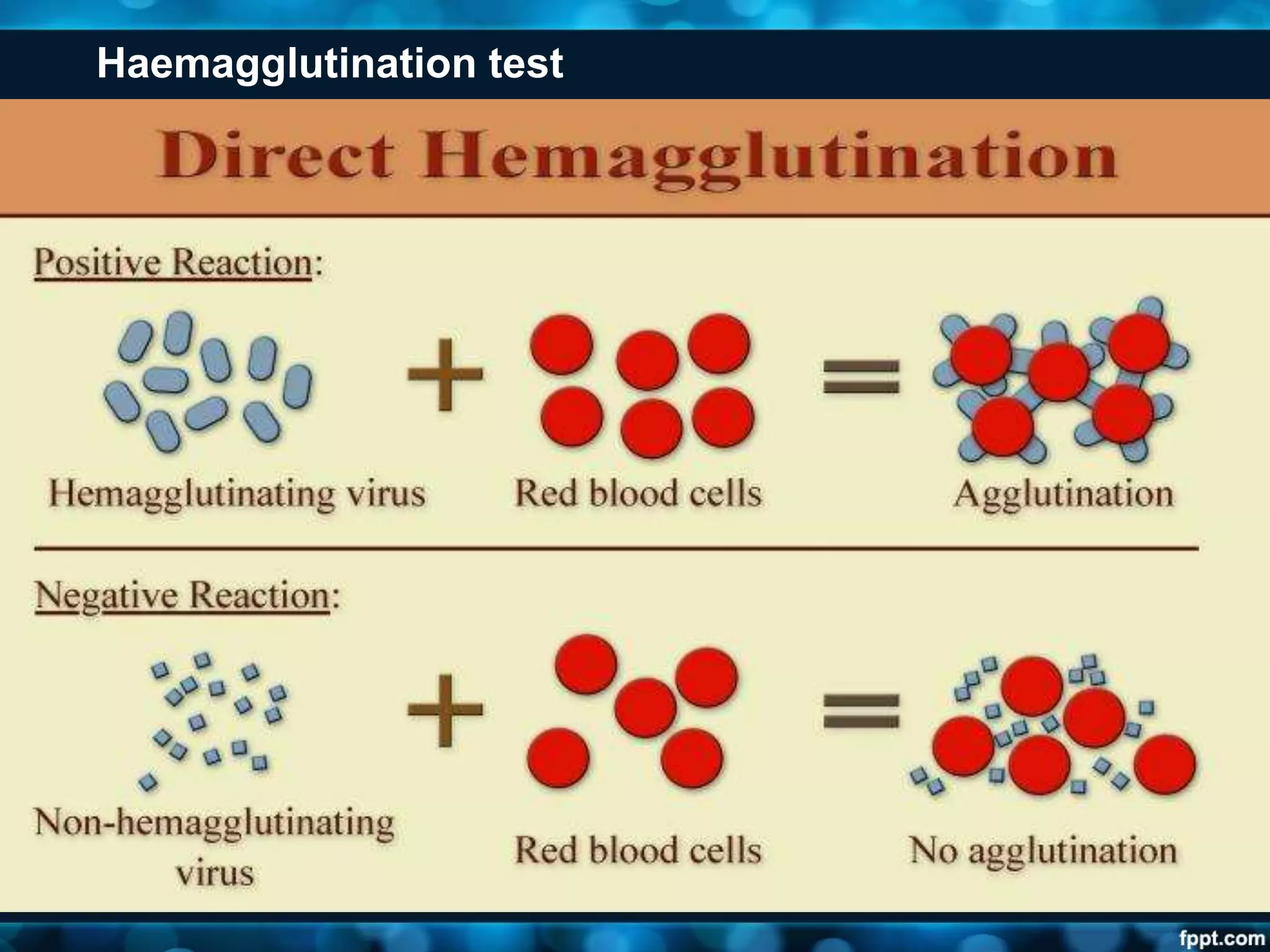
Haemagglutination test
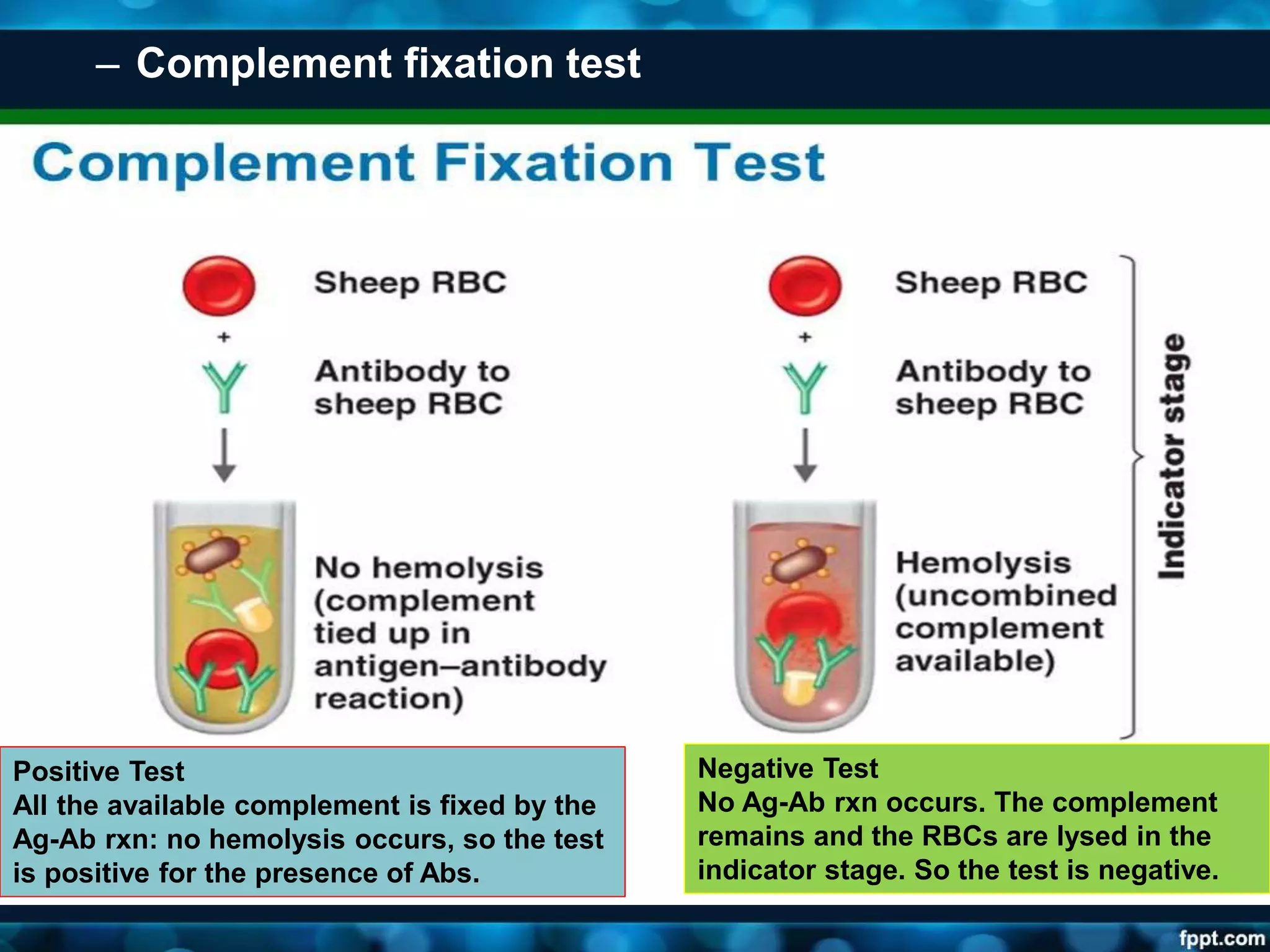
– Complement fixation test
Positive Test
All the available complement is fixed by the
Ag-Ab rxn: no hemolysis occurs, so the test
is positive for the presence of Abs.
Negative Test
No Ag-Ab rxn occurs. The complement
remains and the RBCs are lysed in the
indicator stage. So the test is negative.
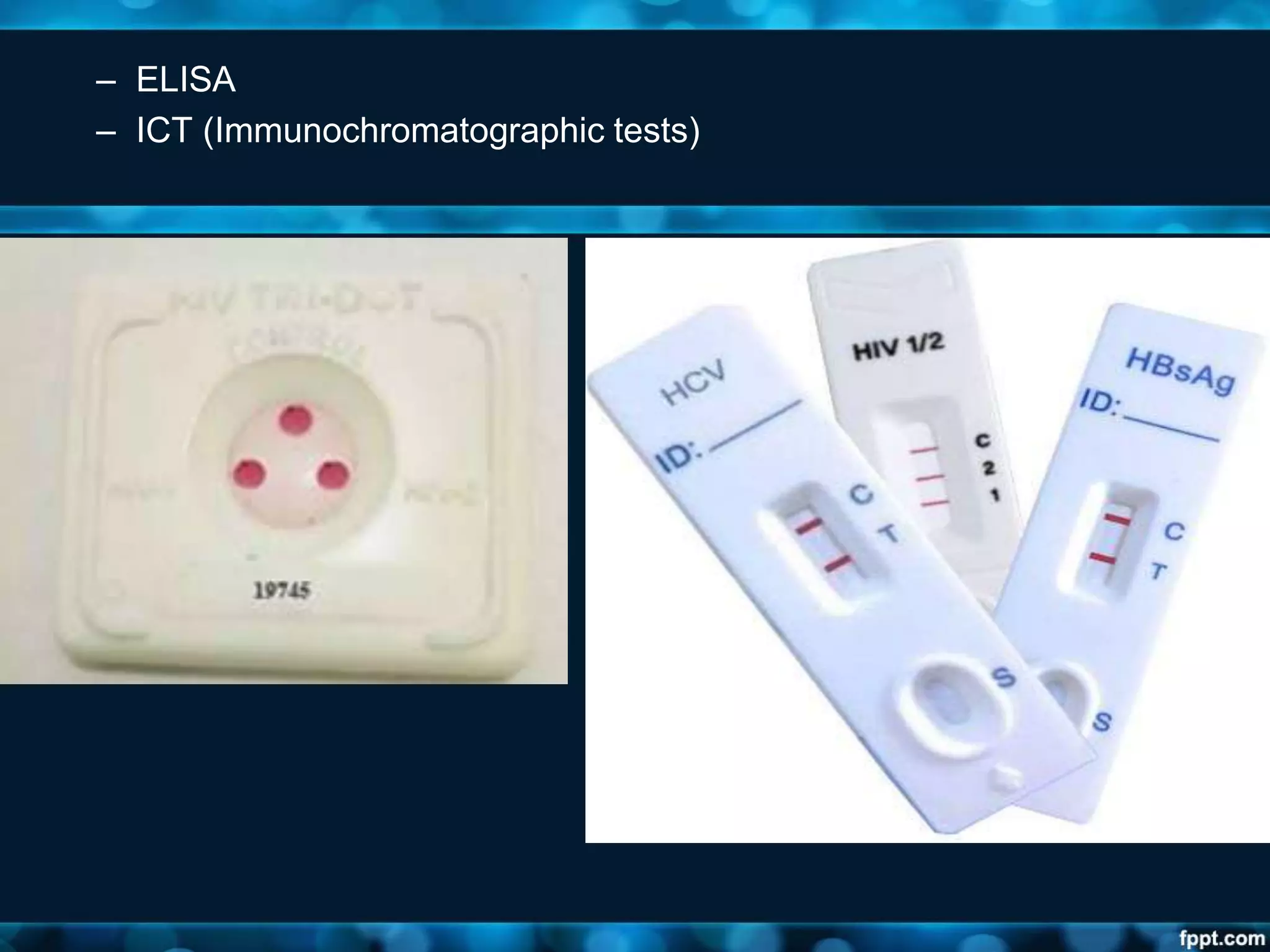
– ELISA
– ICT (Immunochromatographic tests)
Classification, Morphology and Methods for the detection of Viruses

Classification, Morphology and Methods for the detection of Viruses

  • 1.
    Classification, Morphology andMethods for the detection of Viruses Dr. Rakesh Prasad Sah Assistant Professor, Microbiology
  • 2.
    Definition • are thesmallest known infective agents  containing only one type of nucleic acid (DNA or RNA) as their genome. • Do not possess cellular organization and they have no metabolic activity.
  • 3.
    Properties of Viruses •Do not have cellular organization. • Contain only one type of nucleic acid; either DNA or RNA but never both. • Obligate intracellular parasites. • Lack enzymes necessary for protein and nucleic acid synthesis and are dependent for replicaton on the machinery of host cells. • Multiply by a complex process and not by binary fission. • Unaffected by antibacterial antibiotics.
  • 4.
    Differences between Virusand Bacteria Properties Bacteria Viruses Cell wall + _ Ribosome's & enzymes + _ DND & RNA Both present Only one Binary fission + _ Growth in Inanimate media + _ Sensitivity to antibiotics + _ Sensitivity to interferon _ +
  • 5.
    Morphology of Viruses •Viriods: ssRNA that lacks protein coat. • Prions: infectious proteins without any detectable N.A.
  • 6.
    Morphology of Viruses •Extracellular infectious viral particle is called ‘Virion’. • Viruses are much smaller than bacteria. For a time, they were known as ‘filterable agents’ as they can pass through filters that can hold back bacteria. • They can not be seen under light microscope hence called as ‘ultramicroscopic’. • Size range: 20-300 nm • Parvovirus: 20 nm (smallest virus) • Pox virus: 300 nm (biggest virus and can be seen under light
  • 8.
  • 9.
    Viral Capsid • Virusesconsists of nucleic acid core surrounded by a protein called capsid. • Capsid is composed of large number of capsomer which is made up of polypeptide molecules. • The capsid with theenclosed nucleic acid is known as nucleocapsid.
  • 10.
    Functions of Capsid •It protects  viral genome from physical destruction & enzymatic inactivation by nucleases in biological material. • It provides  binding site which enable the virus to attach to specific site on the host cell. • It facilitates  assembly and packaging of viral genetic information. • It serves as a vehicle of transmission from host to another. • It is antigenic and specific for each viruses • It provides the structural symmetry to the virus particle.
  • 11.
    Viral Symmetry 1. IcosahedralSymmetry • An icosahedral (icosa, meaning 20 in greek) is a polgon with 12 vertices or corners and 20 facets or sides. • Each facet is in the shape of an equilateral triangle. • Eg. Adeno viruses Adenovirus
  • 12.
    2. Helical Symmetry •The nucleic acid and capsomers are wound together in the form of helix or spiral. • Eg. Influenza virus, parainfluenz virus, rabies virus. 3. Complex Symmetry • Viruses which don not show either icoshedral or helical symmetry due to complexity of their structure are referred to have complex symmetry. • Eg. Pox viruses
  • 14.
    Viral Envelope • Virionsmay be enveloped and nonenveloped (naked). 1. Enveloped Virus • The envelop or outer covering of virus containing lipid is derived from the plasma membrane of the host cell during the release by budding from the cell surface. • Enveloped viruses are susceptible to the action of lipid solvent such as ether, chloroform and detergent. • Eg. Herpes virus, Hepatitis B virus, HIV virus
  • 15.
    2. Non envelopedvirus • Viruses which does not have outer covering. • Naked viruses are more likely to be resistant to lipid solvents like ether, chloroform and detergent. Peplomers • In mature virus particle, the glycoproteins often appear as projecting spikes on the outer surface of the envelop which are known as peplomers. • A virus may have more than one type of peplomers. E.g the influenza virus carries two types of peplomers, the hemagglutinin and neuraminidase
  • 16.
    Functions of Peplomers •It helps for attachment of virus to the host cell receptors to initiate the entrance of the virion into the cell. • It attach to receptors on red blood cells, causing these cell to agglutinate. • It has enzymatic activity like neuraminidase which cleave neuraminic acid from host cell glycoproteins. • It has antigenic properties.
  • 18.
    Viral Nucleic Acids •Viruses contain a single kind of nucleic acid either DNA or RNA which encodes the genetic information necessary for replication of the virus. • The genome may be single stranded or double stranded, circular or linear, segmented or non segmented. • According to nucleic acid present, viruses can be classified in to DNA viruses and RNA viruses.
  • 20.
    Classification of viruses •Type of nucleic acid • Number of strands of nucleic acid • Polarity of viral genome • Symmetry of nucleic acid • Presence / absence of a lipid envelope
  • 21.
    Classification of viruses DNAViruses Family Species Parvoviridae Adeno associated virus, Parvovirus , Densovirus Herpesviridae HSV 1 & 2, VZV, CMV, HHV type 6,7,8, E.B. virus Hepadenaviridae Hepatitis B virus Papovaviridae Wart viruses, Polyoma viruses, S V 40 Adeno viriadae Adenovirus Poxviridae Variola , Vaccinia, Cowpox, Monkey pox, Molluscum contagiosum,
  • 22.
    Classification of viruses RNAViruses Family Species Orthomyxoviridae Influenza viruses A,B,C Picornaviridae Enteroviruses :Polio, Echo, Coxsackie, Parechovirus, Rhinovirus Hepatovirus : Hepatitis A Paramyxoviridae Paramyxovirus: Human parainfluenza viruses, mumps, Newcasle disease virus Morbillivirus: measles Pneumovirus : RSV & related viruses Bunyaviridae Arboviruses, Hanta virus, Nairo virus, Phlebovirus, UKUvirus
  • 23.
    Classification of viruses •RNA Viruses Family Species Arenaviridae LCM, Lassa viruses Rhabdoviridae Vesiculovirus : Vesicular stomatitis virus, Chandi[ura virus Lyassa virus : Rabies virus Togaviridae Alpha viruse :Gr A arboviruses Rubiviruses : Rubella Pesivirus : Hog cholera virus Coronaviridae Coronavirus , SARS Retroviridae HTLV-1, HTLV-2, HIV 1 & 2, Human foamy virus, Hepatitis D virus Visna and maedi viruses of Sheep
  • 24.
    Classification of viruses` •RNA Viruses Family Species Flaviviridae yellow fever, dengue, JE, Hepatitis C Calciviridae Calcivirus Hepatitis E virus Filoviridae Marburg, Ebola virus Reoviridae Reovirus , Rotavirus Kemerovo virus, Colarado tick fever
  • 25.
    Laboratory Diagnosis ofViral Infections • For the proper management of certain diseases – Rubella  first trimester  abortion is recommended. – Baby born  HbsAg positive mother immunization at birth (mandatory) • Diagnosis – E.g. Herpes viruses antiviral chemotherapy is available. • Screening of blood donors (for HIV & Hep-B & others) • Early detection of epidemics – E.g. influenza, encephalitis, poliomyelitis etc  control measures to prevent spread of inf. • PEP (Post-exp prophylaxis) – HIV, Hep-B
  • 26.
    Lab Diagnosis ofViral Infection Direct demonstration of Virus or it’s components Isolation of Virus Detection of specific Antibodies
  • 27.
    Direct Demonstration ofVirus and It’s components • Electron Microscopy • Immunoelectron Microscopy – Sensitivity of electron microscopy can be increased by adding specific antibody to the specimen to aggregates can be observed under electron microscopy. Specimen Viruses Faeces Rotavirus, Hepatitis A virus, adenovirus, Norwalk virus, astrovirus Vesicular Fluid Herpes simplex, Varicella-zoster CSF Enterovirus, Varicella-zoster Urine Cytomegaloviurs (CMV)
  • 28.
  • 29.
    • Viral Antigens •Nucleic Acid Probes
  • 30.
    • PCR (PolymeraseChain Reaction)
  • 31.
    • Isolation ofthe Virus – Animal inoculation – Egg inoculation – Cell cultures
  • 32.
    • Detection ofSpecific Antibodies – Neutralization test
  • 33.
  • 34.
    – Complement fixationtest Positive Test All the available complement is fixed by the Ag-Ab rxn: no hemolysis occurs, so the test is positive for the presence of Abs. Negative Test No Ag-Ab rxn occurs. The complement remains and the RBCs are lysed in the indicator stage. So the test is negative.
  • 35.
    – ELISA – ICT(Immunochromatographic tests)