AN
INDUSTRIAL TRAINING PRESENTATION
ON
KOTA SUPER THERMAL POWER STATION
Submitted by :-
Name – VINAY MAHAVAR
Roll No. – 23/
Batch - B-6
Department of Electrical Engineering
RAJASTHAN TECHNICAL UNIVERSITY, KOTA
Submitted to:-
Content :-
 Introduction
 Principal
 Layout
 Coal Handling Plant
 Boiler
 Super Heater
 Steam turbine
 Economizer
 Generator
 Water Treatment Plant
 Cooling System
 Ash Handling Plant
 Establishment Year: It was established in 1983.
 Location: It is located on the left bank of the Chambal River,
upstream of Kota Barrage.
 Unit Capacities:
 1st & 2nd units: 110 MW each
 3rd, 4th & 5th units: 210 MW each
 6th & 7th units: 195 MW each
 Total Generation Capacity: The total generation capacity is 1240
MW (calculated as 110+110+210+210+210+195+195=1240
MW).
 Favorable Conditions:
 Abundant quantity of clean cooling water.
 Good transport facility.
INRODUCTION OF THERMAL POWER PLANT :-
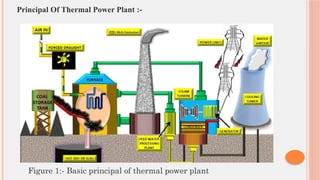
Principal Of Thermal Power Plant :-
Figure 1:- Basic principal of thermal power plant
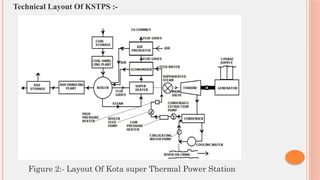
Technical Layout Of KSTPS :-
Figure 2:- Layout Of Kota super Thermal Power Station
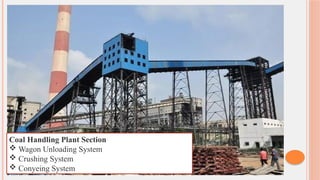
Coal Handling Plant Section
 Wagon Unloading System
 Crushing System
 Conyeing System
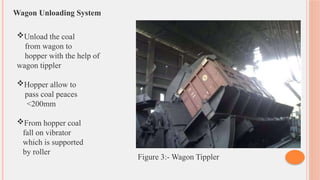
Wagon Unloading System
Unload the coal
from wagon to
hopper with the help of
wagon tippler
Hopper allow to
pass coal peaces
<200mm
From hopper coal
fall on vibrator
which is supported
by roller
Figure 3:- Wagon Tippler
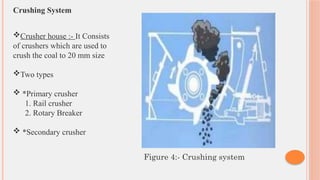
Crushing System
Crusher house :- It Consists
of crushers which are used to
crush the coal to 20 mm size
Two types
 *Primary crusher
1. Rail crusher
2. Rotary Breaker
 *Secondary crusher
Figure 4:- Crushing system
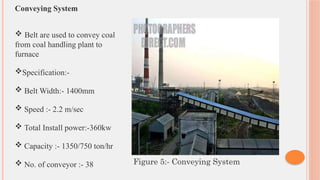
Conveying System
 Belt are used to convey coal
from coal handling plant to
furnace
Specification:-
 Belt Width:- 1400mm
 Speed :- 2.2 m/sec
 Total Install power:-360kw
 Capacity :- 1350/750 ton/hr
 No. of conveyor :- 38 Figure 5:- Conveying System
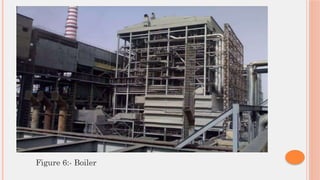
Boiler
 A closed vessel where water under pressure is converted into steam.
 Hot water or steam is used to transfer heat to a process.
 Always designed to absorb the maximum amount of
heat released during combustion
Furnace: The primary part of the boiler where fuel is burned to liberate
heat energy.
 Energy conversion
 Chemical Energy of fuel → Thermal Energy by combustion
Figure 6:- Boiler
Super-heater
Consists of a group of tubes.
These tubes are heated by the hot combustion gases as they pass from
the furnace to the chimney, which increases the temperature of the
steam.
The primary function of the super-heater is to remove moisture from
the steam leaving the boiler tubes.
 A component that increases the temperature of steam, making it superheated,
by utilizing heat from the hot flue gases.
 This process enhances the efficiency of the steam turbine and reduces the risk
of condensation within the turbine, preventing potential damage.
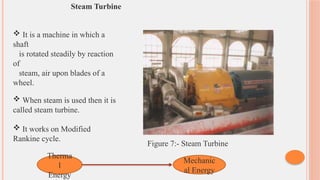
Steam Turbine
 It is a machine in which a
shaft
is rotated steadily by reaction
of
steam, air upon blades of a
wheel.
 When steam is used then it is
called steam turbine.
 It works on Modified
Rankine cycle.
Therma
l
Energy
Mechanic
al Energy
Figure 7:- Steam Turbine
Economizer
• Economizer is a device which recover heat from the flue gases on
their way to chimney.
• It increase the 10-12% efficiency of the plant.
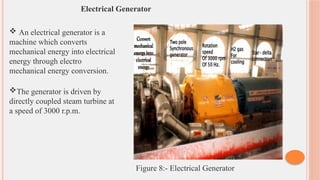
Electrical Generator
 An electrical generator is a
machine which converts
mechanical energy into electrical
energy through electro
mechanical energy conversion.
The generator is driven by
directly coupled steam turbine at
a speed of 3000 r.p.m.
Figure 8:- Electrical Generator
Water Treatment Plant
 Pressure Filter: Removes "undissloved impurities" from raw water. This
suggests a general filtration step for larger particles or suspended solids.
 Carbon Filter: Removes excess chlorine from clarified water. Chlorine is often
used as a disinfectant but can be corrosive or problematic in certain industrial
processes.
 D.M. Plant (Demineralization Plant): Removes dissolved impurities from
clarified water. This is a crucial step for producing high-purity water by
removing ions and minerals.
 Water Quality Monitoring: The conductivity, pH, and silica content of the
treated water must be checked regularly. These parameters are critical for
preventing scaling, corrosion, and other issues in systems like boilers.
Cooling System
 Hydrogen Cooling in KSTPS: In KSTPS , a hydrogen cooling system is
used for generator cooling.
 Reasons for Hydrogen Cooling: Hydrogen is preferred due to its
superior cooling properties and low density. It's noted that the thermal
conductivity of hydrogen (H2​
) is 7.3 times that of air, making it a much more
efficient cooling medium.
 Seal Oil System: A seal oil system is employed in the turbine for less
friction in the bearings. This system ensures smooth operation and reduces
wear in critical rotating components.
 Water Cooling for Fire: Water cooling is also used as a measure for any
kind of fire, indicating its role in fire suppression or prevention within the
plant.
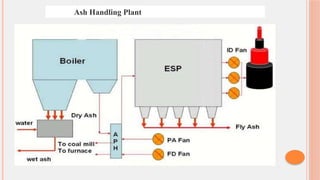
Ash Handling Plant
 Subdivision of a Plant The plant can be subdivided into 3 sub-plants:
1) Fuel and ash plant: Handles the incoming fuel and the initial stages of ash.
2) Air and Gas plant: Manages the air supply for combustion and the exhaust
gases.
3) Ash disposal and dust collection plant: Deals with the collection and disposal
of ash and dust.
 Ash Composition in Thermal Plants
In thermal plants, 25% of the ash is furnace bottom ash, and 75% is pulverized
fuel ash (also known as fly ash).
Fly Ash Removal
An Electrostatic Precipitator is used in the ash handling plant to remove fly ash.
This device is crucial for environmental control, capturing fine particulate matter
Ash Handling Plant
Thank You
&
Any queries ?

vinay_mahavar_enhanddsfsdfssdfssfced.pptx

  • 1.
    AN INDUSTRIAL TRAINING PRESENTATION ON KOTASUPER THERMAL POWER STATION Submitted by :- Name – VINAY MAHAVAR Roll No. – 23/ Batch - B-6 Department of Electrical Engineering RAJASTHAN TECHNICAL UNIVERSITY, KOTA Submitted to:-
  • 2.
    Content :-  Introduction Principal  Layout  Coal Handling Plant  Boiler  Super Heater  Steam turbine  Economizer  Generator  Water Treatment Plant  Cooling System  Ash Handling Plant
  • 3.
     Establishment Year:It was established in 1983.  Location: It is located on the left bank of the Chambal River, upstream of Kota Barrage.  Unit Capacities:  1st & 2nd units: 110 MW each  3rd, 4th & 5th units: 210 MW each  6th & 7th units: 195 MW each  Total Generation Capacity: The total generation capacity is 1240 MW (calculated as 110+110+210+210+210+195+195=1240 MW).  Favorable Conditions:  Abundant quantity of clean cooling water.  Good transport facility. INRODUCTION OF THERMAL POWER PLANT :-
  • 4.
    Principal Of ThermalPower Plant :- Figure 1:- Basic principal of thermal power plant
  • 5.
    Technical Layout OfKSTPS :- Figure 2:- Layout Of Kota super Thermal Power Station
  • 6.
    Coal Handling PlantSection  Wagon Unloading System  Crushing System  Conyeing System
  • 7.
    Wagon Unloading System Unloadthe coal from wagon to hopper with the help of wagon tippler Hopper allow to pass coal peaces <200mm From hopper coal fall on vibrator which is supported by roller Figure 3:- Wagon Tippler
  • 8.
    Crushing System Crusher house:- It Consists of crushers which are used to crush the coal to 20 mm size Two types  *Primary crusher 1. Rail crusher 2. Rotary Breaker  *Secondary crusher Figure 4:- Crushing system
  • 9.
    Conveying System  Beltare used to convey coal from coal handling plant to furnace Specification:-  Belt Width:- 1400mm  Speed :- 2.2 m/sec  Total Install power:-360kw  Capacity :- 1350/750 ton/hr  No. of conveyor :- 38 Figure 5:- Conveying System
  • 10.
    Boiler  A closedvessel where water under pressure is converted into steam.  Hot water or steam is used to transfer heat to a process.  Always designed to absorb the maximum amount of heat released during combustion Furnace: The primary part of the boiler where fuel is burned to liberate heat energy.  Energy conversion  Chemical Energy of fuel → Thermal Energy by combustion
  • 11.
  • 12.
    Super-heater Consists of agroup of tubes. These tubes are heated by the hot combustion gases as they pass from the furnace to the chimney, which increases the temperature of the steam. The primary function of the super-heater is to remove moisture from the steam leaving the boiler tubes.  A component that increases the temperature of steam, making it superheated, by utilizing heat from the hot flue gases.  This process enhances the efficiency of the steam turbine and reduces the risk of condensation within the turbine, preventing potential damage.
  • 13.
    Steam Turbine  Itis a machine in which a shaft is rotated steadily by reaction of steam, air upon blades of a wheel.  When steam is used then it is called steam turbine.  It works on Modified Rankine cycle. Therma l Energy Mechanic al Energy Figure 7:- Steam Turbine
  • 14.
    Economizer • Economizer isa device which recover heat from the flue gases on their way to chimney. • It increase the 10-12% efficiency of the plant.
  • 15.
    Electrical Generator  Anelectrical generator is a machine which converts mechanical energy into electrical energy through electro mechanical energy conversion. The generator is driven by directly coupled steam turbine at a speed of 3000 r.p.m. Figure 8:- Electrical Generator
  • 16.
    Water Treatment Plant Pressure Filter: Removes "undissloved impurities" from raw water. This suggests a general filtration step for larger particles or suspended solids.  Carbon Filter: Removes excess chlorine from clarified water. Chlorine is often used as a disinfectant but can be corrosive or problematic in certain industrial processes.  D.M. Plant (Demineralization Plant): Removes dissolved impurities from clarified water. This is a crucial step for producing high-purity water by removing ions and minerals.  Water Quality Monitoring: The conductivity, pH, and silica content of the treated water must be checked regularly. These parameters are critical for preventing scaling, corrosion, and other issues in systems like boilers.
  • 17.
    Cooling System  HydrogenCooling in KSTPS: In KSTPS , a hydrogen cooling system is used for generator cooling.  Reasons for Hydrogen Cooling: Hydrogen is preferred due to its superior cooling properties and low density. It's noted that the thermal conductivity of hydrogen (H2​ ) is 7.3 times that of air, making it a much more efficient cooling medium.  Seal Oil System: A seal oil system is employed in the turbine for less friction in the bearings. This system ensures smooth operation and reduces wear in critical rotating components.  Water Cooling for Fire: Water cooling is also used as a measure for any kind of fire, indicating its role in fire suppression or prevention within the plant.
  • 18.
    Ash Handling Plant Subdivision of a Plant The plant can be subdivided into 3 sub-plants: 1) Fuel and ash plant: Handles the incoming fuel and the initial stages of ash. 2) Air and Gas plant: Manages the air supply for combustion and the exhaust gases. 3) Ash disposal and dust collection plant: Deals with the collection and disposal of ash and dust.  Ash Composition in Thermal Plants In thermal plants, 25% of the ash is furnace bottom ash, and 75% is pulverized fuel ash (also known as fly ash). Fly Ash Removal An Electrostatic Precipitator is used in the ash handling plant to remove fly ash. This device is crucial for environmental control, capturing fine particulate matter
  • 19.
  • 20.