•Dr. Jaswant Kaur
Assistant professor
Department Biochemistry
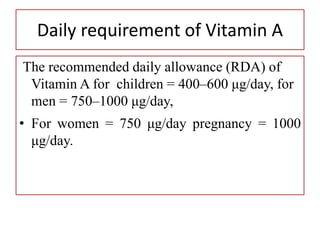
Daily requirement of Vitamin A
The recommended daily allowance (RDA) of
Vitamin A for children = 400–600 μg/day, for
men = 750–1000 μg/day,
• For women = 750 μg/day pregnancy = 1000
μg/day.
• quirement of Vitamin A
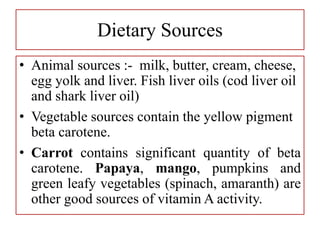
Dietary Sources
• Animal sources :- milk, butter, cream, cheese,
egg yolk and liver. Fish liver oils (cod liver oil
and shark liver oil)
• Vegetable sources contain the yellow pigment
beta carotene.
• Carrot contains significant quantity of beta
carotene. Papaya, mango, pumpkins and
green leafy vegetables (spinach, amaranth) are
other good sources of vitamin A activity.
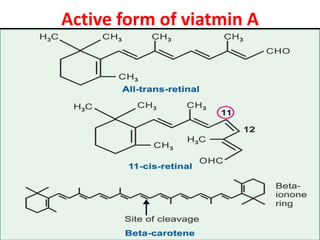
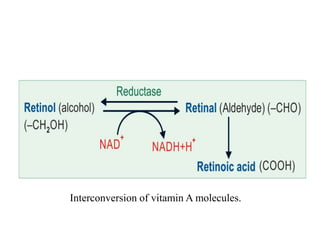
Active form of viatmin A
Interconversion of vitamin A molecules.
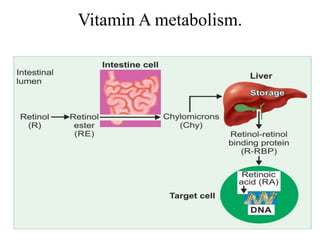
Vitamin A metabolism.
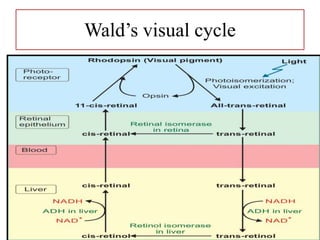
Wald’s visual cycle
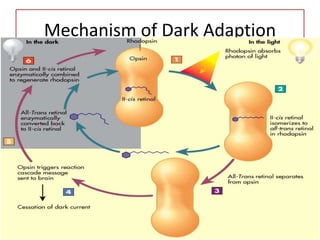
Mechanism of Dark Adaption
Dark adaption mechanism
• Person shifts from bright light to dim area- leads
difficulty in seeing .
Due to resynthesis of rhodopsin & vision is
improved.
• Increased in Vit. A deficiency.
• Red light bleaches rhodopsin to a lesser extent.
photosensitive cells
• Rods cones
( for dim light vision) ( bright light & color vision)
• Vision
• Visual cycle
• Rods are for Vision in Dim Light
• Cones are for Color Vision
• Other Biochemical Functions
• Gene Regulation
• Immunological System
• Reproductive System
• Anti-oxidant Property
• Effect on Skin
Cont.
Deficiency manifestation of Vit. A
• Night Blindness or Nyctalopia
• Bitot’s Spots
• Xerophthalmia
• Keratomalacia
• Preventable Blindness
• Skin and Mucous Membrane Lesions growth retardation
reduced immunity against infections.
• Deficiency of vitamin A: Deficiency leads to a variety of
disorders of the eyes and this affect the vision, some of the
disorders are –
• 1)Night blindness: The person cannot see the objects in
dim light and in nights.
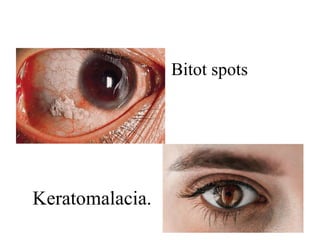
• Bitot’s spot:- seen as greenish white triangular
plaques adherent to conjuctiva.
2)Xeropthalmia : conjuctiva becomes dry, thick, wrinkled.
• Losses its transperancy.
• Dryness spreads to cornea.
3) Keratomalacia ( softening of the cornea) :- Xeropthalmia
persists for long time , leads Keratomalacia .
Occur degeneration of corneal epithelium
Bitot spots
Keratomalacia.
• 4)Skin become scaly, rough and is covered
with papillae (Small eruptions).
• 5)Reproductive functions may also be
effected in vitamin ‘A’ deficiency.
• National Institute of Nutrition, Hyderabad
has evolved a method giving a large dose
(5 – 6 drops) of Vitamin-A once in six
months to prevent blindness in children
Hypervitaminosis A or toxicity
• Excessive intake can lead to toxicity since the
vitamin is stored.
• Symptoms of toxicity are anorexia, irritability,
headache, drowsiness and vomiting, increased
intracranial tension.
• Sometimes swelling over long bones (bony
exostosis) may occur with painful bones.
Enlargement of liver is also seen in children
Objectives
• List the different active forms of vitamin A
State the dietary sources and RDA in children,
adults, pregnancy and lactation
• Explain the role of vitamin A in vision and
Wald’s visual cycle
• Describe the deficiency manifestations of
vitamin A .

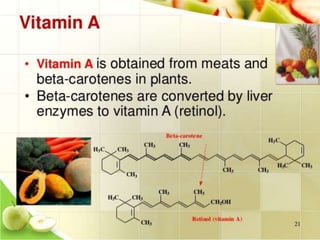
Viatmin a , dr . jaswant kaur

  • 1.
    •Dr. Jaswant Kaur Assistantprofessor Department Biochemistry
  • 6.
    Daily requirement ofVitamin A The recommended daily allowance (RDA) of Vitamin A for children = 400–600 μg/day, for men = 750–1000 μg/day, • For women = 750 μg/day pregnancy = 1000 μg/day. • quirement of Vitamin A
  • 7.
    Dietary Sources • Animalsources :- milk, butter, cream, cheese, egg yolk and liver. Fish liver oils (cod liver oil and shark liver oil) • Vegetable sources contain the yellow pigment beta carotene. • Carrot contains significant quantity of beta carotene. Papaya, mango, pumpkins and green leafy vegetables (spinach, amaranth) are other good sources of vitamin A activity.
  • 8.
    Active form ofviatmin A
  • 9.
  • 10.
  • 11.
  • 12.
  • 13.
    Dark adaption mechanism •Person shifts from bright light to dim area- leads difficulty in seeing . Due to resynthesis of rhodopsin & vision is improved. • Increased in Vit. A deficiency. • Red light bleaches rhodopsin to a lesser extent. photosensitive cells • Rods cones ( for dim light vision) ( bright light & color vision)
  • 14.
    • Vision • Visualcycle • Rods are for Vision in Dim Light • Cones are for Color Vision • Other Biochemical Functions • Gene Regulation • Immunological System • Reproductive System • Anti-oxidant Property • Effect on Skin
  • 15.
  • 16.
    Deficiency manifestation ofVit. A • Night Blindness or Nyctalopia • Bitot’s Spots • Xerophthalmia • Keratomalacia • Preventable Blindness • Skin and Mucous Membrane Lesions growth retardation reduced immunity against infections.
  • 17.
    • Deficiency ofvitamin A: Deficiency leads to a variety of disorders of the eyes and this affect the vision, some of the disorders are – • 1)Night blindness: The person cannot see the objects in dim light and in nights. • Bitot’s spot:- seen as greenish white triangular plaques adherent to conjuctiva. 2)Xeropthalmia : conjuctiva becomes dry, thick, wrinkled. • Losses its transperancy. • Dryness spreads to cornea. 3) Keratomalacia ( softening of the cornea) :- Xeropthalmia persists for long time , leads Keratomalacia . Occur degeneration of corneal epithelium
  • 18.
  • 19.
    • 4)Skin becomescaly, rough and is covered with papillae (Small eruptions). • 5)Reproductive functions may also be effected in vitamin ‘A’ deficiency. • National Institute of Nutrition, Hyderabad has evolved a method giving a large dose (5 – 6 drops) of Vitamin-A once in six months to prevent blindness in children
  • 20.
    Hypervitaminosis A ortoxicity • Excessive intake can lead to toxicity since the vitamin is stored. • Symptoms of toxicity are anorexia, irritability, headache, drowsiness and vomiting, increased intracranial tension. • Sometimes swelling over long bones (bony exostosis) may occur with painful bones. Enlargement of liver is also seen in children
  • 21.
    Objectives • List thedifferent active forms of vitamin A State the dietary sources and RDA in children, adults, pregnancy and lactation • Explain the role of vitamin A in vision and Wald’s visual cycle • Describe the deficiency manifestations of vitamin A .