STRUMENTI E APPLICAZIONI 
PER LA DIVULGAZIONE 
DEL PATRIMONIO LINGUISTICO 
E CULTURALE 
23 aprile 2014, Università di Bologna 
24 aprile 2014, Accademia della Crusca 
LE EDIZIONI DIGITALI NEL SOLCO DEL 
WEB SEMANTICO. 
UN CASO DI STUDIO: VESPASIANO DA 
BISTICCI E LE SUE LETTERE 
Francesca Tomasi 
Dipartimento di Filologia Classica e Italianistica 
[Dept. Of Classical Philology and Italian studies] 
University of Bologna
DIGITAL (ELECTRONIC TEXTUAL) 
EDITING (SCHOLARSHIP) 
 Digital editing as a process: the model of the text; the 
relationships between textual elements; the extra-textual or 
trans-textual component (intertext, paratext, metatext, ipertext, 
architext). 
 Diplomatic/normalized edition – single witness: 
 transcription (e.g. forms of letters, punctuation, capitalization, 
structure, abbreviations, corrections and emendations); 
 internal relationships (e.g. a person and an event; a place 
and a date); 
 comment – external relationships (harvesting re-sources). 
 Levels of hermeneutical approach: 
Annotation=Markup. Embedded XML/TEI markup 
Latent relationships=context/domain. Linked network 
The dialogue. From text to the Web. Against silos…
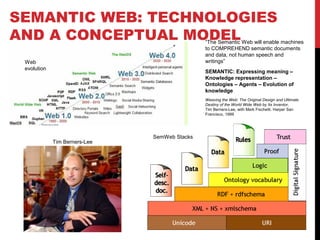
SEMANTIC WEB: TECHNOLOGIES 
AND A CONCEPTUAL MODEL 
Web 
evolution 
SemWeb Stacks 
Tim Berners-Lee 
“The Semantic Web will enable machines 
to COMPREHEND semantic documents 
and data, not human speech and 
writings” 
SEMANTIC: Expressing meaning – 
Knowledge representation – 
Ontologies – Agents – Evolution of 
knowledge 
Weaving the Web: The Original Design and Ultimate 
Destiny of the World Wide Web by Its Inventor. 
Tim Berners-Lee, with Mark Fischetti. Harper San 
Francisco, 1999
“LOD” - LINKED OPEN DATA - ROLE 
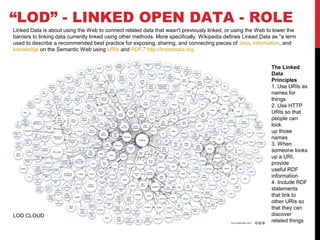
Linked Data is about using the Web to connect related data that wasn't previously linked, or using the Web to lower the 
barriers to linking data currently linked using other methods. More specifically, Wikipedia defines Linked Data as "a term 
used to describe a recommended best practice for exposing, sharing, and connecting pieces of data, information, and 
knowledge on the Semantic Web using URIs and RDF.” http://linkeddata.org 
LOD CLOUD 
The Linked 
Data 
Principles 
1. Use URIs as 
names for 
things 
2. Use HTTP 
URIs so that 
people can 
look 
up those 
names 
3. When 
someone looks 
up a URI, 
provide 
useful RDF 
information 
4. Include RDF 
statements 
that link to 
other URIs so 
that they can 
discover 
related things
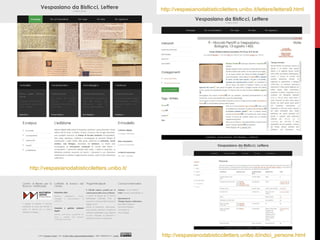
VESPASIANO, LETTERS 
A DIGITAL EDITION 
 A digital annotated (XML/TEI) collection of letters form the XV century 
sent/received to/by the florentine copyist Vespasiano da Bisticci. 
 A web environment that focuses on: persons mentioned in the 
documents; classical latin and greek manuscripts requested, copied, 
mentioned or proposed to/by Vespasiano da Bisticci’s school; 
descriptions of the manuscripts. 
 The purpose is to identify persons related to manuscripts in order to 
expose datasets of people related to manuscripts, these last 
described by technical words. 
 The XML/TEI annotation (persons, manuscripts and technical terms) 
has been realized with embedded markup (@ref=”URI”) pointing to 
stand-off RDF file (with assertion) and controlled form of the names 
(VIAF, LCA, Geonames, etc.) for managing attributes values. 
 The final aim is to expose the letters as Linked Open Data by using 
domain ontologies.
http://vespasianodabisticciletters.unibo.it/lettere/lettera9.html 
http://vespasianodabisticciletters.unibo.it/ 
http://vespasianodabisticciletters.unibo.it/indici_persone.html
A SAMPLE 
carta conservata nella Busta 85, ad vocem Vespasiano da Bisticci, Sez. 
Aut. Sec. xii-xviii, Raccolte Piancastelli, Biblioteca Comunale «A. Saffi», Forlì 
Clarissime atque 
eloquentissime Vir, post 
recomendatione premissa. 
Il Prinio e lla Decha sono di 
tutto finiti in buona forma, in 
modo credo vi piaceranno 
sommamente. Aregli 
arechati chostassù ma alla 
porta non mi arebbono 
lasciato venire. Mandate uno 
chon qualche panno da 
involgergli, 
che non si guastino. Meser 
Piero Strozi ha finite 
l’abreviationi e holle dato a 
Pipo <che> le minî, e subito 
si legaranno. Ad voi mi 
rachomando. 
In Firenze, adì 23 di giugno 
1458. 
Vespasiano di Filippo 
[a tergo] 
<Clariss>imo atque 
elo<quenti>ssimo viro Piero 
<di Chosi>mo de’ Medici, 
Ma<iori su>o honorando. 
We notice: persnames (Vespasiano di Filippo, Piero di Chosimo de’ Medici, Piero Strozi, Pipo), places (Firenze), dates (june 
23 1458), latin texts and authors (Prinio, Decha), technical lexicon (minî, legaranno). 
We understand that: Piero de’ Medici requested to Vespasiano laboratory a Pliny and the Decades and that the copy has 
been made before june 1458. We know also that Piero Strozzi finished the Epitomi and delivered the volume to Pipo, which is 
identifiable in Filippo Torelli, for the illumination and then the binding will be realized.
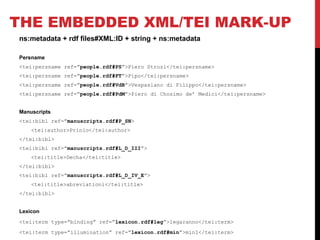
THE EMBEDDED XML/TEI MARK-UP 
ns:metadata + rdf files#XML:ID + string + ns:metadata 
Persname 
<tei:persname ref=”people.rdf#PS”>Piero Strozi</tei:persname> 
<tei:persname ref=”people.rdf#FT”>Pipo</tei:persname> 
<tei:persname ref=”people.rdf#VdB”>Vespasiano di Filippo</tei:persname> 
<tei:persname ref=”people.rdf#PdM”>Piero di Chosimo de’ Medici</tei:persname> 
Manuscripts 
<tei:bibl ref=”manuscripts.rdf#P_SN> 
<tei:author>Prinio</tei:author> 
</tei:bibl> 
<tei:bibl ref=”manuscripts.rdf#L_D_III”> 
<tei:title>Decha</tei:title> 
</tei:bibl> 
<tei:bibl ref=”manuscripts.rdf#L_D_IV_E”> 
<tei:title>abreviationi</tei:title> 
</tei:bibl> 
Lexicon 
<tei:term type=”binding” ref=”lexicon.rdf#leg”>legaranno</tei:term> 
<tei:term type=”illumination” ref=”lexicon.rdf#min”>minî</tei:term>
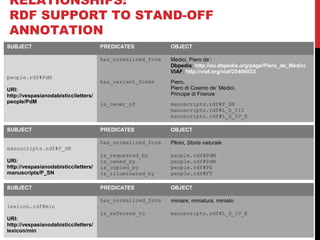
RELATIONSHIPS: 
RDF SUPPORT TO STAND-OFF 
ANNOTATION 
SUBJECT PREDICATES OBJECT 
people.rdf#PdM 
URI: 
http://vespasianodabisticciletters/ 
people/PdM 
has_normalized_form Medici, Piero de’: 
Dbpedia: http://eu.dbpedia.org/page/Piero_de_Medici 
VIAF: http://viaf.org/viaf/25406033 
has_variant_forms Piero, 
Piero di Cosimo de’ Medici, 
Principe di Firenze 
is_owner_of manuscripts.rdf#P_SN 
manuscripts.rdf#L_D_III 
manuscripts.rdf#L_D_IV_E 
SUBJECT PREDICATES OBJECT 
manuscripts.rdf#P_SN 
URI: 
http://vespasianodabisticciletters/ 
manuscripts/P_SN 
has_normalized_form Plinio, Storia naturale 
is_requested_by 
is_owned_by 
is_copied_by 
is_illuminated_by 
people.rdf#PdM 
people.rdf#PdM 
people.rdf#PS 
people.rdf#FT 
SUBJECT PREDICATES OBJECT 
lexicon.rdf#min 
URI: 
http://vespasianodabisticciletters/ 
lexicon/min 
has_normalized_form miniare, miniatura, miniato 
is_referred_to manuscripts.rdf#L_D_IV_E
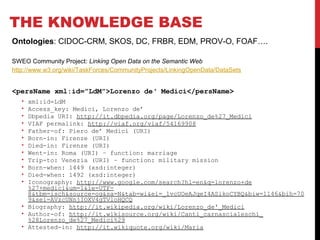
THE KNOWLEDGE BASE 
Ontologies: CIDOC-CRM, SKOS, DC, FRBR, EDM, PROV-O, FOAF…. 
SWEO Community Project: Linking Open Data on the Semantic Web 
http://www.w3.org/wiki/TaskForces/CommunityProjects/LinkingOpenData/DataSets 
<persName xml:id=”LdM”>Lorenzo de‘ Medici</persName> 
• xml:id=LdM 
• Access_key: Medici, Lorenzo de’ 
• Dbpedia URI: http://it.dbpedia.org/page/Lorenzo_de%27_Medici 
• VIAF permalink: http://viaf.org/viaf/54169908 
• Father-of: Piero de’ Medici (URI) 
• Born-in: Firenze (URI) 
• Died-in: Firenze (URI) 
• Went-in: Roma (URI) – function: marriage 
• Trip-to: Venezia (URI) – function: military mission 
• Born-when: 1449 (xsd:integer) 
• Died-when: 1492 (xsd:integer) 
• Iconography: http://www.google.com/search?hl=en&q=lorenzo+de 
%27+medici&um=1&ie=UTF- 
8&tbm=isch&source=og&sa=N&tab=wi&ei=_1vcUOeAJqeI4ASikoCYBQ&biw=1146&bih=70 
9&sei=AVzcUNnjIOXV4gTVloHQCQ 
• Biography: http://it.wikipedia.org/wiki/Lorenzo_de'_Medici 
• Author-of: http://it.wikisource.org/wiki/Canti_carnascialeschi_ 
%28Lorenzo_de%27_Medici%29 
• Attested-in: http://it.wikiquote.org/wiki/Maria
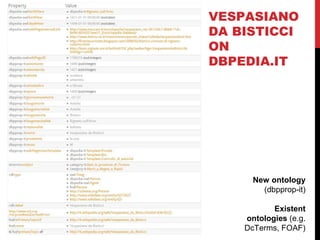
VESPASIANO 
DA BISTICCI 
ON 
DBPEDIA.IT 
New ontology 
(dbpprop-it) 
Existent 
ontologies (e.g. 
DcTerms, FOAF)
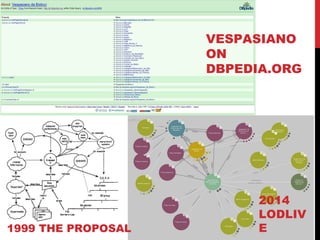
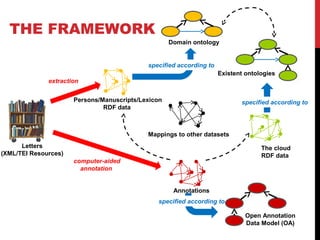
VESPASIANO 
ON 
DBPEDIA.ORG 
2014 
LODLIV 
1999 THE PROPOSAL E
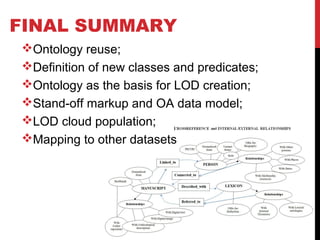
THE FRAMEWORK 
Letters 
(XML/TEI Resources) 
Persons/Manuscripts/Lexicon 
RDF data 
Annotations 
The cloud 
RDF data 
Domain ontology 
Existent ontologies 
extraction 
computer-aided 
annotation 
specified according to 
Open Annotation 
Data Model (OA) 
Mappings to other datasets
FINAL SUMMARY 
Ontology reuse; 
Definition of new classes and predicates; 
Ontology as the basis for LOD creation; 
Stand-off markup and OA data model; 
LOD cloud population; 
Mapping to other datasets
WORKS 
 Barbera M., Meschini F., Morbidoni C., Tomasi F. (2012). Annotating digital libraries and 
electronic editions in a collaborative and semantic perspective, in Proceedings of the 8th 
Italian Research Conference on Digital Libraries (IRCDL 2012) - Revised Selected 
Papers. Communications in Computer and Information Science (CCIS) 354, Heidelberg, 
Germany, Springer, pp. 45-56. 
 F. Tomasi (2012). Digital editions between embedded markup and external 
representation. A case study: Vespasiano da Bisticci's Letters, in Dall'Informatica 
umanistica alle culture digitali, a cura di G. Crupi, F. Ciotti. Quaderni Digilab. II, Sapienza 
Università Editrice, Roma, pp. 201-218. 
 F. Tomasi (2013). L'edizione digitale e la rappresentazione della conoscenza. Un 
esempio: Vespasiano da Bisticci e le sue lettere, «Ecdotica» 2012, 9, pp. 264-286. 
 F. Tomasi (2013). Le edizioni digitali come nuovo modello per dati d'autorità concettuali, 
«JLIS.it» 4.2 (2013). 
 F. Tomasi, F. Vitali (2013). DH-CASE 2013 - Collaborative Annotations in Shared 
Environments: Metadata, Vocabularies and Techniques in the Digital Humanities, New 
York, ACM, pp. 1-113. 
 F. Tomasi, F. Ciotti, M. Lana, F. Vitali, S. Peroni, D. Magro (2013). Dialogue and linking 
between TEI and other semantic models, in: The linked TEI: Text Encoding in the Web, 
Roma, DIGILAB Sapienza University & TEI Consortium, pp. 145 – 158. 
 F. Tomasi, F. Ciotti, M. Lana, F. Vitali, S. Peroni, D. Magro (2014). Methods and 
experiences in cultural heritage enhancement. LOD2014. Linked Open Data: where are 
we? Roma, Archivio Centrale dello Stato, Thursday 20th February 2014, 
http://www.w3c.it/events/2014/lod2014/program.html
GRAZIE! 
FRANCESCA 
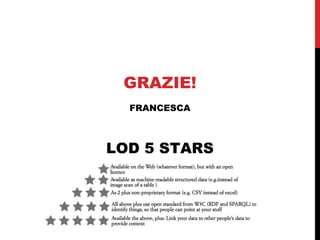
LOD 5 STARS

Le edizioni digitali nel solco del Web semantico. Un caso di studio: Vespasiano da Bisticci e le sue lettere

  • 1.
    STRUMENTI E APPLICAZIONI PER LA DIVULGAZIONE DEL PATRIMONIO LINGUISTICO E CULTURALE 23 aprile 2014, Università di Bologna 24 aprile 2014, Accademia della Crusca LE EDIZIONI DIGITALI NEL SOLCO DEL WEB SEMANTICO. UN CASO DI STUDIO: VESPASIANO DA BISTICCI E LE SUE LETTERE Francesca Tomasi Dipartimento di Filologia Classica e Italianistica [Dept. Of Classical Philology and Italian studies] University of Bologna
  • 2.
    DIGITAL (ELECTRONIC TEXTUAL) EDITING (SCHOLARSHIP)  Digital editing as a process: the model of the text; the relationships between textual elements; the extra-textual or trans-textual component (intertext, paratext, metatext, ipertext, architext).  Diplomatic/normalized edition – single witness:  transcription (e.g. forms of letters, punctuation, capitalization, structure, abbreviations, corrections and emendations);  internal relationships (e.g. a person and an event; a place and a date);  comment – external relationships (harvesting re-sources).  Levels of hermeneutical approach: Annotation=Markup. Embedded XML/TEI markup Latent relationships=context/domain. Linked network The dialogue. From text to the Web. Against silos…
  • 3.
    SEMANTIC WEB: TECHNOLOGIES AND A CONCEPTUAL MODEL Web evolution SemWeb Stacks Tim Berners-Lee “The Semantic Web will enable machines to COMPREHEND semantic documents and data, not human speech and writings” SEMANTIC: Expressing meaning – Knowledge representation – Ontologies – Agents – Evolution of knowledge Weaving the Web: The Original Design and Ultimate Destiny of the World Wide Web by Its Inventor. Tim Berners-Lee, with Mark Fischetti. Harper San Francisco, 1999
  • 4.
    “LOD” - LINKEDOPEN DATA - ROLE Linked Data is about using the Web to connect related data that wasn't previously linked, or using the Web to lower the barriers to linking data currently linked using other methods. More specifically, Wikipedia defines Linked Data as "a term used to describe a recommended best practice for exposing, sharing, and connecting pieces of data, information, and knowledge on the Semantic Web using URIs and RDF.” http://linkeddata.org LOD CLOUD The Linked Data Principles 1. Use URIs as names for things 2. Use HTTP URIs so that people can look up those names 3. When someone looks up a URI, provide useful RDF information 4. Include RDF statements that link to other URIs so that they can discover related things
  • 5.
    VESPASIANO, LETTERS ADIGITAL EDITION  A digital annotated (XML/TEI) collection of letters form the XV century sent/received to/by the florentine copyist Vespasiano da Bisticci.  A web environment that focuses on: persons mentioned in the documents; classical latin and greek manuscripts requested, copied, mentioned or proposed to/by Vespasiano da Bisticci’s school; descriptions of the manuscripts.  The purpose is to identify persons related to manuscripts in order to expose datasets of people related to manuscripts, these last described by technical words.  The XML/TEI annotation (persons, manuscripts and technical terms) has been realized with embedded markup (@ref=”URI”) pointing to stand-off RDF file (with assertion) and controlled form of the names (VIAF, LCA, Geonames, etc.) for managing attributes values.  The final aim is to expose the letters as Linked Open Data by using domain ontologies.
  • 6.
  • 7.
    A SAMPLE cartaconservata nella Busta 85, ad vocem Vespasiano da Bisticci, Sez. Aut. Sec. xii-xviii, Raccolte Piancastelli, Biblioteca Comunale «A. Saffi», Forlì Clarissime atque eloquentissime Vir, post recomendatione premissa. Il Prinio e lla Decha sono di tutto finiti in buona forma, in modo credo vi piaceranno sommamente. Aregli arechati chostassù ma alla porta non mi arebbono lasciato venire. Mandate uno chon qualche panno da involgergli, che non si guastino. Meser Piero Strozi ha finite l’abreviationi e holle dato a Pipo <che> le minî, e subito si legaranno. Ad voi mi rachomando. In Firenze, adì 23 di giugno 1458. Vespasiano di Filippo [a tergo] <Clariss>imo atque elo<quenti>ssimo viro Piero <di Chosi>mo de’ Medici, Ma<iori su>o honorando. We notice: persnames (Vespasiano di Filippo, Piero di Chosimo de’ Medici, Piero Strozi, Pipo), places (Firenze), dates (june 23 1458), latin texts and authors (Prinio, Decha), technical lexicon (minî, legaranno). We understand that: Piero de’ Medici requested to Vespasiano laboratory a Pliny and the Decades and that the copy has been made before june 1458. We know also that Piero Strozzi finished the Epitomi and delivered the volume to Pipo, which is identifiable in Filippo Torelli, for the illumination and then the binding will be realized.
  • 8.
    THE EMBEDDED XML/TEIMARK-UP ns:metadata + rdf files#XML:ID + string + ns:metadata Persname <tei:persname ref=”people.rdf#PS”>Piero Strozi</tei:persname> <tei:persname ref=”people.rdf#FT”>Pipo</tei:persname> <tei:persname ref=”people.rdf#VdB”>Vespasiano di Filippo</tei:persname> <tei:persname ref=”people.rdf#PdM”>Piero di Chosimo de’ Medici</tei:persname> Manuscripts <tei:bibl ref=”manuscripts.rdf#P_SN> <tei:author>Prinio</tei:author> </tei:bibl> <tei:bibl ref=”manuscripts.rdf#L_D_III”> <tei:title>Decha</tei:title> </tei:bibl> <tei:bibl ref=”manuscripts.rdf#L_D_IV_E”> <tei:title>abreviationi</tei:title> </tei:bibl> Lexicon <tei:term type=”binding” ref=”lexicon.rdf#leg”>legaranno</tei:term> <tei:term type=”illumination” ref=”lexicon.rdf#min”>minî</tei:term>
  • 9.
    RELATIONSHIPS: RDF SUPPORTTO STAND-OFF ANNOTATION SUBJECT PREDICATES OBJECT people.rdf#PdM URI: http://vespasianodabisticciletters/ people/PdM has_normalized_form Medici, Piero de’: Dbpedia: http://eu.dbpedia.org/page/Piero_de_Medici VIAF: http://viaf.org/viaf/25406033 has_variant_forms Piero, Piero di Cosimo de’ Medici, Principe di Firenze is_owner_of manuscripts.rdf#P_SN manuscripts.rdf#L_D_III manuscripts.rdf#L_D_IV_E SUBJECT PREDICATES OBJECT manuscripts.rdf#P_SN URI: http://vespasianodabisticciletters/ manuscripts/P_SN has_normalized_form Plinio, Storia naturale is_requested_by is_owned_by is_copied_by is_illuminated_by people.rdf#PdM people.rdf#PdM people.rdf#PS people.rdf#FT SUBJECT PREDICATES OBJECT lexicon.rdf#min URI: http://vespasianodabisticciletters/ lexicon/min has_normalized_form miniare, miniatura, miniato is_referred_to manuscripts.rdf#L_D_IV_E
  • 10.
    THE KNOWLEDGE BASE Ontologies: CIDOC-CRM, SKOS, DC, FRBR, EDM, PROV-O, FOAF…. SWEO Community Project: Linking Open Data on the Semantic Web http://www.w3.org/wiki/TaskForces/CommunityProjects/LinkingOpenData/DataSets <persName xml:id=”LdM”>Lorenzo de‘ Medici</persName> • xml:id=LdM • Access_key: Medici, Lorenzo de’ • Dbpedia URI: http://it.dbpedia.org/page/Lorenzo_de%27_Medici • VIAF permalink: http://viaf.org/viaf/54169908 • Father-of: Piero de’ Medici (URI) • Born-in: Firenze (URI) • Died-in: Firenze (URI) • Went-in: Roma (URI) – function: marriage • Trip-to: Venezia (URI) – function: military mission • Born-when: 1449 (xsd:integer) • Died-when: 1492 (xsd:integer) • Iconography: http://www.google.com/search?hl=en&q=lorenzo+de %27+medici&um=1&ie=UTF- 8&tbm=isch&source=og&sa=N&tab=wi&ei=_1vcUOeAJqeI4ASikoCYBQ&biw=1146&bih=70 9&sei=AVzcUNnjIOXV4gTVloHQCQ • Biography: http://it.wikipedia.org/wiki/Lorenzo_de'_Medici • Author-of: http://it.wikisource.org/wiki/Canti_carnascialeschi_ %28Lorenzo_de%27_Medici%29 • Attested-in: http://it.wikiquote.org/wiki/Maria
  • 11.
    VESPASIANO DA BISTICCI ON DBPEDIA.IT New ontology (dbpprop-it) Existent ontologies (e.g. DcTerms, FOAF)
  • 12.
    VESPASIANO ON DBPEDIA.ORG 2014 LODLIV 1999 THE PROPOSAL E
  • 13.
    THE FRAMEWORK Letters (XML/TEI Resources) Persons/Manuscripts/Lexicon RDF data Annotations The cloud RDF data Domain ontology Existent ontologies extraction computer-aided annotation specified according to specified according to specified according to Open Annotation Data Model (OA) Mappings to other datasets
  • 14.
    FINAL SUMMARY Ontologyreuse; Definition of new classes and predicates; Ontology as the basis for LOD creation; Stand-off markup and OA data model; LOD cloud population; Mapping to other datasets
  • 15.
    WORKS  BarberaM., Meschini F., Morbidoni C., Tomasi F. (2012). Annotating digital libraries and electronic editions in a collaborative and semantic perspective, in Proceedings of the 8th Italian Research Conference on Digital Libraries (IRCDL 2012) - Revised Selected Papers. Communications in Computer and Information Science (CCIS) 354, Heidelberg, Germany, Springer, pp. 45-56.  F. Tomasi (2012). Digital editions between embedded markup and external representation. A case study: Vespasiano da Bisticci's Letters, in Dall'Informatica umanistica alle culture digitali, a cura di G. Crupi, F. Ciotti. Quaderni Digilab. II, Sapienza Università Editrice, Roma, pp. 201-218.  F. Tomasi (2013). L'edizione digitale e la rappresentazione della conoscenza. Un esempio: Vespasiano da Bisticci e le sue lettere, «Ecdotica» 2012, 9, pp. 264-286.  F. Tomasi (2013). Le edizioni digitali come nuovo modello per dati d'autorità concettuali, «JLIS.it» 4.2 (2013).  F. Tomasi, F. Vitali (2013). DH-CASE 2013 - Collaborative Annotations in Shared Environments: Metadata, Vocabularies and Techniques in the Digital Humanities, New York, ACM, pp. 1-113.  F. Tomasi, F. Ciotti, M. Lana, F. Vitali, S. Peroni, D. Magro (2013). Dialogue and linking between TEI and other semantic models, in: The linked TEI: Text Encoding in the Web, Roma, DIGILAB Sapienza University & TEI Consortium, pp. 145 – 158.  F. Tomasi, F. Ciotti, M. Lana, F. Vitali, S. Peroni, D. Magro (2014). Methods and experiences in cultural heritage enhancement. LOD2014. Linked Open Data: where are we? Roma, Archivio Centrale dello Stato, Thursday 20th February 2014, http://www.w3c.it/events/2014/lod2014/program.html
  • 16.