2
Arbitrage with Payouts
Therecan be different types of payouts for
different securities and commodities. Positive
payouts can be there for financial assets, such
as dividends, and negative payouts such as
storage costs, insurance, spoilage etc. for
commodities
t t1 T
Enter Futures Payout of C1 Futures Expires
3.
3
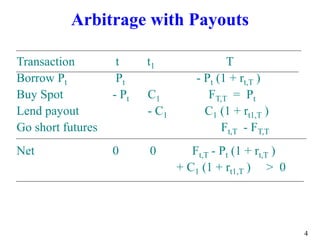
Arbitrage with Payouts
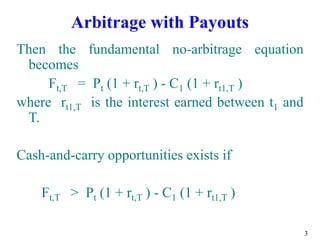
Thenthe fundamental no-arbitrage equation
becomes
Ft,T = Pt (1 + rt,T ) - C1 (1 + rt1,T )
where rt1,T is the interest earned between t1 and
T.
Cash-and-carry opportunities exists if
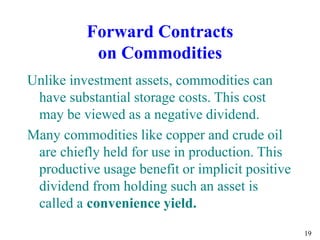
Ft,T > Pt (1 + rt,T ) - C1 (1 + rt1,T )
5
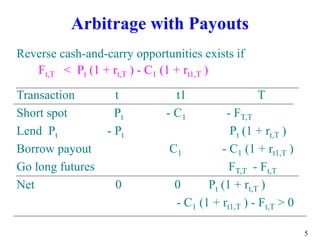
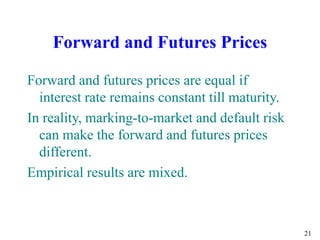
Arbitrage with Payouts
Reversecash-and-carry opportunities exists if
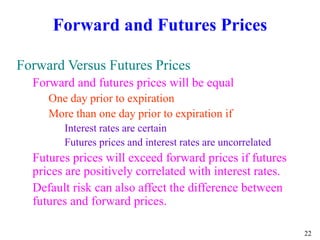
Ft,T < Pt (1 + rt,T ) - C1 (1 + rt1,T )
Transaction t t1 T
Short spot Pt - C1 - FT,T
Lend Pt - Pt Pt (1 + rt,T )
Borrow payout C1 - C1 (1 + rt1,T )
Go long futures FT,T - Ft,T
Net 0 0 Pt (1 + rt,T )
- C1 (1 + rt1,T ) - Ft,T > 0
6.
6
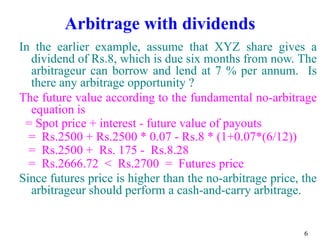
Arbitrage with dividends
Inthe earlier example, assume that XYZ share gives a
dividend of Rs.8, which is due six months from now. The
arbitrageur can borrow and lend at 7 % per annum. Is
there any arbitrage opportunity ?
The future value according to the fundamental no-arbitrage
equation is
= Spot price + interest - future value of payouts
= Rs.2500 + Rs.2500 * 0.07 - Rs.8 * (1+0.07*(6/12))
= Rs.2500 + Rs. 175 - Rs.8.28
= Rs.2666.72 < Rs.2700 = Futures price
Since futures price is higher than the no-arbitrage price, the
arbitrageur should perform a cash-and-carry arbitrage.
7.
7
Transaction Costs andArbitrage
Bid-Ask Spreads
Margins and Short-Selling Costs
Differential Borrowing and Lending Rates
Transaction Fees
8.
8
Cash-and-Carry and Reverse
Cash-and-CarryArbitrage
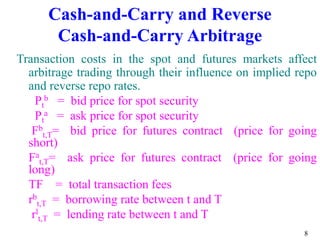
Transaction costs in the spot and futures markets affect
arbitrage trading through their influence on implied repo
and reverse repo rates.
Pt
b = bid price for spot security
Pt
a = ask price for spot security
Fb
t,T= bid price for futures contract (price for going
short)
Fa
t,T= ask price for futures contract (price for going
long)
TF = total transaction fees
rb
t,T = borrowing rate between t and T
rl
t,T = lending rate between t and T
9.
9
Cash-and-Carry and Reverse
Cash-and-CarryArbitrage
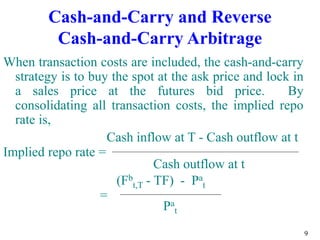
When transaction costs are included, the cash-and-carry
strategy is to buy the spot at the ask price and lock in
a sales price at the futures bid price. By
consolidating all transaction costs, the implied repo
rate is,
Cash inflow at T - Cash outflow at t
Implied repo rate =
Cash outflow at t
(Fb
t,T - TF) - Pa
t
=
Pa
t
10.
10
Cash-and-Carry and Reverse
Cash-and-CarryArbitrage
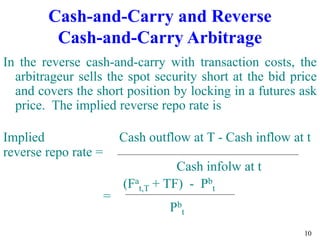
In the reverse cash-and-carry with transaction costs, the
arbitrageur sells the spot security short at the bid price
and covers the short position by locking in a futures ask
price. The implied reverse repo rate is
Implied Cash outflow at T - Cash inflow at t
reverse repo rate =
Cash infolw at t
(Fa
t,T + TF) - Pb
t
=
Pb
t
11.
11
Cash-and-Carry and Reverse
Cash-and-CarryArbitrage
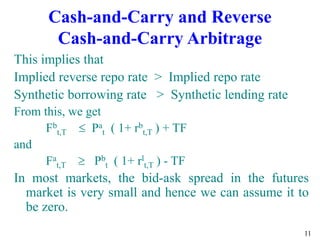
This implies that
Implied reverse repo rate > Implied repo rate
Synthetic borrowing rate > Synthetic lending rate
From this, we get
Fb
t,T Pa
t ( 1+ rb
t,T ) + TF
and
Fa
t,T Pb
t ( 1+ rl
t,T ) - TF
In most markets, the bid-ask spread in the futures
market is very small and hence we can assume it to
be zero.
12.
12
Cash-and-Carry and Reverse
Cash-and-CarryArbitrage
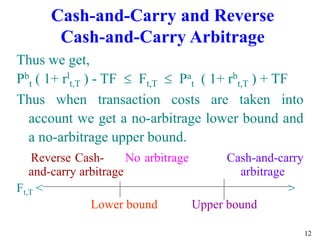
Thus we get,
Pb
t ( 1+ rl
t,T ) - TF Ft,T Pa
t ( 1+ rb
t,T ) + TF
Thus when transaction costs are taken into
account we get a no-arbitrage lower bound and
a no-arbitrage upper bound.
Reverse Cash- No arbitrage Cash-and-carry
and-carry arbitrage arbitrage
Ft,T < >
Lower bound Upper bound
13.
13
Example
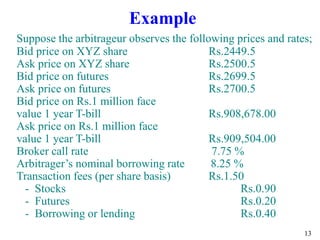
Suppose the arbitrageurobserves the following prices and rates;
Bid price on XYZ share Rs.2449.5
Ask price on XYZ share Rs.2500.5
Bid price on futures Rs.2699.5
Ask price on futures Rs.2700.5
Bid price on Rs.1 million face
value 1 year T-bill Rs.908,678.00
Ask price on Rs.1 million face
value 1 year T-bill Rs.909,504.00
Broker call rate 7.75 %
Arbitrager’s nominal borrowing rate 8.25 %
Transaction fees (per share basis) Rs.1.50
- Stocks Rs.0.90
- Futures Rs.0.20
- Borrowing or lending Rs.0.40
14.
14
Example
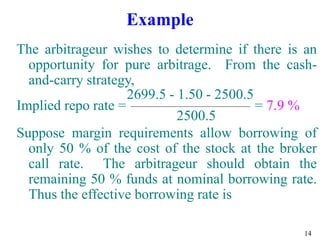
The arbitrageur wishesto determine if there is an
opportunity for pure arbitrage. From the cash-
and-carry strategy,
2699.5 - 1.50 - 2500.5
Implied repo rate = = 7.9 %
2500.5
Suppose margin requirements allow borrowing of
only 50 % of the cost of the stock at the broker
call rate. The arbitrageur should obtain the
remaining 50 % funds at nominal borrowing rate.
Thus the effective borrowing rate is
15.
15
Example
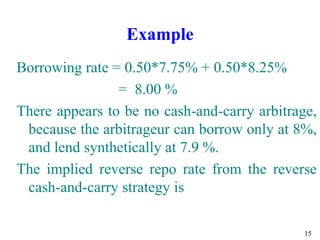
Borrowing rate =0.50*7.75% + 0.50*8.25%
= 8.00 %
There appears to be no cash-and-carry arbitrage,
because the arbitrageur can borrow only at 8%,
and lend synthetically at 7.9 %.
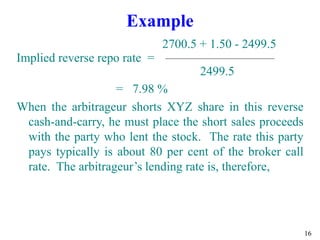
The implied reverse repo rate from the reverse
cash-and-carry strategy is
16.
16
Example
2700.5 + 1.50- 2499.5
Implied reverse repo rate =
2499.5
= 7.98 %
When the arbitrageur shorts XYZ share in this reverse
cash-and-carry, he must place the short sales proceeds
with the party who lent the stock. The rate this party
pays typically is about 80 per cent of the broker call
rate. The arbitrageur’s lending rate is, therefore,
17.
17
Cash-and-Carry and Reverse
Cash-and-CarryArbitrage
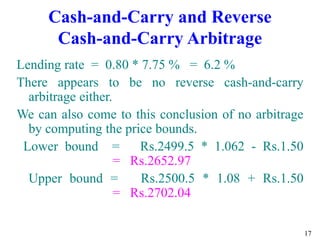
Lending rate = 0.80 * 7.75 % = 6.2 %
There appears to be no reverse cash-and-carry
arbitrage either.
We can also come to this conclusion of no arbitrage
by computing the price bounds.
Lower bound = Rs.2499.5 * 1.062 - Rs.1.50
= Rs.2652.97
Upper bound = Rs.2500.5 * 1.08 + Rs.1.50
= Rs.2702.04
18.
18
Value of aForward Contract
That Began Earlier
At start, value of a forward, V0 = 0
At maturity, value of a forward to Long is
VT = [PT – F0,T] and opposite to Short. Long
gains, Short loses if spot soars.
At intermediate date t, value of a forward to
Long is Vt = present value of [PT – F0,T]
= Pt – F0,T / (1+r t,T)
19.
19
Forward Contracts
on Commodities
Unlikeinvestment assets, commodities can
have substantial storage costs. This cost
may be viewed as a negative dividend.
Many commodities like copper and crude oil
are chiefly held for use in production. This
productive usage benefit or implicit positive
dividend from holding such an asset is
called a convenience yield.
20.
20
Cost-of-Carry with StorageCosts
and Convenience Yields
When storage costs (G) and convenience
yields [Y 0,T ] are included (paid upfront in
our formula), then cash-and-carry is better
described as cost-of-carry relationship.
At time 0, cost-of-carry gives
F0,T = [P0+ G – Y 0,T ] (1 + i T)
21.
21
Forward and FuturesPrices
Forward and futures prices are equal if
interest rate remains constant till maturity.
In reality, marking-to-market and default risk
can make the forward and futures prices
different.
Empirical results are mixed.
22.
22
Forward and FuturesPrices
Forward Versus Futures Prices
Forward and futures prices will be equal
One day prior to expiration
More than one day prior to expiration if
Interest rates are certain
Futures prices and interest rates are uncorrelated
Futures prices will exceed forward prices if futures
prices are positively correlated with interest rates.
Default risk can also affect the difference between
futures and forward prices.
23.
23
Conclusion
Forwards and futuresare similar contracts
except for some institutional features.
A forward price can be easily determined
from the spot by cash-and-carry and cost-
of-carry relationships.
“No-arbitrage” principle also helped to value
a contract that began earlier and exploit an
arbitrage opportunity.
25
Option contract: givesthe owner the right to
buy or sell a fixed number of shares of stock
at a specified price over a limited time.
Call
Put
Options
26.
26
1800s or earlier
1900sPut and Call Brokers and Dealers
Association created an options market.
1973, The Chicago Board of Trade, organized
an exchange exclusively for trading options
on stocks, namely Chicago Board Options
Exchange (CBOE).
It opened its doors for call option trading on
April 26, 1973, and the first puts were added
in June 1977.
History
27.
27
Option buyer, optionholder or long
Option seller, option writer, or short
Option price, option premium or just premium
Exercise price, strike price, striking price, or
strike.
Exercise or exercising the option.
Expiration date
Time to expiration.
Expire worthless
Option Terminologies
28.
28
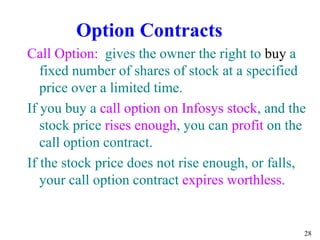
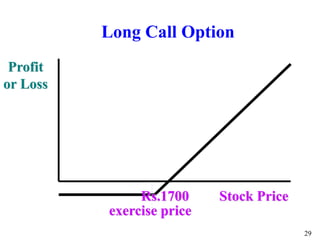
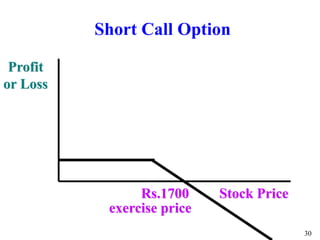
Call Option: givesthe owner the right to buy a
fixed number of shares of stock at a specified
price over a limited time.
If you buy a call option on Infosys stock, and the
stock price rises enough, you can profit on the
call option contract.
If the stock price does not rise enough, or falls,
your call option contract expires worthless.
Option Contracts
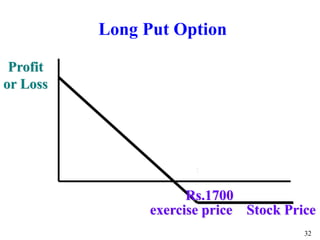
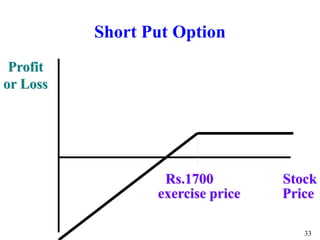
31
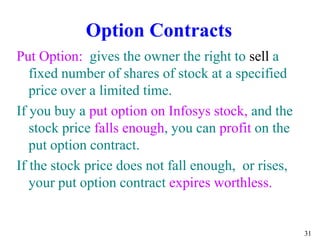
Put Option: givesthe owner the right to sell a
fixed number of shares of stock at a specified
price over a limited time.
If you buy a put option on Infosys stock, and the
stock price falls enough, you can profit on the
put option contract.
If the stock price does not fall enough, or rises,
your put option contract expires worthless.
Option Contracts
34
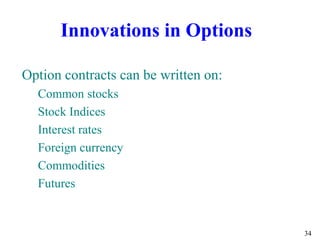
Option contracts canbe written on:
Common stocks
Stock Indices
Interest rates
Foreign currency
Commodities
Futures
Innovations in Options
35.
35
Reducing Risk WithOptions
Example - Omex sells crude oil. Since its
costs are relatively fixed, fluctuations in the
sale price of crude oil can cause unexpected
profits or losses.
How might Omex hedge this risk?
36.
36
Reducing Risk WithOptions
Example - Omex sells crude oil. Since its
costs are relatively fixed, fluctuations in the
sale price of crude oil can cause unexpected
profits or losses.
How might Omex hedge this risk?
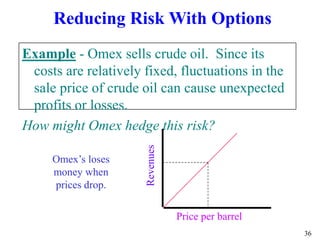
Price per barrel
Omex’s loses
money when
prices drop.
Revenues
37.
37
Reducing Risk WithOptions
Example - Omex sells crude oil. Since its
costs are relatively fixed, fluctuations in the
sale price of crude oil can cause unexpected
profits or losses.
How might Omex hedge this risk?
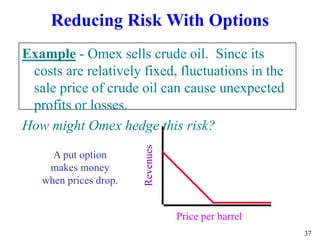
Price per barrel
A put option
makes money
when prices drop.
Revenues
38.
38
Reducing Risk WithOptions
Example - Omex sells crude oil. Since its
costs are relatively fixed, fluctuations in the
sale price of crude oil can cause unexpected
profits or losses.
How might Omex hedge this risk?
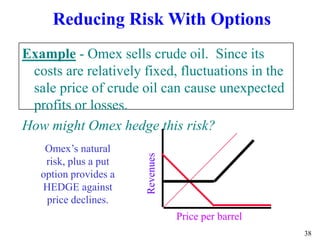
Price per barrel
Omex’s natural
risk, plus a put
option provides a
HEDGE against
price declines.
Revenues

![18
Value of a Forward Contract
That Began Earlier
At start, value of a forward, V0 = 0
At maturity, value of a forward to Long is
VT = [PT – F0,T] and opposite to Short. Long
gains, Short loses if spot soars.
At intermediate date t, value of a forward to
Long is Vt = present value of [PT – F0,T]
= Pt – F0,T / (1+r t,T)](https://image.slidesharecdn.com/drm05-250730182055-dd5aa29b/85/veru-knowledgable-slides-on-derivatives-18-320.jpg)
![20
Cost-of-Carry with Storage Costs
and Convenience Yields
When storage costs (G) and convenience
yields [Y 0,T ] are included (paid upfront in
our formula), then cash-and-carry is better
described as cost-of-carry relationship.
At time 0, cost-of-carry gives
F0,T = [P0+ G – Y 0,T ] (1 + i T)](https://image.slidesharecdn.com/drm05-250730182055-dd5aa29b/85/veru-knowledgable-slides-on-derivatives-20-320.jpg)


![Derivatives.ppt [autosaved]](https://cdn.slidesharecdn.com/ss_thumbnails/derivatives-pptautosaved-121028072053-phpapp02-thumbnail.jpg?width=640&height=640&fit=bounds)


