MOISES ROMERO ROMO (266567)
JAYASURYA A S (267412)
1
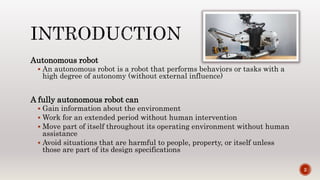
Autonomous robot
 An autonomous robot is a robot that performs behaviors or tasks with a
high degree of autonomy (without external influence)
A fully autonomous robot can
 Gain information about the environment
 Work for an extended period without human intervention
 Move part of itself throughout its operating environment without human
assistance
 Avoid situations that are harmful to people, property, or itself unless
those are part of its design specifications
2
3
4
 To be sure that the autonomous system
perform well in real world.
 To be sure that there is not any type of
failures in the system.
 To prove the system in all possible
scenarios.
 To claim insurance.
 To decide wheter we can deploy our
model on real world or not.
5
 Formal verification
 Model checking
 Theorem proving (logical inference)
 Runtime monitoring
 Integrated formal methods
 Frameworks for verifiable robotic software
 Single path
 Random Path
6
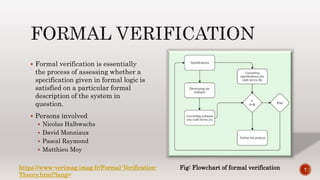
 Formal verification is essentially
the process of assessing whether a
specification given in formal logic is
satisfied on a particular formal
description of the system in
question.
 Persons involved
 Nicolas Halbwachs
 David Monniaux
 Pascal Raymond
 Matthieu Moy
7Fig: Flowchart of formal verificationhttps://www-verimag.imag.fr/Formal-Verification-
Theory.html?lang=
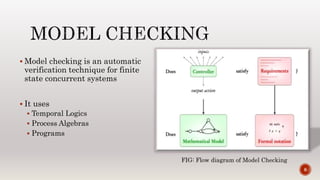
 Model checking is an automatic
verification technique for finite
state concurrent systems
 It uses
 Temporal Logics
 Process Algebras
 Programs
8
FIG: Flow diagram of Model Checking
Advantage
 Fast
 No problem with partial
specifications
 Logics can easily express many
concurrency properties
Disadvantage
 Too many processes
 Data Paths
9
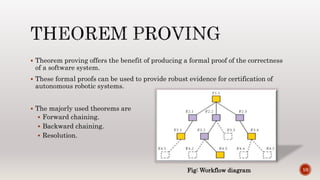
 Theorem proving offers the benefit of producing a formal proof of the correctness
of a software system.
 These formal proofs can be used to provide robust evidence for certification of
autonomous robotic systems.
 The majorly used theorems are
 Forward chaining.
 Backward chaining.
 Resolution.
10Fig: Workflow diagram
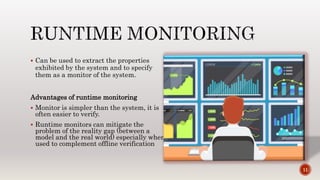
 Can be used to extract the properties
exhibited by the system and to specify
them as a monitor of the system.
Advantages of runtime monitoring
 Monitor is simpler than the system, it is
often easier to verify.
 Runtime monitors can mitigate the
problem of the reality gap (between a
model and the real world) especially when
used to complement offline verification
11
 Can capture several dimensions of a
system at once (e.g., static and
dynamic behavior) for easy analysis
CHALLENGES
 Often best tackled using iFMs.
Examples
 FSP and πADL
 UML-RT and CSP+T
12
 These frameworks often encompass a
number of the techniques already
described but frequently, they
incorporate bespoke tools and
formalisms.
Advantage of using frameworks
 Facilitate the use of multiple verification
techniques.
 But is not usually apply more than one of
previous techniques in practice.
13
 MODELLING REAL-TIME
SOFTWARE
 C/C++ FUNCTIONS.
 MODELS CAN BE VERFIIED
USING D-FINDER TOOL
14
[1]
 VERIFYING TEMPORAL
PROPERTIES OF PROGRAMS.
 CAN OUTPUT VERILOG AND C
CODE
15
[1]
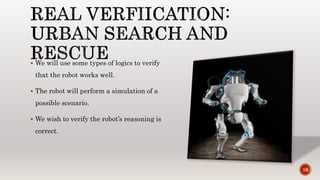
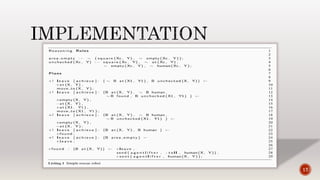
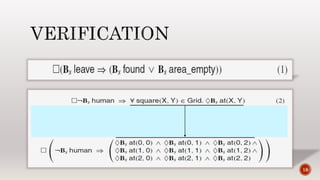
 We will use some types of logics to verify
that the robot works well.
 The robot will perform a simulation of a
possible scenario.
 We wish to verify the robot’s reasoning is
correct.
16
17
18
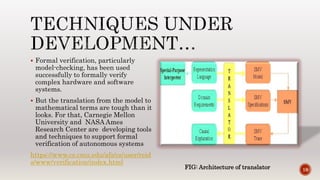
 Formal verification, particularly
model-checking, has been used
successfully to formally verify
complex hardware and software
systems.
 But the translation from the model to
mathematical terms are tough than it
looks. For that, Carnegie Mellon
University and NASA Ames
Research Center are developing tools
and techniques to support formal
verification of autonomous systems
https://www.cs.cmu.edu/afs/cs/user/reid
s/www/verification/index.html
19FIG: Architecture of translator
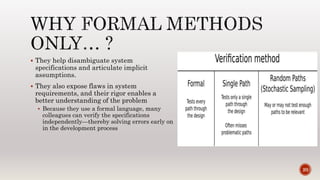
 They help disambiguate system
specifications and articulate implicit
assumptions.
 They also expose flaws in system
requirements, and their rigor enables a
better understanding of the problem
 Because they use a formal language, many
colleagues can verify the specifications
independently—thereby solving errors early on
in the development process
20
 The previous section discussed the formal verification approaches. The most
popular approach is model checking, it is easy for developers to understand and it
is automatic and conceptually similar to exhaustive testing.
 Frameworks are the next most popular approach.
 iFMs are necessary in the verification of robotic systems due to their size and
complexity.
 However, it is not clear, in practice, just how effective these in-built verification
tools are.
21
1. Matt Luckcuck, Marie Farrell, Louise A. Dennis, Clare Dixon, Michael Fisher: Formal
Specification and Verification of Autonomous Robotic Systems.
https://arxiv.org/abs/1807.00048
2. Louise Dennis , Michael Fisher, Marija Slavkovik, Matt Webstera: Formal verification of
ethical choices in autonomous systems.
https://www.sciencedirect.com/science/article/pii/S0921889015003000
3. Louise A. Dennis, Michael Fisher, Nicholas K. Lincoln, Alexei Lisitsa, Sandor M. Veres:
Practical verification of decision-making in agent-based autonomous systems.
https://link.springer.com/article/10.1007/s10515-014-0168-9
4. Félix Ingrand: Recent Trends in Formal Validation and Verification of Autonomous Robots
Software. https://hal.laas.fr/hal-01968265
5. John-Jules Ch. Meyer, Jan Broersen and Andreas Herzig: BDI Logics.
https://www.irit.fr/~Andreas.Herzig/P/HandbkEpi15_chap10.pdf
22
 Techniques under development
https://www.cs.cmu.edu/afs/cs/user/reids/www/verification/index.html
 Formal verification methods https://www-verimag.imag.fr/Formal-Verification-
Theory.html?lang=
23
24

verification of autonomous robotic system

  • 1.
    MOISES ROMERO ROMO(266567) JAYASURYA A S (267412) 1
  • 2.
    Autonomous robot  Anautonomous robot is a robot that performs behaviors or tasks with a high degree of autonomy (without external influence) A fully autonomous robot can  Gain information about the environment  Work for an extended period without human intervention  Move part of itself throughout its operating environment without human assistance  Avoid situations that are harmful to people, property, or itself unless those are part of its design specifications 2
  • 3.
  • 4.
  • 5.
     To besure that the autonomous system perform well in real world.  To be sure that there is not any type of failures in the system.  To prove the system in all possible scenarios.  To claim insurance.  To decide wheter we can deploy our model on real world or not. 5
  • 6.
     Formal verification Model checking  Theorem proving (logical inference)  Runtime monitoring  Integrated formal methods  Frameworks for verifiable robotic software  Single path  Random Path 6
  • 7.
     Formal verificationis essentially the process of assessing whether a specification given in formal logic is satisfied on a particular formal description of the system in question.  Persons involved  Nicolas Halbwachs  David Monniaux  Pascal Raymond  Matthieu Moy 7Fig: Flowchart of formal verificationhttps://www-verimag.imag.fr/Formal-Verification- Theory.html?lang=
  • 8.
     Model checkingis an automatic verification technique for finite state concurrent systems  It uses  Temporal Logics  Process Algebras  Programs 8 FIG: Flow diagram of Model Checking
  • 9.
    Advantage  Fast  Noproblem with partial specifications  Logics can easily express many concurrency properties Disadvantage  Too many processes  Data Paths 9
  • 10.
     Theorem provingoffers the benefit of producing a formal proof of the correctness of a software system.  These formal proofs can be used to provide robust evidence for certification of autonomous robotic systems.  The majorly used theorems are  Forward chaining.  Backward chaining.  Resolution. 10Fig: Workflow diagram
  • 11.
     Can beused to extract the properties exhibited by the system and to specify them as a monitor of the system. Advantages of runtime monitoring  Monitor is simpler than the system, it is often easier to verify.  Runtime monitors can mitigate the problem of the reality gap (between a model and the real world) especially when used to complement offline verification 11
  • 12.
     Can captureseveral dimensions of a system at once (e.g., static and dynamic behavior) for easy analysis CHALLENGES  Often best tackled using iFMs. Examples  FSP and πADL  UML-RT and CSP+T 12
  • 13.
     These frameworksoften encompass a number of the techniques already described but frequently, they incorporate bespoke tools and formalisms. Advantage of using frameworks  Facilitate the use of multiple verification techniques.  But is not usually apply more than one of previous techniques in practice. 13
  • 14.
     MODELLING REAL-TIME SOFTWARE C/C++ FUNCTIONS.  MODELS CAN BE VERFIIED USING D-FINDER TOOL 14 [1]
  • 15.
     VERIFYING TEMPORAL PROPERTIESOF PROGRAMS.  CAN OUTPUT VERILOG AND C CODE 15 [1]
  • 16.
     We willuse some types of logics to verify that the robot works well.  The robot will perform a simulation of a possible scenario.  We wish to verify the robot’s reasoning is correct. 16
  • 17.
  • 18.
  • 19.
     Formal verification,particularly model-checking, has been used successfully to formally verify complex hardware and software systems.  But the translation from the model to mathematical terms are tough than it looks. For that, Carnegie Mellon University and NASA Ames Research Center are developing tools and techniques to support formal verification of autonomous systems https://www.cs.cmu.edu/afs/cs/user/reid s/www/verification/index.html 19FIG: Architecture of translator
  • 20.
     They helpdisambiguate system specifications and articulate implicit assumptions.  They also expose flaws in system requirements, and their rigor enables a better understanding of the problem  Because they use a formal language, many colleagues can verify the specifications independently—thereby solving errors early on in the development process 20
  • 21.
     The previoussection discussed the formal verification approaches. The most popular approach is model checking, it is easy for developers to understand and it is automatic and conceptually similar to exhaustive testing.  Frameworks are the next most popular approach.  iFMs are necessary in the verification of robotic systems due to their size and complexity.  However, it is not clear, in practice, just how effective these in-built verification tools are. 21
  • 22.
    1. Matt Luckcuck,Marie Farrell, Louise A. Dennis, Clare Dixon, Michael Fisher: Formal Specification and Verification of Autonomous Robotic Systems. https://arxiv.org/abs/1807.00048 2. Louise Dennis , Michael Fisher, Marija Slavkovik, Matt Webstera: Formal verification of ethical choices in autonomous systems. https://www.sciencedirect.com/science/article/pii/S0921889015003000 3. Louise A. Dennis, Michael Fisher, Nicholas K. Lincoln, Alexei Lisitsa, Sandor M. Veres: Practical verification of decision-making in agent-based autonomous systems. https://link.springer.com/article/10.1007/s10515-014-0168-9 4. Félix Ingrand: Recent Trends in Formal Validation and Verification of Autonomous Robots Software. https://hal.laas.fr/hal-01968265 5. John-Jules Ch. Meyer, Jan Broersen and Andreas Herzig: BDI Logics. https://www.irit.fr/~Andreas.Herzig/P/HandbkEpi15_chap10.pdf 22
  • 23.
     Techniques underdevelopment https://www.cs.cmu.edu/afs/cs/user/reids/www/verification/index.html  Formal verification methods https://www-verimag.imag.fr/Formal-Verification- Theory.html?lang= 23
  • 24.